Birmingham Museums, Galleries & Photography Guide 2026
Birmingham’s cultural institutions have undergone a remarkable transformation in recent years, and 2026 marks one of the most rewarding seasons the city has ever offered visitors interested in art, science, history, and photography. From the grandly revived Birmingham Museum and Art Gallery — now fully showcasing its world-class Pre-Raphaelite collection again — to the free-to-enter Ikon Gallery in Brindleyplace and a rich constellation of specialist museums across the city, Birmingham rewards thorough exploration. This guide covers every major institution with verified 2026 hours, ticket prices, photography policies, and practical transport information so you can plan each day with confidence.
Key Takeaways
- Birmingham Museum and Art Gallery is free to enter in 2026, open Tuesday to Sunday from 10am to 5pm (daily during school holidays), with the Pre-Raphaelites Galleries, Staffordshire Hoard Gallery, and newly refurbished history galleries among its open spaces.
- Thinktank Birmingham Science Museum charges £18.95 per adult during term-time and £21.95 during school holidays; a last-hour deal (4pm–4:30pm, on-site only) reduces entry to £3 per person, and students enter free Wednesday to Friday with valid ID.
- The Ikon Gallery in Brindleyplace is free to enter Tuesday to Sunday and Bank Holiday Mondays, 11am to 5pm, and presents internationally significant contemporary exhibitions throughout 2026.
- The Barber Institute of Fine Arts remains closed for a major £14.8 million refurbishment project, with reopening now expected in late 2027 rather than 2026 as originally planned; eighteen masterpieces from its collection are on display at The Courtauld Gallery in London.
- A free museum day in Birmingham — combining BMAG, Ikon Gallery, and the surrounding cultural quarter — costs approximately £15–£30 per person in meals and transport; a day including Thinktank and the Museum of the Jewellery Quarter runs approximately £55–£75 per person.
- Photography for personal, non-commercial use is permitted at most Birmingham Museums Trust venues; the Museum of the Jewellery Quarter explicitly confirms photography is allowed (though not for commercial use), and BMAG’s spectacular Victorian interiors and Pre-Raphaelite galleries offer exceptional subjects for camera users.
People Also Ask About Birmingham Museums & Galleries 2026
What are the best free museums to visit in Birmingham in 2026?
Birmingham’s most celebrated free museums in 2026 are Birmingham Museum and Art Gallery and Ikon Gallery. Birmingham Museum and Art Gallery, which completed a phased reopening beginning in October 2024, offers free entry Tuesday to Sunday (and daily during school holidays) with no booking required. Open galleries include the Pre-Raphaelites Galleries — housing one of the world’s largest collections of Pre-Raphaelite art — the Staffordshire Hoard Gallery, the Birmingham History Galleries, the Round Room, the Industrial Gallery, the Bridge Gallery, and Wild City, a dedicated family gallery. The museum’s tearoom and shop are also open. Ikon Gallery in Brindleyplace is likewise free and open Tuesday to Sunday and Bank Holiday Mondays, 11am to 5pm; it presents rotating exhibitions by artists from around the world. Aston Hall’s grounds are free to visit on the days the site is open (Friday to Sunday, 11am to 4pm), though the Hall itself charges admission. The Barber Institute of Fine Arts, historically one of the city’s finest free venues, is closed for refurbishment until late 2027.
How much does a day visiting Birmingham museums cost in 2026?
The cost of a museum day in Birmingham depends entirely on which venues you choose, since two of the most significant — Birmingham Museum and Art Gallery and Ikon Gallery — are free to enter. If you focus on free venues and spend a modest amount on lunch and local transport, a day out costs approximately £15–£30 per person. A mid-range day that adds Thinktank Birmingham Science Museum (£18.95 adult, term-time) and the Museum of the Jewellery Quarter (£10 adult) comes to approximately £55–£75 per person including transport and a sit-down lunch. An ambitious day visiting all major paid venues — Thinktank, the Museum of the Jewellery Quarter, Birmingham Back to Backs, and Aston Hall — runs approximately £65–£105 per person depending on season and dining choices. West Midlands Metro single fares within Zone 1 are £2.50, making it straightforward to combine sites across the city without significant transport costs. Check birminghammuseums.org.uk for current rates before your visit.
Is Birmingham Museum and Art Gallery fully open in 2026?
Birmingham Museum and Art Gallery is open in 2026 following its phased reopening, which began on 24 October 2024 after essential maintenance work on the heating, electrics, lifts, and roofing of the Council House complex. The gallery opened additional spaces — including the newly refurbished Birmingham history galleries — in May 2025, increasing the publicly accessible area significantly. As of 2026, open spaces include the Pre-Raphaelites Galleries, Staffordshire Hoard Gallery, Birmingham History Galleries, Round Room, Industrial Gallery, Bridge Gallery, and Wild City, alongside the tearoom and shop. Not all forty original gallery spaces have reopened simultaneously; the museum has been following a phased approach. The Ozzy Osbourne retrospective exhibition opens at BMAG on 29 July 2026 and runs to 21 February 2027, celebrating the life and legacy of the Birmingham rock legend. The museum is open Tuesday to Sunday, 10am to 5pm, and daily during school holidays; entry is free with no booking required.
Where are the best photography spots in Birmingham in 2026?
Birmingham offers an exceptional range of photography opportunities across its museums, galleries, and public spaces. Inside the museums, the Round Room at Birmingham Museum and Art Gallery — with its soaring Victorian ceiling and natural light from above — is among the finest architectural interiors for photography in the Midlands. The Staffordshire Hoard Gallery offers close-up photography of extraordinary Anglo-Saxon gold metalwork, while the Pre-Raphaelite galleries provide vivid colour and richly decorated spaces. Outside the museums, Chamberlain Square — the civic space fronting BMAG — offers grand Victorian perspectives. Brindleyplace and Gas Street Basin combine canal reflections with the striking neo-Gothic exterior of Ikon Gallery. Digbeth, Birmingham’s creative quarter, is the city’s foremost destination for street art photography, with large-scale murals across warehouse walls. The Jewellery Quarter streets carry Victorian commercial character unmatched in the city, while the Selfridges building at the Bullring — sheathed in more than fifteen thousand aluminium discs — is an internationally recognised modernist landmark. Aston Hall’s Jacobean brick elevations and formal grounds provide period architecture at its most photogenic, particularly in morning light.
Extended multi-day tours – 5+ days
Featured Birmingham Multi-Day Tour Packages

6 days
England in a Week (Classic, Winter)
- ✓ Comprehensive Birmingham tour
- ✓ Expert local guides included
- ✓ All accommodation arranged
- ✓ Transportation provided
7 days
Touring Southern England with London (14 destinations)
- ✓ Comprehensive Birmingham tour
- ✓ Expert local guides included
- ✓ All accommodation arranged
- ✓ Transportation provided

4 days
Touring Southern England (14 destinations)
- ✓ Comprehensive Birmingham tour
- ✓ Expert local guides included
- ✓ All accommodation arranged
- ✓ Transportation provided
4 days
Journey Through Historic England's Heart – 4 days
- ✓ Comprehensive Birmingham tour
- ✓ Expert local guides included
- ✓ All accommodation arranged
- ✓ Transportation provided
Multi-day tour packages powered by TourRadar. Prices and availability subject to change.
Birmingham’s Cultural Scene: A Heritage City Reborn
Birmingham has long been underestimated as a cultural destination, a reputation that no longer holds. The second-largest city in England and the youngest major city in Europe by age profile, Birmingham carries a manufacturing heritage — the city of a thousand trades — alongside a museum and gallery sector of genuine international standing. Its Pre-Raphaelite collection is arguably the finest outside London. Its science museum occupies one of the most accessible and well-equipped science centres in the country. Its contemporary gallery programme, anchored by Ikon, consistently presents work of the highest international calibre. And the city’s specialist museums — from a perfectly preserved Victorian jewellery factory to the last surviving court of back-to-back houses in England — offer experiences impossible to replicate anywhere else.
The post-pandemic and post-renovation period has reshaped Birmingham’s cultural landscape considerably. Birmingham Museum and Art Gallery, closed from December 2022 to October 2024 for essential infrastructure work, returned with reimagined displays and a renewed emphasis on the city’s complex, multicultural identity. Thinktank Birmingham Science Museum has benefited from the opening of the West Midlands Metro’s Millennium Point tram stop in April 2026, making it one of the best-connected science museums in the country. The Barber Institute of Fine Arts, meanwhile, is mid-way through a £14.8 million accessibility transformation that will eventually give the Grade I-listed Art Deco building the inclusive infrastructure it deserves — but visitors will need to wait until late 2027 to see the results.
For photographers, Birmingham is a particularly rewarding city. The contrast between Victorian civic grandeur (Chamberlain Square, the Museum and Art Gallery’s terracotta and brick), post-industrial regeneration (Brindleyplace, Gas Street Basin), contemporary architecture (Selfridges, the Library of Birmingham), and layered street culture (Digbeth, Balsall Heath) gives the camera an unusually rich visual range within a compact geography. Many of the city’s key museum interiors also permit personal photography, adding institutional access to the external locations available on any street-level walk.
Birmingham Museum and Art Gallery in 2026: Collections, Galleries, and Planning Your Visit
Birmingham Museum and Art Gallery occupies a commanding Victorian building in Chamberlain Square at the heart of Birmingham’s civic core, and its reopening in October 2024 was one of the most anticipated cultural events in the city’s recent history. The institution holds collections of genuinely international significance — and crucially, it remains free to enter in 2026, with no booking required for general admission.
The Pre-Raphaelites Galleries are the museum’s most celebrated spaces, and with good reason. The collection of Pre-Raphaelite art here is among the largest anywhere in the world, encompassing works by Dante Gabriel Rossetti, Sir Edward Burne-Jones, Sir John Everett Millais, William Holman Hunt, and Ford Madox Brown, among others. Burne-Jones, who was born in Birmingham, is particularly well represented; the city’s connection to the movement lends the collection a biographical depth that London institutions cannot match. The paintings are displayed in galleries that allow visitors to move from large narrative works to intimate studies, and the 2024 reinstallation has used improved lighting to enhance the vivid colours that define Pre-Raphaelite aesthetics.
The Staffordshire Hoard Gallery presents the single most extraordinary assemblage of Anglo-Saxon gold and silver metalwork ever discovered. Unearthed in a Staffordshire field in 2009, the Hoard comprises more than four thousand items, predominantly military fittings from swords and helmets worked in gold and inlaid with garnets. The gallery explains the discovery, the conservation process, and the historical context of the objects — and the items themselves, displayed close to eye level, reward very careful inspection. Photography for personal use is generally permitted throughout BMAG, making the Staffordshire Hoard Gallery a destination for photographers interested in metalwork and early medieval objects.
The Birmingham History Galleries, which reopened in May 2025, cover over 850 square metres and trace the city from its medieval origins through the world of eighteenth-century industrialisation, the grandeur and squalor of Victorian Birmingham, and into the modern multicultural city. Objects from the museum’s wide-ranging human history collection anchor the narrative at each period. The Round Room — BMAG’s grandest interior space, with its high Victorian dome and sweeping gallery tiers — is restored and in use as part of the exhibitions circuit; it remains one of the most photographically spectacular rooms in any English regional museum.
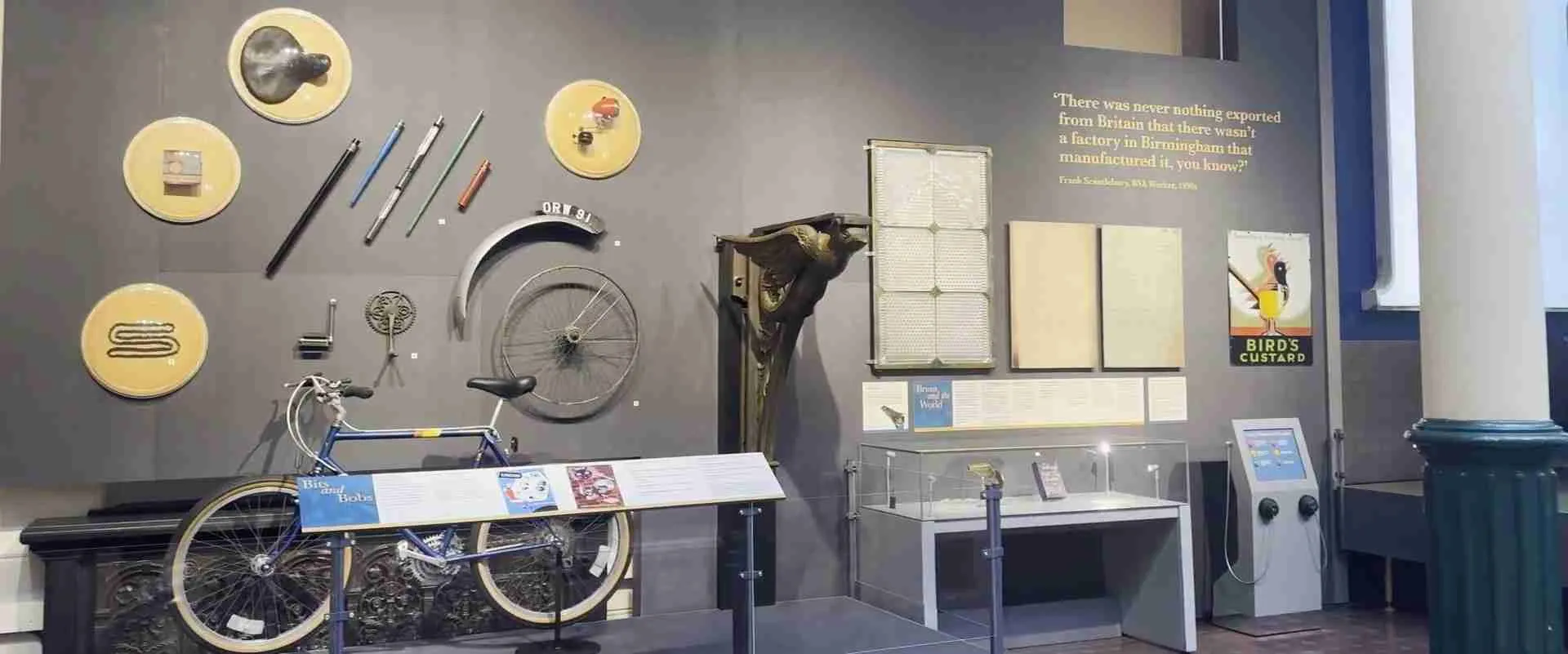
The Industrial Gallery reopened with the “Made in Birmingham” display, which celebrates the city’s manufacturing identity through a deliberately irreverent selection of objects: the giant HP Sauce factory logo, vintage Bird’s Custard advertising, a sign from the Eagle & Tun pub, and other artefacts that capture what the museum describes as the self-deprecating humour and worldwide impact of a city shaped by making things. Wild City, the new family gallery, uses Birmingham’s natural history collections as the basis for interactive exhibits aimed at younger visitors.
The 2026 exhibition programme includes the Ozzy Osbourne retrospective, which opens on 29 July 2026 and runs to 21 February 2027, featuring memorabilia, photographs, and biographical material celebrating the global career of Birmingham’s most famous rock export. This follows an earlier exhibition that was extended following Osbourne’s death. Check birminghammuseums.org.uk for current exhibitions and any temporary closures before visiting.
Practical information: Birmingham Museum and Art Gallery is open Tuesday to Sunday, 10am to 5pm, and daily during school holidays. Entry is free; no booking required. The tearoom and museum shop are open during regular visiting hours. The museum is located in Chamberlain Square, Birmingham, B3 3DH, a five-minute walk from Birmingham New Street station following signs for the city centre and Victoria Square.
Thinktank Birmingham Science Museum in 2026: Science, Spitfires, and the Planetarium
Thinktank Birmingham Science Museum at Millennium Point in Digbeth is one of the most comprehensively equipped science museums outside London, and the opening of the West Midlands Metro’s Millennium Point tram stop in April 2026 has made it the most accessible it has ever been. Spread across four floors, the museum combines hands-on science and technology exhibits with natural history displays, a restored Spitfire, historic steam engines, and the only 4K planetarium in the West Midlands.
The museum’s four themed floors cover the history of technology and industry, the natural world (including the preserved Thinktank Ichthyosaur, a remarkably complete fossil specimen), human biology and medicine, and future science and technology. The Spitfire Gallery is a consistent highlight, presenting the iconic Supermarine Spitfire fighter aircraft within the context of its Birmingham design heritage — the aircraft’s development was closely connected to the city’s engineering industry — and the broader story of the Second World War. The steam locomotive City of Birmingham, a preserved LNER A1 Pacific, stands in the museum alongside Birmingham Corporation Tram 395, both available for close inspection. Photography of the large exhibits is generally well-suited to wide-angle lenses given the scale of the objects on display.
MiniBrum, the museum’s unique cityscape created for children, provides a dedicated space for younger visitors to explore the built environment at a scale designed for them. The outdoor Science Garden is free to enter daily after 3pm, providing an accessible taster for families considering a full visit. The Thinktank Theatre and various regular demonstration programmes run throughout the day; check the museum’s what’s-on calendar for timed events that might shape your visit.
The 4K Planetarium is Thinktank’s most distinctive offering and shows sell out quickly at peak times. Planetarium tickets must be purchased in addition to museum admission, at £3.95 per person (£3 for Birmingham Museums members). Children under three enter planetarium shows free but must sit on an accompanying adult’s lap. At weekends and during school holidays, booking planetarium tickets online at the same time as museum admission is strongly advised, as on-site availability cannot be guaranteed.
Ticket prices in 2026: During term-time, adult admission is £18.95, child (aged 3–15) £9.95, concession £14.95, and family (up to four visitors including at least one child) £45.95. During Birmingham school holidays, prices rise to £21.95 adult, £12.95 child, £17.95 concession, and £54.95 family. Children aged 0–2 enter free. A last-hour deal available only on-site reduces entry to £3 per person for tickets purchased between 4pm and 4:30pm — a saving of around 84% on the standard adult term-time price. Students with valid photo ID enter free on Wednesdays, Thursdays, and Fridays throughout term-time. Birmingham Museums Trust members enter free. Check the official Birmingham Museums website for current rates, as prices may be subject to revision. Pre-booking online is recommended at busy periods.
Opening hours in 2026: Tuesday to Sunday, 10am to 5pm during Birmingham term-time; open daily 10am to 5pm during Birmingham school holidays. Last admission is 4:30pm. The Science Garden is accessible daily. Bank holiday Mondays may vary — check ahead.
Getting there: Thinktank is located at Millennium Point, Curzon Street, Digbeth, Birmingham, B4 7XG. The new Millennium Point tram stop on the West Midlands Metro (opened April 2026) provides a direct connection from Birmingham city centre. The museum is also a ten to fifteen-minute walk from Moor Street station, the Bullring, and Birmingham New Street. A Birmingham City Council multi-storey car park is adjacent to Millennium Point off Jennens Road (charges apply).
Ikon Gallery and the Contemporary Art Scene in Birmingham 2026
Ikon Gallery is internationally acclaimed as one of Britain’s leading contemporary art venues, and it achieves this status as a free, publicly accessible institution open to any visitor willing to engage with challenging and often exceptional work. Located at 1 Oozells Square in the Brindleyplace development, it is housed in a magnificent Grade II listed Victorian Gothic building — the former Oozells Street Board School — whose neo-medieval detailing and distinctive tower make it one of the most photographically satisfying gallery exteriors in any English city outside London.
Ikon’s programme in 2026 continues its record of presenting artists from around the world across a varied range of media — painting, sculpture, film, sound, installation, and photography — over two floors of gallery space. The spring and summer season features Break the Mould (25 March to 6 September 2026), the final exhibition in a trilogy exploring craft, art school pedagogies, and contemporary art practice, with ceramics at its centre. From 29 September 2026, the gallery reopens after an installation period with Balraj Khanna: Lines of Flight, the first major survey exhibition of the acclaimed painter’s work. The programme is designed to give each exhibition extended duration so visitors can return and see the work evolve in its space.
One of Ikon’s most characterful features is its singing lift — a lift fitted with a sound artwork that plays as it travels between floors. Visitors consistently note it as an unexpectedly memorable part of the experience. The gallery also houses Ikon Shop, Birmingham’s only specialist art bookshop, stocking a curated selection of publications, prints, cards, jewellery, and gifts; all purchases support Ikon’s charitable artistic and educational programme. Medicine Bakery, now part of the Ikon building, serves as the gallery’s café and dining space, with terrace seating available in good weather — a pleasant stop before or after viewing exhibitions.
Photography policies for contemporary art galleries require visitors to exercise discretion. Many artists and their estates retain copyright over artworks and may request that photographs of specific pieces not be shared publicly. Ikon generally permits visitor photography in the gallery spaces, but it is courteous to check with gallery staff about any restrictions on specific works, particularly video installations and works by living artists where copyright considerations are most active.
Practical information: Ikon Gallery is at 1 Oozells Square, Brindleyplace, Birmingham, B1 2HS. Open Tuesday to Sunday and Bank Holiday Mondays, 11am to 5pm. Free entry; donations welcome. A two to three-minute walk from Birmingham New Street station via the Brindleyplace pedestrian route.
The Royal Birmingham Society of Artists Gallery
The Royal Birmingham Society of Artists (RBSA) Gallery on Brook Street in the Jewellery Quarter is an independent artist-run gallery with roots going back to 1814, making it one of the oldest artist societies in the country. The gallery presents member exhibitions across a changing programme throughout the year, typically with no admission charge. It operates as a genuinely open artistic community — a contrast to the curated international programme at Ikon — and provides an accessible window into the working practice of Birmingham-based visual artists across every medium. The gallery also runs workshops and life-drawing sessions open to visitors. Check rbsa.org.uk for current exhibition listings and events before visiting.
Commercial Galleries in Birmingham 2026
Beyond the publicly funded institutions, Birmingham supports a network of commercial galleries concentrated particularly in the Jewellery Quarter and Digbeth. The Custard Factory in Digbeth — a large creative complex on the site of a former Bird’s Custard factory — houses studios, galleries, and creative businesses, and its public areas frequently feature artist-made installations and rotating displays. The complex also features significant exterior murals, making it a key photography destination. In the Jewellery Quarter, several smaller galleries show work by local goldsmiths, jewellers, and artists alongside jewellery retail, reflecting the quarter’s long tradition of blending craft production with commercial display. The quarterly Birmingham Open Studios events bring many of these spaces into public view across weekends throughout the year.
Specialist Museums in Birmingham 2026: Jewellery, Victorian Houses, and Heritage Gems
Beyond the city’s flagship institutions, Birmingham’s specialist museums offer experiences that are harder to find in any other British city. The Museum of the Jewellery Quarter, Birmingham Back to Backs, Aston Hall, and the less-visited Soho House represent different aspects of the city’s extraordinary industrial and social heritage — and each rewards a dedicated visit rather than a rushed call-in.
Museum of the Jewellery Quarter in 2026
The Museum of the Jewellery Quarter occupies the former Smith and Pepper jewellery factory on Vyse Street in Hockley — the heart of Birmingham’s historic Jewellery Quarter — which closed in 1981 leaving the workrooms, offices, tools, and overalls essentially undisturbed. When the factory was converted into a museum in 1992, this frozen-in-time quality became its defining characteristic, and it remains the feature visitors most consistently describe: a sense that the workers have just stepped out for lunch. Guided tours, which are the only way to experience the main factory spaces, take approximately forty-five minutes and convey both the craft skills and the social history of a family business that operated continuously for around two centuries.
The guided tour moves through the original offices, workrooms, and factory floor, pausing at demonstration points where guides operate surviving machinery to show the techniques used in mass-producing gold and silver jewellery. The Earth’s Riches gallery explores how gemstones and precious metals are formed and extracted. A temporary exhibition space presents changing displays related to jewellery history and contemporary craft. Photography is explicitly permitted throughout the museum for personal, non-commercial use — the preserved workrooms and their layered patina of industrial use make exceptionally characterful photographic subjects.
A Jewellery Quarter Museums Discount rewards visitors who combine the Museum of the Jewellery Quarter with nearby independent attractions: purchase admission at the Museum of the Jewellery Quarter, The Coffin Works (a preserved coffin fitting factory on Fleet Street), or The Pen Museum (celebrating Birmingham’s Victorian pen-nib industry) and receive 15% off the other two museums when visiting within the same week. This discount applies to walk-up admissions only.
Practical information: The Museum of the Jewellery Quarter is at 70–80 Vyse Street, Hockley, Birmingham, B18 6HA. Open Thursday to Sunday, 10:30am to 4pm. Entry is by guided tours only, departing at 10:45am, 11:15am, 11:45am, 12:30pm, 1pm, 1:45pm, 2:15pm, 2:45pm, and 3:15pm. Pre-booking is strongly advised, especially at weekends. Tickets cost £10 for adults (16 and over), £8 for concessions, and £5 for children aged 3 to 15; children under 3 enter free. Birmingham Museums Trust members enter free. Closed on bank holiday Mondays. The Jewellery Quarter tram stop (West Midlands Metro) is nearby, providing a direct connection from Birmingham city centre.
Birmingham Back to Backs in 2026
Birmingham Back to Backs, managed by the National Trust, preserves the last surviving court of back-to-back workers’ houses in Birmingham — a building type that once housed hundreds of thousands of the city’s industrial workforce. Located at Hurst Street/Inge Street in the Southside area, a short walk from Birmingham New Street station, the site tells the stories of real residents across different periods from the 1840s through to the 1970s through meticulously researched and atmospherically dressed rooms.
The full guided tour (approximately ninety minutes) moves through the small houses of Court 15, pausing in rooms dressed as they would have appeared in different eras — including a bedroom-turned-workshop for Mr Levi, Mrs Oldfield’s kitchen, and the tailor’s shop of George Saunders. Period sounds, smells, and the chill of winter rooms make the experience more visceral than a conventional museum display. Photography is generally possible in the courtyard and public spaces; check with tour guides about policies in the dressed rooms, as some lighting conditions can make interior photography challenging in this type of intimate domestic setting.
Pre-booking is essential for all Birmingham Back to Backs visits; the intimate nature of the house spaces means tour groups are limited in size, and weekend tours frequently sell out well in advance. Online booking opens four weeks ahead of visit, with new availability released every Thursday.
Practical information: Birmingham Back to Backs, 55–63 Hurst Street / 50–54 Inge Street, Birmingham, B5 4TE. Guided tours only; pre-booking online is essential. Full tour: adult £10, child £5, family (two adults) £25 (without Gift Aid). Ground floor tour: adult £8, child £4. Free entry for National Trust members. Note: from 25 June to 1 September 2026 the Government’s temporary VAT reduction means prices may be lower than advertised — confirm with the Welcome Team on arrival. No National Trust car parking; the site is within easy walking distance of Birmingham New Street station via the Hippodrome Theatre. A second-hand bookshop on Hurst Street is free to enter.
Aston Hall in 2026
Aston Hall is a Grade I listed Jacobean mansion in a 65-acre public park in Aston, north of Birmingham city centre, and one of the finest examples of Jacobean architecture surviving in England. Construction began in 1618 for Sir Thomas Holte, a powerful Warwickshire landowner, and was completed in 1635. The mansion’s red-brick elevations, tall chimneys, stone dressings, and gabled skyline are characteristic of the grandest Jacobean building ambitions, and the interiors retain exceptional decorative features: plasterwork ceilings, carved chimneypieces, and the breathtaking oak-lined Long Gallery that runs the full length of one wing. The great oak staircase retains visible battle scars from the English Civil War, when Parliamentarian forces besieged the hall in 1643 — one of the most tangible direct material records of that conflict in any English country house.
In 2026, Aston Hall is open Friday to Sunday, 11am to 4pm (last entry 3pm), with the grounds and Stable Yard Café accessible at the same times at no charge. The Hall itself carries an admission charge (check current prices at birminghammuseums.org.uk, as specific figures are confirmed on the official site); the gardens and grounds are free. On Aston Villa FC home match and event days, road closures in the area affect access and the car park closes — check the football club’s fixture list when planning a visit, and allow extra time or approach on foot from Aston railway station (a fifteen-minute walk). The Hall is closed on bank holiday Mondays and on 28 August 2026.
For photographers, Aston Hall’s exterior — particularly the south-facing entrance front in morning light — offers imposing Jacobean brickwork at close range. The formal gardens and parkland provide foreground context for the building, and the Long Gallery’s windows create strong directional light inside the house that rewards photographers working with available light.
Soho House: Matthew Boulton’s Legacy
Soho House in Handsworth was the home of Matthew Boulton, the eighteenth-century industrialist who, with James Watt, transformed global manufacturing through the commercialisation of the steam engine. The house was the meeting place of the Lunar Society of Birmingham — an informal gathering of Enlightenment thinkers including Watt, Erasmus Darwin, Joseph Priestley, and Josiah Wedgwood — which met at Soho House from around 1765 to 1813. This makes the building one of the most historically significant domestic interiors associated with the British Enlightenment and the Industrial Revolution.
Soho House is managed by Birmingham Museums Trust and is open on limited days; check birminghammuseums.org.uk for current opening hours and any admission arrangements, as these can vary by season and event programme. The house’s period rooms and garden are of particular interest to anyone researching the Lunar Society’s history or the early years of Birmingham’s manufacturing heritage.
The Barber Institute of Fine Arts: What Birmingham Visitors Need to Know in 2026
The Barber Institute of Fine Arts at the University of Birmingham campus in Edgbaston is, when open, one of the finest small art galleries in Britain and among the most important collections of European art assembled in the country during the twentieth century. Its collection of nearly 150 major paintings spans the early Renaissance to the mid-twentieth century and includes works by artists including Sandro Botticelli, Peter Paul Rubens, Thomas Gainsborough, J. M. W. Turner, Claude Monet, Edgar Degas, and Vincent van Gogh. It also holds a coin collection described as one of the most significant assemblages of Roman, Byzantine, and medieval coins in Europe. Entry has historically been free.
However, the Barber Institute is closed throughout 2026 and will not reopen until late 2027. A major building improvement project, funded in part by a £14.8 million fundraising campaign, began in January 2025. The work includes the addition of a ramp and accessible ground-floor entrance, an enlarged terrace, and comprehensive refurbishment of the Grade I-listed Art Deco building designed by Robert Atkinson, which opened in 1939. The project’s timeline has been extended from the originally projected 2026 reopening; the revised expected date is the latter half of 2027, though an exact date had not been confirmed at the time this guide was prepared.
Visitors who wish to see highlights from the Barber collection while the gallery is closed can do so in London: The Courtauld Gallery has been displaying eighteen masterpieces from the Barber — including works by Gainsborough, Reynolds, Turner, Degas, and Monet — in a display titled The Barber in London: Highlights from a Remarkable Collection (opened 23 May 2025). The Barber’s concert series meanwhile continues in the Elgar Concert Hall at the Bramall Building on the University of Birmingham campus, providing some ongoing cultural programme during the closure.
For visitors planning a return trip to Birmingham specifically for the Barber Institute, check barber.org.uk for updates on the reopening date closer to 2027. The transformation, when complete, will make the building significantly more inclusive and accessible, in keeping with Lady Martha Constance Hattie Barber’s founding vision of art freely available to all.
Photography Policies Across Birmingham’s Museums and Galleries in 2026
Understanding the photography policies at Birmingham’s museums and galleries is essential for anyone visiting with creative intent. Policies vary by institution, and even within institutions they may differ between permanent collection galleries and temporary exhibition spaces. The following summary reflects verified policies from official sources; always confirm with staff on the day, as specific exhibitions may carry their own restrictions.
Birmingham Museum and Art Gallery Photography Policy
Birmingham Museum and Art Gallery permits personal, non-commercial photography throughout its permanent collection galleries. Flash photography is not permitted — both because it can be damaging to light-sensitive works and because it is disruptive to other visitors. Tripods and monopods require advance permission and are typically not permitted during standard visiting hours. Photography of temporary exhibitions may be restricted depending on the agreements made with lenders or rights holders; signage at the entrance to each temporary exhibition space will indicate whether photography is permitted. Staff are generally approachable and happy to confirm what is allowed if you are uncertain.
The most photogenic permanent collection spaces at BMAG include the Round Room (for architectural photography), the Pre-Raphaelites Galleries (for vivid colour and large-format figurative painting), and the Staffordshire Hoard Gallery (for close-up metalwork and jewellery photography). Smartphone cameras with portrait or macro modes work well for the jewellery-scale Hoard objects; larger sensor cameras benefit from the directional natural light in the Pre-Raphaelite spaces. The Industrial Gallery’s larger objects — machinery, vehicles, and oversized signs — suit wide-angle compositions.
Thinktank Photography Policy
Thinktank Birmingham Science Museum permits personal photography throughout its public galleries, and the nature of the exhibits — large-scale machinery, historic vehicles, the Spitfire, fossils, and interactive science displays — makes it a particularly rewarding museum for photography. The Planetarium shows do not permit photography once the show is in progress (bright flashes would significantly disrupt other visitors’ experience of the dome). The outdoor Science Garden permits photography freely. As with BMAG, photography for commercial purposes requires advance approval from Birmingham Museums Trust.
Ikon Gallery Photography Policy
Ikon Gallery generally permits visitor photography in its exhibition spaces, but because it exhibits work by living artists — many of whom have active copyright protections over their work — the position on any specific piece may vary. Photography of film and video installations is typically not permitted, as these are the works most directly protected by copyright. Before photographing a specific artwork, particularly a film piece or a work by a living artist, check with gallery staff. The gallery’s exterior — the Victorian Gothic building and its terrace — is freely photographable at all times from Oozells Square.
Museum of the Jewellery Quarter Photography Policy
The Museum of the Jewellery Quarter explicitly confirms that photography is permitted for personal, non-commercial use. The factory spaces, with their original workbenches, tools, machinery, and period surfaces, offer exceptional subjects: macro photography of gem-setting tools and surviving hand-made components, wider shots of the preserved workshop environments, and portrait-style photographs of guides demonstrating jewellery-making techniques during tours. The layered visual texture of a working environment left essentially undisturbed since 1981 gives this museum a quality of photographic authenticity that purpose-built galleries cannot replicate.
Birmingham Back to Backs Photography Policy
Photography within the Birmingham Back to Backs is possible in the courtyard and public areas; the dressed interior rooms of the historic houses are more nuanced. The intimate scale of the rooms means that large cameras can be difficult to manage without disrupting the tour group, and some rooms have particularly low light levels that challenge photographers without high-ISO capability. Speak to your tour guide about photography before the tour begins; they are generally happy to accommodate camera users while keeping the group moving. The exterior of the Back to Backs site on Hurst Street is freely photographable from the public pavement at any time.
Technical Tips for Museum Photography in Birmingham
For indoor museum photography in Birmingham’s Victorian-era spaces, the most important technical consideration is managing variable and often low ambient light without flash. A lens with a maximum aperture of f/2.8 or wider is advantageous; prime lenses at 35mm or 50mm focal lengths balance field of view with low-light performance well in most gallery spaces. Modern mirrorless cameras with good high-ISO handling can produce clean results at ISO 3200 or above in spaces like the Round Room, where natural light from above supplements tungsten lighting. At BMAG and Thinktank, the larger objects and architectural spaces suit wide-angle perspectives; a 16–35mm range handles both well. For the Staffordshire Hoard and museum of the jewellery quarter exhibits, close-focus capability is important — many smartphones in portrait or macro mode perform creditably for objects of this scale. Always shoot raw format if your camera supports it, as the colour casts of mixed museum lighting can be more accurately corrected in post-processing.
Photography Hotspots: Birmingham’s Most Striking Visual Locations in 2026
Birmingham’s photography destinations extend well beyond the museum walls. The city’s fabric includes some of the most visually distinctive architecture in Britain, street art on an international scale, and canal-side environments that contrast engineered infrastructure with reflective water. The following locations are all freely accessible to pedestrians and represent the most rewarding stops for a photography itinerary built around the museum and gallery circuit.
Chamberlain Square and Victoria Square
The civic space immediately surrounding Birmingham Museum and Art Gallery is among the most architecturally imposing public squares in any English city. Chamberlain Square fronts the museum’s imposing terracotta and brick elevation, with Joseph Chamberlain’s memorial fountain providing a strong foreground element. Victoria Square, a few steps away, centres on the Floozy in the Jacuzzi — the popular nickname for Dhruva Mistry’s River sculpture — with the neo-classical Council House as backdrop. Early morning before tourist and office traffic builds is the optimum time for compositions that exclude crowds; golden-hour light from the east catches the Council House elevation beautifully in summer months.
Brindleyplace and Gas Street Basin
The regenerated Brindleyplace development around Oozells Square — where Ikon Gallery sits — and the adjacent Gas Street Basin offer canal-side photography of a distinctly Birmingham character. Gas Street Basin is one of the country’s most important historic inland waterway junctions, where the Birmingham Canal Navigations Main Line meets the Worcester and Birmingham Canal. Narrow boats, bridge reflections, and cast-iron infrastructure from the peak of the canal age provide subject matter that is both picturesque and historically layered. The Ikon Gallery exterior — photographed from the square in the direction of the canal — provides a composition that places Victorian Gothic architecture alongside the waterway. Evening light in summer reflects across the basin with particular intensity.
Digbeth and the Custard Factory
Digbeth, Birmingham’s creative and nightlife quarter, is the city’s most fertile territory for street art photography. Large-scale murals cover the warehouse and factory walls of Digbeth High Street and its surrounding network of industrial-era streets, created by artists from Birmingham, from across the UK, and internationally. The Custard Factory creative complex on Gibb Street anchors a district that has accumulated street art organically over many years, with new commissions appearing regularly; no two visits yield the same subject matter. The quality of light in Digbeth’s east-facing streets is excellent in the morning when shadows fall away from the walls rather than across them. Digbeth is also the location of Birmingham’s coach station, and its functional industrial streetscape provides contextual depth for photographers interested in urban documentary work.
The Jewellery Quarter Streets
The Jewellery Quarter, centred on Vyse Street, Warstone Lane, and Hockley Hill, preserves more late-Victorian commercial streetscape than any other part of Birmingham city centre. The scale of the buildings — predominantly three- and four-storey workshops and showrooms built for the precision metalworking industry — is domestic rather than monumental, creating a pedestrian-friendly environment that rewards slow exploration with a camera. The Jewellery Quarter Memorial Garden (the Warstone Lane Cemetery) contains a remarkable array of Victorian funerary sculpture and provides a quiet photographic counterpoint to the working streets nearby. The neighbourhood’s street-level shop windows, many still displaying hand-made jewellery and silverwork, are useful for compositional juxtapositions of old craft and contemporary display. Morning on a weekday provides working activity on the streets that weekend visits typically do not.
The Selfridges Building at the Bullring
The Selfridges Birmingham building, completed in 2003 and designed by Future Systems architects Jan Kaplický and Amanda Levete, remains one of the most photographically distinctive pieces of British commercial architecture of the twenty-first century. Its curving facade, clad in more than fifteen thousand aluminium discs, has been compared to a chain-mail garment at architectural scale. The building is best photographed from the upper pedestrian level of the Bullring shopping centre, which allows an oblique view of the curved surface without the surrounding retail infrastructure crowding the composition. In direct sunlight, the disc cladding creates strong specular reflections and a tactile pattern that reads well in both wide-angle and telephoto compositions. The building is freely accessible as a public commercial space during Bullring trading hours.
Aston Hall: Exterior Architectural Photography
Aston Hall’s exterior is at its most rewarding for photographers on clear mornings before the site opens, when the east and south elevations catch direct sun and the park is quiet. The approach from Trinity Road gives a long view of the south front that allows the full Jacobean skyline — chimneys, gables, and the distinctive roofline — to read clearly against the sky. The formal gardens, accessible freely from 11am on open days, provide planted foreground elements that contrast with the hard brick of the building. The Hall’s stone dressings and the patterning of its tall, mullioned windows reward telephoto compression for detail shots. Permission from Birmingham Museums Trust is required for commercial photography on the site.
The Library of Birmingham and Centenary Square
The Library of Birmingham (opened 2013, designed by Mecanoo Architects) stands in Centenary Square adjacent to the Birmingham Repertory Theatre and offers a dramatically different architectural character to the Victorian civic buildings nearby. Its interlocking golden rings and perforated filigree facade are particularly effective in afternoon light, when the openwork metalwork casts complex shadow patterns across the facade’s surface. Centenary Square itself — a large public space with Antony Gormley’s Iron Man sculpture as one of its landmarks — provides wide compositional possibilities with the library, REP, and Symphony Hall as backdrop elements.
Getting Around Birmingham’s Museums and Galleries in 2026
Birmingham’s museum geography is compact enough that many of the city-centre institutions — Birmingham Museum and Art Gallery, Ikon Gallery, and the Museum of the Jewellery Quarter — can be linked on foot or by a single tram ride. More outlying sites, including Thinktank, Aston Hall, and Soho House, are best reached by public transport or car. The West Midlands Metro, which has been significantly extended in recent years, is the most relevant public transport choice for most museum visits in 2026.
West Midlands Metro
The West Midlands Metro tram network underwent a major fare revision from 2 January 2026: a Zone 1 single ticket now costs £2.50, and a Zone 1–2 single costs £3.50. The most important development for museum visitors in 2026 is the opening of the Millennium Point tram stop in April 2026, providing a direct Metro connection to Thinktank. The line also serves the Jewellery Quarter (for the Museum of the Jewellery Quarter and the RBSA Gallery), Centenary Square (for the Library of Birmingham and Centenary Square) and Birmingham New Street (for BMAG and Ikon Gallery). Tickets must be purchased before boarding using contactless bank card, Swift card, or smartphone; penalty fares of £100 apply to those travelling without a valid ticket following the introduction of the buy-before-you-board policy in 2026.
On Foot: City-Centre Museum Circuit
A museum walking circuit covering BMAG, Ikon Gallery, and the Jewellery Quarter is achievable on foot for visitors of comfortable mobility. From Birmingham Museum and Art Gallery in Chamberlain Square, it is a five-minute walk to Birmingham New Street station and a further ten minutes through Brindleyplace to Ikon Gallery at Oozells Square. From Ikon Gallery to the Museum of the Jewellery Quarter on Vyse Street is approximately twenty-five minutes on foot, or a single Metro stop from the city centre to Jewellery Quarter tram stop. This circuit covers three significant cultural institutions — BMAG and Ikon both free, the Museum of the Jewellery Quarter paid — without any vehicular transport.
National Express Bus
National Express West Midlands operates an extensive network of bus routes across Birmingham and the wider conurbation. Day tickets covering unlimited bus and Metro travel across zones are available for visitors planning multiple stops in a single day; check nxbus.co.uk for current fares and day ticket options, as prices are subject to revision. The number 61, 63, and X20 bus services connect Birmingham city centre to the University of Birmingham in Edgbaston (for when the Barber Institute eventually reopens), and multiple routes serve Aston for Aston Hall.
Train: Aston Hall
Aston Hall is most conveniently reached by train from Birmingham New Street to Aston station on the Cross City line (journey approximately six minutes), from where it is around a fifteen-minute walk through Aston Park to the Hall. The Cross City line runs frequently throughout the day. Check National Rail or Avanti/West Midlands Railway timetables for current service patterns.
Parking
Parking in central Birmingham is not recommended for museum visits given the city’s well-developed public transport connections and the Clean Air Zone, which applies a daily charge to many older vehicles. For Thinktank, the Birmingham City Council multi-storey car park adjacent to Millennium Point off Jennens Road provides parking at standard municipal charges. Aston Hall has on-site parking but closes this on Aston Villa FC match days. Specific parking charges should be confirmed directly before visiting.
Seasonal Planning for Birmingham Museums in 2026
Birmingham’s museum calendar has seasonal rhythms that materially affect both pricing and the practicalities of visiting, and planning around them produces a meaningfully better experience.
During Birmingham school term-time, Thinktank operates at its standard weekday and weekend admission prices (adult £18.95) and is open Tuesday to Sunday. During Birmingham school holidays — which do not necessarily align exactly with national school holiday dates in other regions — Thinktank is open daily and charges higher admission rates (adult £21.95). For families, the school holiday price uplift is worth factoring into budgets; for adult-only visitors, a term-time weekday visit at standard prices with the free student admission offer (Wednesday to Friday) may provide access at reduced cost if one member of the party holds a valid NUS card.
Birmingham Museum and Art Gallery is open daily during school holidays, which is the most visitor-friendly version of its schedule; during term-time it is closed on Mondays. The museum’s free-entry model means this affects scheduling rather than budget. Weekend mornings before 11am tend to have lighter visitor numbers in the gallery spaces, even during school holidays, making this the optimum photography window.
Aston Hall’s limited Friday-to-Sunday schedule in 2026 means it requires deliberate planning; it cannot be added as a spontaneous stop on a Monday or Thursday. Bank holidays also see closures at most Birmingham Museums Trust sites — always check ahead for specific bank holiday dates. The August Bank Holiday (28 August 2026) is a confirmed closure date for Aston Hall. The Museum of the Jewellery Quarter is closed on bank holiday Mondays.
The Government’s temporary VAT reduction, which runs from 25 June to 1 September 2026, applies to admissions at Birmingham Back to Backs and may reduce the effective price below the advertised ticket price during this period. Visitors during summer 2026 should confirm actual prices with the Welcome Team on arrival or when booking.
Weather affects outdoor photography locations significantly. The canal at Gas Street Basin photographs best in direct sun or at dusk, not under overcast skies. Aston Hall’s grounds are at their most appealing in dry weather, and the park surrounding the Hall becomes muddy in wet conditions. Digbeth’s street art is most vivid on bright days when the colour saturation is strong; flat overcast light can reduce the visual impact of even excellent murals.
Birmingham Museums Membership and Money-Saving Strategies in 2026
A Birmingham Museums Trust membership provides the most comprehensive value for repeat visitors or those planning to explore several Trust venues in a single trip. Membership covers free general admission to Thinktank, the Museum of the Jewellery Quarter, Aston Hall, Blakesley Hall, Sarehole Mill, Soho House, and Weoley Castle for twelve months, alongside access to member events and priority communications about upcoming exhibitions. Given that Thinktank’s standard adult admission alone is £18.95 (term-time), a single return visit to Thinktank over a twelve-month period makes membership worthwhile for many visitors. Check birminghammuseums.org.uk for current membership tiers and pricing.
National Trust members enjoy free admission to Birmingham Back to Backs, which is one of the Trust’s most distinctive urban properties. If you hold National Trust membership for access to country properties and gardens, the Back to Backs provides an included urban heritage experience of exceptional quality. Non-members should note that the Back to Backs Neighbourhood Pass offers free admission for those who live or work near the property — details on the National Trust website.
Thinktank’s last-hour deal — £3 per person for admission purchased on-site between 4pm and 4:30pm — is the most significant per-visit saving available at any Birmingham museum. At term-time adult prices, this represents a saving of around £16 on the standard ticket, though last admission is at 4:30pm and the museum closes at 5pm, leaving one hour for visiting. This is sufficient to complete the Spitfire Gallery, one other floor, and the Science Garden.
Students with valid photo ID enter Thinktank free on Wednesdays, Thursdays, and Fridays throughout term-time. This benefit requires only that students carry their university or college identification card and applies without pre-booking.
The Jewellery Quarter Museums Discount rewards combined visits to the Museum of the Jewellery Quarter, The Coffin Works, and The Pen Museum with 15% off the second and third museums visited within the same week. This discount applies to walk-up admissions only and cannot be pre-booked, but it meaningfully reduces the cost of a full Jewellery Quarter cultural itinerary — a rewarding combination for visitors interested in Birmingham’s historic craft industries.
Birmingham Museum and Art Gallery and Ikon Gallery are free at all times with no discount strategy required. The RBSA Gallery on Brook Street also operates without admission charges for most exhibitions. A visitor focusing exclusively on these three institutions can experience an exceptional range of historical and contemporary art and craftsmanship at no cost beyond transport and refreshments.
Frequently Asked Questions About Birmingham Museums & Galleries 2026
Is Birmingham Museum and Art Gallery free to visit in 2026?
Yes. Birmingham Museum and Art Gallery is free to enter in 2026, with no booking required for general admission during standard opening hours. The museum is open Tuesday to Sunday, 10am to 5pm, and daily during Birmingham school holidays. Free galleries include the Pre-Raphaelites Galleries, Staffordshire Hoard Gallery, Birmingham History Galleries, Round Room, Industrial Gallery, Bridge Gallery, and Wild City (the family gallery). The tearoom and museum shop are open during visiting hours. Temporary exhibitions at BMAG are also free unless specific paid programming is indicated — check the website before visiting. No tickets are needed; just arrive during opening hours.
What are the opening hours for Thinktank Birmingham Science Museum in 2026?
Thinktank Birmingham Science Museum is open Tuesday to Sunday, 10am to 5pm, during Birmingham school term-time, with last admission at 4:30pm. During Birmingham school holidays — including the summer holiday period in July and August, and half-term weeks — the museum opens daily (including Mondays), again from 10am to 5pm. The outdoor Science Garden can be accessed freely from 3pm daily. A last-hour deal reduces on-site tickets to £3 per person for admission purchased between 4pm and 4:30pm. As school holiday dates vary slightly from year to year, confirm the exact schedule at birminghammuseums.org.uk before planning your visit.
Is the Barber Institute of Fine Arts open in 2026?
No. The Barber Institute of Fine Arts is closed for a major building improvement and accessibility project throughout 2026. What was initially projected as a 2026 reopening has been pushed back; the revised expected date is the latter half of 2027. The project, funded in part by a £14.8 million campaign, includes an accessible ground-floor entrance, a ramp, and comprehensive building refurbishment. During the closure, highlights from the Barber’s collection — including works by Gainsborough, Turner, Degas, and Monet — are on display at The Courtauld Gallery in London. The Barber’s concert programme continues at the Elgar Concert Hall in the University of Birmingham’s Bramall Building. Monitor barber.org.uk for an updated reopening date.
How much does it cost to visit the Museum of the Jewellery Quarter in 2026?
Admission to the Museum of the Jewellery Quarter in 2026 costs £10 for adults (aged 16 and over), £8 for concessions (NUS students and those on qualifying benefits), £5 for children aged 3 to 15, and free for children under 3. Birmingham Museums Trust members enter free. If you pay with Gift Aid — which allows the museum to reclaim 25% of your ticket price from the government as a charitable donation and adds a small amount to the ticket cost — the price is £11 for adults, £8.80 concession, and £5.50 child. Entry is by guided tour only, with tours departing at set times throughout the day (first tour 10:45am, last tour 3:15pm). Pre-booking online is strongly advised as tours have limited capacity and sell out at weekends.
Can you take photographs inside Birmingham’s museums in 2026?
Personal, non-commercial photography is permitted at most of Birmingham’s major museums and galleries. Birmingham Museum and Art Gallery allows photography in its permanent collection galleries without flash; specific temporary exhibitions may have their own restrictions, which are indicated by signage at the exhibition entrance. The Museum of the Jewellery Quarter explicitly confirms that photography is allowed for non-commercial purposes. Thinktank permits personal photography throughout its galleries; no photography during Planetarium shows. Ikon Gallery generally allows photography, but photography of film and video installations and works by living artists should be confirmed with staff before shooting. Birmingham Back to Backs permits photography in the courtyard and external areas; check with your guide regarding interior rooms. At all venues, commercial photography requires separate advance permission from the relevant museum trust.
How do I get to Thinktank Birmingham Science Museum by public transport in 2026?
The most direct public transport connection to Thinktank in 2026 is the West Midlands Metro, which has served a Millennium Point tram stop since April 2026. The Metro runs from Birmingham city centre — including stops near Birmingham New Street and Centenary Square — directly to Millennium Point; a Zone 1 single ticket costs £2.50. Thinktank is also around ten to fifteen minutes on foot from Moor Street station, from the Bullring shopping centre, and from Birmingham New Street station. Several National Express bus routes stop near Millennium Point; check nxbus.co.uk for current routing. The museum address for navigation is Millennium Point, Curzon Street, Digbeth, Birmingham, B4 7XG.
What is Ikon Gallery known for in Birmingham in 2026?
Ikon Gallery is internationally recognised as one of Britain’s leading contemporary art venues and presents a programme of temporary exhibitions by artists from the UK and around the world, covering painting, sculpture, film, photography, sound, and installation. It is housed in a Grade II listed Victorian Gothic building — the former Oozells Street Board School — in the Brindleyplace development. Entry is free. In 2026, its programme includes Break the Mould (March to September 2026), a major group exhibition exploring ceramics and art school traditions, followed by a survey exhibition of Balraj Khanna’s paintings from September 2026. The gallery also contains Ikon Shop, Birmingham’s only specialist art bookshop, and the Medicine Bakery café. Its distinctive “singing lift” — a sound artwork installed in the gallery’s elevator — has become one of its most visited and discussed features.
Are Birmingham’s museums suitable for families in 2026?
Birmingham’s museums offer strong provision for families across a range of ages. Thinktank Birmingham Science Museum is the most explicitly family-oriented institution, with hands-on interactive exhibits, MiniBrum (a child-scale cityscape), the Planetarium, and an outdoor Science Garden that children find engaging. Birmingham Museum and Art Gallery’s Wild City family gallery and the tactile, visually vivid Pre-Raphaelite paintings appeal to younger visitors, and the museum is free of charge, making it easy to visit without commitment. Aston Hall runs family-oriented programming during school holidays. The Museum of the Jewellery Quarter’s guided tours suit children aged around eight and above who can sustain attention over forty-five minutes; younger children may find the tour duration challenging. Birmingham Back to Backs tours are also well-suited to children of primary school age and above, bringing Victorian social history to life in a way that schools-based history programmes rarely can. Pushchair access varies by site; check accessibility information on each museum’s website.
What is the best time of year to visit Birmingham’s museums in 2026?
For galleries and indoor museums, Birmingham’s attractions are enjoyable year-round, but autumn and winter weekdays offer the lightest visitor numbers and most relaxed conditions for photography. For Thinktank specifically, term-time weekday visits avoid both the higher school-holiday admission prices and the busier weekend crowds. For Aston Hall, the grounds photograph best in late spring and summer when the parkland is at its fullest, but the Hall’s Jacobean interior is atmospheric in autumn candlelight events (check the Birmingham Museums programme for specific events). For outdoor photography — Digbeth street art, Gas Street Basin, the Jewellery Quarter streets — late spring to early summer provides the best combination of long daylight hours, warm-toned light, and weather reliability. Ikon Gallery and BMAG are equally rewarding at any time of year given their indoor nature and year-round exhibitions.
How do I book tickets for the Museum of the Jewellery Quarter in 2026?
Tickets for the Museum of the Jewellery Quarter can be pre-booked online at the official Birmingham Museums website (birminghammuseums.org.uk). Online pre-booking is strongly advised, particularly for weekend visits and during school holidays, as tour capacity is limited and popular time-slots sell out. Tickets can also be purchased on arrival at the museum, subject to availability. When booking online, you select a specific tour time: options run from 10:45am through to 3:15pm on Thursday to Sunday. Birmingham Museums Trust members should log into their membership account when booking to access free admission. The museum is at 70–80 Vyse Street, Hockley, Birmingham, B18 6HA; the nearest tram stop is Jewellery Quarter on the West Midlands Metro. A single Metro journey from the city centre costs £2.50 (Zone 1, from January 2026).