
Beyond the Pier: Secret Architectural and Geological Road Trip Guide 2026 (Bournemouth to Purbeck)
The Dorset coast south of Bournemouth contains one of southern England’s most compressed concentrations of architectural and geological heritage: a Norman castle reduced to its dramatic skeleton by Civil War cannon, Saxon earthwork ramparts encircling a market town, a 12th-century priory longer than many cathedrals, and a coastline inscribed as England’s only natural UNESCO World Heritage Site. This guide provides verified 2026 logistics — timetables, parking costs, ferry tolls, and crowd-avoidance sequences — so you can reach the best of it without spending half the day in traffic.
Key Takeaways
- The Sandbanks Ferry charges £6.26 per car one-way from April 2026, now cashless and using ANPR technology from July 2026; taking the ferry instead of the Poole ring road saves roughly 25 miles on the outbound leg.
- Swanage Steam Railway day tickets cost £27.50 per adult for unlimited hop-on/hop-off travel across the 9.5-mile heritage line between Norden park-and-ride and Swanage, passing directly beneath Corfe Castle.
- Corfe Castle admission is £12 per adult at peak times and £11 off-peak for National Trust non-members; arriving before 10:30am on weekdays in shoulder season gives near-empty ruins with full viewing time before midday coach parties arrive.
- A budget day trip using the one-way ferry, off-peak Corfe Castle entry, and a packed lunch costs approximately £30–35 per person for two adults sharing a car; the classic circuit adding the Swanage Steam Railway costs £75–85 per person.
- The Dorset National Landscape (the public rebrand of the former Dorset AONB, effective November 2023) covers 43% of the county; the Jurassic Coast, stretching 95 miles from Exmouth to Studland Bay, is England’s only natural UNESCO World Heritage Site, inscribed in 2001.
- Off-peak timing windows — mid-week in April, late May, and October half-term-adjacent weeks — allow Corfe Castle visits at lower admission prices with dramatically thinner crowds, making the same circuit roughly twice as rewarding for a fraction of the summer-holiday frustration.
People Also Ask About the Bournemouth to Purbeck Road Trip 2026
How do I avoid traffic queues on the Purbeck road trip in 2026?
The single biggest traffic pressure point on the Purbeck road trip is the A351 between Wareham and Swanage in summer, which funnels all westbound traffic through the narrow corridor around Corfe Castle village. Departing Bournemouth before 8:30am allows you to cross the Sandbanks Ferry in the quieter morning slot, reach Studland and Old Harry Rocks before they fill, and arrive at Corfe Castle when the National Trust car park has spaces and the ruins are thin on visitors. A secondary strategy is to reverse the loop: begin with Wareham (park at the quay car park, which rarely fills before 10am even in August), drive south to Corfe, then continue to Swanage before returning via the ferry. Avoiding the A351 during the 3pm–6pm summer exodus is equally important; if you are still in Swanage at that point, the Swanage Steam Railway to Norden is a practical alternative to gridlock on the road.
Is the Sandbanks Ferry worth using in 2026, and how does it work?
For a self-drive circuit taking in Studland, Swanage, and Corfe Castle, the Sandbanks Ferry is almost always the correct choice. The car toll is £6.26 one-way from April 2026, covering all passengers in the vehicle; a return crossing costs £12.52. That compares favourably with the extra 25 miles of driving via Poole town centre, which typically adds 40–55 minutes in summer traffic and the associated fuel cost. The ferry has operated entirely cashlessly since April 2026, and from July 2026 an ANPR system means cars drive straight on without stopping at a toll booth: payment is made online or via the Sandbanks Ferry app before midnight on the day of travel. Timetabling is simple: departures from the Sandbanks side run at 20-minute intervals on the hour, 20 past, and 40 past; from Shell Bay (Studland side) they leave at ten past, half past, and ten to. First departure from Sandbanks is 7:00am and the last is 11:00pm, making day-trip planning flexible. The crossing itself is four minutes across the mouth of Poole Harbour. Foot passengers returning from Shell Bay to Sandbanks travel free.
How much does a full day trip from Bournemouth to Corfe Castle cost in 2026?
For two adults sharing a car, a budget day trip using the one-way Sandbanks Ferry, off-peak Corfe Castle admission, car park at West Street, and a packed lunch costs approximately £30–35 per person. Adding the Swanage Steam Railway Freedom of the Line day ticket and a café lunch in Swanage brings the total to approximately £75–85 per person. A grand circuit extending to Lulworth Cove and Durdle Door, with a pub lunch, costs approximately £50–70 per person without the steam railway (the Lulworth parking charge of £10–20 per car is the main variable). All figures assume two adults sharing one car; the ferry, parking, and petrol costs are halved between two passengers.
Can I explore Purbeck without a car in 2026?
A car-free Purbeck day trip is entirely feasible from Bournemouth and is actually a strong option in high season when road congestion is worst. The X54 bus (operated by First Dorset) connects Bournemouth, Poole, Wareham, and Swanage; from Wareham the Swanage Steam Railway carries visitors to Corfe Castle and Swanage. Foot passengers on the Sandbanks Ferry pay £1.18 from the Sandbanks side; the return from Shell Bay is free. Cycling the Studland peninsula after the ferry crossing and then taking the steam train at Swanage is a viable loop requiring no car at all. National Cycle Network Route 2 connects Bournemouth to Christchurch along the seafront, and onward Sustrans routes link into the Purbeck area. Planning the car-free loop takes more care than driving — check the First Dorset X54 timetable before the season, as Sunday services are reduced — but the reward is being able to walk Old Harry Rocks cliffs and Corfe village without worrying about parking availability or exit timing.
Extended multi-day tours – 5+ days
Featured South West England Multi-Day Tour Packages
8 days
Corners of Cornwall
- ✓ Comprehensive South West England tour
- ✓ Expert local guides included
- ✓ All accommodation arranged
- ✓ Transportation provided
3 days
3-Day Stonehenge & Bath Tour from London with Hotel, Breakfast & Entry Tickets
- ✓ Comprehensive South West England tour
- ✓ Expert local guides included
- ✓ All accommodation arranged
- ✓ Transportation provided
3 days
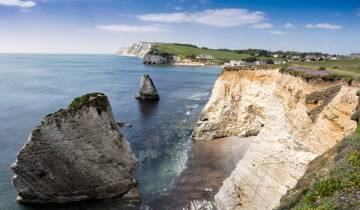
From London: 3 Day Isle of Wight & the Southern Coast
- ✓ Comprehensive South West England tour
- ✓ Expert local guides included
- ✓ All accommodation arranged
- ✓ Transportation provided
8 days
Taste of England | 8 Days Tour
- ✓ Booking needs min. 2 travelers
Multi-day tour packages powered by TourRadar. Prices and availability subject to change.
Planning Your Purbeck Heritage Drive 2026: What This Corridor Covers
The geography between Bournemouth and the Isle of Purbeck is more compressed than it appears on a map. The Sandbanks peninsula, where Bournemouth’s beach suburbia ends, is separated from the Studland peninsula by the narrowest mouth of Poole Harbour — barely 500 metres of water that the chain ferry has been bridging for over a century. Once across, drivers enter a landscape shaped by chalk ridges, limestone plateaux, and the particular engineering logic of defensive geography that made this strip of Dorset one of the most fought-over territories in medieval England.
The heritage circuit available from a Bournemouth base falls into three overlapping categories. The first is architectural: Corfe Castle dominates the Isle of Purbeck so completely from its chalk ridge that virtually every approach road in the area frames it against the sky. Wareham, five miles north, is a compact Saxon burh whose earthwork ramparts survive almost entirely intact, enclosing a gridded street plan that has barely shifted since Alfred the Great’s engineers laid it out in the late 9th century. Christchurch, five miles east of Bournemouth, contributes one of the most extraordinary parish churches in England — 311 feet of Norman and Perpendicular Gothic architecture built on a Saxon foundation — as a logical warm-up stop before the Purbeck loop proper. The second category is geological: the Jurassic Coast, England’s only natural UNESCO World Heritage Site, begins its Dorset chapter at Studland Bay and runs west through Old Harry Rocks, Swanage, Kimmeridge, and Lulworth to the limestone arch of Durdle Door. The third category is purely scenic and seasonal — Studland Heath, the Purbeck ridge, Arne’s RSPB reserve, and the Frome valley offer wildlife, walking, and quiet that most day-trippers never reach because they spend all their time in the Corfe Castle car park queue.
The key planning insight for 2026 is to treat the circuit as a series of nodes rather than a linear drive. Each site has its own optimal arrival window, its own parking logic, and its own exit pressure. The drive-time between nodes is short — Corfe Castle to Wareham is ten minutes, Studland to Swanage is twenty — so the limiting factor is never distance but rather the concentration of visitor arrivals into the same two-hour window around midday. The crowd-avoidance strategies throughout this guide are built around that insight: arrive at each node before the midday peak, move on as others are arriving, and use the Swanage Steam Railway or the Sandbanks Ferry as pressure-relief valves when roads congest.
Accommodation in Bournemouth gives access to everything in this circuit within thirty to forty minutes of the town centre, making it viable as a multi-day base rather than a single excursion. The town’s own Victorian pier, pier approach, and Russell-Cotes Art Gallery sit within walking distance of most accommodation, so days in Purbeck can be balanced with rest days closer to home without requiring a change of base.
The Off-Crowd Purbeck Loop 2026: Self-Drive Itinerary from Bournemouth Hub
The most efficient self-drive circuit from Bournemouth uses the Sandbanks Ferry on the outbound leg only and returns via Wareham and the A35 through Poole. This asymmetric approach avoids the worst of the afternoon ferry queue (which builds on the Shell Bay side from roughly 2pm onwards in peak season) and adds the Wareham leg to the homeward journey rather than making it a detour.
A practical departure time is 8:00am from central Bournemouth. The B3065 via Sandbanks Road and Shore Road is the standard route to the ferry; satnav should be set to postcode BH13 7QN. Traffic along the Sandbanks peninsula begins building from 9am in summer, and the Ferry Road queue starts forming earlier than many visitors expect. An 8:00am departure puts you on the 8:00am or 8:20am crossing, when the ferry is typically running with ample capacity and no queue.
From Shell Bay, the B3351 runs south through the Studland Nature Reserve. The first optional stop is the Old Harry Rocks viewing area, a ten-minute walk from the National Trust Knoll Beach car park (postcode BH19 3AX). Old Harry is one of the most iconic geological formations on the Jurassic Coast: a sequence of chalk stacks and arches marking the eastern end of the Purbeck Hills ridge and the point where the limestone strata that continues across to the Needles on the Isle of Wight was severed by the sea. The car park opens before 9am and is often empty at that hour. If arriving late in the afternoon this car park can be full with no overflow, making the morning window significantly preferable.
From Studland village, the B3351 continues southwest to Corfe Castle; allow approximately 15 minutes for the 7-mile drive. The recommended approach in summer is to bypass the Corfe Castle village car parks entirely and use Norden station park-and-ride instead (postcode BH20 5DT), which sits on the north side of the village before the road drops into the valley floor. Norden is managed by the Swanage Railway and gives access both to the castle (a 1.2-mile walk or a short steam train ride to Corfe Castle station) and to the steam railway network. From Corfe, the A351 north to Wareham is ten minutes. The Wareham town quay car park (postcode BH20 4LP) is the most convenient for the Saxon earthwork circuit, though it is small; the larger Streche Road car park (postcode BH20 4JH) is a short walk further and rarely fills before 10am.
From Wareham, the A35 east through Bere Regis and Poole returns to Bournemouth via a route that entirely avoids the Corfe valley bottleneck. Total loop mileage is approximately 60 miles from central Bournemouth.
Drive-Time Nodes and Departure Sequencing 2026
The drive-time matrix for the Purbeck loop is tight enough that sequencing decisions significantly affect the quality of the experience. The following node-by-node timing is calibrated for a summer weekday departure from Bournemouth at 8:00am:
8:00am: Depart Bournemouth (BH1 area) via Shore Road and Sandbanks Road to ferry. Journey time 20–25 minutes without congestion.
8:20am–8:30am: Sandbanks Ferry crossing. Cross to Shell Bay (4-minute crossing). Pay online after crossing via the Sandbanks Ferry app or website.
8:35am–9:15am: Old Harry Rocks, Knoll Beach. Park at National Trust Knoll Beach car park, walk 10 minutes to the cliff-top viewpoint. The chalk stacks are best photographed in morning light from this direction. Allow 30–40 minutes.
9:30am–11:30am: Corfe Castle. Drive south via Studland village and Harmans Cross (15 minutes from Knoll Beach). Park at Norden station (if combining with the steam railway) or the National Trust Castle View car park (postcode BH20 5EZ) for non-railway visits. Two hours at the castle is comfortable for the ruins, the visitor centre, and the National Trust tea room.
11:45am–1:00pm: Swanage (optional). Board the steam railway at Corfe Castle station for the 20-minute journey to Swanage seafront (if using a day ticket). Swanage has good lunch options on Station Road and the seafront. Alternatively, drive south on the A351 for 20 minutes.
1:30pm–2:30pm: Wareham. Drive north on the A351 (10 minutes from Corfe, 20 minutes from Swanage). Walk the Saxon walls (approximately 1 hour for the full circuit) or visit Lady St Mary Church and St Martin’s-on-the-Walls.
3:00pm: Depart Wareham on the A35 for Bournemouth. Allow 40–50 minutes in summer traffic. Total out-of-car time: approximately six hours.
This schedule targets each node before the peak arrival window (midday to 2pm) and exits Corfe before the afternoon bottleneck on the A351. Visitors starting from 9am or later will find Old Harry Rocks crowded, Corfe Castle’s car park contested, and the A351 south of Wareham sluggish by early afternoon.
Parking Logistics and Micro-Mobility Options for Corfe Castle and Wareham Walls
Parking at Corfe Castle is the most logistically complex element of the Purbeck loop, partly because the village sits at the bottom of a chalk valley with several small car parks at different distances from the ruins, and partly because National Trust membership fundamentally changes the calculus. Non-members have three realistic options in 2026.
The National Trust Castle View car park (postcode BH20 5EZ, 90 spaces including disabled bays and EV charging) is the closest to the ticket office. Non-members pay via JustPark app or payment machines on site. The catch is a steep uphill walk from the car park to the castle entrance — a 10 to 15-minute climb that catches many visitors off guard. National Trust members check in via JustPark and park free. This car park fills quickly in peak season; arriving after 10:30am in August carries a meaningful risk of finding it full.
The West Street car park (postcode BH20 5HH, 125 spaces) is pay-and-display, operated independently of the National Trust, and costs £3.10 for a three-hour ticket at peak times. It is a short, flat walk from the castle entrance via the village square. This is the recommended option for visitors who are not National Trust members and are arriving mid-morning; it adds no meaningful walking penalty and the per-hour rate is reasonable for a Purbeck village.
The Norden station park-and-ride (postcode BH20 5DT, Purbeck Park) is the best option if combining the visit with the Swanage Steam Railway. The car park is operated by the Swanage Railway; all-day parking is available. Visitors board the steam train to Corfe Castle station — a five-minute journey that sweeps around the base of the castle mound and delivers a memorable approach — then walk up to the village and ruins. This option adds the cost of at least a short-hop or single train ticket (£7–14 per adult depending on ticket type), but it eliminates the Corfe village car park competition entirely and rewards with one of the best station approaches in England.
For Wareham, parking pressure is lower than at Corfe. The Quay car park (small, sometimes full on Saturdays) and the larger Streche Road car park are both within reasonable walking distance of the Saxon wall circuit. The walk around the full perimeter of Wareham’s earthworks takes approximately one hour at a moderate pace; the walls are freely accessible at all times with no entry charge. Cyclists visiting Wareham can access the town from the south via the Frome valley path, which runs along the riverside from Holme Lane near Stoborough, avoiding road traffic almost entirely. There is limited cycle parking near the Quay and on North Street adjacent to St Martin’s-on-the-Walls.
Micro-mobility options in the broader Purbeck area are limited. Swanage town centre is compact enough to be explored on foot from the station. Studland village to Old Harry Rocks is an easy walk on the coastal path; the section from the National Trust Knoll Beach car park to the stacks is a well-maintained path requiring no technical capability. Corfe Castle village is small enough that the ruins, the model village, and the Swanage Railway museum station are all reachable on foot within five minutes of each other. Wareham’s Saxon walls circuit is purely pedestrian, as the banks themselves are grassy paths not suitable for cycles.
Sandbanks Ferry 2026: Cashless Crossings, ANPR, and Peak-Season Timing
The Sandbanks Ferry has undergone two significant operational changes in 2026 that every visitor should understand before arrival. The first, effective from April 2026, is the complete removal of cash payment: the ferry now accepts only contactless card, smart device, or online payment. The second, live from July 2026, is an ANPR (Automatic Number Plate Recognition) system that records every vehicle crossing without requiring it to stop at a toll booth. Cars drive straight onto the chain ferry; payment is then made online at sandbanksferry.co.uk or via the official app, either before the crossing or before midnight on the day of travel. Failure to pay triggers additional charges, so setting up the app or making an online payment before the crossing is strongly recommended.
The toll structure from April 2026 is as follows. Cars and small vans pay £6.26 per one-way crossing; the charge covers the vehicle and all passengers travelling within it. There is no separate per-passenger charge for vehicle occupants. Pedestrians and cyclists boarding at the Sandbanks end pay £1.18 per crossing by contactless card. The return journey from Shell Bay (Studland) to Sandbanks is free for foot passengers. Coaches and large vehicles pay £12.52 per one-way crossing.
The timetable runs at 20-minute intervals throughout the operating day. From the Sandbanks side, departures are at the top of the hour, 20 past, and 40 past. From Shell Bay, departures are at ten past, half past, and ten to the hour. The first Sandbanks departure is 7:00am and the last is 11:00pm, making the ferry practical for both early-morning archaeological site visits and evening returns from Swanage. The crossing itself takes four minutes over the half-kilometre mouth of Poole Harbour.
Peak-season timing strategy for the ferry is asymmetric. The Sandbanks side queues build more slowly than the Shell Bay side, which receives returning day-trippers from early afternoon. The worst Shell Bay queue window in summer is approximately 1:30pm to 5:00pm on weekdays and from noon on weekends. If driving the loop in the conventional direction (Sandbanks outbound, Wareham return via the A35), this queue is avoided entirely. If a return ferry crossing is preferred — for instance, to make the circuit fully circular — the best window from Shell Bay is before noon or after 5:30pm.
Parking at the Sandbanks ferry terminal itself is minimal. The Ferry Way car park (postcode BH13 7QN, on the peninsula tip) has limited spaces with a maximum one-hour stay — not useful for a full day trip. Foot passengers arriving from Bournemouth by bus should note that the Yellow Buses route 12 connects Bournemouth Square to Sandbanks, with a journey time of approximately 40 minutes, and that cycling the 8-mile stretch along the Bournemouth seafront and Banks Road is a practical and pleasant alternative.
The chain ferry’s route across Poole Harbour entrance is technically one of the most interesting engineering exercises in south Dorset. The vessel is guided by a continuous chain laid on the harbour bed, which it grips and winds across. This means the ferry is not steered in the conventional sense but hauled along a fixed path — the same principle used by Rhine and Elbe chain ferries in Germany, though those examples are considerably larger. The four-minute crossing offers views of the Sandbanks yacht moorings to the north and the mouth of the harbour opening to the English Channel to the south, with the Bournemouth cliffs visible as a low purple line above the water.
Public Transit and Heritage Rail Connections 2026: Combining Buses and the Swanage Steam Railway
The Purbeck corridor is unusually well served for a rural English peninsula, largely because the Swanage Steam Railway provides a genuine transport function — not just a heritage tourist attraction — between Norden (where it connects with the national bus network at Wareham) and Swanage. Understanding how these two networks mesh is the key to building a viable car-free day trip from Bournemouth in 2026.
The Swanage Steam Railway operates full-size steam and diesel passenger trains on 9.5 miles of track between Norden station (near Corfe Castle) and Swanage. Stations along the route are Norden, Corfe Castle, Harmans Cross, Herston Halt (request stop on the Swanage outskirts), and Swanage terminus. The line operates daily from April through October and on most weekends throughout the year. Day tickets (Freedom of the Line) at £27.50 per adult allow unlimited hop-on/hop-off travel for the day. Standard single tickets across the full line cost £14 per adult. Short-hop tickets between Harmans Cross and any other station cost £7 per adult. The railway is entirely cashless; tickets can be bought online in advance (roughly 10% cheaper than on-the-day), at Norden, Corfe Castle, or Swanage ticket offices, or from conductors on board.
The practical value of the Freedom of the Line ticket is that it converts the railway into a shuttle between three distinct destinations — Norden/Corfe Castle, Harmans Cross (useful for walks across Purbeck Heath), and Swanage — without any timetable pressure. Visitors can ride to Corfe Castle station, spend 90 minutes at the ruins, return to Norden for a walk, take a later train to Swanage for lunch, and return at any point: the ticket covers the full day.
Seamless Connections: Transitioning from Bournemouth Hub Tours to Local Heritage Rail
The critical transfer point for visitors combining Bournemouth-based accommodation with the Swanage Steam Railway is Wareham, six miles north of Corfe Castle. Wareham station sits on the South Western Railway main line between London Waterloo and Weymouth. Regular South Western Railway services connect Bournemouth to Wareham in approximately 20–25 minutes; from Wareham, the X54 Dorset bus service (Jurassic Coaster) and other First Dorset routes connect onwards to Norden and Swanage. The journey from Wareham to Swanage by bus via Corfe Castle takes approximately 35–40 minutes.
Visitors who prefer to avoid buses should note that Norden station sits adjacent to a large car park. The practical Bournemouth-to-Norden drive (Bournemouth → Sandbanks Ferry → Studland → Corfe → Norden, approximately 18 miles) puts a car in the steam railway’s own park-and-ride facility; visitors then travel the railway without driving again until the return journey. This hybrid approach avoids parking at Corfe Castle village entirely and is particularly effective in July and August.
One operational nuance is worth noting for visitors combining the steam railway with a guided Bournemouth walking tour or bus tour on the same day. Commercial coach operators serving Bournemouth typically depart early morning (8am–9am) and return by late afternoon. The steam railway’s last Swanage departure heading north varies by season and day, so confirming the final return service before booking a late lunch in Swanage is important; on quiet winter weekends the service may end earlier than summer timetables suggest. The official Swanage Railway website publishes day-specific timetables.
The Jurassic Coaster Bus and Cross-Purbeck Services for 2026
The X54, marketed as the Jurassic Coaster, is the backbone of car-free Purbeck access from Bournemouth. Operated by First Dorset, the X54 runs from Bournemouth via Poole, Wareham, Corfe Castle, and Swanage, giving a single-bus connection between the Bournemouth seafront and the centre of Corfe Castle village. Journey times from Bournemouth Pool road area are approximately 65–75 minutes to Corfe Castle, varying by time of day and traffic. The route also serves Wool (for the Tank Museum at Bovington, a worthy add-on for those with defence or engineering interests) and links with the Purbeck Breezer seasonal open-top bus that runs the Swanage seafront circuit in summer.
For a purely geological day trip focused on Studland, Old Harry Rocks, and the Studland coastal path, the Sandbanks Ferry foot-passenger crossing (£1.18 outbound, free return) combined with the Sandbanks-to-Studland shuttle bus (run by the National Trust in summer months on the Shell Bay side) allows a car-free loop between Sandbanks and Studland Heath. Walkers prepared for a five-mile coastal route can walk from Studland village to Old Harry Rocks and back via the South West Coast Path, returning by ferry without any bus required.
Cycle hire is available in Swanage town centre; several operators offer bikes suitable for the gentle B3351 route between Studland and Corfe via Harmans Cross. The route is largely flat on the Studland section and gently rolling through the Purbeck Hills south of Corfe; it is not suitable for racing bikes but is manageable on hybrid or touring cycles. Cyclists can take bikes on the Swanage Steam Railway free of charge, which makes a one-way cycling day viable: cycle from Studland to Corfe or Swanage, then return by train.
Architectural Heritage Stops 2026: Corfe Castle, Wareham, and Christchurch Priory
The three architectural anchors of this road trip represent three different phases of English history and three different relationships with power. Corfe Castle represents royal and baronial control of a strategic gap in the Purbeck Hills — a Norman foundation ultimately destroyed by the parliamentary forces of the English Civil War. Wareham’s Saxon earthworks represent the defensive urbanism of Alfred the Great’s Wessex: planned towns as much as fortifications, each positioned to protect a river crossing and host a mint. Christchurch Priory represents Norman ecclesiastical ambition translated into stone over two centuries of building, accumulating a nave longer than many English cathedrals while remaining a parish church throughout.
Corfe Castle in 2026: Visitor Access, Timing Windows, and the National Trust Infrastructure
Corfe Castle’s ruins stand on a natural chalk mound at the only gap in the Purbeck ridge, a position that gave its medieval occupants control over every road between Wareham and the Purbeck coast. The first stone structures were built here in the 11th century, in the decades following the Norman Conquest, replacing what archaeological evidence suggests was an earlier defensive feature. By the 13th century the castle had become a royal residence, holding prisoners of state and serving successive English monarchs as a secure holding point for sensitive persons and transactions.
The castle’s most famous chapter, well documented in contemporary accounts, is its role in the English Civil War. Lady Mary Bankes, whose husband Sir John Bankes was away serving King Charles I, successfully defended the castle twice against Parliamentarian siege: first in 1643 and again during a protracted siege from 1645 to February 1646. The second siege ended when a soldier within the garrison turned traitor and admitted the besieging forces through a side gate. Parliament subsequently ordered the castle slighted — structurally demolished to prevent future use as a royalist stronghold. The dramatic leaning walls and fractured towers that now define Corfe’s skyline are the direct result of seventeenth-century explosive demolition, which split the masonry along geological fault lines in the chalk mound and toppled sections in the picturesque angles that make the ruins so photogenic today.
In 2026, the castle is managed by the National Trust and is open daily except Christmas Day and Boxing Day. Opening hours are 10:00am to 4:00pm with last entry at 3:30pm. Admission for non-members is £12 in peak season (which includes school holiday periods: 28 March to 12 April, 2–4 May, 23–31 May, 25 July to 31 August, 24 October to 1 November) and £11 in off-peak periods. National Trust members enter free. Children between 5 and 17 pay £6 peak and £5.50 off-peak. Children under 5 enter free.
A summer special offer in 2026 allows a 20% reduction on the standard peak admission price for visits arriving after 2:30pm, valid from 25 July to 31 August 2026 — a useful concession for visitors on the grand circuit who reach Corfe later in the day after starting with Lulworth. The National Trust visitor centre at the castle base houses a café, shop, and exhibition space; the Whistlestop café at Corfe Castle station is a separate option for steam railway visitors. Guided tours with ascent of the Kings’ View platform in the Keep tower are available on selected dates; check the National Trust website for current booking status, as this involves a separate supplement.
The castle is best appreciated from the southern approach on the B3351 from Studland, where the mound and towers appear above the village rooftops as the road descends into the valley — this is the angle that most photographs use. The northern approach on the A351 from Wareham is equally striking in morning light. In both cases, the castle sits so prominently above its surroundings that it is visible for several miles of approach and remains in view from most of the steam railway between Corfe and Norden stations.
Wareham’s Saxon Earthworks and Church Trail 2026: Free Heritage in the Gateway Town
Wareham is the most underrated stop on the Purbeck road trip. It costs nothing to enter — the Saxon walls are openly accessible public paths, the two Saxon churches charge no admission, and the Frome riverside is public open space — yet it contains some of the most significant and least-visited early medieval heritage in southern England.
The earthwork ramparts that enclose Wareham on three sides were built in the late 9th century as part of King Alfred the Great’s programme of fortified towns designed to defend Wessex against Viking attack. The Burghal Hidage, a document from the early 10th century listing the fortified places of Alfred’s Wessex, records Wareham as the fourth largest in the kingdom, with a defended perimeter of approximately 2,200 yards. The earthworks were constructed as substantial turf banks topped with a timber palisade; the banks survive in near-complete form on the north, west, and east sides of the town. The River Frome provided the natural southern defence, making a formal wall unnecessary on that flank. Archaeological excavations have confirmed the earth-and-timber construction, which is typical of late Saxon defensive engineering across Wessex.
Walking the full circuit of the walls takes approximately one hour at a comfortable pace. The north wall is the most dramatic, rising several metres above the surrounding ground and giving views across the Frome valley towards the Purbeck ridge. Information boards at regular intervals along the circuit explain the construction, the defensive logic, and Wareham’s subsequent medieval and post-medieval history. The walk connects organically with both of the town’s Saxon churches, both of which merit a visit.
Lady St Mary Church, near the quay on the southern edge of the town, has roots extending to approximately the year 700 AD. According to sources that were compiled considerably later — including the account attributed to Asser, biographer of Alfred the Great — there was a religious community within Wareham’s walls, probably founded or reformed by St Aldhelm around that period, though the original establishment may be even earlier. The current building is substantially medieval and Victorian in its fabric, having been controversially rebuilt in 1841–1842. It retains a remarkable hexagonal Norman font carved with the apostles, medieval knight effigies, and the lower St Edward’s Chapel — named for Edward the Martyr, the young Saxon king murdered in 978 (by tradition near Corfe Castle, in an act of palace intrigue) whose body was first brought here for burial before being translated with great ceremony to Shaftesbury Abbey, where he was subsequently venerated as a saint.
St Martin’s-on-the-Walls, on North Street at the north end of the town near the former north gate, is the smaller of the two Saxon churches and the more complete. Dating in its present form to approximately 1020–1030, it is widely considered the most intact surviving Saxon church in Dorset. Its exterior preserves the characteristic long-and-short quoins and small round-headed windows of late Saxon construction; the interior retains traces of wall arcade and a scale of space that reflects an early medieval parish rather than a later medieval ambition. The church is perhaps best known today for its memorial effigy of T E Lawrence — Lawrence of Arabia — the scholar, soldier, and diplomat who died in a motorcycle accident near Bovington in 1935 and whose rural retreat, Clouds Hill, is a National Trust property north of Wareham.
The Wareham Quay, reached via a riverside path from Lady St Mary, was an important medieval port before silting of the Frome estuary in the 12th century shifted commercial activity permanently to Poole. Today it is a pleasant riverside area with pubs and a Saturday market — a natural lunch stop if sequencing Wareham in the midday window.
Christchurch Priory in 2026: The Longest Parish Church and Its Position in the Circuit
Christchurch Priory sits five miles east of Bournemouth at the confluence of the Rivers Stour and Avon, and its position in the road trip circuit is as a warm-up stop: logical to visit on the outbound journey before heading south towards Sandbanks and the ferry. At 311 feet (95 metres) in length, it is one of the longest parish churches in England — longer than several English cathedrals — and the scale of the building requires a recalibration of expectations for anyone arriving from smaller churches.
Construction of the current priory church began in 1094 under Ranulf Flambard, chief minister to King William II, on a site that had hosted a Saxon minster since approximately the 7th century AD. The building accumulated over two centuries: the Norman nave with its heavy round arches, the Perpendicular Gothic choir rebuilt in the 15th century, the Lady Chapel with its unusual pendant vault shafts, and the west tower, also 15th century, replacing an earlier central tower. The contrast between the massive Norman work at the west end and the lighter Perpendicular work at the east end is one of the more striking spatial transitions in any English building and is visible from a single standing point at the nave crossing.
Entry to Christchurch Priory is free, though donations are requested and the building demonstrably merits them. Opening hours in 2026 are Monday to Saturday 9:30am to 5:00pm, Sunday 2:15pm to 5:30pm. Guided tours of the ground floor are available when stewards are present, at £7.50 per adult. The tower tours, involving a 176-step ascent of an ancient spiral staircase to a view towards Salisbury in one direction and the Isle of Wight in the other, are bookable by arrangement. The priory is a working parish church, not a museum, which means weekday morning visits occasionally encounter services that restrict access to certain areas; arriving mid-morning on a Tuesday or Wednesday typically gives clear access throughout.
The town of Christchurch around the priory is quieter and less commercially pressured than Bournemouth five miles west. The riverside walk below the priory’s east end and the castle ruins adjacent to the churchyard (a Norman earthwork motte, free to visit) add half a morning of context. Christchurch fits naturally into the road trip as a 9am–10:30am stop before driving to Sandbanks for an 11am ferry; this sequencing avoids the Bournemouth-to-Sandbanks rush-hour build-up and gives the priory a near-empty morning slot.
Jurassic Coast Geology 2026: Lulworth Cove, Durdle Door, and Old Harry Rocks
The Jurassic Coast was inscribed as England’s only natural UNESCO World Heritage Site in 2001, the designation recognising 95 miles of coastline from Exmouth in Devon to Studland Bay in Dorset as an exceptional record of Earth history. The rocks exposed in the cliffs and shore platforms along this stretch span from the Triassic through the Jurassic to the Cretaceous periods — roughly 185 million years of deposition visible in cross-section in a single coastal walk. Purbeck contributes the eastern third of this sequence, and three sites within easy reach of the road trip circuit concentrate the most accessible and visually dramatic examples of the coast’s geological story.
Lulworth Cove and Durdle Door 2026: Parking Windows, Costs, and Crowd Timing
Lulworth Cove, fourteen miles west of Wareham via the A352 and B3071, is among the most photographically recognisable geological formations in Britain: a near-circular cove scooped from the coast by wave action exploiting a gap in the Portland limestone cliff. The gap was probably formed through the erosion of a small cave or notch in the cliff, which then rapidly widened as softer Wealden clays behind the limestone were exposed to wave attack. The resulting circular basin, backed by chalk and bounded by limestone arms on either side, demonstrates in one compact view the process of differential erosion that shapes the entire Jurassic Coast sequence.
Durdle Door, reached by a 30-minute walk uphill from the Lulworth Cove car park or a shorter walk from the Durdle Door car park (postcode BH20 5PU), is a Portland limestone arch created when wave erosion punched through a headland of resistant limestone at its weakest point. The arch is at a late stage in its structural life — sea arches ultimately collapse when the span becomes unsupported — and access to the beach beneath it involves a steep path. The walk from the Lulworth Cove car park over the coastal path takes approximately 30 minutes each way and involves a significant climb; it is not suitable for those with limited mobility but is a straightforward walk for fit adults and older children.
Parking in 2026 is managed by the Weld Estate using ANPR and JustPark app payment across three linked car parks: Lulworth Cove (postcode BH20 5RQ), Durdle Door standard car park, and Lulworth Castle. A single ticket purchased at any of these sites is valid across all three, and time is accumulated cumulatively. Prices checked in summer 2026 are £3.10 for up to one hour and £12.40 for up to four hours; all-day parking varies between sources, with the Lulworth Estate’s most recent quoted rate at £20 per day for cars. Payment is by card or JustPark app only — the same cashless model now standard across most of the Dorset coast.
The crowd window at Lulworth is predictably compressed. Both the cove and Durdle Door attract significant visitor numbers from late June through August, with the beach at Durdle Door particularly busy on hot weekends. The most effective approach is to arrive at or before 9:00am, when the car park has ample space and both the arch and the cove photographs are taken in the best morning light. By 11am in high summer the car park can reach capacity and a vehicle queue forms on the narrow access road. Mid-week visits in late May, early June, and early September offer near-shoulder-season experience with full summer weather probability.
The Lulworth Heritage Centre at the cove entrance is a useful first stop for geological context; it explains the formation of the cove and the surrounding landscape with models and interpretive panels. Admission to the Heritage Centre is included with the parking charge. The village of West Lulworth has several cafés and pubs, with the Cove Fish shop near the harbour supplying locally caught seafood — a notable contrast with typical seaside catering.
Old Harry Rocks and Studland’s Norman Church: Free Coastal Geology on the Eastern Loop
Old Harry Rocks, at the eastern end of the Jurassic Coast World Heritage Site, are the geological and visual counterpart to Durdle Door. Where Durdle Door is a limestone arch in mid-destruction, Old Harry represents chalk stacks in an advanced phase of disaggregation: the largest stack, Old Harry himself, has already lost his wife (a smaller stack that collapsed in 1896) and will eventually be reduced to a reef before disappearing into the sea. The rocks mark the eastern terminus of the Purbeck Hills chalk ridge, which continues across the English Channel to the Needles at the western end of the Isle of Wight — the two formations are part of the same interrupted geological fold, separated by the subsidence that created the Solent and Poole Harbour.
Access to the Old Harry Rocks viewpoint is by the South West Coast Path from Studland village or from the National Trust Knoll Beach car park (postcode BH19 3AX). The walk from the car park to the main viewpoint above the stacks is approximately 10–15 minutes along a well-maintained coastal path; the cliff-edge viewpoint looks directly down on the main stack and its attendant stumps. The National Trust manages the landscape; access is free. The car park charges standard National Trust rates. In summer, the path carries significant foot traffic from midday onwards; arriving at 8:30am or 9am gives the view in quiet morning light.
Studland village, set back from the coast in the Studland Heath National Nature Reserve, has a further architectural attraction that is often missed by visitors focused on the coast: the Church of St Nicholas, a 12th-century Norman church that survives in a remarkably complete and largely unaltered state. The building retains its squat tower, rounded Norman apse, and original masonry fabric with minimal later intervention — a rarity in a county where most Norman churches were substantially rebuilt in the medieval and Victorian periods. The interior preserves Norman arcade detailing and chancel furnishing that give a direct sense of 12th-century ecclesiastical space. Entry is free; opening hours vary by season and visiting is subject to the church’s regular service schedule.
The Studland peninsula is also the location of the largest naturist beach in England at South Beach — a fact that catches some visitors by surprise when approaching Old Harry Rocks from the Knoll Beach direction and is worth knowing when planning a route with children. The naturist section is clearly signed and easily avoided; the main coastal path to Old Harry Rocks runs north of it.
Seasonal Strategy and Crowd-Avoidance Route Design 2026
The Purbeck corridor is one of the most seasonally variable visitor environments in southern England. In winter and early spring (November to mid-March) it is nearly empty except at weekends, when local walkers and cyclists use the steam railway and coastal paths. Corfe Castle is open with reduced hours; Old Harry Rocks are magnificent in low winter light with no queue at the viewpoint. The Sandbanks Ferry runs a full timetable throughout the year.
Late spring (April and the non-school-holiday weeks of May) is the optimal window for most visitors: Corfe Castle charges off-peak admission, the steam railway is running its full spring timetable, wildflowers are out on the Purbeck Heath, and visitor numbers are a fraction of August peaks. Mid-week days in April can feel almost private: the castle ruins without other visitors, Old Harry Rocks with only the occasional dog-walker, and Studland’s Norman church in complete silence. The Lulworth car park is unlikely to fill. This is the window to target for the full grand circuit — Christchurch, Sandbanks, Studland, Corfe, Lulworth, Wareham — in a single day without pressure.
June is a transition month. School groups arrive for curriculum day trips, Swanage gets its first influx of seasonal visitors, and Lulworth Cove becomes busy on weekends. Mid-week June remains manageable; weekends begin to feel congested at Corfe by 11am.
July and August (particularly the six-week English school summer holiday period) are the most pressured months. The A351 between Wareham and Swanage can see stationary traffic in both directions between 10am and 6pm on hot days. The National Trust Castle View car park at Corfe fills by 10am. Sandbanks Ferry queues from the Shell Bay side can reach 45–60 minutes at peak. The strategies that work are early departure (before 8:30am from Bournemouth), anticlockwise circuit sequencing (Wareham first, Corfe second, Studland third), and using the Swanage Steam Railway as a primary transport mode rather than the car for the Corfe-Swanage-Norden triangle.
September is underrated. Families return to school, prices remain at peak-season levels at attractions, but visitor numbers drop sharply in the second week. The weather is often as good as July or better. September mid-week visits combine summer conditions with spring crowd levels and are, in practice, the best value days of the year for the Purbeck circuit.
October (half-term excepted) offers the quietest touring conditions with full opening at all sites. The coastal light in October has a particular quality — lower angle, warmer colour — that makes the chalk stacks at Old Harry and the limestone ridgeline above Corfe genuinely photographic. Off-peak admission resumes at Corfe after the half-term closure in November.
Day-Trip Budget Planning 2026: Three Cost Scenarios for the Purbeck Circuit
The following budget breakdowns are expressed per person for two adults sharing a car. Hotel and accommodation costs are not included; these figures cover the day trip costs only, assuming a Bournemouth base is already arranged. All prices are rounded to the nearest £5 for totals and reflect verified 2026 rates.
Scenario One: Budget Route (one-way ferry, off-peak Corfe Castle, packed lunch, no steam railway)
This scenario uses the one-way Sandbanks Ferry outbound and returns via the A35 through Poole. Corfe Castle is visited in the off-peak window (avoiding July–August school holidays). Lunch is self-catered.
Sandbanks Ferry car toll (one-way, £6.26 total divided by two passengers): £3 per person. Corfe Castle off-peak admission: £11 per person. Corfe West Street car park (3 hours peak): £2 per person. Packed lunch and drinks: £8–12 per person. Petrol for a 60-mile circuit (two sharing): £5 per person. Total: approximately £30–35 per person. This scenario is suitable for National Trust members, who replace the £11 Corfe Castle fee with free entry, reducing the total to approximately £20–25 per person.
Scenario Two: Classic Route (return ferry, Swanage Steam Railway Freedom of the Line day ticket, peak season, café lunch)
This scenario uses the Sandbanks Ferry both ways, parks at Norden for the day, and uses the Swanage Steam Railway for the Corfe–Swanage loop. Recommended for first-time visitors who want the full heritage rail experience alongside the castle.
Sandbanks Ferry return car toll (£12.52 total divided by two): £6 per person. Swanage Steam Railway Freedom of the Line day ticket: £27.50 per person. Corfe Castle peak admission: £12 per person. Norden park-and-ride all-day parking (per car, divided by two): £3–4 per person. Café lunch in Swanage: £15–22 per person. Drinks and snacks: £4–7 per person. Petrol for a 70-mile circuit (two sharing): £6–7 per person. Total: approximately £75–85 per person. National Trust members save £12 per person by entering Corfe free, reducing this to approximately £60–75.
Scenario Three: Grand Circuit (one-way ferry, Lulworth extension, pub lunch, no steam railway)
This scenario extends the classic Purbeck loop westward to include Lulworth Cove and Durdle Door. It adds approximately 35 miles and two to three hours to the day. The return is via Wareham and the A352/A35. The steam railway is not included — the circuit is too wide to combine both efficiently in a single day; those wishing to add it should plan a separate day for the Lulworth extension.
Sandbanks Ferry one-way car toll (divided by two): £3 per person. Corfe Castle peak admission: £12 per person. Lulworth Cove or Durdle Door parking (£10–20 per car, divided by two): £5–10 per person. Pub lunch in West Lulworth or Wareham: £18–28 per person. Drinks and snacks through the day: £6–10 per person. Petrol for a 90-mile circuit (two sharing): £7.50–8.50 per person. Total: approximately £50–70 per person. The Lulworth cove entry costs nothing (it is an open beach); the parking charge is the primary cost variable.
EV charging is available at the National Trust Castle View car park at Corfe Castle (four 11kW charging points, accessible via RAW Charging app or contactless). Petrol cost calculations above assume a petrol car; EV running costs on these circuits would be substantially lower and can be approximately calculated at the standard domestic rate per kWh once charging point availability is confirmed.
Frequently Asked Questions About the Bournemouth to Purbeck Road Trip 2026
What is the current Sandbanks Ferry toll in 2026?
The toll for cars and small vans using the Sandbanks Ferry is £6.26 per one-way crossing from April 2026. This flat rate covers the vehicle and all passengers travelling in it — there is no additional per-person charge for vehicle occupants. A full return crossing (two one-way tolls) costs £12.52 per car, which for two adults sharing works out at £6.26 per person. Pedestrians boarding at the Sandbanks end pay £1.18 each by contactless card. The return pedestrian crossing from Shell Bay (Studland) to Sandbanks is free of charge. Cash is no longer accepted at any point in the crossing process. The ANPR system active from July 2026 means vehicles drive on without stopping; payment is made online or via the Sandbanks Ferry app before midnight on the day of travel.
How do I pay for the Sandbanks Ferry in 2026?
Vehicle drivers pay online via sandbanksferry.co.uk or via the official Sandbanks Ferry app, either before travelling or before midnight on the same day as the crossing. The ANPR system records the vehicle registration as it boards; no toll booth stop is required. Setting up the app in advance and loading payment details before arriving at Sandbanks is the most efficient approach, particularly in summer when a queue of vehicles at the terminal can make phone interaction difficult. Pedestrians and cyclists pay by contactless card or smart device directly at the point of travel on the ferry — there is no need to set up an account. Failure to pay the vehicle toll within the required window results in additional charges.
How do I buy Swanage Steam Railway tickets in 2026?
Tickets can be purchased online at swanagerailway.co.uk in advance (typically around 10% less expensive than on-the-day prices), at the ticket offices at Norden, Corfe Castle, or Swanage stations, or from conductors on board. The railway is entirely cashless: all ticket offices and conductors accept card payments only. Day tickets (Freedom of the Line) at £27.50 per adult give unlimited travel for the day. Single full-line tickets are £14 per adult. Short-hop tickets (Harmans Cross to adjacent stations) are £7 per adult. Children aged 5–15 pay half adult fares approximately; children under 5 travel free. Carers travelling with registered disabled passengers travel free on production of valid ID.
What are Corfe Castle’s opening hours and admission prices in 2026?
Corfe Castle is open daily except Christmas Day and Boxing Day. Hours are 10:00am to 4:00pm, with last entry at 3:30pm. Admission for National Trust non-members is £12 per adult at peak times (school holiday periods: 28 March–12 April, 2–4 May, 23–31 May, 25 July–31 August, and 24 October–1 November) and £11 in off-peak periods. Children aged 5–17 pay £6 peak and £5.50 off-peak. Children under 5 are free. National Trust members enter free. A summer offer in 2026 gives a 20% reduction on peak admission for arrivals after 2:30pm, valid 25 July–31 August. Check the National Trust website for current pricing, as annual adjustments apply.
How much does parking at Lulworth Cove cost in 2026?
Parking at the main Lulworth Cove estate car park (postcode BH20 5RQ, managed by the Weld Estate) is charged at £3.10 for up to one hour and £12.40 for up to four hours for standard vehicles in 2026. All-day parking rates vary by source; figures quoted in summer 2026 range up to £20 per day for cars. A single parking ticket purchased at Lulworth Cove is valid for use across the Lulworth Estate’s linked car parks, including Durdle Door standard car park and Lulworth Castle, with cumulative time counting across all three. Payment is by card or JustPark app only — no cash. The JustPark app is strongly recommended: download and set up an account before arriving to avoid delays at the payment machines, which can queue during busy periods.
How long does the full Purbeck loop take by car in 2026?
The core loop — Bournemouth to Sandbanks Ferry, across to Studland, south to Corfe Castle, north to Wareham, and back to Bournemouth via the A35 — covers approximately 60 miles and takes six to seven hours including two hours at Corfe Castle and one hour at Wareham. The grand circuit extending to Lulworth Cove adds 35 miles and two to three hours, making it a nine to ten-hour day in total. Either circuit can be done in a long summer day given an 8am departure; the extended Lulworth loop is tight in autumn and spring when daylight is shorter and is better planned as a standalone trip from Wareham rather than combined with the full Purbeck loop in a single day.
Is Christchurch Priory free to visit in 2026?
Yes. Christchurch Priory charges no admission to enter the main body of the church. Donations are welcomed and the building is exceptionally deserving of them. Guided tours of the ground floor are available when stewards are present, at £7.50 per adult; tower tours ascending 176 steps to a panoramic view across the Dorset coast and Hampshire are available on selected days and must be booked in advance by emailing the priory box office. Opening hours are Monday to Saturday 9:30am to 5:00pm and Sunday 2:15pm to 5:30pm. The priory is a working parish church, so occasional services restrict public access to certain areas; mid-morning weekday visits typically encounter no services and give clear access throughout the 311-foot building.
What bus services connect Bournemouth to Purbeck in 2026?
The X54 (Jurassic Coaster), operated by First Dorset, is the primary bus connection between Bournemouth, Poole, Wareham, Corfe Castle, and Swanage. Journey time from Bournemouth to Corfe Castle is approximately 65–75 minutes. The service runs daily, though Sunday timetables are reduced; checking the First Dorset website before travelling is recommended as timetables vary seasonally. From Wareham station (reachable from Bournemouth by South Western Railway train in 20–25 minutes), connecting services to Swanage via Corfe and Norden are available. The Purbeck Breezer, an open-top bus service, operates seasonally between Swanage, Studland, and Sandbanks during summer months. The Yellow Buses route 12 connects Bournemouth Square to Sandbanks for the ferry foot-passenger crossing.
Are there EV charging points at Corfe Castle and Lulworth in 2026?
Corfe Castle’s National Trust car park (Castle View, postcode BH20 5EZ) has four 11kW electric vehicle charging points, accessible via the RAW Charging app, RFID card, or contactless payment. It is advisable to download the RAW Charging app in advance of your visit. Lulworth Cove car park does not currently list dedicated EV charging facilities on the Weld Estate website; visitors with electric vehicles should charge in Wareham (where Dorset Council has installed EV charging infrastructure in the town centre) or plan the Lulworth extension from a fully charged starting point. Swanage town centre has a small number of public EV charging points; availability varies. The Dorset Council EV charging map is the most reliable current source for infrastructure across the county.
Which Purbeck heritage sites offer the best value in 2026?
The best value sites are those with no admission charge, which include Wareham’s Saxon walls (free at all times), both Saxon churches in Wareham (Lady St Mary and St Martin’s-on-the-Walls), Old Harry Rocks via the South West Coast Path, Christchurch Priory, and Studland’s Norman church of St Nicholas. These collectively provide access to some of the most significant early medieval architecture in southern England and the geological highlight of the Jurassic Coast’s eastern terminus without spending anything beyond parking. For paid sites, the optimal value calculation depends on National Trust membership: members who combine Corfe Castle entry, Studland and Old Harry Rocks parking (NT car park), and Arne RSPB reserve access in a single day extract substantial value from membership against a non-member total of approximately £30–40 in car parks and admission. For non-members visiting a single day, the off-peak Corfe Castle window (£11 versus £12) and early-morning arrival for free or low-charge parking represent the most accessible savings.