Best Time to Visit Seville: Seasonal Planning Guide
Seville’s seasons are among the most extreme of any major European city, transforming the destination from a candlelit procession route in spring to a sun-scorched near-ghost town at midday in August and a quietly elegant winter destination that most northern European visitors never consider. Getting your timing right is not simply a matter of weather — it determines whether you witness one of the continent’s most dramatic cultural events, pay festival premiums at the year’s highest rates, or walk the Real Alcázar with almost no one else in sight. This guide covers every month in precise detail, from verified temperature and rainfall patterns to crowd levels, festival dates, attraction queues, and the accommodation dynamics that can make or break your budget.
Key Takeaways
- Spring (March to May) is Seville’s most celebrated season, combining its best walking temperatures with Semana Santa (Holy Week) and the Feria de Abril — two of Europe’s most dramatic cultural events — but accommodation books out months ahead during festival weeks and prices surge sharply
- Summer (July and August) regularly reaches 36–38°C (97–100°F) with frequent heat waves exceeding 40°C; visitors who adapt to the traditional morning-and-evening rhythm can still experience a distinctive Seville, but those who cannot should choose autumn
- Autumn (late September through November) delivers warm, manageable temperatures and significantly reduced crowds, with October the optimal balance point for most visitors without a specific festival objective
- Winter (December through February) is mild by northern European standards — average highs of 15–17°C (59–63°F) — making Seville one of the warmest urban short-break options in Europe at the year’s lowest accommodation rates
- Hotel rates during Semana Santa and the Feria de Abril routinely reach two to four times standard seasonal levels; booking six months ahead is the practical minimum for central accommodation, and twelve months is not unusual for sought-after properties near procession routes
- The Bienal de Flamenco, staged every two years in September and October of even-numbered years, is the world’s largest flamenco festival and provides an opportunity to see the art form at its highest level in the city most associated with it
People Also Ask About the Best Time to Visit Seville
When is the best time to visit Seville for comfortable weather and manageable crowds?
October consistently earns the recommendation as the single best month for most visitors without a specific festival objective. Average daily highs of around 24–27°C (75–81°F) make outdoor walking comfortable throughout the day, every major attraction operates without the spring queues, and accommodation sits at genuine shoulder-season rates — significantly below the April peak. Late September shares many of these qualities with slightly warmer temperatures; November offers even lower prices and fewer tourists but brings noticeably more rain and shorter daylight hours. For visitors who want festivals alongside good weather, April (planned around the exact Semana Santa and Feria de Abril dates for that year) combines near-perfect walking conditions with the most vivid cultural calendar in Spain. The short answer: October for balance and value, April for cultural intensity, February for budget travel.
What is Seville like in April?
April is simultaneously Seville’s most visited and most memorable month, and the experience depends almost entirely on whether your dates overlap with the city’s two major annual festivals. Average daily highs of 22–25°C (72–77°F) with mostly clear skies are close to ideal for walking the historic center, and the Real Alcázar gardens are at their most spectacular, with wisteria, roses, and orange trees in full bloom. Semana Santa processions — some of the most powerful cultural events in Europe — and the Feria de Abril (April Fair) fall in April in most years, with the exact weeks determined by the Easter calendar. During these festival periods, hotel prices surge to their annual peak, streets are densely packed by day and by night, and the atmosphere is unlike anything else on the continent. Visitors arriving outside the specific festival weeks find April an uncrowded, beautiful month; those arriving during the festivals must plan everything many months ahead and will experience Seville at full emotional intensity.
How hot does Seville get in summer?
Seville is one of the hottest cities in continental Europe, and summer temperatures exceed what most visitors experience in other popular European destinations. Average daily highs in July and August sit at 36–38°C (97–100°F), and heat waves — which occur multiple times each summer — push temperatures above 40°C (104°F) for consecutive days. Seville’s position in the Guadalquivir River valley means it lacks the coastal breezes that moderate temperatures at Spanish seaside destinations. The heat is relatively dry rather than humid, which makes it more physiologically bearable than a tropical climate at the same reading, but the intensity of afternoon sun makes outdoor sightseeing from approximately midday to 17:00 genuinely uncomfortable and potentially unsafe for some visitors. The traditional Sevillian response — morning activity, a long indoor midday rest, then re-emerging for evenings that stretch past midnight — is embedded in daily life and creates a late-night city energy that no other season replicates.
Is Seville worth visiting in winter?
Yes, provided expectations are calibrated to the season. Seville in January and February is quieter, cheaper, and rainier than the tourist-facing seasons, but the city’s character and culture operate fully. Average daily highs of 15–17°C (59–63°F) are warmer than most of western Europe in the same months; heritage attractions have their shortest queues of the year; accommodation rates are at their annual low; and the tapas bars and flamenco venues that define Sevillian life are full of residents rather than visitors. The main practical consideration is that December is Seville’s wettest month and January follows closely — winter rainfall arrives in Atlantic fronts that can persist for a day or two, so itineraries should include indoor alternatives to outdoor sightseeing. December also adds Christmas traditions that are authentically Spanish and worth experiencing on their own terms. Winter Seville is an excellent choice for travelers who prioritize cultural immersion, value, and unhurried access to heritage sites.
Extended multi-day tours – 5+ days
Featured Seville Multi-Day Tour Packages
6 days
6 Days in Seville : with Day Trips to Ronda, Córdoba & Alhambra
- ✓ Comprehensive Seville tour
- ✓ Expert local guides included
- ✓ All accommodation arranged
- ✓ Transportation provided
3 days
3-Day Cordoba, Seville & Costa del Sol from Madrid
- ✓ Comprehensive Seville tour
- ✓ Expert local guides included
- ✓ All accommodation arranged
- ✓ Transportation provided

5 days
Spain: Seville and the Huelva Coast
- ✓ Booking needs min. 2 travelers

7 days
Seville and the Coast: 7 Days in Andalusia Without a Car
- ✓ Booking needs min. 2 travelers
Multi-day tour packages powered by TourRadar. Prices and availability subject to change.
Understanding Seville’s Climate: Why Timing Is Everything
Seville occupies an unusual position among European cities: far enough south at latitude 37.4°N to collect some of the continent’s most intense solar radiation, and enclosed in the Guadalquivir River valley in a way that prevents the Atlantic breezes that moderate temperatures in seaside destinations. The result is a semi-arid Mediterranean climate defined by two opposing personalities, each of which produces a quite different city.
From May through September, Seville is reliably dry. June, July, and August record almost no measurable precipitation, and even May and early September contribute little rainfall. During these months, sunshine is the default condition, heat builds progressively through the morning to a midday peak, and the city’s entire social and economic rhythm adapts to accommodate afternoon temperatures that most visitors find prohibitive outdoors. From October through April, Atlantic weather systems bring the year’s rainfall, concentrated enough in winter months that December — Seville’s wettest month, averaging 90–120mm — can see sustained grey fronts, while October and November carry meaningful precipitation of their own. Understanding this binary pattern is more useful for planning than any annual rainfall total: summer visits can be planned entirely without rain considerations; October and winter visits need indoor flexibility built in.
This climate creates four tourism seasons with sharply different characters. Spring brings the city’s defining cultural events alongside its best walking temperatures. Summer imposes thermal conditions that demand adaptation in exchange for a distinctive local experience unavailable in any other season. Autumn offers spring-quality conditions without spring’s crowds or prices. Winter delivers quiet, value, and authenticity at the cost of shorter days and periodic rain.
Seville’s geographic latitude also produces extreme variation in day length. A July evening may not see true darkness until past 22:30; a December afternoon loses useful light by 18:00. Combined with the temperature calendar, this produces very different available sightseeing windows at different points in the year — July gives nine or more active morning hours before midday heat peaks; December gives perhaps six comfortable outdoor hours in total. Planning around this variation, rather than importing a fixed daily schedule from home, substantially improves the experience in any season.
Spring in Seville: The Festival Season
Spring in Seville begins cautiously in March and builds toward what many long-term visitors describe as the most intense urban cultural experience available anywhere in Europe. The combination of near-perfect walking temperatures, blooming gardens throughout the historic center, and two festivals of extraordinary visual and emotional power makes spring uniquely compelling — and uniquely demanding to plan. The logistical complexity of festival-week accommodation and the pricing premium involved are real enough that many visitors who would prefer spring in principle choose autumn in practice. Both choices are entirely defensible; the difference lies in what you want to manage and what you are willing to pay.
March in Seville
March is an underrated entry point to Seville’s calendar. Early March days average around 17–23°C (63–73°F) during the afternoon, with mornings closer to 8–10°C (46–50°F) that require a jacket. By mid-month, the seasonal trajectory is clear: longer afternoons, the first blooms appearing in the Real Alcázar gardens and the María Luisa Park, and a visible increase in the number of visitors relative to the winter baseline. Rainfall in March averages around 25–50mm across the month — some wet afternoons are likely but extended grey periods are less common than in December or January. The practical advantage is that queues at the Cathedral of Seville and the Real Alcázar remain short, and accommodation prices have not yet reached spring peak levels unless Easter falls in late March.
When the Easter calendar places Holy Week in the final days of March — which occurs in some years — the dynamic changes completely for that final week. Festival-level pricing and crowds arrive abruptly, and the processions that most visitors associate exclusively with April transform the city in the same way they do when they fall later. Checking the Easter date for your travel year and confirming when Semana Santa begins is the essential March planning step. For visitors seeking the spring character of Seville without festival complexity, early to mid-March offers the season’s best hidden window: good conditions, no premiums, short queues, and the city’s gardens just beginning their seasonal display.
April in Seville: The Peak Festival Season
April is Seville’s most visited month and the point around which most serious planning decisions revolve. Average daily highs of 22–25°C (72–77°F) with consistent clear skies represent conditions close to ideal for exploring the UNESCO heritage sites, walking the Barrio Santa Cruz, and spending afternoons at outdoor tapas bars. The María Luisa Park and the Real Alcázar gardens reach their annual visual peak in April, with wisteria cascading over pergola structures, rose beds at their fullest, and the distinctive scent of orange blossom drifting through the narrow streets of the historic center. The light in April has the quality photographers describe as nearly perfect: warm without being harsh, with long golden hours extending the day’s best shooting window.
The month’s character is dominated by its two festivals. Semana Santa brings Holy Week processions of extraordinary scale and solemnity to the streets from Palm Sunday through Easter Sunday; the Feria de Abril follows approximately two to three weeks later. In years when Easter falls early, both events may occur sequentially in April or the Feria may push into early May. In years when Easter falls very late in April, Semana Santa may occupy nearly all the month and leave the Feria to May. Checking the precise dates for your travel year is foundational April planning: the two festivals are the most significant variables in any Seville visit, and they move.
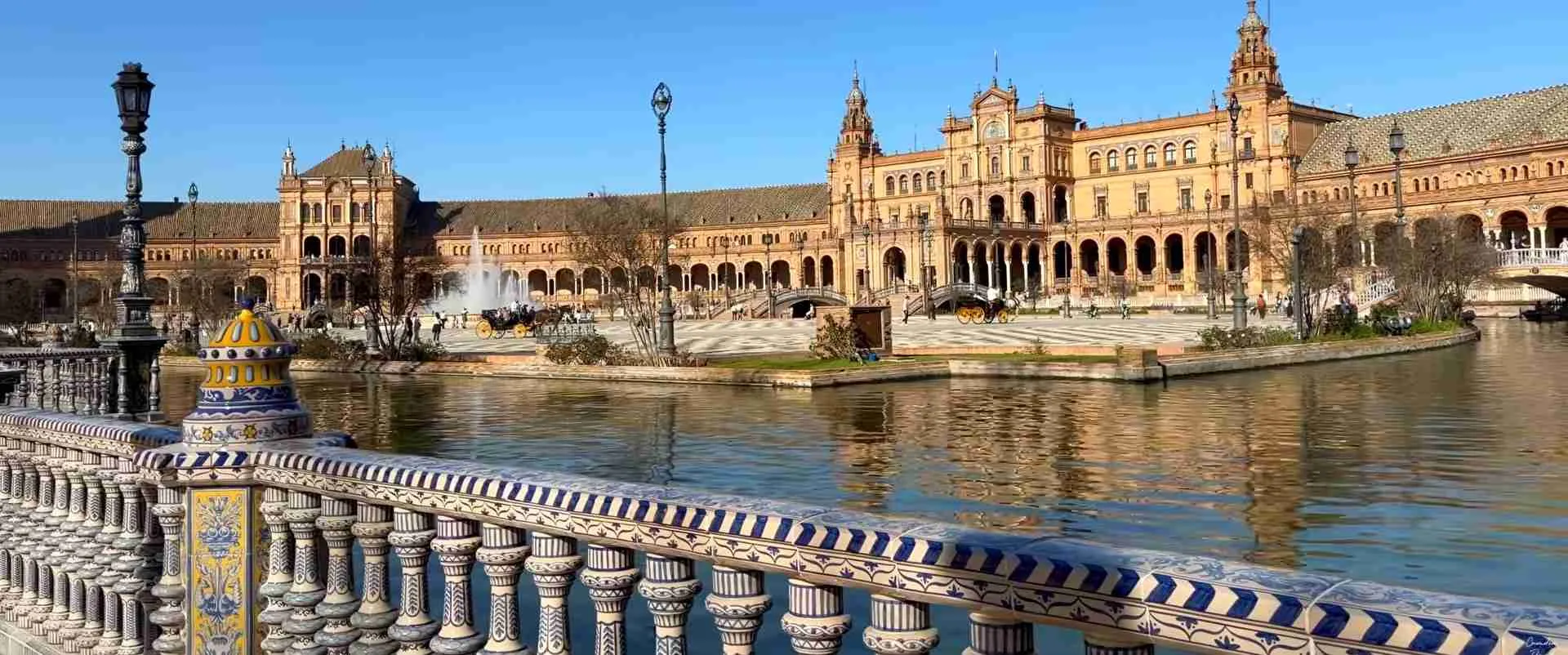
Between and around these festivals, April Seville operates at full cultural capacity. The Plaza de España, the Barrio Santa Cruz, the riverfront promenade, and the neighborhoods surrounding the Cathedral all contribute to a city that feels unambiguously at its peak. Outdoor dining is genuinely pleasant from April onward, which makes the restaurant and bar terraces worth prioritizing. Advance booking for accommodation during festival weeks — discussed in detail in the dedicated festival sections below — is the foundational planning step for any April visit that overlaps with Semana Santa or the Feria.
May in Seville
May consistently surprises first-time Seville visitors: it delivers much of April’s charm without April’s festival-week pricing or its most intense crowds. If the Feria de Abril concludes by late April, May’s first days find the city in a post-celebration ease, with locals returning to normal rhythms and visitors arriving in numbers that feel animated but manageable. Average daily highs advance through May, from around 25°C (77°F) at the start to 28–30°C (82–86°F) by the end. This upward trajectory means late May begins to resemble early summer: midday heat becomes genuinely warm, a pause becomes advisable, and evening outdoor dining takes on its summer character. Early May, by contrast, shares April’s quality of comfortable all-day outdoor activity.
The Corpus Christi procession — which falls sixty days after Easter Sunday, placing it in late May or June depending on the year — is worth noting if dates align with your visit. It brings the Cathedral precinct and surrounding streets a day of elaborate decoration (traditional sand and flower carpets along the route) and civic ceremony. It draws far fewer visitors than Semana Santa but is visually distinctive and represents an authentic piece of Sevillian religious civic life. Accommodation rates in May begin descending from April festival peaks, and by mid-month most years find standard spring prices prevailing across the city. May is an excellent month for a relaxed visit with no major planning hurdles.
Summer in Seville: Extreme Heat and Its Rewards
Summer in Seville requires a specific preparation that is less about packing and more about mindset. The city’s July and August are genuinely extreme by European standards, and the gap between what most visitors expect from “hot weather” and what Seville’s midsummer actually delivers is large enough to derail unprepared trips. The counterpart to this caveat is that a Seville summer, experienced on its own terms and with proper adaptation, has a character that no other season replicates: the city after 21:00 in July belongs to its residents in a way that spring never does, and the late-night atmosphere along the Guadalquivir riverbank and in the Alameda de Hércules is among the great overlooked pleasures of urban Spain.
June in Seville
June is the transitional summer month and the most visitor-friendly of the three. Temperatures rise through the month from around 28–31°C (82–88°F) at the start to 33–35°C (91–95°F) by the end — hot, but manageable with morning and evening focus. Rainfall drops to trace levels in June as the Atlantic systems retreat; the long, dry days that define Sevillian summer arrive reliably by the middle of the month. Evenings become warm enough for genuine outdoor dining from around 20:00, and the city’s bar terraces begin their seasonal peak activity. The cultural calendar may include Corpus Christi if Easter fell in late April, and open-air events increasingly fill the programming as the month progresses. Queues at the Real Alcázar and the Cathedral grow through June as northern European school holidays begin in the second half of the month; booking timed-entry tickets at least a week ahead is advisable from mid-June onward. For visitors who want summer warmth without the intensity of July and August, early to mid-June represents the season’s most accessible window.
July and August in Seville
July and August represent Seville at its most extreme, and any visitor planning these months should do so with complete clarity about what the heat involves. Average daily high temperatures sit at 36–38°C (97–100°F). Heat waves — defined by meteorologists as events where temperatures remain elevated through both day and night — occur multiple times each summer and sustain temperatures above 40°C (104°F) for stretches of consecutive days. Seville and the surrounding Guadalquivir River valley regularly record some of the highest temperatures measured anywhere in Europe during these events. These figures represent normal summer conditions, not unusual or exceptional weather.
The traditional Sevillian day in high summer follows an established rhythm. Early activity runs from approximately 07:00 to 12:00, capturing the Cathedral’s cooler morning interior and the Real Alcázar’s garden shade before the heat peaks. A long midday rest from 13:00 to 17:00 or 18:00 follows, during which air-conditioned accommodation, restaurants, and museums become the appropriate environment. Late afternoon re-emergence begins as the worst heat breaks, and the evening — from 20:00 to well past midnight — is the second, more social active period, with dinner at 21:00 or later and outdoor bars at full energy from 22:00. This schedule produces a seven-to-eight-hour active day entirely viable for comprehensive sightseeing and dining, just not in the midday hours a northern European visitor might instinctively choose.
The crowd profile in July and August differs from spring. Spanish families with school-age children are the dominant demographic, drawn by the only uninterrupted school holiday the calendar provides. International cultural tourists — the primary spring visitor type — are a smaller proportion. August adds an additional variable: a significant number of Sevillanos leave the city for coastal destinations in August, leaving certain neighborhoods with an uncanny summer quietude. The city retains all its character but with fewer people in its streets, which gives normally crowded spaces an unexpectedly intimate quality. Accommodation rates in both months are below the spring festival peak and represent a genuine financial advantage for heat-tolerant visitors; the frantic advance-booking urgency of Semana Santa week does not apply to summer, though booking ahead still ensures the best options.
Autumn in Seville: The Smartest Time to Visit
Autumn — specifically October and the second half of September — consistently outperforms visitor expectations and delivers the best return for most traveler types who arrive without a specific festival objective. The season combines approaching-ideal temperatures with significantly reduced tourist numbers, a descent in accommodation prices from spring peaks, and full operational access to every major attraction without the queue management that April and May require. Autumn Seville is what spring Seville would be if the festival bottlenecks and pricing peaks could be removed.
September in Seville
September begins in full summer mode. The first two weeks are essentially August conditions: temperatures of 32–36°C (90–97°F), almost no rain, the same midday-rest schedule. The transition begins in mid-September, with evenings becoming perceptibly cooler and the intensity of midday heat starting its seasonal retreat. By the end of the month, daily highs have typically fallen to around 28–31°C (82–88°F), which represents a meaningful and welcome shift from the July peak even if temperatures remain warm by most standards.
In even-numbered years, September hosts the opening weeks of the Bienal de Flamenco. This biennial festival brings the most significant artists in flamenco to the Teatro de la Maestranza and a network of smaller venues across the city, with programming ranging from canonical cante jondo (deep song) and baile (dance) to contemporary and cross-disciplinary work. For visitors with genuine interest in flamenco as a musical and dance art form — as distinct from the tourist-oriented tablao performances available year-round — no other period offers what an even-year September delivers. The programming quality is categorically different; many headline artists do not perform regularly in tablao venues. Tickets for major events sell in advance and should be secured early through the festival’s official channels.
Accommodation in September sits at shoulder-to-moderate rates depending on whether the Bienal is in session. Either way, rates are below the spring festival peak. Booking two to four weeks ahead is generally sufficient in non-Bienal years; Bienal-year September warrants earlier planning, particularly for the weekends of headline performances.
October in Seville
October is the single month that earns the clearest recommendation for visitors without a specific festival objective. Average daily highs around 24–27°C (75–81°F) sit in a range that feels comfortable for sustained outdoor activity throughout the day. Rainfall is present and meaningful — October averages around 60–90mm across the month from Atlantic weather fronts that move in and clear within a day or two — but the overall pattern still provides the majority of days suitable for outdoor plans. Evening temperatures of around 13–15°C (55–59°F) are warm enough for outdoor dining with a light jacket, keeping the tapas bar terrace culture accessible through the month.
The Real Alcázar and the Cathedral of Seville, which require careful advance booking in April and May, have significantly shorter queues in October. The Cathedral in particular is much more manageable: same-day or next-day timed-entry is often available, a convenience that simply does not exist in spring. The Archive of the Indies — the least-visited of the three UNESCO-listed monuments — is accessible without any advance booking in all non-peak seasons, including October. Photography in October benefits from excellent natural light: the lower sun angle produces longer golden-hour windows and a warm, slanted light that suits the Cathedral’s stone, the Giralda tower’s intricate historic decoration, and the plaza spaces of the historic center. The Plaza de España, challenging to photograph in peak season due to crowds and harsh midday sun, becomes far more manageable in October’s early mornings and late afternoons.
The Bienal de Flamenco continues into parts of October in even-numbered years, meaning even-year October visitors can access world-class flamenco programming alongside ideal sightseeing conditions — a combination that makes even-year October one of the most complete months in Seville’s calendar. Accommodation rates in October sit at genuine shoulder levels: meaningfully lower than spring festival months and comparable to the best-value periods in early spring.
November in Seville
November marks the definite transition to winter and the experience changes character through the month. Early November retains some of October’s accessible warmth, with daily highs around 18–21°C (64–70°F), but evenings cool sharply and the Atlantic weather systems that constitute Seville’s wet season begin arriving with increasing frequency. Average monthly rainfall of 60–80mm makes November the first month since April where extended rain periods are genuinely likely; multi-day grey fronts are possible, and planning indoor alternatives to outdoor sightseeing becomes a practical necessity rather than a precaution.
The Seville European Film Festival (Festival de Cine Europeo de Sevilla) typically takes place in November and brings a culturally engaged audience of film professionals and cinephiles to the city for screenings and debates. For visitors with interest in European cinema, this provides a specific reason to consider November that the month’s weather alone might not supply. The practical advantages of November for visitors who can accept the weather are considerable: accommodation rates are at some of the year’s lowest levels; every heritage attraction is accessible without queuing; and the tapas bar scene in the Barrio Santa Cruz and Triana neighborhood operates at its most local — the ratio of Sevillanos to tourists in November is the most favorable of any shoulder month, and the city at table, in its bars and markets, feels genuinely like itself rather than its tourist presentation.
Winter in Seville: Mild Days and Authentic Atmosphere
Seville’s winter is systematically underestimated, and the reason is comparison: measured against London, Berlin, or Stockholm, a Seville January is mild to the point of resembling early spring in those cities. Measured against spring Seville, it is undeniably quieter, rainier, and shorter in daylight. The appropriate comparison determines whether winter disappoints or delights. For the right traveler — one who values cultural authenticity, budget efficiency, and queue-free access to great heritage sites over sunshine guarantees — winter Seville is among the best urban-break options in southern Europe.
December in Seville
December in Seville has its own specific personality, anchored in Spanish Christmas traditions that differ substantially from the northern European model. The historic center receives elaborate street lighting installations in the weeks before Christmas, transforming evening walks into a visual event. Chestnut vendors appear on major street corners. Traditional Christmas sweets — polvorones (crumbly almond shortbreads), turrones (nougat bars in numerous regional variants), and marzipan — fill the windows of pastry shops throughout the month. The National Christmas Lottery draw on December 22 (Lotería de Navidad) produces a peculiar nationwide excitement that generates the kind of public energy in bars and on street corners that few other events can replicate.
The Spanish Christmas calendar concentrates celebration differently from the northern model. Christmas Eve (Nochebuena) is typically the most significant family gathering, not Christmas Day. Midnight Mass at the Cathedral of Seville on December 24 fills the building with a large congregation and is a powerful cultural experience for visitors who attend. The celebration cycle culminates in the Three Kings Parade (Cabalgata de Reyes Magos) on the evening of January 5, when floats representing the Magi travel through the city center throwing sweets to crowds lining the route — January 6 (Epiphany) is the traditional Spanish gift-giving day.
December is Seville’s wettest month, averaging 90–120mm, and sustained grey fronts are possible. Temperature-wise, daily highs of 15–17°C (59–63°F) with evenings around 6–8°C (43–46°F) require a warm jacket. The major heritage sites have among their shortest queues of the year in December outside the specific Christmas week, when domestic Spanish travel picks up modestly. For visitors who lean into the indoor culture — cathedral interiors, flamenco shows, tapas routes — December delivers genuine content and good value.
January and February in Seville
January and February are the quietest and least expensive months in Seville’s tourism calendar. After the Three Kings celebrations conclude in the first week of January, the city settles into its most genuinely local rhythm. Average temperatures of 6–17°C (43–63°F) day range — cool mornings, mild afternoons — make outdoor activity pleasant in the middle of the day while requiring warm layers for evenings. January carries meaningful rainfall (around 70–80mm), so some weeks see successive Atlantic fronts limiting outdoor time, though the city’s tapas bars, covered markets, and indoor cultural venues remain fully operational and provide the social infrastructure that keeps a Seville visit engaging in wet conditions.
February is slightly warmer than January, with the seasonal trend moving gradually upward: daily highs of 17–18°C (63–64°F) by the end of the month are common, and occasional early-spring warm spells push into the low twenties. The almond trees in the María Luisa Park sometimes flower in late February, one of the earliest seasonal visual signals of the spring to come. The practical advantages of January and February are unambiguous for the right traveler. Every major attraction — the Cathedral, the Real Alcázar, the Archive of the Indies — is accessible without any meaningful queue. Walk-up tickets at the Real Alcázar, which require careful advance booking in spring, are usually available in January and February with little or no wait. Accommodation rates are at their annual floor, and the best-positioned hotels in the Barrio Santa Cruz and around the Cathedral are available for the kind of last-minute booking that would be impossible in spring. The tapas bars and flamenco venues that constitute Seville’s most authentic cultural experiences operate fully in winter, and the audience is predominantly residents — the visitor-to-local ratio that is least favorable to authentic experience in spring is most favorable in January and February.
Seville’s Festival Calendar: Planning Around Major Events
Seville’s cultural calendar is unusually event-rich for a city of its size, and several events are significant enough to transform the visitor experience — in terms of both what the city offers and how logistics must be managed — to a degree that requires dedicated planning. The events below are the primary ones that should be researched before any visit.
Semana Santa: The Most Important Planning Consideration
Seville’s Holy Week processions are widely recognized as the most elaborate in Spain and among the most significant in the Catholic Holy Week tradition. During the week from Palm Sunday through Easter Sunday, approximately sixty brotherhoods (cofradías) carry massive processional floats (pasos) depicting scenes from the Passion of Christ through the streets of the historic center toward the Cathedral. Each procession is a many-hours-long, carefully organized event: the pasos are carried by teams of costaleros who work unseen beneath the float, taking slow rhythmic steps that create the characteristic swaying movement. Penitents (nazarenos) wearing long robes and pointed hoods accompany each float, carrying candles. The combined effect — at night, with narrow streets filled with candlelight and incense — is one of the most viscerally powerful cultural experiences available in European cities.
For visitors, Semana Santa requires advance planning to a degree unusual even among major European events. Accommodation in the historic center during the most popular procession nights — Palm Sunday, Holy Wednesday, and Good Friday are the most sought-after — closes months ahead. Viewing positions along the official procession route near the Cathedral include ticketed seating that must be reserved well in advance; standing positions in this area require arriving many hours before the procession. However, the processions also pass through the narrow streets of the Barrio Santa Cruz and other historic areas on their way to the main route, and viewing in these locations — where the pasos fill the entire width of a medieval alley and pass within meters of spectators — can be more powerful than any grandstand position. These locations do not require tickets but reward local knowledge of procession times and routes, which change each year and are available on the official Seville Semana Santa website. Holy Week dates change every year (tied to the Easter calendar) and must be confirmed for any planned travel in late March or April.
Feria de Abril: Seville’s Greatest Celebration
The Feria de Abril takes place in the Los Remedios neighborhood, across the Guadalquivir River, two to three weeks after Easter Sunday. The fairground is constructed anew each year and consists of hundreds of decorated marquee tents (casetas) belonging to private families, local brotherhoods, companies, and civic bodies. Each caseta hosts continuous private celebrations of Andalusian culture — flamenco dancing, food, conversation — and is generally accessible only to invited guests. A smaller number of casetas are designated as public.
The public experience of the Feria centers on the afternoon horse procession (paseo de caballos), in which participants in traditional riding costumes and women in flamenca dresses promenade along the fairground’s main avenue; the general atmosphere of the freely accessible fairground; and the official opening fireworks on Monday night (the Alumbrado), when the fairground’s thousands of colored lights are switched on simultaneously. The evening atmosphere from approximately 20:00 onward, when flamenco dancing within casetas intensifies and traditional costumes fill the main avenue, is the visual experience most associated with the Feria internationally. For visitors, the Feria is fascinating to observe and challenging to participate in fully given the private caseta structure; understanding this in advance produces a more rewarding experience than arriving with expectations of full access. Accommodation follows Semana Santa dynamics: prices surge and central hotels fill months ahead.
Bienal de Flamenco
The Bienal de Flamenco, held in Seville every two years in September and October of even-numbered years, is the world’s largest flamenco festival. Programming spans the Teatro de la Maestranza, the Teatro Central, and numerous smaller venues across the city, drawing the most significant names in the art form — performers who do not routinely appear in the tourist-oriented tablao shows available year-round. For visitors with genuine interest in flamenco as a musical and dance art form, this festival represents an opportunity with no equivalent in any other season or location. Tickets for headline performances sell well in advance through the festival’s official channels. Accommodation during the festival’s peak weeks carries a premium over normal September rates, and planning several months ahead is advisable for the best options.
Corpus Christi and Other Annual Events
The Corpus Christi procession, held sixty days after Easter Sunday, brings elaborate street decoration — traditional sand and flower carpets (alfombras) along the Cathedral precinct route — and a day of civic and religious ceremony to the historic center. It falls in late May or June depending on the Easter date and draws a local Sevillian audience rather than significant tourist numbers; it is worth observing if dates align but requires no special planning beyond confirming the date for your travel year. The Seville European Film Festival (Festival de Cine Europeo de Sevilla) takes place in November and adds a culturally engaged dimension to what might otherwise seem a quieter month for visitors.
Seville Weather by Month: Temperature and Rainfall Reference
The following data represents long-term average patterns for planning purposes; year-to-year variation is real and should be expected. Temperature figures represent typical average daily highs and lows; rainfall figures represent monthly averages across multiple years.
- January: Average high 16–17°C (61–63°F), average low 6°C (43°F). Rainfall approximately 70–80mm. One of the wettest months. Minimal tourist activity. Lowest accommodation rates of the year.
- February: Average high 17–18°C (63–64°F), average low 7°C (45°F). Rainfall approximately 50–55mm. Gradual warming begins. Occasional warm spells. Budget prices continue through the month.
- March: Average high 20–23°C (68–73°F), average low 9°C (48°F). Rainfall approximately 25–50mm. Mixed weather with improving trend. First real spring warmth. Festival season begins in late March if Easter falls early.
- April: Average high 22–25°C (72–77°F), average low 11°C (52°F). Rainfall approximately 35–50mm. Near-ideal walking temperatures. Semana Santa and/or Feria de Abril most years. Peak crowds and prices during festival weeks.
- May: Average high 26–28°C (79–82°F), average low 14°C (57°F). Rainfall approximately 25–45mm. Excellent conditions throughout. Post-festival calm in most years. Corpus Christi possible in late month.
- June: Average high 31–34°C (88–93°F), average low 17–18°C (63–64°F). Rainfall approximately 5mm. Summer conditions arrive. Long dry days. Best of the three summer months for most visitors.
- July: Average high 36–38°C (97–100°F), average low 20–21°C (68–70°F). Essentially no rainfall. Extreme midday heat. Traditional rhythm essential. Late-night city atmosphere exceptional.
- August: Average high 36–38°C (97–100°F), average low 21°C (70°F). Essentially no rainfall. Similar to July. Partial local population absent. Quieter streets, same heat.
- September: Average high 31–32°C (88–90°F), average low 17°C (63°F). Rainfall approximately 30–40mm. Heat retreating gradually from mid-month. Bienal de Flamenco in even-numbered years. Improving through the month.
- October: Average high 24–27°C (75–81°F), average low 13–15°C (55–59°F). Rainfall approximately 60–90mm (meaningful; plan indoor alternatives). Ideal sightseeing temperatures. Best overall month for most visitors.
- November: Average high 18–21°C (64–70°F), average low 9–10°C (48–50°F). Rainfall approximately 60–80mm. Cooling, meaningful rain, very low crowds. Seville Film Festival typically this month.
- December: Average high 15–17°C (59–63°F), average low 6–8°C (43–46°F). Rainfall approximately 90–120mm (the wettest month of the year). Christmas traditions active. Short daylight hours.
Crowd Levels and Accommodation Pricing by Season
Seville’s crowd and pricing dynamics have a counterintuitive quality that catches first-time visitors off guard. August is physically demanding but carries lower cultural tourist numbers than April; summer accommodation is cheaper than spring. Winter is quiet and genuinely inexpensive. The festival-week premiums are large enough that the difference between booking inside and outside those specific weeks substantially changes the total cost of a visit. Understanding these patterns is as important as understanding the weather.
Festival weeks (Semana Santa and Feria de Abril: variable dates in March–May) represent Seville’s absolute accommodation peak. Hotels in the historic center — particularly those in the Barrio Santa Cruz, along the main procession routes, and around the Cathedral — reach their highest rates of the year, often two to four times standard non-festival prices, and availability closes many months ahead. The first properties to sell out are those on or adjacent to major procession routes during Semana Santa. For Feria de Abril, proximity to the Los Remedios fairground adds a premium. Visitors who want centrally located accommodation during these weeks should begin searching six months ahead as a minimum; for Semana Santa specifically, twelve months is not unusual for the most desirable locations. If booking is made late (within six weeks of the event), apartment rental platforms typically offer more remaining options than hotel inventory, though prices remain at festival levels across all accommodation types.
High season (April outside festival weeks, May, and late September) sees elevated visitor numbers and accommodation pricing that is meaningful but not at the festival-week extreme. Booking two to three months ahead is advisable for first-choice properties; last-minute availability is possible but limited as the month approaches.
Shoulder season (non-festival March, October, and early June) combines good-to-excellent conditions with moderate accommodation prices and manageable tourist volumes. These months offer the best combination of experience and value for visitors without a festival-specific agenda. Booking one to two months ahead is generally sufficient, though desirable central properties in October can fill earlier as the month’s popularity becomes more widely recognized.
Low season (July, August, November, December, January, and February) covers months that are all lower in price and cultural tourist volume than the spring peak, though for different reasons. Summer months see lower cultural tourism despite high family-holiday travel; the heat rather than availability is the main planning variable. November through February see the year’s genuinely lowest accommodation rates and minimal attraction queuing. In January and February, same-week or even same-day bookings are possible at many central properties — a flexibility that is entirely impossible during the spring festivals.
Best Time to Visit Seville for Your Travel Priorities
The optimal season depends heavily on what a visitor wants from Seville. The following maps specific priorities directly to the months that best serve them.
For heritage sightseeing with minimal queuing: October is the clear primary choice, with January and February close behind. The Real Alcázar’s timed-entry queues, the Cathedral’s ticket lines, and the Archive of the Indies’ access are all at their simplest outside April through June. Same-day or next-day booking is the norm in October and winter months rather than the exception.
For cultural festivals and events: Semana Santa is irreplaceable for the traditions specific to Seville; it requires extensive advance planning but rewards it unconditionally. The Feria de Abril, held two to three weeks later, is the more celebratory counterpart and opens a partial but genuine face to visitors. If flamenco is the specific interest, the Bienal de Flamenco in even-year September-October is the single most significant opportunity in the world for that art form at its highest level.
For photography: April provides festival scenes, full-bloom gardens, and the visual intensity of processions and fair. October delivers the year’s best natural light for architectural photography with manageable crowds; the lower sun angles produce golden-hour light across a larger window of the day than summer allows. January and February offer the Cathedral and the Plaza de España essentially without other visitors in the frame — images that are impossible to replicate in any other season.
For food and the tapas culture: Quality is consistent year-round, but the local-to-visitor ratio in bars is most favorable in winter. The outdoor terrace culture is best in May and October. The late-night summer eating culture — dining at 21:30 with the whole city outdoors simultaneously, bars open past 02:00 on weekends — is unique to July and August and cannot be approximated in other seasons.
For families with children: May and October balance comfortable temperatures with full operational accessibility. The Three Kings Parade on January 5 is an exceptional experience for families traveling at Epiphany — genuinely child-centered and deeply embedded in Spanish tradition. Summer is feasible but requires rigorous heat management for children who may struggle with sustained high temperatures.
For budget travel: January and February deliver the lowest accommodation rates, shortest attraction queues, and full cultural access at the year’s best value. November is the next-best budget option with slightly better weather but more rain. All three months allow last-minute booking flexibility that no spring month offers.
For solo travelers: October combines the safety, energy, and cultural accessibility of a mid-size Spanish city with a crowd profile — independent travelers rather than family groups or festival tour parties — that makes casual conversation in bars and at heritage sites straightforward. The Bienal de Flamenco in even-year October adds a specialist-interest dimension that draws an engaged, conversation-ready audience.
Seville’s UNESCO World Heritage Complex by Season
Seville’s UNESCO World Heritage inscription covers three adjacent monuments at the heart of the historic center: the Cathedral of Seville, the Real Alcázar, and the Archive of the Indies. Together they form one of the most concentrated heritage complexes in Europe, and each responds differently to the seasonal crowd and temperature pressures that the city experiences.
The Cathedral of Seville and the Giralda Tower
The Cathedral — built from 1401 on the footprint of a former mosque and widely recognized as the world’s largest Gothic cathedral — maintains a cool atmosphere by virtue of its stone mass even in summer, making it one of the more comfortable midday destinations when outdoor temperatures are prohibitive. The Giralda tower, originally built as a minaret in the late 12th century and standing approximately 104 meters, is ascended by a series of ramps rather than stairs — a design that by tradition allowed the muezzin to reach the summit on horseback — which makes it more accessible than most tower climbs and rewards visitors with the most comprehensive elevated view of Seville available to the public. Ascending the Giralda in summer should be timed to the early morning; in autumn and winter, the climb can be made at any point in the day without heat concerns.
Peak queues at the Cathedral occur from April through June, particularly during midday hours, when wait times from the general ticket line can extend significantly. Advance ticket purchase through the official website eliminates the primary waiting risk in all seasons. In October, November, and the winter months, tickets are often available with little or no wait directly at the entrance, though the official online channel remains the most reliable route when plans are fixed.
The Real Alcázar
The Royal Palace of Seville — still an official royal residence, with sections closed when the royal family is in residence — is one of the finest examples of Mudéjar architecture in the world. Its gardens are among its most celebrated features and change character dramatically through the seasons. In March and April, the wisteria pergola, rose gardens, and orange trees are at their most spectacular; in summer, the cooling water channels and shade structures make the garden experience different but still valuable; in autumn, reduced crowds and warm light make October garden visits particularly pleasant; in winter, the evergreen structure of the garden persists and the palace interior feels appropriately grand in the lower, more angled light. Timed-entry ticketing is essential during spring and early summer; slots sell out weeks or months ahead during Semana Santa and Feria de Abril periods. In October and through winter, advance booking of a few days to a week is generally sufficient, and same-day tickets are often available directly at the entrance.
The Archive of the Indies
The Archive of the Indies (Archivo de Indias) — a 16th-century building housing the documentary record of Spain’s historic presence in the Americas, including original letters, maps, and administrative documents among the most significant historical materials in the world — is the least-visited of the three UNESCO monuments and maintains a different character from the palace and cathedral. Admission is free; queues are minimal in all seasons; and the building itself, designed after plans associated with the royal architect Juan de Herrera and completed in the late 16th century, is a significant example of Renaissance-Herreran architecture in its own right. Rotating exhibitions from the archive’s collection are available to general visitors in dedicated gallery spaces; the archive rooms are restricted to registered researchers. The Archive of the Indies is worth visiting in any season and represents the heritage complex’s most logistically accessible element regardless of when you arrive.
Day Trips from Seville: Seasonal Recommendations
Seville’s high-speed rail connection from Santa Justa station places several major destinations within comfortable day-trip range, and the question of which season makes each trip most rewarding is genuinely worth considering.
Córdoba (approximately 45 minutes by AVE high-speed train) is the most convenient major day trip from Seville and one of the most rewarding destinations in Spain. The Mosque-Cathedral of Córdoba — an extraordinary building integrating a medieval cathedral into a great 10th-century Islamic prayer hall — is reachable in under an hour. Spring and autumn are the optimal seasons: the prayer hall’s courtyard of orange trees and roses is at its most beautiful in April and May, the old Jewish quarter (Judería) is most pleasant to walk in mild temperatures, and the overall experience of the historic center is less impeded by heat than in summer. Córdoba has its own significant Semana Santa traditions, making a combined Seville-Córdoba trip during Holy Week a worthwhile option for visitors already in the region for the spring festivals.
Granada and the Alhambra (approximately 3 hours by bus; rail connections exist but are often slower for this route) requires advance booking for the Alhambra palace complex regardless of season — Alhambra tickets sell out days or weeks ahead during spring and can be scarce year-round for the most sought-after interior sections. The physical experience of a Granada day trip is most comfortable in spring and autumn: the Alhambra grounds require substantial outdoor walking, and summer day trips combine travel time from Seville with two cities’ worth of intense heat. Granada’s tapas culture — the city still offers free tapas with many drinks, a tradition that has largely disappeared elsewhere in Spain — operates year-round and enhances any visit. Late October and November benefit from lower crowds at the Alhambra and autumn color in the Generalife gardens.
Cádiz (approximately 1.5 hours by train) is Seville’s natural summer day trip. Average summer temperatures in Cádiz run 4–6°C lower than Seville due to consistent Atlantic sea breezes, the Atlantic beaches are excellent, and the historic old town — one of the oldest continuously inhabited settlements in western Europe, with Phoenician origins — is walkable and atmospheric. For summer visitors in Seville who need genuine temperature relief, a Cádiz day trip provides a different climatic experience within a short train journey. In other seasons, Cádiz rewards visits for its remarkable history, its fish and produce market, and the promenade walks along its ocean-facing city walls.
Coto Doñana National Park — a UNESCO Natural World Heritage Site protecting one of Europe’s most significant wetland and scrubland ecosystems — is accessible from Seville through authorized guided tours. Birdwatching is the principal visitor activity, and the park hosts extraordinary species diversity during spring (April–May, when migratory concentrations include flamingos, herons, spoonbills, and dozens of other species) and autumn (October–November). Summer visits are possible but the heat makes them less comfortable and many species retreat in the most intense months. Access without an authorized guided operator is restricted; advance booking through licensed tour providers is required for any visit.
Practical Tips for Visiting Seville in Any Season
Advance booking priorities by season
During festival weeks in April: treat accommodation (minimum six months ahead), Real Alcázar tickets (weeks to months ahead for timed entry), Cathedral tickets (days to weeks ahead), and any flamenco shows you specifically want to attend as logistical priorities to address before anything else. In October: book the Real Alcázar one to two weeks ahead as a reasonable precaution; Cathedral tickets can often be purchased on the day. In January and February: no advance booking is typically required for any attraction, though the Real Alcázar’s official website remains the most reliable channel regardless of season.
Hydration in any season
Seville’s dry climate means dehydration can occur faster than in humid environments, and not only in summer. Even in October, a full day of walking with insufficient water intake produces fatigue disproportionate to the temperature. Carrying a refillable bottle and using the city’s functioning public drinking fountains — which are distributed throughout the historic center — is a practical baseline for all seasons.
The daily rhythm
The pause that occurs in Seville between approximately 14:00 and 17:00 is not universally observed by all businesses, but enough shops and smaller services follow some version of it that visitors who do not account for it find closed doors. Major tourist attractions operate through midday in the main tourist seasons, but planning midday around a long lunch rather than a rushed tour produces a better experience and aligns with Seville’s genuine strengths as a food city. This rhythm matters more in summer, when the pause is also a heat-management necessity, but the underlying logic applies year-round.
Footwear
The historic center of Seville is paved in a combination of cobblestones and uneven stone surfaces that are hard on footwear and feet. Comfortable walking shoes suited to uneven terrain are strongly recommended in all seasons; smart shoes that prioritize appearance over support become problematic after the first few hours. In summer, lighter options with adequate sole protection make more sense than boots; in winter, something water-resistant is worth considering for November through January visits given the rainfall those months carry.
Dress codes at religious sites
The Cathedral of Seville is an active place of worship and requires covered shoulders and knees for entry. The Real Alcázar has no formal dress code. Lightweight layers that can cover exposed skin — a scarf for shoulders, trousers or a long skirt — solve the cathedral requirement without adding meaningful weight to a summer bag and are worth packing as a matter of course.
Getting around
The historic center is compact enough that the Cathedral, the Real Alcázar, the Archive of the Indies, the Barrio Santa Cruz, and the surrounding tapas streets are all within ten minutes of each other on foot. Extending to the Triana neighborhood across the Triana Bridge (Puente de Isabel II) adds a fifteen-minute riverside walk. Seville’s tram and metro system provides useful connections for neighborhoods further out. The city was an early pioneer of urban cycling infrastructure in Spain, and the bike-sharing network is a practical option for capable cyclists in spring and autumn; summer daytime cycling is inadvisable on heat grounds alone.
Language
Seville is the capital of Andalusia and the regional accent is distinctive within Spain. English is spoken in the tourist center but less universally outside it than in cities with heavier international tourism. A few Spanish words produce a reception that is invariably warm in smaller tapas bars and off-tourist-street shops; the effort is noted and appreciated even when it does not get far linguistically.
Frequently Asked Questions About the Best Time to Visit Seville
What month is the absolute best to visit Seville?
October consistently earns the recommendation as the single best month for most visitors without a specific festival objective. Average daily highs of 24–27°C (75–81°F) make outdoor walking comfortable throughout the day; every major attraction has significantly shorter queues than spring; accommodation sits at shoulder rates rather than festival peaks; and the lower autumn sun angle produces the year’s best natural light for architectural photography. The occasional October rain shower arrives and clears within a day, leaving the majority of days suitable for outdoor plans. Late September shares most of these qualities with slightly warmer temperatures; early November offers even lower prices and fewer tourists at the cost of more rain and shorter daylight hours. If a festival experience is the priority, April — planned carefully around the Semana Santa and Feria de Abril dates specific to that year — offers unmatched cultural intensity.
How far in advance should I book accommodation for Semana Santa?
Six months ahead is the practical minimum for centrally located accommodation during Semana Santa week, and twelve months is not excessive for the best-positioned properties on or near major procession routes. The most sought-after nights — Palm Sunday, Holy Wednesday, and Good Friday — fill earliest. Properties in adjacent neighborhoods (the Nervión district east of the center, the Triana neighborhood across the river) generally have better availability than the Barrio Santa Cruz and Cathedral area, though they too see meaningful price increases during these weeks. If you are searching with less than two months to go before Semana Santa, apartment rental platforms typically show more remaining inventory than hotel platforms, though at festival prices across all accommodation types.
Is August in Seville really as hot as people say?
The figures are not exaggerated. Average daily highs in August sit at 36–38°C (97–100°F), and heat waves — which occur every summer — push temperatures above 40°C (104°F) for stretches of consecutive days. Seville’s inland position in the Guadalquivir River valley means it lacks the coastal breezes that moderate temperatures at beach destinations in Spain; visitors who have managed summer heat in Mediterranean seaside resorts will typically find Seville significantly more intense. The heat is manageable if you follow the local rhythm of morning activity, long indoor midday rest, and evening outdoor life, and if your accommodation has functioning air conditioning — which should be confirmed before booking. Visitors who cannot adapt to this pattern are better served by September, October, or spring.
What is the weather like in Seville in October?
October delivers some of the year’s most pleasant conditions for sightseeing, with average daily highs of 24–27°C (75–81°F) making outdoor walking comfortable throughout the day. Rainfall is present — October averages around 60–90mm from Atlantic fronts — but typically arrives in events that clear within a day or two rather than in persistent grey periods. Planning at least one indoor alternative for each day of an October visit is sensible; building that flexibility in still leaves the majority of days for outdoor exploration. Evening temperatures of 13–15°C (55–59°F) are warm enough for outdoor dining with a light jacket through most of the month. The autumn light — lower sun angles and longer golden-hour windows than summer — makes October the year’s best month for photography of Seville’s honey-colored stone architecture.
When does Seville get the most rain?
December is Seville’s wettest month, averaging 90–120mm across the month. October, November, and January each carry 60–90mm on average. The summer months — June through August — are effectively dry; July and August record almost no measurable precipitation. This concentration of rainfall in the October-to-January window means that winter visits require indoor flexibility as a matter of planning, while summer visits can be organized entirely without rain considerations. Spring falls in between: March sees moderate rainfall, April is lighter but not guaranteed to be dry, and May is mostly dry as summer approaches.
Are flamenco shows better at a particular time of year?
Tourist-oriented flamenco tablao shows — ticketed performances in dedicated venues — operate year-round in Seville and maintain relatively consistent quality throughout the calendar. The significant exception is the Bienal de Flamenco, held in September and October of even-numbered years: a festival that operates at a categorically different level, with internationally significant artists, programming spanning canonical and contemporary forms, and an audience of specialists and serious enthusiasts rather than casual visitors. For anyone whose interest in flamenco is substantive, timing a visit to an even-year September or October provides access to the art form at its highest publicly available level in the city most historically associated with it. Year-round, Seville also has peña flamenco (flamenco club) performances that are less organized for tourism and more embedded in the local scene; asking at accommodation in the Triana neighborhood about current peña schedules can lead to more spontaneous and authentic experiences than any tablao offers.
Can I visit the Real Alcázar without booking in advance?
In low-season months — January, February, and most of November and December — walk-up tickets at the Real Alcázar are usually available with little or no wait. In October, advance booking of a few days to a week is advisable but not usually critical. From April through June, particularly during Semana Santa and the Feria de Abril, all timed-entry slots sell out weeks or months in advance; visiting without a pre-booked ticket means either being turned away or waiting for same-day release tickets, which are limited and not guaranteed. Booking through the Real Alcázar’s official website provides access to the full range of time slots and avoids the service fees that third-party platforms typically add. For spring visitors, treating the Real Alcázar booking as a logistical priority in the same category as accommodation is the right approach.
Is Seville worth visiting in December?
Yes, for the right travel style. December Seville combines mild daytime temperatures of 15–17°C (59–63°F) with a genuine Spanish Christmas atmosphere: elaborate street lighting installations throughout the historic center, traditional Christmas sweets in every pastry shop, and cultural events organized for residents rather than tourists. December is the city’s wettest month, which means itineraries should include meaningful indoor options alongside outdoor sightseeing. Heritage sites have minimal queues through most of December. Accommodation rates are at low-season levels outside the specific Christmas and New Year period, when domestic Spanish travel creates a modest uptick. For visitors who value authenticity over sunshine, December’s combination of Spanish Christmas traditions, empty heritage sites, and low prices makes it a strong option.
What should I pack for Seville in April?
April requires more layering than most spring destinations. Morning temperatures of 10–13°C (50–55°F) and afternoon highs of 22–25°C (72–77°F) mean the same day can feel genuinely cool early and comfortably warm by mid-afternoon. A light to medium jacket for mornings and evenings is essential throughout April. If your visit overlaps with Semana Santa processions — which take place through the night into the early morning hours — warmer layers become important for extended outdoor standing in overnight temperatures that can fall to single figures on some nights. Comfortable walking shoes suited to cobbled streets matter more than stylish footwear; the historic center’s uneven paving is demanding enough to make this a practical rather than aesthetic consideration.
How significant is the price difference between spring festival weeks and October?
The gap is large enough to be a meaningful planning consideration. During Semana Santa week and the Feria de Abril, hotel rates in the historic center typically run two to four times what the same properties charge in October. A mid-range hotel in the Barrio Santa Cruz area priced at around €150–200 per night in October may charge €350–500 or more per night during Semana Santa, and availability at any price point is limited. October rates represent genuine shoulder pricing — good value relative to spring peaks, and often with the booking flexibility (free cancellation, no minimum stay requirements) that festival-week bookings rarely offer. For visitors whose travel timing is genuinely flexible, the price differential between an October visit and a spring festival visit to Seville can fund several additional days of travel without any reduction in the quality of the city experienced.