Best Day Trips from Seville 2027: Córdoba, Ronda & Cádiz
Seville’s central Andalusian position puts three of Spain’s most rewarding destinations within two hours by rail. Córdoba delivers a UNESCO World Heritage Mosque-Cathedral and a perfectly preserved medieval quarter; Ronda perches dramatically above a sheer gorge that stops visitors in their tracks; Cádiz sits at the end of a narrow Atlantic peninsula, one of Europe’s oldest continuously inhabited cities. All three make realistic, deeply satisfying day trips from Seville in 2027, and this guide gives you the transport details, costs, itineraries, and practical tips to plan each one.
Key Takeaways
- Córdoba is the quickest and easiest day trip from Seville — 45 minutes by AVE high-speed train, dominated by the world-class Mosque-Cathedral (Mezquita), and easily managed as a full day out and back.
- Ronda is the most visually dramatic choice — allow 2–3 hours each way for the train or direct bus, but the payoff is the Puente Nuevo bridge spanning El Tajo gorge at approximately 98 meters and a compact Moorish old town that rewards slow exploration.
- Cádiz takes 1.5–2 hours by train and rewards with Atlantic beaches, Phoenician history dating to around 1100 BCE, and some of Andalusia’s finest seafood tapas.
- Budget travelers can complete any of these day trips for approximately €30–50 per person including return transport; mid-range visitors spend €55–90 per person depending on admissions and dining choices.
- Book Renfe trains at least two weeks in advance to unlock Promo fares — the cheapest advance AVE tickets for the Seville–Córdoba route can be under €12 each way, compared to over €25 at the door.
- Spring (March–May) and mid-September to November offer the most comfortable temperatures for all three day trips; July and August bring extreme heat, particularly in inland Córdoba where temperatures regularly exceed 40°C.
People Also Ask About Seville Day Trips 2027
How much does a day trip from Seville to Córdoba cost in 2027?
A Córdoba day trip costs approximately €30–50 per person on a tight budget, rising to €65–90 per person at mid-range. The main variable is your train ticket: an advance Promo fare on the Renfe AVE costs approximately €10–15 each way, while a walk-up standard ticket runs €22–28 each way, making the return total €20–50 depending on how far ahead you book. Entry to the Mosque-Cathedral of Córdoba (the Mezquita) costs €13 per adult in 2027 — check the official Mezquita website for current pricing and any seasonal changes before travel. A budget visitor who focuses on free sights and eats tapas at the bar stays toward the lower end of the range; a mid-range visitor who includes the Mezquita, the Alcázar of the Christian Monarchs, and a sit-down menu del día lunch comfortably fits within €65–90.
Is Ronda worth the longer journey from Seville in 2027?
Ronda is consistently rated one of the most scenically extraordinary towns in Spain, and most travelers who make the 2–3 hour journey consider it time exceptionally well spent. The Puente Nuevo bridge spanning El Tajo gorge at approximately 98 meters is one of those views that exceeds expectations in person. The historic old town, the bullring (one of Spain’s oldest, opened 1785), and the Moorish ruins in the lower town fill several rewarding hours. The key practical point for 2027 is that the train to Ronda requires a change at Bobadilla or Antequera-Santa Ana, making the direct bus — approximately a 2-hour service — worth considering. Mid-range total cost for a Ronda day trip runs approximately €60–90 per person.
How do I get from Seville to Cádiz by train in 2027?
Cercanías and Media Distancia trains from Seville’s Santa Justa station reach Cádiz in approximately 1.5 to 2 hours, with departures every hour or more frequently during peak periods. No changes are required. Return tickets in 2027 run approximately €18–26 per person — verify current Renfe fares at renfe.com before booking. Trains terminate at Cádiz station in the northern part of the old city, a 15-minute walk or short taxi ride from the cathedral and the main sights. The route passes through Jerez de la Frontera, which can be added as a stop on the return for sherry bodegas and equestrian culture without extra cost on Cercanías services.
Which of the three day trips is best for first-time visitors to Andalusia in 2027?
Córdoba is the strongest choice for first-time visitors because it combines the highest concentration of world-class heritage — the Mezquita, the Jewish Quarter, the Alcázar, the Roman Bridge — with the shortest travel time from Seville. The 45-minute AVE ride means you arrive with the whole day ahead of you, and the compact historic center is entirely walkable. Ronda is the second recommendation if you prioritize dramatic landscapes over monument density; the gorge view from Puente Nuevo is something most visitors rank as a highlight of their entire Andalusian trip. Cádiz appeals most to those who want beaches alongside history, or who have already seen Córdoba and Ronda on a previous visit to Spain.
Extended multi-day tours – 5+ days
Featured Seville Multi-Day Tour Packages
6 days
6 Days in Seville : with Day Trips to Ronda, Córdoba & Alhambra
- ✓ Comprehensive Seville tour
- ✓ Expert local guides included
- ✓ All accommodation arranged
- ✓ Transportation provided
3 days
3-Day Cordoba, Seville & Costa del Sol from Madrid
- ✓ Comprehensive Seville tour
- ✓ Expert local guides included
- ✓ All accommodation arranged
- ✓ Transportation provided

7 days
Seville and the Coast: 7 Days in Andalusia Without a Car
- ✓ Booking needs min. 2 travelers

6 days
Andalusia – Gibraltar, Seville and the Beauty of Small Towns
- ✓ Booking needs min. 2 travelers
Multi-day tour packages powered by TourRadar. Prices and availability subject to change.
Why Seville Is the Perfect Day Trip Hub in 2027
Santa Justa station, Seville’s main rail hub, sits about 1.5 kilometers northeast of the city center and provides direct or easily connected services to virtually every significant destination in Andalusia. The AVE high-speed line connects Seville to Córdoba in under an hour, while the Media Distancia and Cercanías networks extend southwest toward Jerez and Cádiz, and east and southeast toward Ronda and beyond. This rail infrastructure, continuously expanded since the 1992 Expo, makes Seville unusually efficient as a base for day excursions without requiring a car or overnight stays at each destination.
Beyond the trains, long-distance buses from the Plaza de Armas and Prado de San Sebastián bus stations serve destinations where the rail connection is less convenient, including Ronda, where the direct bus typically outperforms the train in journey time. Organized day tours departing from central Seville provide a third option — particularly useful for Ronda and the villages of the Sierra de Grazalema — and give travelers who prefer guided commentary an efficient alternative to independent navigation.
Andalusia’s climate reinforces Seville’s value as a base. Early morning departures are comfortable for most of the year, and in spring and autumn the light and temperatures across all three destinations are outstanding for walking and photography. The main constraint is the summer heat, which makes midday exploration of inland Córdoba and Ronda uncomfortable between roughly mid-June and mid-September, pushing the sensible strategy toward early arrivals and extended rest breaks during the hottest hours.
On an average day in 2027, travelers can reasonably cover Córdoba’s entire historic center between a 9 AM arrival and a 7 PM return train. Ronda requires a similar full day but with more travel time at each end. Cádiz is the most relaxed paced of the three, particularly for those who want to include an afternoon at La Caleta beach — the compact old city and coastal area are easily covered in 6–7 hours, leaving room for a long seafood lunch near the port.
Day Trip to Córdoba from Seville 2027
Córdoba is the model Andalusian day trip: fast to reach, dense with world-class heritage, and compact enough to cover thoroughly in a single day. The Mosque-Cathedral alone justifies the journey, but the Jewish Quarter, the Alcázar of the Christian Monarchs, and the option of visiting Medina Azahara in the afternoon extend a Córdoba day into one of the most historically rich experiences available anywhere in southern Spain.
Getting to Córdoba from Seville in 2027
The Renfe AVE high-speed service from Seville’s Santa Justa station to Córdoba takes approximately 45 minutes and runs frequently throughout the day, typically every 30 to 90 minutes. This is the fastest and most convenient option, and advance booking almost always pays off substantially. A Promo advance fare purchased two or more weeks ahead costs approximately €10–15 each way; the standard Tarifa General fare bought at the station on the day can reach €22–28 each way, making the return total roughly €20–30 on advance booking versus €44–56 at walk-up prices. Book at renfe.com — check for current 2027 fare tiers and advance booking windows, as Renfe adjusts these conditions periodically (check renfe.com for current rates before travel).
On arrival at Córdoba station, the historic center is approximately 1.5 kilometers south, an easy 20-minute walk along the Paseo de la Victoria, or a 5–7 minute taxi or city bus ride. The Mosque-Cathedral’s tower is visible across the rooftops and serves as a useful orientation landmark on the walk down. There is no need to arrange private transport; connections from the station are straightforward in 2027.
An alternative for travelers who want a more leisurely pace is the slower Media Distancia train, which takes around 1.5–2 hours but stops at intermediate towns and offers a different perspective on the Guadalquivir valley landscape. For a pure day trip from Seville, the AVE is the clear choice.
Top Sights in Córdoba for Day Trippers 2027
The Mosque-Cathedral of Córdoba — universally known as the Mezquita — is the defining reason to visit and should anchor the day. Built originally as a mosque beginning in 784 CE under Abd ar-Rahman I on the site of an earlier Visigothic church, the Mezquita was expanded substantially by successive Umayyad rulers over the following two centuries, creating a forest of 856 columns supporting striped red-and-white double arches that form one of the most mesmerizing interior spaces in European architecture. A Renaissance cathedral was inserted into the building’s center following the Reconquista in 1236, creating an architectural contrast that is jarring and extraordinary in equal measure. Entry costs €13 per adult in 2027; check the official Mezquita website for current pricing and any seasonal variations before travel. Early morning visits from the 8:30 AM religious opening are the most atmospheric and least crowded; the full tourist entry opens at 10 AM.
The Jewish Quarter surrounding the Mezquita to the north and west is among the most photogenic urban neighborhoods in Spain. Whitewashed lanes, geranium-hung facades, and small plazas carry an unhurried quality even in peak season. The Córdoba Synagogue on Calle Judíos — one of only three medieval synagogues surviving in Spain, built in the early 14th century — is worth the nominal entry and takes no more than 20 minutes to visit. The Zoco Municipal artisan market nearby is a good stop for browsing leather goods and Córdoba-style silver filigrana jewelry in the mornings.
The Alcázar of the Christian Monarchs, a 14th-century fortress-palace built for Alfonso XI, stands a few hundred meters southwest of the Mezquita. The Moorish-style gardens with terraced fountains and reflecting pools are particularly beautiful in spring and early autumn. Entry runs approximately €5–6 per adult in 2027 — confirm current rates at the official Córdoba tourism website. Allow 1–1.5 hours to do the gardens and interior justice.
The Roman Bridge spanning the Guadalquivir is free to walk and offers excellent views back toward the Mezquita tower across the water. The Torre de la Calahorra at the southern end houses a museum on Córdoba’s three-culture history; entry is approximately €5. The bridge approaches make for particularly pleasant late-afternoon walking when the light on the water turns golden.
For travelers with a specific interest in the Umayyad period, Medina Azahara (Madinat al-Zahra) — a 10th-century palace-city built by Abd ar-Rahman III approximately 8 kilometers west of Córdoba — is a compelling half-day addition. A UNESCO World Heritage Site since 2018, the partially excavated complex conveys the scale and ambition of the Caliphate of Córdoba at its peak. Access from the city center is by shuttle bus from the adjacent museum. Entry costs approximately €6 for EU residents and €9 for non-EU visitors in 2027 — verify current pricing at the official Medina Azahara website before travel. Fitting Medina Azahara into a day trip from Seville works best if you visit the Mezquita first thing in the morning and take the shuttle in the early afternoon.
Where to Eat in Córdoba on a Day Trip 2027
Córdoba’s best-value dining sits one or two streets back from the main Mezquita frontage, where locally frequented bars serve the menu del día — three courses, bread, and a drink — for approximately €12–18 per person at mid-range establishments. The streets immediately adjacent to the monument entrance carry a significant tourist premium on both price and quality.
Salmorejo is the essential Córdoba dish: a thick, cold purée of tomato, bread, olive oil, and garlic, served with finely chopped hard-boiled egg and jamón on top. Richer and more substantial than Seville’s gazpacho, it appears on virtually every bar menu in the historic center. Rabo de toro (oxtail stew), flamenquín (pork loin rolled in jamón and fried in breadcrumbs), and tortilla española are the other core local plates.
The Mercado Victoria, a renovated 19th-century iron market on the Paseo de la Victoria between the station and the historic center, offers high-quality tapas from around 10 AM and makes an excellent choice for a varied late-morning snack or a light early lunch. For a full sit-down meal, the area around Plaza de la Corredera — a 17th-century arcaded square about 600 meters northeast of the Mezquita — offers outdoor seating and generally reasonable prices; budget approximately €20–30 per person for a two-course meal with wine.
Córdoba Day Trip Budget Breakdown 2027
Budget travelers completing a Córdoba day trip in 2027 spend approximately €30–50 per person. This covers an advance Promo return AVE ticket (€20–25), free or low-cost sights such as the Roman Bridge and the Jewish Quarter streets, and a market lunch or tapas at the bar (€8–12 for food, €4–6 for drinks). Travelers who attend the 8:30 AM religious opening at the Mezquita rather than the full paid tourist entry can reduce admissions costs significantly, though the visit is shorter and more restricted than the full experience.
Mid-range visitors spend approximately €65–90 per person. This includes an advance or semi-advance return AVE ticket (€28–38), Mezquita entry (€13), Alcázar of the Christian Monarchs entry (€5–6), a sit-down menu del día lunch (€15–22), and coffee and snacks throughout the day (€5–8). Adding Medina Azahara (€6–9 plus shuttle) or the Torre de la Calahorra museum (€5) pushes toward the upper end of this range.
Premium visitors choosing a private guided full-day tour from Seville — including private transport, skip-the-line entry, and a restaurant lunch — typically pay €150–250 per person in 2027. Organized group tours from Seville operators generally cost €80–130 per person with transport and guide included; admission costs may be additional or bundled depending on the package.
Suggested Córdoba Day Trip Itinerary 2027
A well-paced Córdoba day works as follows. Take an early AVE from Santa Justa, arriving in Córdoba by 9:30–10 AM. Walk directly to the Mezquita for the 10 AM tourist opening (allow 1.5–2 hours inside). Walk through the Jewish Quarter and the Zoco (45–60 minutes). Continue southwest to the Alcázar of the Christian Monarchs gardens (1–1.5 hours). Cross the Roman Bridge before lunch. After a midday sit-down menu del día (1.5 hours), spend the afternoon at the Mercado Victoria area or — if pre-arranged — take the shuttle to Medina Azahara. Board a late-afternoon or early-evening AVE back to Seville, arriving by 8–9 PM. Total walking distance for the core historic center itinerary is approximately 4–5 kilometers.
Day Trip to Ronda from Seville 2027
Ronda is one of those Andalusian destinations where photographs do not prepare you for the reality. The town sits atop a dramatic limestone plateau divided by El Tajo gorge, with the Puente Nuevo — completed in 1793 after decades of construction — spanning the void in a single arch above a drop of approximately 98 meters. For a day trip from Seville, Ronda demands more travel time than Córdoba, but the visual payoff and the character of the hilltop old town make it a consistent highlight of most visitors’ Andalusia itineraries.
Getting to Ronda from Seville in 2027
The train journey from Seville to Ronda requires a change at Bobadilla junction or Antequera-Santa Ana and takes approximately 2–3 hours total, depending on the connection timing. Renfe’s regional service operates this route, with tickets running approximately €12–18 each way in 2027 (verify current Renfe fares and schedules at renfe.com before booking).
The direct bus is a strong alternative for the Ronda day trip. Services from Seville’s Plaza de Armas bus station to Ronda — operated within the Avanza and Linesur network — take approximately 2 hours via the main road route and typically cost €10–14 each way in 2027. This is generally faster than the train and avoids the connection at Bobadilla. The bus drops you at Ronda’s bus station on the edge of the newer town, a 10–15 minute walk from the Puente Nuevo area. Check current schedules and book online through the operator’s website or at the bus station ticket window; frequency is limited (typically 3–5 departures daily each way), and weekend services fill up during peak periods.
A common practical strategy is to take the bus to Ronda and the train back, which gives slight schedule flexibility. Private transfers from Seville take approximately 1.5–2 hours by road (via the A-92 toward Antequera, then A-384 and A-374 through the foothills of the Sierra de las Nieves) and cost approximately €100–180 for a private taxi or shared shuttle depending on group size.
Once in Ronda, the old town (La Ciudad) is a compact area of roughly 500 by 400 meters and entirely walkable. The bus station is about a 15-minute walk to the Puente Nuevo; the train station sits at the eastern edge of town, 1.5 kilometers from the bridge — take a taxi or walk along the main road.
What to See in Ronda on a Day Trip 2027
The Puente Nuevo is the centerpiece of any Ronda visit. Completed in 1793 and spanning the deep limestone chasm of El Tajo at a height of approximately 98 meters, the bridge’s enormous central arch is the defining image of Andalusia’s white-town country. The best views are not from the bridge deck itself but from the Camino de los Molinos footpath that descends partway into the gorge from the Jardines de Cuenca on the Mercadillo (newer town) side. The walk down takes 20–30 minutes, offers dramatic close-up perspectives on the arch from below, and is free of charge. Wear appropriate footwear; the path is rocky and steep in places. The Puente Nuevo’s interior houses a small museum documenting the bridge’s construction history and its use as a prison; entry costs approximately €4–5 in 2027.
The Plaza de Toros de Ronda is the town’s second great draw. Inaugurated in 1785 and associated in bullfighting history with the Romero family — Pedro Romero in particular is widely credited as a key figure in shaping the practice as it came to be codified in the late 18th century — the ring’s graceful white stone arcading and ochre interior are architecturally fine on their own terms. The adjacent bullfighting museum is one of the more interesting of its kind in Spain. Entry to both the ring and museum costs approximately €10–12 in 2027 — confirm current pricing at the official Ronda website before travel.
The old town (La Ciudad) south of Puente Nuevo is the Moorish core of Ronda. A 16th-century collegiate church built over the main mosque stands near the center; the 14th-century Mondragón Palace now houses the Ronda Municipal Museum; and the Arab Baths at the foot of the town near the Guadalevín river — 13th-century vaulted structures with characteristic star-shaped skylights — are typically open for free or a low entry fee. The streets of the old town are quiet by Andalusian tourist-center standards and reward slow exploration.
The Alameda del Tajo at the western edge of the newer town is a public garden with spectacular views south toward the Sierra de Grazalema. Entry is free, and the benches at the garden’s edge overlooking the valley are among the most peaceful spots in Ronda for a mid-afternoon rest before heading back to the bus or train.
Where to Eat in Ronda 2027
Ronda’s restaurant scene divides between the area immediately around Puente Nuevo — where terrace tables with gorge views command a significant premium — and the main commercial artery of the newer town (Calle Espinel, locally called La Bola), where locally frequented bars serve the menu del día for €12–16 per person. The practical advice for day trippers is to eat one or two streets back from the main tourist axis and save the gorge-view terrace for a coffee or a glass of wine rather than a full meal.
Ronda’s cuisine draws on mountain produce: jamón serrano from the surrounding sierra, rabo de toro (oxtail stew), local kid goat (chivo), and intensely flavored olive oil from the Ronda growing area. The Serranía de Ronda wine designation produces notable reds and whites from the surrounding highland vineyards, typically available at modest prices by the glass at local restaurants. Budget approximately €18–28 per person for a two-course lunch with a glass of local wine at a mid-range restaurant away from the tourist main.
Ronda Day Trip Budget Breakdown 2027
Budget travelers spending a day in Ronda from Seville typically pay approximately €30–50 per person. This covers a round-trip bus or train ticket (€20–28 for a bus return, slightly more for train depending on timing), free walking of the old town streets and the Camino de los Molinos gorge path, and a budget lunch from a local bar (€10–15 for food, €4–6 for drinks). The Puente Nuevo bridge deck is free to walk at all times, and a deeply satisfying day in Ronda is achievable without paying any admissions at all.
Mid-range visitors spend approximately €60–90 per person. This includes transport (€24–38 return), entry to the Plaza de Toros and museum (€10–12), the Puente Nuevo interior museum (€4–5), a sit-down lunch with a glass of local wine (€20–28), and afternoon coffee (€4–6).
Premium visitors on private guided full-day tours from Seville typically pay €150–250 per person, often including stops in the Sierra de Grazalema natural park on the approach to or return from Ronda. Organized group tours generally cost €80–130 per person.
Suggested Ronda Day Trip Itinerary 2027
For a Ronda day from Seville, target the first bus or train of the day, arriving in Ronda by 10:30–11 AM. Walk or take a taxi to the Puente Nuevo area (15 minutes from the bus station). Spend 30 minutes on and around the bridge, then descend to the Camino de los Molinos gorge path for the low-level view (allow 45 minutes including descent and return). Visit the Puente Nuevo museum if of interest (30 minutes). Walk into the old town for the Arab Baths and Mondragón Palace (1–1.5 hours combined). Have lunch one street back from the tourist main (1.5 hours). Visit the Plaza de Toros bullring in the early afternoon (1 hour). End at the Alameda del Tajo gardens for the valley views, then walk to the bus station or taxi to the train station. Total walking distance is approximately 4–5 kilometers.
Day Trip to Cádiz from Seville 2027
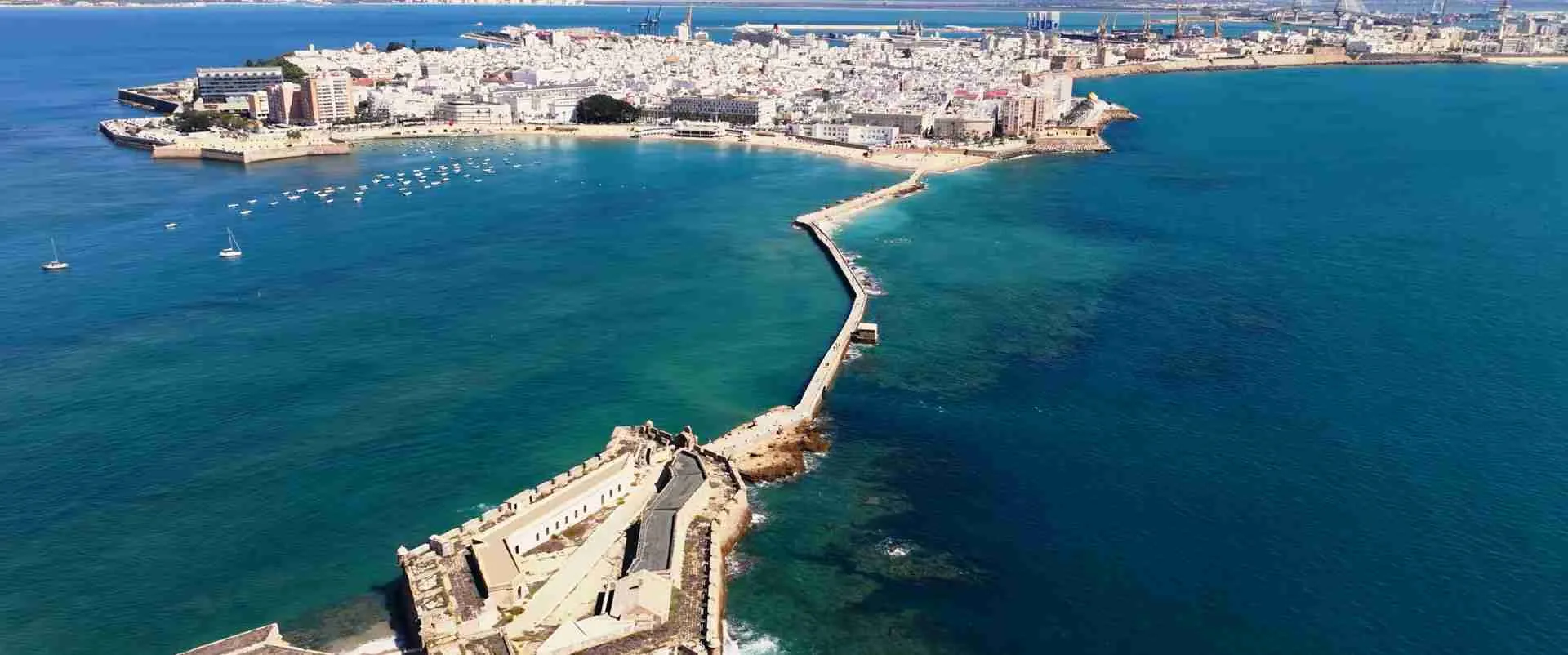
Cádiz occupies a geographically unusual position: a narrow Atlantic peninsula connected to the mainland by a slender isthmus, with open ocean on three sides. The city established by Phoenician traders — who founded a settlement here around 1100 BCE by tradition, making Cádiz among the oldest continuously inhabited cities in Western Europe — is today a place of striking contrasts. The gleaming white towers and golden Cathedral dome visible for miles offshore, the dense medieval street pattern of the old city, and the long Atlantic beaches curving around both sides of the peninsula create a destination unlike any other accessible from Seville as a day trip.
Getting to Cádiz from Seville in 2027
Renfe Cercanías C-1 and Media Distancia trains from Seville’s Santa Justa station reach Cádiz in approximately 1.5 to 2 hours, with departures every hour or more frequently during peak morning and evening periods. The service is direct — no changes required. Return tickets cost approximately €18–26 per person in 2027; verify current pricing at renfe.com before travel, as fares are subject to periodic Renfe adjustments. No advance booking is required for Cercanías services, though booking ahead is advisable for the faster Media Distancia trains during weekends and Spanish public holidays.
The route passes through Jerez de la Frontera (approximately 45 minutes from Seville) and El Puerto de Santa María. Both deserve visits in their own right and can be added as a stop on the return journey without extra cost on Cercanías services. Cádiz station sits at the northern edge of the old city, a 15–20 minute walk from the cathedral and La Caleta beach, or a 5-minute taxi ride to the center.
Long-distance coaches from Seville’s Prado de San Sebastián bus station also serve Cádiz in approximately 1.5–2 hours and can be price-competitive with the train, particularly for advance bookings. For most day-trip travelers, the train is the more consistent and convenient choice given frequency and station location.
What to See in Cádiz on a Day Trip 2027
The Cádiz Cathedral (Catedral de Santa Cruz de Cádiz), a Baroque and Neoclassical structure built mainly during the 18th and early 19th centuries, dominates the city’s skyline with its distinctive golden-tiled dome visible from far out at sea. Entry to the cathedral and its tower viewpoint costs approximately €7–9 per person in 2027 — confirm current pricing at the official cathedral website before travel. The tower climb is worth the effort: the panoramic view takes in the Atlantic, the Bay of Cádiz, and the full length of the old-city peninsula.
The Roman Theatre (Teatro Romano), located on Calle Mesón 8, is an unexpectedly large 1st-century BCE structure partly excavated during urban redevelopment work and now open as a free archaeological site embedded in the living city. The neighboring interpretation center provides historical context. Visiting the Roman Theatre makes Cádiz’s claim to deep antiquity concrete in a way few other sights in the old town achieve — the layered occupation from Phoenician through Roman through modern is visible in compressed form.
The Torre Tavira, the highest point in the old city and the official watchtower used to spot incoming merchant ships in the 18th century when Cádiz was Spain’s primary Atlantic trading port, houses a camera obscura projecting a live image of the city’s streets and rooftops. Entry costs approximately €7–8 in 2027. The tower platform also provides excellent 360-degree views over the old-town roofscape — a combination of cupolas, whitewashed watchtowers, and flat terraces unlike any other Spanish city.
The Cádiz History Museum, housed in a fine neoclassical building on Plaza de Mina, contains one of the most remarkable collections in the region. Two Phoenician anthropoid marble sarcophagi from the 5th century BCE — extraordinarily rare examples of Phoenician funerary art found during 19th-century excavations in the city — are the centerpiece highlights and compelling evidence of Cádiz’s Phoenician origins. The museum also holds a notable collection of paintings including works attributed to Zurbarán. Entry is free for EU residents; a nominal fee applies to non-EU visitors in 2027 (confirm at the museum website).
La Caleta is the city’s urban beach, set into the western shore of the peninsula between the Santa Catalina and San Sebastián castle ruins. The beach is small and typically busy in summer, but swimming here with the fort ruins framing the horizon carries a particular Cádiz atmosphere. The La Viña neighborhood surrounding La Caleta — the heart of the internationally renowned Cádiz Carnaval, held each February — has a grittier, more residential character than the cathedral quarter and rewards a slow walk for its murals and neighborhood bar scene.
Where to Eat in Cádiz 2027
Cádiz has a strong claim to being one of the best tapas cities in Spain, and the most rewarding strategy for a day visitor is to graze across several bars rather than commit to a single sit-down meal. Seafood dominates: tortillitas de camarones (crispy shrimp fritters in a thin batter — a Cádiz specialty impossible to find in quite the same form anywhere else in Spain), papas aliñás (cold dressed potato salad with olive oil, vinegar, and parsley), chipirones (small squid) fried or in ink sauce, and freshly fried pescaíto (a mixed plate of small fried fish) are the essential local plates.
The Mercado Central de Cádiz on Plaza de las Flores is open in the mornings with fresh fish, produce, and tapas bars inside. Arriving between 10 AM and 1 PM gives the liveliest atmosphere. For lunch, the streets of the La Viña neighborhood near La Caleta consistently offer the best combination of price and quality; a full seafood lunch in this area runs approximately €18–30 per person with a drink. The afternoon fino sherry — poured from a bottle kept cool behind the bar — is the traditional early-evening punctuation to a Cádiz day.
Cádiz Day Trip Budget Breakdown 2027
Budget travelers spending a day in Cádiz from Seville typically pay approximately €30–50 per person. This covers a return Cercanías or Media Distancia train ticket (€18–26), free admission to the Roman Theatre and the Cádiz History Museum (for EU visitors), a beach afternoon at La Caleta, and tapas and drinks from local bars (€10–15 for food, €4–6 for drinks). Cádiz is among the most budget-friendly of the three day trips because several of its best experiences — the old-town streets, the beaches, the Roman Theatre, the coastal fortresses — carry no admission charge.
Mid-range visitors spend approximately €55–85 per person. This includes the return train (€22–30 for Media Distancia or with slight advance booking), Cádiz Cathedral and tower entry (€7–9), Torre Tavira (€7–8), and a sit-down seafood lunch with wine in La Viña (€22–30). Afternoon coffee adds €4–6.
Organized day tours combining Cádiz with a morning sherry bodega visit in Jerez de la Frontera typically cost €80–120 per person from Seville, including transport and guide. Private guided Cádiz-only tours run approximately €140–220 per person.
Suggested Cádiz Day Trip Itinerary 2027
Take the first or second morning train, arriving in Cádiz by 9–10 AM. Walk directly to the Cádiz Cathedral for the opening; the tower climb takes 30–40 minutes, the interior another 30. Continue to the Roman Theatre nearby (30 minutes) and the Cádiz History Museum if the Phoenician sarcophagi appeal (1 hour). Walk through the old town to Torre Tavira for panoramic views (30 minutes). Stop at the Mercado Central for a mid-morning snack if you arrive before 1 PM. Lunch in the La Viña neighborhood near La Caleta (1.5 hours). Spend the afternoon at La Caleta beach (1–2 hours in good weather). Walk back through the old town in the late afternoon, stopping for a fino sherry near Plaza San Juan de Dios. Take a late-afternoon or early-evening train back to Seville. Total walking distance is approximately 5–6 kilometers, naturally tracing the old-city circuit.
Comparing Córdoba, Ronda & Cádiz as Day Trips from Seville in 2027
The three destinations serve different visitor priorities, and choosing between them is largely a question of what you want from an Andalusian day trip.
Córdoba offers the strongest single-day heritage experience. The density of world-class monuments in its historic center — the Mezquita, the Jewish Quarter, the Alcázar, the Roman Bridge, and the broader UNESCO ensemble — is unmatched among the three destinations, and the fast AVE connection means you arrive in Córdoba with the full day ahead of you. It is also the most appropriate choice in poor weather, since the Mezquita interior provides hours of fully sheltered exploration. The main drawbacks are the extreme summer heat and the peak-season crowds around the Mezquita, which can be heavy between 10 AM and 2 PM in July and August.
Ronda provides the most distinctive visual experience. The combination of vertiginous cliff scenery and a well-preserved Moorish old town in a compact space is essentially unique in Spain. Puente Nuevo and El Tajo gorge are free to experience, and the old town rewards spontaneous, unscheduled exploration. The main constraint is transport time: the 2–3 hour each-way journey makes for a long day from Seville, and independent travelers need to pay careful attention to return schedules — particularly the last bus or train of the evening.
Cádiz is the most relaxed and beach-oriented of the three and the best choice in summer, when Atlantic breezes keep the peninsula noticeably cooler than inland Córdoba or Ronda. It is also the most budget-friendly, with significant free attractions. Its relative weakness as a day trip is that it lacks a single unmissable monument-level sight in the way the Mezquita defines Córdoba and Puente Nuevo defines Ronda; Cádiz rewards wandering and absorption of atmosphere more than monument-checking.
For travelers visiting all three over a week in Seville, a useful sequence is: Córdoba early in the stay (day 1 or 2, to get the most important heritage site covered while energy is high), Ronda mid-week with bus research done in advance, and Cádiz as a relaxed late-week option. The combined mid-range three-day-trip budget runs approximately €180–265 per person, exclusive of accommodation and meals in Seville itself.
Best Season for Day Trips from Seville in 2027
The most important seasonal variable for day trips from Seville is heat. Andalusia has one of the most extreme summer climates in Europe, and inland cities like Córdoba and Ronda can record temperatures above 40°C between late June and late August. Outdoor exploration of cobblestone historic centers in those conditions is genuinely uncomfortable and poses real risks to vulnerable travelers. The coastal position of Cádiz moderates this significantly, with Atlantic breezes typically holding summer highs in the low-to-mid 30s.
Spring (March–May) is the optimal season for all three day trips. Temperatures are pleasant across the region (typically 18–26°C), the countryside is in bloom, and Córdoba’s celebrated Patio Festival in early May — when dozens of private courtyard gardens open to the public in competition — adds a remarkable extra dimension to a Córdoba visit. The Patio Festival period (typically the first two weeks of May) is very popular; trains to Córdoba and accommodation in Seville book more quickly than usual in this period.
Early autumn (mid-September to November) is nearly as good, with moderate temperatures and the exceptional golden light of Andalusian autumn that makes photography particularly rewarding. The Feria Goyesca — Ronda’s prestigious September bullfighting festival held in period costume — brings a distinctive cultural intensity to the town; while it does not affect the practicality of day trippers from Seville, it is worth timing a visit to coincide with or to avoid, depending on preference. Harvest season brings fresh olive oil and young wines to restaurant menus across all three destinations.
Winter (December–February) is underrated for day trips from Seville. Temperatures in Córdoba and Ronda run 8–15°C — cold by Spanish standards but mild for Northern European visitors — the monuments are significantly less crowded, and the winter light gives the stone architecture of the Mezquita and the Ronda gorge a sharp, unforgiving clarity. Cádiz in February during Carnaval is a different proposition entirely: the city transforms into one of the most original and musically creative street festivals in Europe, running over ten days. Trains from Seville to Cádiz on Carnaval weekend sell out weeks in advance.
Summer (June–August) is manageable for Cádiz, challenging for Córdoba and Ronda. If summer is your only window for Córdoba, the best strategy is to arrive at the Mezquita opening (8:30–10 AM) and then retreat to air-conditioned restaurants, museums, and inner patios during the 1–5 PM peak heat — a rhythm that mirrors how many locals live in summer. The Mezquita itself is cool inside regardless of season, making it suited to a long mid-morning visit. For Ronda in summer, early-morning arrival maximizes comfort before temperatures build on the exposed gorge viewpoints.
Train and Bus Booking for Seville Day Trips in 2027
Understanding the Renfe booking system and the bus network saves time and money on all three day trips from Seville in 2027. The core principle is simple: book earlier, pay less — especially for the AVE to Córdoba, where the spread between advance and walk-up fares is most extreme.
Renfe’s online booking platform at renfe.com allows tickets to be purchased up to 60 days ahead. The cheapest fare tier — the Tarifa Promo — sells in limited quantities per train and goes first. Once Promo fares are exhausted, the Promo+ tier applies, followed by Tarifa General (the highest walk-up rate). For the AVE to Córdoba, booking two or more weeks ahead almost always secures a Promo fare; booking the day before typically means paying Tarifa General, which runs roughly twice the advance price. For the regional MD services to Ronda and the Cercanías/MD to Cádiz, the pricing spread is less dramatic but advance booking still guarantees a seat during busy weekends and Spanish public holidays.
The Renfe app (available for iOS and Android) is the easiest way to manage tickets and check real-time train status. Download it before travel and save your tickets to the app — digital tickets scan at the platform gate without requiring a mobile data connection. The Renfe website has a full English-language interface and accepts international credit cards.
For bus bookings to Ronda, the main operators from Seville are within the Avanza and Linesur networks. Tickets can be booked online through the operators’ websites or at the Plaza de Armas bus station ticket windows. Weekend and holiday services on the Ronda route can fill up; booking online the day before is a sensible precaution. A practical note on return timing: the last return trains from Córdoba to Seville run until approximately 10–11 PM, giving substantial evening flexibility. The last buses from Ronda typically run by 8–9 PM; check the specific schedule when booking to avoid being stranded. Cádiz trains to Seville run until approximately 10–11 PM, making an evening beach visit followed by a late dinner and a 9 PM train back a comfortable option in summer.
More Day Trip Options from Seville in 2027
Córdoba, Ronda, and Cádiz are the three most established day trips from Seville, but Andalusia offers further compelling options for travelers with more than a few days in the city.
Jerez de la Frontera, on the Cádiz train line approximately 45 minutes from Seville (Cercanías fare approximately €5–8 each way), combines sherry wine culture, Andalusian equestrian tradition, and flamenco heritage in a compact and elegant city. The González Byass and Bodegas Tradición bodegas are the most visitor-ready, offering guided tours and tastings for approximately €15–20 per person. The Royal Andalusian School of Equestrian Art presents public shows several times weekly (entry approximately €20–30 per person; check current schedule at the school’s website). Jerez pairs naturally with Cádiz on the same train line — a combined Jerez morning and Cádiz afternoon makes a satisfying full day.
Carmona, 35 kilometers east of Seville and reachable by bus in 35–45 minutes (approximately €4–6 return), is a dramatically sited hilltop town whose Roman Necropolis is one of the most important and best-preserved Roman burial sites in the Iberian Peninsula. Entry costs approximately €5 (confirm current pricing at the official site). The views from Carmona’s fortress walls over the Guadalquivir plain are exceptional, particularly at sunset. The town itself is quiet, charming, and largely free of the tourist density of the three main day trips.
Italica, on the outskirts of modern Santiponce approximately 20 minutes by bus from Seville’s Plaza de Armas, is the site of a significant Roman town whose partially excavated amphitheater, mosaics, and urban grid offer a compelling close-to-Seville archaeology option. Entry is low-cost or free for EU residents, and the site combines easily with a half-day in Seville itself.
Granada, home to the Alhambra, is technically reachable from Seville as a day trip (approximately 3 hours by bus or regional train each way), but the combination of long travel time and the requirement to pre-book Alhambra tickets weeks in advance makes it a poor candidate for a spontaneous day outing. Travelers with Granada on their Andalusian itinerary are almost always better served by basing there for one or two nights independently rather than attempting it as a day trip from Seville.
Practical Tips for Seville Day Trips in 2027
Santa Justa station opens from approximately 5:30 AM and is accessible by Tussam city buses, taxi, or on foot from central Seville — approximately 25 minutes on foot from the Santa Cruz neighborhood. The bus stations for Ronda and some other destinations (Plaza de Armas, Prado de San Sebastián) are in different parts of the city; confirm your departure point well in advance and allow adequate transit time, particularly for early morning buses.
Download the Renfe app and offline Google Maps for Córdoba, Ronda, and Cádiz before departing Seville. Digital tickets in the Renfe app scan without a mobile data connection at the platform gate. Offline maps eliminate navigational dependency on data coverage in the historic centers of all three destinations. A portable phone charger is useful for a full day of navigation and photography.
ZTL (zona de tráfico limitado — restricted traffic zones) apply to the historic centers of Córdoba and Cádiz and to parts of the old-town approaches in Ronda. Driving and parking in these areas without authorization is impractical and subject to heavy fines. The public transport network makes private vehicles unnecessary for all three routes.
Accessibility: Santa Justa station is fully step-free with lift access to all platforms. AVE trains to Córdoba are level-boarding and wheelchair accessible. Ronda presents the greatest accessibility challenges among the three destinations — the gorge footpath descent into El Tajo is steep and uneven, and many streets in the old town have significant gradients; the Puente Nuevo and gorge views from road level are accessible without descending the footpath. Cádiz is the flattest and most accessible of the three destinations, with the cathedral, museum, and old-town streets navigable on a single relatively level plane.
Frequently Asked Questions About Day Trips from Seville 2027
How early should I leave Seville for a Córdoba day trip in 2027?
The 8 AM or 9 AM AVE from Santa Justa is optimal for a full Córdoba day, arriving in Córdoba by 9:45–10 AM in time for the main tourist opening at the Mezquita. The 6–7 AM first trains are useful only if you specifically want to attend the 8:30 AM religious opening. The last practical return trains from Córdoba depart between 8–10 PM, giving a comfortable 9–10 hours on the ground. Reserve seats on both the outward and return journeys when booking; the last evening trains on the popular Seville–Córdoba route fill up on weekends.
Can I visit the Mezquita without paying entry in Córdoba in 2027?
The Mosque-Cathedral opens for Catholic religious services from 8:30 AM Monday to Saturday, during which the interior is accessible without the full tourist ticket — but access is limited to the designated worship area, and the visit is shorter and more restricted than the paid tourist experience. The full tourist entry at €13 per adult in 2027 allows access to all areas including the cathedral section. For visitors who have traveled from Seville specifically to see the Mezquita, purchasing the full tourist ticket is clearly worthwhile. The free religious opening is genuinely available and gives an impression of the space, but it is not a substitute for the full visit.
Is there a direct bus from Seville to Ronda in 2027?
Yes. Direct buses from Seville’s Plaza de Armas bus station to Ronda run by the Avanza/Linesur network take approximately 2 hours and typically cost €10–14 each way in 2027. This is generally faster and more direct than the train, which requires a change at Bobadilla or Antequera-Santa Ana. Book online through the operator’s website or at the bus station ticket window. Check schedules carefully — there may be only 3–5 departures daily in each direction, and weekend services fill up during peak periods.
What is the best way to book Renfe tickets from Seville in 2027?
The Renfe website (renfe.com) and the Renfe app are both reliable, have English-language interfaces, and accept international credit and debit cards. For the AVE to Córdoba, book at least two weeks ahead to access Promo fares at approximately €10–15 each way. For MD trains to Ronda and Cercanías/MD to Cádiz, booking 5–7 days ahead is generally sufficient except during Semana Santa, summer peak season, and national public holidays, when booking further ahead is strongly advisable. Tickets are delivered as a PDF or QR code; the Renfe app stores and displays them for scanning at the platform gate without requiring a mobile data connection.
Are there luggage storage options at Seville’s Santa Justa station in 2027?
Luggage storage lockers are available at Santa Justa station, located in the main concourse. Pricing typically runs €4–6 per locker per 24-hour period in 2027 — verify current pricing at the station on arrival. Private left-luggage services also operate near the city center (search for luggage storage Seville, or use platforms such as Stasher), which may be more convenient if you want to drop bags before walking to the station in the morning and retrieve them after returning in the evening.
Can I combine two day trips from Seville into a single day in 2027?
Combining two destinations in one day is theoretically possible only for Córdoba and Cádiz — and only with a very early start and strict time management. Ronda’s 2–3 hour each-way journey makes combining it with anything from Seville effectively impossible in a single day. A Córdoba–Cádiz combination would require arriving in Córdoba by 8:30–9 AM, limiting the visit to 3 hours maximum, then connecting south to Cádiz for a late-afternoon visit. This is logistically complex and reduces both visits to superficial experiences. The strong recommendation is one destination per day — the travel times within Andalusia reward depth, and each of the three destinations fills a full day satisfyingly.
Is Cádiz worth visiting in winter from Seville in 2027?
Cádiz in winter is genuinely rewarding and often overlooked. Temperatures in December–February typically run 10–17°C — cold by Spanish standards but mild for Northern European visitors — and the old town is quiet, the beaches peaceful for coastal walks, and restaurants operating without summer-season pressure. The specific reason to visit Cádiz in late winter is the Carnaval de Cádiz, typically held over ten days in February, which is widely considered one of the most original and musically inventive street carnivals in Europe. Trains from Seville to Cádiz on Carnaval weekend sell out weeks in advance; book early if this is your goal.
What is the best option if I have only a half day for a day trip from Seville in 2027?
Córdoba is the only realistic half-day day trip among the three main options, and it requires an early train. A 7–8 AM AVE from Santa Justa puts you in Córdoba by 8:30–9 AM; 3–4 hours focused on the Mezquita and the immediately surrounding Jewish Quarter covers the essentials; a midday AVE returns you to Seville by 2 PM. This compressed itinerary requires skipping the Alcázar, Medina Azahara, and the south bank, but the Mezquita and the Jewish Quarter alone are worth the half-day investment. Cádiz and Ronda are not practical for half-day trips given their travel times from Seville.
Are organized day tours from Seville good value in 2027?
Organized tours add real value in specific circumstances: guided access to the Mezquita with expert commentary, skip-the-line entry through the group queue, freedom from navigating connections independently, and an efficient structured itinerary. Standard group day tours from Seville operators typically cost €55–90 per person for Córdoba or Ronda, with admission costs additional or bundled. Private guided tours run €150–300 per person depending on group size and inclusions. Independent travelers comfortable with the Renfe booking process and online admissions will generally find the self-directed approach more flexible and less expensive; the main advantage of organized tours is the guided commentary and reduced logistical overhead.
What are the best photography spots at each destination for day trippers in 2027?
In Córdoba, the Mezquita interior during morning light through the high clerestory windows is the most iconic photographic space; the Roman Bridge with the Torre de la Calahorra and the Mezquita tower in the background, photographed from the south bank of the Guadalquivir, is the defining exterior composition. In Ronda, the classic Puente Nuevo shot requires descending the Camino de los Molinos gorge path on the Mercadillo side of the bridge — morning light falls beautifully on the west face of the arch; the Alameda del Tajo provides the opposing afternoon light direction. In Cádiz, the Torre Tavira rooftop and the ramparts above La Caleta beach offer the best panoramic perspectives; the Cádiz Cathedral dome from the waterfront promenade is the defining city composition and is best photographed in the late afternoon before sunset.