Barcelona UNESCO World Heritage Guide: Complete Site Analysis
Key Takeaways
- Nine UNESCO-Listed Properties: Barcelona hosts nine distinct UNESCO World Heritage properties including seven works by Antoni Gaudí (Park Güell, Palau Güell, Casa Milà, Casa Vicens, Sagrada Família facade and crypt, Casa Batlló, Colònia Güell crypt) plus two masterworks by Lluís Domènech i Montaner (Palau de la Música Catalana and Hospital de Sant Pau)
- Modernisme Global Recognition: UNESCO designation recognizes Catalan Modernisme as exceptional artistic movement representing innovative responses to industrialization, social change, and cultural identity through architecture that integrated fine arts, decorative arts, and engineering in revolutionary synthesis
- Gaudí’s Organic Innovation: Gaudí’s inclusion criteria emphasize his radical structural innovations including catenary arches, hyperboloid forms, and nature-inspired geometries that anticipated computer-age parametric design while creating spiritually expressive architecture transcending pure engineering rationality
- Social Architecture Heritage: Domènech i Montaner’s Hospital de Sant Pau and Palau de la Música Catalana represent Modernisme’s social idealism—creating uplifting, democratic spaces for working-class healthcare and cultural participation through total artistic integration of architecture, sculpture, ceramics, and stained glass
- Multiple Inscription Phases: Barcelona’s UNESCO sites received designation through four separate inscriptions (1984, 2005, 2022) reflecting evolving understanding of Modernisme’s significance and conservation priorities, with Sagrada Família notably awaiting interior completion before inclusion
- Outstanding Universal Value: Barcelona’s UNESCO properties demonstrate exceptional achievement satisfying multiple designation criteria including representing masterpieces of human creative genius, exhibiting important architectural developments, and embodying significant cultural traditions during European modernization’s critical period
Understanding Barcelona’s UNESCO Heritage
Barcelona holds exceptional status within UNESCO’s World Heritage system through nine distinct architectural properties representing Catalan Modernisme’s peak period from 1884 to 1930. These inscriptions recognize not merely individual buildings’ aesthetic qualities but their collective demonstration of innovative responses to industrialization, urbanization, and cultural identity challenges facing Europe during modernization’s transformative period. The UNESCO designations validate Catalan Modernisme as a global artistic movement comparable to French Art Nouveau, Austrian Secession, and British Arts and Crafts in importance while possessing distinctive characteristics rooted in Catalonia’s specific historical, social, and cultural contexts.
The concentration of nine UNESCO properties within a single city reflects Barcelona’s unique historical circumstances between 1850 and 1930 when industrial wealth, cultural renaissance (Renaixença), and architectural innovation converged. The 1859 Eixample expansion provided territory for bourgeois building patronage enabling architectural experimentation. Wealthy industrialists commissioned private residences, cultural institutions, and social infrastructure expressing Catalan identity through distinctive artistic forms. This patronage system allowed architects including Gaudí, Domènech i Montaner, and Puig i Cadafalch to develop comprehensive visions integrating architecture, sculpture, ceramics, metalwork, furniture, and glass into unified artistic environments. The resulting built heritage demonstrates exceptional concentration of architectural innovation within brief historical period and limited geographic area.
UNESCO recognition arrived through multiple phases reflecting changing conservation priorities and expanding appreciation of Modernisme’s significance. Gaudí’s works received initial recognition in 1984 (Palau Güell, Park Güell, Casa Milà) emphasizing his individual genius and radical structural innovation. The 2005 expansion added Casa Batlló, Casa Vicens, and Colònia Güell crypt demonstrating Gaudí’s complete stylistic evolution. Sagrada Família’s nativity facade and crypt entered the list in 2005, though interior spaces awaited completion before inclusion. The 2022 addition of Domènech i Montaner’s Hospital de Sant Pau and Palau de la Música Catalana recognized Modernisme as collective movement beyond Gaudí’s singular achievements, acknowledging other architects’ exceptional contributions to the movement’s social, artistic, and technical innovations.
People Also Ask About Barcelona UNESCO Heritage
Why does Barcelona have so many UNESCO World Heritage Sites?
Barcelona’s concentration of UNESCO properties reflects the exceptional architectural flowering during Catalan Modernisme’s 1880-1920 peak period when industrial prosperity, cultural renaissance, and architectural innovation converged. The movement produced buildings satisfying UNESCO’s criteria for Outstanding Universal Value through demonstrating masterpieces of human creative genius, exhibiting important interchange of human values, and representing exceptional technological and artistic achievement. Gaudí’s radical structural innovations including catenary arches, hyperboloid forms, and nature-inspired organic structures anticipated contemporary parametric design while solving engineering challenges through intuitive geometric understanding. Domènech i Montaner’s Hospital de Sant Pau demonstrated how architecture could promote healing through beauty, light, and artistic enrichment, revolutionary concept in hospital design.
The multiple inscriptions also reflect UNESCO’s serial nomination procedures allowing related properties demonstrating common themes or historical developments to receive collective designation. “Works of Antoni Gaudí” serial inscription recognizes seven buildings spanning his stylistic evolution from Islamic-influenced Casa Vicens through organic mature style in Park Güell and structural experimentation in Casa Milà. This serial approach acknowledges that individual buildings gain fuller significance when understood within the architect’s complete oeuvre and broader artistic movement. The concentration within Barcelona reflects both historical circumstances enabling the architectural flowering and contemporary conservation efforts documenting and protecting the heritage prompting UNESCO recognition.
What makes Gaudí’s architecture worthy of UNESCO designation?
Gaudí’s UNESCO inscription emphasizes his radical structural innovations that revolutionized architecture through applying natural forms and geometric systems to solve engineering challenges while creating spiritually expressive spaces transcending pure rationalism. His use of catenary arches (the natural curve a hanging chain forms) optimized structural loads, eliminating need for flying buttresses while creating organic interior spaces. The hyperboloid columns in Sagrada Família transfer loads through twisted geometric forms inspired by tree trunks, demonstrating how observation of natural structures could inform architectural innovation. This integration of structural rationality with natural inspiration and spiritual symbolism created architecture uniquely positioned between engineering science and poetic expression.
The designation criteria also emphasize Gaudí’s pioneering role in architectural innovation that influenced subsequent developments including organic architecture, biomimicry, and contemporary parametric design. His methods anticipated computer-age possibilities through intuitive geometric understanding and physical model experimentation including the famous hanging chain models for Colònia Güell crypt. The trencadís mosaic technique using broken ceramic fragments created distinctive decorative surfaces while solving practical problems of covering complex curved forms. The integration of fine arts, crafts, and architecture into unified artistic environments established comprehensive design approaches later formalized in Gesamtkunstwerk (total work of art) concepts. These technical and artistic innovations demonstrate exceptional creative achievement justifying UNESCO recognition.
How does Hospital de Sant Pau qualify as World Heritage?
Hospital de Sant Pau’s 2022 UNESCO inscription recognized Lluís Domènech i Montaner’s revolutionary approach to healthcare architecture integrating medical function with therapeutic beauty through pavilion layout, extensive gardens, artistic decoration, and attention to light, air, and patient wellbeing. The design challenged prevailing hospital architecture conventions emphasizing institutional efficiency over patient experience, proposing instead that beauty, nature, and artistic enrichment promoted healing. Each pavilion received distinctive decorative programs using sculptures, ceramics, mosaics, and stained glass creating uplifting environments for patients and staff. The underground tunnel system connecting pavilions demonstrated technical innovation while maintaining surface-level gardens and pleasant circulation paths.
The UNESCO designation also recognizes the hospital’s social significance as a philanthropic institution funded by banker Pau Gil specifically for working-class Barcelona residents. This social mission combined with exceptional architectural quality demonstrates Modernisme’s idealistic dimension—wealthy patrons funding beautiful public institutions serving broader society rather than only private luxury. The hospital operated continuously from 1930 until 2009, proving that exceptional architecture could fulfill practical medical functions across decades of changing healthcare practices. The designation criteria emphasize how Hospital de Sant Pau represents an important interchange of human values regarding healthcare, social welfare, and the role of architecture in promoting human dignity and wellbeing beyond pure functional requirements.
What distinguishes Palau de la Música Catalana’s UNESCO status?
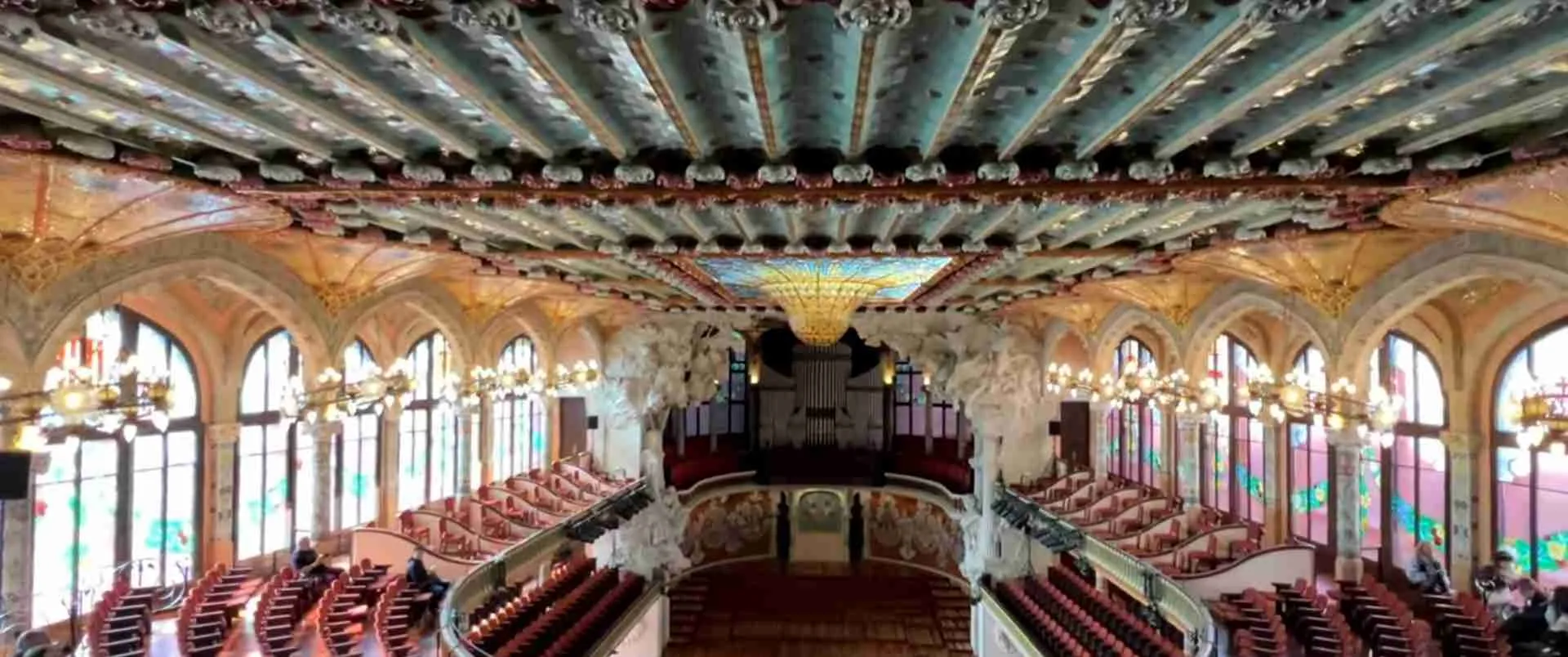
Palau de la Música Catalana received UNESCO recognition alongside Hospital de Sant Pau in 2022, validating Domènech i Montaner’s masterwork as exceptional example of Modernisme’s integration of architecture, sculpture, decorative arts, and music in service of Catalan cultural identity. The building functioned as home for Orfeó Català choral society, embodying how Modernisme architects created spaces for working and middle-class cultural participation rather than exclusively elite patronage. The interior concert hall achieves Modernisme’s most spectacular space through the enormous stained glass skylight, sculptural muses emerging from walls, floral motifs, and complete decorative integration creating immersive artistic environment enhancing musical performance through visual splendor.
The UNESCO criteria emphasize the building’s architectural innovation particularly in structural solutions allowing the unprecedented skylight illuminating the concert hall and the exterior facade’s sculptural integration on a constrained narrow street site. Domènech i Montaner collaborated with sculptor Miquel Blay, ceramicist Antoni Rigalt, and other artisans creating unified artistic program where architecture, sculpture, ceramics, and glass work in concert (literally and metaphorically). The building’s continued function hosting 300+ concerts annually demonstrates living heritage rather than museum preservation, satisfying UNESCO preferences for properties maintaining original purposes. The designation recognizes Palau de la Música Catalana as masterpiece of human creative genius and outstanding example of technological and artistic achievement during Modernisme’s peak period.
Extended multi-day tours – 5+ days
Featured Barcelona Multi-Day Tour Packages
2 days
Montserrat, Girona and Costa Brava in 2 days from Barcelona
- ✓ Comprehensive Barcelona tour
- ✓ Expert local guides included
- ✓ All accommodation arranged
- ✓ Transportation provided

5 days
Best of Catalonia, Self-drive
- ✓ Comprehensive Barcelona tour
- ✓ Expert local guides included
- ✓ All accommodation arranged
- ✓ Transportation provided

7 days
Lisbon, Madrid and Barcelona
- ✓ Comprehensive Barcelona tour
- ✓ Expert local guides included
- ✓ All accommodation arranged
- ✓ Transportation provided
5 days
Trip to Barcelona in 5 Days
- ✓ Comprehensive Barcelona tour
- ✓ Expert local guides included
- ✓ All accommodation arranged
- ✓ Transportation provided
Multi-day tour packages powered by TourRadar. Prices and availability subject to change.
Works of Antoni Gaudí (UNESCO Serial Inscription)
Park Güell (1900-1914) demonstrates Gaudí’s mature style through organic forms, innovative structural solutions, and integration of architecture with landscape. The park originated as garden city project where industrialist Eusebi Güell commissioned Gaudí to design an exclusive residential development combining English garden city ideals with Mediterranean landscape and Catalan cultural identity markers. The commercial failure (only two houses sold) paradoxically preserved Gaudí’s comprehensive vision when Barcelona converted the property to public park. The monumental entrance stairway features the famous mosaic dragon fountain and leads to the hypostyle hall with 86 Doric columns supporting the plaza above through innovative load distribution. The serpentine bench encircling the plaza demonstrates trencadís mosaic technique creating continuous seating and balustrade while providing drainage and spectacular city views.
The viaducts throughout the park demonstrate Gaudí’s ability to integrate infrastructure with artistic expression and natural landscape. The inclined columns supporting walkways lean at angles following force lines, creating structurally efficient supports that appear organic rather than engineered. The rough stone columns seem to grow from the hillside, blurring boundaries between built and natural elements. This integration of architecture with natural forms anticipated ecological design and biomimetic approaches by nearly a century. The park represents Gaudí’s comprehensive vision where every element—from grand architectural gestures to smallest decorative details—serves unified artistic and philosophical program celebrating nature, Catalan identity, and spiritual values through built form.
Palau Güell (1886-1890) represents Gaudí’s early masterwork demonstrating his emerging style while working within urban constraints on a narrow Gothic Quarter site. The building functioned as Barcelona townhouse for patron Eusebi Güell, requiring Gaudí to create impressive social spaces, private family quarters, and service areas within limited footprint. The innovative parabolic arch portal allowed carriage entry while creating distinctive facade presence. The central hall rises through multiple floors topped by a dome with small openings creating starlight effects, demonstrating how Gaudí manipulated space and light dramatically within constrained conditions. The rooftop chimneys preview the sculptural treatments Gaudí would develop more fully in later works, transforming utilitarian ventilation elements into artistic forms covered with ceramic mosaics.
The building’s UNESCO designation emphasizes its position in Gaudí’s stylistic development, showing how he absorbed Gothic revival, Islamic, and early Modernisme influences while developing his distinctive approach. The interior decorations including carved wood ceilings, wrought iron work, and built-in furniture demonstrate Gaudí’s attention to total environment design. The parabolic arch throughout the building—portals, windows, structural elements—shows Gaudí’s early exploration of this geometric form he would employ increasingly throughout his career. The building represents important transitional work where Gaudí moved beyond eclectic historicism toward the organic, nature-inspired forms characterizing his mature style.
Casa Milà (La Pedrera, 1906-1912) demonstrates Gaudí’s fully developed mature style through its undulating stone facade, complete absence of load-bearing walls, rooftop sculptural chimneys, and innovative structural system. The building’s nickname “La Pedrera” (The Stone Quarry) reflects initial public reactions to its rough, organic facade contrasting sharply with Eixample’s typical flat surfaces and geometric regularity. The building employs reinforced concrete columns and floor slabs throughout, freeing the facade from structural requirements and allowing the sinuous curves and balconies that characterize its appearance. This structural innovation anticipated modern architecture’s separation of structure and facade while creating distinctive aesthetic effects impossible with traditional load-bearing walls.
The rooftop terrace features sculptural chimney groupings that Gaudí transformed from utilitarian elements into artistic forms suggesting warriors, creating one of Barcelona’s most iconic architectural experiences. The attic space employs catenary arches forming a rhythmic sequence sometimes called the “whale belly” due to its organic, skeletal quality. The building housed luxury apartments demonstrating how Gaudí’s radical aesthetic could accommodate bourgeois domestic requirements including servants’ quarters, storage, and modern amenities. The UNESCO designation emphasizes Casa Milà’s structural innovations, organic integration of form and function, and position as mature expression of Gaudí’s architectural philosophy before his complete focus on Sagrada Família construction.
Casa Vicens (1883-1885) represents Gaudí’s first major commission, revealing his early style before developing the organic forms of his mature period. The building combines Islamic-influenced ceramic tile decoration with Gothic structural elements and innovative spatial planning for the Vicens family’s summer residence in what was then semi-rural Gràcia. The checkerboard brick and green ceramic tile exterior creates striking visual effects, while interior ceilings feature elaborate Mudéjar-inspired decorative painting. The building shows young Gaudí absorbing diverse influences—Islamic architecture from Spain’s Moorish heritage, Gothic revival popular among Modernisme architects, and Japanese design elements then fashionable in European arts.
The garden originally included a waterfall and fountain demonstrating Gaudí’s attention to landscape integration, though subsequent urban development eliminated most outdoor spaces. The palm leaf ceiling decorations in the smoking room demonstrate meticulous attention to decorative detail characteristic of Gaudí’s complete design approach. The building’s 2005 addition to UNESCO listing (converted to museum after lengthy restoration) demonstrates how early works illuminate artistic development leading to mature masterpieces. Casa Vicens shows Gaudí’s exceptional talent already evident at age 31 while revealing how he absorbed and transformed diverse influences into distinctive architectural language he would develop throughout his career.
Casa Batlló (1904-1906) represents Gaudí’s transformation of an existing building into one of his most celebrated works through facade remodeling and interior reconstruction. The building’s undulating facade with skeletal balconies, scaly roof suggesting dragon’s back, and polychrome ceramic decoration creates fantastical appearance earning the nickname “House of Bones.” The interpretation as Saint George slaying the dragon connects the building to Catalan patron saint mythology—the roof represents the dragon’s back, the tower topped with cross symbolizes the saint’s lance, and the balconies suggest bones of dragon’s victims. This narrative program demonstrates how Gaudí embedded Catalan cultural references within architectural forms.
The building’s interior features demonstrate Gaudí’s attention to functional requirements alongside artistic ambition. The light well uses graduated ceramic tiles from deep blue at top to lighter shades descending, creating even light distribution throughout the building. The organic door and window frames, carved wood details, and custom furniture integrate decorative and functional elements seamlessly. The flowing interior spaces and curved walls eliminate right angles, creating fluid spatial experiences contrasting with traditional rectilinear rooms. The building functioned as private residence until conversion to museum, demonstrating how Gaudí’s radical aesthetic accommodated actual domestic living rather than existing purely as artistic statement.
Sagrada Família’s Nativity Facade and Crypt received UNESCO designation in 2005 recognizing the portions completed under Gaudí’s direction while the basilica’s interior and Glory Facade continued construction. The nativity facade (1894-1930) demonstrates Gaudí’s organic architectural approach through naturalistic sculptural programs, innovative structural solutions, and spiritual symbolism embedded in every architectural element. The three portals dedicated to Faith, Hope, and Charity feature elaborate sculptural narratives depicting Christ’s birth and childhood through hundreds of figures, plants, and animals cast from life creating unprecedented naturalistic detail. The four towers topped with colorful mosaic-covered finials rise 100+ meters, creating distinctive Barcelona skyline elements while housing bells and serving as metaphorical fingers pointing toward heaven.
The UNESCO designation criteria emphasize the nativity facade’s exceptional artistic achievement and Gaudí’s radical innovations in merging Gothic structural principles with organic natural forms and modern construction technologies. The facade represents Gaudí’s mature style where architecture, sculpture, and symbolism unite in comprehensive artistic program. The crypt demonstrates Gaudí’s early involvement with the project, showing his development from Gothic revival starting point toward the increasingly organic approach of later work. The basilica’s continued construction according to Gaudí’s designs and models makes it unique among UNESCO properties—a living work rather than completed historical monument, though debate continues about whether post-Gaudí construction authentically represents his vision or constitutes well-intentioned interpretation.
Colònia Güell Crypt represents Gaudí’s most radical structural experimentation through his famous hanging chain models determining optimal load-bearing forms. Patron Eusebi Güell commissioned a complete industrial village including church for his textile workers outside Barcelona. Gaudí designed an ambitious church with multiple levels, but only completed the lower crypt (1898-1914) before project abandonment. The crypt employs inclined columns, hyperbolic arches, and irregular forms following force lines determined by the hanging model experiments. The structure represents pure engineering rationality expressed through organic forms appearing random but precisely calculated to optimize structural efficiency.
The crypt’s rough materials—brick, stone, recycled ceramic fragments in trencadís decoration—create rustic aesthetic contrasting with refined urban works like Casa Batlló. The intimate scale and irregular forms create mystical, cave-like atmosphere appropriate for spiritual space. The UNESCO designation emphasizes the crypt’s exceptional demonstration of structural innovation and its position as laboratory for techniques Gaudí would employ in Sagrada Família. The hanging chain model methodology—inverting catenary curves to find compression-only structural forms—anticipated computational design approaches by nearly a century. The crypt demonstrates how Gaudí’s intuitive geometric understanding and experimental methods achieved results that would require sophisticated computer modeling using contemporary techniques.
Palau de la Música Catalana: Domènech i Montaner’s Masterpiece
Palau de la Música Catalana (1905-1908) demonstrates Lluís Domènech i Montaner’s genius through the integration of architecture, sculpture, ceramics, mosaics, stained glass, and ironwork creating Barcelona’s most spectacular Modernisme interior. The building served as home for the Orfeó Català choral society, founded to promote Catalan language and culture during the Renaixença cultural renaissance. Domènech i Montaner designed both functional concert hall and symbolic temple to Catalan musical traditions. The building’s constrained site on narrow Carrer Palau de la Música required ingenious spatial planning maximizing interior volume while creating impressive street presence through elaborate facade sculpture.
The exterior facade features sculptural group by Miquel Blay depicting allegory of Catalan popular song with figures representing musicians emerging from architectural frame topped by Saint George slaying the dragon. The exposed brick, ceramic decorations, and ironwork demonstrate Modernisme’s celebration of materials and craft traditions. The corner tower creates vertical accent on the compressed site, while the facade’s transparency through extensive glazing reveals interior activities to street level, democratizing access to cultural experience. The building expressed Modernisme’s social idealism—creating spaces for working and middle-class cultural participation rather than exclusively elite venues.
The interior concert hall achieves Modernisme’s supreme spatial triumph through the enormous stained glass skylight dominating the ceiling, creating natural illumination that transforms throughout the day. The skylight’s inverted dome form in amber, red, and blue glass creates the impression of sun radiating light downward. The Muses emerge from walls as three-dimensional sculptures framing the stage, while the organ pipes integrate into decorative scheme. The proscenium arch features bust of Beethoven alongside representations of Valkyries from Wagner’s Ring Cycle, connecting Catalan musical traditions to broader European classical music heritage. The floral motifs covering columns, balustrades, and decorative elements create comprehensive organic program where every surface receives artistic attention.
The hall’s acoustics demonstrate how Domènech i Montaner integrated functional requirements with artistic ambition—the organic decorations and varied surface treatments contribute to sound dispersion and acoustic quality rather than existing purely as decoration. The building continues its original function hosting over 300 concerts annually from classical to jazz to world music, demonstrating successful integration of exceptional architectural quality with practical performance venue requirements. The UNESCO designation recognizes the Palau as masterpiece of human creative genius and outstanding example of Modernisme’s integration of multiple artistic disciplines in unified architectural program serving social and cultural purposes beyond pure aesthetic display.
Hospital de Sant Pau: Healing Through Beauty
Hospital de Sant Pau (1902-1930) represents Lluís Domènech i Montaner’s most ambitious work and Modernisme’s largest architectural complex, demonstrating revolutionary approach to healthcare architecture through pavilion layout, extensive gardens, artistic decoration, and emphasis on light, air, and beauty as therapeutic elements. Banker Pau Gil bequeathed his fortune specifically to build a modern hospital for Barcelona’s working-class residents, enabling Domènech i Montaner to create comprehensive vision unconstrained by normal budget limitations. The architect positioned 27 separate pavilions for different medical specialties within landscaped grounds, believing that separation prevented disease transmission while gardens and beauty promoted patient wellbeing.
The main administration building features elaborate exterior decoration including ceramic sculptures, mosaics, and architectural ornament celebrating health, science, and Catalan identity. The clock tower creates vertical landmark visible across Barcelona, while the interior spaces include reception hall with carved wood ceilings, stained glass windows, and ceramic tile decoration creating impressive public spaces. Each pavilion received distinctive decorative programs—surgical pavilions featured imagery of Saint Cosmas and Damian (patron saints of surgery), maternity pavilions celebrated motherhood, children’s wards displayed playful decorations. This comprehensive artistic program created healing environments through beauty rather than institutional sterility.
The underground tunnel system connecting pavilions demonstrates technical innovation allowing material and patient transport while maintaining surface-level gardens and pleasant circulation paths. The tunnels themselves received decorative treatment with ceramic tile walls and stained glass skylights at intervals, showing how Domènech i Montaner extended artistic attention even to utilitarian spaces. The pavilion system and garden landscape created village-like atmosphere within medical complex, humanizing healthcare delivery at unprecedented scale. The complex operated continuously as working hospital from 1930 until 2009, proving that exceptional architecture could accommodate evolving medical practices across 80 years of technological and treatment advances.
The UNESCO designation emphasizes Hospital de Sant Pau’s outstanding universal value through multiple criteria: masterpiece of human creative genius, exceptional architectural and artistic achievement, testimony to cultural tradition emphasizing social welfare and humanitarian values, and outstanding example of technological innovation in healthcare architecture. The designation recognizes both Domènech i Montaner’s individual genius and the hospital’s representation of Modernisme’s social idealism—wealthy patronage funding beautiful public institutions serving broader society rather than private luxury. The complex restoration following hospital relocation converted pavilions to cultural and educational uses while preserving architectural heritage, demonstrating successful adaptive reuse of exceptional architectural properties.
UNESCO Designation Criteria and Significance
Barcelona’s UNESCO properties satisfy multiple criteria from the ten possible designation standards, particularly emphasizing: (i) representing masterpiece of human creative genius; (ii) exhibiting important interchange of human values over span of time regarding developments in architecture or technology; and (iv) being outstanding example of architectural ensemble illustrating significant stage in human history. Gaudí’s works particularly satisfy criterion (i) through radical structural innovations, nature-inspired organic forms, and integration of artistic and engineering achievement. Domènech i Montaner’s buildings emphasize criteria (ii) and (iv) through demonstrating how architecture responded to industrialization’s social challenges and expressing cultural values through artistic programs.
The Outstanding Universal Value statements justify inscription through demonstrating how Barcelona’s Modernisme properties represent exceptional architectural achievement with significance extending beyond local or national contexts to matter for all humanity. The UNESCO committee emphasized how these buildings solved 19th-century challenges regarding urbanization, industrialization, and cultural identity through architectural innovation that influenced subsequent developments worldwide. The organic architecture and biomimetic approaches pioneered by Gaudí anticipated contemporary sustainable design and parametric architecture. The social welfare institutions by Domènech i Montaner demonstrated how architecture could serve humanitarian purposes while achieving exceptional artistic quality.
The serial inscription approach for Gaudí’s works recognizes that individual buildings gain fuller meaning when understood within the architect’s complete stylistic development and broader Modernisme movement. The seven buildings span Gaudí’s career from early Islamic-influenced Casa Vicens through mature organic style in Park Güell and Casa Milà to final spiritual synthesis in Sagrada Família. This chronological sequence demonstrates artistic evolution while each building maintains individual exceptional character justifying separate attention. The serial approach also acknowledges practical conservation realities—different buildings have different ownership, management structures, and conservation challenges despite their common authorship and cultural significance.
Conservation Challenges and Heritage Management
Barcelona’s UNESCO properties face conservation challenges balancing heritage preservation with continued use, tourist pressures, urban development, and climate change impacts. Sagrada Família’s ongoing construction raises philosophical questions about authenticity—whether completing Gaudí’s designs using contemporary materials and techniques constitutes faithful continuation or creative interpretation. The basilica’s massive tourist visitation (3+ million annually pre-pandemic) creates crowd management challenges and physical wear on materials while generating revenue supporting construction and conservation. The balance between access and preservation remains ongoing challenge for all Barcelona UNESCO properties receiving intensive tourist interest.
Casa Milà’s conversion from residential building to museum and cultural center demonstrates adaptation challenges when original residential function becomes incompatible with heritage tourism demands. The building maintains some residential apartments while dedicating portions to museum displays, creating hybrid use attempting to preserve living heritage character. Park Güell similarly struggles balancing public access and heritage protection, implementing entrance fees and visitor limits after unrestricted access caused deterioration and overcrowding. These management decisions spark debates about whether limiting access contradicts public heritage ideals or necessary protects irreplaceable architectural properties for future generations.
Climate change creates increasing challenges through stronger storms, temperature fluctuations, and humidity changes affecting building materials. Gaudí’s trencadís mosaics and stone carvings face erosion from pollution and weather exposure. Domènech i Montaner’s ceramic decorations and stained glass require careful monitoring for thermal stress and structural movement. The extensive use of iron structural elements throughout Modernisme buildings creates rust and corrosion concerns requiring preventive conservation. These technical conservation challenges demand sophisticated interventions using contemporary materials science while respecting historical authenticity and original construction techniques.
Educational and Cultural Impact
Barcelona’s UNESCO properties function as educational resources demonstrating architectural history, structural innovation, artistic integration, and social idealism to millions of visitors annually. The buildings serve architecture students, scholars, and practitioners as primary sources for understanding Modernisme’s technical and artistic achievements. The Sagrada Família workshops provide training in traditional stonecarving and sculptural techniques, maintaining craft knowledge essential for heritage conservation. The buildings inspire contemporary architects exploring organic forms, sustainable design, and integration of architecture with natural systems, demonstrating how historical heritage remains relevant to current design challenges.
The cultural impact extends beyond architectural education to broader questions about identity, cultural heritage, and social values. The buildings embody Catalan cultural identity claims and provide tangible symbols for political debates about autonomy and self-determination. The Palau de la Música Catalana’s role in preserving Catalan language and musical traditions during repressive periods makes it cultural resistance symbol alongside architectural monument. Hospital de Sant Pau represents idealistic belief in architecture’s social purpose and humanitarian responsibility. These cultural meanings transcend purely aesthetic appreciation, embedding the buildings within living cultural and political contexts rather than simply historical preservation.
The UNESCO designations validate Catalan architectural heritage within global cultural frameworks, providing international recognition that supports conservation funding, tourism development, and cultural prestige. The properties contribute substantially to Barcelona’s tourism economy while creating heritage management responsibilities and costs. The economic benefits and conservation burdens distribute unevenly across stakeholders—tourism industries profit while residential communities absorb negative impacts from crowds and noise. Managing these complex relationships among preservation, access, economic development, and community wellbeing remains ongoing challenge for Barcelona’s heritage authorities and UNESCO monitoring processes.
Comparative Context: Modernisme and Art Nouveau
Barcelona’s UNESCO properties gain fuller significance through comparison with related Art Nouveau movements across Europe including French Art Nouveau, Austrian Secession, Belgian works by Victor Horta and Henry van de Velde, and Glasgow School led by Charles Rennie Mackintosh. These parallel movements shared rejection of historical eclecticism, embrace of new materials including iron and glass, integration of fine and decorative arts, and organic natural motifs. However, Catalan Modernisme distinguished itself through particular emphasis on Catalan cultural identity, structural innovation beyond decorative application, and social idealism expressed through public institutions like hospitals and concert halls.
Gaudí’s structural innovations particularly distinguish Barcelona’s Modernisme from purely decorative Art Nouveau trends. While French Art Nouveau architects created beautiful organic decorations and spatial experiences, they rarely achieved Gaudí’s integration of structural innovation with organic forms. The Sagrada Família’s hyperboloid columns, Park Güell’s inclined viaducts, and Colònia Güell crypt’s catenary arches demonstrate structural rationality expressed through natural forms rather than applied decoration. This structural emphasis anticipated modern architecture’s concern with honest expression of construction systems while maintaining Modernisme’s organic aesthetic contrary to International Style’s geometric abstraction.
The social dimension of Barcelona’s Modernisme particularly evident in Hospital de Sant Pau and Palau de la Música Catalana contrasts with Art Nouveau’s frequent focus on private luxury residences and commercial establishments. Catalan industrialists including Eusebi Güell and Pau Gil funded public institutions serving working-class populations through exceptional architecture demonstrating belief that beauty and quality should extend beyond elite circles. This democratic impulse, however imperfect its realization, distinguishes Modernisme’s idealistic social dimension from Art Nouveau movements more focused on aesthetic innovation for wealthy patrons. The UNESCO recognition acknowledges this social significance alongside purely architectural achievements.
Frequently Asked Questions About Barcelona UNESCO Heritage
Can you visit all of Barcelona’s UNESCO sites in one day?
Visiting all nine UNESCO properties in a single day is theoretically possible but provides only superficial experience inadequate for appreciating architectural and artistic complexity. Casa Milà, Casa Batlló, and Casa Vicens located in Eixample can be visited in sequence with 1-2 hours each. Palau Güell in Gothic Quarter requires separate visit. Park Güell on Barcelona’s periphery needs 2-3 hours including travel time. Sagrada Família demands minimum 2 hours. Hospital de Sant Pau and Palau de la Música Catalana each merit 2+ hours. Colònia Güell crypt requires train journey to Santa Coloma de Cervelló outside Barcelona. Meaningful UNESCO heritage experience requires minimum 3-4 days with multiple hours at each property for architectural appreciation, contextual understanding, and avoiding exhausting monument marathon.
Which Barcelona UNESCO site should I visit if I can only see one?
Sagrada Família represents Gaudí’s life work and Barcelona’s most iconic building, making it the single most essential UNESCO property for visitors with limited time. The basilica demonstrates Gaudí’s complete architectural philosophy, structural innovation, and spiritual vision through the nativity facade’s organic sculptures, the forest-like interior with hyperboloid columns, and the continuing construction representing living architectural heritage. The scale, ambition, and comprehensive artistic program make Sagrada Família Barcelona’s supreme architectural experience. However, visitors particularly interested in complete Modernisme interiors might prefer Palau de la Música Catalana’s spectacular concert hall, while those drawn to organic residential architecture might choose Casa Batlló’s fantastical rooms and dragon-back roof terrace.
Are all Barcelona UNESCO sites original works or have they been heavily restored?
Barcelona’s UNESCO properties maintain varying degrees of original fabric versus restoration based on individual conservation histories. Sagrada Família represents ongoing construction with nativity facade preserving Gaudí’s original work while Glory Facade and interior spaces continue construction following his designs. Casa Milà and Casa Batlló underwent restorations removing previous modifications and restoring original decorative schemes—some elements are original, others carefully reconstructed based on historical evidence. Park Güell’s architecture remains substantially original though weathering requires ongoing conservation and some trencadís mosaics have been restored. Casa Vicens underwent major restoration converting it from private residence to museum, reconstructing lost elements based on historical documentation. Hospital de Sant Pau’s restoration following hospital relocation involved structural reinforcement and decorative conservation while maintaining original architectural character. The balance between preservation and necessary intervention represents ongoing conservation challenge evaluated differently for each property.
Why isn’t Sagrada Família’s interior included in the UNESCO designation?
The Sagrada Família UNESCO inscription (2005) included only the nativity facade and crypt—portions completed under Gaudí’s direct supervision before his 1926 death. The interior spaces and Glory Facade continued construction based on Gaudí’s plans, models, and drawings interpreted by subsequent architects. UNESCO typically designates completed works with established historical significance rather than ongoing construction projects with uncertain authenticity questions. The interior’s completion in 2010 and papal consecration as basilica established the spaces as functional architectural achievement, potentially qualifying for future UNESCO expansion. However, debates continue about whether contemporary construction authentically represents Gaudí’s vision or constitutes creative interpretation by well-intentioned collaborators working from incomplete information. The designation likely awaits resolution of these authenticity questions and demonstration of long-term stability and significance.
What makes Domènech i Montaner’s buildings as significant as Gaudí’s works?
Lluís Domènech i Montaner’s inclusion in UNESCO listings (2022 for Hospital de Sant Pau and Palau de la Música Catalana) recognizes his exceptional contributions to Modernisme independent of Gaudí’s fame. Domènech i Montaner served as Modernisme’s organizational leader, professor at Barcelona architecture school, and prolific architect completing more buildings than Gaudí during his career. His work demonstrates alternative Modernisme approach emphasizing Islamic-influenced decoration, structural rationalism expressed through exposed materials, and comprehensive integration of sculpture, ceramics, and mosaics. Hospital de Sant Pau represents architecture’s largest Modernisme complex and revolutionary healthcare design. Palau de la Música Catalana achieves Modernisme’s most spectacular interior through unprecedented integration of multiple artistic disciplines. The UNESCO recognition acknowledges Modernisme as collective movement with multiple significant contributors beyond single genius narrative.
Can you take photos inside Barcelona’s UNESCO sites?
Photography policies vary among Barcelona’s UNESCO properties based on ownership, management, and conservation concerns. Sagrada Família allows personal photography without flash or tripods in most areas though some chapels restrict photography. Casa Batlló, Casa Milà, and Casa Vicens permit personal photography following similar no-flash, no-tripod rules. Palau de la Música Catalana restricts photography during concerts but allows it during guided tours. Park Güell allows photography throughout public areas. Commercial photography and filming require advance permission and may incur fees at all sites. The policies balance visitor experience and social media promotion against conservation concerns including light damage to sensitive materials and crowd management challenges when visitors stop for extended photography sessions blocking circulation.
How does Barcelona’s UNESCO concentration compare globally?
Barcelona’s nine UNESCO properties within a single city represents exceptional concentration, though several cities worldwide claim higher numbers. Rome leads with numerous properties across ancient, medieval, Renaissance, and Baroque periods. Paris includes banks of Seine with multiple monuments plus Versailles nearby. Venice entire city center holds UNESCO designation. However, Barcelona’s concentration focusing on single architectural movement within brief historical period (1883-1930) creates unusual coherence. The properties demonstrate unified cultural phenomenon—Catalan Modernisme responding to specific historical circumstances—rather than accumulating diverse monuments across centuries. This thematic unity makes Barcelona’s UNESCO heritage particularly suitable for understanding complete artistic movement through actual buildings rather than merely collecting famous monuments from disparate periods and styles.
Are Barcelona’s UNESCO sites wheelchair accessible?
Accessibility varies significantly among Barcelona’s UNESCO properties due to historical architecture predating accessibility requirements and conservation restrictions limiting modifications. Sagrada Família provides elevator access to towers and generally accessible ground-level areas. Hospital de Sant Pau offers flat pathways between pavilions and accessible building entrances. Park Güell’s hillside topography creates accessibility challenges despite some adapted pathways. Casa Milà provides elevator access to apartments and rooftop. Casa Batlló, Casa Vicens, and Palau Güell have limited accessibility due to historic stairs and narrow passages. Palau de la Música Catalana offers assisted access but with limitations in some areas. Colònia Güell crypt involves stairs and uneven surfaces creating accessibility barriers. Visitors with mobility requirements should research specific properties and contact ahead regarding accessibility provisions and available assistance.
What threats face Barcelona’s UNESCO heritage properties?
Barcelona’s UNESCO properties face multiple conservation threats requiring ongoing management and intervention. Tourism pressure creates physical wear on materials, crowd management challenges, and vandalism risks while generating revenue supporting conservation. Climate change accelerates weathering through stronger storms, temperature fluctuations, and pollution impacts on stone, ceramic, and iron elements. Urban development pressures surrounding properties create visual impacts and potential structural stresses. Pollution from traffic and industry damages materials particularly affecting Gaudí’s exposed stone carvings and trencadís mosaics. Sagrada Família faces ongoing construction challenges balancing ambitious completion timeline with conservation requirements. The balancing act between access, preservation, economic sustainability, and heritage protection requires sophisticated management combining technical conservation, visitor management, financial planning, and stakeholder coordination.
How do Barcelona residents view the UNESCO properties?
Barcelona residents maintain complex relationships with UNESCO properties balancing pride in architectural heritage against tourism frustrations and daily life impacts. The buildings embody Catalan identity and cultural achievement generating genuine local pride and political significance during autonomy debates. However, tourism concentration around UNESCO sites creates neighborhood disruptions including noise, crowds, property speculation, and displacement of traditional businesses by tourist-oriented commerce. Some residents feel UNESCO designation prioritizes tourist attraction over living city functions and community needs. Younger Catalans particularly question whether heritage conservation and tourism promotion overshadow contemporary urban challenges including housing costs, gentrification, and quality of life. These tensions reflect broader issues facing historic cities worldwide where heritage tourism brings economic benefits alongside social and environmental costs distributed unevenly across stakeholders.