Bamberg Old Town: UNESCO Medieval Gem Guide
Key Takeaways
- Bamberg preserves one of Europe’s most intact medieval urban centers, with architectural heritage spanning Romanesque, Gothic, Renaissance, and Baroque periods across more than 1,000 protected buildings
- The city’s unique topography of seven hills created distinct urban districts: the episcopal “Berg” (mountain) city housing religious and political power, and the burgher “Insel” (island) city serving as commercial center
- The Imperial Cathedral houses the Bamberg Rider, medieval Germany’s most famous equestrian sculpture, alongside the tomb of Pope Clement II, the only papal burial north of the Alps
- UNESCO recognition in 1993 acknowledged Bamberg as an exceptional example of medieval urban planning that illustrates the transition from ecclesiastical to secular power structures
- The Old Town Hall, constructed on an artificial island in the Regnitz River, symbolizes the negotiated relationship between prince-bishops and burghers that shaped Bamberg’s development
- Bamberg’s architectural ensemble demonstrates how a medieval imperial residence evolved into a baroque prince-bishopric without sacrificing its historical layers through centuries of continuous occupation
Introduction: The Seven-Hill Medieval Marvel
Bamberg Old Town rises across seven hills above the Regnitz River in northern Bavaria, creating an architectural panorama that rivals Rome in topographic drama and surpasses most European cities in historical authenticity. This remarkably preserved medieval urban complex demonstrates how ecclesiastical and secular powers shaped urban development across eight centuries, creating architectural layers that document the evolution from imperial residence through prince-bishopric to modern cultural center. The city’s exceptional state of preservation reflects fortunate historical circumstances that spared Bamberg from wartime destruction while economic conditions delayed modernization that transformed other German cities.
Founded in the 10th century and elevated to bishopric status in 1007 by Emperor Henry II, Bamberg served as a crucial center of imperial power during the Holy Roman Empire’s peak influence. Henry’s vision transformed a modest castle settlement into a major ecclesiastical and political center, deliberately modeled on Rome’s seven hills. This conscious imitation established Bamberg’s identity as a “second Rome,” though the city developed distinctive character reflecting German imperial traditions rather than simply copying Italian precedents. The donation of the imperial palace to establish the bishopric created the foundation for Bamberg’s dual urban structure that persists today.
The UNESCO World Heritage designation, awarded in 1993, recognizes Bamberg as an outstanding example of medieval European urban planning where topography, architecture, and social structure integrated into a coherent urban organism. The historic center encompasses approximately 140 hectares containing over 1,200 protected monuments, creating one of Germany’s largest preservation zones. This exceptional concentration of historic architecture spans seven centuries of continuous development, documenting shifts in architectural style, building technology, and urban function while maintaining remarkable spatial coherence.
Bamberg’s topography fundamentally shaped urban development, creating natural divisions between power centers. The cathedral district crowns the highest hill, establishing visual and symbolic dominance. The Island City (Inselstadt) occupies the river valley, serving as commercial heart with market squares, merchant houses, and guildhalls. The Market Gardener’s District (Gärtnerstadt) extends across lower hills, preserving a unique urban agricultural landscape where houses combine living quarters with productive gardens. These distinct districts, each with characteristic architecture and social functions, interlock to create the complete urban system recognized by UNESCO.
The architectural ensemble demonstrates extraordinary stylistic diversity unified through consistent urban planning principles. Romanesque foundations support Gothic churches; medieval street patterns accommodate baroque palaces; rococo decoration enhances renaissance structures. This layering reflects Bamberg’s continuous importance across changing political circumstances, as successive rulers invested in building campaigns that enhanced rather than replaced existing architecture. The result presents a comprehensive architectural history where buildings from different periods coexist harmoniously, creating visual richness while documenting cultural evolution.
People Also Ask About Bamberg Old Town Medieval Heritage
Why is Bamberg called the city of seven hills?
Emperor Henry II deliberately established Bamberg on seven hills to create symbolic parallels with Rome, emphasizing the city’s intended role as a northern ecclesiastical center rivaling the papacy’s southern capital. The seven hills—Cathedral Hill (Domberg), Michaelsberg, Kaulberg, Stephansberg, Jakobsberg, Altenburger Berg, and Abtsberg—provided natural defensive positions while creating dramatic topographic variety that shaped urban development. Each hill developed distinctive character determined by its elevation and purpose: Cathedral Hill housed religious and political authority; Michaelsberg supported monastic communities; other hills accommodated residential districts and fortifications. The topography forced creative urban planning solutions, including terraced streets, hillside gardens, and connecting staircases that contribute to Bamberg’s exceptional townscape character.
The seven-hill concept proved more than symbolic imitation. The elevated positions provided strategic military advantages during medieval conflicts, with each hill potentially defended independently. The varied topography created microclimates supporting specialized agriculture, particularly the hillside viticulture that flourished until the 19th century. The necessity of building across challenging terrain encouraged architectural innovation and created the distinctive spatial relationships between upper and lower city districts that define Bamberg’s urban character. Modern visitors experience this topographic complexity through dramatic viewpoints, surprising vistas, and the physical effort required to navigate between urban districts, creating memorable spatial experiences impossible in flat cities.
What makes the Bamberg Rider sculpture historically significant?
The Bamberg Rider (Bamberger Reiter), located in the Imperial Cathedral, represents medieval Germany’s most famous and enigmatic equestrian sculpture. Created around 1225-1230, this limestone masterpiece depicts an idealized mounted figure embodying chivalric virtue and royal authority. The sculpture’s identity remains debated among scholars, with proposed identifications including Emperor Conrad III, King Stephen of Hungary, various saints, or an allegorical representation of ideal Christian kingship. The figure’s youthful appearance, noble bearing, and calm authority communicate idealized medieval concepts of righteous rulership combining spiritual and temporal power.
The artistic significance extends beyond identity questions to encompass technical achievement and cultural influence. The sculptor created an unprecedented synthesis of classical Roman equestrian monuments with medieval Christian iconography, producing work that influenced German sculpture for centuries. The naturalistic treatment of horse and rider, unusual in Gothic sculpture, suggests direct study of ancient Roman models while adapting classical forms to express medieval Christian values. The placement within the cathedral, prominently positioned near the choir, emphasizes connections between earthly and divine authority central to medieval political theology. The Rider’s serene confidence and physical perfection present monarchy as divinely ordained institution embodying moral and spiritual ideals alongside political power.
How does Bamberg’s Old Town Hall demonstrate medieval urban politics?
The Old Town Hall (Altes Rathaus), constructed on an artificial island in the Regnitz River, embodies the complex relationship between episcopal and burgher authority that shaped Bamberg’s development. According to tradition, the prince-bishop refused to grant land for a town hall, prompting resourceful citizens to create their own territory by driving wooden piles into the river and constructing an island. While this dramatic origin story likely oversimplifies historical reality, the building’s unusual location reflects genuine political tensions between religious authorities controlling hilltop territories and merchants seeking autonomous civic spaces.
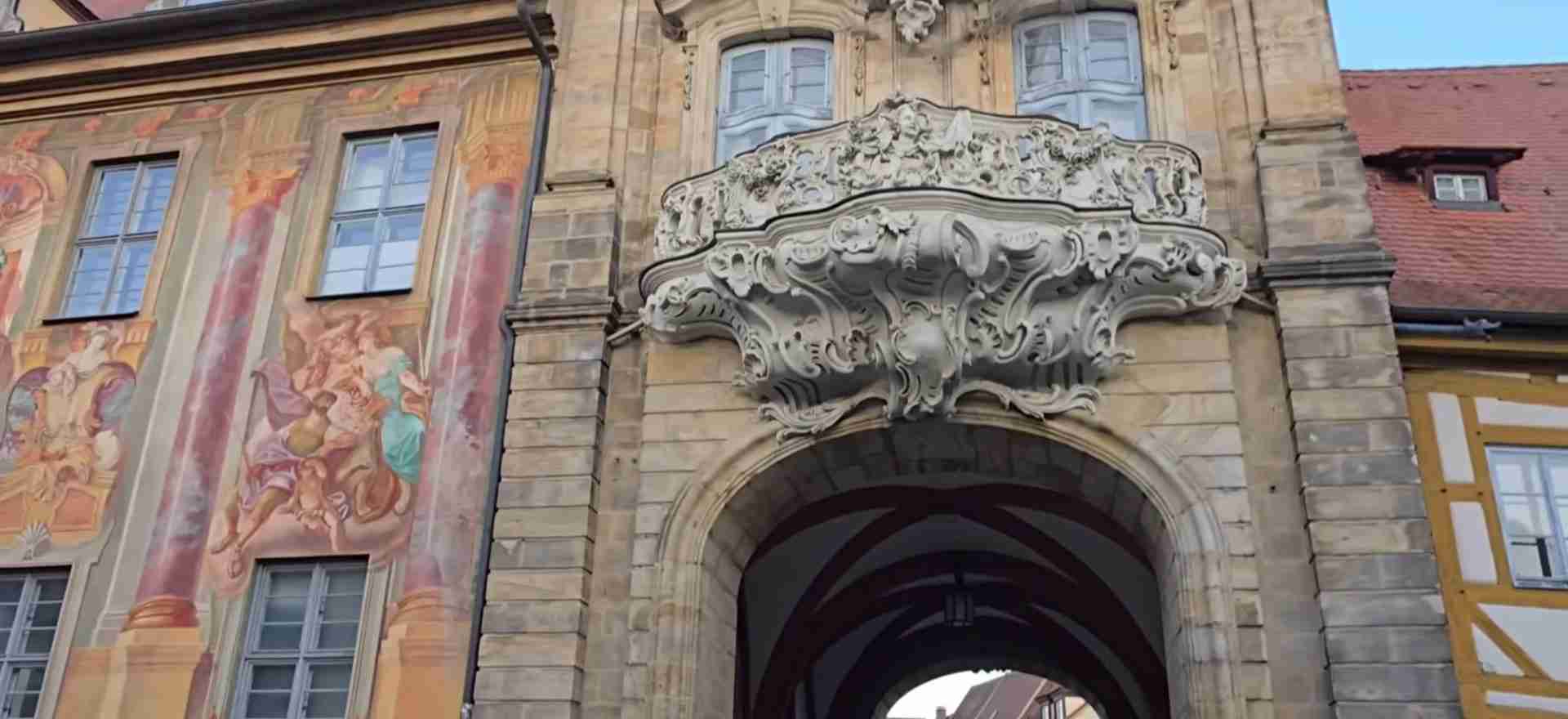
The architectural ensemble combines functional necessity with symbolic assertion of burgher independence. The bridge structure connects the Island City (burgher territory) with the Garden City, positioning the town hall at the junction of commercial districts. The half-timbered upper story, added in the 15th century, extends dramatically over the bridge, maximizing limited space while creating Bamberg’s most photographed architectural feature. The baroque frescoes covering exterior walls (added 1744-1756) transform the building into a spectacular visual statement, demonstrating civic pride and economic prosperity rivaling episcopal splendor. The interior rococo hall, with elaborate stucco decoration and ceiling frescoes, provides ceremonial spaces befitting civic authority. The building thus communicates multiple messages: practical necessity creating usable space where land grants failed; political assertion of burgher rights against episcopal control; artistic achievement demonstrating cultural sophistication; and economic success funding lavish decoration.
What architectural periods are represented in Bamberg’s buildings?
Bamberg’s architectural heritage spans Romanesque origins through baroque culmination, creating a comprehensive survey of European architectural development across seven centuries. Romanesque foundations appear in the Cathedral’s eastern choir (11th century) and crypts, establishing massive masonry traditions. Gothic development transformed ecclesiastical architecture with pointed arches, ribbed vaults, and vertical emphasis visible in the Cathedral’s western choir, St. Martin’s Church, and Dominican Church. Renaissance influences appear more subtly, primarily in decorative details and palace renovations rather than complete buildings.
The baroque period brought Bamberg’s most extensive building campaign, as prince-bishops employed leading architects to transform the city into a spectacular princely residence. Balthasar Neumann and the Dientzenhofer family created masterpieces including the New Residence, St. Martin’s Church completion, and numerous palaces. Baroque architects worked within medieval street patterns, creating dramatic facades and interior spaces while respecting existing urban structure. This approach preserved medieval spatial relationships while updating visual vocabulary. Rococo refinements added elaborate interior decorations, particularly in churches and palace state rooms, representing the final flowering of baroque artistic traditions. The 19th century brought relatively modest additions, with Bamberg spared the aggressive historicism that transformed other German cities. This architectural continuity creates exceptional opportunities for understanding how styles evolved and coexisted within consistent urban frameworks.
Extended multi-day tours – 5+ days
Featured Bamberg Multi-Day Tour Packages
3 days
Bamberg 3-Day Discovery Tour
- ✓ Comprehensive Bamberg experience
- ✓ Expert local guides included
- ✓ All accommodation included
- ✓ Transportation provided
5 days
Bamberg 5-Day Highlights Experience
- ✓ Comprehensive Bamberg experience
- ✓ Expert local guides included
- ✓ All accommodation included
- ✓ Transportation provided
7 days
Bamberg 7-Day Cultural Journey
- ✓ Comprehensive Bamberg experience
- ✓ Expert local guides included
- ✓ All accommodation included
- ✓ Transportation provided

10 days
Bamberg 10-Day Complete Adventure
- ✓ Comprehensive Bamberg experience
- ✓ Expert local guides included
- ✓ All accommodation included
- ✓ Transportation provided
Multi-day tour packages powered by TourRadar. Prices and availability subject to change.
Historical Background: From Imperial Foundation to Prince-Bishopric
Bamberg’s history begins with Emperor Henry II’s deliberate act of urban creation in 1007. Henry, the last Saxon emperor, sought to strengthen imperial authority in Franconia while establishing a loyal ecclesiastical territory. The founding charter elevated the existing castle settlement to bishopric status, donating extensive lands and granting exceptional privileges that established Bamberg as a major ecclesiastical principality. Henry’s personal involvement extended to detailed planning, supposedly designing the cathedral layout himself and consciously modeling the city on Rome’s seven-hill topography. This imperial foundation distinguished Bamberg from cities that evolved organically, as deliberate planning shaped development from the beginning.
The Emperor and his wife Kunigunde lavished attention on their foundation, endowing the cathedral with relics, liturgical objects, and land revenues ensuring financial security. Henry’s canonization in 1146 and Kunigunde’s in 1200 transformed Bamberg into a pilgrimage destination, with the imperial couple’s tomb in the Cathedral becoming a focus of devotion. This sacred status enhanced political authority, as the city hosting saintly founders’ relics claimed special spiritual significance. The connection between Bamberg and imperial sanctity persisted through centuries, influencing how successive bishops understood their role as stewards of a sacred imperial legacy.
The cathedral chapter, composed of nobles from leading German families, exercised considerable power alongside bishops. Canon positions provided younger sons of aristocratic families with prestigious ecclesiastical careers without requiring priestly ordination. The chapter controlled significant land holdings, advised bishops on policy, and elected new bishops upon vacancies. This aristocratic character shaped Bamberg’s cultural life, as noble canons maintained sophisticated households, patronized arts, and cultivated political connections linking Bamberg to broader European noble networks. The preserved canonical houses surrounding the cathedral demonstrate the physical manifestation of this ecclesiastical aristocracy.
The 13th century established Bamberg’s administrative and legal structures. The city received imperial privileges granting self-government rights, though ultimate authority remained with the bishop. A city council, composed of wealthy merchants and craftsmen, managed daily administration, regulated commerce, and maintained order. Complex negotiations between episcopal and civic authorities characterized governance, with periodic conflicts over taxation, jurisdiction, and building rights. The Old Town Hall’s construction symbolized these tensions, as burghers asserted autonomy within constraints imposed by episcopal territorial control.
The Reformation created profound challenges for Catholic Bamberg. While neighboring territories adopted Lutheranism, Bamberg’s bishops maintained Catholic orthodoxy, positioning the city as a Counter-Reformation stronghold. This religious commitment shaped 17th and 18th-century development, as baroque church architecture and Jesuit educational institutions reinforced Catholic identity. The witch trials of 1626-1632, among Germany’s most severe, represented a dark manifestation of Counter-Reformation anxieties, with approximately 1,000 victims executed. This tragic episode reflected broader European witch persecution while demonstrating how religious authorities wielded power over life and death.
The baroque period (1650-1750) brought Bamberg’s greatest architectural flowering under ambitious prince-bishops who transformed the medieval city into a spectacular residence. The Schönborn dynasty of bishops proved particularly influential, employing leading architects to create palaces, churches, and gardens rivaling any European court. Lothar Franz von Schönborn (reigned 1693-1729) commissioned the New Residence and rebuilt the Old Court, establishing visual frameworks that subsequent bishops enhanced. The building campaigns required enormous resources, funded through agricultural revenues, brewing monopolies, and taxation that sometimes created tension with subjects bearing the financial burden.
Secularization in 1802 ended Bamberg’s independence as ecclesiastical principality. The territory transferred to Bavaria, fundamentally altering political structures while preserving architectural heritage. The loss of independence brought economic disruption as administrative functions relocated to Munich. However, secularization also prevented the aggressive modernization that transformed many German cities during industrialization. Bamberg remained a provincial town, preserving medieval character through economic stagnation that frustrated contemporary residents but proved fortunate for long-term architectural preservation.
The 19th century brought gradual modernization within historic constraints. Railway connections (1844) integrated Bamberg into Bavaria’s transportation network. Garrison duties, with Bamberg hosting military units, provided economic stability. The university, suppressed during secularization, never fully recovered its former prominence, contributing to the city’s quiet provincial character. Conservation awareness developed gradually, with local societies documenting architectural heritage and advocating preservation. These early conservation efforts, though modest by modern standards, established traditions of respecting historic fabric that proved crucial when 20th-century pressures intensified.
World War II miraculously spared Bamberg from the destruction that devastated most German cities. Strategic bombing focused on industrial centers and major cities, largely bypassing Bamberg’s limited industrial capacity. The rapid American advance in April 1945 prevented defensive battles that might have damaged the historic center. This fortunate survival positioned Bamberg as one of Germany’s most intact medieval cities when post-war reconstruction began. The presence of complete medieval urban fabric influenced preservation philosophy, as authorities recognized exceptional heritage value deserving protection rather than replacement.
Architectural Significance: From Cathedral to Baroque Splendor
Bamberg’s architectural significance encompasses both individual monuments of exceptional quality and the complete urban ensemble demonstrating medieval and baroque planning principles. The integration of buildings from different periods into a coherent cityscape provides outstanding examples of how European cities evolved across centuries while maintaining spatial continuity. The preservation of this integrated system allows understanding of urban architecture as an interconnected organism rather than isolated monuments.
The Imperial Cathedral (Bamberger Dom) dominates the historic center, its four towers visible from throughout the city. Founded in 1004 and rebuilt after fires in 1081 and 1185, the cathedral combines Romanesque eastern sections with Gothic western portions, creating an architectural palimpsest documenting stylistic evolution. The eastern choir, consecrated in 1012, represents late Romanesque massive simplicity, with thick walls, rounded arches, and restricted fenestration creating solemn interior spaces. The western choir, rebuilt after the 1185 fire in early Gothic style, introduces pointed arches, ribbed vaulting, and larger windows allowing increased light penetration.
The cathedral’s sculpture collection ranks among medieval Germany’s finest achievements. The Bamberg Rider occupies the place of honor, but numerous other masterpieces deserve attention. The Visitation group depicts Mary and Elizabeth with unprecedented emotional naturalism, capturing the joy of their meeting through facial expressions and body language. The prophets and apostles flanking the choir demonstrate the transition from Romanesque stylization toward Gothic naturalism. The tomb of Emperor Henry II and Empress Kunigunde, created by Tilman Riemenschneider (1499-1513), represents late Gothic sculpture at its finest, with detailed relief panels narrating the imperial couple’s lives and miracles. The tomb of Pope Clement II, the only papal burial north of the Alps, provides tangible connection to Bamberg’s significance within medieval ecclesiastical politics.
St. Michael’s Church, crowning Michaelsberg hill, demonstrates Benedictine monastic architecture adapted to challenging topography. Founded in 1015, rebuilt after fires, and extensively modified in baroque period, the church showcases architectural evolution across eight centuries. The ceiling paintings (1617-1618) transform the nave into a celestial garden, with approximately 600 plants and flowers depicted with botanical accuracy, creating one of Germany’s most unusual church decorations. The monastery complex, though partially destroyed and rebuilt, preserves cloisters, gardens, and monastic buildings demonstrating religious community life. The terrace gardens descending the hillside, replanted following historical models, recreate baroque landscaping integrating architecture with nature.
The New Residence represents baroque palace architecture at its most refined. Constructed 1695-1704 under Prince-Bishop Lothar Franz von Schönborn, the palace housed episcopal administration and provided state apartments for ceremonial functions. The facade balances monumentality with elegant proportions, creating impressive presence without overwhelming the cathedral square. The interior state rooms demonstrate rococo decoration at its finest, with the Imperial Hall (Kaisersaal) showcasing ceiling frescoes by Melchior Steidl depicting the Olympian gods. The Rose Garden, extending from the south wing, provides terraced baroque landscaping with spectacular views across the Old Town, demonstrating how palace complexes integrated building and landscape into unified compositions.
The Old Town Hall (Altes Rathaus) creates Bamberg’s most memorable architectural image through its extraordinary bridge location. The medieval core, built on pile foundations driven into the river, supports a half-timbered superstructure dramatically cantilevered over the water. Johann Anwander’s baroque fresco decoration (1744-1756) creates illusionistic architecture suggesting windows, balconies, and sculptural elements that enliven the facade. The interior rococo hall, accessed via the bridge passage, contains elaborate stucco work and ceiling frescoes by Johann Anwander creating ceremonial spaces worthy of civic pride. The building demonstrates how creative architecture overcomes physical constraints to produce memorable results.
Merchant and burgher houses create the historic streetscape character, with hundreds of buildings preserving medieval, renaissance, and baroque forms. The characteristic Bamberg house type features high gabled roofs, regularly spaced windows, and ground-floor shops or workshops. Construction techniques evolved from medieval half-timbering to renaissance stone construction to baroque plastered facades, creating visual variety within consistent proportional systems. The preservation of complete street frontages, rather than isolated buildings, maintains spatial relationships essential to urban character. Courtyards behind street facades contain additional structures, gardens, and passageways creating dense development patterns characteristic of medieval urbanism.
The Market Gardener’s District (Gärtnerstadt) represents a unique category of urban architecture combining residential and agricultural functions. This district developed during the 18th century when market gardeners established a specialized economy supplying the city with vegetables, particularly onions and liquorice. The characteristic house type, still visible along major streets, features living quarters in front sections with access to long garden plots extending behind. This urban agricultural landscape, recognized as integral to Bamberg’s UNESCO designation, demonstrates how cities incorporated food production within urban boundaries. Many original gardens remain active, cultivating traditional crops and maintaining historic landscape patterns.
Church architecture demonstrates stylistic evolution across eight centuries. St. Martin’s Church, rebuilt in baroque style by the Dientzenhofer brothers (1686-1693), showcases sophisticated planning creating dramatic interior spaces within medieval street constraints. The Upper Parish Church (Obere Pfarre), serving the cathedral district, preserves Gothic architecture with baroque modifications. St. Gangolf Church in the Island City demonstrates late Gothic hall church design serving burgher congregations. These churches, each adapted to specific topographic and social contexts, create the spiritual infrastructure serving different urban districts while contributing to the skyline composition of towers and spires.
Fortification remnants preserve evidence of Bamberg’s defensive systems. While systematic dismantling occurred during the 19th century, surviving gates, wall sections, and towers document medieval military architecture. The Michael Tower, incorporated into residential buildings, demonstrates how defensive structures transformed into domestic spaces when military functions became obsolete. The integration of fortification remnants into later development creates historical layers visible in building fabric, with medieval masonry supporting baroque additions and modern renovations.
Cultural Impact: Imperial Foundation and Ecclesiastical Patronage
Bamberg’s cultural significance stems from its dual identity as imperial foundation and ecclesiastical capital, creating a sophisticated urban culture combining religious devotion, aristocratic refinement, and burgher prosperity. The prince-bishops’ court attracted artists, musicians, and scholars, establishing cultural institutions that shaped regional development. The cathedral chapter’s noble members maintained connections to leading European families, ensuring Bamberg’s participation in broader cultural movements while developing distinctive local traditions.
The cathedral treasury preserves exceptional examples of medieval liturgical art and imperial regalia. The Star Mantle of Emperor Henry II, an elaborate textile masterpiece, demonstrates the sophistication of early medieval court workshops. Illuminated manuscripts, including the Bamberg Apocalypse and various liturgical books, showcase bookmaking artistry achieving remarkable technical and aesthetic quality. These treasures, accumulated through episcopal patronage and imperial donations, represent not merely artistic achievement but also the spiritual and political power wielded through control of sacred objects. The treasury functioned as both repository for liturgical use and display of institutional wealth and prestige.
Musical traditions developed strong roots in Bamberg’s ecclesiastical institutions. The cathedral choir school trained singers for liturgical services while cultivating broader musical culture. The position of cathedral music director attracted renowned composers and performers. While Bamberg never achieved the musical prominence of nearby Würzburg, local musical life maintained high standards, with church music, court entertainment, and public concerts creating varied musical opportunities. The city’s musical heritage continues through the Bamberg Symphony Orchestra, one of Germany’s finest ensembles, maintaining traditions of musical excellence in contemporary contexts.
The imperial connection fostered distinctive political culture emphasizing Bamberg’s special status within the Holy Roman Empire. The city hosted imperial diets and served as occasional imperial residence. This connection to empire-wide politics elevated local concerns into broader contexts, as Bamberg’s bishops participated in imperial assemblies and ecclesiastical councils. The consciousness of serving as an imperial foundation shaped local identity, creating pride in the city’s origins and sense of responsibility for maintaining standards worthy of imperial patronage. Ceremonial life reflected these imperial connections, with processions, anniversaries, and official visits following elaborate protocols demonstrating Bamberg’s position within imperial hierarchies.
Educational institutions shaped intellectual life. The cathedral school provided basic education to clergy and elite laymen. The Jesuit college, established during Counter-Reformation, offered advanced education emphasizing Catholic orthodoxy while maintaining classical learning. The university, founded in 1647, achieved modest prominence in theology and law before suppression during secularization. While never rivaling major universities, these institutions created educated elite capable of sophisticated theological, legal, and administrative work. The emphasis on education contributed to Bamberg’s reputation as a center of Catholic learning during Counter-Reformation conflicts.
Brewing traditions developed distinctive local character, with Bamberg becoming renowned for Rauchbier (smoked beer), a specialty using malt dried over open flames creating characteristic smoky flavor. This brewing tradition, maintained by traditional breweries continuing historical techniques, represents living craft heritage connecting contemporary practice to medieval origins. The association between Bamberg and brewing extends into cultural identity, with beer production understood as integral to local character rather than merely commercial activity. The preservation of traditional breweries and taverns maintains social spaces where community life centers around beer consumption following centuries-old patterns.
The Market Gardener’s District developed distinctive social culture around specialized agriculture. The gardeners formed close-knit community with unique traditions, including elaborate costumes worn during festivals and processions. This subculture, though diminished, maintains identity through annual celebrations, traditional cultivation practices, and architectural preservation. The gardeners’ contribution to urban life extended beyond vegetable production to encompass landscape maintenance, festival decoration, and community organization. The recognition of this cultural landscape within UNESCO designation acknowledges how urban agriculture created distinctive social and cultural patterns deserving preservation alongside architectural monuments.
Artistic Elements: Medieval Sculpture to Baroque Decoration
Bamberg’s artistic heritage encompasses outstanding individual masterpieces and comprehensive decorative programs demonstrating how visual arts functioned within religious, political, and domestic contexts. The cathedral sculpture provides the cornerstone, but baroque decorative arts transformed the city during the 17th and 18th centuries, creating integrated aesthetic environments where architecture, painting, sculpture, and decorative arts combined into unified artistic statements.
The Bamberg Rider stands as the single most famous work, but the cathedral contains numerous other sculptural masterpieces. The prophets and apostles in the choir demonstrate late Romanesque to early Gothic stylistic transition, with increasingly naturalistic treatment of drapery and facial features. The Adam and Eve figures at the Prince’s Portal represent Gothic sculpture achieving unprecedented naturalism, with detailed anatomy and psychological characterization creating remarkably human representations of the biblical first parents. The Visitation group captures the emotional intensity of Mary and Elizabeth’s meeting, expressing joy through subtle gestures and facial expressions demonstrating sophisticated understanding of human emotion.
Tilman Riemenschneider’s tomb of Henry II and Kunigunde represents late Gothic sculpture at its pinnacle. The tomb chest features relief panels narrating significant episodes from the imperial couple’s lives and posthumous miracles. The carving demonstrates extraordinary technical virtuosity, with deep undercutting creating dramatic shadows and complex spatial relationships. The figures express religious devotion through refined gestures and contemplative expressions, avoiding emotional excess in favor of dignified spirituality. The effigy figures atop the tomb present idealized imperial authority combined with saintly piety, communicating the dual nature of their status as both earthly rulers and heavenly intercessors.
Baroque painting transformed church interiors through elaborate fresco programs creating illusionistic heavenly visions. The ceiling frescoes in St. Martin’s Church, by Giovanni Francesco Marchini, depict St. Martin’s life through dramatic compositions employing baroque theatricality and emotional intensity. The technique of quadratura creates illusionistic architecture that appears to extend the building upward into celestial realms, dissolving boundaries between physical structure and painted illusion. These frescoes demonstrate how Counter-Reformation Catholicism employed visual arts for theological education and emotional persuasion, creating overwhelming sensory experiences reinforcing religious messages.
Secular baroque decoration reached its height in the New Residence state rooms. The Imperial Hall ceiling, by Melchior Steidl, presents the Olympian gods in elaborate baroque compositions combining mythological learning with decorative exuberance. The stucco work throughout the palace, executed by Italian specialists, creates elaborate three-dimensional ornament framing paintings and mirrors while establishing spatial rhythms through repeated decorative motifs. The integration of painting, sculpture, and decorative arts created total environments expressing princely magnificence and cultural sophistication. These state rooms functioned as political theater where ceremonial activities occurred within carefully designed aesthetic settings emphasizing episcopal power and refinement.
The Diocesan Museum preserves significant ecclesiastical art collections spanning medieval to modern periods. Late Gothic altarpieces demonstrate the sophisticated woodcarving and painting traditions serving liturgical functions. Vestments, liturgical vessels, and religious objects showcase metalwork and textile crafts achieving remarkable technical quality. The collections document how artistic production supported religious practice while demonstrating the wealth and taste of episcopal patrons. The museum’s location in the Old Court, a palace complex preserving medieval and renaissance architecture, creates appropriate historical setting for understanding these artworks within their original cultural contexts.
The Historical Museum Bamberg presents city history through artistic artifacts, architectural fragments, and decorative arts. The collections include medieval sculpture removed from buildings during renovations, demonstrating original polychrome decoration often lost from in-situ examples. Furniture, ceramics, and household objects document domestic life across centuries, showing how aesthetic preferences evolved while maintaining continuity with local traditions. The museum occupies the Old Court, creating integrated experience where museum displays and historic architecture combine to communicate Bamberg’s cultural heritage.
Contemporary artistic production continues in Bamberg through galleries, studios, and cultural institutions. The ETA Hoffmann Theater, named after the Romantic writer who served as Bamberg theater director (1808-1813), maintains performing arts traditions while commissioning contemporary productions. The Villa Dessauer, a stunning rococo palace, houses changing contemporary art exhibitions, creating dialogue between historical architecture and modern creativity. These contemporary cultural activities demonstrate that Bamberg remains a living city where artistic production continues rather than a museum-piece frozen in the past.
Legends and Stories: Tales from Seven Hills
Bamberg’s legends and local traditions create narrative layers that animate the historic cityscape with human drama, supernatural encounters, and moral lessons reflecting the values and anxieties of past generations. These stories, transmitted through oral tradition and local literature, express community identity while providing alternative historical understanding complementing official chronicles and architectural evidence.
The foundation legend of the Old Town Hall embodies civic pride and burgher determination. According to tradition, when citizens petitioned the prince-bishop for land to build a town hall, he arrogantly refused, declaring they could build in the river. Taking him literally, clever burghers drove wooden piles into the Regnitz and constructed an artificial island, creating the extraordinary structure visible today. This story, though historically simplified, expresses genuine tensions between episcopal authority and burgher autonomy that shaped medieval urban politics. The tale celebrates burgher ingenuity and determination while subtly criticizing episcopal arrogance, providing narrative framework for understanding the complex power relationships embedded in Bamberg’s urban structure.
The Devil’s Bridge (Teufelsbrücke) legend explains the distinctive humped-back profile of a medieval bridge through supernatural intervention. According to the story, bridge construction faced insurmountable difficulties until a desperate builder made a pact with the Devil, promising the first soul to cross in exchange for completing the bridge overnight. The clever builder fulfilled the contract’s letter while avoiding its spirit by driving a rooster across first, technically satisfying terms while preventing human sacrifice. The enraged Devil tried to destroy the bridge but managed only to create the characteristic hump. This tale, common in European folklore, reflects medieval anxieties about technological achievement exceeding human capabilities and the moral dangers of desperation-driven bargains.
Emperor Henry II’s sanctity generated numerous miracle stories demonstrating divine favor and intercession. Legends describe his childless marriage to Kunigunde, explaining the absence of heirs through voluntary celibacy undertaken for spiritual purity. Miracle accounts report divine visions guiding his decisions, healing powers exercised during his lifetime, and posthumous miracles at his tomb. These stories served political as well as religious functions, legitimizing Bamberg’s special status while providing models of Christian rulership combining temporal power with spiritual devotion. The persistence of these legends, collected in medieval hagiographies and repeated in local tradition, demonstrates how sacred narratives shaped community identity and self-understanding.
The witch trials generated tragic stories that later generations preserved as warnings against persecution and mass hysteria. Individual victim accounts, often emphasizing innocence and unjust suffering, express modern moral unease with historical violence. The story of Johannes Junius, deputy mayor forced to confess under torture and executed despite writing a smuggled letter protesting innocence, became a particularly powerful tale demonstrating the horrors of witch persecution. These narratives, though painful, serve educational purposes, warning against the dangers of religious fanaticism, torture, and abandoning rational legal processes. The preservation of these stories represents attempts to honor victims while learning from historical errors.
The Market Gardeners developed distinctive local traditions including the onion festival (Zwiebelfest) and elaborate traditional costumes still worn during celebrations. Stories describe the gardeners’ special relationship to the land, their skill in cultivating difficult crops, and their pride in supplying the city with essential produce. Tales emphasize community solidarity, hard work, and the dignity of agricultural labor. These narratives, though perhaps less dramatic than supernatural legends, preserve authentic social history while maintaining cultural traditions connecting contemporary gardeners to their historical predecessors.
The brewery traditions generated stories emphasizing the importance of beer to local culture and identity. Tales describe master brewers’ secrets, the discovery of Rauchbier’s distinctive smoky flavor, and legendary drinking contests. While often humorous, these stories express genuine cultural values emphasizing craft skill, traditional knowledge, and communal bonding through shared consumption. The preservation of brewing traditions through both active practice and narrative repetition demonstrates how tangible heritage (operating breweries) and intangible heritage (stories and traditions) reinforce each other in maintaining cultural continuity.
Photography Guide: Capturing Medieval and Baroque Architecture
Photographing Bamberg demands understanding how the seven-hill topography creates dramatic viewpoints while presenting compositional challenges from elevation changes and dense urban development. Successful photography captures both individual monuments and the integrated urban landscape that constitutes Bamberg’s essential character. The following guidance addresses technical considerations and creative approaches for documenting this UNESCO World Heritage site.
The Old Town Hall provides Bamberg’s signature photographic composition, best captured from the Lower Bridge (Untere Brücke) viewing both river facades. The classic viewpoint positions the half-timbered structure dramatically cantilevered over the Regnitz, with baroque frescoes creating colorful surface decoration. Morning light from the east illuminates the principal facade while creating dimensional modeling through shadows. The flowing water adds dynamic element, with long exposures creating silky motion effects contrasting with architectural stability. Reflections in calm water double the visual interest, though these require careful exposure management to preserve detail in both direct and reflected images. Wide-angle lenses capture the full structure within its river context, while telephoto compression emphasizes the building’s dramatic overhang and decorative details.
The panoramic view from the New Residence Rose Garden provides the essential cityscape composition encompassing the Island City and surrounding hills. This elevated perspective, accessible through the palace tour, allows comprehensive documentation of Bamberg’s topographic setting and architectural ensemble. The Cathedral towers, St. Martin’s dome, and numerous church spires create a layered skyline composition. The island city’s dense roofscape, with regular patterns of terra cotta tiles and punctuating chimneys, demonstrates urban texture. Seasonal variations significantly affect this viewpoint: summer foliage partially obscures lower structures while adding color contrast; autumn colors create warm tones complementing brick architecture; winter clarity provides maximum architectural detail; spring blossoms frame compositions with natural elements. Blue hour photography captures building illumination against twilight sky, creating dramatic atmospheric effects.
Cathedral interior photography confronts the challenge of limited natural light and restrictions on flash and tripod use during services. The Romanesque eastern choir, with its restricted fenestration, creates particularly dark conditions requiring high ISO performance and image stabilization. The Gothic western choir benefits from larger windows providing more natural illumination. The Bamberg Rider, positioned along the south wall, receives indirect north light creating relatively even illumination favorable for photography. However, the sculpture’s placement within architectural context creates compositional challenges, as surrounding columns and spatial constraints limit ideal shooting positions. Detail shots isolate specific sculptural elements—the horse’s head, rider’s expression, decorative details—complementing wider environmental shots showing the piece within its architectural setting.
Architectural detail photography throughout the Old Town documents the extraordinary variety of decorative elements enriching building facades. Baroque doorways with elaborate stucco surrounds, wrought-iron balconies, painted house signs, window decorations, and sculptural fragments demonstrate the accumulated layers of architectural enrichment. These close-up images require careful attention to lighting conditions that reveal three-dimensional modeling and surface textures. Raking light from early morning or late afternoon emphasizes relief sculpture and architectural moldings through shadow patterns. Overcast conditions provide even diffused light eliminating harsh shadows while revealing subtle color variations and surface treatments. Macro photography techniques capture fine decorative details invisible to casual observation, documenting craft techniques and artistic creativity.
The Market Gardener’s District requires different photographic approach emphasizing the integration of architecture and landscape. The characteristic house-and-garden combinations create distinctive urban patterns best documented from elevated positions showing the long garden plots extending behind street frontages. Ground-level photography captures architectural details of the houses while including garden elements in foreground or background contexts. Seasonal variations dramatically affect these compositions, with spring and summer showcasing active cultivation while winter reveals spatial structures obscured by vegetation. Human activity—gardeners working, residents in daily routines—adds narrative dimension to architectural photography, demonstrating the living quality of this heritage landscape.
Night photography transforms Bamberg’s architectural character through selective illumination emphasizing major monuments. The Cathedral’s floodlighting creates dramatic presence dominating the skyline, while church tower lighting marks vertical elements across the cityscape. The Old Town Hall’s illumination makes the baroque frescoes glow against dark water, creating magical effects. Bridge lighting reflects in the river creating symmetric compositions. Long exposures blur moving water and clouds while accumulating sufficient light for proper architectural exposure. Blue hour provides optimal conditions, with residual ambient light maintaining environmental context while building illumination gains prominence. Technical considerations include managing extreme contrast between illuminated and shadow areas, using graduated neutral density filters or HDR techniques to balance exposure ranges.
Street photography capturing daily life within the historic setting documents the continuing vitality of heritage spaces. Market scenes in the Green Market (Grüner Markt), cafe culture along the Regnitz embankments, students cycling through medieval streets, and brewery tavern gatherings demonstrate how historic architecture accommodates contemporary urban life. These images require sensitivity to privacy concerns while documenting authentic activities rather than staged compositions. Candid approaches capture natural behaviors and interactions, creating narrative depth that pure architectural photography cannot convey. Black and white treatment can emphasize timeless qualities of urban life while eliminating distracting color elements.
Seasonal variations create dramatically different photographic opportunities. Winter offers potential snow coverage creating high contrast against dark architecture, bare trees revealing architectural forms, and atmospheric conditions with fog or low light. Spring brings blooming gardens in the Gardener’s District, fresh green foliage, and generally favorable weather. Summer provides long daylight hours and vibrant activity but also challenges with harsh midday light and tourist crowds. Autumn delivers spectacular foliage colors complementing warm brick tones, comfortable temperatures for extended shooting sessions, and generally stable weather. Timing visits to seasonal conditions matching desired aesthetic approaches enhances photographic success.
Conservation Efforts: Protecting a Complete Medieval City
Preserving Bamberg’s exceptional architectural heritage requires comprehensive approaches addressing individual monuments, urban infrastructure, and the complete historic ensemble. Conservation work balances multiple sometimes-competing interests: maintaining historical authenticity, ensuring structural stability, accommodating contemporary urban functions, managing tourism impacts, and addressing climate change challenges. The city’s conservation strategy employs legal protections, technical expertise, public engagement, and substantial financial investment to maintain the qualities justifying UNESCO recognition.
The legal framework protecting Bamberg’s heritage operates at multiple governmental levels. National monument protection laws provide baseline requirements for treating protected structures. Bavaria’s state heritage protection system adds additional regulations specific to regional conditions and priorities. Local preservation ordinances, particularly within the UNESCO zone, impose the most stringent controls on alterations, new construction, and land use changes. These overlapping legal protections create comprehensive regulatory frameworks ensuring proposed changes undergo rigorous review before implementation. While property owners sometimes chafe under restrictions limiting alterations, the regulatory system prevents inappropriate changes that would compromise heritage values.
The Cathedral’s conservation presents ongoing challenges due to the structure’s age, size, and complexity. Regular inspection identifies structural problems, material deterioration, and water infiltration requiring intervention. The stone sculpture, exposed to weathering for eight centuries, gradually erodes despite sheltered positions. Conservation work employs specialized techniques preserving original material where possible while replacing severely deteriorated elements with compatible stone. The cleaning and conservation of the Bamberg Rider in recent years demonstrated the technical challenges of removing accumulated dirt and past restoration materials while preserving delicate original surfaces and traces of medieval polychromy. The work required international expertise and advanced scientific analysis to develop appropriate treatment approaches.
The Old Town Hall’s unusual construction on pile foundations creates specific preservation challenges. The wooden piles, driven into the riverbed in medieval times, support enormous structural loads in wet, oxygen-poor conditions that preserve timber but make inspection and maintenance difficult. Modern engineering analysis employs sonar imaging and underwater inspection to monitor pile conditions without destructive investigation. The building’s position spanning the river complicates access for maintenance work while exposing structure to water damage, freeze-thaw cycling, and potential flood impacts. Recent conservation campaigns addressed structural stabilization, facade cleaning, and fresco restoration, employing specialized techniques appropriate to the building’s unique characteristics.
Baroque palace maintenance focuses on preserving elaborate interior decorations while ensuring buildings meet modern functional requirements. The New Residence houses museum displays and administrative offices requiring climate control, security systems, and accessibility features. Integrating these modern systems without damaging historic fabric demands creative engineering solutions. The state room decorations—stucco work, ceiling frescoes, original furnishings—require controlled environmental conditions preventing deterioration while allowing public access. Conservation work on these delicate surfaces employs specialized craftspeople trained in historic techniques, with careful documentation recording conditions and treatments.
The Market Gardener’s District presents unique conservation challenges combining architectural and landscape heritage. Maintaining active agricultural use preserves the authentic character that justifies UNESCO recognition, but modern economic realities make small-scale urban agriculture challenging. Some gardens convert to ornamental landscapes or building sites, threatening the district’s essential character. Conservation strategies emphasize supporting continued cultivation through economic incentives, regulatory protections preventing garden conversion, and public programming demonstrating the cultural value of this unique urban landscape. The success of these efforts determines whether the Gardener’s District survives as living heritage or becomes merely architectural preservation with lost agricultural function.
Tourism management balances economic benefits against heritage protection. Bamberg attracts approximately 300,000 overnight visitors annually, generating substantial revenue supporting local economy and creating political support for preservation investments. However, tourism creates pressures including foot traffic wearing historic pavements, vehicle emissions damaging building facades, and development pressures for tourist facilities potentially compromising historic character. The city implements visitor management strategies including pedestrian routing to distribute traffic, parking regulations limiting vehicles in the historic center, and design controls for commercial signage and street furniture. These measures attempt to maintain tourism’s economic benefits while minimizing negative impacts on heritage values.
Climate change poses emerging threats requiring proactive responses. Increased precipitation intensity overwhelms historic drainage systems designed for different weather patterns. Extreme temperature fluctuations cause expansion and contraction stressing building materials. More frequent freeze-thaw cycles accelerate deterioration of porous stone and brick. Rising groundwater levels threaten foundations, particularly along the Regnitz River. Conservation planning increasingly incorporates climate adaptation, improving drainage capacity, monitoring structural movements, and developing responsive maintenance protocols addressing climate-driven deterioration patterns. The long-term nature of climate change requires sustained commitment to adaptive management as conditions continue evolving.
Craft skills preservation represents critical but sometimes overlooked conservation requirement. The specialized knowledge for maintaining baroque stucco work, fresco painting, historic timber framing, stone masonry, and decorative metalwork resides in aging craftspeople. Without deliberate training programs, these skills face extinction. Apprenticeship initiatives, supported by heritage organizations and government agencies, transfer traditional techniques to younger generations while providing the skilled workforce necessary for ongoing conservation. The maintenance of these craft traditions benefits broader heritage preservation beyond Bamberg, as similar skills apply throughout Bavaria and Central Europe.
Public engagement supports conservation through building awareness and generating political will for preservation funding. Educational programs introduce school groups to architectural heritage, explaining historical significance and conservation challenges. Public archaeology and restoration projects, where work becomes visible and interpreted for audiences, demonstrate conservation processes connecting contemporary citizens to material heritage. Annual heritage days and architectural tours provide access to normally closed spaces while explaining preservation work. These initiatives build constituency supporting preservation investments while fostering appreciation for the knowledge and skills required for maintaining historic cities.
UNESCO Recognition: Outstanding Universal Value
The UNESCO World Heritage designation, awarded to Bamberg Old Town in 1993, recognizes the city’s outstanding universal value as an exceptional example of medieval urban planning that survived intact across seven centuries while continuously adapting to changing social and political circumstances. The inscription acknowledges both specific architectural achievements and the integrated urban ensemble demonstrating how European cities evolved from medieval origins through baroque transformation to modern conditions.
The nomination fulfilled multiple criteria for World Heritage inscription, though UNESCO officially cited criteria (ii) and (iv). Criterion (ii) recognizes “important interchange of human values over a span of time or within a cultural area of the world on developments in architecture or technology, monumental arts, town-planning or landscape design.” Bamberg demonstrates these exchanges through its role as imperial foundation spreading architectural and urban planning concepts, its baroque transformation reflecting broader European cultural movements, and its influence on regional development through economic and ecclesiastical networks.
Criterion (iv) identifies “an outstanding example of a type of building, architectural or technological ensemble or landscape which illustrates a significant stage in human history.” Bamberg exemplifies the transition from medieval ecclesiastical power to secular princely authority, with urban form and architecture documenting these political transformations. The preservation of both the medieval episcopal city and the baroque princely additions creates comprehensive record of this historical evolution. The integration of these different periods within coherent urban structure demonstrates sophisticated planning approaches maintaining spatial continuity despite changing architectural vocabularies.
The integrity and authenticity of Bamberg’s historic fabric strengthened the World Heritage case. Unlike many German cities severely damaged during World War II, Bamberg preserves its essential medieval character through intact street patterns, complete building ensembles, and minimal intrusive modern development. Post-war growth occurred primarily outside the historic center, leaving the UNESCO zone remarkably intact. This physical preservation allows authentic experience of medieval and baroque urbanism impossible in reconstructed cities where authenticity questions arise from extensive rebuilding. The survival of complete urban systems—street networks, fortifications, water management, building types—permits understanding of historical urban function rather than appreciating isolated monuments.
The outstanding universal value statement emphasizes several specific qualities justifying World Heritage status. The seven-hill topography creates unique urban landscape with dramatic visual qualities and complex spatial relationships between distinct urban districts. The architectural heritage spans eight centuries of continuous development, documenting stylistic evolution from Romanesque through Gothic to baroque while maintaining urban continuity. The integration of ecclesiastical, political, and commercial functions within coordinated urban planning demonstrates sophisticated medieval urbanism. The Market Gardener’s District preserves unique urban agricultural landscape representing traditional food production systems integrated within city fabric.
The UNESCO designation imposed responsibilities for heritage protection through comprehensive management planning. Bamberg developed conservation strategies addressing monument maintenance, urban development controls, tourism management, and public engagement. The protected zone encompasses approximately 140 hectares with buffer zones providing additional protection for view corridors and setting. Development proposals within this area undergo review ensuring compatibility with heritage values. While these regulations impose restrictions on property owners, they also preserve the qualities attracting tourism, enhancing property values, and distinguishing Bamberg from ordinary cities.
The economic impacts of World Heritage status extend beyond direct tourism revenue. The designation raises international profile, establishing Bamberg as a cultural destination attracting heritage enthusiasts, architectural scholars, and quality-conscious tourists. The heritage brand influences regional economic development, supporting hospitality industries, cultural institutions, and heritage crafts. Property values within the historic zone reflect UNESCO status, with owners recognizing both enhanced marketability and preservation responsibilities. The city leverages World Heritage designation for cultural programming, establishing festivals and events emphasizing heritage themes that attract visitors while engaging local communities.
World Heritage status integrates Bamberg into international preservation networks facilitating knowledge exchange and technical cooperation. Conservation professionals share expertise with colleagues working on similar heritage sites across Europe and worldwide. The city participates in international heritage conferences, contributing to discussions on urban conservation challenges, tourism management, and climate adaptation. These connections strengthen local preservation capacity while promoting Bamberg’s achievements to global audiences. The networking opportunities create partnerships supporting collaborative research, staff exchanges, and shared problem-solving addressing common challenges facing historic cities.
The broader UNESCO World Heritage system contextualizes Bamberg within global heritage, connecting this Franconian city to outstanding sites worldwide. This global perspective emphasizes shared human heritage transcending national boundaries while recognizing specific cultural achievements deserving international protection. The designation argues that Bamberg’s preservation matters not merely to Germany or Europe but to humanity generally, as an exceptional example of medieval urban achievement worthy of protection for future generations. This universal framing elevates local preservation from parochial concern to global responsibility, strengthening arguments for sustained conservation investments.
Frequently Asked Questions
How long does exploring Bamberg Old Town require?
A comprehensive exploration requires at least two full days for meaningful engagement with major monuments and atmospheric appreciation of the historic ensemble. Day one typically focuses on the Cathedral Hill district, including the Imperial Cathedral (minimum 1-2 hours for thorough visit), New Residence and Rose Garden (1-2 hours), and Old Court area. Day two covers the Island City, including the Old Town Hall, Market Gardener’s District walking tour, and St. Michael’s Monastery. Museums—the Diocesan Museum, Historical Museum, and various specialized collections—require additional time beyond architectural touring. Photography enthusiasts benefit from extended visits allowing optimal lighting conditions at different times of day. Serious architectural study or research demands multiple days examining specific buildings, consulting archives, and studying comparative examples.
What makes Bamberg’s urban topography unique?
Bamberg’s development across seven hills creates exceptional urban landscape with dramatic elevations, distinct districts, and complex spatial relationships impossible in flat cities. The topography naturally divided the city into functional zones: the Cathedral Hill housing ecclesiastical and political authority; the Island City serving as commercial center; the Gardener’s District extending across lower hills; and Michaelsberg supporting monastic communities. This vertical arrangement created visual hierarchies communicating power structures, with sacred and secular authority literally elevated above commercial activities. The terrain required creative planning solutions including terraced streets, hillside gardens, connecting staircases, and dramatic viewpoints. The resulting urban form provides varied experiences as one moves between districts, with changing perspectives and elevation transitions creating memorable spatial sequences. The topographic complexity distinguishes Bamberg from flat river cities while creating challenges for modern transportation and accessibility that require sensitive solutions respecting heritage values.
Why is the Bamberg Rider’s identity uncertain?
Despite centuries of scholarly investigation, the Bamberg Rider’s identity remains debated because the sculpture includes no identifying inscriptions, heraldic devices, or attributes definitively indicating a specific historical figure. Proposed identifications include Emperor Conrad III, who supported Bamberg during the 12th century; King Stephen of Hungary, related to the founding imperial couple; various saints associated with horsemanship or imperial authority; or allegorical representations of ideal Christian kingship rather than specific individuals. The sculpture’s creation around 1225-1230 occurred during complex political circumstances following the Hohenstaufen dynasty’s conflicts, potentially explaining intentional ambiguity serving multiple interpretive possibilities. The artistic style combines idealization with individualized features, suggesting both portrait and archetype. The lack of definitive identification perhaps enhances rather than diminishes the sculpture’s significance, as the universal qualities of noble bearing, calm authority, and youthful strength communicate idealized medieval concepts of righteous rulership transcending specific historical identities. The mystery invites continued engagement with the work, as viewers project their own interpretations onto this enigmatic figure.
How did Bamberg avoid World War II destruction?
Bamberg’s survival resulted from fortunate strategic circumstances rather than deliberate preservation efforts. Allied strategic bombing focused on industrial centers, transportation hubs, and major cities hosting military production or administrative functions. Bamberg, a provincial city with limited industrial capacity and no significant military targets, attracted minimal strategic bombing attention. The industrial facilities present—breweries, small-scale manufacturing—held insufficient military significance to justify bombing missions. The city’s position away from major transportation corridors further reduced strategic importance. The rapid American advance in April 1945 prevented defensive battles that might have damaged the historic center, as German commanders recognized the futility of resistance and surrendered without major fighting. This combination of factors—limited strategic value, marginal geographic position, rapid conquest—preserved Bamberg while systematic bombing devastated larger German cities. The survival proved crucial for post-war preservation, as the presence of intact medieval fabric influenced conservation philosophy emphasizing authentic preservation rather than reconstruction or modernization.
What architectural elements identify specifically Bamberg building traditions?
While Bamberg’s architecture draws from broader German traditions, several characteristics create distinctive local identity. The integration of Romanesque and Gothic elements within single structures reflects the city’s continuous architectural evolution across transitional periods. The baroque building campaigns adapted existing medieval structures through facade renovations and interior remodeling rather than wholesale replacement, creating hybrid buildings combining different stylistic elements. The Market Gardener houses represent unique building type combining residential and agricultural functions within standardized design. The use of local sandstone in warm yellowish tones creates consistent material palette unifying buildings across different periods. Baroque decoration demonstrates particular exuberance, with elaborate stucco work and fresco programs more extensive than typical Bavarian towns, reflecting princely ambitions and available patronage. The preservation of complete street frontages rather than isolated monuments creates ensemble character where individual buildings contribute to collective urban landscape. These characteristics, while individually found elsewhere, combine to create distinctively “Bamberg” architectural character recognizable to informed observers.
How does the Market Gardener’s District function today?
The Gärtnerstadt maintains its distinctive character through a combination of continued agricultural use, residential occupation, and heritage tourism. Many original garden plots remain actively cultivated, producing vegetables using traditional intensive methods though modern economic realities limit commercial viability compared to industrial agriculture. The houses continue residential use, with occupants maintaining both dwelling and garden areas. Some properties convert to purely residential use with ornamental gardens replacing productive cultivation, gradually transforming the district’s character. Heritage organizations work to support continued agricultural use through economic incentives, educational programs demonstrating traditional cultivation techniques, and public events celebrating gardening heritage. The district attracts heritage tourism, with guided walking tours explaining the unique urban agricultural landscape and visiting active gardens. The challenge lies in maintaining authentic agricultural character against economic pressures favoring conversion to purely residential use. Success requires balancing preservation ideals with practical realities facing contemporary urban gardeners while engaging public appreciation supporting this distinctive heritage landscape.
What role did the prince-bishops play in Bamberg’s development?
The prince-bishops combined ecclesiastical authority as heads of the diocese with secular political power as territorial rulers, controlling legislation, taxation, justice, and military forces within their principality. This dual authority shaped every aspect of urban development from the 11th through 18th centuries. Prince-bishops determined architectural character through personal building campaigns, commissioned major monuments, regulated urban planning, and controlled economic activities through monopolies and trade regulations. The most influential prince-bishops—particularly the Schönborn dynasty during the baroque period—employed leading architects and artists transforming Bamberg into a spectacular residence rivaling major European courts. The bishops’ patronage supported arts, education, and religious institutions while pursuing political objectives through architecture and urban planning. The relationship between episcopal authority and burgher autonomy created productive tension, as merchants sought independence while bishops maintained control, producing the distinctive urban character visible in monuments like the Old Town Hall. Secularization in 1802 ended this system, but the physical legacy of princely patronage continues defining Bamberg’s architectural character.
What conservation challenges does Bamberg currently face?
Contemporary conservation addresses multiple interconnected challenges requiring coordinated responses. Climate change creates emerging threats through increased precipitation overwhelming historic drainage systems, temperature fluctuations stressing building materials, and groundwater level changes threatening foundations. Tourism pressures, while generating economic benefits, create physical wear on historic pavements, pollution damaging building facades, and development pressures for tourist facilities. The aging building stock requires continuous maintenance with specialized expertise that becomes increasingly difficult to find as traditional craft skills decline. Balancing contemporary functional requirements—accessibility, building codes, modern utilities—with heritage preservation necessitates creative solutions respecting historic fabric. Economic pressures encourage converting heritage buildings to more profitable uses potentially compromising character. The Market Gardener’s District faces particular challenges maintaining agricultural use against economic realities favoring purely residential conversion. Managing these diverse challenges requires sustained commitment to comprehensive preservation strategies, adequate funding, regulatory frameworks preventing inappropriate changes, and public engagement building support for conservation investments. The UNESCO designation helps maintain focus on preservation responsibilities while providing international visibility supporting heritage protection arguments.
How does Bamberg’s brewing tradition connect to heritage preservation?
Bamberg’s brewing heritage represents living cultural tradition connecting tangible heritage (brewery buildings, equipment, taverns) with intangible heritage (traditional recipes, production techniques, consumption customs). The city maintains traditional breweries continuing historical production methods, particularly for Rauchbier (smoked beer), a distinctive specialty using malt dried over open beechwood fires creating characteristic smoky flavor. These breweries occupy historic buildings, preserving architectural heritage through active commercial use. The traditional taverns and beer gardens provide social spaces where community life follows patterns established centuries ago. The brewing tradition influences urban identity, with beer production understood as integral to local character rather than merely commercial activity. Conservation efforts address both physical preservation of brewery buildings and continuation of traditional production methods threatened by industrial consolidation. The tradition attracts heritage tourism, with beer enthusiasts visiting historic breweries and sampling distinctive local styles. This combination of active production, architectural preservation, tourism appeal, and cultural identity demonstrates how living traditions can support heritage conservation when economic viability aligns with preservation goals. The success of Bamberg’s brewery heritage shows how intangible cultural practices and tangible architectural heritage reinforce each other in maintaining authentic historical continuity.
What makes the cathedral sculpture collection historically significant?
The Imperial Cathedral houses one of medieval Germany’s finest sculpture collections, documenting stylistic evolution from late Romanesque through high Gothic while achieving exceptional artistic quality. The Bamberg Rider stands as the collection’s masterpiece, but numerous other works demonstrate sophisticated artistry and iconographic complexity. The eastern choir prophets and apostles show the transition from Romanesque stylization toward Gothic naturalism, with increasingly refined treatment of drapery, anatomy, and facial expression. The Visitation group achieves remarkable emotional naturalism capturing the joy of Mary and Elizabeth’s meeting through subtle gestures and expressions. The Prince’s Portal sculptures demonstrate architectural integration of figurative programs communicating theological concepts. Tilman Riemenschneider’s tomb of Henry II and Kunigunde represents late Gothic virtuosity with elaborate relief narratives and idealized effigy figures. The collection’s significance extends beyond individual masterpieces to encompass comprehensive representation of medieval sculptural development within original architectural context. Unlike museum collections where sculptures stand isolated, Bamberg’s pieces remain in situ, functioning within spaces they were designed to inhabit, creating authentic relationships between architecture, sculpture, and liturgical use. This integration provides exceptional opportunities for understanding how medieval sculpture functioned within religious and political contexts serving both devotional and didactic purposes.