
Arches National Park Travel Guide 2026: Ultimate Planning Resource
Arches National Park contains over 2,000 natural stone arches carved into red sandstone formations, making it one of the world’s most concentrated collections of natural stone arches and a premier destination in Utah’s canyon country. Located just five miles north of Moab in southeastern Utah, this 120-square-mile desert landscape draws approximately 1.5 million visitors annually who come to witness the iconic Delicate Arch, hike through dramatic rock formations, and experience the raw beauty of the American Southwest during their 2026 adventure.
Key Takeaways for Arches National Park 2026
- Timed Entry Requirement 2026: From April 1 through October 31 in 2026, all private vehicles entering between 7 AM and 4 PM require advance timed-entry reservations through Recreation.gov, with tickets released up to three months ahead and costing $2 plus the standard $30 park entrance fee.
- Budget Planning 2026: Budget travelers need $110-165 per person daily assuming two sharing budget accommodation, mid-range visitors spend $255-360 per person daily sharing mid-range hotels, while luxury travelers invest $430-795 per person daily for upscale experiences and accommodations.
- Peak Season Timing: April through October 2026 represents peak season with ideal weather but maximum crowds requiring timed entry, while November through March offers uncrowded access, no reservation requirements, and dramatic winter landscapes with temperatures ranging from freezing mornings to pleasant afternoons.
- Essential Planning Timeline: Book timed-entry reservations exactly three months in advance when they open at 8 AM Mountain Time for the best selection of entry windows, reserve Moab accommodation four to six months ahead for spring and fall 2026 visits, and secure Devils Garden Campground sites six months in advance through Recreation.gov.
- Top Hiking Experiences: Delicate Arch via the 3-mile trail delivers the park’s most iconic view requiring 480 feet of elevation gain, Devils Garden Primitive Loop extends 7.2 miles past eight major arches including Landscape Arch, while Windows Section trails provide easy family-friendly access to North Window, South Window, and Turret Arch within a concentrated area.
- Strategic Visit Approach: Arrive before 7 AM or after 4 PM during peak season to bypass timed-entry requirements entirely, plan 2-3 full days minimum to experience the major trails without rushing, and carry three liters of water per person daily as summer temperatures frequently exceed 100°F with zero shade on most trails.
People Also Ask About Arches National Park 2026
How much does Arches National Park cost per day in 2026?
Daily costs at Arches National Park in 2026 range $110-165 per person for budget travelers sharing budget accommodation, $255-360 per person daily for mid-range comfort sharing hotels, and $430-795 per person daily for luxury experiences. Park entrance costs $30 for private vehicles valid seven days plus $2 timed-entry reservation during peak season April through October. These ranges include accommodation divided by two for shared rooms, all meals from budget diners to upscale restaurants, transportation including rental car share and fuel, and park admission plus activities.
Do I need reservations for Arches National Park in 2026?
Yes, timed-entry reservations are mandatory for all private vehicles entering Arches National Park between 7 AM and 4 PM from April 1 through October 31 in 2026. Reservations open three months in advance through Recreation.gov and cost $2 plus the standard $30 vehicle entrance fee. Visitors can bypass this requirement by arriving before 7 AM or after 4 PM, or by joining commercial guided tours which include pre-arranged park access. No timed-entry reservations are required November through March when you can enter anytime.
What is the best month to visit Arches National Park in 2026?
April, May, September, and October 2026 offer the optimal combination of comfortable temperatures ranging 60-85°F, minimal precipitation, and extended daylight hours for hiking, though these months require timed-entry reservations and experience peak crowds. March and November provide excellent shoulder-season alternatives with cooler temperatures around 45-65°F, no reservation requirements, significantly reduced crowds, and dramatic lighting for photography. June through August deliver scorching heat exceeding 100°F making mid-day hiking dangerous, while December through February bring freezing morning temperatures but peaceful solitude and stunning snow-dusted red rock landscapes.
How many days do you need in Arches National Park 2026?
Plan minimum two to three full days to experience Arches National Park’s essential attractions without rushing in 2026. Day one covers the iconic Delicate Arch hike and Windows Section trails, day two explores Devils Garden area and Landscape Arch, while a third day allows the Fiery Furnace guided tour, sunrise or sunset photography sessions, and less-visited areas like Park Avenue or Balanced Rock. First-time visitors attempting to see only the main highlights can accomplish the scenic drive with short walks in one very full day, while photography enthusiasts and serious hikers benefit from four to five days to catch optimal lighting conditions and complete longer backcountry trails.
Extended multi-day tours – 5+ days
Featured Southwest Usa Multi-Day Tour Packages
3 days
Southwest Usa 3-Day Discovery Tour
- ✓ Comprehensive Southwest Usa experience
- ✓ Expert local guides included
- ✓ All accommodation included
- ✓ Transportation provided
5 days
Southwest Usa 5-Day Highlights Experience
- ✓ Comprehensive Southwest Usa experience
- ✓ Expert local guides included
- ✓ All accommodation included
- ✓ Transportation provided
7 days
Southwest Usa 7-Day Cultural Journey
- ✓ Comprehensive Southwest Usa experience
- ✓ Expert local guides included
- ✓ All accommodation included
- ✓ Transportation provided
10 days
Southwest Usa 10-Day Complete Adventure
- ✓ Comprehensive Southwest Usa experience
- ✓ Expert local guides included
- ✓ All accommodation included
- ✓ Transportation provided
Multi-day tour packages powered by TourRadar. Prices and availability subject to change.
Introduction to Arches National Park 2026
Arches National Park stands as a geological masterpiece showcasing the dramatic results of 300 million years of deposition, erosion, and natural sculpting across southeastern Utah’s red rock country. The park protects the world’s densest concentration of natural stone arches—over 2,000 cataloged formations ranging from the massive 290-foot wingspan of Landscape Arch to intimate openings barely wide enough for hikers to pass through. These delicate sandstone sculptures, carved by water, ice, and wind from the 150-million-year-old Entrada Sandstone formation, create an otherworldly landscape that has captivated visitors since the area gained national monument status in 1929 and full national park designation in 1971.
Located five miles north of Moab, Utah along Highway 191, Arches encompasses 120 square miles of high desert terrain perched at elevations between 4,000 and 5,650 feet above sea level. The park’s accessibility combined with its concentrated scenic wonders makes it one of Utah’s most visited national parks, drawing approximately 1.5 million visitors annually. This popularity led to the implementation of a timed-entry reservation system beginning in 2022, which continues through 2026 to manage congestion during peak visitation periods from April through October. Understanding this system and planning accordingly represents the single most important factor in successfully visiting Arches in 2026.
The park’s landscape divides into several distinct sections, each accessible via the 18-mile paved scenic drive that climbs from the visitor center at 4,085 feet to the Devils Garden area at 5,200 feet. The Windows Section near the park’s midpoint concentrates multiple arches within easy walking distance, making it ideal for families and those with limited mobility. Devils Garden at the north end contains the park’s highest concentration of named arches along a trail system extending from easy half-mile walks to challenging 7.2-mile primitive loops. The Delicate Arch area on the east side requires a strenuous 3-mile roundtrip hike to reach Utah’s most photographed natural landmark, visible on the state’s license plates and recognized worldwide as the symbol of Utah’s canyon country.
Climate extremes define the Arches experience across all four seasons. Summer months June through August bring daytime temperatures regularly exceeding 100°F, with July averaging 103°F and occasional readings reaching 115°F. The exposed nature of most trails means zero natural shade, making afternoon hikes potentially dangerous without proper hydration and sun protection. Spring and fall shoulder seasons offer more comfortable temperatures ranging 60-85°F during the day, though nights can drop below freezing into early May and starting again in October. Winter transforms the park into a serene snow-dusted landscape with daytime highs around 40-50°F and nighttime lows frequently below 20°F, creating dramatic contrasts between red sandstone and white snow while delivering near-empty trails and parking areas.
The implementation of the timed-entry reservation system fundamentally changed how visitors plan their Arches experience. During peak season months April through October 2026, anyone driving a private vehicle into the park between 7 AM and 4 PM must secure an advance timed-entry reservation through Recreation.gov in addition to paying standard entrance fees. These reservations open exactly three months in advance at 8 AM Mountain Time and typically sell out within hours for weekends and holidays, requiring strategic planning and immediate booking when reservations become available. The system aims to eliminate the hours-long entrance queues and full parking lots that previously frustrated visitors and damaged fragile desert vegetation as cars parked illegally along roadsides.
Moab serves as the primary gateway community for Arches, offering the full spectrum of accommodation from budget motels to luxury resorts, diverse dining options ranging from food trucks to upscale restaurants, and essential services including grocery stores, outdoor gear shops, and gas stations. The town sits just five miles south of the park entrance via Highway 191, making it the logical base for multi-day Arches visits. Moab’s location also provides easy access to Canyonlands National Park 32 miles south and Dead Horse Point State Park 23 miles southwest, allowing visitors to combine multiple destinations into comprehensive southeastern Utah itineraries. However, Moab’s popularity means accommodation books solid months in advance during spring and fall peak seasons, with prices reflecting strong demand and limited supply in this remote desert setting.
First-time visitors face crucial strategic decisions about timing, length of stay, and which trails to prioritize. The difference between visiting Arches on a scorching July afternoon when temperatures exceed 105°F and trails close for safety versus a crisp October morning with comfortable 70°F temperatures and golden light illuminating red rock formations cannot be overstated. Similarly, the experience of fighting crowds for parking at Delicate Arch trailhead at 10 AM versus hiking in solitude at sunrise represents two entirely different National Park Service experiences. Understanding these variables and planning accordingly transforms Arches from a frustrating checkbox destination into a profound encounter with one of Earth’s most remarkable landscapes.
Understanding Arches National Park Timed Entry System 2026
The timed-entry reservation system represents the most significant operational change in Arches National Park’s modern history and directly impacts every visitor’s planning process for 2026. This section provides comprehensive details about how the system works, when you need reservations, how to secure them, and strategies for visiting without reservations.
When Timed Entry Reservations Are Required in 2026
Timed-entry reservations are mandatory for all private vehicles entering Arches National Park during these specific periods in 2026: April 1 through October 31, daily between 7:00 AM and 4:00 PM. During these dates and times, you cannot enter the park in a private vehicle without a confirmed timed-entry reservation regardless of whether you hold an annual pass, senior pass, or other National Park Service entrance permit. The reservation requirement applies to the vehicle, not individual passengers, meaning one reservation covers everyone in your car, truck, RV, or motorcycle.
No timed-entry reservations are required during these periods: November 1 through March 31 at any time of day, or April 1 through October 31 before 7:00 AM and after 4:00 PM. Visitors arriving during these periods pay only the standard entrance fee with no reservation needed, though extremely early morning arrivals may find gates closed until official opening time around 6:00 AM depending on season.
Commercial tour operators running guided trips into the park are exempt from the timed-entry requirement as they hold special commercial permits. This exemption makes guided tours an attractive option for visitors unable to secure reservations or those preferring hassle-free access with expert interpretation included.
How to Make Timed Entry Reservations for 2026
All timed-entry reservations must be made through Recreation.gov, either via their website or mobile app. The system releases reservations in monthly batches exactly three months in advance at 8:00 AM Mountain Time on the first day of each month. For example, April 2026 reservations opened January 1, 2026 at 8:00 AM MT, while September 2026 reservations open June 1, 2026 at 8:00 AM MT.
Here’s the complete 2026 reservation opening schedule: April, May, and June 2026 reservations opened January 2, 2026 at 8:00 AM MT. July 2026 reservations open February 1, 2026 at 8:00 AM MT. August 2026 reservations open March 1, 2026 at 8:00 AM MT. September 2026 reservations open April 1, 2026 at 8:00 AM MT. October 2026 reservations open May 1, 2026 at 8:00 AM MT.
When making reservations, you select your desired date and choose from hourly entry windows. If you select the 9:00-10:00 AM window, you must arrive at the entrance station sometime between 9:00 and 10:00 AM. Your reservation remains valid for your entire day in the park once you enter during your designated window—you don’t need to exit by a certain time. Each vehicle can make one reservation per day.
The timed-entry reservation costs $2 per vehicle as a non-refundable processing fee. This $2 fee is separate from and in addition to the standard park entrance fee of $30 per vehicle for seven days, $25 per motorcycle, or $15 per individual entering by foot or bicycle. If you hold an annual pass like America the Beautiful ($80 annually), you still pay the $2 timed-entry processing fee even though your pass covers the entrance fee.
Strategies for Securing Competitive Reservations
Weekend and holiday reservations during prime months April, May, September, and October typically sell out within minutes of becoming available three months in advance. Weekday reservations last slightly longer but prime morning entry windows 8:00-11:00 AM still disappear within hours. Follow these proven strategies to maximize your chances of securing reservations:
Set multiple alarms for 7:55 AM Mountain Time on reservation release dates. Have your Recreation.gov account created and credit card information saved in advance. Be logged in and ready at the reservation page before 8:00 AM. When 8:00 AM arrives, refresh the page and immediately select your preferred dates and times. The system processes requests in the order received, so speed matters significantly.
Consider less popular entry windows if prime morning slots are taken. The 12:00-1:00 PM and 1:00-2:00 PM windows receive less demand yet still provide adequate time for afternoon hiking and sunset photography. Early evening windows 3:00-4:00 PM work well for visitors planning to stay past sunset for dramatic lighting and night sky viewing.
Build flexibility into your travel dates. Having several acceptable date options rather than a single fixed date dramatically improves your reservation chances. Mid-week dates Tuesday through Thursday consistently show better availability than weekend days.
Check Recreation.gov starting at 6:00 PM Mountain Time the evening before your desired visit date. The National Park Service releases a limited number of last-minute tickets at this time for next-day entry. These tickets often sell quickly but represent a genuine opportunity for spontaneous visits or backup options if your original reservation falls through.
Visiting Without Reservations: Alternative Strategies for 2026
Several legitimate methods allow you to experience Arches without securing timed-entry reservations during peak season:
Arrive before 7:00 AM or after 4:00 PM when no reservations are required. Early morning entry starting around 6:00 AM provides spectacular sunrise light on the arches, empty trails, and comfortable temperatures during summer months. Evening entry after 4:00 PM works excellently for sunset photography at Delicate Arch or Windows Section, with the park remaining open well past sunset year-round. This strategy requires no advance planning beyond paying the standard entrance fee at the entrance station.
Book a commercial guided tour. Multiple Moab-based tour operators including Moab Adventure Center, NAVTEC Expeditions, and Red River Adventures offer half-day and full-day Arches tours that include transportation, guide services, and park access without needing individual timed-entry reservations. Tours typically cost $90-180 per person for half-day trips covering the major viewpoints and short trails, or $180-280 for full-day experiences including longer hikes and multiple park sections. These tours eliminate parking concerns, provide expert interpretation, and work well for visitors uncomfortable driving on park roads or hiking without guidance.
Visit during the November through March shoulder season when no reservations are required at any time. Winter visits to Arches offer extraordinary experiences with snow-dusted red rock formations, dramatically reduced crowds, and no booking hassles. Temperatures require appropriate cold-weather gear but trails remain accessible and the park’s scenic drive stays open except during active snowstorms.
Arches National Park Entrance Fees and Passes 2026
Park entrance fees at Arches cost $30 per private vehicle valid for seven consecutive days, $25 per motorcycle also valid seven days, or $15 per individual entering on foot or bicycle valid seven days. Check the official National Park Service website for current rates as pricing updates occasionally. These fees cover park entry only and do not include camping, which requires separate fees, or timed-entry reservations during peak season which add $2 per vehicle.
The America the Beautiful Annual Pass costs $80 and provides entrance to all National Park Service sites plus other federal recreation areas for twelve months from purchase date. This pass makes economic sense for anyone visiting three or more national parks within a year, or making multiple trips to Arches and nearby Canyonlands National Park during 2026. Senior passes available to U.S. citizens or permanent residents age 62 and older cost $80 for annual or $80 for lifetime access and provide the same benefits plus discounts on some camping and tour services.
The Southeast Utah Parks Annual Pass costs $55 and provides entrance to Arches National Park, Canyonlands National Park, and Natural Bridges National Monument for the month of purchase. This pass works well for visitors spending a week exploring multiple southeastern Utah national parks but represents poor value compared to the America the Beautiful pass for anyone traveling beyond this specific region.
Payment at entrance stations accepts credit cards, debit cards, and cash. The entrance station operates 24 hours daily except during severe weather. If you arrive when the entrance station is closed or unstaffed, entry is free but technically violates park regulations—better to pay the entrance fee during your visit at the visitor center or entrance station on your way out.
Best Time to Visit Arches National Park 2026
Selecting the right time to visit Arches National Park fundamentally determines your experience quality, from weather conditions and crowd levels to wildlife activity and photographic opportunities. Each season brings distinct advantages and challenges that appeal to different visitor priorities and preferences.
Spring Season in Arches: March Through May 2026
Spring represents one of two prime visiting seasons at Arches, with March through May offering increasingly comfortable temperatures, blooming desert wildflowers, and excellent hiking conditions. March straddles the line between winter and spring with daytime highs around 55-65°F and nighttime lows frequently dropping below freezing, requiring layered clothing and warm sleeping bags for camping. April brings true spring weather with daytime temperatures climbing to 65-75°F, perfect for all-day hiking without heat stress, though occasional cold fronts can deliver snow flurries even in mid-April.
May transitions toward summer heat with afternoon temperatures reaching 80-90°F by month’s end, still manageable for hiking but requiring increased water consumption and earlier trail starts. Spring precipitation remains relatively low, averaging around one inch monthly across March, April, and May, though brief afternoon thunderstorms can develop particularly in May as monsoon patterns begin establishing. These storms usually last 30-60 minutes and rarely impact full-day hiking plans.
Desert wildflowers peak during April and early May following winter and spring moisture, transforming typically barren areas into carpets of yellow, purple, and red blooms. Indian paintbrush, sand verbena, evening primrose, and Utah penstemon create spectacular displays particularly in sandy areas between rock formations. Wildlife activity increases during spring as animals emerge from winter dormancy, with lizards sunning on warm rocks, bighorn sheep visible on high cliffs, and various bird species including ravens, jays, and raptors actively nesting.
Crowd levels escalate rapidly through spring, with March offering moderate visitation, April bringing substantial crowds particularly during spring break periods, and May approaching summer peak numbers especially over Memorial Day weekend. The timed-entry reservation system begins April 1, requiring advance planning and potentially restricting spontaneous visits. Spring represents prime season for international visitors and domestic tourists from cold-weather climates seeking warm-weather escapes, creating parking challenges at popular trailheads even with the reservation system in place.
Photography during spring benefits from pleasant working conditions and dynamic weather patterns that create dramatic cloud formations. Sunrise occurs around 6:30-7:00 AM depending on the specific date, with sunset around 7:30-8:30 PM, providing long working days for photographers. Late afternoon light from 4:00-7:00 PM illuminates red sandstone formations with warm golden tones perfect for iconic Arches imagery.
Summer Season in Arches: June Through August 2026
Summer at Arches National Park tests human endurance with extreme heat that transforms the landscape into a furnace and limits outdoor activities to early morning and evening hours. June temperatures range 85-100°F during afternoon hours, July and August regularly exceed 100°F with frequent readings reaching 105-110°F, and record highs have touched 115°F. These are not dry heat temperatures that “feel better than humid heat”—sustained exposure to 105°F air while hiking exposed trails with zero shade creates genuine health risks including heat exhaustion and heat stroke.
Rangers frequently close trails during summer afternoons when temperatures exceed safe thresholds. The Delicate Arch trail, Fiery Furnace, and Devils Garden Primitive Loop face regular closures starting around noon and reopening only when temperatures moderate in evening. Even when trails remain open, hiking in midday summer heat requires consuming three to four liters of water per person, applying and reapplying sunscreen every two hours, and recognizing early signs of heat illness including dizziness, nausea, and decreased coordination.
Smart summer visitors shift their schedules dramatically, hiking from dawn until 10:00 AM and resuming activity after 5:00 PM. A typical summer day starts with a 5:30 AM trail start for Delicate Arch, breakfast back in Moab by 9:00 AM, midday hours spent in air-conditioned comfort at the Moab Recreation Center pool or hotel, return to the park around 4:00 PM for the scenic drive and short walks, and evening hiking or photography until well after sunset around 9:00 PM. This schedule reduces heat exposure while still allowing comprehensive park exploration.
Summer brings intense thunderstorm activity particularly July and August when monsoon moisture flows northward from Mexico and the Gulf of California. Afternoon storms develop rapidly over the La Sal Mountains east of the park around 2:00-4:00 PM and sweep westward across Arches, bringing brief torrential rain, lightning strikes, and occasional hail. These storms create spectacular photography opportunities with lightning illuminating red rock formations and rainbow arcs spanning the desert, but hikers exposed on ridges or in slot canyons face genuine danger from flash flooding and lightning strikes. Morning hours typically remain clear with storms building in afternoon.
Despite challenging heat, summer offers several advantages including the longest daylight hours of the year with sunrise around 6:00 AM and sunset approaching 9:00 PM, providing 15 hours of potential activity time if you work around midday heat. Warm evening temperatures allow comfortable camping and night sky viewing without bulky cold-weather gear. Summer also sees the lowest accommodation prices in Moab as many visitors avoid peak heat, creating occasional bargains on hotels and greater availability for last-minute bookings.
Fall Season in Arches: September Through November 2026
Fall rivals spring as the premium season for visiting Arches National Park, with September through November delivering increasingly comfortable temperatures, reduced but still substantial crowds, and exceptional photography conditions as low-angle autumn sun illuminates red sandstone formations. Early September retains summer heat characteristics with afternoon temperatures frequently exceeding 95°F through mid-month, but mornings cool to pleasant 65-75°F perfect for early hiking starts. Late September marks the transition to genuine fall weather with afternoon highs moderating to 75-85°F and evening temperatures dropping into the 50s.
October represents the single best month for visiting Arches based on weather conditions alone, with daytime temperatures ranging 60-75°F, nighttime lows in the comfortable 40-50°F range, minimal precipitation averaging less than one inch for the month, and stable high-pressure systems creating string after string of perfect blue-sky days. These ideal conditions attract maximum visitation particularly weekends in early and mid-October, requiring timed-entry reservations through October 31 when the system ends for the season.
November transitions toward winter conditions with daytime highs dropping to 50-60°F and nights regularly falling below freezing by month’s end. Early November through Thanksgiving typically provides gorgeous Indian summer weather with crisp mornings warming to pleasant afternoons, light jacket requirements, and no reservation hassles as the timed-entry system ends November 1. Late November and especially Thanksgiving weekend can bring the season’s first significant snowfall, transforming red rock formations with snow blankets and creating challenging driving conditions on the park’s scenic drive.
Fall wildflower blooms pale compared to spring displays, but autumn brings different natural highlights including fall foliage along riparian corridors where cottonwood trees turn brilliant gold, increased wildlife activity as animals prepare for winter including more frequent bighorn sheep sightings on high cliffs, and cooler temperatures that make reptiles and small mammals more active during midday hours when they’re visible to hikers.
Crowd management during fall focuses primarily on early and mid-October weekends when visitation approaches spring peaks. Columbus Day weekend and mid-October weekends coinciding with peak fall colors in nearby mountains see particularly heavy use requiring early entry times and tolerance for full parking areas at popular trailheads. November provides relief with dramatically reduced crowds particularly weekdays, though Thanksgiving week brings another surge of holiday travelers.
Photography during fall benefits from low-angle light that creates longer golden hours and warmer illumination of red rock formations. Sunrise shifts from 6:30 AM in early September to 7:30 AM by November’s end, while sunset moves from 7:30 PM in early September to 5:00 PM by late November, condensing prime photography hours but intensifying light quality during shorter windows. Fall’s typically clearer skies mean less dramatic cloudy formations than spring but more predictable good weather for photography planning.
Winter Season in Arches: December Through February 2026
Winter transforms Arches National Park into a serene snow-dusted landscape with dramatically reduced visitation, no reservation requirements at any time, and unique photographic opportunities that reward visitors willing to embrace cold weather and potentially challenging road conditions. December through February see daytime high temperatures ranging 35-50°F with nighttime lows regularly dropping to 10-25°F, requiring substantial cold-weather gear including insulated layers, warm hats and gloves, and winter sleeping bags rated for sub-freezing temperatures for anyone camping.
Snowfall varies significantly by year and month, with December and January averaging 3-5 inches monthly though individual storms can dump 8-12 inches creating temporary road closures and trail accessibility challenges. February transitions toward spring with slightly warmer temperatures and decreasing snowfall. Snow typically melts rapidly from exposed rock surfaces within 24-48 hours of storms but lingers in shaded areas particularly on north-facing slopes and in protected canyons where trails can remain snow-covered or icy for weeks.
Winter visitation drops to a fraction of peak-season numbers, with weekdays seeing perhaps 100-200 visitors park-wide compared to 5,000-6,000 during peak spring weekends. This solitude creates extraordinary experiences including hiking for hours without encountering another person, photographing iconic arches with no people visible in frames, and enjoying complete silence broken only by wind and occasional raven calls. Parking at popular trailheads poses zero challenge, the scenic drive flows without traffic, and visitor center rangers have time for extended conversations about park geology, ecology, and history.
Winter hiking requires additional preparation including microspikes or similar traction devices for icy trails, warm layers easily adjusted as exertion level changes, and understanding that shorter daylight hours from 7:30 AM sunrise to 5:30 PM sunset compress activity windows. Many visitors find winter hiking surprisingly comfortable as exertion generates body heat quickly, though rest breaks cool the body rapidly requiring immediate layer addition. Snow and ice create hazardous conditions on trails with exposure including the Delicate Arch trail’s final approach along slickrock fins where ice makes traction nearly impossible and falls could prove fatal.
Photography during winter offers unique opportunities including red rock formations contrasted against white snow, dramatic storm systems moving through creating moody cloudscapes, and clear cold nights perfect for night sky and Milky Way photography without summer heat haze. Winter’s low sun angle creates all-day warm light rather than harsh midday conditions, though shadows remain longer and colder than other seasons. Winter storms break quickly creating windows of clear light between systems that produce particularly dramatic imagery.
Winter visitors must prepare for variable conditions and potential road closures. The park’s scenic drive occasionally closes during active snowstorms but reopens quickly once snow removal crews clear the pavement, typically within 24 hours. No services operate in winter beyond the entrance station and restroom facilities—the visitor center maintains winter hours but the campground closes, and no food, water, or emergency services exist beyond what you bring yourself.
Arches National Park Accommodation Costs 2026
Accommodation planning for Arches National Park centers entirely on Moab, the gateway community five miles south of the park entrance offering the full spectrum of lodging options from budget motels to luxury resorts. The park contains only one campground with no lodges, cabins, or hotels within park boundaries, making Moab accommodation essential for all but primitive backcountry camping permit holders.
Budget Accommodation Options in Moab 2026
Budget travelers in Moab choose between hostel dormitory beds, older independent motels, and basic chain properties, with nightly rates ranging $85-150 per room during peak season and $65-100 during winter months. Hostels provide the most economical option with dormitory beds costing $40-50 per person per night including shared bathroom facilities, common kitchen access, and social atmosphere. Moab doesn’t offer the robust hostel culture of international backpacker destinations, with only one or two facilities operating, but beds book months ahead during spring and fall peak seasons.
Independent budget motels line Main Street and surrounding blocks offering basic rooms with private bathrooms, often outdated furnishings, minimal amenities beyond perhaps a small pool, and the advantage of walking distance to downtown restaurants and services. Properties like Apache Motel, Inca Inn, and various other locally owned operations charge $85-130 per room in peak season, $65-95 in winter, with rates spiking during major events like the Moab Jeep Safari in April. These properties typically include free parking, basic WiFi, air conditioning for brutal summer heat, and not much more—expect thin walls, firm beds, and facilities that haven’t been updated since the 1990s.
National budget chains including Super 8, Days Inn, and similar properties charge $110-150 per room peak season, $85-120 winter, delivering predictable quality with updated bathrooms, comfortable beds, free continental breakfast reducing dining costs, swimming pools, and the consistency chain properties provide. Budget chains book early particularly spring weekends when Moab hotel inventory sells out months ahead, requiring reservations four to six months in advance for April, May, September, and October dates.
Budget accommodation searchers benefit from focusing on weekday dates when prices drop $20-40 below weekend rates, or pushing visits into November through March when winter rates cut costs 30-40 percent below peak season. Booking sites like Booking.com, Hotels.com, and Expedia occasionally offer last-minute deals during slow periods, though relying on last-minute bookings risks finding no available rooms or only expensive options remaining.
Mid-Range Hotel Options in Moab 2026
Mid-range properties dominate Moab’s accommodation landscape, offering comfortable updated rooms with modern bathrooms, quality beds, useful amenities, and central locations within easy walking or short driving distance of downtown restaurants and shops. Nightly rates range $220-280 per room during peak spring and fall seasons, $160-220 during summer, and $140-180 during winter months. These properties include updated chain hotels from Hampton Inn, Holiday Inn Express, Best Western Plus, and similar brands, plus locally owned boutique properties like Hotel Moab Downtown and Wolfe’s Hotel Moab.
Hampton Inn Moab charges $220-260 per night peak season for rooms with plush beds, quality linens, modern bathrooms with good water pressure, free hot breakfast reducing daily dining costs by $20-30 per couple, outdoor pool for afternoon cooling, fitness room, and service-oriented staff trained in regional tourism. Similar properties including Holiday Inn Express & Suites and Best Western Plus Canyonlands Inn deliver comparable quality and rates, with slightly higher or lower prices depending on specific dates and how far ahead you book.
Boutique mid-range properties like Hotel Moab Downtown opened in 2024 offer stylish rooms with local design elements, central Main Street locations perfect for walking to restaurants and bars, small but attractive pool areas, and higher rates around $250-280 peak season, $180-220 shoulder season reflecting their newer condition and unique character. Wolfe’s Hotel Moab similarly combines boutique styling with practical amenities including outdoor saltwater pool, sauna, and walking proximity to downtown Moab’s restaurant district.
Mid-range properties provide the sweet spot for most Arches visitors balancing comfort, location, amenities, and cost. Booking four to six months ahead secures best selection and occasionally early-booking discounts of 10-15 percent off published rates. Joining hotel loyalty programs often provides members-only rates $10-20 below standard prices plus points toward future stays. Mid-range properties book solid on weekends during March through October requiring advance reservations, while weekday availability remains better particularly during early and late season periods.
Luxury Accommodation Options in Moab 2026
Luxury visitors to Moab choose between upscale resort properties, boutique hotels, and glamping experiences offering premium service, exceptional locations, upscale dining, and rates ranging $400-700 per room per night with some properties exceeding $800 during peak season weekends. These properties cater to affluent travelers seeking comfort, privacy, and distinctive experiences beyond standard hotel stays.
Sorrel River Ranch Resort & Spa sits 17 miles northeast of Moab along the Colorado River offering luxurious cabins with private porches overlooking red rock cliffs, gourmet restaurant serving contemporary Western cuisine, full-service spa with treatments highlighting desert botanicals, horseback riding programs using the ranch’s own horses, and extensive grounds perfect for morning walks or evening stargazing. Rooms range $450-700 peak season depending on cabin size and river views, with suites exceeding $800 per night. The remote setting provides peaceful seclusion while remaining within 25-minute drive of Arches entrance.
Red Cliffs Lodge occupies a dramatic riverside location 15 miles northeast of Moab with log cabin-style rooms featuring Western decor, private balconies or patios, upscale Cowboy Grill restaurant known for steaks and regional trout, swimming pool overlooking red rock cliffs, on-site winery offering tastings of Utah wines, and evening entertainment including ranch activities. Rates range $420-650 per night peak season with premium river-view rooms commanding top prices. The property’s location along scenic Highway 128 places it 20 minutes from Arches but provides dramatic Colorado River scenery justifying the distance.
Under Canvas Moab offers luxury glamping experiences combining upscale tent accommodations with resort amenities including comfortable beds with premium linens, private bathrooms in each tent, wood-burning stoves for chilly evenings, gourmet breakfast included daily, evening campfires with s’mores service, and guided activities ranging from yoga to stargazing programs. Safari tents range $380-600 per night peak season, with larger family tents reaching $700 per night. The property sits seven miles north of Moab near Arches entrance providing convenient park access.
Hoodoo Moab Curio Collection by Hilton represents Moab’s newest luxury property opened in 2024 featuring contemporary design highlighting red rock aesthetics, rooftop pool with panoramic views of surrounding cliffs, full-service spa, upscale restaurant and bar, and central location allowing easy walking to downtown restaurants. Rooms range $400-550 per night peak season reflecting the property’s new construction and modern amenities. The downtown location eliminates driving for evening dining and entertainment.
Luxury accommodation requires booking six to twelve months in advance for prime spring and fall dates, particularly weekends and holiday periods. Many properties implement multi-night minimum stays during peak periods, typically two to three nights minimum on weekends and three to four nights minimum during holiday weeks. Cancellation policies vary but typically allow free cancellation up to 14-30 days before arrival with deposits forfeited for later cancellations.
Camping at Arches National Park Devils Garden Campground 2026
Devils Garden Campground provides the only camping option within Arches National Park boundaries, offering 50 sites near the north end of the scenic drive at 5,200 feet elevation surrounded by red rock formations and within walking distance of multiple trailheads. Sites cost $30 per night March through October, $25 per night November through February, accommodating tents, small RVs up to 30 feet, and trailer combinations up to 40 feet total length. Facilities include picnic tables, fire rings, and flush toilets but no showers, electric hookups, or dump station.
Reservations are mandatory March through October and highly recommended November through February even when first-come first-served sites become available. Book through Recreation.gov exactly six months in advance when reservations open, typically selling out within hours for weekend dates and days for weekday sites during April, May, September, and October. The reservation window opens at 8:00 AM Mountain Time on the date six months prior to your intended arrival date—for example, October 15 reservations open April 15 at 8:00 AM MT.
Devils Garden Campground sites vary in size and privacy with some offering substantial rock formations creating natural separation from neighbors while others provide minimal screening. Specific site selection isn’t guaranteed when booking—the system assigns sites within your reserved dates. Arrive early on check-in day to claim your assigned site, particularly during peak seasons when campers eagerly await site availability.
Evening programs led by park rangers occur several times weekly March through October at the campground amphitheater covering topics from desert ecology to park geology and night sky observation. These free programs provide excellent educational opportunities and family entertainment after full days hiking.
Camping outside Arches on nearby Bureau of Land Management lands offers additional options with primitive free camping available on public lands surrounding Moab particularly along roads leading to destinations like Sand Flats Recreation Area. These dispersed camping areas provide no facilities requiring complete self-sufficiency but allow camping without reservations and without fees. Popular BLM camping areas fill early during peak seasons with campers claiming spots before noon particularly on Fridays.
Dining and Food Costs in Moab 2026
Moab’s dining scene has evolved dramatically over the past decade from basic tourist fare to an impressive range of options spanning food trucks and budget diners to upscale restaurants featuring regional ingredients and craft cocktail programs. Dining costs vary substantially by restaurant tier and meal timing, with most visitors spending $60-140 per person daily on meals depending on whether you choose budget, mid-range, or upscale options.
Budget Dining Options in Moab 2026
Budget-conscious visitors can eat well in Moab for $35-55 per person daily by combining grocery store meals, food trucks, and casual restaurants with occasional splurges at mid-range establishments. This approach requires strategic planning and willingness to prepare some meals yourself rather than dining out for every meal.
Grocery shopping at City Market on Main Street provides ingredients for breakfast preparations, trail snacks, and simple dinners at budget accommodation with kitchen facilities or campground picnic tables. Stock up on bagels, peanut butter, fresh fruit, pre-made sandwiches, pasta, canned goods, and bottled water to cover multiple meals. Budget $8-12 per person for breakfast items eaten over 2-3 days, $10-15 for lunch components, and $15-20 for simple dinner ingredients. Total grocery spending of $60-80 covers several days of partial self-catering reducing restaurant reliance.
Moab Diner operates as a classic American diner serving hearty breakfasts from 7:00 AM featuring massive portions of eggs, hash browns, bacon, pancakes, and sourdough French toast for $8-14 per person. The retro-desert atmosphere and generous servings make it popular with budget travelers and locals alike. Arrive before 8:30 AM weekends to avoid 30-45 minute waits or come after 10:00 AM when breakfast rush subsides.
Food trucks clustered in downtown Moab including Quesadilla Mobilla, Bali Food Truck, and rotating seasonal vendors serve filling meals for $10-16 per person. Quesadilla Mobilla offers massive quesadillas stuffed with choice of meats, vegetables, and cheese for $12-15 providing more food than most people finish in one sitting. Food truck meals work perfectly for midday refueling between morning and evening park visits.
Peace Tree Juice Cafe serves fresh smoothies, acai bowls, and light breakfast items for $8-14 providing healthy fuel for trail days. The build-your-own smoothie bowls topped with granola, fresh fruit, and honey offer substantial nutrition and energy for $12-14 per person.
Pizza chains including Domino’s and Papa John’s plus local spots like Zax Pizza provide budget dinner options with large pizzas feeding two to three people for $18-25 total. All-you-can-eat pizza, soup, and salad at Zax costs $15 per person and works well for hungry hikers with massive appetites after full days exploring Arches.
Fast food options including McDonald’s, Subway, Wendy’s, and similar chains operate in Moab offering familiar menu items at standard national chain prices around $8-12 per meal per person. These provide quick convenient refueling when time is limited between park visits.
Mid-Range Dining Experiences in Moab 2026
Mid-range restaurants dominate Moab’s dining scene offering quality meals in comfortable atmospheres at prices reasonable for resort town standards. Budget $60-90 per person daily eating primarily at mid-range establishments, or mix budget breakfasts with mid-range lunches and dinners for $45-65 daily spending.
Moab Brewery anchors the casual dining scene with extensive menu ranging from burgers, sandwiches, and pizza to steaks, pasta, and regional trout plus house-brewed beers on tap. Lunch items run $12-18 per person, dinner entrees $18-28, with appetizers adding $8-14 to shared meals. The family-friendly atmosphere, large portions, and central Main Street location make it consistently busy particularly evenings. Expect 20-30 minute waits for tables during 6:00-8:00 PM peak dinner hours or arrive before 5:30 PM or after 8:30 PM for immediate seating.
Antica Forma specializes in authentic Neapolitan pizza fired in imported Italian wood-burning ovens producing thin-crust pizzas with high-quality toppings for $16-24 per pizza. Each 12-inch pizza typically serves one hungry person or splits between two with appetizers or salad added. The Italian-style approach emphasizes quality ingredients over massive portions, with pizzas featuring fresh mozzarella, prosciutto, arugula, and house-made sauces rather than heavy American-style toppings.
Miguel’s Baja Grill serves fresh Mexican cuisine emphasizing grilled fish tacos, carne asada, and creative vegetarian options in casual colorful atmosphere. Dinner entrees range $15-25 per person with margaritas adding $10-12 to bills. The carne asada tacos earn particular acclaim from locals and return visitors for tender well-seasoned meat with fresh toppings.
Desert Bistro operates as Moab’s upscale casual option featuring contemporary American cuisine highlighting regional ingredients in converted 1950s home with intimate dining rooms and seasonal patio. Dinner entrees range $28-45 per person with appetizers adding $12-18, creating total meal costs around $45-65 per person including beverage but before alcohol. Reservations are essential particularly weekends during spring and fall when the restaurant books weeks ahead.
Sabaku Sushi provides the unexpected amenity of quality sushi in the Utah desert serving fresh rolls, nigiri, and sashimi plus cooked options like teriyaki and tempura. Lunch costs $15-22 per person, dinner $22-35 depending on how many specialty rolls you order. The intimate space seats perhaps 30 people making reservations advisable for dinner service.
Upscale Dining in Moab 2026
Upscale dining in Moab centers on a handful of restaurants offering sophisticated menus, extensive wine lists, expert service, and prices reflecting resort town economics and remote desert location. Plan $90-140 per person for upscale dinners including appetizers, entrees, and wine but before dessert or cocktails which add another $15-25 per person.
Sunset Grill occupies a hillside location above Moab in a historic home providing panoramic valley views perfect for watching sunset over the Colorado River and La Sal Mountains while dining. The menu features steaks, fresh fish, and regional game including elk and bison with entrees ranging $35-55 per person. Start with appetizers like crab cakes or bacon-wrapped scallops adding $14-22, and finish with house-made desserts at $10-14 per person. Wine list emphasizes California producers with bottles ranging $45-150. Total meal costs typically reach $100-130 per person for multi-course dinners with wine. Reservations are mandatory and should be made at least one week ahead for weekend prime dinner times.
Cowboy Grill at Red Cliffs Lodge serves upscale Western cuisine in dramatic riverside setting 15 miles northeast of Moab featuring wood-fired steaks, fresh trout from nearby waters, and seasonal vegetables from the property’s garden. Dinner entrees run $38-65 per person with bone-in ribeyes and filet mignon commanding top prices. The remote location eliminates casual walk-in traffic creating more relaxed intimate atmosphere than downtown Moab restaurants. Plan total meal costs around $110-140 per person for multi-course dinners with wine or craft cocktails included.
Both upscale restaurants implement dress codes prohibiting tank tops, torn clothing, and athletic wear at dinner though enforcement remains relatively casual by urban fine dining standards. Most diners wear clean jeans or casual pants with collared shirts or blouses rather than formal business attire. The restaurants attract couples celebrating special occasions, sophisticated travelers seeking elevated dining experiences, and well-heeled adventure tourists willing to pay premium prices for quality food and ambiance.
Transportation Costs and Strategies for Arches National Park 2026
Reaching and exploring Arches National Park requires private transportation as no public transit, shuttle services, or commercial transportation options serve the park entrance or internal roads. Understanding transportation costs and strategies is essential for budget planning and logistics management.
Driving to Arches National Park 2026
Most visitors arrive at Arches by private vehicle either driven from home or rented from airports in nearby cities. The park entrance sits five miles north of Moab, Utah along Highway 191, accessible via these primary routes: from Interstate 70 take Exit 182 at Crescent Junction then drive 28 miles south on Highway 191, from Interstate 15 through southern Utah drive east on Highway 24 then north on Highway 191, or from Colorado approach via Highway 128 along the Colorado River to Highway 191 then north five miles to the park entrance.
Nearest airports include Grand Junction Regional Airport (CNT) 110 miles east in Colorado offering limited direct flights from Denver, Dallas, Las Vegas, and Phoenix, Salt Lake City International Airport (SLC) 235 miles northwest in Utah providing comprehensive domestic connections and nonstop flights to many international destinations, Las Vegas McCarran International Airport (LAS) 450 miles southwest offering extensive domestic and international service, and Denver International Airport (DEN) 350 miles east providing major hub connectivity but requiring longer driving time through Colorado mountain passes.
Most visitors fly to Salt Lake City or Grand Junction then rent vehicles for the drive to Moab. Driving from Salt Lake City requires 3.5-4 hours via Interstate 15 south to Highway 6 east through Price then Highway 191 south to Moab, passing through dramatic canyon country and high desert landscapes. The drive from Grand Junction takes 1.5-2 hours via Interstate 70 west to Highway 191 south offering quicker access for visitors from eastern Colorado or middle America arriving through Denver connections.
Car Rental Costs and Strategies 2026
Rental cars represent the primary transportation method for fly-in visitors exploring Arches and surrounding Utah canyon country. Costs vary dramatically by pickup location, vehicle type, season, and booking timing. Daily rental rates from Salt Lake City Airport range $50-90 for compact or midsize sedans during low season, $70-130 during peak spring and fall periods, with SUVs commanding $80-140 daily. Week-long rentals typically discount daily rates by 15-20 percent compared to single-day pricing.
Renting from Grand Junction Colorado Regional Airport often provides lower base rates than Salt Lake City, with compact cars starting around $45-75 daily and SUVs $65-110 daily, though limited flight options to Grand Junction often offset rental savings through higher airfare. Compare total trip costs including flights, rental car rates, and driving time rather than focusing solely on rental prices.
Vehicle selection for Arches visits requires understanding park road conditions and your planned activities. The main 18-mile scenic drive through Arches is fully paved with switchbacks climbing 1,100 feet elevation gain from entrance to Devils Garden. Any vehicle including compact sedans handles this road fine in dry conditions. However, if your itinerary includes dirt road approaches to destinations outside the park like Onion Creek, Shafer Trail, or Gemini Bridges, high-clearance vehicles become necessary with 4WD required for some routes. Most visitors staying on paved roads within Arches manage perfectly well with standard sedans saving $200-400 weekly compared to SUV or truck rentals.
Booking rental cars three to six months ahead of spring and fall peak season visits secures better rates and ensures vehicle availability, particularly critical during Moab’s major events like Easter Jeep Safari in April when rental inventory sells out completely. Last-minute bookings face inflated rates potentially doubling normal daily costs and risk finding no vehicles available particularly in Moab itself where one small rental agency operates with limited inventory.
Gas costs for a week exploring Arches and surrounding areas including round-trip driving from Salt Lake City run approximately $120-180 total depending on fuel prices and vehicle efficiency. Current Utah gas prices average $3.50-4.00 per gallon with Moab stations typically charging $0.20-0.40 above state average reflecting remote location and limited competition. A week of driving totals roughly 600-800 miles including round-trip from Salt Lake City, scenic drives through Arches and Canyonlands, and daily driving between Moab and park entrances, consuming 20-30 gallons in typical midsize sedan achieving 25-30 MPG.
Transportation Within Arches National Park 2026
All exploration within Arches occurs by private vehicle on the 18-mile paved scenic drive with parking areas at trailheads and viewpoints along the route. No shuttle system operates within the park requiring every visitor to drive their own vehicle or participate in commercial guided tours that provide transportation as part of tour packages.
The scenic drive begins at the visitor center and climbs steadily through a series of switchbacks gaining 1,100 feet elevation over the first few miles before leveling out along the park’s high plateau. Major stops along the drive include Park Avenue viewpoint at 1 mile, La Sal Mountains Viewpoint at 9 miles, Balanced Rock at 9.5 miles, Windows Section at 12 miles, Delicate Arch viewpoint and trailhead at 13 miles, Fiery Furnace viewpoint at 15 miles, and Devils Garden trailhead at the 18-mile end of the road. Most visitors require 45-60 minutes to drive the full scenic route one-way making stops at viewpoints but not hiking trails.
Parking availability fluctuates by location and time of day even with the timed-entry reservation system managing overall park visitation. Windows Section and Devils Garden trailhead parking lots fill earliest, typically reaching capacity by 9:00-10:00 AM during peak season. If you arrive to find a parking lot full, park policy requires continuing to the next parking area rather than waiting for spaces to open, potentially forcing you to return later in the day or skip that particular hike. Starting your park visit early around 7:00-8:00 AM maximizes parking availability and comfortable hiking temperatures.
Fuel is not available within Arches National Park requiring you to arrive with adequate gas for an entire day of driving within the park. The scenic drive plus side road to Delicate Arch trailhead totals approximately 40 miles round-trip from visitor center consuming minimal fuel, but running out of gas in the remote park would create serious problems requiring expensive towing from Moab.
Commercial Tour Transportation Options 2026
Multiple Moab-based tour operators provide guided Arches tours including transportation from downtown Moab hotels, eliminating parking concerns and reservation requirements while adding expert interpretation. Half-day tours covering major viewpoints and 1-2 shorter trails cost $90-180 per person, while full-day experiences including multiple longer hikes and lunch run $180-280 per person.
Moab Adventure Center operates daily morning and sunset tours into Arches featuring comfortable tour vans, knowledgeable guides, stops at Balanced Rock, Windows Section, Delicate Arch viewpoint, and Devils Garden, with half-day tours at $120-140 per person. Their guides provide geological interpretation, photography tips, and regional history context enriching the experience beyond self-guided visits.
NAVTEC Expeditions offers similar guided tours plus specialized photography tours timed for optimal light at $140-180 per person half-day. Photography-focused tours appeal to serious photographers wanting expert guidance on locations, composition, and timing while guides handle driving and logistics.
Red River Adventures combines Arches tours with nearby Canyonlands access creating full-day multi-park experiences at $220-280 per person including lunch, allowing visitors to experience both parks efficiently without driving themselves or managing separate timed-entry reservations.
Guided tours work particularly well for solo travelers avoiding car rental costs, visitors uncomfortable driving unfamiliar roads, international tourists preferring not to navigate American highways, and anyone unable to secure timed-entry reservations during peak season. The per-person cost of $90-180 half-day often compares favorably to rental car expenses when split between one or two people, while adding value through expert interpretation unavailable during self-guided visits.
Essential Arches National Park Hiking Trails 2026
Arches National Park’s trail system ranges from wheelchair-accessible paved paths to challenging backcountry routes requiring route-finding skills and endurance. Understanding trail characteristics, difficulty ratings, and timing requirements helps you select hikes matching your abilities and interests while maximizing your limited park time.
Delicate Arch Trail: The Iconic Arches Experience 2026
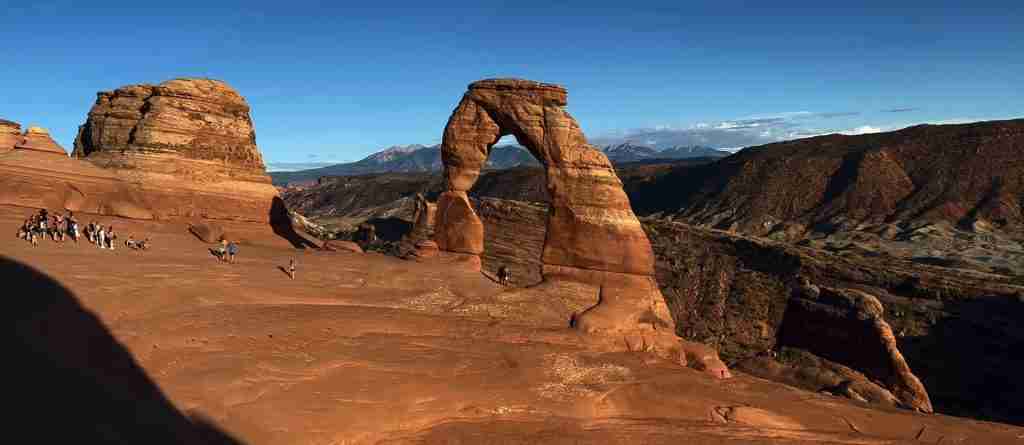
Delicate Arch represents Utah’s most recognizable landmark, appearing on license plates and tourism marketing worldwide as the symbol of Utah’s canyon country. The 3-mile roundtrip trail to reach this 65-foot freestanding arch requires 480 feet of elevation gain over slickrock surfaces with the final approach traversing an exposed narrow ledge along a cliff face, creating a moderately strenuous hike unsuitable for anyone with mobility limitations or severe fear of heights.
The trail begins at Wolfe Ranch parking area 13 miles from the visitor center, accessed via a 2.5-mile side road branching east from the main scenic drive. Start hiking across a suspension footbridge over Salt Wash, pass historic Wolfe Ranch cabin built in 1906 by Civil War veteran John Wesley Wolfe, then begin ascending slickrock slopes marked by rock cairns showing the route. The trail climbs steadily but not steeply for the first 1.5 miles before reaching the base of the rock fin containing Delicate Arch.
The final 0.25 miles traverses the most dramatic and potentially intimidating section following a narrow ledge carved into the cliff face with 400-foot exposure dropping away to your right. No railings or safety cables protect this section—hikers must rely on good traction, steady nerves, and appropriate footwear with aggressive tread. In icy winter conditions or during thunderstorms with wet rock, this section becomes genuinely dangerous and rangers may close the trail entirely for safety.
Upon rounding the final corner, Delicate Arch appears suddenly framed against the La Sal Mountains 30 miles distant, creating one of American landscape photography’s most iconic compositions. The natural amphitheater surrounding the arch can accommodate 50-100 people though it rarely feels that crowded as visitors spread out photographing from different angles. Plan to spend 20-40 minutes at the arch photographing, resting, and absorbing the scene before beginning the return hike.
Timing your Delicate Arch hike makes or breaks the experience. Sunrise hikes starting in darkness 45-60 minutes before sunrise position you at the arch as dawn light illuminates the La Sal Mountains creating dramatic golden light on the arch around 20-30 minutes after sunrise. Expect to share this experience with 30-60 other photographers during peak season all jockeying for prime shooting positions. Sunset hikes position you at the arch as afternoon light intensifies to golden hour 60-90 minutes before sunset, but you’ll be hiking out in darkness requiring headlamps. Midday summer hikes subject you to brutal heat with temperatures on exposed slickrock surfaces exceeding 120°F and zero shade anywhere along the route—rangers strongly discourage summer midday Delicate Arch attempts.
Water requirements are substantial with park rangers recommending 1.5-2 liters per person as minimum for the 2-3 hour hike, doubling to 3 liters during summer heat. No water sources exist along the trail and temperatures on exposed slickrock amplify heat stress significantly. Proper footwear with aggressive tread is essential particularly for the exposed ledge section where slick-soled shoes create dangerous situations. Hiking poles help many people feel more secure on the final exposed section.
Alternative views of Delicate Arch without hiking the trail are available from two viewpoints accessed via short walks from the Delicate Arch Viewpoint parking area 1 mile beyond Wolfe Ranch. Lower Viewpoint requires a level 100-yard walk providing distant views of the arch about 0.5 miles away, while Upper Viewpoint adds another 0.5 miles and 200 feet elevation gain for slightly closer but still distant views. These viewpoints work well for visitors unable to hike the full trail or those wanting preview views before committing to the longer hike.
Devils Garden Trail System: Eight Arches in One Hike 2026
Devils Garden Trail at the north end of the scenic drive provides access to eight major arches along a trail system ranging from easy 1-mile walks to challenging 7.2-mile primitive loops requiring scrambling and exposure tolerance. The trailhead parking lot fills earliest in the park typically by 9:00 AM peak season, requiring early starts for parking availability.
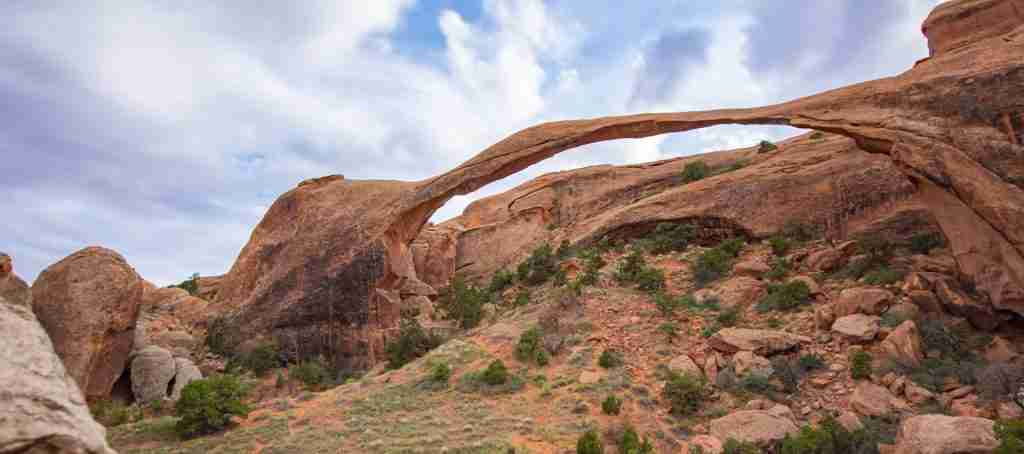
The primary Devils Garden Trail extends 2.0 miles one-way to Landscape Arch gaining just 60 feet elevation over relatively flat terrain suitable for families and casual hikers. This section passes Tunnel Arch and Pine Tree Arch within the first 0.5 miles before reaching Landscape Arch, one of the world’s longest natural stone spans at 290 feet. The massive arch appears impossibly thin and delicate, with geologists predicting eventual collapse though that might occur tomorrow or in 1,000 years. Visitors can walk beneath the arch admiring its graceful curve and contemplating geological timescales. The 4-mile roundtrip to Landscape Arch and back requires 2-2.5 hours including time at the arch.
Beyond Landscape Arch the trail transforms into the Devils Garden Primitive Loop, a challenging 5.2-mile route adding another six arches including Navajo Arch, Partition Arch, Double O Arch, and Dark Angel spire. This section requires scrambling over boulders, navigating narrow rock fins with exposure, and following cairns marking routes that aren’t always obvious. The complete 7.2-mile loop combining the maintained trail to Landscape Arch with the primitive loop beyond takes 4-5 hours for fit hikers, ranking as one of the park’s most strenuous trails despite moderate elevation gain.
Double O Arch at 4.0 miles from the trailhead represents the primitive loop’s highlight featuring two arches stacked vertically creating the unusual “double O” configuration. Reaching Double O requires 8 miles roundtrip from the trailhead or 7.2 miles if completing the full loop rather than backtracking the primitive section. Most visitors hiking beyond Landscape Arch complete the full loop as the primitive section is equally challenging in both directions making backtracking unappealing.
Dark Angel, a towering sandstone spire, marks the trail’s furthest extent at 4.3 miles from trailhead. Some hikers push to Dark Angel then loop back while others reverse course at Double O Arch depending on energy levels and time constraints. The primitive loop section sees significantly fewer hikers than the maintained trail to Landscape Arch, with solitude increasing as you venture deeper into the trail system.
Water requirements for Devils Garden trails scale with distance and conditions. The short 4-mile roundtrip to Landscape Arch requires 1.5 liters per person as minimum, while the full primitive loop demands 3 liters summer and 2 liters spring/fall. No water sources exist along the trail and summer temperatures on exposed rock surfaces create severe heat stress. Start early morning for best conditions and parking availability, carrying extra water beyond minimum recommendations.
Windows Section Trails: Family-Friendly Arch Access 2026
Windows Section at mile 12 of the scenic drive concentrates multiple large arches within easy walking distance of the parking area, making it ideal for families with young children, visitors with limited mobility, and anyone seeking impressive arches without strenuous hiking. The Windows Loop Trail covers 1 mile with minimal elevation change accessing North Window, South Window, and Turret Arch in under one hour walking time.
The trail begins from the Windows parking area climbing gently through the first 0.25 miles before splitting into a loop. Going clockwise takes you first to North Window, a massive opening framing views of surrounding desert landscape. The arch’s large size and easy access make it popular for photography, with morning light illuminating the arch’s east-facing opening beautifully. South Window sits 100 yards beyond along the trail, offering similar impressive dimensions and photographic opportunities.
The trail continues around the loop passing beneath both arches on the return route, providing different perspective views and additional photography angles. Total walking time runs 30-45 minutes at casual pace with children, extending to 60-75 minutes if you photograph extensively and explore different viewpoint locations around each arch.
Turret Arch viewpoint branches off the Windows Loop Trail via a 0.15-mile spur accessing views of this distinctive formation featuring multiple openings and unusual turret-like pinnacles. The classic photography composition shoots through North Window with Turret Arch visible in the distance framed by the arch’s opening, requiring positioning yourself inside North Window’s alcove.
Double Arch Trail branches from the Windows parking area as a separate 0.5-mile walk leading to a unique formation where two massive arches share a common stone support. The trail is mostly level and suitable for wheelchairs with assistance, ending at the base of these impressive arches where you can walk into the alcove beneath both openings. Double Arch gains fame for appearing in Indiana Jones and the Last Crusade adding Hollywood recognition to its natural splendor.
Windows Section trails receive heavy use particularly late morning and early afternoon when families and casual visitors arrive after breakfast. Sunrise and sunset visits provide more solitude and superior photographic lighting with fewer people visible in your images. The area’s east-facing arches receive beautiful light at sunrise, while afternoon and sunset light works better for some compositions depending on your specific photographic goals.
Fiery Furnace Guided Hike Experience 2026
Fiery Furnace represents Arches’ most restricted area requiring either ranger-guided hikes or advance permits for experienced route-finding hikers. The 2-mile ranger-guided experience navigates narrow canyons, tight squeezes between rock fins, and scrambling challenges through one of the park’s most spectacular yet fragile areas containing numerous unnamed arches and dramatic slot canyons.
Ranger-guided hikes operate daily April through October departing twice daily at 9:00 AM and 4:00 PM from the Fiery Furnace viewpoint parking area. Each hike accommodates maximum 8-10 participants ensuring personal attention and manageable group sizes through tight passages. Cost is $16 per adult, $8 per child ages 5-12, with children under 5 not permitted due to challenging terrain. Reservations are mandatory through Recreation.gov and typically book solid 2-3 months in advance for peak season dates requiring early planning.
The guided experience lasts 2.5-3 hours covering approximately 2 miles of hiking but feeling more challenging due to constant scrambling over boulders, squeezing through narrow passages, and navigating complex terrain. Rangers lead groups through the labyrinth of sandstone fins explaining geology, ecology, and desert survival strategies while pointing out hidden arches and photogenic compositions invisible from viewpoints above. This represents one of the park’s premier educational experiences combining physical challenge with interpretation.
Self-guided Fiery Furnace permits allow experienced desert hikers to explore independently after watching an online orientation video and paying $8 per person. These permits book through Recreation.gov weeks in advance and require demonstrated navigation skills, fitness for challenging scrambling, and commitment to staying on designated routes to protect fragile biological soil crusts. Most visitors choose ranger-guided hikes rather than self-guided permits unless they’re experienced desert navigators comfortable with route-finding in complex terrain.
Additional Notable Trails in Arches 2026
Park Avenue Trail offers an easy 1-mile one-way walk descending through a dramatic canyon flanked by towering rock walls resembling New York City skyscrapers, hence the name. The trail begins at the Park Avenue viewpoint parking area 2 miles from the visitor center and ends at Courthouse Towers viewpoint 1 mile north, requiring either two vehicles for a car shuttle or 2 miles roundtrip hiking if you backtrack to your starting point. The gentle downhill grade makes the south-to-north direction easier, though most people prefer hiking downhill from Park Avenue viewpoint to Courthouse Towers. Allow 45-60 minutes one-way including time to photograph the dramatic rock walls.
Balanced Rock Trail circles this iconic formation via a 0.3-mile loop requiring just 15-20 minutes walking time. The massive boulder perched atop a narrow pedestal appears ready to topple, creating dramatic photography opportunities particularly at sunset when golden light illuminates the western face. This ranks among the park’s easiest trails suitable for anyone able to walk a few hundred yards on level paved path.
Sand Dune Arch Trail leads 0.4 miles roundtrip through a narrow canyon filled with deep sand deposits to a hidden arch tucked between rock fins. Children love playing in the sand while parents photograph the arch’s graceful curve. The shaded canyon provides welcome relief during summer heat making this a good midday option when other trails face brutal sun exposure.
Broken Arch Trail extends 2 miles roundtrip from the Devils Garden trailhead area to an arch visible from the campground and scenic drive but accessible only by trail. Despite the name, the arch isn’t actually broken—the name refers to a crack visible in the stone arch. This trail sees light use compared to more famous routes providing more solitude.
Photography Guide for Arches National Park 2026
Arches National Park ranks among Earth’s premier landscape photography destinations with iconic formations, dramatic red rock scenery, and lighting conditions that create spectacular images during golden hours. Understanding optimal times, locations, and techniques separates good photos from extraordinary images worth printing large and hanging prominently.
Best Times for Photography in Arches 2026
Golden hour illumination transforms Arches from attractive to spectacular, with warm low-angle light painting red sandstone formations in rich amber and orange tones while creating long dramatic shadows emphasizing three-dimensional texture. Spring and fall offer the longest golden hours extending 60-90 minutes around sunrise and sunset as the sun’s lower angle prolongs transitional lighting. Summer’s higher sun angle compresses golden hour to 30-45 minutes around sunrise and sunset but delivers intensely saturated colors. Winter’s lowest sun angles create all-day warm light though midday still produces harsh shadows.
Sunrise photography at Arches begins with pre-dawn darkness positioning yourself at chosen locations 45-60 minutes before sunrise when the sky first begins glowing with twilight colors. The period 30 minutes before sunrise through 30 minutes after provides optimal light with the pre-sunrise blue hour creating soft even illumination perfect for capturing arch silhouettes against colorful skies. Post-sunrise golden hour light illuminates east-facing formations directly while creating warm reflected light on west-facing surfaces.
Sunset photography reverses the timing with setup beginning 90-120 minutes before sunset allowing time for composition refinement and light quality assessment as shadows lengthen and colors intensify. The hour before sunset through 30 minutes after creates prime photography conditions with west-facing arches receiving direct warm illumination while east-facing formations glow with warm reflected light. Lingering 30-45 minutes after sunset captures twilight colors and potentially stars emerging in darkening skies.
Midday photography during summer becomes nearly impossible as harsh overhead sun creates dense black shadows in arch openings, washes out colors with intense glare, and produces flat uninspiring lighting lacking dimensional quality. Spring, fall, and winter midday light works better for photography though still inferior to golden hour conditions. Overcast days eliminate harsh shadows and provide soft even light excellent for photographing details, textures, and intimate landscapes though lacking the drama of dramatic sunrise and sunset light.
Iconic Photography Locations at Arches 2026
Delicate Arch at sunrise ranks as Arches’ premier photography location with the arch framed against the La Sal Mountains creating the classic Utah landscape composition appearing in countless photo books, calendars, and tourism marketing. Position yourself anywhere in the natural amphitheater surrounding the arch with the La Sal Mountains visible through the arch opening in the background. Morning light illuminates the mountains while the arch itself glows with warm reflected light from red rock formations to the east. Plan to share this experience with 30-60 other photographers during peak season all competing for prime positions.
Delicate Arch at sunset offers alternative lighting creating warm direct illumination on the arch’s west-facing surface while the La Sal Mountains fall into shadow. Many photographers prefer sunset light for its warm direct quality though you lose the dramatic mountain backdrop lit at sunrise. Sunset photography requires hiking out in darkness with headlamps after shooting twilight colors, adding logistical complexity but reducing competition compared to sunrise crowds.
Mesa Arch in adjacent Canyonlands National Park rather than Arches itself represents the most famous arch sunrise in the region, though it’s worth mentioning for Arches visitors planning multi-day photography trips. Many serious photographers base in Moab shooting Mesa Arch at sunrise then driving to Arches for midday scouting and sunset photography creating efficient workflows maximizing shooting opportunities across both parks.
Windows Section arches provide excellent photography opportunities throughout the day with varied compositions available depending on light direction and time. North Window faces east making it ideal for sunrise light streaming through the opening illuminating the alcove beyond. Late afternoon and sunset light illuminates the arch’s western exterior creating warm glows on the stone. The classic composition shooting through North Window toward Turret Arch in the distance works in morning and afternoon light depending on your desired effect.
Balanced Rock photographs beautifully at sunset when golden light illuminates its western face creating warm tones on the precariously balanced boulder. The formation’s distinctive shape reads clearly in silhouette making it work well even in backlit conditions. Evening light creates the most dramatic imagery with long shadows stretching eastward emphasizing scale and dimension.
Double Arch in Windows Section offers unique composition opportunities shooting upward through both openings to frame sky and clouds in the arches’ curves. Midday light works better here than most locations as the arches face upward rather than horizontally, though morning and afternoon light creates more dimensional modeling of the rock surfaces. This location works well during weather systems when dramatic clouds add visual interest to the sky framed by the arches.
Photography Tips and Techniques for Arches 2026
Wide-angle lenses ranging 14-24mm on full-frame cameras or equivalent ultra-wide angles on crop sensors are essential for capturing arch formations with adequate surrounding landscape context. Most iconic arch compositions require ultra-wide lenses to include foreground elements, the entire arch, and background landscape in single frames. Standard zoom lenses in the 24-70mm range provide versatility for detail shots and portraits but limit your ability to capture classic wide-angle arch compositions.
Tripods are essential for sunrise, sunset, and night photography requiring longer exposures in dimmer light. The park allows tripod use on trails and around arches though prohibits them from blocking trails or being left unattended. Carbon fiber tripods reduce weight for long hikes to locations like Delicate Arch where every ounce matters over the 3-mile roundtrip.
Graduated neutral density filters help balance exposure between bright skies and darker foreground landscapes, essential during sunrise and sunset when dynamic range exceeds camera sensor capabilities. A 2-stop or 3-stop soft-edge graduated ND filter handles most situations in Arches. Polarizing filters deepen blue skies and reduce glare on rock surfaces but require careful use to avoid creating unnatural dark blue skies that appear artificial.
Focusing techniques in arch photography prioritize maximum depth of field keeping both near foreground elements and distant backgrounds sharp. Use apertures f/11 to f/16 for landscape shots, focusing about one-third into the scene using hyperfocal distance techniques. Modern mirrorless cameras with focus peaking or magnification functions simplify achieving critical focus across the entire scene. Bracket exposures capturing multiple frames at different brightness levels for potential HDR processing later when single exposures can’t capture the scene’s full tonal range.
Composition in arch photography benefits from including foreground interest elements like rocks, desert vegetation, or geological features that lead the viewer’s eye toward the main subject. The classic mistake is centering the arch in the frame creating static compositions lacking visual flow. Instead, position arches off-center following rule-of-thirds guidelines, and use leading lines to guide attention through the image toward the arch as primary subject.
Wildlife and Natural Features in Arches 2026
Arches National Park protects diverse desert ecosystems supporting surprising wildlife variety considering the harsh environment’s limited water and extreme temperatures. While visitors come primarily to see geological formations, the park’s plants and animals add dimension to the landscape and reward observant explorers.
Desert Wildlife at Arches National Park
Mule deer represent the park’s most commonly observed large mammal, frequently seen grazing near the visitor center in early morning and evening hours, bedded in shade beneath pinyon pines and junipers during midday heat, or browsing along roads at twilight. These graceful animals with distinctive large mule-like ears show little fear of humans, often allowing close approach though feeding wildlife violates park regulations and creates dangerous habituation patterns.
Desert bighorn sheep inhabit the park’s most rugged cliff areas, occasionally visible from trails and viewpoints to patient observers scanning high rocky outcrops with binoculars. Rams with massive curved horns impress viewers with their agility navigating seemingly impossible cliff faces, while ewes with lambs in spring add tenderness to harsh desert landscapes. Park Avenue Trail, Delicate Arch Trail’s slickrock sections, and Devils Garden Primitive Loop offer the best bighorn spotting opportunities, particularly during morning and evening hours when sheep move between feeding and bedding areas.
Coyotes prowl the park hunting rodents, rabbits, and occasional unwary ground-nesting birds, most often heard howling at dawn and dusk though occasionally seen trotting across open areas or along roads. These intelligent adaptable predators thrive in Arches’ desert environment, filling the ecological niche left by extirpated gray wolves and mountain lions. Maintaining safe distance from coyotes protects both humans and animals while allowing observation of natural behaviors.
Smaller mammals including rock squirrels, chipmunks, and various mouse species inhabit rocky areas throughout the park, with rock squirrels being particularly bold around picnic areas and trailheads where they’ve learned to exploit human food sources. Never feed these animals as it creates dangerous dependency, spreads disease, and teaches animals to associate humans with food creating aggressive behaviors. Prairie dogs once inhabited areas near the park but were extirpated by human conflict and disease, though reintroduction efforts continue in some Colorado Plateau regions.
Lizards dominate reptile sightings at Arches with collared lizards, desert spiny lizards, and eastern fence lizards commonly seen basking on warm rocks particularly during spring and fall when temperatures suit their thermal requirements. These colorful reptiles add life and motion to seemingly barren landscapes, catching insects with lightning-fast strikes and displaying territorial behaviors defending choice basking spots. Snakes including rattlesnakes, gopher snakes, and occasional king snakes inhabit the park but are encountered far less frequently than lizards, with midget faded rattlesnakes being the primary venomous species requiring caution when hiking off-trail or placing hands on ledges you can’t see.
Birdlife in Arches includes common ravens, pinyon jays, black-throated sparrows, rock wrens, and various raptors including red-tailed hawks, golden eagles, and occasional peregrine falcons. Ravens in particular become constant companions entertaining hikers with acrobatic flight displays and opportunistic behavior investigating any potential food source. Spring migration brings increased bird diversity with warblers, flycatchers, and other neotropical migrants passing through on journeys between winter and breeding grounds.
Desert Plant Communities and Adaptations
Arches’ plant life demonstrates remarkable adaptations to extreme heat, minimal rainfall averaging just 9 inches annually, and intense solar radiation at 4,000-5,600 foot elevations. The park’s plant communities organize into distinct zones based on elevation, aspect, and soil type creating mosaic patterns across the landscape.
Pinyon pine and Utah juniper woodlands dominate cooler north-facing slopes and higher elevations, with these slow-growing trees sometimes exceeding 400 years age despite modest 15-25 foot mature heights. Pinyon pines produce nutritious pine nuts harvested traditionally by Native peoples and still collected today by wildlife including pinyon jays that cache thousands of nuts for winter survival. Utah junipers contribute their distinctive twisted shapes and aromatic scent to the desert landscape while providing shelter for numerous bird species and small mammals.
Blackbrush shrublands cover extensive areas on flat or gently sloping terrain, with this small gray-green shrub forming nearly monoculture stands across thousands of acres. Blackbrush grows incredibly slowly, taking decades to reach mature 2-3 foot heights, and reproduces rarely making these communities extremely sensitive to disturbance from vehicles, foot traffic, or grazing. Once damaged, blackbrush stands require centuries to recover if they recover at all.
Biological soil crust covers the ground between shrubs and trees creating dark irregular patches that look like dried mud but actually represent complex communities of cyanobacteria, lichens, mosses, and microfungi. These organisms colonize bare sand and silt, binding soil particles to prevent erosion, fixing atmospheric nitrogen enriching desert soils, and creating conditions allowing vascular plants to establish. Biological soil crusts require 50-250 years to develop fully but can be destroyed in seconds by a single boot step, making staying on established trails critical for protecting these fragile yet essential communities.
Desert wildflowers transform Arches each spring following winter and spring precipitation, with peak blooms typically occurring April through early May though timing varies based on moisture patterns. Indian paintbrush splashes orange and red across sandy areas, evening primrose unfolds massive white flowers that open at dusk attracting moth pollinators, sand verbena creates purple carpets in disturbed sandy soils, and Utah penstemon adds blue-purple flowers to rocky slopes. These ephemeral displays reward spring visitors with color contrasts against red rock backgrounds.
Daily Budget Breakdowns for Arches National Park 2026
Understanding detailed daily costs helps travelers plan realistic budgets and avoid financial surprises during Arches visits. These breakdowns account for accommodation shared between two people, all meals, transportation, park admission, and activities creating comprehensive cost pictures for three budget tiers.
Budget Traveler Daily Costs Arches National Park 2026
Budget travelers visiting Arches National Park need $110-165 per person daily when sharing budget accommodation with a companion and making strategic choices about dining, transportation, and activities. This budget tier requires disciplined spending, self-catering some meals, and choosing free or low-cost activities over guided tours and premium experiences.
Accommodation costs $85-130 per room for budget motels or $40-50 per person for hostel dormitory beds. Using budget motels at $85-130 per room divided by two travelers sharing creates per-person costs of $43-65 nightly. Hostel dormitory beds eliminate the need to find a travel companion for room sharing but offer less privacy and amenities. Budget accommodation typically includes free parking and basic WiFi but rarely features pools, fitness rooms, or included breakfast requiring separate food costs.
Food costs for budget travelers range $35-55 daily combining grocery store self-catering for breakfast and some lunches with budget restaurant dinners. Breakfast items purchased at City Market including bagels, peanut butter, fruit, and coffee for preparation at your accommodation cost $8-12 per person spread over 2-3 days of eating. Lunch options include sandwiches assembled from grocery ingredients for $8-12 per person, or occasional budget restaurant meals at Moab Diner or food trucks for $10-16. Dinner at budget-friendly spots like Zax Pizza all-you-can-eat or fast-food chains runs $15-25 per person including beverage.
Transportation costs for budget travelers typically involve rental car sharing with a companion, with compact rental cars costing $50-90 daily in peak season. Split between two people, this creates $25-45 per person daily costs. Add gas expenses averaging $12-18 daily for driving between Moab and the park plus exploring the scenic drive, divided by two travelers creating $6-9 per person fuel costs. Total transportation runs $31-54 per person daily with car sharing being essential to budget travel viability since guided tours cost $90-180 per person eliminating budget status.
Park entrance fees of $30 per vehicle for seven days equal approximately $4 daily per vehicle, or $2 per person when split between two travelers. The $2 timed-entry reservation fee during peak season adds another $1 per person when vehicle costs are shared. Combined park admission totals $3-4 per person daily including timed-entry fees when applicable.
Activities for budget travelers emphasize free hiking on park trails rather than paid guided tours or premium experiences. All major trails including Delicate Arch, Devils Garden, and Windows Section charge no fees beyond park admission. Total daily costs for budget Arches visits are calculated as follows: accommodation $43-65 per person for shared room, meals $35-55 per person, transportation $25-45 per person for shared rental car, gas $6-12 per person, park entrance $3-4 per person. This totals $112-181 per person daily, which rounds to the range of $110-165 per person daily accounting for strategic choices within each category that allow staying at the lower end of ranges.
Mid-Range Traveler Daily Costs Arches National Park 2026
Mid-range travelers visiting Arches National Park spend $255-360 per person daily for comfortable accommodation, quality restaurant meals, convenient transportation, and selective guided activities creating balanced experiences between budget constraints and luxury indulgences. This tier represents the most popular choice among Arches visitors seeking good value without excessive spending or sacrifice of comfort.
Accommodation costs $220-280 per room at mid-range hotels including Hampton Inn, Holiday Inn Express, or boutique properties like Hotel Moab Downtown. Divided between two travelers sharing a room with two beds, this creates $110-140 per person nightly costs. Mid-range properties typically include complimentary hot breakfast buffets featuring eggs, breakfast meats, pastries, and beverages reducing separate breakfast costs, plus amenities like pools, fitness centers, comfortable common areas, and professional service enhancing overall travel experience.
Food costs for mid-range travelers range $60-90 daily with complimentary hotel breakfast eliminating morning meal costs, lunch at casual restaurants like food trucks or Moab Brewery running $18-28 per person including beverage, and dinner at mid-range restaurants like Miguel’s Baja Grill or Antica Forma costing $30-45 per person. Adding occasional coffee shop stops, trail snacks, and ice cream treats fills out the $60-90 daily range without requiring significant restraint yet avoiding premium dining expenses.
Transportation costs for mid-range travelers typically involve midsize or compact SUV rentals costing $65-110 daily in peak season. Split between two travelers, this creates $33-55 per person daily rental costs. Gas expenses averaging $15-22 daily divided by two travelers adds $8-11 per person daily. Some mid-range travelers substitute occasional guided tours for self-driving, with half-day tours at $90-140 per person eliminating one day’s rental car expenses while adding expert interpretation and hassle-free logistics. Total transportation including both rental car and selective guided tour days averages $41-66 per person daily.
Park entrance fees and timed-entry reservations total $3-4 per person daily as with budget travelers when vehicle costs split between two people. Mid-range travelers typically add selective paid activities including one guided Fiery Furnace hike at $16 per person, or sunset photography tours at $140-180 per person, or scenic flight options at $200-300 per person. Spreading these experiences across a multi-day visit creates average additional activity costs of $10-20 per person daily beyond basic park admission.
Total daily costs for mid-range Arches visits are calculated as follows: accommodation $110-140 per person for shared room, meals $60-90 per person with hotel breakfast included, transportation $33-55 per person for shared rental car, gas $8-11 per person, park entrance and activities $13-24 per person. This totals $224-320 per person daily, which rounds to the range of $255-360 accounting for variations in specific choices within each category and the reality that some days cost more while others cost less creating overall averages within this range.
Luxury Traveler Daily Costs Arches National Park 2026
Luxury travelers visiting Arches National Park invest $430-795 per person daily for upscale resort accommodation, gourmet dining experiences, premium transportation, and exclusive guided activities creating distinctive high-end experiences emphasizing comfort, service, and unique opportunities unavailable to budget or mid-range visitors. This tier appeals to affluent travelers prioritizing quality and exclusivity over cost considerations.
Accommodation costs $400-700 per room at luxury properties including Sorrel River Ranch Resort, Red Cliffs Lodge, or Under Canvas Moab glamping resort. Divided between two travelers sharing a room or luxury tent, this creates $200-350 per person nightly costs. Luxury properties feature gourmet restaurants, full-service spas, private guided activities, premium linens and furnishings, exceptional service, and distinctive locations along the Colorado River or near park entrances enhancing overall experience quality substantially compared to standard hotels in downtown Moab.
Food costs for luxury travelers range $90-140 daily including gourmet breakfast at resort restaurants or room service for $25-35 per person, lunch at upscale casual spots or resort cafes running $30-40 per person, and dinner at fine dining establishments like Sunset Grill or Cowboy Grill at Red Cliffs Lodge costing $100-130 per person for multi-course meals with wine. Luxury travelers prioritize food quality, local ingredients, expert preparation, and dining ambiance over cost considerations.
Transportation costs for luxury travelers involve premium SUV or full-size truck rentals at $95-150 daily, or private guide services with luxury vehicles included in tour pricing at $250-400 per person daily. Split between two travelers, rental SUVs create $48-75 per person daily costs, while private guided services eliminate driving responsibilities entirely at premium prices. Gas expenses for larger vehicles run $18-28 daily split between two travelers adding $9-14 per person daily. Some luxury travelers hire private drivers for multi-day trips eliminating all driving concerns at costs around $500-800 daily for vehicle and professional driver serving two to four passengers.
Park entrance fees remain $3-4 per person daily as with other tiers when vehicle costs split between two people, but luxury travelers add substantial activity costs including private guided photography tours at $300-500 per person, scenic helicopter flights over Arches and Canyonlands at $250-400 per person, private Fiery Furnace guides serving just their party at $200-300 per person, and sunset arch viewing from exclusive locations accessed only by private guides at $200-350 per person. These premium experiences create additional activity costs averaging $100-200 per person daily when spread across a multi-day visit.
Total daily costs for luxury Arches visits are calculated as follows: accommodation $200-350 per person for shared luxury room, meals $90-140 per person at upscale restaurants, transportation $48-75 per person for premium SUV rental or private guide services, gas $9-14 per person, park entrance and premium activities $103-204 per person. This totals $450-783 per person daily, which rounds to the range of $430-795 accounting for the reality that some luxury travelers spend at the lower end choosing selective premium experiences while others invest heavily in exclusive guided adventures and finest dining creating substantial range within the luxury tier.
Sample Itineraries for Arches National Park 2026
Strategic itinerary planning maximizes your Arches experience by efficiently organizing hiking, photography, and sightseeing while accommodating weather, crowds, and personal interests. These sample itineraries provide proven frameworks adaptable to different trip lengths and budget levels.
Three-Day Budget Itinerary Arches National Park 2026
Day One begins with 5:30 AM departure from your budget motel in Moab, arriving at the park entrance by 6:00 AM before timed-entry requirements begin at 7:00 AM. Drive directly to Delicate Arch trailhead at Wolfe Ranch beginning your hike in early morning light reaching the arch around 7:30 AM for sunrise photography with fewer crowds than later arrivals. Spend 45 minutes at the arch photographing and enjoying the scene before returning to your car by 9:30 AM. Breakfast back at your motel room or quick stop at City Market for bagels and coffee costs $10-15 per person. Return to the park around 11:00 AM visiting Windows Section trails including the easy Windows Loop and Double Arch spending 2-3 hours hiking and photographing. Lunch consists of sandwiches prepared from grocery ingredients eaten at Windows picnic area for $8-12 per person. Afternoon explores Devils Garden Trail hiking the 4-mile roundtrip to Landscape Arch arriving back at your car by 4:30 PM. Dinner at Zax Pizza all-you-can-eat provides substantial food for $15 per person refueling after a full hiking day. Evening activities include stargazing from anywhere in Moab or the park which remains open 24 hours. Day one costs approximately $43 accommodation per person, $33 food per person, $25 transportation per person, $8 gas per person, $3 park entrance per person, totaling around $112 per person.
Day Two starts with casual 8:00 AM breakfast at your motel room using remaining grocery items for $8-10 per person, then departure for the park arriving around 9:30 AM. Morning activities include Park Avenue Trail, Balanced Rock trail, and the Fiery Furnace viewpoint totaling 2-3 hours of easier hiking and sightseeing. Lunch at a Moab food truck provides variety and good value at $12-15 per person. Afternoon returns to Devils Garden area attempting the primitive loop beyond Landscape Arch if you have energy and time, or exploring shorter spurs to Tunnel Arch and Pine Tree Arch. Late afternoon and sunset focus on photography at Balanced Rock and Windows Section as golden hour light illuminates formations. Dinner at Moab Diner delivers classic American fare at reasonable prices around $18-22 per person. Day two costs approximately $43 accommodation per person, $38 food per person, $25 transportation per person, $8 gas per person, totaling around $114 per person.
Day Three begins with checkout from your motel by 10:00 AM following final breakfast from grocery items for $8-10 per person. Morning visits any missed park areas or returns to favorite spots for additional time and different lighting conditions. Lunch back in Moab before departing for your next destination or heading home runs $15-18 per person at quick casual spots. Total three-day costs include $129 accommodation for three nights divided by two people (checked out morning of day three), $109 food, $75 transportation rental car split between two people, $24 gas split between two people, $9 park entrance for multi-day vehicle pass split between two people, creating total three-day costs of approximately $346 per person, or $115 per person per day average.
Five-Day Mid-Range Itinerary Arches National Park 2026
Day One arrives Moab mid-afternoon following morning flight to Salt Lake City and 3.5-hour drive south. Check into mid-range hotel with time to refresh before late afternoon entry to Arches around 4:00 PM. Scenic drive to Devils Garden watching sunset from various viewpoints along the 18-mile route familiarizes you with park layout and major formations. Dinner at Moab Brewery provides welcome meal after travel day costing $25-30 per person including local craft beer. Day one costs include $110 accommodation per person sharing mid-range hotel, $30 dinner per person, $33 rental car per person, $8 gas per person, $3 park entrance per person, totaling approximately $184 per person for partial day.
Day Two begins with hot breakfast included at your hotel followed by 7:00 AM park entry during reserved timed-entry window. Morning tackles Delicate Arch trail starting around 8:00 AM reaching the arch by 9:30 AM with good light and manageable crowds. Return to car by 11:30 AM with lunch at food truck in Moab running $18-22 per person. Afternoon explores Windows Section trails thoroughly including Windows Loop, Double Arch, and Garden of Eden viewpoint spending 3-4 hours hiking and photographing. Late afternoon visits Balanced Rock and other roadside features. Dinner at Miguel’s Baja Grill costs $30-38 per person. Day two costs $110 accommodation per person, $68 food per person including lunch and dinner, $33 rental car per person, $8 gas per person, totaling approximately $219 per person.
Day Three features booked Fiery Furnace ranger-guided hike departing 9:00 AM and lasting until noon. This $16 per person experience represents excellent value for guided interpretation through the park’s most spectacular slot canyons. Lunch back in Moab at Antica Forma wood-fired pizza runs $22-26 per person. Afternoon visits Canyonlands National Park Island in the Sky district 32 miles from Moab exploring Mesa Arch, Grand View Point, and other iconic overlooks, or stays local with mountain biking, river activities, or Moab recreation options. Dinner at Desert Bistro delivers upscale experience at $50-65 per person creating a special evening. Day three costs $110 accommodation per person, $88 food per person, $33 rental car per person, $11 gas per person including Canyonlands driving, $16 Fiery Furnace per person, totaling approximately $258 per person.
Day Four attempts Devils Garden Primitive Loop, the park’s longest and most challenging maintained trail covering 7.2 miles requiring 4-5 hours. Start hiking by 7:30 AM bringing substantial food and water for the long hike. Lunch consists of trail food carried from Moab grocery store for $15-18 per person. Afternoon provides rest and recovery time at hotel pool, or visits to any missed park areas for additional photography. Dinner at Moab Brewery or similar casual spot runs $28-32 per person. Day four costs $110 accommodation per person, $61 food per person, $33 rental car per person, $8 gas per person, totaling approximately $212 per person.
Day Five begins with final hotel breakfast before checkout and last park visit focusing on sunrise photography at preferred location, perhaps Windows Section or Park Avenue. Depart Moab by 10:00 AM beginning drive back to Salt Lake City for afternoon flight home. Lunch enroute at Price or Helper small towns along Highway 6 runs $18-22 per person. Total five-day costs include $550 accommodation for five nights divided by two people, $329 food including hotel breakfasts, lunches, and dinners, $165 rental car for five days split between two people, $43 gas split between two people, $19 park entrance and Fiery Furnace split between two people, creating total five-day costs of approximately $1,106 per person, or $221 per person per day average.
Three-Day Luxury Itinerary Arches National Park 2026
Day One features afternoon arrival at Sorrel River Ranch Resort 17 miles northeast of Moab checking into a riverfront cabin at $450-600 per room. Settle into your luxury accommodation enjoying the riverside setting before dinner at the resort’s gourmet restaurant featuring contemporary Western cuisine with entrees at $40-55 per person plus wine selections bringing meal total to $95-130 per person. After dinner, enjoy the ranch’s evening bonfire with s’mores service included with your stay. Day one costs include $225 accommodation per person sharing luxury cabin, $110 dinner per person, $48 rental premium SUV per person, $9 gas per person, totaling approximately $392 per person for partial arrival day.
Day Two begins with gourmet breakfast at resort restaurant serving fresh pastries, custom omelets, and regional specialties for $25-32 per person. Depart for Arches around 7:00 AM with reserved timed-entry ticket for private photography tour meeting your expert guide at the park entrance. The guide drives you to prime locations in their luxury vehicle focusing on Delicate Arch, Windows Section, and Devils Garden major formations with photography instruction throughout the morning. Tour costs $300 per person. Lunch at resort or upscale Moab restaurant runs $35-45 per person. Afternoon includes spa treatment at resort’s full-service spa with massages and treatments at $150-200 per person. Dinner features sunset meal at Cowboy Grill at Red Cliffs Lodge requiring 20-minute drive showcasing dramatic riverside setting with Colorado River flowing below red rock cliffs, costing $110-140 per person for multi-course meal with wine. Day two costs $225 accommodation per person, $270 food per person including breakfast, lunch, and dinner, $48 rental SUV per person, $9 gas per person, $300 photography tour per person, $175 spa treatment per person, totaling approximately $1,027 per person.
Day Three starts with leisurely resort breakfast followed by 45-minute scenic helicopter flight departing Moab airport circling Arches and Canyonlands national parks from aerial perspective costing $350 per person. After helicopter tour, luxury travelers may choose horseback riding at the resort, private guided hiking, or relaxation at the riverside pool. Lunch at resort cafe runs $30-40 per person. Checkout from resort by 4:00 PM with evening departure or one final luxury dinner at Sunset Grill in Moab costing $110-130 per person. Total three-day luxury costs include $675 accommodation for three nights divided by two people, $450 food, $144 premium SUV rental split between two people, $27 gas split between two people, $300 photography tour per person, $175 spa treatment per person, $350 helicopter tour per person, creating total three-day costs of approximately $2,121 per person, or $707 per person per day average reflecting luxury tier’s substantially higher daily costs compared to budget and mid-range approaches.
Money-Saving Strategies for Arches National Park 2026
Strategic planning and tactical choices can reduce Arches travel costs substantially without significantly compromising experience quality. These proven strategies help budget-conscious travelers maximize value and minimize expenses across accommodation, dining, transportation, and activities.
Timing Strategies to Reduce Costs 2026
Visit during November through March shoulder season when Moab accommodation prices drop 30-40 percent below peak spring and fall rates. Hotels charging $220-280 per room in April and October cost just $140-180 in January and February for identical properties and rooms. These winter savings extend beyond accommodation to include lower rental car rates, reduced competition for last-minute deals, and occasional restaurant discounts targeting slower winter business. Winter visits eliminate timed-entry reservation fees and hassles while providing solitude impossible during peak seasons. The tradeoff involves colder temperatures requiring appropriate gear and occasional snow conditions limiting access, but for travelers willing to embrace winter conditions, savings of $50-80 per person daily make winter visits compelling.
Book weekday dates Tuesday through Thursday when Moab hotel rates run $30-50 below weekend Friday and Saturday prices even during peak spring and fall seasons. This strategy works particularly well for flexible travelers able to arrange Tuesday arrival with Thursday departure avoiding premium weekend pricing entirely. Combining weekday dates with shoulder season timing compounds savings creating opportunities for mid-range accommodation at budget prices.
Secure accommodation four to six months ahead of spring and fall peak season visits locking in published rates before dynamic pricing algorithms increase prices as availability tightens. Hotels implement revenue management systems that automatically raise rates as rooms sell out, meaning early bookers pay substantially less than last-minute travelers competing for remaining inventory. Save $40-80 per room per night by booking in December for April visits or in April for September visits rather than waiting until two weeks before arrival.
Accommodation Cost Reduction Strategies 2026
Camp at Devils Garden Campground at $30 per site per night rather than paying $110-280 for hotel rooms, reducing accommodation costs by $80-250 nightly per couple. While camping requires gear, tolerates less comfort, and provides no showers, the massive cost savings fund other trip elements like better dining, longer stays, or premium activities. Camping six nights saves $480-1,500 per couple compared to mid-range hotels, enough to upgrade dining from budget to mid-range tier for the entire week without exceeding the original hotel budget.
Share rooms with travel companions beyond romantic partners or immediate family when traveling in larger groups. Booking a room with two queen beds and splitting costs among three or four travelers reduces per-person accommodation expenses dramatically. A $240 mid-range hotel room split four ways costs just $60 per person versus $120 for couples, saving $60 per person nightly. This strategy works particularly well for friend groups, adult siblings traveling together, or solo travelers connecting with compatible travel partners through forums or social media groups.
Book vacation rentals through Vrbo or Airbnb for groups of four or more when multi-bedroom condos, townhomes, or houses cost $280-450 nightly total while sleeping 4-8 people. Split among occupants, costs drop to $35-75 per person per night even during peak season, substantially below hotel rates. Vacation rentals add full kitchen facilities enabling grocery store meals reducing dining costs an additional $20-40 per person daily.
Food Cost Reduction Strategies 2026
Self-cater breakfast and lunch using grocery store ingredients prepared at accommodation with kitchens or eaten as trail food on hikes, reserving restaurant budgets for dinners only. This approach reduces daily food costs from $60-90 for three restaurant meals to $35-50 including one restaurant dinner, saving $25-40 per person daily or $175-280 weekly per person. Stock up on bagels, peanut butter, fresh fruit, sandwich ingredients, pasta, and canned goods at City Market creating multiple simple meals for a fraction of restaurant costs.
Choose hotels including complimentary hot breakfast which typically provides eggs, breakfast meats, pastries, fruit, and beverages worth $12-18 per person if purchased at restaurants. Over a five-night six-day visit, included breakfast saves $72-108 per person, potentially offsetting higher hotel base rates. Many mid-range chains including Hampton Inn, Holiday Inn Express, and Homewood Suites include substantial breakfast buffets as standard amenities.
Pack coolers with drinks, snacks, and lunch components avoiding expensive convenience store prices and limited dining options during full park days. Bottled water costs $1 per liter at grocery stores versus $3-4 at park-adjacent convenience stores, while pre-made sandwiches run $5-7 at City Market versus $12-15 at food trucks. Bringing lunch to the park daily saves $7-10 per person per day adding up to $49-70 weekly savings.
Transportation Cost Reduction Strategies 2026
Share rental car costs with travel companions splitting daily rental rates and gas expenses among three or four people rather than couples. A $90 daily rental plus $20 gas totaling $110 daily costs just $27.50 per person split four ways versus $55 per person for couples, saving $27.50 per person daily or $192.50 weekly. Online forums, social media groups, and travel planning sites help solo travelers connect with others seeking shared transportation arrangements.
Fly to Grand Junction Colorado rather than Salt Lake City when airfare differentials favor the closer regional airport despite typically higher per-flight costs. Shorter 1.5-hour drive from Grand Junction versus 3.5 hours from Salt Lake reduces gas consumption by 240 miles saving $35-45 per vehicle in fuel costs while reducing wear on both driver and vehicle. Calculate total trip costs including flights and ground transportation rather than focusing solely on lowest airfare.
Book rental cars through aggregator sites like Autoslash, Costco Travel, or AAA which often provide rates 15-25 percent below direct booking through rental companies. These services access special negotiated rates and corporate codes unavailable to individual consumers. Monitor prices after booking as rates fluctuate constantly, with Autoslash automatically rebooking if lower rates emerge before pickup date.
Activity Cost Reduction Strategies 2026
Focus on self-guided hiking rather than paid guided tours saving $90-280 per person daily while still experiencing the park’s major attractions. All iconic features including Delicate Arch, Devils Garden, Windows Section, and Park Avenue are accessible via maintained trails requiring no guide services. Reserve paid guided experiences for truly unique opportunities like Fiery Furnace ranger walks at just $16 per person representing excellent value compared to commercial tours.
Purchase America the Beautiful Annual Pass at $80 for twelve months entrance to all national parks and federal recreation areas rather than paying individual park entrance fees at each destination. The pass makes economic sense when visiting three or more fee-charging parks within a year, quickly paying for itself while covering entrance to thousands of sites including nearby Canyonlands National Park, Natural Bridges National Monument, and recreational areas throughout the West.
Visit during November through March when no timed-entry reservations are required saving $2 per vehicle per visit while gaining flexibility to enter the park spontaneously at any hour without advance booking constraints. While winter conditions require appropriate gear, eliminating reservation fees and hassles while adding solitude and unique snow-dusted landscapes creates compelling value for cold-weather-tolerant visitors.
Seasonal Weather Patterns and Planning Considerations 2026
Weather patterns dramatically influence Arches visit planning from trail conditions and photography opportunities to crowd levels and accommodation availability. Understanding seasonal weather characteristics beyond simple temperature averages helps travelers select optimal visit timing matching their priorities and tolerances.
Spring Weather Patterns March Through May 2026
Spring temperatures progress steadily warmer through the season with March averaging 55°F daytime highs and 32°F nighttime lows, April reaching 65°F days and 41°F nights, and May climbing to 76°F days and 51°F nights. These comfortable temperatures allow all-day outdoor activity without heat stress though mornings and evenings require layers in March and early April. Temperature variability remains high during spring with individual days fluctuating 20-30 degrees from seasonal averages as warm fronts and cold fronts alternate bringing dramatic day-to-day changes.
Precipitation during spring averages modest totals around 1 inch monthly spread across 6-8 rain days, though individual storms can deliver brief heavy downpours creating flash flood potential in normally dry washes. Spring thunderstorms typically develop during afternoon hours particularly in May as monsoon moisture begins flowing northward from Mexico, creating brief but intense rainfall, frequent lightning, and occasional small hail. Morning hiking typically avoids precipitation with storms holding off until 2:00-5:00 PM most days.
Wind during spring can be fierce particularly March and April when strong pressure gradients create sustained winds 20-35 mph with gusts reaching 50-60 mph. These winds create sandblasting conditions making outdoor activities uncomfortable, generate dust storms reducing visibility, and create hazardous driving conditions for high-profile vehicles. Wind typically peaks during mid-afternoon hours with calmer conditions at sunrise and sunset. Check local weather forecasts for wind warnings before venturing into exposed areas like Delicate Arch or Devils Garden where sustained strong winds create unpleasant or potentially dangerous hiking conditions.
Summer Weather Patterns June Through August 2026
Summer temperatures at Arches reach extreme levels regularly exceeding 100°F during afternoon hours with July averaging 103°F daily highs and occasional readings touching 115°F. Overnight lows provide minimal relief dropping only to 75-80°F creating 24-hour heat stress and preventing comfortable outdoor sleeping even for experienced campers. These temperatures make midday outdoor activity genuinely dangerous with rangers closing trails when heat indices exceed safe thresholds typically around 105-110°F.
Humidity during summer remains generally low at 20-30 percent relative humidity providing some relief through evaporative cooling, though monsoon moisture flow in July and August occasionally pushes humidity to uncomfortable 40-50 percent levels amplifying heat stress. The common misconception that “dry heat isn’t that bad” fails at Arches where 105°F air temperature feels dangerously hot regardless of humidity levels, creating rapid dehydration and heat exhaustion risk for unprepared visitors.
Thunderstorms develop reliably during July and August monsoon season with storms forming over the La Sal Mountains east of the park around 1:00-3:00 PM and sweeping westward across Arches between 2:00-5:00 PM. These storms bring brief torrential rainfall creating flash floods in normally dry washes, frequent cloud-to-ground lightning strikes threatening exposed hikers, and dramatic temperature drops of 20-30 degrees providing welcome relief from heat. Storms typically last 30-90 minutes before dissipating revealing clear skies and rainbows. Smart summer visitors finish exposed hikes by 1:00 PM before afternoon storm development or wait until evening when storms have passed to resume outdoor activities.
Fall Weather Patterns September Through November 2026
Fall temperatures decrease steadily creating increasingly comfortable conditions with September averaging 88°F daytime highs and 60°F lows, October reaching 74°F days and 47°F nights, and November cooling to 54°F days and 32°F nights. This progression creates ideal hiking weather particularly October when moderate temperatures eliminate heat stress while remaining warm enough for comfortable all-day outdoor activity. Early fall September retains summer heat characteristics requiring morning hiking starts, while late fall November brings jacket weather and potential for season’s first snow.
Precipitation during fall reaches annual minimums with September, October, and November averaging less than 1 inch monthly creating extended dry periods perfect for multi-day trips without weather concerns. Fall’s stable high-pressure patterns bring string after string of clear blue-sky days with minimal cloud cover, though this can create monotonous lighting conditions for photography lacking dramatic cloud formations. October represents the driest month at Arches averaging just 0.7 inches total precipitation spread across 4-5 rain days.
Temperature inversions during fall create unique conditions where cold air settles in valleys overnight with warmer air aloft, producing dramatic morning fog banks in the Colorado River corridor while the park’s higher elevations remain clear. These inversions create outstanding photography opportunities with fog-filled valleys contrasting against illuminated red rock formations above, typically dissipating by 9:00-10:00 AM as surface heating breaks down the inversion layer.
Winter Weather Patterns December Through February 2026
Winter temperatures at Arches create challenging conditions requiring cold-weather preparedness with December averaging 43°F daytime highs and 21°F lows, January reaching just 38°F days and 16°F nights, and February warming slightly to 46°F days and 24°F nights. These averages mask substantial variability with some winter days reaching pleasant 55-60°F while others remain below freezing all day particularly when arctic air masses sweep south from Canada bringing sustained cold. Wind chill during winter cold snaps can push apparent temperatures well below actual readings creating dangerous exposure conditions for unprepared hikers.
Snowfall varies dramatically by year and month with some winters bringing 3-5 inches monthly while others see minimal accumulation. December and January represent peak snow months though February can deliver surprise late-season storms. Individual snowfall events typically deposit 2-8 inches with occasional major storms dropping 12-18 inches creating temporary road closures and trail access challenges. Snow melts rapidly from exposed south-facing rock surfaces often within 24 hours but lingers for days or weeks in protected north-facing areas where trails can remain icy long after the park reopens.
Ice on trails creates the primary winter safety concern particularly on the Delicate Arch trail’s exposed final approach where ice makes the already challenging section genuinely dangerous. Microspikes or similar traction devices become essential equipment for winter hiking converting icy trails into manageable challenges rather than impassable hazards. Rangers may close trails entirely during icy conditions when safe passage becomes impossible even with traction devices.
Frequently Asked Questions About Arches National Park 2026
Can you drive through Arches National Park without hiking?
Yes, the 18-mile paved scenic drive through Arches provides excellent park experiences without hiking, featuring numerous pullouts and viewpoints showcasing major formations visible from your vehicle or very short walks of 100-300 yards. Key roadside attractions include Park Avenue viewpoint offering dramatic canyon views just 50 yards from parking, Balanced Rock visible from the parking area requiring no walking, La Sal Mountains Viewpoint providing panoramic vistas accessible from your car, and Fiery Furnace overlook showcasing this complex area from above. The complete scenic drive requires 45-60 minutes one-way without stops, extending to 2-3 hours when you stop at viewpoints for photography and interpretation. While hiking trails access the park’s most iconic features including Delicate Arch and Devils Garden arches, visitors unable or unwilling to hike still experience substantial Arches beauty from the scenic drive alone.
Is one day enough for Arches National Park?
One day allows you to experience Arches’ major highlights but feels rushed and prevents deeper exploration of the park’s trail system and photographic opportunities. A realistic one-day itinerary includes arriving at 7:00 AM before timed-entry requirements begin, hiking Delicate Arch trail requiring 3 hours roundtrip including time at the arch, driving to Windows Section for the easy Windows Loop taking 60-90 minutes, visiting Balanced Rock and other roadside features, then hiking part or all of Devils Garden trail to Landscape Arch requiring 2-3 hours roundtrip. This schedule allows you to see the park’s most famous features but eliminates flexibility for optimal lighting, provides no buffer for weather delays or crowded trails, and forces you to skip numerous excellent but less-famous locations. Plan minimum two to three full days to experience Arches properly without rushing, allowing time for sunrise or sunset photography, longer hikes like the Devils Garden Primitive Loop, and revisiting favorite locations under different lighting conditions.
What is the best way to avoid crowds at Arches in 2026?
Avoiding Arches crowds requires strategic timing combining seasonal selection, time of day planning, and tactical trail choices. Visit November through March when visitation drops to 20-30 percent of peak season levels, no timed-entry reservations are required, and you can enter the park anytime finding empty parking lots and solitary trails. During peak season April through October, arrive before 7:00 AM when gates open but timed-entry requirements haven’t begun, positioning yourself on popular trails like Delicate Arch before crowds arrive around 9:00-10:00 AM. Alternative timing involves entering after 4:00 PM when timed-entry requirements end and day-trippers depart, allowing you to hike during golden hour light and into evening with minimal company. Choose weekday visits Tuesday through Thursday when visitation runs 30-40 percent below weekend levels. Focus on less-famous trails including Park Avenue, Broken Arch, Tower Arch, and extended Devils Garden Primitive Loop which see lighter use than Delicate Arch and Windows Section. These combined strategies transform Arches from a crowded destination into a relatively peaceful experience even during popular seasons.
Do you need a 4-wheel drive vehicle for Arches National Park?
No, Arches National Park’s main scenic drive is completely paved requiring no 4-wheel drive or high-clearance capability, with any vehicle from compact sedans to large RVs handling the road fine in dry conditions. The 18-mile scenic drive includes switchbacks climbing 1,100 feet from the entrance to Devils Garden with grades around 6-8 percent easily managed by any vehicle. Side roads to Delicate Arch viewpoint and Wolfe Ranch trailhead are also fully paved. Four-wheel drive becomes necessary only if your plans include exploring areas outside the park on dirt roads like Shafer Trail connecting Arches to Canyonlands, Gemini Bridges road, or Onion Creek route where rough conditions, loose sand, and potential water crossings require high-clearance 4WD vehicles. For visitors staying within Arches National Park boundaries on paved roads and maintained trails, standard two-wheel drive sedans work perfectly while saving $200-400 weekly on rental car costs compared to SUVs or trucks.
What should I pack for a day hike in Arches National Park?
Essential day hiking items for Arches include three liters of water per person as minimum summer requirement or two liters spring and fall, substantial sun protection including wide-brimmed hat, sunglasses with UV protection, and sunscreen SPF 30 or higher reapplied every two hours, appropriate footwear with aggressive tread for slickrock hiking particularly the exposed sections on Delicate Arch trail, layered clothing allowing adjustment for temperature changes from cool morning starts to warm afternoons, trail food including salty snacks and energy-dense items like nuts, energy bars, or dried fruit providing fuel for strenuous hiking, basic first aid supplies including adhesive bandages, pain relievers, and any personal medications, and navigation tools like downloaded offline maps on your phone since cell service is unreliable within the park. Additional recommended items include trekking poles providing stability on uneven terrain especially beneficial for knee protection on descents, camera or smartphone for photography capturing the experience, headlamp if planning sunrise hikes starting in darkness or potentially returning after sunset, and extra water beyond minimum recommendations since desert conditions create rapid dehydration. Pack all items in a comfortable daypack sized 20-30 liters providing adequate capacity without excessive weight or bulk.
Can you see Delicate Arch without hiking?
Yes, two viewpoints provide distant views of Delicate Arch without requiring the strenuous 3-mile roundtrip hike to reach the arch itself, though these viewpoints offer significantly less impressive and intimate perspectives compared to standing beneath the arch. Access these viewpoints from the Delicate Arch Viewpoint parking area located 1 mile past Wolfe Ranch where the main trail begins. Lower Viewpoint requires a level 100-yard walk from the parking area providing views of Delicate Arch approximately 0.5 miles distant across a valley—you can see the arch’s distinctive shape but it appears small with little sense of scale or grandeur. Upper Viewpoint adds another 0.5 miles and 200 feet elevation gain beyond Lower Viewpoint bringing you slightly closer but still around 0.4 miles from the arch with marginally better views. These viewpoints work well for visitors unable to hike the full trail due to mobility limitations, extreme heat, or time constraints, and serve as worthwhile previews helping you decide whether to commit to the full hike. However, they cannot substitute for the experience of standing in the natural amphitheater surrounding Delicate Arch with the La Sal Mountains visible through the opening—if you’re physically capable of hiking 3 miles with moderate climbing, make the full hike to the arch itself.
How much does a week at Arches National Park cost in 2026?
A week at Arches National Park costs $770-1,155 per person for budget travelers sharing budget accommodation, $1,785-2,520 per person for mid-range comfort sharing mid-range hotels, and $3,010-5,565 per person for luxury experiences including upscale resorts and premium activities. Budget week costs include accommodation $301-455 for seven nights in budget motels or hostels divided by two people sharing, meals $245-385 primarily from grocery stores with selective budget restaurant dinners, transportation $175-315 for rental car week split between two people, gas $42-84 divided by two people, and park entrance $21-28 for vehicle pass and timed-entry fees split between two people. Mid-range week costs include accommodation $770-980 for seven nights in quality hotels divided by two people, meals $420-630 with hotel breakfast included and mid-range restaurant lunch and dinner, transportation $231-385 for rental car and selective guided tours split between two people, gas $56-77 divided by two people, and park entrance plus activities $70-140 including Fiery Furnace and potentially one premium experience. Luxury week costs include accommodation $1,400-2,450 for seven nights in resort properties divided by two people, meals $630-980 at upscale restaurants, transportation $336-525 for premium SUV rental or private guides split between two people, gas $63-98 divided by two people, and activities $400-1,400 including private tours, helicopter flights, and exclusive experiences creating substantially higher total costs compared to budget and mid-range tiers.
Is Arches or Canyonlands better for first-time visitors?
Arches National Park works better for first-time visitors to Utah’s canyon country due to its more concentrated attractions, easier accessibility, shorter hiking distances to major features, and iconic recognizable landmarks like Delicate Arch familiar from photographs and tourism marketing. Arches’ 18-mile paved scenic drive reaches all major areas within a compact geography allowing efficient visits of 1-3 days seeing most highlights, while maintained trails ranging 0.3 to 7.2 miles provide options for all fitness levels accessing the park’s famous arches. Canyonlands National Park spans vastly larger territory divided into three separate districts requiring more time, longer drives on unpaved roads to reach some areas, and greater physical demands for seeing premier features like the 11-mile roundtrip hike to Druid Arch or technical 4WD routes accessing remote sections. First-time visitors often prefer Arches’ more accessible nature and concentrated attractions, then progress to Canyonlands’ wilder more remote character during subsequent trips once they’ve experienced the region’s flagship destination. However, visitors with ample time, 4WD vehicles, and strong hiking abilities may appreciate Canyonlands’ solitude and dramatic canyon vistas despite its greater logistical challenges. Ideally, allow 2-3 days in Arches then add 1-2 days exploring Canyonlands’ Island in the Sky district 32 miles from Moab experiencing both parks during a comprehensive southeastern Utah trip.
What is the best season for photography at Arches in 2026?
Spring April through May and fall September through October offer optimal photography conditions at Arches National Park combining comfortable working temperatures, dynamic weather patterns creating dramatic skies, pleasant golden hour light quality, and desert wildflowers in spring adding color to landscapes. April delivers peak wildflower blooms particularly after wet winters creating foreground interest and color contrasts against red rock formations, while October provides the year’s most reliable weather with stable high pressure creating string after string of clear days perfect for planning multi-day photography trips. Winter December through February creates unique opportunities including snow-dusted red rock formations, moody storm light, and solitary compositions without visible people, though extreme cold challenges both photographers and equipment requiring substantial preparation and cold-weather tolerance. Summer June through August offers the longest daylight hours and most intense color saturation from low humidity and strong light, but brutal heat makes midday photography uncomfortable or dangerous while restricting shooting to early morning and evening hours. Professional landscape photographers often prefer spring for its wildflowers and dynamic weather or fall for reliable clear weather and comfortable working conditions, though winter appeals to those seeking distinctive imagery unavailable during other seasons. Plan photography-focused trips for 4-5 days allowing multiple attempts at key locations under different lighting conditions, weather patterns, and times of day rather than single-day visits relying on luck for optimal conditions.
Are there restaurants inside Arches National Park?
No, Arches National Park contains no restaurants, snack bars, cafes, or food services of any kind within park boundaries, requiring visitors to bring all food and beverages with them or return to Moab five miles south for meals. The park’s visitor center operates a small bookstore selling field guides, maps, and educational materials but offers no food items beyond perhaps pre-packaged snacks like granola bars. This complete absence of food services distinguishes Arches from larger national parks like Yellowstone or Grand Canyon where lodges and restaurants operate within park boundaries. Plan accordingly by packing substantial trail food, snacks, and beverages sufficient for full days in the park, or budget time and energy for returning to Moab during midday for lunch before afternoon park return. The nearest restaurants sit five miles south in Moab ranging from fast food chains and casual diners to upscale establishments, requiring 15-20 minutes driving time each direction from the park entrance. Devils Garden Campground at the north end of the scenic drive provides picnic tables where campers prepare meals, but no food sales exist even at the campground. This food service absence emphasizes Arches’ natural character and prevents infrastructure impacts on the desert landscape, though it requires visitors to practice greater self-sufficiency than parks with extensive commercial development.