
Aosta and the Aosta Valley Museums & Galleries 2026: Ultimate Cultural Guide
Italy’s smallest region packs a cultural punch far exceeding its size. Wedged between the highest peaks of the Alps, Aosta and the Valle d’Aosta hold Roman ruins intact since 25 BC, the largest covered megalithic area in Europe, eight medieval castle-museums, a Napoleonic-era fortress re-imagined as an alpine cultural powerhouse, and galleries acquiring contemporary Italian art across a network unrivalled in any comparably small Italian region. This guide covers every significant museum, gallery, and cultural site in 2026 — with verified admission prices, opening hours, and the pass strategies that make the entire network accessible for far less than you expect.
Key Takeaways
- Under-18 entry is free at all regional museums and castles — a significant saving for families, as standard adult prices range from €5 to €24 depending on site. Students aged 19–25 pay just €3 at most sites.
- Forte di Bard All Forte pass costs €24 and covers four permanent museums plus all temporary exhibitions inside the valley’s flagship cultural complex; under-18 is free. New pricing effective from 29 November 2025.
- The Teatro Romano di Aosta is currently closed for major restoration works in 2025–2026; as a result, the Aosta Archeologica circuit forfait has been reduced to €5, covering the MAR Archaeological Museum, the Cryptoporticus Forense, and the Paleochristian Basilica of San Lorenzo.
- The MegaMuseo (Area Megalitica di Saint-Martin-de-Corléans) reopened in November 2023 after a decade-long renovation. Admission is €7 (€5 reduced), and it houses Europe’s largest covered megalithic site — 46 anthropomorphic stelae and a neolithic necropolis dating to the 5th millennium BC.
- The Abbonamento Musei card (€58/year for Piemonte and Valle d’Aosta) covers unlimited visits to 30+ Valle d’Aosta sites including all eight castles, Forte di Bard, the entire Aosta archaeological circuit, Castello Gamba, and Centro Saint-Bénin. Visitors planning three or more cultural days will recover the cost entirely.
- Castles and most museums close on Mondays except during July and August; Aosta’s archaeological sites stay open seven days a week. Summer hours run 9:00–19:00 across almost all sites; winter hours shorten to 10:30–13:00 / 14:00–17:00 at castles.
People Also Ask About Aosta Valley Museums and Galleries 2026
How much does it cost to visit museums in the Aosta Valley in 2026?
Entry prices range from free to €24 depending on the site. The Aosta Archeologica circuit forfait covers the MAR Archaeological Museum, the Cryptoporticus, and San Lorenzo basilica for €5 (temporarily reduced while the Teatro Romano is under restoration). The MegaMuseo charges €7 full price, €5 reduced. Individual castles cost €6–€10 for adults. The All Forte pass at Forte di Bard costs €24 for all four permanent museums plus temporary exhibitions. Under-18 entry is free at all regional sites; students aged 19–25 pay just €3. A focused three-day cultural itinerary covering Aosta city, two valley castles, and Forte di Bard totals approximately €61 per adult in entry fees without any pass. The Abbonamento Musei card (€58/year) covers unlimited access to all those sites and breaks even after roughly seven standard-price entries.
Which is the most important museum in the Aosta Valley?
The answer depends on your interests. For prehistoric and Roman archaeology, the MAR Archaeological Museum and the Area Megalitica di Saint-Martin-de-Corléans (MegaMuseo) are the essential institutions — the latter is one of the most significant prehistoric sites in Europe, housing neolithic stelae and burial structures over 6,000 years old. For alpine culture, natural history, and art, Forte di Bard is unmatched: its four permanent museums span military history, mountain ecology, and contemporary photography across a 19th-century fortress accessible by panoramic lifts. For medieval and Renaissance heritage, Castello di Fénis and Castello di Issogne represent two of the finest examples of late-medieval aristocratic art and architecture in northwestern Italy.
What is the Abbonamento Musei and how does it work in Valle d’Aosta in 2026?
The Abbonamento Musei is an annual card offering unlimited free access to 500+ cultural sites across Piemonte, Lombardia, and Valle d’Aosta. The Piemonte and Valle d’Aosta version costs €58 per year; the Lombardia and Valle d’Aosta version costs €52. A combined Formula Extra covering all three regions costs €87. In Valle d’Aosta, the card covers all eight castle-museums (Fénis, Issogne, Aymavilles, Sarre, Verrès, Sarriod de la Tour, Castel Savoia, and Castello Gamba), the entire Aosta archaeological circuit, the MegaMuseo, Forte di Bard, Centro Saint-Bénin, the Museo Regionale di Scienze Naturali at Castello Saint-Pierre, the Pont d’Ael Roman aqueduct bridge, and numerous smaller museums, ecomusei, and botanic gardens. Cards are purchased at participating museums or online, are valid for 365 days from activation, and are strictly personal.
Are museums in the Aosta Valley free for children in 2026?
Yes. Under-18 entry is entirely free at all sites managed by the Regione Autonoma Valle d’Aosta — this includes all eight castles, the Forte di Bard complex, the MAR Archaeological Museum, the MegaMuseo, the Cryptoporticus Forense, the Paleochristian Basilica of San Lorenzo, and the Museo Regionale di Scienze Naturali. The Cathedral Treasury Museum also offers free entry for under-18s and students up to 25. Privately managed sites such as the Chiostro di Sant’Orso (€2 for the cloister) are exceptions, but even there, group rates are available. Families visiting the Aosta Valley can plan a substantial multi-day cultural programme for the cost of adult tickets only.
Extended multi-day tours – 5+ days
Featured Alps Multi-Day Tour Packages

3 days
Alps 3-Day Discovery Tour
- ✓ Comprehensive Alps experience
- ✓ Expert local guides included
- ✓ All accommodation included
- ✓ Transportation provided

5 days
Alps 5-Day Highlights Experience
- ✓ Comprehensive Alps experience
- ✓ Expert local guides included
- ✓ All accommodation included
- ✓ Transportation provided
7 days
Alps 7-Day Cultural Journey
- ✓ Comprehensive Alps experience
- ✓ Expert local guides included
- ✓ All accommodation included
- ✓ Transportation provided
10 days
Alps 10-Day Complete Adventure
- ✓ Comprehensive Alps experience
- ✓ Expert local guides included
- ✓ All accommodation included
- ✓ Transportation provided
Multi-day tour packages powered by TourRadar. Prices and availability subject to change.
Introduction: The Aosta Valley as a Cultural Laboratory
The Valle d’Aosta defies easy categorization. With just 125,000 residents and an area of roughly 3,260 square kilometres, it is Italy’s smallest and least populous region — yet its cultural density is remarkable. The valley’s strategic position at the convergence of the Mont Blanc, Great St Bernard, and Little St Bernard passes meant that every major civilization moving through the Alps left a mark here: the Celtic Salassi tribe, the Roman legions of Emperor Augustus, the medieval dynasties of Savoy and Challant, and the Napoleonic armies that blew open Forte di Bard in 1800. Each layer survives, often in extraordinary condition, and much of it is now publicly accessible through a network of museums, castle-museums, and cultural centres that rivals anything in regions twenty times its size.
What distinguishes the Valle d’Aosta’s museum offer in 2026 is the quality of the curatorial approach. The region is bilingual — Italian and French — and its cultural institutions reflect both Alpine practicality and a deep French influence on taste and institutional presentation. The eight castles managed by the regional heritage body receive guided visits every half-hour; the MegaMuseo integrates an active archaeological site with a world-class interpretive facility; and Forte di Bard has evolved, since its 2006 reopening, into a model of how to reimagine decommissioned military architecture for civic cultural use. The region also participates in the Abbonamento Musei circuit alongside Piemonte and Lombardia — a network of 500+ sites accessible on a single annual card — making the Valle d’Aosta an integral part of one of Europe’s most ambitious regional museum pass systems.
This guide presents each site in full, with verified 2026 admission prices, opening hours, and practical information. It also addresses pass strategies, accessible routes, the temporary closure of the Teatro Romano, and how to build multi-day itineraries around the valley’s scattered but richly rewarding cultural institutions.
Aosta’s Roman Archaeological Museums 2026: The Aosta Archeologica Circuit
Aosta’s urban archaeology is extraordinary. Founded in 25 BC as Augusta Praetoria Salassorum, the Roman military colony was laid out as a perfect grid — the castrum — whose street plan survives almost intact in the modern city. Roman walls still define the historic centre; the Arch of Augustus still stands at the eastern entrance to town (free to view, exterior); and beneath the modern piazza in front of the Cathedral, a covered section of the Roman forum’s Cryptoporticus survives intact. Visiting the Roman layers of Aosta means moving between surface monuments (free) and the ticketed underground and interior sites bundled into the Aosta Archeologica circuit forfait.
In 2026, the Aosta Archeologica forfait covers three sites and costs €5 per adult — a price temporarily reduced from the standard €10 because the Teatro Romano is currently closed for major structural restoration. The forfait ticket, valid for six months from the date of issue, gives one entry to each of the three open sites: the MAR Archaeological Museum, the Cryptoporticus Forense, and the Paleochristian Basilica of San Lorenzo. Under-18 and under-25 access is free. Check the official Valle d’Aosta Heritage website (valledaostaheritage.com) for current rates once the Teatro Romano reopens, as the forfait price will return to the standard level.
MAR — Museo Archeologico Regionale
Housed in a handsome 17th-century palazzo built over the Roman foundations of the Porta Principalis Sinistra — the ancient city’s western gateway — the MAR is the essential starting point for any cultural visit to Aosta. Its collection spans the entire timeline of human presence in the valley, from Mesolithic hunting camps to early medieval Christian communities, with particular depth in Roman Imperial material.
The permanent exhibition opens with a room dedicated to the valley’s scholarly tradition of collecting, anchored by a display of Sumerian economic tablets from the 3rd Dynasty of Ur — a nod to the collections of Canon Justin Boson, the museum’s first director and an eminent Assyriologist. From there the chronological narrative begins: vitrines of Copper and Bronze Age material from the Area Megalitica excavations share the first galleries with several of the magnificent anthropomorphic stelae recovered from Saint-Martin-de-Corléans. These 5,000-year-old carved standing stones — some over two metres tall — were among the most important Neolithic artistic discoveries of the 20th century in Italy, and seeing a selection in the MAR is excellent preparation for visiting the MegaMuseo itself.
The Roman rooms occupy the museum’s largest section. Highlights include a detailed scale model of the entire colonial city of Augusta Praetoria as it appeared at the height of the Empire; an exceptional series of funerary assemblages from the necropolis of San Rocco, including a reconstructed wooden funerary bed; a comprehensive epigraphic collection of military inscriptions; the celebrated Balteo bronzeo — a bronze belt buckle with incised scenes of battles between Romans and Barbarians; and the extraordinary gilded silver bust of Jupiter Graeus, found on the Col du Petit-Saint-Bernard and associated with a rich votive deposit. The basement level preserves the actual Roman stonework of the city gate, fully excavated and lit to convey the original monumentality of the structure.
The final rooms trace the transition from Roman paganism to Christianity and the emergence of early medieval material culture in the valley. The museum’s Carugo Collection adds an unusual Egyptian, Etruscan, and Mesopotamian dimension — not locally sourced but forming a coherent display of comparative ancient material. The MAR is open Tuesday to Sunday 10:00–18:00; closed Monday, 1 January, and 25 December. Entry is included in the €5 Aosta Archeologica forfait.
Cryptoporticus Forense and Paleochristian Basilica of San Lorenzo
The Cryptoporticus Forense is a Roman underground gallery running beneath the northern side of the ancient forum — three parallel tunnel corridors of dressed stone, built around 25 BC to support the forum pavement above and provide covered commercial or administrative space below. Walking its slightly chilly vaulted passages, where original stone paving and wall plaster survive in patches, is one of the most atmospheric Roman experiences in northern Italy. Both sites open at the same times as the MAR and are included in the same forfait.
The Basilica Paleocristiana di San Lorenzo — the Paleochristian Basilica of San Lorenzo — is even older in origin: the first cathedral complex of Aosta, whose various building phases between the late 4th and 7th centuries are visible in a single excavated space beneath the modern ground level. Mosaic floors, column foundations, and baptistery structures survive in a sequence that traces the earliest Christianization of the valley.
The Arco di Augusto — the triumphal arch erected in 25 BC to commemorate the Roman conquest of the Salassi — stands freely visible at the eastern end of the city centre. It is not ticketed; visitors see it from the street at any hour. The Arch is among the best-preserved Roman triumphal arches in Italy, its single barrel vault intact and its dedicatory inscription still legible. Similarly, the Porta Praetoria — the main western gate of the Roman city, its double archway surviving almost to full height — can be entered and walked through for free as part of daily pedestrian traffic. These two monuments alone make the centre of Aosta one of the most remarkably preserved Roman townscapes north of Rome.
The MegaMuseo 2026: Europe’s Largest Covered Megalithic Site
Six metres below the current street level in a western suburb of Aosta lies one of the most startling prehistoric discoveries in Alpine Europe. The Area Megalitica di Saint-Martin-de-Corléans was first identified in the 1970s during construction works and excavated systematically over the following decades. What emerged was a ritual complex of extraordinary complexity and duration: human activity here began in the middle of the 5th millennium BC — roughly 4500 BC — and continued, in overlapping phases, through the Copper Age, Bronze Age, and into Roman times, a span of nearly 4,500 years of ritual use of the same sacred space.
The site contains two large necropolises, a series of post-hole alignments interpreted as the bases of wooden ritual structures, a central stone dolmen, field boundaries and ritual pits, and — most spectacularly — 46 anthropomorphic carved standing stones (stelae), originally arranged in rows and subsequently demolished and stacked face-down, their iconography of daggers, solar discs, and stylized human figures representing a Copper Age cosmology unique in northwestern Italy. When the site was finally given its purpose-built museum — the MegaMuseo — it became the largest covered megalithic area in Europe.
The MegaMuseo reopened to the public on 11 November 2023 after extensive renovation works that extended the protective structure, improved the interpretive displays, and created a new section focused on the Bronze Age phases of the site. The experience is genuinely unlike any other in the region: you descend below street level into a climate-controlled space where the actual excavated surfaces — soil layers, post holes, stone alignments, and the stelae — are presented at their original depth, illuminated and explained through a multimedia interpretive installation. The effect of walking through six thousand years of stratified prehistory, seeing the stelae in their partially re-erected positions, and reading the sequential phases of human use through the preserved ground itself is both scholarly and viscerally impressive.
Admission to the MegaMuseo is €7 full price, €5 reduced (groups, over-65s), and free for under-18s. Holders of the Aosta Archeologica forfait receive the reduced rate of €5 — making the combination of the city circuit plus the MegaMuseo cost just €10 total per adult. Both guided and self-guided visits are possible; guided tours deepen the interpretive experience considerably. Opening hours in summer (April–September) are 9:00–19:00; winter hours are 10:00–18:00. The site is closed on Mondays except in July and August. The site is accessible for wheelchair users. Purchase tickets via midaticket.it or at the site. Check valledaostaheritage.com for current rates and visit information.
Cathedral Treasures and Romanesque Art 2026
Aosta’s religious architecture is as layered as its archaeology. The Cathedral of Santa Maria Assunta and the adjacent Collegiate Church of Santi Pietro e Orso (Sant’Orso) contain between them two of the most important cycles of 11th-century fresco painting in Alpine Europe — comparable to the Ottonian frescoes of Reichenau and directly linked to the artistic traditions of the Cluniac reform movement. Access to these interior treasures is largely ticketed, though the cathedral and church themselves are freely open for prayer and general visits.
Museo del Tesoro della Cattedrale
The Cathedral Treasury Museum occupies the Gothic ambulatory of the Cathedral — the colonnaded walkway connecting the two lateral naves behind the high altar — and the adjacent Chapel of Relics. Opened to the public in 1984 and described at inauguration as an “anthology of the historical-artistic production of the entire region,” it presents a panoramic survey of sacred art in the valley from the 1st century AD to the late 19th century.
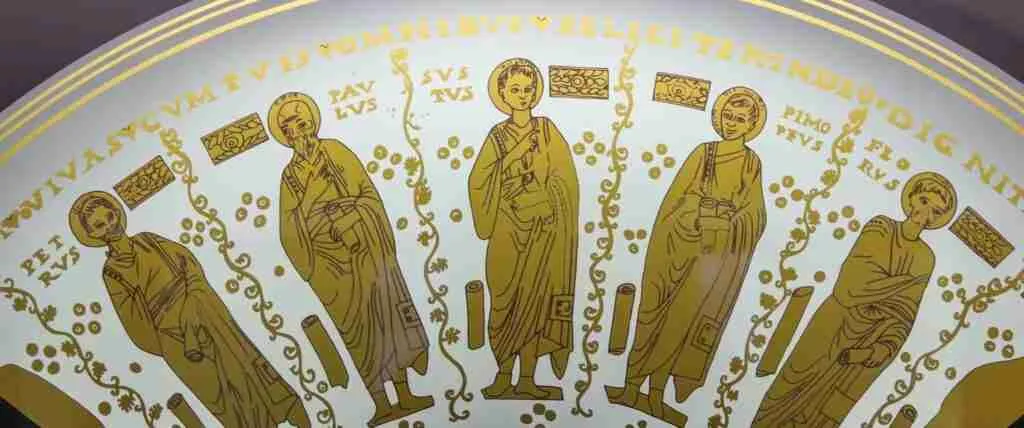
The collection’s most celebrated single object is the Diptych of Emperor Honorius (406 AD) — a consular ivory diptych of exceptional quality, depicting the Western Roman Emperor in full military regalia. It is one of the finest surviving examples of late-Roman ivory carving and one of only a handful of imperial consular diptychs remaining anywhere in the world. It arrived in the cathedral’s treasury in late antiquity, repurposed as a liturgical cover, and has remained in Aosta ever since. Other highlights include Romanesque and Gothic stained-glass roundels (12th century), the Cassa reliquiario di San Grato — the 15th-century reliquary casket of Aosta’s patron saint, begun by Guglielmo di Locana and completed by the Flemish goldsmith Jean de Malines — and a comprehensive survey of regional goldsmithing in silver and gilt copper from the 13th to the 18th centuries.
Admission to the museum alone is €4. The combined ticket for the museum plus the 11th-century fresco cycle in the cathedral loft (sottotetto) costs €5. Entry is free for under-18s, students under 25, and Abbonamento Musei holders. The Treasury and frescoes are open Saturday and Sunday 15:00–17:30 with volunteer custodians through the “Chiese Aperte” programme; for visits outside these hours, contact the cathedral at [email protected]. The loft frescoes — depicting scenes from the Old and New Testaments and the life of Sant’Eustachio — were discovered in 1979 during restoration works and represent one of the most extensive pictorial cycles of the year 1000 known in Europe. Verify current opening hours directly with the cathedral before planning your visit.
Romanesque Cloister and Frescoes of Sant’Orso
The Collegiate Church of Santi Pietro e Orso — universally known as Sant’Orso — stands just beyond the Roman walls, a short walk from the city centre. It is one of the most architecturally and artistically complex buildings in the Alps: the church itself occupies multiple building phases from the 4th century to the 15th, its exterior Romanesque tower among the most elegant in the region.
The church interior is freely accessible. The carved wooden choir stalls (1469), attributed to Jean Vion and Jean de Chetro, are among the finest examples of late Gothic woodcarving in northwestern Italy. For the Romanesque cloister — a masterpiece of 12th-century carved capital decoration, each column capital depicting a different biblical narrative or animal scene in a style combining Burgundian Romanesque with local Alpine invention — admission is €2 per person (€1 for groups with a local guide). For the 11th-century fresco cycle in the church loft, discovered in the same building campaign as the Cathedral frescoes and together forming one of the largest Ottonian pictorial programmes anywhere, admission is €5 (€3.50 for groups with guide). The cloister and frescoes open daily: November to February 9:00–17:00, March and October 9:00–18:00, April to September 9:00–19:00. Guided visits operate daily at 11:00 and 15:00 (16:00 from April to October), except Christmas Day.
Together, the Cathedral Treasury and Sant’Orso offer a remarkably complete picture of Aosta as one of the most significant centres of Ottonian and Romanesque art in Italy — a status rarely acknowledged in mainstream cultural itineraries but fully apparent to any visitor who takes the time to climb both church lofts.
Forte di Bard 2026: The Flagship Cultural Complex of the Lower Valley
In the narrowest gorge of the entire Valle d’Aosta, where the Dora Baltea river squeezes between sheer cliff faces at the village of Bard, a massive 19th-century fortress commands the pass from its rocky promontory. Forte di Bard was built by the Savoy dynasty between 1830 and 1838 on the foundations of an earlier medieval structure destroyed by Napoleon’s forces in 1800 — the famous siege in which the Grande Armée was held up for two weeks by a tiny Piedmontese garrison, a delay that may have affected the entire Italian campaign. The fortress never fired a shot in anger after that siege; it was progressively decommissioned and eventually abandoned before being acquired by the Regione Autonoma Valle d’Aosta and transformed, in a decade-long restoration project completed in 2006, into the valley’s foremost cultural centre.
Today Forte di Bard houses four permanent museums, a rotating programme of major temporary exhibitions, a hotel, a restaurant, and a series of panoramic lifts that carry visitors between the three main operational levels of the complex — the Opera Ferdinando at the base, the Opera Mortai and Opera Vittorio in the middle tier, and the enormous Opera Carlo Alberto at the summit, its Piazza d’Armi (parade ground) ringed by cannon embrasures converted into gallery spaces. The complex is one of the most architecturally dramatic museum settings in Italy.
Four Permanent Museums at Forte di Bard 2026
Museo delle Alpi occupies the first floor of the Opera Carlo Alberto and is the largest of the four permanent collections. Its 29 rooms trace the entire human relationship with the Alpine arc — geology, ecology, the historical development of mountain agriculture and pastoralism, the transformation of the Alps by hydroelectric engineering and the ski industry, and the changing relationship between mountain communities and the lowland cities. The display methodology mixes traditional object showcases with immersive audiovisual installations and interactive stations that work as well for children as for adult specialists. The soundtrack — a continuous “mountain symphony” composed specifically for the museum — underscores the experience throughout.
Le Alpi dei Ragazzi (The Alps for Young People) is the most recent addition, opening in October 2025 in the Opera Vittorio. Its focus is climate change in the Alpine environment — a sensitively designed, deliberately accessible exhibition aimed at school groups but engaging for all ages. Its two immersive rooms using projection and sound to evoke the ecological transformation of the Alpine environment at accelerating speed.
Le Prigioni (The Prisons) occupies the underground level of the Opera Carlo Alberto, where 24 original prison cells survive from the period when the Forte served as a military detention facility. Archival documents, 3D reconstructions, and period imagery guide visitors through the history of the fortress from its medieval predecessor to its Napoleonic destruction and Savoy reconstruction, culminating in its Cold War decommissioning. It is a compact but unusually affecting museum experience.
Ferdinando — Museo delle Fortificazioni e delle Frontiere (Museum of Fortifications and Frontiers) is in the Opera Ferdinando, the lowest and oldest section of the complex. Its two-part exhibition traces first the evolution of military fortification from Roman defensive earthworks to 20th-century reinforced concrete — illustrated through scale models, original weapons, and reconstructed siege apparatus — then pivots to the concept of the frontier itself: border as barrier, border as meeting point, border as political construction. In a region that literally straddles three national cultures (Italian, French, Swiss), this section resonates with unusual immediacy.
Temporary Exhibitions at Forte di Bard 2026
The cannon embrasures and galleries of the Opera Carlo Alberto form some of the most distinctive temporary exhibition spaces in northern Italy: long, vaulted stone corridors that create a dramatic framing for large-format photography and installation art. Forte di Bard has hosted exhibitions of international stature — Wildlife Photographer of the Year, Sebastião Salgado retrospectives, and major Italian contemporary art shows. Check fortedibard.it for the 2026 exhibition calendar; temporary shows renew in spring and autumn.
Forte di Bard 2026 Admission and Hours
From 29 November 2025, Forte di Bard applies a new pricing structure. Access to the entire fortress complex plus three exhibition spaces of your choice: €15 full price, €12 reduced (groups of 12 or more, over-65s). All Forte pass — access to all museums and all temporary exhibitions: €24 full price, free for under-18. Access to the monumental complex only, without museums: €5. Under-18 is free for all museum access; teachers on school trips are admitted free. Abbonamento Musei card holders enter free. Purchase tickets at the ticket office at the foot of the panoramic lifts, or online at midaticket.it.
Opening hours in 2026: Tuesday to Friday 10:00–18:00; Saturday, Sunday, and public holidays 10:00–19:00. The fortress is closed on Mondays except during August, when it opens daily 10:00–18:00. The ticket office closes one hour before the fortress. Check fortedibard.it for the latest hours, including any extraordinary openings for special events. A restaurant (La Polveriera) operates within the complex, and entry to the complex is free for restaurant reservation holders who do not wish to visit exhibitions.
The medieval village of Bard at the foot of the fortress is worth exploring in its own right — classified among Italy’s borghi più belli (most beautiful villages), its narrow lanes and historic houses are accessible year-round and entirely free. Train access from Aosta takes approximately 45 minutes; the Hône-Bard station is a short walk from the fortress ticket office.
The Castle Museum Circuit 2026: Eight Medieval and Renaissance Treasures
The Valle d’Aosta’s castle heritage is unique in Italy. Eight castle-museums are maintained by the regional heritage administration and open to the public on a ticketed basis; a ninth (Introd) opens seasonally. These are not romantic ruins or reconstructed shells: they are largely intact interiors, several with original furniture, frescoes, and decorative cycles that illuminate the courtly culture of the powerful Challant dynasty — the family that dominated the valley for six centuries — and the Savoy sovereigns who succeeded them. Guided visits operate every half-hour during opening hours; the guide, provided by the site staff, is compulsory at most castles. Visits run approximately 30 minutes, with Issogne requiring a full hour due to the extended Avondo itinerary added in recent years.
Common to all eight sites: under-18 entry is free; under-25 pays €3; Abbonamento Musei holders enter free; groups of 25 or more receive the reduced group rate regardless of guide status. All sites are closed on Mondays (except July and August), on 1 January, and on 25 December. Photography without flash or tripod is permitted throughout.
Fénis, Issogne and the Eastern Valley Castles 2026
Castello di Fénis is the most photographed castle in the Valle d’Aosta — a compact, bristling mass of towers and crenellated walls perched on a low promontory in the central valley floor, surrounded by a concentric ring of exterior fortifications that give it the complete appearance of an idealized medieval castle. Its visual power comes partly from the near-perfect state of preservation: the structure built by Ibleto di Challant at the end of the 14th century, incorporating earlier elements, survives largely intact. The interior holds the most important cycle of Gothic frescoes in the region, attributed to the late 14th-century Aosta workshop tradition: a series of paintings in the courtyard depicting Saint George slaying the dragon, the Annunciation, and a procession of saints with an unusual iconographic program. The main hall and private apartments retain their original character. Admission: €10 full price, €7 reduced. Summer hours (April–September): 9:00–19:00. Winter hours (October–March): 10:30–13:00 / 14:00–17:00.
Castello di Issogne requires a full hour’s guided visit and is architecturally and artistically distinct from Fénis. Where Fénis is a fortress, Issogne is a palace — the elegant Renaissance residence of Georges de Challant, completed around 1497, its Gothic-Renaissance loggia frescoed with extraordinary domestic scenes: a pharmacy, a butcher’s shop, a bakery, a gaming house, and various commercial interiors of late 15th-century life in the valley. The pomegranate fountain at the centre of the courtyard is one of the most celebrated pieces of decorative ironwork in Italy. The castle passed to the Piedmontese artist-collector Vittorio Avondo in the late 19th century; the new Percorso Avondo (Avondo Itinerary), which opened recently and includes previously inaccessible rooms, traces Avondo’s extraordinary transformation of the castle into a lived-in work of art and his relationships with the intellectual circles of late-Romantic Turin. Admission: €10 full price, €7 reduced. Same seasonal hours as Fénis.
Castello di Verrès dominates the valley from a sheer rocky spine above the town of Verrès — a spare, severe early-Renaissance structure built by Ibleto di Challant in the 1390s as a pure military stronghold, with none of the residential warmth of Fénis or Issogne but extraordinary views across the valley in both directions. Its most dramatic feature is the interior courtyard: three floors of open arcaded galleries stacked around a narrow well shaft, the arches growing lighter and more decorative as they ascend. Admission: €6 full price, €4 reduced.
Upper Valley Castles 2026
Castello di Aymavilles, the most recently restored of the regional castles (open to the public since 2022), differs from its siblings in two significant ways: visits are self-guided rather than escorted, and the interior now houses an interactive natural history museum presenting the fauna, flora, and geology of the Valle d’Aosta and the Gran Paradiso National Park through sophisticated audiovisual installations. The castle itself is a 14th-century structure heavily remodelled in the 17th and 18th centuries — its four cylindrical corner towers giving it a distinctive Baroque profile unusual in the valley. Admission: €9 full price, €7 reduced; family ticket €25 (2 adults, 2 children). Guided visits with an operator are available once or twice daily for an additional charge of €12 per person. Summer hours: 9:00–19:00. Winter hours: 10:00–18:00. Fully accessible for wheelchair users.
Castello Reale di Sarre is the finest of the Savoy royal residences in the valley — a compact neo-Gothic castle with pointed towers and a dramatically furnished interior, chosen by King Vittorio Emanuele II as his hunting lodge in 1869. The walls of the main halls are lined with the trophies of decades of royal chamois hunts: hundreds of ibex horns in geometric arrangements, skulls, and mounted heads that give the interior an extraordinary, slightly surreal atmosphere. A guided tour reveals both the intimacy of the royal private apartments and the political ambition encoded in the castle’s hunting imagery. Admission: €8 full price, €6 reduced.
Castel Savoia di Gressoney-Saint-Jean is the most romantically situated of the valley’s castle-museums — a fairy-tale neo-Gothic villa built in the 1890s for Queen Margherita of Savoy, set above the village of Gressoney-Saint-Jean in the Lys Valley at 1,385 metres, surrounded by larches and overlooking the Lyskamm and Monte Rosa glaciers. Its interior preserves the personal furnishings, correspondence, and mountain equipment of a late-Victorian royal holidaymaker with an unusually modern passion for Alpine climbing. The main staircase was under restoration during June 2025 but all principal rooms remain accessible. Admission: €10 full price, €7 reduced. Summer hours: 9:00–19:00. Winter hours: 10:30–13:00 / 14:00–17:00.
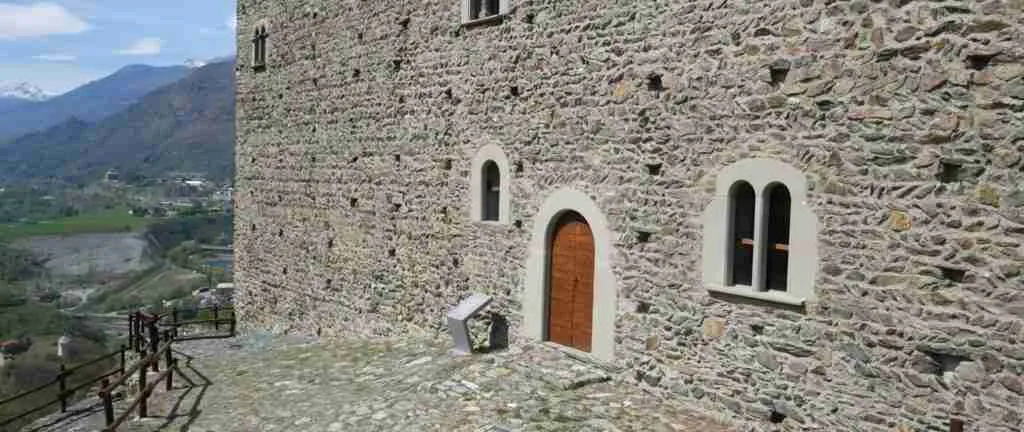
Castello Sarriod de la Tour at Saint-Pierre is one of the oldest inhabited structures in the valley — a tower-house with a 12th-century keep, documented from the 11th century, that passed through numerous aristocratic owners before acquisition by the regional authority. Its most singular feature is the main audience chamber, whose 15th-century sculpted vault corbels depict a grotesque carnival of monsters, hybrid beasts, and caricatured human faces — one of the most extraordinary ensembles of late-Gothic decorative sculpture in Alpine Italy. Admission: €6 full price, €4 reduced.
Castle Pass Options 2026
For visitors planning to explore multiple castles, three dedicated passes offer meaningful savings over individual entry prices. The Culture Card Castelli covers one entry to each of all nine castles in the regional circuit for €48, valid for six months from first use. The Culture Card Bassa Valle covers five sites — Fénis, Castello Gamba, Verrès, Issogne, and Castel Savoia di Gressoney — for €26 (six months). The Culture Card Alta Valle covers five sites — Aymavilles, Sarre, Sarriod de la Tour, Castello Saint-Pierre (Natural History Museum), and the Pont d’Ael Roman aqueduct bridge — also for €26 (six months). All three cards are sold at the ticket offices of participating castles, are non-refundable, and are valid from first activation. For visitors with an Abbonamento Musei card, all nine castles are included without additional charge.
Castello Gamba and Contemporary Art 2026
At Châtillon, 27 kilometres east of Aosta, a dramatically positioned early-20th-century villa on a rock spur above the Dora Baltea houses the Regione Autonoma Valle d’Aosta’s collection of modern and contemporary Italian art. Castello Gamba was built between 1901 and 1903 by the Turin baron Carlo Maurizio Gamba as a summer residence for his wife — and it retains the human scale and aesthetic intimacy of a grand private house rather than the institutional sobriety of a regional museum. The building is surrounded by a 7,000-square-metre park containing a California giant sequoia planted in 1888, a 120-year-old Gleditsia triacanthos, and a 121-year-old bald cypress introduced from Florida — a collection of specimen trees that makes the grounds as interesting as the interior.
The permanent collection numbers over 1,500 works, with approximately 150 displayed across 13 rooms on a rotating basis. Its scope is the history of Italian art from the early 20th century to the contemporary present, with particular depth in mid-century Figurative and Informal work. Canonical names represented in the collection include sculptors Arturo Martini, Umberto Mastroianni, Giacomo Manzù, and Arnaldo and Giò Pomodoro; painters Felice Casorati, Filippo De Pisis, Carlo Carrà, and Renato Guttuso. The collection’s strongest Italian regional dimension is its dedication to Italo Mus (1892–1967) — the symbolic artist of the Valle d’Aosta, born in Aosta and trained in Turin, whose landscapes and portraits constitute one of the finest records of 20th-century mountain life anywhere in Italy. A dedicated permanent gallery presents a sustained survey of Mus’s work across all periods.
Castello Gamba also operates a vigorous temporary exhibition programme. In spring 2026, the museum is presenting Sole caduto Aosta: Giò Pomodoro, a retrospective devoted to the sculptor’s relationship with the Valle d’Aosta landscape. Check castellogamba.vda.it for the full 2026 calendar. Admission: €6 full price, €4 reduced; free for under-18 and Abbonamento Musei holders. Same seasonal hours as the castles: summer 9:00–19:00, winter 10:00–17:00, closed Monday.
Centro Saint-Bénin: International Exhibitions in a Baroque Chapel
Back in Aosta city, the Centro Saint-Bénin (Via Festaz 27) hosts the region’s most ambitious programme of temporary international exhibitions inside the 17th-century chapel of a Benedictine priory founded around 1000 AD. The chapel — rebuilt from 1676 to 1680 alongside a Romanesque campanile with bifora windows dating to the 12th century — presents its vaulted stone interior and a spectacular Baroque altar with twisted columns as a permanent backdrop to an annual sequence of shows that has brought Rodin, Andy Warhol, Giorgio De Chirico, Steve McCurry, and Brassaï to Aosta since the programme began in 1986.
In 2026 the Centro Saint-Bénin is presenting Mario Giacomelli. Oltre il visibile — a major retrospective of the Marchigian photographer whose black-and-white images of seminary life, Italian peasants, and the marks of agriculture on the landscape represent some of the most affecting photography made anywhere in Italy in the second half of the 20th century. Ticket prices for temporary exhibitions at the Centro Saint-Bénin vary by show; Abbonamento Musei holders enter free. Check the regional culture website (regione.vda.it) for current exhibition details and prices.
Together, Castello Gamba and Centro Saint-Bénin form the backbone of the Valle d’Aosta’s engagement with contemporary art and international cultural programming — an offer that, combined with the permanent collection at Gamba and the archaeological depth of Aosta, provides a remarkably complete cultural experience across all periods and media.
Natural History and Specialist Museums 2026
Museo Regionale di Scienze Naturali “Efisio Noussan” — Castello Saint-Pierre
The Museo Regionale di Scienze Naturali occupies the Castello Saint-Pierre — a 12th-century tower-castle on a hillside above the village of Saint-Pierre, roughly 10 kilometres west of Aosta. The museum’s permanent exhibition presents the natural environment of the Valle d’Aosta in systematic depth: geology and mineralogy (the region sits at the geological boundary between African and European plates, creating remarkable diversity in rock types and mineral deposits); Alpine ecology from valley floor to the high-altitude desert above 3,500 metres; and the fauna of the region, including the ibex and chamois populations of the Gran Paradiso National Park, the largest protected Alpine territory in Italy. The display methodology is consistently high-quality, and the two immersive rooms — one evoking the sounds and light changes of a complete Alpine year, one exploring the extreme winter silence of the snowbound landscape — are among the most affecting natural history installations in northern Italy.
Entry to the Museo Regionale di Scienze Naturali is €10 full price, €8 reduced (groups of 15 or more, or accompanied by a local guide). Under-18 and Abbonamento Musei holders enter free. The museum is visited on self-guided admission, with small groups entering roughly every hour. Opening hours: 10:00–18:00 Tuesday to Sunday, closed Monday. Advance reservation is strongly recommended, especially on weekends; book through museoscienze.vda.it.
The Miniere di Cogne: An Industrial Heritage Complex
At the upper end of the Valsavarenche, the village of Cogne was for much of the 20th century the site of the largest magnetite iron ore mine in Italy — a complex of underground galleries, processing facilities, and workers’ housing that at its peak employed over 3,000 people and produced iron for the Fiat and Ansaldo industrial empires of Turin and Genoa. The mine closed in 1979; the complex has since been transformed into the Parco Minerario della Valle d’Aosta — a mining heritage park combining a substantial museum with the possibility of guided tours into the actual mine tunnels.
The museum at Cogne tells the story of the mine’s geology, its social history (the company town, the workers’ welfare system, the closure), and the technical evolution of deep-rock ore extraction from pick-and-shovel to mechanized drilling. The underground tour portion of the visit is the most affecting element: guided groups enter the original mine workings at around 1,600 metres altitude, moving through tunnels cut directly into the mountain, past the original machinery and ore-loading infrastructure. Check the Fondation Grand Paradis (grand-paradis.it) for current opening season, hours, and ticket prices, as these vary annually.
Museo dell’Artigianato Valdostano (MAV) and Ecomusei
The Museo dell’Artigianato Valdostano (MAV) in Aosta city presents the traditional craft heritage of the valley: woodcarving, ironwork, textile production, cheese-making equipment, and the extraordinary range of domestic objects and tools that sustained mountain communities across the centuries before industrial goods became available. The collection is particularly strong on pane di segale — the rye bread culture of the valley — and on the carved wooden cou, the yoke used in the valley’s traditional Batailles des Reines (cow-fighting competitions). Check the regional tourism website lovevda.it for current opening hours and admission.
Scattered across the valley are several smaller ecomusei — eco-museums embedded in still-functioning or recently decommissioned agricultural and artisanal environments. These include mountain farmsteads open for guided visits at fixed times, a traditional cheesemaking dairy in the Valgrisenche, and a medicinal herbs museum in the middle valley. The Observatoire Astronomique de la Région Autonome Vallée d’Aoste at Saint-Barthélemy, in the hills above Nus, hosts public astronomy evenings and planetarium shows at an altitude that provides genuinely dark-sky conditions. Reservation is compulsory and capacity is limited; book well in advance through the regional tourism website.
The Abbonamento Musei and Other Passes: Complete 2026 Planning
The most important practical decision for any serious cultural visitor to the Valle d’Aosta in 2026 is whether to purchase a museum pass. Three systems operate simultaneously, and the right choice depends on the length and scope of your visit.
Abbonamento Musei Piemonte / Valle d’Aosta 2026
The Abbonamento Musei Piemonte e Valle d’Aosta costs €58 per year (365 days from activation) for a standard adult. A Lombardia and Valle d’Aosta version costs €52. The combined Formula Extra covering all three regions — Piemonte, Lombardia, and Valle d’Aosta — costs €87. Reduced rates exist for students with ISEEU/ISEE qualifications and for certain partner organizations. The card is strictly personal, non-transferable, and requires proof of identity at all participating sites.
In the Valle d’Aosta, the Abbonamento Musei provides free unlimited access to: all eight castles (Fénis, Issogne, Verrès, Aymavilles, Sarre, Sarriod de la Tour, Castel Savoia di Gressoney, and Castello Gamba); the entire Aosta archaeological circuit (MAR, Cryptoporticus, San Lorenzo); the MegaMuseo; Forte di Bard; Centro Saint-Bénin; the Museo Regionale di Scienze Naturali at Castello Saint-Pierre; the Pont d’Ael Roman aqueduct bridge; plus numerous ecomusei, mine museums, and botanical gardens. The total face value of single-entry tickets to all these sites, at full adult price, comfortably exceeds €200; the card pays for itself in approximately seven visits to standard-price sites. For any visitor planning three or more cultural days in the valley, the card represents clear financial logic. Cards are sold at museum ticket offices and online at abbonamentomusei.it.
Culture Card Castelli Options 2026
The Culture Card Castelli options are designed for visitors whose primary interest is the castle circuit. Culture Card Castelli (all nine sites, six months): €48. Culture Card Alta Valle (Aymavilles, Sarre, Sarriod de la Tour, Castello Saint-Pierre, Pont d’Ael, six months): €26. Culture Card Bassa Valle (Fénis, Castello Gamba, Verrès, Issogne, Castel Savoia, six months): €26. All three cards are sold exclusively at the ticket offices of participating castles. The Bassa Valle card saves €16 compared to individual admissions to all five sites; the full Castelli card saves approximately €42 over individual entries. Cards are non-refundable.
Summary of Entry Prices 2026
- Aosta Archeologica forfait (MAR + Cryptoporticus + San Lorenzo): €5 (temporarily reduced; Teatro Romano closed)
- Area Megalitica / MegaMuseo: €7 full, €5 reduced; forfait holders receive reduced rate
- Cathedral Treasury Museum (Museo del Tesoro): €4 museum only; €5 museum + 11th-century frescoes
- Sant’Orso Romanesque Cloister: €2; frescoes tour: €5 (€3.50 with guide)
- Forte di Bard: €15 (3 spaces), €24 All Forte pass; free under-18
- Castles Fénis, Issogne, Castel Savoia, Aymavilles: €9–€10 full
- Castles Sarre: €8; Verrès, Sarriod de la Tour, Castello Gamba: €6 each
- Museo Regionale di Scienze Naturali (Castello Saint-Pierre): €10 full, €8 reduced
- Under-18: free at all regional sites; under-25: €3 at most regional sites
- Abbonamento Musei (Piemonte/VdA): €58/year; (Lombardia/VdA): €52/year
- Culture Card Castelli (all 9): €48; Alta Valle or Bassa Valle (5 sites each): €26
A Three-Day Cultural Itinerary for Aosta Valley 2026
The following itinerary covers the major highlights across three days and is designed for first-time cultural visitors arriving by train or car. Adult entry costs without any pass total approximately €61 per person; with the Abbonamento Musei (€58), the same three days cost only the card fee — a difference of €3 that rewards any visitor planning to continue into the Piedmontese or Lombard museum network afterward.
Day 1: Aosta City — Romans, Megaliths, and Sacred Art 2026
Arrive early in Aosta city. Begin at the MAR Archaeological Museum (Piazza Roncas), purchasing the €5 Aosta Archeologica forfait at the ticket desk; allow 90 minutes for the full permanent collection. From the MAR, a short walk reaches the Cryptoporticus Forense — descend into the Roman underground galleries for 30 minutes. Continue to the Paleochristian Basilica of San Lorenzo (15 minutes). En route, take in the Porta Praetoria and the Arch of Augustus from the street.
After lunch in the city centre — the covered market area around Via Xavier de Maistre has good value lunch options — dedicate the afternoon to the Area Megalitica / MegaMuseo (allow 90 minutes minimum; book in advance). Before dinner, visit the Romanesque Cloister of Sant’Orso (€2; one of the most beautiful Romanesque spaces in the Alps and entirely worth its price). If time permits, book the Cathedral Treasury Museum (€4–€5; Saturday and Sunday 15:00–17:30, or by appointment on weekdays).
Day 1 entry costs per adult (without pass): MAR forfait €5 + MegaMuseo €5 (reduced) + Sant’Orso cloister €2 + Cathedral Treasury €4 = €16.
Day 2: The Eastern Valley Castles 2026
Take the train or drive east toward the Bassa Valle. Begin at Castello di Fénis (allow 45 minutes; book the 9:30 or 10:00 guided entry online at midaticket.it to avoid waiting). Continue 15 kilometres to Castello di Issogne — the one-hour Avondo itinerary makes this the longest single castle visit, and it repays the time fully. If energy allows, continue another 12 kilometres to Castello di Verrès for a third castle contrast (€6). End the day at Castello Gamba in Châtillon for contemporary Italian art in an extraordinary park setting (€6; same cultural ticket network). Return to Aosta or overnight in Châtillon.
Day 2 entry costs per adult (without pass): Fénis €10 + Issogne €10 + Verrès €6 + Gamba €6 = €32. With the Culture Card Bassa Valle (€26), the same four sites cost only the card fee.
Day 3: Forte di Bard 2026
Dedicate the full third day to Forte di Bard. The All Forte pass (€24) covers all four permanent museums plus all temporary exhibitions and is the most logical ticket for a full-day visit. Plan four to five hours minimum: the Museo delle Alpi alone takes 90 minutes at an absorbing pace, and the temporary exhibition halls in the Opera Carlo Alberto often host major shows worth a further hour. Lunch at La Polveriera restaurant inside the fortress (book a table in advance at 0125 833868) or picnic on the Piazza d’Armi with valley views. Before leaving, walk through the medieval village of Bard at the foot of the fortress.
Day 3 entry costs per adult (without pass): All Forte pass €24.
Three-day total entry cost per adult without any pass: approximately €72. With Abbonamento Musei (€58): the card alone covers all sites across all three days and extends to hundreds more sites in Piemonte and Lombardia.
Practical Tips for Cultural Visitors 2026
Booking and Advance Ticketing 2026
Castle visits in the Valle d’Aosta operate on timed entry with groups limited to 30 people per slot. During July and August, and on Italian public holidays throughout the year, waiting times at the most popular castles (Fénis, Issogne, Aymavilles) can exceed an hour without advance booking. Book castle visits online through midaticket.it up to 30 days in advance; there is no booking fee. Forte di Bard does not require advance booking except for guided tours, which must be reserved by email ([email protected]). The MegaMuseo accepts both walk-in and advance bookings; pre-booking is advisable at peak summer weekends. The Museo Regionale di Scienze Naturali at Castello Saint-Pierre requires advance reservation through museoscienze.vda.it due to limited capacity in the timed-entry format.
Getting Around the Valley 2026
A car offers maximum flexibility for visiting the dispersed castle network, but is not essential. The main SS26 road and the Turin–Courmayeur railway line run the length of the valley, connecting Aosta to all major sites. Forte di Bard is directly accessible by rail (Hône-Bard station, 45 minutes from Aosta). Châtillon (Castello Gamba) is on the same rail line, 20 minutes from Aosta. The Fenis bus service from Aosta takes approximately 25 minutes. Car hire is available at Aosta station. Within Aosta city, all archaeological sites and museums are within a compact 2-kilometre pedestrian zone; the city centre is easily walked.
Seasonal Considerations 2026
The Valle d’Aosta’s cultural sites operate year-round, but the experience varies significantly by season. Summer (June–August) brings extended 9:00–19:00 hours at all sites, Monday openings, and a full programme of temporary exhibitions and evening events. August is the busiest month; castle queues at Fénis and Issogne can be significant without advance booking. Spring (April–May) and autumn (September–October) offer ideal weather, lower crowds, and the full exhibition calendar still in operation — the best overall period for cultural visits. Winter (November–March) sees reduced hours at castles (10:30–13:00 / 14:00–17:00) and Monday closures, but the MegaMuseo, MAR, and Forte di Bard all maintain regular schedules, and the valley’s Christmas markets (Aosta’s is one of northern Italy’s finest) create a compelling winter cultural atmosphere. Note: the Skyway Monte Bianco cable car is closed for maintenance from 20 April to the end of May 2026.
Accessibility 2026
Forte di Bard is fully accessible at all levels via panoramic lifts and ramps — one of the most wheelchair-accessible heritage sites in northern Italy, remarkable given the building’s military origins. The MegaMuseo, MAR, Castello di Aymavilles, and Castello Saint-Pierre (Natural History Museum) are all accessible for wheelchair users. The medieval castles — Fénis, Issogne, Verrès, Sarre, Castel Savoia, Sarriod de la Tour — have varying degrees of accessibility due to their original staircase-heavy construction; check individual site pages on valledaostaheritage.com or abbonamentomusei.it for specific accessibility information before planning a visit.
Frequently Asked Questions About Aosta Valley Museums 2026
Is the Teatro Romano di Aosta open in 2026?
No. The Teatro Romano di Aosta is currently closed for major structural restoration works affecting the entire surrounding area. There is no confirmed reopening date as of mid-2026. The closure has resulted in a temporary reduction of the Aosta Archeologica circuit forfait from €10 to €5; once the theatre reopens and rejoins the circuit, the forfait price will return to the standard level. The external façade of the Roman theatre — its three-storey stage wall standing to nearly full height — remains visible from the adjacent street at no cost. Check valledaostaheritage.com for the latest update on the restoration timeline.
How many museums and cultural sites are there in the Valle d’Aosta?
The Abbonamento Musei circuit includes approximately 30 distinct cultural sites in the Valle d’Aosta alone, ranging from the major museums and castle complexes described in this guide to smaller ecomusei, mining heritage centres, visitors’ centres of the Gran Paradiso National Park, botanical gardens, and artisan craft museums. When smaller private museums, church treasuries, and seasonally open cultural spaces are included, the total exceeds 40. The concentration of significant cultural sites in a region this size — smaller than many individual Italian provincial cities — is genuinely exceptional.
Can I visit Forte di Bard with children in 2026?
Yes, and it is one of the best family cultural destinations in the entire Alpine arc. Entry to all Forte di Bard museums is free for under-18s (adults pay €15 for three spaces or €24 for the All Forte pass). Le Alpi dei Ragazzi, the newest permanent museum (opened October 2025), is specifically designed for younger visitors and explores climate change in the Alps through highly engaging interactive media. The Museo delle Alpi has interactive stations throughout its 29 rooms. The panoramic lifts connecting the fortress levels are a ride in themselves. The medieval village at the foot of the fortress has cafes and picnic areas. Plan for at least four hours with children who engage with the interactive elements.
What is the Area Megalitica and why is it significant?
The Area Megalitica di Saint-Martin-de-Corléans is a prehistoric ritual complex discovered beneath a western suburb of Aosta in the 1970s, dating from approximately 4500 BC to the Iron Age — a span of over 4,000 years of continuous use of the same sacred site. It contains two neolithic necropolises, ritual post-hole alignments, a central dolmen, and 46 carved anthropomorphic standing stones (stelae) depicting daggers, solar discs, and stylized human figures. The site is one of the most important prehistoric discoveries made in Italy in the 20th century and houses the largest covered megalithic area in Europe. The MegaMuseo built around the excavated site allows visitors to walk through the actual prehistoric layers at their original depth.
How do I get to Forte di Bard from Aosta by train?
Take any train on the Turin–Aosta line eastbound toward Ivrea or Turin. The Hône-Bard station is approximately 45 minutes from Aosta and a 10-minute walk from the fortress ticket office at the foot of the panoramic lifts. Trains run approximately hourly; check the Trenitalia website or app for current timetables. By car, Forte di Bard is on the SS26 main valley road approximately 45 kilometres east of Aosta, with a paid multi-storey car park directly at the fortress entrance (€3 weekdays, €4 weekends). Two free car parks are available approximately 200–300 metres from the entrance along the SS26.
Is the Abbonamento Musei worth buying for a 3-day visit to the Valle d’Aosta?
Yes, clearly. The entry fees for three focused cultural days — Aosta city (€16 in entries), two valley castles plus Castello Gamba (€32), and Forte di Bard All Forte pass (€24) — total approximately €72 per adult without any pass. The Abbonamento Musei Piemonte and Valle d’Aosta costs €58 for 365 days, covering every one of those sites and dozens more. For a standalone three-day visit, the card saves approximately €14 over individual entry prices, and becomes more valuable for any visit exceeding three days. For visitors already holding the Abbonamento Musei from a previous Piemonte visit, all Valle d’Aosta sites are included at no additional cost.
What are the best museums for contemporary art in the Valle d’Aosta?
Castello Gamba at Châtillon is the permanent home of the regional collection of modern and contemporary Italian art — 150+ works on display across 13 rooms, with particular strength in mid-century Italian figurative and informal painting and sculpture (Martini, Manzù, Casorati, Guttuso, Giò Pomodoro). Its temporary exhibition programme runs year-round. Centro Saint-Bénin in Aosta city hosts major international temporary exhibitions — photography, installation, and contemporary art — in a Baroque chapel setting that constitutes one of the most distinctive exhibition spaces in northern Italy. The temporary exhibition halls at Forte di Bard regularly host large-format photography retrospectives and contemporary art shows of national significance. All three venues have hosted internationally recognized artists and exhibitions in recent years.
Which castle in the Valle d’Aosta is best for frescoes?
Castello di Fénis has the most important and extensive medieval fresco cycle among the castles — a late-14th-century Gothic programme covering the courtyard arcades and chapel with Saints, the Annunciation, and Saint George, attributed to the Aosta workshop tradition and considered among the finest of its period in northwestern Italy. For Renaissance domestic frescoes, Castello di Issogne surpasses all others: its loggia is covered with detailed scenes of late-15th-century market life — pharmacy, butcher, bakery — that are unique in Italian art as a documentary record of valley commerce and daily activity. For Romanesque fresco painting in a religious context rather than a castle, the church lofts of Aosta Cathedral and Sant’Orso contain two of the most complete Ottonian fresco cycles in Europe, both from the first half of the 11th century.
Are there free museums in Aosta and the Valle d’Aosta in 2026?
Several significant cultural experiences are free of charge. The Arco di Augusto (Arch of Augustus) and the Porta Praetoria in Aosta city are freely accessible at all hours as pedestrian infrastructure. The Romanesque exterior and church interior of Sant’Orso are freely entered; only the cloister and loft frescoes are ticketed. The Basilica of the Cathedral is freely accessible; only the Treasury Museum and loft frescoes require a ticket. The medieval village of Bard at the foot of Forte di Bard is entirely free. Temporary outdoor exhibitions and public art installations in Aosta city’s historic centre appear regularly through the cultural season. The Villa Romana della Consolata — a preserved Roman domestic interior in central Aosta — is free on reservation, open Thursday 10:00–13:00 and Saturday 14:00–17:00 (call 0165 275911 to book).
What is the best time of year to visit cultural sites in the Valle d’Aosta?
Late spring (May–June) and early autumn (September–October) offer the best combination of conditions: full 9:00–19:00 hours at all sites, the complete temporary exhibition calendar in operation, moderate crowds compared to July and August, and favorable Alpine weather. July and August have the highest visitor volumes — castle queues without advance booking can be significant — but also the longest hours and Monday openings. Late autumn and winter offer a different but equally valid experience: reduced castle hours but the atmospheric context of an Alpine valley in its quieter season, the extraordinary Aosta Christmas market running from late November to early January, and the full cultural programme of Forte di Bard, the MegaMuseo, and Aosta city sites maintained throughout. Winter is the ideal season for in-depth visits to Aosta’s Roman archaeology, which benefits from the absence of summer crowds.