
Ancient Olympia UNESCO Guide: Birthplace of the Olympics
Ancient Olympia stands as one of the most spiritually significant archaeological sites in classical civilization, functioning for over a millennium as both the primary sanctuary of Zeus and the birthplace of the Olympic Games that unified the Greek world every four years. The sacred precinct of the Altis, nestled in a fertile valley where the Alpheios and Kladeos rivers converge, preserves temples, training facilities, and athletic structures that embodied ancient Greece’s highest ideals of physical excellence, peaceful competition, and divine worship.
Key Takeaways
- Ancient Olympia received UNESCO World Heritage designation in 1989 based on its exceptional testimony to ancient Greek civilization, housing one of the highest concentrations of masterpieces from the classical world within the sacred Altis precinct
- The Olympic Games began at Olympia in 776 BC according to traditional chronology and continued for 1,169 years until Emperor Theodosius I abolished pagan festivals in 393 AD, making them the longest-lived institution of antiquity
- The Temple of Zeus at Olympia housed the chryselephantine Statue of Zeus created by Pheidias, ranked among the Seven Wonders of the Ancient World for its 13-meter height and masterful combination of ivory and gold on a wooden framework
- The archaeological site preserves the complete infrastructure of ancient athletic competition including the stadium with its 192-meter track, gymnasium, palaestra training facilities, and the starting mechanism that launched runners simultaneously across the ancient world’s most prestigious racecourse
- Archaeological Museum of Olympia displays the world’s richest collection of ancient bronze objects alongside the monumental sculptures from the Temple of Zeus pediments depicting the chariot race of Pelops and the battle between Lapiths and Centaurs
- The sanctuary’s Sacred Truce (Ekecheiria) suspended hostilities across the Greek world for three months surrounding each Olympic festival, enabling athletes and spectators to travel safely from distant city-states and demonstrating sport’s power to transcend political conflicts
People Also Ask About Ancient Olympia
What makes Ancient Olympia a UNESCO World Heritage Site?
Ancient Olympia earned UNESCO World Heritage status in 1989 for its outstanding universal value as the birthplace of the Olympic Games and one of the most important Panhellenic sanctuaries of the ancient Greek world. The site meets UNESCO criteria for demonstrating exceptional testimony to a cultural tradition through its role as the spiritual and athletic center where Greeks from all city-states gathered peacefully every four years for over a millennium. The Altis sacred precinct contains one of the world’s highest concentrations of ancient Greek architectural and sculptural masterpieces, including the Temple of Zeus that housed Pheidias’s chryselephantine statue ranked among the Seven Wonders of the Ancient World. UNESCO recognizes Olympia’s enduring influence on human civilization through the Olympic ideal of peaceful competition, which Pierre de Coubertin revived in 1896 to promote international understanding through sport.
How long did the ancient Olympic Games last at Olympia?
The ancient Olympic Games at Olympia spanned 1,169 years from their traditional founding in 776 BC until 393 AD when Roman Emperor Theodosius I banned pagan festivals as part of Christianity’s establishment as the empire’s official religion. The games evolved from a single-day footrace into a five-day festival by 472 BC, incorporating chariot racing, pentathlon, wrestling, boxing, and various running distances. These quadrennial competitions occurred without interruption throughout this period despite nearly continuous warfare among Greek city-states, protected by the Sacred Truce that guaranteed safe passage for athletes and spectators. The games’ remarkable continuity across nearly twelve centuries demonstrates their central role in Greek cultural identity and religious life, functioning as the ancient world’s most prestigious athletic and social gathering that transcended political divisions.
What happened to the Statue of Zeus at Olympia?
The Statue of Zeus at Olympia, one of the Seven Wonders of the Ancient World, met an uncertain end sometime between the 5th and 6th centuries AD after surviving approximately 800 years since its creation by Pheidias around 435 BC. Ancient sources provide conflicting accounts of the statue’s fate: the Byzantine historian Georgios Kedrenos claims it was transported to Constantinople where it perished in a palace fire in 475 AD, while other evidence suggests it remained at Olympia until the temple’s destruction. Theodosius II ordered the demolition of pagan temples in 426 AD, and subsequent earthquakes in 522 and 551 AD caused extensive damage to Olympia’s structures. The statue’s ivory and gold materials made it valuable for plunder during the chaotic transitional period between paganism and Christianity, explaining why no physical remains have been discovered despite the workshop of Pheidias being excavated with tools and molds confirming the statue’s creation at Olympia.
Can you visit the ancient Olympic stadium at Olympia?
The ancient Olympic stadium at Olympia remains accessible to visitors as part of the archaeological site, preserving its original 192.27-meter track length that defined the “stadion” unit of measurement used throughout the Greek world. Visitors walk through the vaulted entrance tunnel (krypte) that athletes used to enter the competition area, emerging onto the earthen track where sprinters competed for olive wreath crowns before crowds of up to 45,000 spectators seated on grassy embankments. The stadium’s starting and finish lines survive as stone sills with grooves where runners positioned their feet for simultaneous starts controlled by a mechanical gate system. Modern Olympic torch lighting ceremonies occur at Olympia’s ancient stadium before each Olympic Games, connecting contemporary athletic competition with its 2,800-year heritage. The site’s restoration in the 1950s-1960s maintained archaeological authenticity while making the stadium’s scale and layout comprehensible to visitors experiencing the space where Western athletic tradition originated.
Extended multi-day tours – 5+ days
Featured Peloponnese Islands Multi-Day Tour Packages
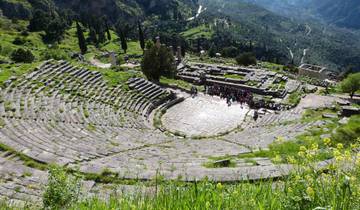
3 days
Epidaurus, Mycenae, Olympia and Delphi Three Days Tour from Athens
- ✓ Comprehensive Peloponnese Islands tour
- ✓ Expert local guides included
- ✓ All accommodation arranged
- ✓ Transportation provided
5 days
Athens, Delphi & Greek Islands By Cruise – 5 Days
- ✓ Comprehensive Peloponnese Islands tour
- ✓ Expert local guides included
- ✓ All accommodation arranged
- ✓ Transportation provided
5 days
Discovery of Athens, Argolis & Delphi – 5 Days
- ✓ Comprehensive Peloponnese Islands tour
- ✓ Expert local guides included
- ✓ All accommodation arranged
- ✓ Transportation provided
8 days
Paradisial Peloponnese | Semi-Private 8-Day Guided Tour
- ✓ Comprehensive Peloponnese Islands tour
- ✓ Expert local guides included
- ✓ All accommodation arranged
- ✓ Transportation provided
Multi-day tour packages powered by TourRadar. Prices and availability subject to change.
Introduction: The Sacred Sanctuary of Zeus
Ancient Olympia occupies a valley of exceptional natural beauty at the confluence of the Alpheios and Kladeos rivers in the northwestern Peloponnese, approximately 18 kilometers from the Ionian Sea. The site’s geographic position combined fertility, abundant water, and accessibility to create an ideal location for a Panhellenic sanctuary that would attract pilgrims and athletes from across the Mediterranean world. Mount Kronion rises immediately north of the sanctuary, its pine-covered slopes providing a dramatic backdrop to the temples and treasuries clustered in the Altis, the sacred grove dedicated to Zeus where the most important religious and athletic activities occurred.
The sanctuary’s origins reach into the Bronze Age, with archaeological evidence indicating continuous habitation from 2000-1600 BC and significant religious activity beginning in the 10th century BC when Zeus worship became established at the site. Early votive offerings including bronze tripods, figurines, and weapons demonstrate Olympia’s growing importance as a cult center during the Geometric period (900-700 BC), when the sanctuary emerged as one of several Panhellenic religious sites including Delphi, Delos, and Isthmia where Greeks transcended city-state rivalries through shared worship and competition.
Olympia’s transformation from regional sanctuary to Panhellenic institution occurred gradually between the 8th and 6th centuries BC as the Olympic Games gained prestige and participation expanded beyond the Peloponnese to include athletes from Greek colonies in Sicily, southern Italy, Asia Minor, and the Black Sea region. The sanctuary’s administration passed from the nearby city of Pisa to Elis around 570 BC, with Elean officials managing the games and sacred precinct for the remainder of antiquity. This political arrangement sometimes caused friction when Elean favoritism toward local athletes created accusations of bias, though the games’ sacred character generally ensured fair competition and impartial judging.
The classical period (5th-4th centuries BC) witnessed Olympia’s architectural zenith as major construction projects transformed the sanctuary into one of antiquity’s most impressive religious complexes. The Temple of Zeus, completed around 456 BC, housed Pheidias’s chryselephantine statue and established the site’s visual dominance through its massive Doric columns and elaborate sculptural programs. Wealthy city-states and individuals sponsored treasuries, monuments, and statues that lined the sacred way, creating a landscape where religious devotion, athletic achievement, and political display intermingled in sophisticated spatial relationships designed to impress pilgrims with Greek cultural accomplishment.
Roman patronage sustained Olympia’s prominence after Greece’s incorporation into the empire, with emperors including Augustus, Nero, and Hadrian sponsoring building projects and attending the games to demonstrate their philhellenic credentials. Nero’s participation in 67 AD scandalized traditionalists when he entered chariot races and theatrical competitions added specifically for his visit, winning despite falling from his chariot. The games continued under Roman rule until the late 4th century AD when Christianity’s triumph led to the suppression of pagan festivals and Olympia’s gradual abandonment as a religious center.
Natural disasters sealed Olympia’s fate following its religious decline. Theodosius II ordered temple destruction in 426 AD, earthquakes in 522 and 551 AD toppled remaining structures, and flooding from the Kladeos River deposited layers of silt that buried the ruins and preserved them for modern excavation. The site remained hidden under alluvial deposits for over a millennium until scientific archaeology beginning in the 1820s gradually revealed the sanctuary’s extent and significance, establishing Olympia as a cornerstone of classical archaeology and a symbol of sport’s enduring cultural importance.
UNESCO World Heritage Status and Significance
The Archaeological Site of Olympia received UNESCO World Heritage inscription in 1989 under criteria recognizing exceptional testimony to cultural traditions and outstanding examples of architectural and technological ensembles representing significant stages in human history. The inscription specifically acknowledges Olympia’s role in developing the Olympic ideal that promoted peaceful competition and physical excellence as expressions of human virtue, values that transcended ancient Greek civilization to influence modern international sport through the Olympic movement’s revival in 1896.
UNESCO’s designation emphasizes Olympia’s concentration of artistic masterpieces within the relatively compact Altis precinct, where temples, treasuries, and monuments display the full range of classical Greek architectural orders, sculptural styles, and decorative programs. The Temple of Zeus pediments, the Hermes of Praxiteles statue, and the Nike of Paionios represent sculptural achievements that established aesthetic standards for Western art across subsequent centuries. The sanctuary’s monumental bronze statues, though surviving only in fragmentary form or ancient descriptions, constituted the world’s largest assembly of large-scale bronze sculpture, demonstrating technical mastery in casting and artistic sophistication in athletic representation.
The site’s universal value extends beyond artistic and architectural significance to encompass the ideological framework of the Olympic Games as instruments of cultural unity and peaceful interaction. The Sacred Truce (Ekecheiria) that suspended warfare for three months surrounding each festival demonstrated sport’s capacity to transcend political conflicts, enabling Greeks who might be enemies on the battlefield to compete peacefully in Zeus’s sanctuary. This tradition of Olympic peace influenced Pierre de Coubertin’s vision for modern Olympics as vehicles for international understanding, connecting ancient Greek idealism with contemporary efforts to use sport as a diplomatic tool and peace-building mechanism.
UNESCO’s recognition also addresses Olympia’s authenticity and integrity as an archaeological landscape where the relationship between natural setting, built environment, and cultural practices remains comprehensible despite the site’s ruined condition. The Altis’s tree cover preserves the sacred grove character described in ancient sources, the stadium’s earthen banks maintain their original topography, and the rivers’ courses define the sanctuary’s boundaries as they did in antiquity. This landscape integrity enables visitors to experience Olympia’s spatial relationships and environmental context rather than encountering decontextualized ruins or excessively reconstructed monuments.
The World Heritage designation includes buffer zones protecting the archaeological site from modern development pressures and vehicle traffic that could damage monuments through vibration and pollution. A 2008 restriction on road traffic through the sanctuary addressed these threats while improving visitor experience through reduced noise and air quality enhancement. Fire represents the primary natural threat to the site following destructive wildfires in 2007 that damaged the surrounding Peloponnese region, though immediate restoration efforts prevented irreversible harm to Olympia’s monuments and landscape.
The Ancient Olympic Games: History and Evolution
The Olympic Games began in 776 BC according to traditional chronology preserved by ancient historians, though modern scholars recognize this date as the point when Greeks started maintaining systematic records of Olympic victors rather than the games’ actual origin. Archaeological and mythological evidence suggests athletic competitions at Olympia predated the 8th century BC, potentially originating in Bronze Age funeral games honoring heroic dead or religious festivals celebrating Zeus’s dominance over earlier deities. The footrace remained the sole event for the first 13 Olympiads (52 years), establishing the stadion sprint as the most prestigious competition and giving its name to the standard Greek distance measurement.
The games expanded gradually between 724-472 BC through the addition of longer footraces, combat sports, equestrian events, and boys’ competitions that transformed the single-day festival into a five-day spectacle. The diaulos (two-stadion race) and dolichos (long-distance race of 7-24 stadia) joined the program in 724 and 720 BC respectively, while wrestling, boxing, and pankration (a brutal combination of both) established the combat sports that tested strength, endurance, and tactical intelligence. Chariot racing, introduced in 680 BC, brought aristocratic prestige and massive expense to the games as wealthy sponsors competed for glory through their horses and professional drivers.
The pentathlon, added in 708 BC, combined five disciplines (stadion, long jump, discus, javelin, and wrestling) requiring versatile athleticism rather than specialized excellence. Ancient Greeks considered pentathletes the most balanced athletes, embodying the ideal of harmonious physical development that influenced Greek educational philosophy and aesthetic theory. The pentathlon’s inclusion of both running and combat elements created comprehensive tests of speed, strength, and skill that demonstrated complete mastery of athletic fundamentals.
Olympic competition followed strict regulations enforced by Hellanodikai (judges) who supervised training, verified eligibility, and punished rule violations through fines or corporal punishment. Athletes trained at Olympia for one month before the games under official supervision, ensuring competitors met fitness standards and understood competition rules. Only freeborn Greek males could compete, though Greek colonial expansion extended eligibility to athletes from Sicily to the Black Sea region as long as they claimed Greek ancestry and spoke Greek. Women faced execution if caught attending the men’s games, though they held their own separate festival honoring Hera with footraces for unmarried girls.
Victory at Olympia brought unparalleled prestige to athletes and their home cities despite the absence of material prizes beyond the olive wreath crown cut from Zeus’s sacred grove. Successful athletes received hero’s welcomes including civic honors, monetary rewards, free meals for life, and front-row theater seating, transforming Olympic champions into celebrities whose fame spread throughout the Greek world. Cities commissioned victory odes from poets including Pindar and erected statues at Olympia commemorating their champions, creating a landscape of competitive display where athletic achievement merged with political propaganda and artistic patronage.
The Sacred Truce (Ekecheiria) protected the games from military interference by requiring all Greek states to suspend hostilities and guarantee safe passage for athletes, officials, and spectators traveling to Olympia. Heralds traveled throughout the Greek world announcing each Olympiad’s approach and invoking the sacred truce, which could extend three months to accommodate travel from distant regions. Violations resulted in heavy fines and exclusion from future games, though the truce’s effectiveness varied depending on political circumstances and the willingness of powerful states to subordinate military objectives to religious obligations.
The games’ duration evolved from one day to five days by 472 BC, with the expanded program allowing more events and larger crowds while maintaining the festival’s religious character. Day one featured opening ceremonies, sacrifices to Zeus, and oaths sworn by athletes to compete fairly; days two and three held equestrian and track events; day four featured combat sports; and day five concluded with awards, closing sacrifices, and victory celebrations. This structure balanced athletic competition with religious ritual, emphasizing the games’ sacred purpose while showcasing Greek physical culture at its competitive peak.
Temple of Zeus and the Statue: The Seven Wonders Connection
The Temple of Zeus dominated Ancient Olympia’s sacred landscape as the largest temple in the Peloponnese and the architectural centerpiece around which the sanctuary’s other structures organized. Constructed between 470-456 BC under the direction of the architect Libon of Elis, the temple exemplified classical Doric order principles through its massive limestone columns covered in stucco to simulate marble, creating a harmonious proportion of 6 columns by 13 columns surrounding the cella that housed Pheidias’s legendary statue.
The temple’s sculptural programs presented sophisticated mythological narratives on the east and west pediments that communicated moral lessons to ancient visitors. The east pediment depicted the chariot race between Pelops and Oinomaos for the hand of Hippodameia, the mythological event that allegedly established Olympia’s sacred character and explained the games’ origin. The west pediment showed the battle between Lapiths and Centaurs at Peirithoos’s wedding, symbolizing civilization’s triumph over barbarism through the intervention of Apollo who stands centrally directing the conflict’s resolution. These sculptural compositions, now displayed in the Archaeological Museum of Olympia, represent high classical sculpture at its narrative and technical apex.
The chryselephantine Statue of Zeus created by Pheidias around 435 BC stood approximately 13 meters tall, depicting Zeus seated on an elaborate throne decorated with precious materials and mythological scenes. The statue’s visible surfaces combined ivory for flesh and gold for drapery, jewelry, and throne ornaments, creating a luminous effect enhanced by the olive oil pool at the statue’s base that reflected light upward while preventing ivory deterioration in Olympia’s humid environment. Pheidias’s workshop, excavated 70 meters west of the temple, yielded tools, ivory chips, and molds confirming the statue’s manufacture at Olympia rather than Athens, establishing the site’s role in producing one of antiquity’s most celebrated artworks.
Ancient writers including Strabo, Pausanias, and Pliny the Elder described the statue in detail, enabling modern reconstructions of its appearance and iconography. Zeus held a Nike (Victory) figure in his extended right hand and a scepter surmounted by an eagle in his left, symbols of divine authority and power appropriate to the king of gods. The throne incorporated sculptural panels depicting the Amazonomachy, Niobids’ slaughter, and victories of Heracles, reinforcing themes of divine justice and heroic virtue central to Greek religious thought. Precious materials including ebony, gems, and colored glass enhanced the throne’s splendor, making the complete ensemble rather than the statue alone qualify as a Wonder of the Ancient World.
The statue’s impact on ancient viewers transcended aesthetic appreciation to produce religious awe and emotional transformation. The 1st-century AD orator Dio Chrysostom claimed that viewing the statue brought comfort to the troubled, as Zeus’s majestic representation induced feelings of peace and divine benevolence. This psychological effect demonstrates ancient Greek art’s capacity to manipulate materials and scale for religious purposes, creating sacred images that functioned as conduits between mortal and divine realms rather than mere decorative objects.
The temple’s metopes displayed twelve labors of Heracles above the inner colonnade, reinforcing the hero’s connection to Olympia’s founding myths and athletic values. These sculptural programs created a comprehensive iconographic scheme linking divine authority (Zeus), heroic virtue (Heracles), and human excellence (athletic victors) within a unified religious and philosophical framework. The temple thus functioned not merely as a housing for cult statue but as a three-dimensional text teaching Greek cultural values through architectural space, sculptural narrative, and ritual performance.
Athletic Facilities: Stadium, Gymnasium, and Palaestra
The Olympic stadium evolved from informal racing grounds to a precisely engineered athletic facility accommodating up to 45,000 spectators on earthen embankments that defined the track’s boundaries. The stadium’s final form, established in the 4th century BC, measured 192.27 meters in length for the stadion sprint, the distance allegedly paced by Heracles according to founding myth. This measurement became standardized as the “stadion” unit used throughout the Greek world, though local variations existed reflecting different founding legends and measurement systems.
Athletes entered the stadium through a vaulted stone tunnel (krypte) that created dramatic ceremonial passage from preparation areas to competition space, heightening psychological tension before races while controlling crowd flow and maintaining order. The tunnel’s 32-meter length and corbelled vault construction represent sophisticated engineering that influenced later stadium architecture across the Hellenistic and Roman worlds. Modern visitors recreate ancient athletes’ experience by walking through this preserved entrance, emerging onto the track where countless champions competed for olive wreaths and eternal glory.
The starting mechanism (hysplex) synchronized runners at the stadion and diaulos races through a rope or gate system that dropped simultaneously across all lanes when released by a starter positioned at a central post. Stone starting blocks with two parallel grooves positioned athletes’ feet while their hands touched a stone sill, ensuring equal starting positions and preventing early departures that would constitute false starts punishable by flogging. This mechanical precision demonstrates Greek concern for fair competition and the technological sophistication applied to athletic infrastructure even in seemingly simple footraces.
The gymnasium complex, constructed in the 2nd century BC, provided covered training facilities for runners and throwers during Olympia’s rainy winters when open-air practice proved impractical. The building’s rectangular plan enclosed a large courtyard with colonnaded porticoes surrounding the perimeter, creating shaded running tracks exactly one stadion in length where athletes practiced regardless of weather conditions. This architectural type influenced Hellenistic and Roman gymnasium design throughout the Mediterranean, establishing standardized layouts that combined athletic facilities with educational and social spaces reflecting Greek ideals of holistic physical and intellectual development.
The palaestra, built during the 3rd century BC adjacent to the gymnasium, served as the specialized training facility for combat sports including wrestling, boxing, and pankration. The building’s square plan organized around an open courtyard where athletes practiced under supervision of specialized trainers who taught techniques, strategies, and conditioning methods. Covered porticoes provided spaces for rubbing down with oil before practice, dusting with powder to improve grip, and washing after training in basins filled from the complex’s elaborate water supply system. Side rooms functioned as changing areas, equipment storage, and social gathering spaces where athletes, trainers, and visitors discussed technique and philosophy.
The South Stoa, erected in the 4th century BC along the Altis’s southern boundary, housed officials and distinguished visitors during the Olympic festival while serving as a monumental architectural backdrop defining the sacred precinct’s edge. The building’s two-story colonnade stretched 84 meters in length, creating an imposing facade that separated sacred from secular space while providing practical shelter and accommodation for the thousands of spectators attending the games. Archaeological excavations revealed dining facilities and storage areas supporting the logistics of feeding and housing massive crowds during Olympia’s quadrennial festivals.
Archaeological Museum of Olympia: World-Class Collections
The Archaeological Museum of Olympia houses one of Greece’s most important collections of ancient art, displaying sculptures, bronzes, and architectural elements excavated from the sanctuary over 150 years of systematic archaeology. The museum’s permanent exhibition follows chronological arrangement from prehistoric settlement through Byzantine period, enabling visitors to trace Olympia’s development from Bronze Age village to Panhellenic sanctuary and understand the material culture that sustained religious and athletic activities across two millennia.
The museum’s sculptural collection centers on the Temple of Zeus pediments, metopes, and decorative elements reconstructed at actual scale in dedicated galleries that recreate the temple’s visual program. The east pediment’s chariot race scene preserves remarkable detail in figures including the aged Oinomaos, young Pelops, and presiding Zeus who occupies the central position signifying divine oversight of the mythological contest. The west pediment’s centauromachy demonstrates classical sculpture’s capacity to depict violent motion and emotional extremes while maintaining compositional balance, with Apollo’s calm authority contrasting with the chaotic struggle between civilized Lapiths and bestial Centaurs surrounding him.
The Hermes of Praxiteles, discovered in the Temple of Hera’s ruins in 1877, represents either an original work by the renowned 4th-century BC sculptor or an extremely high-quality Hellenistic copy of his famous statue. The marble sculpture depicts Hermes pausing during his journey to carry the infant Dionysus to the nymphs, capturing a moment of divine tenderness rare in Greek religious sculpture. The figure’s polished surface, natural posture, and subtle modeling demonstrate Praxiteles’s innovative approach to marble carving that influenced Hellenistic and Roman sculptural aesthetics for centuries.
The Nike of Paionios, erected around 420 BC to commemorate Messenian and Naupaktian victory over Sparta, stood atop a 9-meter triangular pillar creating dramatic vertical emphasis within the Altis. The marble sculpture depicts Nike descending from Olympus, her windswept drapery clinging to and revealing the body beneath while suggesting rapid forward motion through space. This technical achievement in rendering transparent fabric and implied movement influenced later Hellenistic baroque sculpture, establishing aesthetic principles that reached their culmination in works like the Winged Victory of Samothrace.
The bronze collection constitutes the world’s largest assembly of ancient Greek bronzes, with over 6,000 objects ranging from weapon dedications and armor to figurines, vessels, and decorative elements. Geometric period tripods demonstrate early Greek bronze casting technology and artistic conventions, while Classical period athlete statues and horse figurines illustrate the sanctuary’s athletic and equestrian focus. A bronze battering ram from a naval battle, dedicated as victory spoils, exemplifies how Olympia received trophies from military successes across the Greek world, transforming the sanctuary into a repository of Panhellenic military history.
The terracotta collection displays architectural decoration from treasuries and temples, votive offerings representing worshippers and deities, and functional pottery used in sanctuary rituals and daily life. Painted terracotta roof tiles, antefixes, and acroteria demonstrate Greek architectural polychromy and decorative programs that enhanced buildings’ visual impact and communicated symbolic messages. Miniature votive offerings including warriors, horses, and chariots reflect the donor population’s diverse social status, as humble craftsmen could afford clay dedications while aristocrats commissioned bronze and marble monuments.
The museum’s Olympic Games exhibition traces athletic competition’s development through victor lists, starting mechanisms, athletic equipment, and victory monuments. Bronze discuses, stone jumping weights (halteres), and strigils (body scrapers) provide tangible connections to ancient athletic practice, while inscriptions recording Olympic victors from the 8th century BC through Roman period demonstrate the games’ continuity and prestige. Models reconstructing Olympia’s appearance at various historical periods help visitors understand the sanctuary’s spatial organization and architectural evolution across the eleven centuries when the games functioned as ancient Greece’s premier athletic and religious festival.
Temple of Hera and Other Sacred Structures
The Temple of Hera, constructed around 600 BC, stands as one of Greece’s earliest monumental stone temples and the best-preserved structure at Olympia despite significant architectural modifications across its six-century use period. The temple’s elongated plan with 6 by 16 columns demonstrates archaic Greek architectural proportions before classical canons standardized temple design, while its original wooden columns were gradually replaced with stone versions as resources allowed and wood deteriorated, creating an unusual situation where no two columns match exactly in style or proportion.
The temple functioned as Olympia’s primary cult building before the Temple of Zeus’s construction, housing cult statues of both Hera and Zeus in its cella and serving as the religious focus for sacrifices and dedications. The building’s architectural history illustrates Greek temple evolution from wood and mudbrick construction to all-stone monumentality, preserving transitional technologies and design solutions that disappeared in later, more sophisticated structures. The temple’s stylobate and foundations survive almost intact, enabling visitors to appreciate archaic Greek architecture’s experimental character and the builders’ responses to structural challenges in early stone construction.
Modern Olympic torch lighting ceremonies occur at the Temple of Hera’s ruins, connecting ancient and contemporary Olympic traditions through ritual performed at authentic ancient settings. Actresses portraying high priestesses use mirrors to ignite torches from the sun’s rays in a choreographed ceremony invented for the 1936 Berlin Olympics but now integral to Olympic Games opening rituals. This modern tradition, though historically inaccurate as ancient Olympic fire rituals occurred at Zeus’s altar rather than Hera’s temple, effectively links past and present while maintaining Olympia’s symbolic role as the Olympic movement’s spiritual origin.
The Metroon, erected in the 4th century BC, honored Meter (Cybele), an Anatolian mother goddess whose worship entered Greece during the archaic period and became incorporated into Olympia’s cult practices. The small Doric temple’s inclusion within the Altis demonstrates Greek religious syncretism and the sanctuary’s willingness to accommodate diverse deities alongside Zeus worship. The building’s modest scale and peripheral location reflect Meter’s secondary status compared to Olympic deities, while her presence acknowledges the goddess’s importance to Greek colonists in Asia Minor who visited Olympia and expected recognition of their regional religious practices.
The Pelopion, a low tumulus surrounded by a pentagonal wall, marks the alleged tomb of Pelops, the mythological hero whose chariot victory over Oinomaos established Olympia’s sacred character according to founding legends. The monument’s Bronze Age origins suggested to ancient Greeks that Pelops represented historical reality rather than pure myth, lending credibility to Olympia’s claim as a sanctuary of exceptional antiquity. Regular sacrificial rituals at the Pelopion maintained the hero’s cult and reinforced mythological narratives connecting Olympic competition to divine favor and heroic precedent, creating ideological frameworks that elevated athletics beyond mere physical contest to acts of religious devotion.
The Philippeion, begun by Philip II of Macedon after the Battle of Chaironeia (338 BC) and completed by Alexander the Great, represented unprecedented political assertion within the sacred Altis through its circular plan and chryselephantine statues of the Macedonian royal family. The building’s innovative tholos design and precious materials deliberately echoed the Temple of Zeus’s statue, appropriating religious architectural language for dynastic propaganda. This intrusion of Macedonian monarchy into a Panhellenic religious sanctuary demonstrated Philip’s claim to leadership over all Greeks while challenging traditional Olympic values of citizen equality and competitive individualism.
Treasuries and Victory Monuments: Politics in Sacred Space
The Treasury Terrace along the Altis’s northern edge displays twelve small temple-like buildings erected by wealthy city-states to house valuable dedications and demonstrate civic prestige within the Panhellenic sanctuary. These treasuries, constructed primarily during the 6th and 5th centuries BC, functioned as permanent advertisements of city-state power and piety, competing for visual attention through elaborate architectural decoration and strategic positioning along the sacred way that pilgrims followed entering the Altis. Cities including Megara, Sikyon, Epidamnos, Byzantion, Sybaris, Cyrene, Selinus, Metapontum, Gela, and two unidentified poleis erected these structures to maintain presence at Olympia even when unable to send athletes or delegations to every festival.
The treasuries’ architectural diversity reflects regional styles and chronological development, with archaic structures displaying experimental forms while classical buildings demonstrate standardized temple types adapted to reduced scales. Decorative programs featuring sculptural pediments, painted terracotta roofing, and elaborate metalwork transformed these small buildings into jewel-box showcases of Greek artistic achievement. The treasuries’ interior spaces stored valuable dedications including precious metal vessels, armor, jewelry, and victory crowns, creating secure repositories for civic treasures that required protection from theft while remaining accessible to appropriate officials during the Olympic festival.
Victory monuments erected by individuals and city-states created a landscape of competitive commemoration where Olympic success generated permanent architectural and sculptural celebration. Wealthy victors commissioned bronze or marble statues by renowned artists including Myron, Polykleitos, and Lysippos, transforming the Altis into an open-air sculpture gallery displaying the ancient world’s finest athletic representations. These monuments followed strict regulations limiting size and preventing excessive individual glorification, though wealthy patrons circumvented restrictions through elaborate bases, multiple dedications, or expensive materials that demonstrated their resources while technically conforming to egalitarian Olympic ideology.
The Nike Monument by Paionios exemplifies how military victory and Olympic success merged in Panhellenic monuments claiming divine favor and political legitimacy. The Messenians and Naupaktians commissioned this elaborate sculpture celebrating their defeat of Sparta while positioning their dedication prominently within Zeus’s sanctuary, appropriating Olympic sacred space for political propaganda directed at rivals and potential allies. This pattern of using religious sites for political communication characterized Greek interstate relations, where sanctuaries functioned as neutral ground enabling competitive display without risking military confrontation.
The Zanes, bronze statues of Zeus purchased with fines levied against athletes who cheated or violated Olympic regulations, lined the route to the stadium entrance creating a moral gauntlet reminding competitors and spectators of integrity’s importance in athletic competition. Inscriptions on statue bases identified the transgressor’s name, city, and offense, transforming punishment into permanent public shame while funding dedications that honored Zeus through the very wealth extracted from those who dishonored him. This system of justice through monumentalization demonstrates how ancient Greeks embedded ethical instruction in built environment, creating landscapes that taught cultural values through spatial experience and inscribed memory.
The Sacred Truce: Olympia’s Contribution to Peace
The Olympic Ekecheiria (Sacred Truce) suspended warfare across the Greek world for three months surrounding each Olympic festival, creating protected periods when armies ceased campaigning and belligerent states guaranteed safe passage for athletes, officials, and spectators traveling to Olympia. Three heralds (spondophoroi) departed Elis approximately three months before each Olympiad carrying staffs topped with olive wreaths and announcing the truce’s commencement, visiting major city-states and distant colonies to publicize the games’ approach and invoke Zeus’s protection for Olympic pilgrims.
The truce’s religious foundation derived from Zeus’s authority as father of gods and guarantor of oaths, making violations sacrilegious acts punishable by divine retribution in addition to human sanctions. States that refused to observe the truce or harmed Olympic travelers faced heavy fines payable to the Eleans, exclusion from current and future games, and potential religious pollution that could only be cleansed through expensive rituals and temple dedications. These combined spiritual and practical consequences created powerful incentives for compliance, though enforcement depended ultimately on shared belief in Zeus’s power and the games’ sacred character rather than military force.
Historical violations of the Sacred Truce demonstrate both its normal effectiveness and its limitations when political expediency conflicted with religious obligation. Sparta’s blockade of Athenian delegations during the Peloponnesian War and Elis’s exclusion of Sparta from Olympic participation following treaty disputes show how interstate conflicts occasionally overrode sacred obligations. However, these exceptions proved rare compared to the truce’s general success in facilitating peaceful athletic competition throughout eleven centuries of nearly continuous Greek warfare, suggesting that shared religious values and cultural identity could temporarily transcend political divisions when reinforced by sacred sanctions.
The Olympic truce’s broader cultural significance extended beyond its practical function in protecting travelers to embody Greek ideals of peaceful competition and agonal culture where individual excellence could be demonstrated through athletic contest rather than violence. This concept of channeling competitive impulses into controlled, rule-bound activities reflected sophisticated understanding of human psychology and social organization, providing alternatives to warfare while maintaining the honor-based competitive values central to Greek aristocratic ideology. The truce thus represented not merely logistical necessity but philosophical statement about sport’s capacity to substitute for and potentially reduce armed conflict.
Modern Olympic movement founder Pierre de Coubertin explicitly invoked the Sacred Truce tradition when establishing the contemporary Olympic Games, arguing that international athletic competition could promote peace by fostering mutual understanding and respect among nations. The Olympic Charter’s emphasis on truce observance during modern games attempts to recreate ancient Greek practice, though contemporary implementation proves more symbolic than practically effective given modern warfare’s continuous nature and the difficulty of enforcing ceasefires through sporting events. Nevertheless, the ancient Olympic truce remains powerful ideological foundation for claims that sport transcends politics and that athletic competition can reduce international tensions.
Excavation History: Rediscovering Ancient Olympia
The first systematic excavation at Olympia occurred in 1829 when the French Expédition Scientifique de Morée spent six weeks investigating the buried sanctuary, identifying the Temple of Zeus’s location through trial trenches and recovering sculptural fragments that entered the Louvre’s collections. This pioneering work established scientific archaeological methodology including site division into squares, stratigraphic excavation, and architectural reconstruction based on measured drawings, transforming archaeology from treasure hunting to systematic study of ancient material culture. The French expedition’s brief duration limited their discoveries, but their methodological innovations influenced subsequent excavations throughout Greece and established Olympia as a priority site for future archaeological investigation.
German archaeological teams led by Ernst Curtius began comprehensive excavations in 1875 that continued through 1881, uncovering the entire Altis precinct and revealing ancient Olympia’s spatial organization for the first time. These excavations adopted the French expedition’s scientific approach while implementing larger scale, longer duration work that transformed understanding of Greek sanctuaries and athletic complexes. The Germans’ systematic documentation, measured plans, and careful stratigraphic recording established standards for classical archaeology while producing monumental publications that disseminated discoveries to scholarly and general audiences, establishing Olympia as the premier example of systematic archaeological excavation in the late 19th century.
Excavations resumed in 1936 under German Archaeological Institute direction, focusing on the stadium’s complete excavation and restoration. Work interrupted by World War II recommenced in 1952, expanding investigations to previously unexplored areas including Pheidias’s workshop identified through discovery of sculptor’s tools, molds, and the famous cup inscribed “I belong to Pheidias” that confirmed ancient literary testimonia describing the statue’s creation at Olympia. This discovery demonstrated archaeology’s capacity to verify historical texts while establishing the Temple of Zeus’s exact relationship to the Seven Wonders tradition through physical evidence of Pheidias’s presence and working methods.
Late 20th and early 21st century excavations employed modern technologies including ground-penetrating radar, magnetometry, and digital documentation to identify buried structures without extensive digging and to create comprehensive site records accessible through digital platforms. These techniques revealed previously unknown buildings, refined chronological understanding through improved dating methods, and enabled non-invasive investigation of areas where excavation would damage preserved archaeological deposits. The shift toward preservation and digital documentation reflects changing archaeological priorities that emphasize conservation over extraction and public access over academic monopolization of knowledge.
The excavation history’s political dimensions influenced both methodology and interpretation, with successive national teams (French, German, Greek) approaching Olympia through different cultural lenses and ideological frameworks. The Germans’ emphasis on architectural reconstruction and monumental publication reflected 19th-century German classical scholarship’s focus on Greek cultural achievement as foundation for European civilization. Later Greek-led excavations emphasized Olympia’s role in Hellenic identity formation and contemporary political relevance, connecting archaeological work to nation-building projects and cultural patrimony protection. These shifting interpretive frameworks demonstrate how archaeological practice reflects broader cultural values and political contexts beyond purely scientific concerns.
Visiting Ancient Olympia: Practical Information
The Archaeological Site of Olympia operates daily year-round with seasonal hours accommodating different daylight periods and tourist volumes. Summer season (April through October) hours typically run 8:00 AM to 8:00 PM, providing extended access during peak tourism months when international visitors arrive in large numbers and daylight extends visiting time. Winter season (November through March) operates reduced hours from 8:30 AM to 3:30 PM, reflecting decreased tourist traffic and earlier sunset. Last admission occurs 20 minutes before closing time across all seasons, allowing visitors sufficient time to enter but preventing late arrivals from accessing the site when guards prepare to close facilities.
Entrance fees for the archaeological site and museum follow standard Greek Ministry of Culture pricing structures with full admission charged to non-EU visitors over 25 years old. EU citizens under 25 receive free admission upon presenting valid identification proving age and citizenship, while children under 5 enter free regardless of nationality. Reduced-rate tickets apply to seniors and students with appropriate documentation, though online booking platforms typically offer only full-price tickets with reduced rates available exclusively at on-site ticket offices where officials verify eligibility. Combined tickets covering the archaeological site, Archaeological Museum of Olympia, and Museum of the History of the Olympic Games provide modest savings compared to separate admission purchases while enabling comprehensive site exploration across multiple venues.
Free admission days occur throughout the year on specific dates including March 6 (Melina Mercouri Memorial Day), April 18 (International Monuments Day), May 18 (International Museums Day), the last weekend of September (European Heritage Days), October 28 (Greek National Holiday), and every first Sunday from November through March. These free access periods attract significantly larger crowds, particularly during favorable weather when local and regional visitors supplement international tourists, potentially diminishing experience quality through overcrowding and noise despite financial savings. Visitors prioritizing peaceful contemplation and optimal photography conditions should avoid free admission days, while budget-conscious travelers willing to accept crowds can substantially reduce costs through strategic timing of visits.
The archaeological site covers extensive area requiring 2-3 hours minimum for basic exploration of major monuments including both temples, the stadium, gymnasium, and palaestra. Comprehensive visits incorporating thorough examination of treasuries, victory monuments, and peripheral structures extend visit duration to 4-5 hours, while serious students of classical archaeology may spend full days examining architectural details, inscriptions, and spatial relationships. The site’s mostly flat terrain and well-maintained paths accommodate visitors of varying mobility levels, though some areas feature uneven ancient paving and the stadium requires modest climb to reach upper seating areas. Wheelchair access exists for primary monuments including the Temple of Zeus, Temple of Hera, and lower stadium sections, though complete site coverage proves challenging for visitors with significant mobility limitations.
The Archaeological Museum of Olympia merits 1.5-2 hours for general visitors seeking understanding of major artworks and sanctuary development, while detailed examination of the extensive bronze and terracotta collections could occupy specialist audiences for half days or multiple visits. The museum’s air-conditioned galleries provide respite during summer heat, making it strategic to alternate between outdoor archaeological exploration and indoor museum time to manage physical demands and environmental exposure. Guided audio tours available for rental supplement label text with historical context and interpretive detail, enhancing visitor comprehension of complex archaeological and art historical material.
Getting to Ancient Olympia
Ancient Olympia sits in the northwestern Peloponnese approximately 320 kilometers west of Athens, accessible by car, bus, or organized tour though no direct rail service reaches the modern town. The drive from Athens via the Rio-Antirio Bridge takes 3.5-4 hours through diverse Peloponnese landscapes, with modern highways facilitating smooth travel and roadside services providing rest stops and refreshment. Car rental enables flexible scheduling and allows combination of Olympia with other Peloponnese destinations including Ancient Corinth, Mycenae, Epidaurus, and Nafplio in multi-day archaeological itineraries.
KTEL intercity buses depart Athens Kifissos Terminal for Olympia twice daily, with journey time of approximately 5-6 hours including rest stop and fare around €30-35 one-way. Buses arrive in modern Olympia town, located 500 meters from the archaeological site entrance and accessible via short walk through the village’s main street lined with hotels, restaurants, and souvenir shops. Return buses to Athens operate on similar schedules, though travelers should verify current timetables as frequencies vary seasonally and may be reduced during winter months when tourist traffic decreases.
Organized day tours from Athens provide comprehensive Olympia experiences including round-trip coach transport, licensed guide services, entrance fees, and sometimes lunch, with departure around 7:00-8:00 AM and return to Athens approximately 8:00-9:00 PM. These full-day excursions deliver convenience and historical expertise while eliminating navigation concerns and parking challenges, appealing to visitors prioritizing efficiency over independent flexibility. Tour group sizes vary by operator from intimate 15-person maximum to large 50+ person coaches, with pricing reflecting group scale and included amenities. Private tours offer customization and personalized attention at premium rates, enabling tailored itineraries that adjust pacing and focus to individual interests.
The nearest airport, Araxos Airport near Patras, receives limited seasonal charter flights serving the greater western Peloponnese region. Most international visitors access Olympia through Athens International Airport followed by car rental or bus transfer, or via cruise ship calls at Katakolon port 30 kilometers west of Olympia. Shore excursions from Katakolon provide condensed 4-5 hour visits accommodating cruise ship schedules, though the compressed timing limits exploration depth and forces rapid movement through the extensive archaeological site and museum.
Olympia Town: Accommodation and Services
Modern Olympia functions primarily as a tourist service center supporting archaeological site visitors, with accommodation ranging from budget hostels and family-run guesthouses to upscale hotels offering pools, restaurants, and spa facilities. The town’s compact size enables walking access to all services within 10-15 minutes, with the archaeological site entrance, bus station, restaurants, and most hotels concentrated along or near the main street. This pedestrian-friendly scale creates relaxed village atmosphere contrasting with Greece’s larger archaeological sites where modern cities surround ancient monuments and urban pressures diminish visitor experience.
Hotel pricing varies seasonally with summer peak (May-October) commanding premium rates particularly during July-August when European vacation schedules concentrate demand. Advance booking during these months proves advisable as Olympia’s modest hotel inventory can fill completely when large tour groups or cruise ship arrivals coincide. Winter months (November-April) see dramatically reduced rates and minimal crowding, though some hotels and restaurants close entirely during the lowest-traffic winter period when overnight visitors become extremely sparse. Shoulder months of April-May and September-October offer optimal balance of good weather, uncrowded conditions, and moderate pricing.
Dining options emphasize traditional Greek taverna cuisine with grilled meats, fresh salads, and local wines dominating menus across price ranges. Restaurants concentrate along the main pedestrian street where outdoor seating enables evening strolling and people-watching, creating social atmosphere where visitors from diverse nationalities mingle over relaxed meals. Quality varies as in all tourist-dependent towns, with establishments closer to the archaeological site entrance sometimes offering less value than those requiring short walks away from the most trafficked areas. Locals and repeat visitors develop preferences through experience, while first-time visitors can reference online reviews to identify superior options.
The town provides essential services including ATMs, pharmacies, small supermarkets, and souvenir shops selling Olympic-themed merchandise, archaeological reproductions, local products, and standard tourist commodities. The Museum of the History of the Ancient Olympic Games located in town supplements the main archaeological museum by focusing specifically on athletic competition’s development and social context, presenting artifacts and interpretive displays that illuminate Greek sporting culture beyond monumental art and architecture. This additional museum merits 45-60 minutes for visitors seeking comprehensive understanding of Olympic Games history and athletic practices.
Frequently Asked Questions
How long should I spend visiting Ancient Olympia?
A thorough visit to Ancient Olympia requires minimum 4-5 hours to properly experience the archaeological site (2-3 hours), Archaeological Museum of Olympia (1.5-2 hours), and account for rest and refreshment breaks. Visitors with deep interest in classical archaeology or athletic history may prefer full-day visits allowing unhurried exploration of peripheral monuments, detailed museum examination, and potential inclusion of the Museum of the History of the Ancient Olympic Games in modern Olympia town. Rushed visits under 3 hours sacrifice depth for superficial coverage, missing the site’s spatial relationships and failing to appreciate the museum’s extensive collections beyond headline sculptures. Overnight accommodation in Olympia town enables relaxed two-day exploration splitting the archaeological site and museums across separate days, reducing fatigue while permitting evening strolls through the pleasant village atmosphere.
Can I see where the ancient Olympic Games were actually held?
The ancient Olympic stadium remains accessible as part of the archaeological site, preserving the 192.27-meter track where sprinters competed for Olympic crowns across eleven centuries. Visitors walk through the original vaulted stone entrance tunnel (krypte) that athletes used, emerging onto the earthen track between grass embankments that accommodated up to 45,000 spectators. The starting line’s stone sills with foot grooves survive in place, enabling visitors to stand where countless ancient champions positioned themselves for the stadion sprint. The stadium’s remarkable preservation allows genuine connection to ancient athletic competition’s physical setting, though the absence of starting gates, turning posts, and crowd noise requires imagination to recreate the charged atmosphere when tens of thousands gathered to witness Greece’s premier athletic spectacle.
Is Ancient Olympia suitable for children and families?
Ancient Olympia accommodates families effectively through its outdoor archaeological setting enabling children to move freely while learning about ancient sports and mythology that capture young imaginations. The site’s flat terrain and grassy areas provide safe exploration environment, while the stadium’s track invites children to run where ancient athletes competed, creating memorable participatory experiences beyond passive monument viewing. The Archaeological Museum’s sculpture galleries may challenge younger children’s attention spans, though the athletic equipment displays and bronze collections featuring warriors and horses often engage elementary-age visitors. Family-oriented guided tours occasionally operate offering age-appropriate narratives and interactive elements, though independent visits work well for families comfortable creating their own interpretive framework. Summer heat demands sun protection and frequent hydration breaks, while winter months provide more comfortable temperatures for children’s outdoor activity.
What should I wear and bring when visiting Olympia?
Comfortable walking shoes with good support prove essential for navigating the archaeological site’s uneven ancient paving and modern paths, while sun protection including hats, sunglasses, and high-SPF sunscreen becomes critical during summer months when exposed monuments offer minimal shade. Bringing sufficient water (1-2 liters per person) ensures hydration across the extensive site where drinking fountains appear intermittently but not always conveniently located. Light layers accommodate the Archaeological Museum’s air conditioning that may feel cold after outdoor heat, while modest clothing respects the sacred site’s historical character though formal dress requirements don’t apply. Photography equipment including cameras and charged devices captures memories, while notepads enable recording observations and inscriptions for later reference. Small backpacks distribute weight comfortably while carrying these necessities plus any purchased guidebooks or museum publications.
Is photography allowed at Ancient Olympia?
Photography without flash is permitted throughout the archaeological site and Archaeological Museum, enabling visitors to document their experience and capture the monuments’ details for later study. Tripods require special permission and may be prohibited in certain museum galleries to prevent obstructing other visitors or creating safety hazards in crowded spaces. Commercial photography and filming require advance permits from the Greek Ministry of Culture and payment of appropriate fees, with restrictions on equipment and crew sizes. Respectful photography that avoids disturbing other visitors or touching monuments contributes to shared enjoyment of Olympia’s cultural heritage, while social media posting helps spread awareness of the site’s significance though copyright considerations apply to detailed architectural documentation or museum object images used for commercial purposes.
Can I visit Olympia independently or should I join a tour?
Independent visits to Ancient Olympia work well for travelers comfortable with self-guided exploration and willing to research the site’s history through guidebooks, audio tours, or advance reading. The archaeological site’s clear signage, well-maintained paths, and relatively straightforward layout enable confident navigation without professional guides, while the museum’s comprehensive labels and chronological organization facilitate understanding without supplementary interpretation. However, guided tours add significant value through historical context, mythological narratives, and architectural explanations that transform ruins from confusing stone fragments into coherent representations of ancient Greek civilization. Licensed guides identify details and relationships that independent visitors might miss, explain sculptural programs’ iconography, and answer questions about ancient religious practices, athletic competitions, and daily life that deepen comprehension and enhance appreciation.
What happened to Ancient Olympia after the Olympic Games ended?
Ancient Olympia declined rapidly following Emperor Theodosius I’s 393 AD prohibition of pagan festivals and Theodosius II’s 426 AD order to destroy pagan temples. The sanctuary’s religious and athletic functions ceased as Christianity became Greece’s dominant religion and resources previously supporting Olympic festivals redirected to Christian institutions. Earthquakes in 522 and 551 AD toppled remaining structures already weakened by deliberate demolition and material robbing for construction elsewhere. Flooding from the Kladeos River gradually buried the ruins under alluvial deposits that paradoxically preserved monuments by protecting them from further human or natural damage until 19th-century excavations revealed the sanctuary’s extent. A small Byzantine settlement occupied the area briefly, but Olympia essentially disappeared from active use for 1,400 years before modern archaeology and Olympic movement revival restored its global prominence.
Why was Olympia chosen as the Olympic Games location?
Ancient Greeks chose Olympia for the Olympic Games due to its established status as a major Zeus sanctuary, central Peloponnese location accessible from diverse Greek regions, and fertile valley landscape capable of supporting massive quadrennial gatherings. The site’s mythological associations with Pelops and Heracles provided legendary founding narratives legitimizing athletic competitions’ sacred character, while Zeus worship created religious framework elevating sports from mere physical contests to acts of divine honor. Olympia’s control by Elis, a relatively weak city-state lacking military power to dominate other Greeks, enabled the sanctuary to function as neutral ground where rival city-states could compete peacefully under divine protection. The combination of religious authority, geographic accessibility, mythological prestige, and political neutrality created ideal conditions for Panhellenic gatherings that required transcending city-state rivalries through shared cultural identity and religious devotion.
Are there other museums besides the Archaeological Museum at Olympia?
The Museum of the History of the Ancient Olympic Games, located in modern Olympia town approximately 500 meters from the archaeological site, complements the Archaeological Museum by focusing specifically on athletic competition’s development, training methods, and social context across the games’ eleven-century history. This museum displays sports equipment, victor lists, athletic representations from pottery and sculpture, and interpretive materials explaining competition rules, training regimens, and the Olympic festival’s religious and cultural dimensions. The Museum of the History of the Excavations, operated by the German Archaeological Institute, presents the 19th and 20th-century excavation history through archival photographs, excavation tools, and documentation illustrating how systematic archaeology revealed ancient Olympia. These supplementary museums add specialized perspectives beyond the Archaeological Museum’s comprehensive collection, meriting additional time for visitors seeking complete understanding of Olympia’s athletic, religious, and archaeological significance.
How does Ancient Olympia compare to other major Greek archaeological sites?
Ancient Olympia offers more cohesive understanding of a single-function sanctuary compared to multi-period sites like Athens Acropolis or Delphi where successive civilizations created complex architectural palimpsests. Olympia’s relatively focused purpose as an athletic and religious sanctuary dedicated primarily to Zeus creates clearer interpretive framework than sites serving diverse civic, commercial, and residential functions. The site’s exceptional sculpture collections rival or exceed other Greek museums, particularly regarding architectural sculpture and bronzes, though the Acropolis Museum surpasses Olympia in architectural refinement and preservation. Olympia’s peaceful valley setting contrasts with dramatic landscapes at Delphi or Meteora, offering pastoral beauty rather than sublime grandeur. The site’s significance for Western civilization through the Olympic tradition creates unique contemporary relevance exceeding most ancient sites’ purely historical interest, connecting ancient Greek culture to modern global society through athletic competition’s enduring cultural importance.