
All the Must-See Sites on the Rhône Between Lyon, Provence, and the Camargue
From its descent through Lyon’s ancient hills to the wild marshlands where the river fragments into the Mediterranean, the Rhône traces one of Europe’s most historically layered journeys. This single southward corridor concentrates five UNESCO World Heritage Sites, some of the finest surviving Roman monuments anywhere in the Western world, prehistoric cave art more than thirty millennia old, two of France’s most celebrated medieval cities, and finally the singular wilderness of the Camargue — all connected by one river and one route.
- Five UNESCO World Heritage Sites line the Rhône corridor between Lyon and the sea — Lyon (1998), the Roman Theatre and Triumphal Arch of Orange (1981), the Historic Centre of Avignon (1995), the Roman and Romanesque Monuments of Arles (1981), and the Chauvet-Pont d’Arc Cave (2014) accessible via the Ardèche tributary — with a sixth, the Pont du Gard (1985), a short detour from the main route.
- Roman heritage of unparalleled density: Orange preserves the only intact Roman theatre stage wall surviving in the Western world; Arles contains eight individually UNESCO-listed monuments within a single city; Vienne shelters one of the best-preserved imperial cult temples in the Roman Empire.
- The world’s oldest figurative art lies within reach of the Rhône, in the Chauvet Cave near Vallon-Pont-d’Arc, whose paintings have been carbon-dated to the Aurignacian period between 30,000 and 36,000 years before the present — older than anything at Lascaux.
- The wine terroirs that frame the valley — Côte-Rôtie, Hermitage, and Saint-Joseph in the north; Châteauneuf-du-Pape, Gigondas, and Vacqueyras in the south — make viticulture an inseparable dimension of the region’s cultural identity, shaping its landscapes, economies, and traditions for more than two thousand years.
- Avignon’s medieval transformation stands as one of the most consequential episodes in Christian history: for more than a century (1309–1423), the city functioned as the seat of the Catholic Church, leaving behind a palace complex that remains the largest Gothic building in Europe.
- The Camargue Regional Natural Park, established in 1970 and designated a UNESCO Biosphere Reserve in 1977, covers approximately 85,000 hectares of delta wetland and hosts Europe’s largest flamingo colony alongside the indigenous Camargue horse, black bulls, and over 300 bird species.
People Also Ask About the Rhône Between Lyon and the Camargue
What UNESCO World Heritage Sites are found along the Rhône between Lyon and the Camargue?
Five UNESCO World Heritage Sites line the Rhône corridor between Lyon and the Mediterranean. Lyon’s Historic Site was inscribed in 1998 under criteria ii and iv, covering 427 hectares across four historic districts including Vieux-Lyon, Fourvière, Croix-Rousse, and the Presqu’île. The Roman Theatre and its Surroundings and the Triumphal Arch of Orange received inscription in 1981 under criteria iii and vi (reference 163bis). Avignon’s Historic Centre — encompassing the Palais des Papes, the Episcopal ensemble including the Cathedral Notre-Dame-des-Doms, and the Pont Saint-Bénézet — was inscribed in 1995 under criteria i, ii, and iv (reference 228). The Roman and Romanesque Monuments of Arles (reference 164), inscribed in 1981 under criteria ii and iv, protect eight individual monuments across 65 hectares. The Decorated Cave of Pont d’Arc, known as Grotte Chauvet-Pont d’Arc, was inscribed in 2014 under criteria i and iii (reference 1426) as the world’s oldest-known figurative art site. A sixth UNESCO property, the Pont du Gard Roman aqueduct (reference 344, inscribed 1985), lies some 25 kilometres west of Avignon and makes an essential detour from the main corridor.
Which Roman monuments in the Rhône Valley are considered the best preserved in Europe?
Three monuments in the Rhône Valley rank among the finest surviving Roman structures in Europe. The Roman Theatre of Orange retains its original stage wall entirely intact — its 103-metre facade, standing 37 metres high and 1.80 metres thick, is the only such structure surviving in the Western world and prompted Louis XIV to call it “the most beautiful wall in my kingdom.” The Arles Amphitheatre, completed around 90 AD and capable of seating 20,000 spectators, remains in active use for events today. The Temple of Augustus and Livia in Vienne, built between 20 and 10 BC, stands virtually complete in its original urban setting, representing one of the most intact imperial cult sanctuaries anywhere in the former empire. The combination of these three monuments, supplemented by the Arles Cryptoporticus, the Thermae of Constantine, and the necropolis of Les Alyscamps, makes the Rhône Valley an unrivalled open-air museum of Roman provincial architecture.
What is the Chauvet Cave and why is it important?
The Chauvet-Pont d’Arc Cave, discovered in December 1994 near Vallon-Pont-d’Arc in the Ardèche, contains the oldest known figurative cave paintings in the world. Carbon dating places the art in the Aurignacian period, between 30,000 and 36,000 years before the present — at least twice the age of the Lascaux paintings. The cave walls carry more than 1,000 drawings depicting 14 animal species, including lions, rhinoceroses, mammoths, and horses, executed with anatomical precision and compositional sophistication that challenged previous assumptions about the development of human artistic intelligence. UNESCO inscribed the site in 2014 under criteria i and iii (reference 1426). The original cave remains permanently closed to prevent deterioration. The Chauvet 2 – Ardèche replica, opened in 2015 near Vallon-Pont-d’Arc, reproduces the cave’s walls, ceilings, floors, and archaeological remains at full scale, offering visitors a scientifically accurate experience of the original space.
What makes the Camargue unique at the mouth of the Rhône?
The Camargue is one of Europe’s largest and most ecologically significant river delta systems, formed where the Rhône divides into the Grand Rhône and the Petit Rhône before reaching the Mediterranean Sea. The Regional Natural Park, established in 1970, covers approximately 85,000 hectares of salt marshes, lagoons, sand dunes, rice paddies, and reed beds, designated a UNESCO Biosphere Reserve in 1977. The territory supports more than 300 bird species, including Europe’s largest colony of greater flamingos nesting at the Étang de Fangassier, along with the Camargue horse — an ancient semi-wild breed indigenous to the region — and the black Camargue cattle herded by guardians (gardians) in a tradition centuries old. Les Saintes-Maries-de-la-Mer, the main settlement at the mouth of the Petit Rhône, draws tens of thousands of pilgrims each May for the veneration of Saint Sara, making the Camargue simultaneously a wilderness reserve and a living cultural landscape.
Extended multi-day tours – 5+ days
Featured Provence Multi-Day Tour Packages
8 days
Rhône Route Provence 2027 – A-Rosa Stella
- ✓ Comprehensive Provence tour
- ✓ Expert local guides included
- ✓ All accommodation arranged
- ✓ Transportation provided

8 days
Cycle Provence
- ✓ Comprehensive Provence tour
- ✓ Expert local guides included
- ✓ All accommodation arranged
- ✓ Transportation provided
7 days
Provence Discovery Tour
- ✓ Comprehensive Provence tour
- ✓ Expert local guides included
- ✓ All accommodation arranged
- ✓ Transportation provided

6 days
Rhône Route Rendez-Vous 2026
- ✓ Comprehensive Provence tour
- ✓ Expert local guides included
- ✓ All accommodation arranged
- ✓ Transportation provided
Multi-day tour packages powered by TourRadar. Prices and availability subject to change.
The Rhône Between Lyon and the Sea: An Introduction to the Corridor
The Rhône descends from the Alps through Lac Léman, crosses the Swiss plateau, and enters France at Geneva before sweeping south in the arc that defines the eastern boundary of the Massif Central. From Lyon to the sea, the river covers approximately 300 kilometres, dropping through five French departments and multiple climate zones as the landscape transitions from the granite and schist of the northern Rhône gorges to the limestone plateaux of Provence and finally to the alluvial flatness of the Camargue delta.
The density of heritage along this corridor reflects the river’s role as one of the great highways of ancient and medieval Europe. The Rhône was the route by which Mediterranean civilisation moved north into Gaul, and the route by which Rome maintained its grip on the western provinces. Greeks established colonies at the river’s mouth as early as the 7th century BC. The Romans built their principal Gaulish capital at Lyon, connected their roads and aqueducts through the valley, and lined the river’s banks with cities, theatres, amphitheatres, and temples whose ruins — in several cases extraordinarily complete — survive to the present day.
The valley’s medieval chapter proved equally transformative. When the papacy transferred its seat from Rome to Avignon in 1309, the Rhône became, for a century, the axis of Western Christianity. The immense palace complex that rose above the Provençal river bend reoriented the cultural geography of Europe, drawing artists, architects, musicians, and theologians from every Catholic nation. That gravitational pull left its mark on settlements up and down the valley, from the charterhouses of Villeneuve-lès-Avignon to the episcopal seats of Viviers and Vienne.
The natural landscape that frames this human history is as compelling as the monuments themselves. The northern Rhône, where the river cuts through steep-sided gorges between the crystalline massifs of Ardèche and Drôme, generates the valley’s most celebrated wine appellations: Côte-Rôtie, Condrieu, Hermitage. The middle Rhône opens into the broader Provençal plain where the Mistral sculpts the vegetation and the light acquires the particular quality that drew Vincent van Gogh to Arles in 1888. At the journey’s end, the river dissolves into Europe’s largest river delta, a landscape of infinite flatness and atmospheric intensity where flamingos wade through shallow lagoons and the horizon seems to recede indefinitely.
A north-to-south journey from Lyon to the Camargue, whether by car, train, or boat, constitutes one of France’s most rewarding cultural itineraries. The sites below are organised geographically, as they appear along the river’s course, from the confluence of the Saône and the Rhône in Lyon to the Mediterranean shore where the river finally ends.
Lyon: UNESCO World Heritage City at the Confluence of Rivers
Lyon is the starting point of the Rhône journey south and, in its own right, one of France’s most historically rich cities. UNESCO inscribed the Historic Site of Lyon in 1998 under criteria ii and iv, designating 427 hectares — approximately ten percent of the modern city — as an outstanding example of over two millennia of continuous urban settlement. The inscription covers four distinct historic districts: Fourvière, Vieux-Lyon, the slopes of Croix-Rousse, and the Presqu’île between the Saône and the Rhône.
Fourvière and the Roman City of Lugdunum
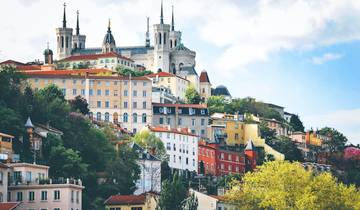
The hill of Fourvière is where Lyon begins. The Romans founded Lugdunum in 43 BC as the capital of the Three Gauls — Gallia Lugdunensis, Gallia Belgica, and Gallia Aquitania — making it the administrative centre of the entire western Roman province. The archaeological remains of this capital survive on the hillside above the modern city in a form that few Roman sites anywhere can match. Two ancient theatres stand side by side: the Grand Théâtre, built in the 1st century BC and expanded in the 2nd century AD, seated up to 10,000 spectators; the Odéon beside it, smaller and more intimate, hosted public readings and recitals. Both remain in occasional use for contemporary performances. The adjacent Lugdunum museum, modernised in 2018, displays the remarkable finds from excavations across the city — mosaic floors, bronze inscriptions, sculpted friezes, and everyday objects that illuminate daily life in Roman Gaul. Fourvière is also where the Basilique Notre-Dame de Fourvière (1872–1896) rises above the city in a florid Romano-Byzantine style that now serves as Lyon’s defining silhouette; its twin observation towers offer the fullest panoramic view of the Rhône and Saône valleys below.
Vieux-Lyon: The Largest Renaissance District in France
At the foot of Fourvière, on the right bank of the Saône, lies Vieux-Lyon — the largest Renaissance urban ensemble in France. Three parishes (Saint-Jean, Saint-Paul, and Saint-Georges) preserve a dense grid of 15th and 16th-century streets, façades, and the traboules — covered passageways cutting through building blocks that connected the silk workers of the hills to the river quays below. Traboules became famous beyond Lyon during the Second World War, when the Resistance used them to evade German patrols; guided traboule walks now form one of the city’s signature visitor experiences. The Cathédrale Saint-Jean-Baptiste, built between the 12th and 15th centuries, anchors the quarter with its Flamboyant Gothic façade and its celebrated astronomical clock (14th century) that still performs a mechanical spectacle at noon, 2pm, 3pm, and 4pm. The Musée Gadagne within Vieux-Lyon occupies a superb Renaissance palace and houses both a city history museum and the Musée des Arts de la Marionnette, reflecting Lyon’s long tradition as the birthplace of the Guignol puppet theatre.
The Presqu’île and the Croix-Rousse
Between the Saône and the Rhône, the Presqu’île district concentrates the city’s 19th-century civic ambitions in the form of broad Haussmann-scale boulevards, the magnificent Place Bellecour (one of the largest public squares in France), and the Musée des Beaux-Arts — considered France’s finest fine art collection outside Paris, housed in a 17th-century Benedictine convent with holdings spanning Antiquity to the 20th century. Immediately north, the hillside slopes of Croix-Rousse preserve the industrial heritage of Lyon’s once-dominant silk weaving industry. The quarter’s unusually tall buildings — constructed to accommodate the large Jacquard looms used by the canuts (silk weavers) — create an atmosphere unlike anywhere else in France, intimate and labyrinthine, with murals at every turn celebrating the neighbourhood’s working-class history.
The Musée des Confluences
At the southern tip of the Presqu’île, where the Saône pours into the Rhône, the Musée des Confluences (opened 2014) occupies one of France’s most audacious pieces of contemporary architecture — an aluminium and glass “crystal cloud” by the Vienna studio Coop Himmelblau. Its permanent collection addresses the great themes of human origin, diversity, and fate through natural history, anthropological, and cultural holdings drawn from former colonial collections. It makes a compelling prologue to the southward journey: at the precise point where Lyon’s two rivers meet and the Rhône turns definitively south, this museum frames the questions about human civilisation that the valley’s monuments will spend the next 300 kilometres answering.
Vienne: The Roman Capital That Time Bypassed
Thirty kilometres south of Lyon, Vienne offers one of the most rewarding Roman cityscapes in France — a city where ancient monuments sit embedded in the ordinary fabric of a provincial town as naturally as if they had always been there. Vienne was the major Roman settlement on the upper Rhône, known as Vienna to its inhabitants, and served as the capital of the Allobroges before Rome transformed it into a full colonial city after 47 BC. Its Roman heritage is distributed across the city and across the river in a form that rewards an unhurried half-day or full day of exploration.
The Temple of Augustus and Livia
The Temple of Augustus and Livia stands at the centre of modern Vienne on the Place du Palais de Justice with an immediacy that continues to surprise first-time visitors. Built between 20 and 10 BC as an imperial cult sanctuary, the temple is among the best-preserved Roman temples in the world. Its Corinthian colonnade — six columns across the front, seven down each flank — survives virtually complete, the entablature and pediment intact above. The survival results from an early conversion to Christian use as a church (from the 5th century), which protected the structure through the medieval period. The oldest inscription on the temple dedicates it to “Rome and to Augustus Caesar, son of the divine Julius Caesar,” with Livia added to the dedication as the emperor’s deified wife. A 19th-century restoration removed medieval accretions and returned the building to its Roman form. The temple’s proximity to the ancient forum square, whose extent is revealed by the Jardin de Cybèle nearby — where two Roman arcades mark the forum’s limits — makes this corner of Vienne a remarkably intact piece of ancient urban space.
The Roman Theatre and the Great Pyramid
On the hillside behind the central city, cut into the rock overlooking the Rhône valley, the Roman Theatre of Vienne is one of the largest in Gaul. Capable of seating approximately 13,000 spectators, it served the Roman city’s public entertainment needs from the 1st century AD onwards. Excavations since the 1930s have revealed the cavea, the orchestra, and substantial portions of the stage building. Today the theatre hosts the Jazz à Vienne festival each July, bringing the site back to its function as a gathering place for 20,000 people. On Boulevard Fernand-Point nearby, a 20-metre Roman obelisk (originally the turning post of the city’s circus, or chariot-racing track) stands in the middle of the road, easily overlooked but dating from the 1st century AD.
Saint-Romain-en-Gal Archaeological Site
Across the Rhône from Vienne’s city centre, the archaeological site and Gallo-Roman Museum of Saint-Romain-en-Gal preserves the largest excavated Gallo-Roman residential and commercial district in France. A 7-hectare cultural park now protects what was the right-bank quarter of ancient Vienna — a prosperous neighbourhood of townhouses, warehouses, craftsmen’s workshops, and two bathing complexes (including one specifically for athletes) that flourished from the 1st century BC through the 3rd century AD. The museum’s most celebrated possessions are its extraordinary mosaic floors, many discovered in situ and lifted for conservation. The Mosaic of the Ocean, the Autumn Mosaic, and the mosaic of the Calendar of the Rural Year display a technical mastery and compositional ambition that speak to the wealth of Roman Vienne. The museum offers a fully immersive account of Gallo-Roman daily life — economy, crafts, domestic interiors — with one of the best-contextualised collections in France.
The Cathédrale Saint-Maurice
Vienne’s cathedral, dedicated to Saint Maurice, takes its current form over a construction period spanning the 12th to 16th centuries and represents a compelling dialogue between Romanesque structure and Gothic embellishment. Its three-nave interior, unusually wide and light, preserves Romanesque bays that were progressively heightened as Gothic construction techniques evolved. The façade’s three deeply sculpted portals deliver a compendium of medieval iconography — apostles, biblical narratives, and zodiacal figures — in a provincial Burgundian idiom. Cathedral and Roman temple stand less than five minutes’ walk apart, making this corner of Vienne a vivid demonstration of the layering of civilisations that defines the Rhône corridor.
The Northern Rhône Wine Corridor: Tournon, Tain-l’Hermitage, and the Hermitage Vineyards
South of Vienne, the Rhône narrows as it cuts between the granite massifs of the Massif Central on the west and the Pre-Alps on the east, and the slopes that fall to the river’s edge become some of the most prized agricultural land in France. This is the northern Rhône wine corridor — a sequence of appellations formed on soils of decomposed granite, loess, and gneiss that produce wines of austere power and great longevity. The landscape here is as much cultural heritage as it is natural scenery, shaped by two thousand years of terraced viticulture on gradients that make mechanised cultivation impossible.
Tournon-sur-Rhône and Tain-l’Hermitage
The twin towns of Tournon-sur-Rhône (on the Ardèche bank) and Tain-l’Hermitage (on the Drôme side) face each other across the river at a point where the valley narrows dramatically, framed by the great granitic dome of the Hermitage hill. Tournon’s Château de Tournon (16th century) dominates the Ardèche bank from a platform above the river; its three towers and Renaissance courtyard now house the Musée des Vins du Rhône, which documents the history of viticulture in the valley. The château was a favourite residence of the kings of France during the Renaissance, and it was here that the young Mary Queen of Scots passed part of her childhood during her years as Queen Consort of France. The Collège de Tournon, founded by Cardinal François de Tournon in 1536, is one of the oldest secondary schools in France still in operation.
The Hermitage Hill
Rising directly above Tain-l’Hermitage, the granite outcrop known as the Hill of Hermitage is one of the most celebrated wine-growing sites in the world. The Syrah planted on its south-facing slopes produces the Hermitage appellation, a red wine first documented in the 13th century and now produced on approximately 136 hectares. A small chapel, the Chapelle de Saint-Christophe, stands at the hill’s summit beside the vineyards of the great négociants — Jaboulet, Chapoutier, Chave — whose names are written in white letters directly on the hillside’s rock faces in a tradition that doubles as permanent advertisement. The panoramic view from the chapel over the town, the river, and the enclosing hills captures the northern Rhône valley at its most theatrical. The Valrhona chocolate factory at Tain-l’Hermitage, founded in 1922, adds a more recent layer to the town’s culinary identity and operates the Cité du Chocolat, one of France’s most popular gastronomy museums.
The Ardèche Gateway: Valence and the Narrowing of the Valley
Further south, Valence marks the midpoint of the Rhône between Lyon and the sea and the gateway to Provence. The city’s Cathédrale Saint-Apollinaire (11th–12th century, heavily restored after Huguenot damage) anchors a graceful historic centre around the Place des Ormeaux. The Musée de Valence occupies a former archbishop’s palace and holds a distinguished collection including Hubert Robert drawings and a substantial archaeological section. It was in Valence that Napoleon Bonaparte spent months as a young artillery officer before his first campaigns in Italy, and the city maintains a modest Museum of Natural History as well as the Kiosque Peynet, immortalised by the illustrator Raymond Peynet as the setting for his beloved “Amoureux” (Sweethearts) series.
The Ardèche Junction: Where Prehistoric Art Meets Canyon Wilderness
As the Rhône continues south from Valence, it receives on its right (western) bank the waters of the Ardèche River — and with them, the gateway to one of the most dramatic natural landscapes in France and to the world’s oldest cave paintings. The Ardèche joins the Rhône near Saint-Martin-d’Ardèche, having flowed through 30 kilometres of spectacular gorges from its headwaters in the Cévennes. For travellers on the Rhône corridor, a detour west along the Ardèche delivers a UNESCO World Heritage Site and natural scenery of unforgettable power.
The Chauvet Cave and the Chauvet 2 Replica
Near Vallon-Pont-d’Arc in the southern Ardèche, a cave discovered in December 1994 by three local cavers — Jean-Marie Chauvet, Éliette Brunel, and Christian Hillaire — transformed understanding of the origins of human artistic intelligence. The Grotte Chauvet-Pont d’Arc contains figurative paintings and engravings carbon-dated to the Aurignacian period, between 30,000 and 36,000 years before the present — the oldest known art of its kind on Earth. UNESCO inscribed the cave in 2014 under criteria i and iii (reference 1426) as “the best-preserved expression of artistic creation of the Aurignacian people.” The cave’s more than 1,000 images depict 14 animal species including cave lions, woolly rhinoceroses, mammoths, horses, aurochs, and panthers. Many display sophisticated compositional devices: multiple legs conveying motion, shading to suggest volume, the deliberate use of the cave wall’s natural reliefs as sculptural elements. These techniques were previously believed to be developments of a much later era; the Chauvet paintings moved the emergence of sophisticated pictorial thinking back by tens of thousands of years.
The original cave remains permanently sealed. The Chauvet 2 – Ardèche replica, opened in 2015 at Vallon-Pont-d’Arc, is the most scientifically accurate cave reproduction ever created, built by a team of artists and archaeologists over four years. Its 8,500 square metres of sculpted and painted surfaces reproduce the cave’s walls, ceilings, floors, stalactites, archaeological remains, and the paintings themselves with museum-grade fidelity. The adjacent Aurignacian Gallery and Chauvet: The Scientific Adventure exhibition contextualise the discovery and its significance for human prehistory. No visit to the Rhône-Ardèche corridor is complete without it.
The Ardèche Gorges and the Pont d’Arc
The 30-kilometre gorge through which the Ardèche cuts its way to the Rhône is one of France’s great natural spectacles. Classified as a National Nature Reserve since 1980 (protecting 2,000 hectares), the canyon descends through 300-metre limestone cliffs in a sequence of bends, overlooks, and protected coves accessible by foot, bicycle, and kayak. The Pont d’Arc, at the gorge’s northern entrance — a natural limestone arch 34 metres high and 59 metres wide spanning the river — is one of the most photographed natural monuments in France and the most visited point of the gorge. The Belvédère de la Haute Corniche road along the northern rim offers a series of panoramic viewpoints over the white cliffs and the turquoise river below. The picturesque villages lining the flanks of the gorge — Balazuc, Vogüé, Labeaume — are among the most beautiful in the Ardèche, their medieval stone buildings perched on cliffs above the river in characteristic southern style.
Viviers and Montélimar: Medieval Heritage on the Middle Rhône
Between the Ardèche junction and Orange, the Rhône passes through a transitional zone where the climate sheds its northern character and adopts the dryness, light, and vegetation of the Mediterranean south. Two towns along this stretch reward a stop: Viviers, tucked against a cliff on the western bank, and Montélimar, the nougat capital of France on the Drôme plain.
Viviers: The Bishopric of the Ardèche
Viviers is among the most atmospheric medieval towns in the Rhône Valley, a place where the Middle Ages feel genuinely present rather than artificially reconstructed. The city has served as the seat of the Bishopric of the Ardèche since the 5th century AD — making it one of the oldest continuously active episcopal sees in France — and its former role as capital of the Vivarais region left it with an urban fabric disproportionate in grandeur to its modest modern size. The upper town, climbing steeply from the river, comprises a maze of steep medieval streets, Renaissance hôtels particuliers, and Romanesque doorways punctuated by tower houses built by noble families during the city’s medieval prosperity. The Cathédrale Saint-Vincent, built in the Romanesque style in the 12th century and substantially reworked in the 17th, rises above the town with a commanding square tower. The Place de la Plâtre, the historic heart of the upper town, preserves a concentration of Renaissance buildings with carved doorways and inscribed lintels that document the city’s intellectual and commercial life in the 15th and 16th centuries. The Office de Tourisme classifies Viviers as a Ville d’Art et d’Histoire (City of Art and History), a national designation that reflects the authentic density of its surviving heritage.
Montélimar: The Château des Adhémar
Montélimar, famous worldwide for its nougat production, conceals above its busy commercial centre a medieval fortress of genuine architectural distinction. The Château des Adhémar, built in the 11th and 12th centuries by the Lords of Adhémar on a promontory above the Roubion plain, features one of the finest Romanesque chapels in the Drôme — the Chapelle Sainte-Croix, with its austere apse and well-preserved carved capitals. The château suffered damage and modification in every subsequent century, giving it a layered authenticity that contrasts with more uniformly restored fortresses. Its hilltop position delivers wide views across the Montélimar plain toward the pre-Alpine ridges and is well worth the short climb from the nougat shops of the town below.
Orange: The UNESCO Roman Theatre and the Triumphal Arch
Orange commands attention as the site of the two best-preserved Roman monuments in France. The ancient city of Arausio, founded by veterans of the Roman Second Legion in 35 BC, grew into a prosperous provincial capital, and two of its public monuments survive in a condition that astonishes even visitors familiar with Rome itself. UNESCO inscribed the Roman Theatre and its Surroundings and the Triumphal Arch of Orange in 1981 under criteria iii and vi (reference 163bis) as outstanding testimony to Roman civilisation and its cultural transmission.
The Roman Theatre of Orange
The Roman Theatre of Orange is the best-preserved Roman theatre in Europe and arguably the most imposing Roman building still standing above ground in the western world. Its stage wall — the postcaenium — is the critical element: a 103-metre long, 1.80-metre thick, and 37-metre high facade of dressed stone that has survived intact for two thousand years, the only such structure remaining in the Western Roman world. (Of the other great Roman theatres — those of Rome, Pompeii, and Aspendos — none retain their stage walls at this height or completeness.) Louis XIV’s remark, that this was “the most beautiful wall in my kingdom,” captures both the wall’s physical presence and the pride early modern France took in its Roman inheritance. The cavea (seating area) cut into the hillside of Saint-Eutrope accommodated approximately 9,000 spectators; most of the tiers and the access corridors survive, and the theatre continues to function as a performance venue for the Chorégies d’Orange, the annual opera and classical music festival that has used this space since 1869. The bronze statue of Emperor Augustus in the central niche of the stage wall — a 19th-century copy of the original — lends the space a startling presence, reminding visitors that Roman theatrical entertainment was inseparable from the cult of imperial power. The stage wall bears rows of corbels in its upper third that once supported a velarium (awning) protecting the stage; the 103 holes from which the awning’s supporting masts extended are still visible in the stone.
The Triumphal Arch of Orange
At the northern entrance to Orange, the triumphal arch known as the Arc de Triomphe d’Orange stands on the ancient Via Agrippa at a point where it has marked arrivals and departures for two thousand years. Built between 10 and 25 AD during the reign of Augustus, it is one of the largest and most elaborately decorated provincial triumphal arches in the Roman Empire, measuring 19 metres high, 19.5 metres wide, and 8.4 metres deep. The arch commemorates the military victories of the Second Legion through a programme of sculptural relief that covers almost every available surface: scenes of battle, piles of captured weapons (spolia), naval trophies, and representations of the Pax Romana — the peace that followed Roman conquest. The three-bay structure, unusually well preserved because it was incorporated into the medieval town wall as a defensive gate, displays a compositional sophistication — different relief registers, varied pictorial depths, alternating surface textures — that places it among the masterworks of Roman narrative sculpture. Together with the theatre, it makes Orange one of the essential stops on any tour of Roman Provence.
The Chorégies d’Orange and the Living Theatre
The Chorégies d’Orange, founded in 1869 and held each summer in the Roman theatre, is one of the world’s oldest and most atmospheric opera festivals. The combination of professional-level productions — two operas and one orchestral concert per season — staged against the ancient stage wall transforms the building from archaeological monument to fully functional cultural venue. The acoustic properties of the surviving wall are extraordinary: sound projects clearly to every seat in the cavea without electronic amplification, demonstrating why the Romans chose precisely this architectural form for large-scale public performance. Attendance has reached 8,000 per performance in a space designed two millennia ago for exactly that number.
Châteauneuf-du-Pape: Vines, Ruins, and Papal Wine
Châteauneuf-du-Pape is one of those places where landscape, history, and gastronomy converge so completely that each element becomes inseparable from the others. The name — literally “New Castle of the Pope” — locates the village within the Avignon papacy’s story: Pope John XXII (1316–1334) established a summer residence on this wind-swept plateau north of Avignon and planted vines across its peculiar terrain of large rolled stones (galets roulés) deposited by ancient river action. The wines produced here became the most prestigious of the papal court and eventually the foundation of one of France’s most celebrated appellations contrôlées.
The Château des Papes
The remains of the summer palace built by Pope John XXII from 1317 stand on the highest point of the village, commanding an extraordinary panorama across the Rhône valley, the Dentelles de Montmirail, and the distant outline of Mont Ventoux. The castle was largely destroyed during the Wars of Religion in the 16th century and further damaged when German forces blew up the main tower in August 1944 during their retreat. A single square tower survives, rising above the village skyline. The village that grew up around the castle preserves a network of medieval lanes, vaulted passages, and stone-built dwellings whose terracotta-coloured facades intensify in the late-afternoon light. The Musée du Vin in the château caves traces the history of the appellation and provides context for the tasting rooms that line the village’s main street.
The Terroir and the Wine Heritage
The Châteauneuf-du-Pape AOC covers approximately 3,200 hectares, planted on soils of ancient river sediment covered by the distinctive large galets — rounded quartzite stones that absorb heat during the day and radiate it to the vines at night, contributing to the exceptional ripeness of the grapes. The appellation permits up to 18 grape varieties in its blend, though Grenache dominates in most cuvées, supplemented by Syrah, Mourvèdre, and Cinsault. The wine was the subject of the first Appellation d’Origine Contrôlée legislation in France in 1935, drafted in part by the producer Baron Le Roy de Boiseaumarié; the Châteauneuf-du-Pape AOC thus became the template for France’s entire system of regulated wine appellations. To walk between the vineyards, the galets crunching underfoot as Ventoux fills the eastern horizon, is to move through a cultural landscape in which every element — soil, climate, history, and human craft — contributes to a coherent whole.
Avignon: The UNESCO City of Popes on the Rhône
Avignon stands at the bend of the Rhône where the river curves around a rocky outcrop before continuing south, and it is this bend — this pause in the river’s southward momentum — that gave the city its strategic and eventually its transcendent historical importance. UNESCO inscribed the Historic Centre of Avignon: Papal Palace, Episcopal Ensemble and Avignon Bridge in 1995 under criteria i, ii, and iv (reference 228), recognising it as a masterpiece of medieval European architecture and the outstanding physical record of one of the most consequential episodes in the history of the Catholic Church.
The Palais des Papes
The Palais des Papes is the largest Gothic palace in Europe, covering more than 15,000 square metres on the Rocher des Doms, the rocky promontory above the Rhône. Construction proceeded in two distinct phases: the first palace (Palais Vieux) was built by Pope Benedict XII (1334–1342) in an austere, fortified Cistercian style; the second (Palais Neuf) was added by Pope Clement VI (1342–1352) in a more ornate, courtly Rayonnant Gothic style. Together they constitute a structure of extraordinary scale — the chronicler Froissart called it “the most beautiful and the most fortified house in the world” — and the ensemble makes immediate sense of why Avignon served as the seat of the Catholic Church for more than a century. The papacy transferred its seat from Rome to Avignon in 1309 under Pope Clement V, driven by French political pressure and the instability of Rome; a succession of nine popes and antipopes governed the Church from this site until the official restoration of the papacy to Rome in 1377, with a subsequent schism keeping antipopes at Avignon until 1423. The palace’s interior retains remarkable painted cycles by the Italian master Matteo Giovanetti — the frescoes of the Chambre du Cerf (Stag Room) and the Grande Chapelle are among the finest surviving examples of 14th-century Gothic mural painting in France — alongside the more austere spaces of the Consistoire (the hall where the pope received ambassadors), the throne room, and the papal apartments. The building accommodates approximately 600,000 visitors annually, making it one of the most visited monuments in France.
The Episcopal Ensemble: Cathedral and Petit Palais
Beside the Palais des Papes, the Cathedral of Notre-Dame-des-Doms is a 12th-century Romanesque structure whose simple, powerful interior contrasts deliberately with the Gothic exuberance of the palace beside it. The cathedral was the seat of the Archbishop of Avignon throughout the papal period and houses the tomb of Pope John XXII — the very pope who established the summer residence at Châteauneuf-du-Pape — a 14th-century Gothic mausoleum of considerable refinement. Above the cathedral’s entrance, a gilded statue of the Virgin (19th century) serves as one of Avignon’s most visible landmarks from the Rhône. The Petit Palais, built between 1317 and 1320 as the palace of the Archbishop of Avignon, now functions as an outstanding fine arts museum. Its collection of Italian and Avignonnais painting from the 13th to 16th centuries includes important works by Botticelli, Carpaccio, and the Sienese school — testament to the cosmopolitan cultural scene that papal Avignon sustained as an international meeting point of Mediterranean artistic currents.
The Pont Saint-Bénézet
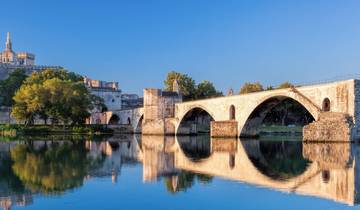
The Pont Saint-Bénézet — familiar across the world through the nursery rhyme “Sur le pont d’Avignon” — was first constructed between 1177 and 1185 by an order of bridge-building monks inspired, according to legend, by a shepherd boy named Bénézet who received a divine vision commanding him to span the Rhône. At its full extent, the bridge measured approximately 900 metres and carried 22 arches across both arms of the river to the opposite bank at Villeneuve-lès-Avignon, making it one of the longest bridges in medieval Europe and, for centuries, the only crossing point on the lower Rhône. Successive floods and the force of spring Rhône floods progressively destroyed its arches; today four arches and a small Romanesque chapel remain, projecting into the river from the city wall and ending abruptly above the current. The truncated bridge has an elegiac quality — it ends in mid-air, caught in the act of crossing — that makes it one of the most photographed fragments in France. The chapel of Saint-Nicolas on the second pier preserves a lower Romanesque level and an upper Gothic level added in the 14th century.
The Ramparts and the Festival d’Avignon
Avignon’s medieval ramparts, built and expanded between the 13th and 14th centuries under papal patronage, enclose the entire historic centre in a circuit of approximately 4.3 kilometres. Their crenellated towers and gates — several of which have been restored — give the city an unusually complete medieval silhouette when viewed from the Rhône bridge or from the Villeneuve side. Within the walls, the city maintains one of the most sophisticated cultural calendars in France. The Festival d’Avignon, founded by Jean Vilar in 1947, has grown into one of the world’s largest performing arts events, drawing over 140,000 spectators each July to performances in the Palais des Papes courtyard and in dozens of venues across the city. The festival’s parallel fringe (Festival Off) now generates over 1,000 productions annually. The combination of medieval architecture, summer climate, and this concentration of cultural activity makes Avignon one of the most fully alive historic cities in France.
Villeneuve-lès-Avignon: The Cardinal’s City Across the River
Directly across the Rhône from Avignon, connected to it historically by the Pont Saint-Bénézet and separated from it today by the dual carriageway of the N100, Villeneuve-lès-Avignon developed during the papal period as the French royal counterpoint to the papal city. While Avignon lay technically within the territory of the Holy Roman Empire (it became formally French property only in 1791), Villeneuve stood on indisputably French soil and served both as a watchtower over the papacy and as a wealthy suburb where cardinals built lavish residences.
The Tour Philippe-le-Bel, built by the French king Philip IV in 1307 on the right bank as a customs and toll post at the end of the bridge, still rises at the entrance to the town as a symbol of royal authority over the crossing. The Fort Saint-André, constructed between 1360 and 1365 on the Mont Andaon above the town, is the largest and most impressive of the royal fortifications, its twin round towers and crenellated curtain wall dominating the town from above. Inside the fort, the Abbaye Saint-André survives as a private garden of exceptional beauty, its terraced spaces and ruined church offering an unexpected oasis of botanical calm.
The Chartreuse du Val de Bénédiction, founded in 1356 by Pope Innocent VI (who chose Villeneuve as his burial site), became one of the largest and wealthiest charterhouses in Europe, with 24 cells for monks arranged around three cloisters. After Revolutionary suppression, much of the complex fell into ruin, but a major restoration effort has reopened large portions, revealing remarkable painted cycles by the school of Matteo Giovanetti in the church and in the cellae. The tomb effigy of Innocent VI — a delicate, white-marble Gothic masterpiece — remains in the refectory.
Tarascon and Beaucaire: Twin Fortresses at the Provençal Frontier
Where the Rhône marks the ancient boundary between Provence (the Bouches-du-Rhône department, historically belonging to the County of Provence) and Languedoc (the Gard department, part of the French crown), two fortresses face each other across the river from their respective banks — Tarascon on the eastern (Provençal) side and Beaucaire on the western (Languedocian) side. Together they represent one of the most visually dramatic medieval pairings on the Rhône, their towers and walls reflected in the water between them.
Château de Tarascon
The Château de Tarascon, constructed between 1401 and 1449 by the Counts of Provence (later the kings of Naples and then the kings of France), is one of the finest examples of late-Gothic military architecture in France — a building that manages to be simultaneously a fortress and a palace, combining defensive machicoulis and towers with courtyards of courtly elegance. The limestone walls rise sheer from the Rhône’s edge, creating a vertical relationship between the castle and the river that is virtually unique in French fortress architecture. The interior preserves two distinct registers: the functional, utilitarian lower levels of the garrison, and the refined upper apartments of the Count’s court, with ribbed vaulted ceilings, carved chimneys, and heraldic carvings in the stone. The castle also served for two centuries as a state prison (prisoners carved inscriptions into the walls of the upper chambers), and it survived the Revolutionary period as a result of this continuing institutional use. The town of Tarascon, gathered around the castle’s walls, takes its name from the Tarasque — a legendary monster said to have terrorised the Rhône until Saint Martha subdued it — and celebrates this myth each year with the Fête de la Tarasque, a popular procession of carnival floats that has been a feature of local life since the 15th century.
Château de Beaucaire
Across the river from Tarascon, the Château de Beaucaire occupies a comparable defensive position on the Languedoc bank — perched on a rocky promontory above the confluence of the Rhône and the Canal du Rhône à Sète. Founded in the 11th century, the castle reached its greatest importance in the 13th century as the French crown’s gateway into the south after the Albigensian Crusade. Its triangular tower, unusual in its plan, rises above the ruins of the remaining walls and courtyard in a state of romantic dilapidation quite different from Tarascon’s immaculate preservation. The town of Beaucaire was for five centuries the site of one of the most important annual fairs in Europe — the Foire de la Madeleine, held each July — which attracted merchants from across the Mediterranean world and made Beaucaire one of the wealthiest market towns in France before the development of modern transport disrupted the fair circuit.
Pont du Gard: The Essential Detour to Rome’s Greatest Aqueduct
The Pont du Gard lies some 25 kilometres west of Avignon, spanning the Gardon River in the limestone scrubland of the Gard department. It is not on the Rhône itself, but no itinerary along the Rhône corridor between Avignon and Arles is complete without it. UNESCO inscribed the Pont du Gard in 1985 under criteria i and iii (reference 344), recognising it as a masterpiece of Roman engineering and the most spectacular surviving section of one of the Roman Empire’s most ambitious hydraulic works.
The Three-Tier Aqueduct Bridge
The Pont du Gard was constructed in the 1st century AD as part of a 50-kilometre aqueduct carrying fresh water from the springs at Uzès to the Roman city of Nîmes (Nemausus). At the point where the aqueduct crosses the Gardon River gorge, a bridge of three superimposed tiers of arches was required to maintain the consistent and very gentle gradient — a fall of only 1 in 3,000 — that allowed water to flow by gravity alone over the entire 50-kilometre distance. The result is a structure 49 metres high and 275 metres long at its topmost level, the tallest Roman aqueduct bridge still standing anywhere in the world. The lower two tiers are built of massive limestone blocks, the largest weighing up to six tons, fitted together with extraordinary precision but without mortar — the joints were filled with iron clamps and the weight of the stone itself held the arches in compression. The upper tier, which carries the water channel, uses smaller rubble masonry. The bridge was constructed by an estimated thousand men in approximately five years, a feat of project management as impressive as the engineering itself. Jean-Jacques Rousseau, visiting in the 18th century, recorded that the sight left him struck dumb — “I had been told to go and see the Pont du Gard… this time the object surpassed my expectation, for the only time in my life.”
Experiencing the Site
The Pont du Gard attracts more than a million visitors annually, and the site organisation reflects the scale of that interest. A museum on the left bank deploys 2,500 square metres of exhibition space and multimedia installations to explain the aqueduct’s construction, engineering, and the broader context of Roman hydraulic technology across the empire. The Ludo area provides interactive workshops for children aged 5–12. Several walking trails cross the garrigue scrubland around the bridge, and in summer the Gardon River below the bridge offers swimming beneath the arches — a spectacle that combines Roman grandeur and Mediterranean ease in a manner entirely typical of Provence. The bridge is best seen early in the morning, before crowds gather, when the golden limestone reflects the low sunlight and the silence of the scrubland amplifies the structure’s presence.
Arles: Where Roman Antiquity Meets Romanesque Splendour
Arles is the culmination of the Rhône corridor’s Roman heritage — a city where the density of ancient monuments per square kilometre has no parallel in France and few rivals anywhere in the former empire. UNESCO inscribed the Roman and Romanesque Monuments of Arles in 1981 under criteria ii and iv (reference 164), protecting eight individual monuments across 65 hectares as an outstanding testimony to the ancient history of the city. Arles served as a major Roman port and strategic crossing point on the Rhône from the 1st century BC onwards, becoming under Constantine (early 4th century AD) one of the most important cities in the western empire, sometimes called the “little Rome of the Gauls.”
The Arles Amphitheatre
The Arènes d’Arles is the defining monument of the city — a two-tiered Roman amphitheatre 136 metres long and 109 metres wide, built around 90 AD with a capacity of 20,000 spectators for the gladiatorial combats, animal hunts, and chariot races that constituted Roman public spectacle. At 21 metres high, the exterior arcade of 120 arches (60 per level) creates a rhythmic stone facade of considerable elegance. The building survived the medieval period because it was converted into a fortified village: 212 houses, two churches, and a watchtower were constructed within and above the ancient seats between the 6th and 9th centuries, when the population retreated inside for protection. The medieval accretions were cleared in the 19th century to restore the amphitheatre to approximately its Roman form, and today it functions again as a venue for bullfighting during the Feria d’Arles (twice annually) and for theatrical and musical events throughout the summer. The tower at the northwest angle of the facade — one of three medieval watchtowers added during the inhabited period — remains in place as a monument to the building’s extraordinary continuity of use across two millennia.
The Roman Theatre and the Cryptoporticus
The Roman Theatre of Arles, built in the 1st century BC under the reign of Augustus and capable of seating approximately 8,000 spectators, is a great deal less complete than its counterpart at Orange — its stone was systematically pillaged during the early medieval period to build the city’s walls and churches — but the two columns of the stage building’s architectural backdrop that remain standing (known as the “Two Widows”), rising 19 metres above the orchestra floor, constitute one of the most powerful fragments of Roman architecture in Provence. The stage building’s foundations and the outlines of the cavea are extensively visible, and the theatre functions as a summer performance venue. The Cryptoporticus, directly beneath the Forum on the Place du Forum, is a U-shaped underground gallery 90 metres long and 60 metres wide, built in the 1st century BC as the substructure of the raised forum platform. The cool, dim chambers — lit by oblique shafts from the pavement above — now serve as exhibition spaces and convey, more vividly than any above-ground structure, the scale of Roman Arles’s civic ambition.
The Church of Saint-Trophime
The Romanesque church of Saint-Trophime, built in the 11th and 12th centuries on the foundations of an earlier Merovingian basilica dedicated to the first bishop of Arles, represents the finest Romanesque ecclesiastical architecture in Provence and one of the supreme achievements of that style in France. Its façade portal (c. 1180) is carved with a programme of extraordinary richness: the Last Judgement in the tympanum, apostles and saints in the jamb figures, a frieze of the Elect processing toward Heaven and the Damned marching toward Hell below. The carving is characterised by the peculiar Provençal Romanesque quality of classical revival — figures of Roman sarcophagal grandeur in early medieval poses — and the result is a visual narrative of startling power. The cloister (1150–1190), entered from within the church, is one of the most celebrated in France: its north and east galleries in Romanesque style, its south and west galleries in Gothic, each pier carved with apostle and narrative figures of extraordinary quality. The cloister is both an artwork and a sanctuary — its carved column shafts and capitals forming a Bible in stone that the cathedral chapter would have read daily as they circled its garth.
Les Alyscamps and the Thermae of Constantine
Les Alyscamps — from the Latin Elysii Campi (Elysian Fields) — is a necropolis that has been in use from the Roman period through the early Christian centuries, one of the most celebrated burial grounds in the ancient Mediterranean world. Thousands of sarcophagi once lined the ancient Via Aurelia leading from the city to this sacred precinct; medieval pilgrims on the Santiago route incorporated it into the itinerary of holy sites, and it appears in Dante’s Inferno as an image of the great Christian burial place. Today, a long sycamore-shaded avenue leads through the remaining tombs and the ruined church of Saint-Honorat (11th–12th century) in a scene of picturesque melancholy. The avenue and its sarcophagi inspired two paintings by Van Gogh (October 1888) and one by Gauguin during the two months the artists shared a house in Arles. The Thermae of Constantine, surviving as the largest Roman baths complex in southern Gaul, preserves its exedra and portions of the caldarium and frigidarium walls to considerable height beside the Rhône, silent witnesses to the city’s 4th-century imperial grandeur.
The Musée Départemental Arles Antique and Van Gogh’s Arles
The Musée Départemental Arles Antique, opened in a striking blue parallelogram-shaped building in 1995 immediately beside the Roman circus site, holds the most comprehensive collection of Arles Roman antiquities in existence — including the extraordinary collection of marble sarcophagi that made Arles famous throughout the medieval Christian world as a source of funerary art, along with floor mosaics, portraits, inscriptions, architectural fragments, and the prow of a Rhône river barge. The museum also conserves a remarkable full-scale reconstruction of the Roman circus (the circuit for chariot racing), 450 metres long, that occupied the area between the theatre and the riverbank. Outside the museum, the modern city carries a parallel artistic heritage: Vincent van Gogh arrived in Arles in February 1888 and spent fifteen months producing over 200 paintings and 100 drawings, including the Sunflowers series, the Bedroom series, the Night Café, and the Starry Night Over the Rhône. While Arles retains few of the specific buildings Van Gogh painted (the Yellow House was destroyed in 1944), the Foundation Vincent Van Gogh Arles on the Place du Forum hosts major exhibitions connecting Van Gogh’s Arles work with the tradition it inspired, and a walking circuit of bronze plaques on the pavements locates every site he depicted.
The Camargue: Where the Rhône Dissolves into the Sea
The Camargue is the delta where the Rhône — after 300 kilometres of southward travel through some of the most densely historicised landscape in Europe — ceases to be a river and becomes a wetland, a wilderness, and a sea. The Grand Rhône and the Petit Rhône divide south of Arles to enclose a triangular territory of salt marshes, freshwater lagoons, sand dunes, rice fields, and sedge flats before both arms reach the Mediterranean. This is Europe’s only significant river delta on the Mediterranean coast, and its ecological character is unlike anything else in France.
The Camargue Regional Natural Park
The Parc Naturel Régional de Camargue, established in 1970, covers approximately 85,000 hectares of the delta between Arles in the north and the coast in the south. UNESCO designated the area a Biosphere Reserve in 1977, recognising the exceptional ecological value of a territory shaped by the continuous interaction between fresh river water, Mediterranean salt water, wind, and human land management over centuries. The park divides broadly into three zones: the Camargue proper (the central delta between the two arms of the Rhône), the La Crau plain to the east (one of the last semi-arid steppe landscapes in France), and the littoral zone of beaches and lagoons to the south. The Étang de Vaccarès, the largest of the Camargue’s lagoons covering approximately 6,500 hectares, forms the heart of the National Nature Reserve and is the primary habitat of the flamingo colonies, grey herons, purple herons, avocets, and black-winged stilts that make the Camargue France’s premier birdwatching destination.
The Flamingos and the Wildlife
The Camargue’s greater flamingo (Phoenicopterus roseus) colony is the largest in Europe. More than 10,000 pairs breed annually on the Étang de Fangassier, a protected lagoon within the National Nature Reserve accessible only on foot or by authorised guided excursion, with nesting activity concentrated between April and June. The flamingos stand in vast pink-tinged congregations in the shallow lagoons visible from the road circuit around Vaccarès and from observation platforms at La Capelière (the main reserve information centre) and along the Route de la Capelière. The 300-plus bird species recorded in the Camargue across the year include both breeding residents and large migratory populations passing through on the flyway between Africa and northern Europe — storks, egrets, black-tailed godwits, little terns, and greater spotted eagles in their respective seasons. The Parc Ornithologique de Pont de Gau, a 60-hectare privately managed wildlife park near Saintes-Maries-de-la-Mer, provides 4 kilometres of marked trails through reed beds and marshland with observation hides allowing prolonged, close-range flamingo viewing.
The Camargue Horse and the Gardians
The Camargue horse (cheval camargue) is one of the oldest horse breeds in the world, its bloodline traceable to prehistoric horses depicted in the cave paintings of southern Europe. Semi-wild herds graze the Camargue marshes year-round, their white coats (they are born dark and lighten with age) visible against the grey-green of the sedge and tamarisk. The gardians — the mounted herdsmen who manage the Camargue cattle (black bulls bred for the bullfighting traditions of Arles and Nîmes) — represent a cowboy tradition unique in Europe, working on horseback across the open marshland with methods that have changed little in centuries. The Maison du Cheval at the Domaine du Château d’Avignon near Saintes-Maries provides the best context for understanding the breeds and the herding culture.
Les Saintes-Maries-de-la-Mer
Les Saintes-Maries-de-la-Mer, the Camargue’s principal settlement, stands at the mouth of the Petit Rhône where it reaches the Mediterranean coast. Its fortified Romanesque church of Notre-Dame-de-la-Mer (12th century), with its crenellated roof-terrace designed for use as a watchtower and defensive platform, is the most distinctive building in the delta — part fortress, part lighthouse, part pilgrimage destination. The church houses the relics of the “Three Maries” (Mary Magdalene, Mary Salome, and Mary Jacobe, who according to Provençal legend arrived by boat from Palestine after the Crucifixion) and, in the crypt, the statue of Saint Sara — the Romani patron saint venerated by Roma communities across Europe. The annual pilgrimage on 24–25 May, when Roma caravans and pilgrims from across Europe converge on Saintes-Maries for the procession of Saint Sara’s statue to the sea, is one of the most vibrant and emotionally charged folk religious events in France. A smaller autumn pilgrimage on 22 October celebrates the feast of Saint Mary Salome.
Planning a Journey Through the Rhône Corridor
The Rhône corridor from Lyon to the Camargue accommodates itineraries of almost any length, from a focused four-day sprint through the principal UNESCO sites to a leisurely two-week immersion in the full range of heritage and natural landscape along the route.
Getting Around
The TGV and TER rail network serves the corridor comprehensively, connecting Lyon to Valence, Montélimar, Orange, Avignon, Tarascon, and Arles by direct or near-direct service. Avignon has two stations: Avignon-Centre (for the historic walled city) and Avignon-TGV (for connections to Paris and the south). Hiring a car provides the flexibility to reach secondary sites such as Vienne, Saint-Romain-en-Gal, Châteauneuf-du-Pape, Viviers, and the Ardèche gorges, none of which are easily accessible by public transport. River cruises on the Rhône, offered by several European cruise lines, provide an unhurried perspective on the corridor’s landscape and heritage, with guided excursions at each major port of call. The Via Rhôna long-distance cycling route (EuroVelo 17) follows the Rhône from Lac Léman to the sea and passes every major site on this itinerary.
How Many Days to Allow
A focused six-day itinerary visiting the five principal UNESCO sites (Lyon two nights, Orange/Avignon two nights, Arles two nights) covers the core heritage comfortably without rushing. Extending to eight or ten days adds Vienne, the Ardèche/Chauvet Cave, Châteauneuf-du-Pape, Pont du Gard, and a full day in the Camargue. A two-week itinerary accommodates the entire route from Lyon to the Camargue coast at a comfortable pace, with time for the wine villages, secondary medieval towns, and the natural landscapes between the major monuments. The northern Rhône is cooler and greener than Provence; the south is drier, windier (the Mistral is strongest between Avignon and Arles), and hotter in summer. Spring (April–June) and early autumn (September–October) offer the most pleasant conditions across the full length of the corridor, with the bonus of the spring flamingo breeding season in the Camargue.
Frequently Asked Questions About the Rhône Corridor
Is it possible to visit the original Chauvet Cave in the Ardèche?
The original Chauvet Cave remains permanently closed to prevent deterioration of its 30,000–36,000-year-old paintings. Access is restricted to authorised scientific researchers under strict protocols. The Chauvet 2 – Ardèche replica near Vallon-Pont-d’Arc provides the definitive visitor experience: built over four years by a team of artists and archaeologists, the full-scale reproduction replicates the cave’s walls, ceilings, floors, geological formations, and paintings with museum-grade accuracy. It is not a reduced copy but a complete simulation of the original cave environment, covering 8,500 square metres. The accompanying Aurignacian Gallery and scientific adventure exhibition provide full context for the paintings’ significance in the history of human art.
How many of the Rhône corridor’s UNESCO sites can realistically be seen in one week?
All five UNESCO sites along the main corridor — Lyon, Orange, Avignon, Arles, and the Chauvet Cave — can be visited within a single week, combined with the Pont du Gard detour, provided the itinerary is structured efficiently. A practical approach: one full day in Lyon (Fourvière, Vieux-Lyon, the Lugdunum museum), one day for Vienne and the northern Rhône wine corridor en route to Orange, one day for Orange and Châteauneuf-du-Pape, one and a half days for Avignon and Villeneuve-lès-Avignon, a half-day morning at Pont du Gard followed by Arles in the afternoon and a full second day in Arles, and finally a day in the Camargue. This constitutes eight days at a focused pace; seven days requires cutting either Vienne or the Ardèche excursion to the Chauvet Cave.
What is the best season to visit the Camargue?
The Camargue is most rewarding in spring and early autumn, when the flamingo colonies are most active and the weather remains manageable. April and May offer the spectacle of the breeding season at the Étang de Fangassier, when the flamingo colony reaches its maximum density. May also brings the Roma pilgrimage to Les Saintes-Maries-de-la-Mer on 24–25 May, one of the most culturally vivid events in Provence. September and October deliver the autumn migration of shorebirds and waders in large numbers. Summer is entirely viable but the Camargue Mistral (which blows hardest south of Avignon) can be unpleasant, and the mosquito population in the marshlands peaks in June and July; insect repellent is essential between May and August. Winter offers surprisingly good birdwatching, with large flocks of wintering wildfowl on the lagoons, though some park facilities operate reduced hours.
Is Vienne worth visiting as a day trip from Lyon?
Vienne is one of the most rewarding half-day or full-day excursions from Lyon, and it is consistently undervalued by visitors who prioritise the larger UNESCO cities further south. The combination of the Temple of Augustus and Livia, the Roman Theatre, the Saint-Romain-en-Gal archaeological park and museum, and the Cathedral of Saint-Maurice constitutes a heritage circuit of genuine depth that would rank highly in any European city without Lyon’s gravitational pull nearby. Vienne is 30 minutes by regional TER train from Lyon Perrache station, and the principal Roman monuments are concentrated within comfortable walking distance of the station. The jazz festival in July transforms the Roman theatre into a contemporary venue capable of drawing 20,000 spectators per evening, making Vienne a destination in its own right during that month.
What is the significance of Avignon in the history of the Catholic Church?
The transfer of the papal seat from Rome to Avignon in 1309 under Pope Clement V initiated a period known as the Avignon Papacy (or, disparagingly, the Babylonian Captivity of the Church), during which the Catholic Church was governed from French soil rather than from Rome. Nine popes and two antipopes ruled from Avignon between 1309 and 1423, transforming the city into the administrative, judicial, and artistic centre of Western Christianity. The Palais des Papes, constructed between 1334 and 1352, represents the physical expression of this ecclesiastical empire: the largest Gothic building in Europe, decorated by Italian masters including Simone Martini and Matteo Giovanetti, and equipped with the full apparatus of papal governance. The papacy’s presence at Avignon drew artists, scholars, musicians, and diplomats from across Catholic Europe and made Avignon one of the most cosmopolitan cities of the 14th century. The return of the papacy to Rome in 1377 under Gregory XI did not end the city’s importance; the subsequent Great Schism (1378–1417) kept an antipope at Avignon until 1423, and the city remained part of papal territorial possessions until the French Revolution.
What are the eight monuments included in the UNESCO inscription for Arles?
The UNESCO inscription for the Roman and Romanesque Monuments of Arles (reference 164, 1981) covers eight individual monuments within the city: the Amphitheatre (Arènes), built around 90 AD; the Roman Theatre, constructed in the 1st century BC; the Cryptoporticus (underground forum galleries), also 1st century BC; the Thermae of Constantine, the largest surviving Roman baths in Gaul; the Roman Obelisk, a 4th-century pink granite monolith in the Place de la République; the Church of Saint-Trophime with its Romanesque cloister; the Les Alyscamps necropolis; and the exedra of the Forum (now incorporated into the courtyard of the Museon Arlaten). Together these monuments document the continuous development of Arles from its Roman foundation through its Romanesque Christian florescence across nearly fifteen centuries of urban history.
Which is more impressive: the Roman Theatre of Orange or the Amphitheatre of Arles?
The two monuments are impressive in different ways and represent distinct types of Roman public architecture. The Roman Theatre of Orange is unsurpassed for the survival of its stage wall — the 103-metre, 37-metre-high postcaenium is the only intact Roman stage wall in the Western world, and the sheer mass and presence of this structure, particularly experienced from the cavea at a performance, is unlike anything else in France. The Arles Amphitheatre is a more complete structure overall — both arcaded tiers survive almost in their entirety, and the building’s continued active use (for bullfighting and events) connects it to a living cultural tradition. If the question is which delivers the more dramatic architectural experience, Orange edges ahead by virtue of its irreplaceable stage wall. If the question is which is more fully integrated into the fabric of a living city, Arles wins without contest.
What is the Via Rhôna and how does it relate to the Rhône corridor?
The Via Rhôna (EuroVelo 17) is a 815-kilometre long-distance cycling route connecting Lake Geneva (Lac Léman) with the Mediterranean coast at Port-Saint-Louis-du-Rhône, following the Rhône valley its entire length. The route is largely on dedicated cycling infrastructure — canal towpaths, river levees, quiet rural roads — and is classified as part of the European EuroVelo network. It passes through or within cycling distance of every major heritage site on the Rhône corridor: Lyon, Vienne, Tournon, Valence, the Ardèche junction, Viviers, Orange, Avignon, Arles, and the Camargue. Cycling the full route takes approximately ten to fourteen days at a comfortable touring pace. Shorter sections — particularly the stretch between Avignon and Arles (50 kilometres) or between Arles and the Camargue coast (25–30 kilometres) — make excellent half-day or full-day cycling excursions from either city.
Are there any prehistoric sites on the Rhône corridor besides the Chauvet Cave?
The Ardèche department, which joins the Rhône north of Orange, contains several significant prehistoric sites in addition to the Chauvet Cave. The Aven d’Orgnac, classified as a Grand Site de France, is a spectacular active cavern system some 20 kilometres west of the Ardèche gorges; while its stalactite and stalagmite formations are its primary attraction, its associated Museum of Prehistory documents the human occupation of the Ardèche plateau from Palaeolithic times. The Ardèche gorge itself has yielded evidence of Neanderthal occupation from sites on the canyon’s flanks. Further south, the Luberon area east of Avignon contains numerous dolmens and menhirs from the Neolithic period. The Grotte de la Baume Latrone in the Gardon gorge near the Pont du Gard preserves Palaeolithic rock engravings considerably older than the painted cave tradition. The Camargue’s archaeology extends back to Bronze Age settlements on the natural levees above the ancient delta margins, though most evidence lies buried beneath subsequent alluvial deposition.
What food and wine experiences define the Rhône corridor?
The Rhône corridor is one of France’s great gastronomic routes, and the food and wine traditions of the valley are woven into its cultural identity as completely as the Roman monuments. In Lyon, the bouchon tradition — small, informal restaurants serving Lyonnais specialities such as quenelles de brochet, gratins d’écrevisses, and tablier de sapeur (tripe) — represents France’s most cohesive urban food culture; Lyon holds more Michelin stars per capita than any other French city. The northern Rhône wine appellations — Côte-Rôtie, Condrieu (which produces the only great white wine from Viognier), Hermitage, Crozes-Hermitage, and Saint-Joseph — are among France’s most celebrated, combining extreme individual character with great longevity. In the south, Châteauneuf-du-Pape, Gigondas, Vacqueyras, and the Côtes du Rhône Villages appellations produce the archetypal Provençal red wines. The Camargue adds its own distinctive contributions: rice (the delta is the principal rice-growing region of France), Camargue salt (fleur de sel from the Salin de Giraud salt works), and the gardians’ bull stew (gardiane de taureau) — one of the most robustly flavoured traditional dishes in Provence.