The Gothic Soul of the Alps: Discovering the Sacra di San Michele and Susa Valley’s Hidden Gems
The Sacra di San Michele rises from Mount Pirchiriano at 960 meters above sea level, a thousand-year-old abbey where Romanesque foundations merge with Gothic aspirations against the backdrop of the Cottian Alps. This symbolic monument of Piedmont anchors a valley rich with medieval villages, ancient pilgrimage routes, and architectural treasures that remain largely undiscovered by international travelers despite their profound historical significance.
Key Takeaways: Sacra di San Michele and Susa Valley Essentials
- Architectural Fusion: The Sacra di San Michele represents a rare synthesis of 10th-century Romanesque foundations with 12th-13th century Gothic expansions, creating a vertical architectural composition that rises 26 meters from its rocky base to the church level.
- Sacred Geography: The abbey forms part of the legendary Line of Saint Michael, a mystical alignment connecting three major European pilgrimage sites dedicated to the Archangel Michael across 2,000 kilometers from Ireland’s Skellig Michael through Mont-Saint-Michel in France to Monte Sant’Angelo in Puglia.
- Literary Legacy: Umberto Eco drew inspiration from the Sacra’s medieval atmosphere when writing “The Name of the Rose,” and the abbey was considered for the 1986 film adaptation before logistical constraints redirected filming elsewhere.
- Hidden Monastic Network: The Susa Valley harbors multiple ecclesiastical treasures including Novalesa Abbey (founded 726 AD, the oldest in the Western Alps), creating a concentrated landscape of monastic architecture within a single Alpine valley.
- Roman Heritage: The town of Susa preserves exceptional Roman monuments including the Arch of Augustus, the Porta Savoia (3rd century gate with four-story windows), an aqueduct, and an amphitheater, establishing the valley as a crucial crossroads between Italy and France since antiquity.
- Access and Experience: The abbey requires a 15-minute uphill walk from parking, with 243 steps through the Scalone dei Morti (Staircase of the Dead) leading to the main complex, creating a pilgrimage experience that mirrors medieval approaches to sacred architecture.
People Also Ask About Sacra di San Michele and Susa Valley
What architectural styles define the Sacra di San Michele?
The Sacra di San Michele showcases a stratified architectural evolution spanning three centuries. The 10th-century foundations and lower structures exhibit Romanesque characteristics with massive stone walls, barrel vaults, and minimal ornamentation designed to support the structure on the rocky pinnacle. The 12th-13th century additions introduce Gothic elements including pointed arches, ribbed vaulting in the church, and the celebrated Zodiac Portal with its intricate sculptural program featuring zodiacal signs, fantastical creatures, and religious iconography carved by Maestro Nicolao around 1120-1130. The vertical composition emphasizes ascent from earthly to celestial realms, with the church positioned 26 meters above the base structures, accessible only through the dramatic Scalone dei Morti carved directly into the mountain rock. The Torre di Bell’Alda, a defensive tower integrated into the complex, adds military architectural elements characteristic of fortified Alpine monasteries.
How does Novalesa Abbey differ from the Sacra di San Michele?
Novalesa Abbey, founded in 726 AD, predates the Sacra by approximately 250 years and represents a fundamentally different monastic model. Positioned in the valley floor rather than on a mountain peak, Novalesa developed as a major Carolingian cultural center housing over 500 monks during Charlemagne’s era, with a renowned library and scriptorium where monks transcribed and illuminated manuscripts. The abbey’s architecture combines Carolingian, Romanesque, and 18th-century Baroque elements, with the current church dating from a Baroque reconstruction that replaced an 11th-century Romanesque predecessor. Novalesa preserves four detached medieval chapels scattered across its grounds, the most significant being the Chapel of Sant’Eldrado with complete 11th-century frescoes including a Byzantine-influenced Christ Pantocrator. While the Sacra emphasizes vertical drama and defensive positioning, Novalesa embodies the horizontal expansion of a valley-based monastic community focused on scholarship, manuscript production, and agricultural management across extensive landholdings.
What is the Line of Saint Michael?
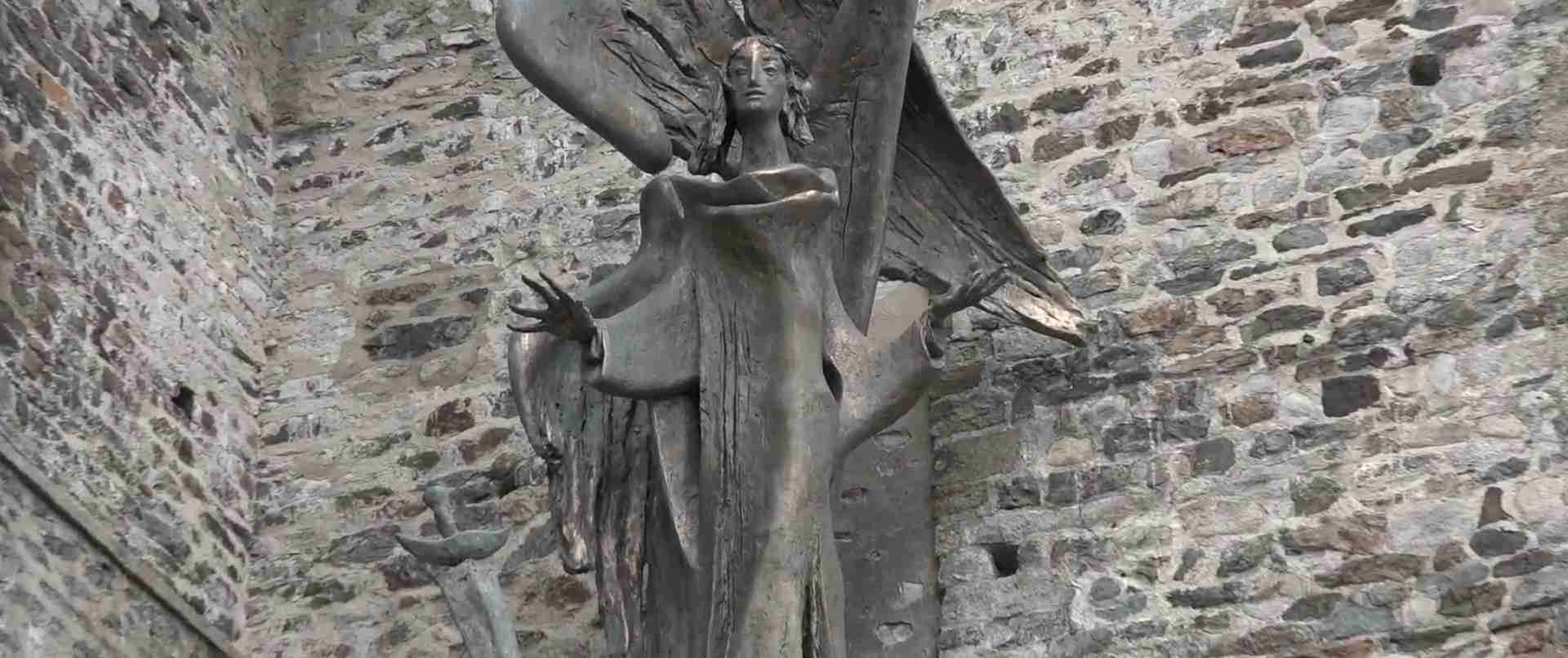
The Line of Saint Michael represents a geographic and spiritual alignment connecting seven major European sanctuaries dedicated to the Archangel Michael, forming an approximately straight line across 2,000 kilometers. The alignment begins at Skellig Michael off the Irish coast, continues through St. Michael’s Mount in Cornwall, Mont-Saint-Michel in Normandy, the Sacra di San Michele in Piedmont, continues to the Sanctuary of San Michele Arcangelo at Monte Sant’Angelo in Puglia (a UNESCO World Heritage Site inscribed in 2011 as part of “Longobards in Italy: Places of Power”), and extends further east. Medieval tradition interpreted this alignment as the path struck by Saint Michael’s sword when casting Satan from heaven to hell, creating a sacred geography that pilgrims traversed as a spiritual journey. The three most prominent sites—Mont-Saint-Michel, Sacra di San Michele, and Monte Sant’Angelo—formed a recognized medieval pilgrimage circuit, with the Sacra serving as the Italian gateway along the Via Francigena route connecting Canterbury to Rome and eventually to Jerusalem.
Can you visit the Sacra di San Michele year-round?
The Sacra di San Michele opens daily throughout the year with seasonal hour adjustments reflecting Alpine daylight patterns. Winter months from November through February operate from 9:30 AM to 4:30 PM daily, while summer hours from March through October extend to 9:30 AM to 5:30 PM daily. Sunday mornings from 11:30 AM to 1:00 PM restrict access to those attending Holy Mass only, a policy that preserves the abbey’s active religious function. Admission costs €8 for adults, with an optional €2 audio guide providing detailed architectural and historical commentary available at the ticket office. The Torino+Piemonte Card grants free entry. Visitors arriving via the combined train-and-bus service from Avigliana station receive a 25% discount on admission when presenting their transport ticket. The abbey remains open during most holidays, though occasionally closes for special religious observances, making advance verification through the official website advisable for holiday travel. Winter visits offer solitude and dramatic snow-covered Alpine vistas, while summer provides longer daylight for photography and hiking in the surrounding trails.
Extended multi-day tours – 5+ days
Featured Piedmont Multi-Day Tour Packages
3 days
Piedmont 3-Day Discovery Tour
- ✓ Comprehensive Piedmont experience
- ✓ Expert local guides included
- ✓ All accommodation included
- ✓ Transportation provided
5 days
Piedmont 5-Day Highlights Experience
- ✓ Comprehensive Piedmont experience
- ✓ Expert local guides included
- ✓ All accommodation included
- ✓ Transportation provided
7 days
Piedmont 7-Day Cultural Journey
- ✓ Comprehensive Piedmont experience
- ✓ Expert local guides included
- ✓ All accommodation included
- ✓ Transportation provided
10 days
Piedmont 10-Day Complete Adventure
- ✓ Comprehensive Piedmont experience
- ✓ Expert local guides included
- ✓ All accommodation included
- ✓ Transportation provided
Multi-day tour packages powered by TourRadar. Prices and availability subject to change.
Introduction: Where Gothic Ambition Meets Alpine Majesty
The Susa Valley cuts a strategic passage through the Cottian Alps, a natural corridor that has channeled armies, pilgrims, merchants, and ideas between the Italian plains and Transalpine Europe for three millennia. Within this Alpine gateway, human ambition carved monuments that defy their rugged geography—none more dramatically than the Sacra di San Michele, an abbey perched improbably on Mount Pirchiriano’s summit where vertical stone walls merge seamlessly with living rock, creating an architectural composition that appears to emerge from the mountain itself rather than merely stand upon it.
This is not merely another Italian monastery preserved as historical artifact. The Sacra lives as Piedmont’s symbolic monument, its silhouette reproduced on regional license plates, its bells audible across the valley, its presence commanding the visual identity of an entire region. Yet the abbey represents only the most visible element of a concentrated sacred landscape that includes Novalesa Abbey’s Carolingian manuscripts, the Roman monuments of Susa that predate Christianity itself, and a network of medieval villages where stone houses cluster around Romanesque churches along ancient pilgrimage routes.
Understanding the Sacra requires understanding its context within both the physical valley that cradles it and the spiritual geography that positioned it along one of medieval Europe’s most significant pilgrimage corridors. The Via Francigena, the great road connecting Canterbury to Rome, passes directly through the Susa Valley, making the Sacra di San Michele the first major Italian sanctuary encountered by northern pilgrims descending from Alpine passes. This positioning embedded the abbey within international networks of devotion, architecture, and cultural exchange that shaped its development across ten centuries.
The valley itself preserves layers of civilization stacked like geological strata. Roman engineers built the Arch of Augustus in Susa in 8 BCE, establishing the valley as an imperial frontier. Lombard rulers fortified strategic points with castles that still crown hilltops. Carolingian monks established scriptoria where illuminated manuscripts preserved classical learning through the Dark Ages. Medieval pilgrims wore paths into stone stairways climbing to mountain sanctuaries. Each layer remains legible in the contemporary landscape, creating a palimpsest where 21st-century visitors can trace 2,000 years of continuous human presence.
The architectural heritage concentrated here includes rare examples of Romanesque sculpture, Gothic spatial experimentation, Baroque ecclesiastical reconstruction, and military fortifications spanning from medieval keeps to 18th-century artillery strongholds. These monuments remain functional—churches hold daily Mass, monasteries house active religious communities, fortresses host museums and cultural events. The valley’s cultural richness exists not as a museum district but as a living landscape where historical continuity shapes contemporary life.
For travelers, the Susa Valley offers an alternative to Italy’s overcrowded pilgrimage circuits. While Florence and Venice strain under mass tourism, the Sacra di San Michele receives fewer than 100,000 annual visitors despite its architectural significance and dramatic setting. The valley’s villages maintain authentic rhythms largely unaffected by tourism, with local bakeries selling traditional pilgrim biscuits, stone fountains flowing in village squares, and elderly residents conversing in Piedmontese dialect on benches outside Romanesque churches.
This guide explores the Gothic soul embedded in Alpine stone, tracing the Sacra’s architectural evolution while revealing the hidden cultural treasures scattered throughout the Susa Valley. We examine the abbey’s construction history, decode its sculptural programs, explain its position within European pilgrimage networks, and provide the practical knowledge needed to experience these monuments as pilgrims once did—through sustained engagement with place, architecture, and the accumulated spiritual weight of centuries.
The Sacra di San Michele: A Vertical Architectural Pilgrimage
The Sacra di San Michele confronts visitors with an architectural challenge before they enter a single structure: the mountain itself must be conquered. Mount Pirchiriano rises abruptly from the valley floor, its western face a near-vertical rock wall that medieval builders selected not despite but because of its daunting topography. The abbey’s architects understood that pilgrimage requires physical exertion, that sacred space gains power through the effort demanded to reach it.
Construction began in the late 10th century when Bishop Amizone of Turin granted land on Mount Pirchiriano to the Benedictine order. Historical sources debate whether construction commenced in 966 or 983-987, but archaeological evidence confirms that builders first carved platforms directly into the mountain’s living rock, creating artificial terraces on which foundation walls could rise. These foundation walls, some reaching 26 meters in height, appear from below as sheer stone faces indistinguishable from the natural cliff, a deliberate architectural strategy that merged human construction with geological formation.
The approach to the abbey follows the Scalone dei Morti, the Staircase of the Dead, a 243-step passage carved through solid rock and walled with mortuary niches where monks’ remains were interred. This funerary corridor establishes the pilgrimage’s central metaphor: the ascent from death to spiritual rebirth, from earthly burial to heavenly sanctuary. Medieval pilgrims climbing these steps passed eye-level with the dead, a memento mori that prepared consciousness for the sacred encounter awaiting above.
The staircase emerges at the Zodiac Portal, the abbey’s sculptural masterpiece created by Maestro Nicolao around 1120-1130. This Romanesque doorway frames the church entrance with a program of carved imagery that synthesizes Christian theology with astrological symbolism inherited from classical antiquity. The twelve zodiacal signs circle the portal in calendar order, each accompanied by corresponding agricultural labors representing humanity’s earthly toil. Above this earthly cycle, Christ and the evangelists occupy the tympanum, establishing the celestial realm toward which pilgrims aspire. Fantastical creatures—winged beasts, hybrid animals, foliate heads—populate the margins, representing the chaos and temptation that pilgrims must navigate to achieve salvation.
Beyond the portal, the church interior rises in Gothic proportions, a transformation from the Romanesque mass of the lower structures to the vertical aspiration characteristic of 12th-13th century ecclesiastical architecture. Pointed arches direct the eye upward to ribbed vaulting that distributes structural weight through stone ribs rather than massive walls, allowing larger windows that flood the interior with Alpine light. The church measures approximately 26 meters in length with a single nave terminating in a semicircular apse, a relatively modest scale necessitated by the restricted mountaintop building site.
Fourteenth-century frescoes, partially preserved, decorate the walls with biblical narratives and saintly imagery executed in the International Gothic style. These paintings demonstrate the abbey’s continued cultural significance three centuries after its foundation, when wealthy patrons commissioned artistic programs comparable to those in urban churches. The frescoes’ fragmentary state—sections lost to moisture damage, pigments faded, entire panels reduced to ghostly outlines—creates haunting beauty where incomplete images suggest rather than specify their subjects.
The Torre di Bell’Alda, a defensive tower named for a legendary maiden who supposedly leaped from its heights pursued by soldiers during a siege, stands as the abbey’s most visible landmark. The tower served both religious functions—housing bells that called monks to prayer and warned valley residents of danger—and military purposes, providing a fortified observation point with commanding views across the Susa Valley and toward Alpine passes. The legend of Bell’Alda, preserved in local folklore and carved inscriptions, adds a human narrative to the architectural forms, reminding visitors that these stones witnessed individual lives, desperate choices, and legendary acts across ten centuries.
The Nuovo Monastero (New Monastery), dating from the 14th-15th centuries, represents the abbey’s expansion during its period of maximum influence when the community required additional residential structures, storage facilities, and workshops. Much of this complex now lies in picturesque ruin, walls standing to varying heights, window openings framing sky, vegetation reclaiming courtyards. These ruins attract visitors specifically for their romantic decay, their suggestion of vanished communities and abandoned purposes that stir imagination more powerfully than perfectly preserved structures.
A 2018 fire damaged sections of the Monastero Vecchio (Old Monastery), particularly affecting wooden roof structures while sparing the abbey’s most architecturally significant stone elements. Restoration work continues, addressing not only fire damage but also centuries of weathering, seismic stress, and water infiltration that constantly threaten these mountaintop structures. Conservation specialists confront unique challenges here: materials must be transported up the mountain, work proceeds in Alpine weather that limits the construction season, and interventions must respect both medieval building techniques and modern structural requirements.
The abbey’s museum spaces, currently undergoing accessibility improvements including a new elevator carved through 27 meters of solid rock, house liturgical objects, illuminated manuscripts, architectural fragments, and archaeological finds that document the site’s millennium of continuous occupation. These collections provide scholarly resources while making the abbey’s history tangible through physical objects—a medieval chalice worn smooth by centuries of use, manuscript pages where monk-scribes’ annotations survive in margin notes, carved capitals displaying the evolution of decorative styles across generations.
The Sacra di San Michele’s power derives not from any single architectural element but from the cumulative experience of ascent, passage, and arrival—the physical exertion of climbing 243 stone steps, the psychological impact of moving through mortuary spaces, the sensory shift from enclosed stairway darkness to the flooded light of the church interior, and the panoramic revelation of the valley spreading below when emerging onto exterior terraces. This is architecture as pilgrimage made stone, a designed sequence of experiences that transforms the visitor through calculated progression from base to summit, earth to heaven, death to transcendence.
Architectural Analysis: Romanesque Foundations and Gothic Aspirations
The Sacra di San Michele embodies architectural contradictions inherent in medieval building practice: massive foundations supporting ethereal superstructures, defensive military elements integrated with contemplative religious spaces, Romanesque solidity giving way to Gothic levity. These contradictions arose from the abbey’s extended construction chronology, as each generation of builders adapted existing structures to serve evolving needs while working within severe topographical constraints.
Romanesque architecture, dominant in Western Europe from roughly 1000-1200 CE, emphasized mass over void, structural stability over decorative elaboration, and horizontal extension over vertical aspiration. The Sacra’s Romanesque foundations demonstrate these principles through walls averaging 1.5-2 meters in thickness, semicircular arches that direct force vertically down through supporting piers, and small window openings that preserve wall strength while admitting minimal light. These lower structures functioned as both spiritual spaces and fortress, with the abbey occupying a strategic military position along frontier passes where religious and martial purposes merged.
The transition to Gothic elements in the 12th-13th century church represents a fundamental shift in architectural philosophy. Gothic builders discovered that forces could be channeled through skeletal stone frameworks rather than continuous walls, allowing structures to rise higher while using less material. Pointed arches, by concentrating forces more efficiently than semicircular arches, enabled greater structural height with reduced lateral thrust. Ribbed vaulting distributed weight along stone ribs that functioned as structural skeletons, with the space between ribs filled by thinner stone webs. Flying buttresses, though not employed extensively at the Sacra due to site constraints, would normally transfer thrust from high vaults to external buttresses, freeing walls to become networks of glass rather than load-bearing stone.
The Sacra’s builders adopted Gothic structural innovations while maintaining Romanesque aesthetic conservatism in certain elements. The church vault employs Gothic ribbed construction, yet the overall interior proportions remain relatively squat compared to contemporary French Gothic cathedrals that aspired to record-breaking heights. This restraint reflects both practical concerns—building higher on an exposed mountaintop increases vulnerability to Alpine storms and seismic events—and regional preferences, as Italian Gothic generally favored horizontal emphasis over the extreme verticality pursued north of the Alps.
The Zodiac Portal exemplifies Romanesque sculptural programs where architectural elements become vehicles for theological instruction. Medieval worshippers, largely illiterate, learned Christian doctrine through visual narratives carved in stone. The portal’s iconographic program operates on multiple interpretive levels simultaneously. The zodiacal signs represent the earthly year, agricultural labor, and cosmic order established at creation. The associated labors of the months—pruning vines, harvesting grain, slaughtering pigs—depict humanity’s post-Fall condition, condemned to work the earth by the sweat of their brows. Christ and the evangelists in the tympanum represent redemption from this earthly cycle, offering spiritual transcendence to those who pass through the portal in faith. The fantastical creatures inhabiting the margins symbolize the chaos that preceded divine creation and the temptations that constantly threaten to return humanity to that primal disorder.
Maestro Nicolao, the sculptor identified by inscription as the portal’s creator, worked within conventions established by earlier Romanesque masters while contributing distinctive stylistic elements. His figures display the characteristic Romanesque combination of rigid formality and expressive distortion, with bodies elongated or compressed to fit architectural frames, faces rendered as masks rather than individualized portraits, and drapery falling in parallel grooves that suggest textile folds through conventional linear patterns rather than naturalistic observation. These “distortions” reflect not sculptural incompetence but deliberate aesthetic choices: Romanesque art prioritized symbolic meaning over visual naturalism, using stylization to emphasize figures’ spiritual significance over their physical reality.
The church frescoes, executed in the International Gothic style that emerged in the 14th century, demonstrate dramatically different aesthetic priorities from the Romanesque portal. International Gothic privileged elegance, decorative richness, and emotional expressiveness. Figures assume graceful S-curve postures, wear elaborately detailed contemporary costumes, and display individualized faces capable of conveying specific psychological states. Compositions grow more complex spatially, with overlapping figures, architectural backgrounds suggesting depth, and landscape elements creating environmental context. These frescoes represent late medieval aristocratic taste, commissioned by patrons who expected religious art to display the same sophistication as secular palace decoration.
The abbey’s spatial organization reflects Benedictine monastic requirements codified in the Rule of Saint Benedict. Monasteries required a church for communal worship, a chapter house for daily community meetings, a refectory for communal meals, dormitories, a scriptorium for manuscript production, storage facilities, workshops, stables, and guest quarters. The Sacra’s limited building site forced vertical stacking of these functional spaces rather than the horizontal courtyard arrangement typical of valley monasteries. This vertical organization intensified the pilgrimage metaphor: monks ascended through increasingly sacred spaces as they moved from lower storage and work areas toward the summit church, their daily routine architecturally enacted as spiritual ascent.
Construction techniques visible in exposed sections reveal medieval building practices. Large limestone blocks quarried from nearby sources were shaped with iron chisels and assembled without mortar in the foundations, relying on precise fitting and gravitational weight for stability. Upper walls employed smaller stones set in lime mortar, a mixture of limestone burned to quicklime, then slaked with water and mixed with sand. Wooden centering supported vault construction until mortar cured, creating temporary frameworks that were removed once structural integrity was achieved. Iron cramps, H-shaped metal fasteners set in lead, joined critical stone blocks at points of maximum stress. These techniques, developed over centuries of experimentation, achieved remarkable structural longevity: the abbey has withstood Alpine weather, periodic earthquakes, military conflicts, and general abandonment during the Napoleonic suppression of religious houses.
The abbey’s windows demonstrate the evolution from Romanesque to Gothic fenestration. Lower levels feature small, round-arched openings that pierce thick walls without compromising structural integrity. Higher levels employ larger pointed-arch windows with stone tracery dividing the opening into multiple lights. This tracery, the stone framework supporting stained glass, evolved from simple geometric patterns in early Gothic to the flowing curvilinear designs characteristic of late Gothic “Flamboyant” style. The Sacra preserves examples spanning this evolution, creating an architectural textbook of medieval window development legible in a single monument.
The Sacra’s UNESCO Candidacy and Cultural Significance
The Sacra di San Michele stands as Piedmont’s symbolic monument, its image reproduced on regional license plates, tourism posters, and official emblems. This recognition reflects the abbey’s position in regional identity formation, serving as a visual shorthand for Piedmontese cultural heritage distinct from neighboring Lombardy or Liguria. Yet international recognition through UNESCO World Heritage designation remains pending, with the abbey currently included in Italy’s Tentative List as part of a serial nomination titled “The Cultural Landscape of Medieval Benedictine Settlements in Italy.”
UNESCO’s Tentative List functions as a preparatory inventory of sites that national governments intend to nominate for World Heritage status. Inclusion on the Tentative List constitutes the mandatory first step in the nomination process but provides no guarantee of eventual inscription. The nomination dossier, publicly presented in March 2017, argues for inscribing multiple Italian Benedictine sites as a cultural landscape demonstrating the order’s transformative impact on European civilization. This serial approach recognizes that individual monasteries gain significance through their position within networks of religious houses that collectively shaped medieval society.
The nomination faces complex challenges inherent in UNESCO’s evaluation criteria. Outstanding Universal Value, the foundational concept determining inscription, requires demonstrating that a site possesses cultural or natural significance “so exceptional as to transcend national boundaries and to be of common importance for present and future generations of all humanity.” This standard demands evidence that the nominated site represents unique historical processes, artistic achievements, or cultural practices with global rather than merely regional significance.
The Sacra’s nomination argues for recognition under multiple criteria including architectural innovation, artistic achievement, and association with significant historical processes. The abbey’s fusion of Romanesque and Gothic elements in a mountain setting, its position along the Via Francigena pilgrimage route, and its role in the Line of Saint Michael spiritual geography provide evidence of cultural significance extending beyond regional importance. However, UNESCO evaluators must consider whether these characteristics distinguish the Sacra from already-inscribed sites like Mont-Saint-Michel in France (inscribed 1979) or the Longobards in Italy sites including the Sanctuary of Monte Sant’Angelo (inscribed 2011), which share similar religious functions, architectural features, and pilgrimage associations.
The nomination process extends over many years, requiring detailed documentation of the site’s historical development, architectural analysis, archaeological investigations, conservation plans, management strategies, and evidence of community support. Italian national authorities must prioritize the nomination among competing candidates from other regions, each advocating for their own cultural treasures. UNESCO’s World Heritage Committee evaluates only a limited number of nominations annually, creating a competitive environment where even exceptional sites may wait decades for consideration.
Regardless of UNESCO status, the Sacra di San Michele’s cultural significance within Italian heritage remains undisputed. The abbey served as a major pilgrimage destination for northern European Christians traveling to Rome, providing hospitality, spiritual guidance, and physical refuge along a route that required months of walking through sometimes hostile territory. The abbey’s strategic position made it a political prize contested by local lords, bishops, and eventually the House of Savoy, whose members received burial in the church crypt, establishing the site’s importance to Piedmontese dynastic identity.
The abbey’s influence on Italian literature, particularly through Umberto Eco’s “The Name of the Rose,” extended its cultural reach far beyond the Susa Valley. Eco specifically acknowledged the Sacra as inspiration for his medieval mystery novel, citing the abbey’s isolated mountain setting, its medieval architecture, and its historical association with manuscript production as models for his fictional monastery. The 1986 film adaptation starring Sean Connery considered filming at the Sacra before logistical concerns—the difficulty of transporting film equipment up the mountain, the limited interior space, and the need to construct elaborate sets—led to location changes. Nevertheless, the association between Eco’s novel and the Sacra became fixed in popular imagination, drawing literary pilgrims to the site seeking the atmospheric medieval spaces described in the book.
The abbey’s symbolic function within Piedmontese identity reflects broader patterns of regional heritage construction in contemporary Italy. As Italy struggles to balance national unity with strong regional identities, monuments like the Sacra serve as rallying points for regional pride distinct from but complementary to national identity. The abbey appears in Piedmontese visual culture, school curricula emphasize its historical importance, and regional festivals incorporate the site into collective celebrations. This contemporary cultural function matters as much as historical significance in determining a monument’s long-term preservation and public support.
Novalesa Abbey: The Valley’s Carolingian Treasure
Novalesa Abbey occupies the valley floor 15 kilometers northwest of the Sacra di San Michele, a positioning that reflects fundamentally different monastic models. While the Sacra emphasized defensive isolation and pilgrimage drama through mountaintop inaccessibility, Novalesa developed as an integrated valley community with extensive agricultural lands, a major library, and direct engagement with secular power structures. Founded in 726 AD by Abbone, governor of Maurienne and Susa, the abbey predates the Sacra by approximately 250 years and represents the earlier Carolingian phase of Benedictine expansion across the Alps.
The abbey’s foundation occurred during a critical period when Frankish rulers were extending power into northern Italy, establishing alliances with local lords and churchmen while confronting Lombard kingdoms controlling the peninsula. Charlemagne himself stayed at Novalesa in 773 before launching his campaign against King Desiderius of the Lombards, a visit that transformed the abbey into a major political symbol. During Charlemagne’s patronage, Novalesa housed over 500 monks and maintained one of Europe’s most significant scriptoria, where monks transcribed classical texts, Christian theological works, and historical chronicles including the famous Chronicon Novalicense, a medieval historical narrative documenting the abbey’s early centuries.
The abbey’s library, partially destroyed in the 906 Saracen raid that forced monks to flee to Turin, had preserved classical manuscripts that might otherwise have vanished during the Early Medieval period when literacy contracted dramatically following Rome’s collapse. Carolingian scriptoria functioned as preservation networks, with monks copying texts whose parchment originals were decaying, creating manuscript chains that transmitted ancient learning across centuries. Many classical texts survive today only because Carolingian monks considered them worth preserving, copying works by authors who had been dead for a thousand years into new manuscripts that would themselves survive another thousand years to reach modern readers.
Architectural remains from the Carolingian period survive in the four detached chapels scattered across the abbey grounds, particularly the Chapel of Sant’Eldrado, which preserves nearly complete 11th-century fresco cycles. The chapel honors Eldrado, a 9th-century abbot whose sanctity attracted pilgrimage even before formal canonization. The frescoes, painted in the Romanesque style characteristic of the 11th century, cover every interior surface with biblical narratives, saintly legends, and apocalyptic visions executed in earth-tone pigments still vivid after nine centuries. The central dome presents a Byzantine-influenced Christ Pantocrator (Christ the Almighty), surrounded by archangels including Michael and Gabriel, a composition that demonstrates direct artistic influence from Byzantine Italy through centers like Ravenna.
The main abbey church, reconstructed in Baroque style during the 18th century, replaced an earlier Romanesque structure that had fallen into disrepair following centuries of instability after the Saracen raid. This Baroque reconstruction reflects a broader pattern in Italian religious architecture where medieval churches were “modernized” to align with contemporary aesthetic preferences emphasizing theatrical spatial effects, ornate decoration, and dramatic lighting. The current church features a single broad nave terminating in a semicircular apse, with side altars occupying shallow chapels, plaster vaulting decorated with painted scenes, and an elaborate high altar incorporating colored marbles and gilt sculpture. This Baroque interior contrasts sharply with the austere Romanesque of the preserved chapels, demonstrating the dramatic shifts in religious aesthetic across seven centuries.
The abbey returned to Benedictine occupation in 1973 when the Congregation of San Giorgio established a small monastic community focused on manuscript conservation and liturgical music. These contemporary monks continue traditions established twelve centuries earlier, maintaining regular liturgical schedules, producing handcrafted goods including honey and herbal products, and offering spiritual hospitality to visitors seeking retreat from secular life. The community remains small—typically fewer than ten monks—reflecting the general decline of monastic vocations in contemporary Europe, yet their presence preserves the abbey’s essential character as a living religious community rather than merely a museum.
The abbey’s archaeological museum displays artifacts excavated from the site and surrounding territory, including Roman coins, medieval pottery, liturgical objects, architectural fragments, and illuminated manuscript pages. These collections document the valley’s continuous occupation from Roman times through the present, with particular strength in Carolingian-era materials that illuminate daily life in a major medieval monastery. The museum’s educational programming targets school groups, providing hands-on experiences with medieval writing techniques, monastic crafts, and historical research methods.
Visiting Novalesa requires planning around its limited hours. The abbey opens Saturdays from 10:30 AM to 11:30 AM and Sundays at 11:30 AM during the March-June season, expanding to Tuesday through Sunday during July and September with morning and afternoon sessions. Admission operates on a voluntary donation basis, a practice reflecting the Benedictine principle of hospitality that welcomes all visitors regardless of means. Group visits and school programs can be arranged by advance reservation throughout the year, with monks or trained guides providing detailed tours exploring the site’s architectural evolution, manuscript heritage, and continuing religious life.
The contrast between Novalesa’s valley-floor accessibility and the Sacra’s mountaintop isolation illuminates different strategies for monastic presence in the landscape. Novalesa engaged directly with valley life, owning farmland, operating mills, providing hospitality to travelers, and serving as an economic anchor for surrounding villages. The Sacra maintained deliberate separation, its inaccessibility creating sacred distance that intensified its symbolic power while limiting practical economic integration with valley communities. Both models persisted throughout the medieval period, with valley monasteries focusing on agricultural production, manuscript culture, and integration with secular power structures, while mountain monasteries emphasized pilgrimage, contemplative withdrawal, and symbolic presence commanding regional visual identity.
The Ancient Town of Susa: Rome’s Alpine Gateway
Susa occupies the strategic junction where roads ascending to the Mont Cenis and Montgenèvre passes converge, a geographic position that determined the town’s importance since pre-Roman times. The Celtic Segusini tribe controlled this territory before Roman conquest, with their king Cottius negotiating a clever alliance with Augustus that preserved substantial local autonomy in exchange for securing the Alpine passes against potential invaders. The Arch of Augustus, erected in 8 BCE to celebrate this alliance, survives as one of the finest provincial Roman arches, demonstrating how Rome projected power through monumental architecture even in remote frontier zones.
The arch stands 14 meters tall with a single barrel-vaulted passageway wide enough for Roman military traffic and trade caravans. Relief sculptures, partially preserved, depict diplomatic rituals between Roman officials and local tribal leaders, establishing through stone imagery the legal foundations of the alliance. Latin inscriptions identify the monument’s purpose and dating, providing historians with precise documentation of Romano-Celtic political relations in the decades following Augustus’s consolidation of imperial power. The arch’s preservation reflects its continuous use: unlike many Roman monuments that became quarries for medieval builders seeking cut stone, Susa’s arch remained a functional gateway, its utility protecting it from destruction.
The Porta Savoia, a 3rd-century Roman gate, presents an even more impressive architectural survival. The gate features two parallel walls pierced by an arched passageway at ground level, with four stories of window openings rising above, creating a vertical composition that served both defensive functions—troops stationed in upper chambers could rain projectiles on attackers attempting to force the gate—and symbolic purposes, proclaiming Roman engineering supremacy to travelers entering the city. The gate’s name honors the House of Savoy, which controlled Piedmont from the medieval period until Italian unification in the 19th century, demonstrating how ancient structures acquire layer after layer of historical association across two millennia of continuous use.
Sections of the Roman aqueduct survive on the town’s outskirts, stone arches that once carried water from mountain sources to urban cisterns and public fountains. Roman aqueduct engineering represented one of the empire’s most significant technological achievements, allowing cities to maintain populations far exceeding what local water sources could support. The aqueducts functioned through gravity flow, with builders calculating precise gradients that maintained sufficient water velocity to prevent stagnation while avoiding erosive speeds that would damage the channels. Susa’s aqueduct fragments preserve this engineering sophistication while testifying to the Roman commitment to urban infrastructure in even peripheral provincial towns.
The Roman amphitheater, excavated and partially reconstructed, demonstrates the empire’s cultural agenda of imposing Roman entertainment forms throughout conquered territories. Amphitheaters hosted gladiatorial contests, animal hunts, public executions, and theatrical performances, events that simultaneously entertained local populations and transmitted Roman values of martial prowess, civic order, and imperial grandeur. Susa’s amphitheater, modest compared to the Colosseum but substantial for an Alpine town, indicates the settlement’s importance as a regional administrative center worthy of major public architecture.
Medieval Susa overlays this Roman foundation with its own architectural heritage. The Cathedral of San Giusto, constructed in the 11th century with subsequent Gothic and Baroque modifications, preserves a Romanesque bell tower and sections of medieval fresco cycles inside. The cathedral’s construction history mirrors broader patterns in Italian ecclesiastical architecture where buildings underwent continuous modification across centuries as liturgical requirements, aesthetic preferences, and patron ambitions evolved. The current structure combines Romanesque solidity in the lower sections, Gothic pointed arches in the nave, and Baroque decorative programs in side chapels, creating an architectural palimpsest where attentive visitors can trace seven centuries of stylistic evolution.
The Castle of Countess Adelaide, perched on a hilltop overlooking the town, commemorates one of medieval Italy’s most powerful women. Adelaide of Susa (1016-1091) ruled as regent for her young son, controlled vast territories in Piedmont, and exercised political influence across northern Italy and southern France. The castle, largely dating from later medieval and early modern periods, now houses the Civic Museum displaying archaeological finds, medieval artifacts, and historical documents that chronicle the valley’s development from prehistory through the present. The museum’s collections include Roman inscriptions, medieval weapons, Renaissance paintings, and 19th-century photographs documenting the valley’s transformation during Italy’s industrialization.
Susa’s Diocesan Museum of Alpine Religious Art occupies the Church of the Bridge, a medieval structure that spans a small stream, creating an unusual architectural situation where the church literally forms a bridge. The museum displays liturgical objects, vestments, processional crosses, illuminated manuscripts, and sacred paintings collected from churches throughout the Susa Valley and surrounding Alpine valleys. These collections document the development of religious art in mountain communities, showing how Alpine parishes adapted liturgical forms to local conditions while maintaining connections to broader Italian artistic currents. Particularly notable are the processional crosses used in outdoor ceremonies as communities carried sacred objects to remote mountain chapels, the painted standards that identified different religious confraternities during public festivals, and the ex-voto paintings commissioned by pilgrims who survived accidents or illnesses attributed to divine intervention.
The town retains its medieval street pattern with narrow lanes climbing the hillside, stone houses presenting blank walls to the street while hiding interior courtyards, and covered passageways providing shelter during mountain weather. This medieval urbanism, largely erased in Italy’s larger cities through subsequent redevelopment, survives in Susa because the town never experienced major modern expansion. Walking these streets provides direct experience of medieval urban space, where buildings crowd together for mutual protection and warmth, streets follow topographic contours rather than geometric grids, and public fountains mark community gathering points where residents collected water and exchanged news.
Susa’s strategic position along international routes shaped its historical development and continues to influence contemporary life. The town serves as a railway hub where the Turin-Lyon line traverses the Alps through the Fréjus tunnel, one of Europe’s longest rail tunnels, making Susa accessible by train from both Italian and French networks. Highway infrastructure similarly converges here, with the A32 motorway providing rapid connections to Turin while mountain roads ascend to Alpine passes and ski resorts. This transportation infrastructure supports a diverse economy combining tourism, services for through-travelers, and light manufacturing, creating a living town rather than a preserved historical shell dependent entirely on heritage tourism.
Avigliana and the Lakeside Villages
Avigliana guards the eastern entrance to the Susa Valley, its medieval core crowning a low hill between two glacial lakes that create a distinctive landscape where mountains meet water. The town developed during the medieval period as a way station along the Via Francigena pilgrimage route, offering travelers their last opportunity for provisions and rest before ascending into the Alps or their first chance for accommodation when descending from mountain passes. This functional role as a threshold location shaped Avigliana’s architecture and urban organization, with churches, hospices, inns, and commercial buildings clustered along the pilgrimage route.
The Avigliana Lakes Natural Park protects the two lakes—Lago Grande and Lago Piccolo—and surrounding wetlands, forests, and meadows where diverse ecosystems support bird populations, aquatic species, and plant communities characteristic of Alpine foothill environments. The park’s trail network accommodates gentle walks along lakeshores, steeper climbs to viewpoints overlooking the water, and longer circuits through oak-chestnut forests that display spectacular autumn colors. Summer brings swimmers and picnickers to small beaches, while spring and fall attract birdwatchers during migration periods when waterfowl and raptors pause to rest and feed.
The medieval town preserves sections of defensive walls, gates, and towers that once protected the community during the constant warfare that afflicted Piedmont as local dynasties competed for territorial control. The Casa dei Savoia, a medieval residence associated with the House of Savoy, demonstrates the architectural forms preferred by northern Italian nobility: stone construction with small windows for defense, interior courtyards providing private space, and upper-story loggias offering protected outdoor areas. The building now houses cultural offices and exhibition spaces, with occasional access allowing visitors to explore the medieval interior arrangement.
Church architecture in Avigliana spans from Romanesque to Baroque with particularly fine examples of 14th-century Gothic. The Church of San Giovanni displays a Gothic façade with pointed-arch portal, rose window, and vertical emphasis characteristic of the style’s tendency to direct the eye upward toward heaven. Interior frescoes, partially preserved, demonstrate the International Gothic style that emerged in the 14th century, characterized by graceful figures, detailed costumes, and emotional expressiveness that contrasts with the more hieratic formality of earlier medieval painting.
The town’s position below Mount Pirchiriano means the Sacra di San Michele dominates the western skyline, creating a constant visual relationship between valley settlement and mountain sanctuary. Medieval pilgrims staying in Avigliana would have awakened to this view, the abbey’s silhouette a reminder of their destination and a visual promise of the spiritual reward awaiting their continued journey. This landscape relationship between valley town and mountain monastery exemplifies how sacred geography structured medieval spatial consciousness, creating networks of meaning that connected sites across physical distances through visual sight lines, pilgrimage routes, and shared devotional practices.
Contemporary Avigliana balances heritage preservation with modern development, maintaining the medieval core while allowing controlled expansion in peripheral zones. The town supports a year-round population engaged in diverse economic activities rather than depending solely on tourism, creating authentic community life that visitors experience alongside historical monuments. Local festivals, particularly those celebrating patron saints and seasonal agricultural cycles, continue traditions with deep medieval roots, involving costumed processions, traditional music, and communal meals that reinforce social bonds while performing historical continuity.
Fort Exilles and the Valley’s Military Heritage
Fort Exilles rises on a rocky outcrop commanding the mid-valley, a massive stone fortress whose current form dates primarily from the 18th century though military fortifications occupied this strategic position since medieval times. The fort’s prominence in popular culture stems from its association with the Man in the Iron Mask legend, the mysterious prisoner whose identity remained concealed behind a mask during long imprisonment in various French and Piedmontese fortresses in the late 17th century. Historical evidence confirms that a masked prisoner was transferred to Fort Exilles in 1681, though his actual identity and the reasons for his masked confinement remain disputed despite three centuries of speculation.
The fortress complex extends across multiple terraced levels following the mountain’s contours, creating a defensive system where each level could provide covering fire to lower positions while remaining protected by higher ramparts. Stone walls average 2-3 meters thick at the base, tapering slightly at higher elevations, with construction employing both precisely cut stone blocks for corners and critical openings and rougher rubble-fill construction for wall cores. These walls survive artillery testing from multiple historical sieges, their massive thickness dissipating impact forces that would have shattered thinner masonry.
Interior spaces demonstrate the evolution of military architecture from medieval defensive structures focused on repelling siege attacks to early-modern fortifications designed to mount artillery. Vaulted chambers housed cannons positioned to cover valley approaches, with narrow embrasures allowing gunners to target attackers while remaining protected from return fire. Barracks accommodated garrison troops in utilitarian spaces prioritizing defensive efficiency over comfort. Powder magazines, with especially thick walls and isolated positions, stored gunpowder and ammunition, their separation from other structures minimizing damage if accidental detonation occurred. Officers’ quarters, while austere by civilian standards, provided private chambers and modest decoration acknowledging rank hierarchies.
The fort’s evolution reflects broader patterns in European military engineering. Medieval castles emphasized passive defense through high walls and restricted access, relying on garrison troops to resist attackers through arrows, boiling liquids, and dropped stones. The development of effective siege artillery in the 15th-16th centuries rendered traditional high walls vulnerable, as cannons could batter vertical stone surfaces until breaches opened. Military engineers responded by lowering wall heights, increasing wall thickness, and adding projecting bastions that allowed defenders to subject attackers to crossfire from multiple angles. Fort Exilles demonstrates these adaptations, its 18th-century reconstruction incorporating bastioned defenses, cannon positions with protected firing chambers, and underground passages allowing troops to move between defensive positions without exposure to enemy fire.
The fortress museum displays military artifacts, historical documents, and interpretive exhibits explaining the fort’s construction history, military functions, and the various sieges and occupations it experienced. Weapons collections include medieval swords, pikes, and crossbows alongside early modern muskets, pistols, and artillery pieces, demonstrating the technological evolution of warfare. Uniform displays show how military dress evolved from purely practical protective gear toward elaborate ceremonial costumes incorporating regimental colors and insignia. The Iron Mask exhibits explore historical evidence regarding the mysterious prisoner, presenting competing theories about his identity while acknowledging that definitive proof remains elusive.
Guided tours lead visitors through defensive systems, underground passages, and the specific chamber where the masked prisoner was supposedly held. These tours emphasize the fortress’s military architecture while incorporating human stories of garrison life, siege conditions, and the psychological experience of imprisonment in isolated mountain fortifications. Summer months feature historical reenactments with costumed interpreters demonstrating military drill, weapons handling, and daily routines of 18th-century soldiers, bringing the fortress’s history alive through performance and participatory activities.
The fortress’s position overlooking the valley provides panoramic views encompassing the entire mid-valley section from Avigliana to Susa, making clear why this location possessed strategic value worth the enormous investment required to construct and maintain such elaborate fortifications. Military engineers selected positions based on control of transportation routes, visual command over surrounding territory, and defensive strength against assault. Fort Exilles satisfied all these criteria, its prominence allowing garrison troops to monitor valley traffic, signal to allied positions, and interdict hostile movements while occupying ground that attackers could approach only through exposed, uphill assault.
The fort’s accessibility from the valley floor makes it an easier destination than the mountain-climbing required for the Sacra di San Michele. A paved road climbs to the fortress entrance, with parking available at the fort itself. This accessibility combined with the Iron Mask legend’s popular appeal through literature and film draws visitor numbers comparable to more significant historical monuments. The fortress demonstrates how cultural associations and narrative intrigue can elevate a site’s public profile beyond what its architectural or historical significance alone might generate, a pattern visible throughout heritage tourism where sites connected to famous stories receive disproportionate attention relative to arguably more important but less dramatically narrative monuments.
The Via Francigena: Pilgrimage Routes Through the Valley
The Via Francigena, the great medieval pilgrimage route connecting Canterbury to Rome, passes through the Susa Valley along paths that pilgrims walked for over a thousand years. This route represented one of Christianity’s three major pilgrimage destinations alongside Santiago de Compostela in Spain and Jerusalem in the Holy Land. Unlike modern tourism where travelers select destinations based on personal interests, medieval pilgrimage followed prescribed routes toward sacred sites invested with spiritual power. Completing a pilgrimage earned indulgences reducing time in purgatory, fulfilled vows made during crisis, sought miraculous healing, or simply expressed devotion through the physical sacrifice of months or years of walking.
Pilgrims from England, northern France, the Low Countries, and Germanic territories converged on Alpine passes providing access to Italy, with the Susa Valley’s Mont Cenis and Montgenèvre passes offering relatively manageable crossings compared to more eastern routes. The journey from Canterbury to Rome required three to six months of walking depending on pace, weather, financial resources, and physical condition. Pilgrims covered approximately 20-30 kilometers daily, a pace sustainable over long distances by travelers carrying only essential possessions and stopping at hostels or religious houses offering accommodation.
The Sacra di San Michele served as one of the Via Francigena’s most important Italian stopping points, offering pilgrims spiritual renewal, physical rest, and practical assistance. The abbey maintained a hospice providing free accommodation to pilgrims who could prove their status through credentials issued by their home parishes and stamped at each major stop along the route. This hospitality system, mandated by the Rule of Saint Benedict and supported by charitable donations, allowed pilgrims without personal financial resources to complete journeys that would otherwise have been impossible. The abbey’s position just inside Italian territory meant pilgrims arriving from northern passes encountered it as their first major Italian sanctuary, making the emotional impact of arriving at the Sacra particularly powerful after crossing the Alps.
The physical challenges of medieval pilgrimage are difficult for modern travelers to appreciate. Pilgrims walked on roads that were often little more than packed earth tracks, became impassable mud during rain, and provided no shelter from weather. Mountain crossings exposed walkers to altitude sickness, hypothermia, and the danger of sudden storms. Bandits haunted less-traveled sections, preying on pilgrims whose known possession of travel funds made them attractive targets. Illness threatened constantly in an era without antibiotics or sterile medical practice, with even minor injuries potentially leading to infections that could prove fatal. The mortality rate among pilgrims was substantial enough that many drafted wills before departure and said farewells to families they might never see again.
The spiritual dimensions of pilgrimage extended beyond simply reaching Rome to encompass the journey itself as a transformative experience. Pilgrims understood their walking as metaphor for the soul’s progress toward salvation, with physical difficulties representing spiritual trials that tested and strengthened faith. The daily rhythm of walking, praying at waypoint shrines, and resting in religious houses created a liminal state between normal life and sacred time, a temporary suspension of social identity where all pilgrims regardless of rank shared common experiences of hardship and devotion. This communitas—the sense of shared equality and purpose among pilgrims—represented a powerful emotional experience in societies otherwise rigidly structured by social hierarchies.
Contemporary pilgrimage organizations have worked to revive the Via Francigena as a walking route for modern travelers seeking spiritual, cultural, or athletic challenges. Detailed guidebooks map the historical route through contemporary landscapes, identifying churches, monuments, and accommodations along the way. Some walkers pursue authentic medieval-style pilgrimages, staying in religious houses, attending daily Mass, and collecting stamps in credential passports at each stage. Others approach the route as a long-distance hiking challenge or cultural tourism experience, staying in commercial accommodations and covering stages by bicycle or vehicle when convenient. This diversity of motivations reflects contemporary pluralism where the same physical route serves multiple purposes ranging from religious devotion to historical tourism to outdoor recreation.
Walking any substantial section of the Via Francigena through the Susa Valley provides experiential understanding of medieval pilgrimage’s physical reality. The constant uphill and downhill grades test leg muscles and cardiovascular endurance. The distance between villages makes planning necessary around accommodation availability and food supplies. The weather shifts rapidly in mountain environments, requiring protective clothing and flexibility about daily distances. Even walking with modern equipment—waterproof boots, synthetic fabrics, detailed maps, mobile phones for emergencies—conveys something of what medieval pilgrims experienced without these advantages, creating visceral connection to historical experience that cannot be achieved through reading alone.
The valley’s pilgrimage infrastructure, while diminished from medieval levels, persists in modified forms. Some religious houses continue offering simple accommodation to walkers, maintaining the hospitality tradition though on smaller scale than medieval hospitality systems that sometimes housed hundreds of pilgrims simultaneously. Parish churches maintain shrines and artwork specifically associated with pilgrimage traditions, including statues of Saint James (patron saint of pilgrims), reliquaries containing saints’ relics believed to possess healing powers, and votive offerings left by pilgrims across centuries. Local festivals sometimes incorporate pilgrimage themes, with costumed processions recreating medieval devotional practices that connected valley communities to international pilgrimage networks.
Lesser-Known Villages and Mountain Treasures
The Susa Valley harbors dozens of small villages that never achieved the prominence of Susa or Avigliana yet preserve authentic Alpine architectural traditions and cultural practices. These settlements, typically clustering around Romanesque churches with populations measured in hundreds rather than thousands, offer insights into the valley’s historical fabric less mediated by modern tourism development. Visiting these villages requires patience, as many lack regular public transportation and maintain limited tourist infrastructure, but rewards visitors with encounters with communities where traditional life patterns persist alongside modern conveniences.
Sant’Ambrogio di Torino, the municipality encompassing part of the Sacra di San Michele, features stone houses with slate roofs typical of Piedmontese mountain architecture, narrow streets designed for foot and mule traffic rather than automobiles, and public fountains fed by mountain springs that remain functional despite centuries of use. The village church preserves medieval frescoes depicting biblical scenes and local saints, executed in styles ranging from Romanesque formality to Gothic elegance. The local museo opens sporadically, displaying agricultural implements, domestic tools, and historical photographs documenting the transition from subsistence agriculture to contemporary economies based on services and light industry.
Chiusa di San Michele, the second municipality sharing the Sacra’s territory, derived its name from the “chiuse”—the fortified gates that controlled valley access during the Lombard period and medieval conflicts. Archaeological remains of these fortifications scatter across hillsides, stone foundations and wall fragments marking where wooden palisades once barred passage to hostile forces. The village maintains traditional festivals including the Festa del Cavallo, a celebration incorporating equestrian displays that honor the valley’s historical dependence on horses for agriculture, transportation, and military service before mechanization.
Villar Dora preserves one of the valley’s finest medieval castles, the Castello di Villar Dora, a fortified residence whose origins date to the 11th century with subsequent expansions through the Renaissance. The castle features round towers, crenellated walls, and a commanding position overlooking the Dora Riparia river. While not regularly open for public tours, the exterior exemplifies the architectural forms that Piedmontese nobility employed to demonstrate power and provide physical security during centuries of regional warfare. The castle’s connection to the Iron Mask legend adds intrigue, with local tradition claiming the mysterious prisoner spent time here though historical documentation remains inconclusive.
Bussoleno occupies the valley’s mid-section where the Dora Riparia valley widens slightly, allowing more extensive settlement than the narrower upper valley. The town’s bridge, dating from medieval construction with subsequent rebuilding, demonstrates the engineering challenges of spanning mountain rivers subject to spring floods. The historic center preserves covered arcades providing shelter during mountain weather, a common feature in Alpine towns where commercial activities and social gathering needed protection from rain and snow. The local church houses a notable 15th-century polyptych, a multi-panel altarpiece whose separate painted scenes depict the Virgin Mary’s life with the detailed realism characteristic of late Gothic painting’s evolution toward Renaissance naturalism.
Oulx, in the upper valley approaching the Montgenèvre pass, historically functioned as the last major Italian settlement before French territory. The village developed around the Church of Santa Maria Assunta, whose 11th-century bell tower stands as one of the valley’s finest Romanesque structures. The tower’s design employs the characteristic Romanesque combination of massive lower stories providing structural support with progressively lighter upper levels, culminating in an open belfry where sound carries across the valley. The church interior preserves medieval frescoes in varying states of preservation, their fragmentary condition paradoxically enhancing aesthetic impact by suggesting lost artistic programs while preserving enough detail to demonstrate original quality.
Bardonecchia, the valley’s westernmost major town, combines historical village core with modern ski resort development. The old town preserves traditional Alpine architecture while surrounding slopes host contemporary ski infrastructure serving international winter tourism. This juxtaposition, jarring to purists seeking unspoiled traditional environments, honestly represents the Alps’ contemporary reality where mountain communities survive economically through combining heritage preservation with winter sports tourism. The town serves as a practical base for accessing high-altitude hiking trails during summer months, when ski infrastructure stands idle and Alpine meadows display wildflower diversity that attracts botanists and nature photographers.
The valley’s smaller hamlets—Giaglione, Venaus, Mompantero, Condove—each possess distinctive characteristics worth exploring for travelers with time to pursue comprehensive valley discovery. These settlements maintain traditions of cheese production, wood crafting, slate roofing, and stone masonry that constitute intangible cultural heritage as significant as the architectural monuments that receive more attention. Observing craftsmen replacing slate roof tiles using traditional techniques, watching cheesemakers transform milk into aged cheeses following centuries-old recipes, or examining stone walls assembled without mortar through precise fitting provides tangible connection to living traditions that link contemporary practice to medieval precedents.
Local Gastronomy and Cultural Traditions
The Susa Valley’s culinary heritage reflects its position spanning Alpine pastoral traditions and Piedmontese agricultural abundance. Mountain valleys produce limited crops—the growing season shortens with altitude, steep slopes resist cultivation, and cold temperatures rule out many Mediterranean plants that thrive in Italian lowlands. Valley communities historically depended on livestock, particularly cattle providing milk for cheese production, and on preserving summer abundance through drying, salting, smoking, and aging to sustain populations through long winters when fresh food disappeared.
Valsusa chestnuts, protected by IGP (Indicazione Geografica Protetta) designation recognizing their distinctive quality, grow in the valley’s chestnut groves where trees sometimes reach centuries of age. These chestnuts, smaller and sweeter than commercial varieties, appear in both savory and sweet preparations. Traditional dishes include castagnaccio, a flat cake combining chestnut flour with rosemary, pine nuts, and olive oil; marrons glacés, chestnuts preserved in sugar syrup representing luxury confections historically consumed only by nobility; and roasted chestnuts sold by street vendors during autumn and winter months, their smoky aroma filling village squares during festivals.
Alpine cheeses represent the valley’s most significant gastronomic tradition. Toma Piemontese, the regional cheese protected by DOP (Denominazione di Origine Protetta) status, comes in multiple variants reflecting different aging periods, production altitudes, and milk sources. Fresh toma, aged only weeks, displays mild flavor and soft texture suitable for table consumption. Semi-aged toma develops sharper flavor and firmer texture appropriate for grating over pasta. Aged toma, matured six months or longer, achieves intense flavor and granular texture suitable for finishing dishes or consuming with honey as dessert. Summer mountain cheeses, produced from milk of cattle grazing high-altitude pastures, command premium prices for their complex flavors reflecting Alpine wildflower diversity in the cattle’s diet.
Salumi production follows traditions adapted to mountain climate where cool temperatures and low humidity create ideal conditions for curing meats. Salame della duja, a salami preserved in rendered lard inside ceramic crocks, develops distinctive flavor through slow aging in cool cellars. Mocetta, lean meat from chamois or ibex dried with mountain herbs, represents high-altitude hunting traditions though contemporary production typically substitutes domesticated meats due to wildlife protection laws. Lardo, cured pork fat aged in marble boxes with herbs and spices, transforms a humble ingredient into a delicacy consumed sliced thin on warm bread or melted over polenta.
Polenta, cornmeal cooked into porridge and served as accompaniment to meats, cheese, or vegetables, constituted the valley’s staple carbohydrate before wheat cultivation expanded in recent centuries. Traditional preparation requires constant stirring in copper pots for 45 minutes or longer as cornmeal hydrates and starches gelatinize, creating a dish requiring significant labor investment that contemporary cooks often avoid through instant polenta or other shortcuts. Purists insist that proper polenta demands traditional preparation, arguing that slow cooking develops flavor and texture impossible to achieve through rapid methods.
Local bakeries produce the biscotto del pellegrino, the pilgrim’s biscuit, recreated from historical recipes by contemporary bakers seeking to revive traditional pilgrimage foods. These cookies, made from ancient grain varieties with honey and dried fruits, were designed to provide concentrated nutrition in portable form that would not spoil during long journeys. The biscuits’ modern revival serves partly as marketing strategy targeting heritage tourists but also reflects genuine interest in recovering historical foodways that connected the valley to international pilgrimage networks.
Wine production in the valley itself remains minimal due to altitude and climate, but the broader Piedmont region produces some of Italy’s finest wines. Barolo and Barbaresco, both produced from Nebbiolo grapes grown in hills near Alba, represent Italy’s most prestigious red wines, requiring extended aging before reaching maturity and commanding prices reflecting their quality and scarcity. Barbera, a more approachable red wine suitable for everyday consumption, pairs excellently with the valley’s hearty cuisine. Arneis and Gavi provide white wine options, though Piedmont’s reputation rests primarily on its reds.
Festivals throughout the year celebrate seasonal cycles and patron saints through communal meals, processions, and traditional performances. The Sagra del Marrone, chestnut festival, coincides with autumn harvest and features roasted chestnuts, chestnut-based dishes, craftwork displays, and folk music. The Festa di San Giovanni, celebrating Saint John the Baptist, involves evening bonfires and traditional dances whose origins predate Christianity, representing pagan midsummer celebrations absorbed into Christian observance. These festivals function as living traditions rather than staged tourist entertainments, with local participation and social reinforcement that maintains community identity across generations.
Hiking, Nature, and Outdoor Activities
The Susa Valley’s landscape ranges from 500-meter valley floors to 3,500-meter Alpine summits, creating diverse hiking opportunities across multiple elevation zones. Lower elevations feature deciduous forests—oak, chestnut, ash—with trail networks suitable for families and casual walkers. Mid-elevations transition to coniferous forests—larch, spruce, pine—where trails become steeper and require moderate fitness. High elevations reach Alpine meadows and bare rock zones where trails demand mountaineering skills for safe passage, particularly early and late season when snow and ice persist.
The Sentiero dei Principi, the Trail of the Princes, climbs from the town of Avigliana to the Sacra di San Michele, following the historical pilgrimage approach that predates the modern road. This trail ascends steadily through mixed forests with occasional viewpoint clearings offering valley vistas. The route requires 2-3 hours uphill, with the final approach emerging at the Sepulchre of the Monks, a medieval cemetery chapel that marks the abbey’s lower boundary. Descending via the same route takes 1.5-2 hours, though many hikers opt for the faster road descent. The trail’s moderate difficulty makes it accessible to reasonably fit walkers, providing the satisfaction of approaching the Sacra as pilgrims did across centuries.
Monte Pirchiriano’s summit, accessible via trails continuing above the Sacra, reaches 1,165 meters with panoramic views encompassing the Po plain toward Turin, the Maritime Alps to the south, and the higher Graian Alps to the north. Summit trails require caution on steep, exposed sections where loose rock and precipitous drops demand attention and proper footwear. The summit’s strategic visibility explains why the abbey’s founders selected this prominence despite the construction challenges: the ability to see and be seen across vast distances provided practical defensive value while creating symbolic presence dominating regional consciousness.
The Avigliana Lakes Natural Park maintains an extensive trail network around both lakes with additional routes climbing into surrounding forests. The lakeside paths remain nearly flat, suitable for strollers and wheelchairs on paved sections, with benches and viewing platforms positioned at scenic points. Forest trails ascend more steeply to ridges separating the lakes from the Dora valley, rewarding the climb with views combining water, mountains, and valley settlements in composed landscape scenes. Spring hiking reveals wildflower diversity, particularly orchids and Alpine endemic species. Autumn provides spectacular foliage colors as deciduous trees transition from summer green to yellows, oranges, and reds before leaf drop.
High-altitude hiking in the upper valley requires proper preparation including appropriate clothing, navigation tools, weather awareness, and realistic assessment of physical capability. Mountain weather changes rapidly with afternoon thunderstorms common in summer, making early-morning starts advisable for summit attempts. Alpine routes may involve exposure to steep terrain where falls could prove serious or fatal, requiring hikers to honestly evaluate their comfort with heights and ability to maintain focus during long days. Mountain refuges, simple hostels operated by Alpine clubs, provide overnight accommodation for multi-day treks, though these fill quickly during July-August peak season making advance reservation essential.
Winter transforms the valley into ski territory with numerous resorts offering Alpine skiing, cross-country skiing, and snowshoeing. The Via Lattea (Milky Way), a network of interconnected ski resorts, provides access to extensive terrain with single lift tickets covering multiple mountain areas. Sestriere, site of alpine events during the 2006 Turin Winter Olympics, offers high-altitude skiing with reliable snow conditions from December through April. Lower-elevation areas provide snowshoeing routes through winter forests where animal tracks in fresh snow reveal wildlife activity invisible during snow-free seasons.
Mountain biking attracts cyclists seeking challenging terrain with dedicated bike parks in Bardonecchia, Sauze d’Oulx, and other locations providing downhill courses, technical trails, and lift-accessed riding. These facilities serve experienced riders comfortable with steep descents, jumps, and technical features requiring advanced skills. Road cycling on valley roads and mountain passes draws endurance cyclists training on the same routes used by professional racing including stages of the Giro d’Italia, Italy’s grand tour race that frequently includes Alpine stages through the Susa Valley.
Rock climbing routes on valley cliffs provide opportunities ranging from beginner sport climbing on bolted routes to serious multi-pitch traditional climbs requiring full mountaineering equipment and advanced skills. The Mount Pirchiriano area offers several climbing zones with routes graded from 4 to 8 on the French system, covering the full difficulty spectrum from moderate to extremely difficult. Local climbing guidebooks detail specific routes with approach information, though many routes remain lightly documented relying on local knowledge passed through climbing communities.
Photography and Artistic Inspiration
The Sacra di San Michele presents photographers with extraordinary compositional opportunities combining architecture with landscape. The classic perspective from the valley floor captures the abbey’s dramatic profile silhouetted against sky, its vertical composition emphasizing the impossible ambition of building such structures on mountaintops. This view works particularly well during golden hour when low-angle sunlight illuminates the abbey’s western face while the eastern valley remains in shadow, creating dramatic contrast and emphasizing three-dimensional form.
Interior photography faces significant challenges from limited light in medieval spaces designed before artificial illumination and with small windows preserving heat and defensive integrity. The Scalone dei Morti provides atmospheric opportunities with shaft light penetrating from above, illuminating stone steps and creating pools of light in otherwise dark passages. These conditions suit black-and-white photography emphasizing form and texture over color, with high contrast between illuminated and shadowed areas creating dramatic compositions.
The Zodiac Portal demands detailed photography capturing sculptural relief at varying scales. Wide shots establish the portal’s position within the larger architectural context, showing how the decorated entrance mediates between exterior ascent and interior sacred space. Medium-distance shots isolate the portal itself, displaying its overall compositional structure and the relationship between architectural elements and sculptural decoration. Close-up photography reveals individual sculptural details—the specific animals representing zodiacal signs, the tools associated with monthly labors, the facial expressions on human figures, and the fantastic creatures populating margins.
Seasonal variation dramatically affects photographic opportunities. Winter snow transforms the landscape into monochromatic compositions where the abbey’s dark stone contrasts sharply against white surroundings. Spring’s emerging vegetation creates layers of green across mountainsides with occasional late-season snow patches providing visual contrast. Summer’s full foliage and longer daylight hours allow extended shooting times but can produce flat, even lighting less interesting than the more dramatic conditions of shoulder seasons. Autumn foliage, particularly the golden larches that turn brilliant yellow before dropping needles, creates spectacular color contrasts against dark evergreen forests and gray rock.
Weather conditions beyond photographer control often produce the most memorable images. Cloud formations streaming through valley channels, fog filling the valley while mountaintops emerge as islands above a white sea, dramatic storm light with dark clouds and isolated sunbeams, and post-storm clearing when moisture in the atmosphere creates exceptionally vivid colors all create conditions that reward patience and flexibility. Professional photographers often spend multiple days in location waiting for optimal conditions rather than attempting to force successful images during poor weather.
The valley’s villages provide photographic subjects emphasizing architectural texture, human-scale spaces, and the relationship between built environment and landscape. Stone buildings weathered by centuries display material qualities—the grain of rock, the patina on wooden doors, the texture of slate roofs—that create visual interest through pattern and detail. Village streets with their vertical compositions, buildings framing narrow passages leading toward church towers or mountain views, support strong perspective compositions that emphasize depth and three-dimensionality.
Novalesa Abbey’s frescoes in the Chapel of Sant’Eldrado present particular challenges requiring specialized equipment and permissions. These medieval paintings suffer damage from camera flashes and excessive light exposure, making photography restricted or prohibited. When permitted, fresco photography requires fast lenses capable of gathering sufficient light without flash, tripods for stable long exposures, and careful attention to white balance capturing accurate color rendition under available light conditions that may include mixed daylight and artificial sources. The fragmentary nature of partially preserved frescoes creates interesting compositional opportunities where intact sections contrast with blank areas where pigment has vanished, suggesting rather than completely depicting their original subjects.
The Line of Saint Michael concept inspires photographic projects documenting the three major sanctuaries and attempting to capture the spiritual geography connecting them across 2,000 kilometers. Such projects require sustained commitment across multiple trips photographing Mont-Saint-Michel in France, the Sacra in Italy, and Monte Sant’Angelo in Puglia, then organizing resulting images into cohesive presentations that convey not just individual monuments but their relationship within this sacred alignment. Documentary approaches might emphasize each site’s unique architectural characteristics while also highlighting common elements—devotion to Saint Michael, mountaintop or island positions, pilgrimage traditions—that link them across geographic distances.
Planning Your Visit: Practical Considerations
Accessing the Susa Valley from Turin, the nearest major city, requires approximately 50 kilometers of travel through varied landscapes. The A32 motorway provides the fastest route with exits at Avigliana for the lower valley and Susa for the mid-valley. Public transportation options include regional trains running from Torino Porta Nuova station to various valley destinations with journey times of 45-90 minutes depending on the specific destination. Local buses connect valley towns and villages, though service frequency varies with some routes operating only a few times daily, particularly on weekends and holidays when reduced schedules apply.
Reaching the Sacra di San Michele specifically requires choosing between driving to the Piazzale Croce Nera parking area, walking 15 minutes uphill from parking to the abbey entrance, or using seasonal public transportation combining trains and buses. The parking area charges hourly rates of approximately €1.50, with spaces filling during peak visiting times particularly summer weekends and holidays. The combined train-and-bus service operates April through October on weekends and holidays only, departing from Avigliana station at morning and afternoon intervals. This service offers the advantage of 25% discount on abbey admission when presenting the transport ticket, partially offsetting transportation costs.
The abbey’s operating hours vary seasonally with winter restricting access to 9:30 AM to 4:30 PM daily and summer extending hours to 9:30 AM to 5:30 PM daily. Sunday mornings from 11:30 AM to 1:00 PM remain reserved for Holy Mass, closing the abbey to tourism during religious services, a policy that preserves the site’s active spiritual function. Occasional closures occur for special religious observances or conservation work, making advance verification through the official website advisable particularly for travelers with limited flexibility.
Admission pricing reflects the abbey’s status as a cultural monument requiring significant maintenance investment. Adult tickets cost €8, with the optional audio guide available for an additional €2. The audio guide provides detailed commentary on architecture, history, and artworks in multiple languages, significantly enhancing understanding for visitors without specialist knowledge of medieval architecture or religious iconography. The Torino+Piemonte Card, a tourism card providing access to multiple Piedmont attractions, includes free Sacra admission along with over 200 other museums, castles, and monuments across the region. This card proves economical for visitors planning to visit multiple attractions during several days in Piedmont.
Physical demands of visiting the Sacra require honest assessment of capability and appropriate preparation. The climb from parking requires 15 minutes of steady uphill walking on uneven surfaces. The Scalone dei Morti involves 243 stone steps with irregular rises and limited handrails. Interior exploration includes additional stairs and uneven medieval floors. Visitors with mobility limitations face significant accessibility challenges, though an elevator system currently under installation will improve access to some areas when construction completes. The abbey can confirm current accessibility provisions when contacted directly.
Appropriate clothing and equipment depend on season and planned activities. The mountaintop location exposes visitors to weather more severe than valley conditions, with temperatures typically 5-10 degrees cooler and wind significantly stronger than sheltered valley locations. Even summer visits benefit from layered clothing allowing adjustment as conditions change. Rain gear proves essential given the frequency of afternoon mountain showers particularly during summer months. Sturdy walking shoes with good traction prevent slips on stone stairs and outdoor surfaces that become slick when wet or icy.
Photography within the abbey requires awareness of policies and practical limitations. Interior photography faces challenges from limited light, with flash photography typically prohibited to protect frescoes and artworks from light damage. High-ISO capable cameras or fast lenses allow handheld photography in these conditions, though results will not match the technical quality achievable in better-lit environments. Tripods may be restricted during busy periods when they would obstruct visitor flow, though sometimes permitted during quiet times with staff permission.
Combining the Sacra visit with other valley attractions requires planning around locations, operating hours, and transportation logistics. A comprehensive full-day itinerary might include morning ascent to the Sacra, lunch in Avigliana, afternoon exploration of the Avigliana Lakes Natural Park, and evening in Susa visiting Roman monuments. Multi-day visits allow more thorough valley exploration with overnight stays in valley hotels, agriturismi (farm-stay accommodations), or mountain refuges depending on preferred accommodation style and budget.
Accommodation ranges from budget hostels and agriturismi offering simple rooms at €40-80 per night to mid-range hotels at €80-150 per night and luxury options at €150-300+ per night. Agriturismi provide authentic experiences with home-cooked meals featuring farm products, though locations in rural areas require personal transportation to access. Valley towns offer more accommodation choices with hotels at various price points plus restaurants, shops, and services within walking distance of lodging.
Dining options span from simple pizzerias and trattorias serving hearty regional dishes at €15-30 per person to refined restaurants emphasizing Piedmontese cuisine and premium ingredients at €40-80+ per person. Fixed-price menus at traditional restaurants typically include multiple courses with wine, providing good value compared to à la carte ordering. Local bakeries and food shops allow purchasing picnic supplies for outdoor dining in scenic locations, a practical and economical option during hiking days.
Optimal visiting seasons depend on priorities and constraints. Summer from June through September provides reliable weather, long daylight hours, and full operating hours for all attractions, but brings peak visitor numbers, higher accommodation prices, and crowded conditions at major sites. Shoulder seasons of May and October offer excellent weather with fewer crowds and lower prices, though occasional attractions may observe reduced hours or close entirely. Winter from November through April brings snow, shorter days, and limited operating hours but rewards visitors with solitude, dramatic winter landscapes, and authentic experience of the valley’s seasonal rhythms largely unaffected by tourism.
Cultural Context: Understanding the Susa Valley’s Historical Significance
The Susa Valley’s importance transcends its individual monuments to encompass its function as a cultural corridor connecting Italian and Transalpine civilizations across three millennia. Geographic determinism shaped this role: the valley provides the lowest, most accessible crossing of the western Alps, making it the natural route for armies, merchants, pilgrims, and ideas moving between the Mediterranean world and northern Europe. This corridor function embedded the valley within international networks that connected local communities to continental developments, making Susa Valley history inseparable from broader European historical processes.
Pre-Roman Celtic tribes who controlled the territory before Roman conquest understood the valley’s strategic value, extracting tolls from traders while maintaining military control of passes. Rome’s expansion into Transalpine territories required securing these routes, leading to Augustus’s negotiated alliance with King Cottius that preserved local autonomy in exchange for guaranteed passage. This arrangement, commemorated in the Arch of Augustus, demonstrated Roman pragmatism in frontier administration: where military conquest would prove costly and potentially destabilizing, negotiated alliances achieved Rome’s strategic objectives while reducing administrative burdens.
The Lombard invasion of Italy in the 6th century established Germanic kingdoms controlling much of the peninsula, with the Susa Valley becoming a contested frontier between Lombard territories and Frankish domains beyond the Alps. The eventual Frankish conquest under Charlemagne unified northern Italy with Transalpine territories within the Carolingian Empire, making the valley an internal imperial corridor rather than a frontier. This shift enabled the flourishing of institutions like Novalesa Abbey, which required political stability and royal patronage to develop into a major cultural center.
The medieval period saw the valley integrated into pilgrimage networks as the Via Francigena channeled northern European pilgrims toward Rome. This pilgrimage traffic brought economic benefits through hospitality services, stimulated architectural development as churches competed to attract pilgrim donations, and created cultural exchange as travelers from diverse regions encountered local communities. The pilgrimage economy supported specialized craftsmen, innkeepers, guides, and monastic institutions whose prosperity derived from serving transient populations rather than local agricultural production.
The House of Savoy’s rise to regional dominance in the late medieval and early modern periods transformed the valley into a core territory of an emerging state that would eventually lead Italian unification. Savoy rulers invested in military infrastructure including Fort Exilles, established administrative structures, and promoted economic development that gradually shifted the valley from primarily agricultural economy toward more diversified activities. The dynasty’s patronage of the Sacra di San Michele, including the burial of family members in the abbey church, reinforced the monument’s symbolic association with Piedmontese regional identity.
The 19th-century construction of the Fréjus tunnel, completed in 1871 as one of Europe’s first major Alpine rail tunnels, revolutionized the valley’s transportation function. Trains replaced the weeks-long journey over Alpine passes with a several-hour transit, dramatically reducing travel costs and times. This infrastructure development integrated the valley into industrial-era transportation networks while also ending many traditional livelihoods based on pack-animal transport and way-station hospitality. The valley’s economy adapted through developing tourism, winter sports, light manufacturing, and services for through-travelers, creating the contemporary mixed economy visible today.
The 20th century brought two world wars during which the valley’s Alpine passes gained military importance as potential invasion routes. Both world wars saw military installations constructed, troops stationed in valley towns, and local populations affected by material shortages and military operations. The postwar period brought reconstruction, gradual prosperity, depopulation of marginal mountain hamlets as residents sought urban opportunities, and eventually the development of ski tourism that created new mountain economies partially replacing traditional agricultural livelihoods.
Contemporary challenges facing the valley include balancing heritage preservation with economic development, maintaining cultural traditions as populations age and young people migrate to larger cities, managing tourism impacts that bring economic benefits but risk overwhelming small communities, and adapting to climate change affecting Alpine environments. These challenges mirror broader patterns throughout the European Alps where mountain regions struggle to maintain viable contemporary economies while preserving the historical and natural heritage that defines regional identity and attracts tourism.
Frequently Asked Questions About the Sacra di San Michele and Susa Valley
How difficult is the climb to reach the Sacra di San Michele?
The standard approach from the Piazzale Croce Nera parking area requires a 15-minute uphill walk covering approximately 800 meters distance with an elevation gain of about 100 meters. The path follows a paved road suitable for walking in normal conditions, though it becomes slippery during rain or ice. Once at the abbey entrance, visitors must climb the Scalone dei Morti (Staircase of the Dead), a 243-step stone stairway carved through rock with irregular rises and limited handrails. These steps constitute the most challenging portion physically, requiring steady climbing without significant breaks as there are few places to pause within the confined stairway. Total ascent time from parking to church level typically requires 25-35 minutes for visitors with average fitness, though individuals with excellent conditioning can complete the climb more quickly while those with limited fitness or mobility issues may need 45-60 minutes with rest breaks. The descent generally takes 15-25 minutes, with stone steps requiring careful footing to avoid slips. An elevator system currently under construction will eventually provide improved accessibility to some abbey areas, though the Scalone dei Morti will likely remain the primary access route preserving the pilgrimage approach experience. Visitors with significant mobility limitations should contact the abbey directly to inquire about current accessibility provisions and whether alternative access routes are available.
Can you visit both the Sacra di San Michele and Novalesa Abbey in one day?
Visiting both abbeys in a single day proves feasible with careful planning around operating hours and transportation logistics. The two sites lie approximately 30 kilometers apart, a 40-minute drive through valley roads with scenic mountain views. A practical itinerary would begin with morning arrival at the Sacra when opening at 9:30 AM, spending 2-3 hours exploring the abbey, Scalone dei Morti, church, and viewpoints. Departing the Sacra by early afternoon allows reaching Novalesa by 2:00 PM, providing time to explore the abbey church, the detached chapels including the remarkable Chapel of Sant’Eldrado with its 11th-century frescoes, the archaeological museum, and the abbey grounds. Novalesa’s operating hours vary seasonally and are generally more restricted than the Sacra, particularly operating only weekends during spring and fall months, making advance verification of Novalesa’s schedule essential when planning this combined visit. During the July-September summer season when Novalesa opens Tuesday through Sunday with both morning and afternoon sessions, combining both abbeys becomes straightforward. Public transportation connecting the sites remains impractical given limited bus frequencies and the need to coordinate schedules around specific arrival and departure times, making personal transportation or guided tours the realistic options. Some organized tours from Turin specifically combine both abbeys in full-day itineraries including transportation, guided visits, and sometimes meals, providing a convenient though more expensive alternative to independent travel.
What is the significance of the Zodiac Portal at the Sacra di San Michele?
The Zodiac Portal represents one of Romanesque sculpture’s finest achievements in northern Italy, a complex iconographic program synthesizing Christian theology with astrological symbolism inherited from classical antiquity. Created by Maestro Nicolao around 1120-1130, the portal frames the church entrance with carved imagery operating on multiple interpretive levels. The twelve zodiacal signs arranged in calendar order around the portal’s archivolt represent the cosmic order established at creation, with each zodiacal sign accompanied by corresponding agricultural labors—pruning vines, harvesting grain, slaughtering pigs for winter provisions—depicting humanity’s post-Fall condition condemned to work the earth. This pairing of celestial and terrestrial imagery emphasizes the relationship between heavenly spheres governing seasonal cycles and earthly existence constrained by those cycles. The tympanum above presents Christ enthroned among the four evangelists, representing divine transcendence over the earthly cycle depicted below and offering salvation to those who pass through the portal in faith. Fantastical creatures—winged beasts, hybrid animals combining human and animal features, foliate heads emerging from vegetation—populate the margins, symbolizing the chaos and temptation that constantly threaten to disrupt divine order and trap souls in eternal damnation. Medieval worshippers passing through this portal received theological instruction through visual imagery, learning Christian doctrine through careful observation of sculptural programs that functioned as sermons in stone for largely illiterate congregations. The portal’s preservation despite nine centuries of Alpine weather, military conflicts, and general use testifies to medieval stone-carving technical excellence and the quality of locally-quarried limestone that resists weathering better than softer stone types. Contemporary conservation efforts focus on stabilizing areas where pollution and acid rain have accelerated stone deterioration, removing biological growth that damages surfaces, and monitoring structural stability to prevent catastrophic collapse that would destroy this irreplaceable artwork.
Are there any festivals or special events at the Sacra di San Michele?
The Sacra di San Michele hosts several annual events that combine religious observance with cultural celebration, providing opportunities to experience the abbey within its living spiritual context rather than merely as a historical monument. The Feast of Saint Michael the Archangel on September 29 brings special religious services including a solemn Mass attended by regional church officials, pilgrims, and valley residents, followed by traditional blessings and processions. This celebration honors the abbey’s patron saint and reinforces the site’s continuing role as an active place of worship rather than a secularized museum. Summer months typically feature evening concerts leveraging the church’s exceptional acoustic properties for performances of sacred music, medieval chant, and classical compositions. These concerts require separate tickets beyond normal admission and often sell out well in advance, particularly for renowned performers or ensembles. The abbey occasionally hosts cultural lectures, book presentations, and educational programs related to medieval history, Benedictine monasticism, architectural heritage, and regional cultural traditions. The Via Francigena pilgrimage movement organizes periodic group walks culminating at the Sacra, recreating medieval pilgrimage experiences with participants following historical routes, staying in religious houses, and attending Mass at major waypoint churches including the abbey. These organized pilgrimages typically occur during spring and fall shoulder seasons when weather remains pleasant but summer crowds have not yet arrived or have already departed. Throughout the year, the abbey maintains daily Mass open to public attendance, providing opportunities for visitors to participate in the continuing liturgical life that has animated the site across ten centuries. Special Christmas and Easter services draw particularly large attendance from valley residents for whom the abbey functions as their spiritual home despite its international fame. Information about upcoming events appears on the abbey’s official website and social media channels, with advance booking often required for concerts and special programming while religious services remain open to all without reservation.
What makes the Susa Valley different from more famous Italian destinations like Tuscany or the Amalfi Coast?
The Susa Valley offers authentic Alpine Italian culture relatively undiscovered by international mass tourism that has transformed famous destinations like Tuscany, the Amalfi Coast, and Cinque Terre into overcrowded experiences where tourists vastly outnumber residents and local culture adapts to serve tourist expectations rather than maintaining organic community patterns. The valley preserves genuine regional identity rooted in mountain traditions distinct from the Mediterranean Italy familiar from popular culture—stone architecture replacing stucco, hearty mountain cuisine rather than coastal seafood or Tuscan olive oil, Piedmontese dialect maintaining distinct vocabulary and pronunciation, and economic life mixing agriculture, light industry, winter sports, and tourism rather than depending almost entirely on heritage tourism. The valley’s monuments, while architecturally and historically significant, lack the name recognition of Florence’s Duomo or Venice’s canals, resulting in visitor numbers measured in tens of thousands annually rather than millions, creating relaxed visiting conditions without queues, crowding, or pressure from guides and vendors. This lower profile also means significantly lower prices for accommodation and dining compared to famous destinations where tourism inflation pushes costs to levels often exceeding major international cities. The valley’s accessibility as a day trip from Turin makes it convenient for travelers based in northern Italy’s cities while maintaining character distinct from urban environments, offering mountain landscapes, medieval villages, and outdoor recreation within an hour of metropolitan areas. Perhaps most significantly, the valley retains authentic community life where tourism constitutes one economic component among several rather than the dominant industry shaping all aspects of local existence. Visitors encounter genuine local businesses serving regional populations rather than operations designed exclusively for tourist trade, shop in stores where locals actually buy their daily provisions rather than souvenir emporia, and eat in restaurants preparing food for Italian palates rather than adapting cuisine to foreign expectations. This authenticity proves increasingly rare in Italy where the most famous destinations face overtourism challenges threatening to destroy the very cultural character that originally attracted visitors.
How does the Line of Saint Michael concept connect the three major sanctuaries?
The Line of Saint Michael represents a geographic alignment connecting seven major European sanctuaries dedicated to the Archangel Michael across approximately 2,000 kilometers from Ireland to southern Italy, with the three most prominent sites being Mont-Saint-Michel in Normandy, the Sacra di San Michele in Piedmont, and the Sanctuary of Monte Sant’Angelo in Puglia. Medieval tradition interpreted this alignment as the path struck by Saint Michael’s sword when casting Satan from heaven to hell as described in Revelation, creating a sacred geography that pilgrims traversed as spiritual journey. While modern geodetic analysis reveals the alignment is approximate rather than perfectly straight—these sites do not lie on a single great circle route but rather occupy a northeast-southwest band across southern Europe—the medieval perception of alignment held powerful symbolic meaning that shaped pilgrimage patterns and devotional practices. Each sanctuary occupies a dramatic natural setting—Mont-Saint-Michel on its tidal island, the Sacra on its mountain peak, Monte Sant’Angelo in its cave—creating physical experiences of sacred encounter that reinforced theological concepts of heavenly power manifested in earthly locations. The three sites developed interconnected pilgrimage networks with travelers sometimes visiting all three as an extended holy journey requiring months or years, though more commonly pilgrims incorporated one or two of these sanctuaries into broader pilgrimages toward Rome, Santiago de Compostela, or Jerusalem. Documentary evidence including pilgrimage narratives, ecclesiastical records, and archaeological finds confirms substantial movement of pilgrims among these sites throughout the medieval and early modern periods. The sanctuaries maintained communication networks exchanging relics, sharing architectural innovations, and coordinating liturgical practices, creating institutional connections that paralleled the physical alignment. Contemporary scholarship has explored whether this alignment reflects intentional planning by early medieval church authorities seeking to create a devotional geography, accidental coincidence that medieval Christians invested with meaning, or potentially even pre-Christian sacred sites along an ancient route that Christianity appropriated through rededication to Saint Michael. Regardless of origins, the Line of Saint Michael functioned as a lived reality for medieval pilgrims who understood these sites as constituting a unified sacred landscape where heavenly power descended to earth in particularly concentrated form, making pilgrimage to these locations especially efficacious for earning indulgences, seeking miraculous intervention, or expressing devotion through the physical sacrifice of long-distance walking.
What is the current status of the Sacra di San Michele’s UNESCO nomination?
The Sacra di San Michele currently holds the status of a nominated site on Italy’s UNESCO Tentative List as part of a serial nomination titled “The Cultural Landscape of Medieval Benedictine Settlements in Italy,” publicly presented in March 2017. UNESCO’s Tentative List functions as a preparatory inventory where national governments register sites they intend to nominate for World Heritage status, constituting the mandatory first step in the inscription process but providing no guarantee of eventual recognition. The nomination argues for inscribing multiple Italian Benedictine sites collectively as a cultural landscape demonstrating the order’s transformative impact on European civilization through religious architecture, manuscript preservation, agricultural innovation, and the establishment of pilgrimage networks that shaped medieval European cultural unity. This serial approach recognizes that individual monasteries gain significance through their position within networks of religious houses that collectively influenced medieval society more profoundly than any single institution could achieve alone. The nomination process extends over many years, requiring extensive documentation of each site’s historical development, architectural analysis, archaeological investigations, conservation plans, management strategies, and evidence of community support. Italian national authorities must prioritize the nomination among competing candidates from other regions, each advocating for their own cultural treasures and historic sites worthy of UNESCO recognition. UNESCO’s World Heritage Committee evaluates only a limited number of nominations annually from all member nations, creating a highly competitive environment where even exceptional sites may wait decades for consideration, particularly when proposed nominations include sites similar to already-inscribed properties. The Sacra faces challenges demonstrating sufficient distinction from already-recognized sites including Mont-Saint-Michel in France (inscribed 1979), the Longobards in Italy sites including the Sanctuary of Monte Sant’Angelo (inscribed 2011), and numerous other medieval religious complexes already holding World Heritage status. UNESCO evaluators must determine whether the nominated sites possess “Outstanding Universal Value”—cultural or natural significance so exceptional as to transcend national boundaries and prove important for all humanity—rather than merely regional importance or national heritage value, a standard that demands evidence of global rather than local significance. Regardless of UNESCO status, the Sacra di San Michele’s importance within Italian cultural heritage remains undisputed, with regional laws recognizing it as Piedmont’s symbolic monument and national heritage protection ensuring ongoing conservation funding and scholarly attention. Many observers note that UNESCO recognition, while prestigious and potentially beneficial for tourism promotion, matters less than the actual preservation work and public engagement that maintains these monuments for future generations, whether or not they receive international designation.
What clothing and equipment should visitors bring to the Sacra di San Michele?
Appropriate preparation for visiting the Sacra di San Michele requires accounting for its mountaintop position at 960 meters altitude where weather conditions prove significantly more severe than valley floors just a few hundred meters lower in elevation. Sturdy walking shoes with good traction constitute the single most important equipment item, as the approach from parking requires uphill walking on sometimes uneven surfaces, the Scalone dei Morti involves 243 stone steps that become slippery when wet, and interior exploration covers uneven medieval floors with worn stone and occasional steps. Athletic shoes with decent tread suffice for most visitors, though hiking boots provide additional ankle support beneficial on steep sections. Layered clothing allows adjustment as conditions change, with temperatures typically 5-10 degrees cooler on the mountain than in the valley and wind significantly stronger in exposed locations. Even summer visits benefit from bringing a light jacket or fleece as temperatures can drop quickly when clouds move through or afternoon storms approach. Rain gear proves essential given the frequency of mountain showers particularly during summer months when afternoon thunderstorms develop regularly. A compact rain jacket or poncho protects against sudden downpours while being easy to carry during dry conditions. Sun protection including hat and sunscreen becomes crucial during summer when high-altitude sun exposure proves more intense than at sea level, with UV radiation increasing approximately 10-12% for every 1000 meters of elevation gain. The abbey’s interior spaces remain relatively cool year-round due to thick stone walls and limited heating, making a light sweater or jacket comfortable even during warm weather for extended interior exploration. A small daypack proves useful for carrying extra layers, rain gear, water, snacks, and camera equipment, distributing weight comfortably across shoulders rather than hand-carrying items during the climb. Water bottles or hydration systems help maintain proper hydration particularly during warm weather and physical exertion, though drinking fountains at the parking area and abbey entrance provide opportunities to refill. Camera equipment benefits from protection against weather changes, with a simple plastic bag or dedicated rain cover protecting expensive gear during unexpected showers. Visitors planning to attend Mass should dress respectfully, covering shoulders and avoiding shorts or very short skirts as appropriate for religious spaces, though the abbey maintains relatively relaxed standards compared to major basilicas in Rome that enforce strict dress codes. Winter visits require more substantial preparation including warm layers, waterproof insulated boots, hat, gloves, and potentially traction devices like microspikes if snow or ice cover the approach path and stairs. Winter visitors should verify current conditions before traveling as occasional heavy snowfall can temporarily close the abbey when access becomes dangerous despite snow clearing efforts. Binoculars enhance appreciation of architectural details visible only from distance, particularly on the abbey’s exterior where sculptural elements on upper levels prove difficult to see clearly without optical aid. A small flashlight or headlamp helps illuminate darker interior spaces and proves essential if visiting near closing time when natural light fades.
Can you stay overnight near the Sacra di San Michele?
Overnight accommodation near the Sacra di San Michele concentrates in the valley towns of Avigliana, Sant’Ambrogio di Torino, and Chiusa di San Michele, each located within 5-10 kilometers of the abbey with travel times of 10-20 minutes by car. Avigliana, the largest nearby town, offers the widest accommodation selection including several hotels ranging from simple two-star establishments at €50-80 per night to more comfortable three-star hotels at €80-140 per night. The town’s lakeside location and historic center provide pleasant evening settings with restaurants, cafes, and shops open during standard business hours. Sant’Ambrogio di Torino and Chiusa di San Michele offer fewer accommodation options but provide closer proximity to the Sacra, reducing travel time for morning visits when lighting conditions often prove optimal for photography. These smaller villages feature agriturismi, family-run rural accommodations that combine lodging with working farms, offering rooms at €60-100 per night typically including breakfast with farm-fresh products. Agriturismo accommodations provide authentic regional experiences with home-cooked meals emphasizing local ingredients, though locations in rural areas mean limited walking access to restaurants and services, making personal transportation essential. Some agriturismi operate seasonally, closing during winter months when tourism drops significantly and maintaining operations becomes economically unviable. Bed and breakfast establishments, typically family homes with guest rooms, offer another accommodation option at €50-90 per night with breakfast included and opportunities to interact with local hosts who can provide insider recommendations about valley attractions, restaurants, and hiking trails. These B&Bs vary considerably in amenities and comfort levels, with some offering simple rooms with shared bathrooms while others provide en-suite facilities, private entrances, and amenities approaching hotel standards. The broader Susa Valley, particularly the towns of Susa and Bardonecchia, expands accommodation options substantially while increasing distance from the Sacra to 20-40 kilometers requiring 30-60 minutes driving. These larger valley towns support year-round tourism, maintaining stable hotel operations and restaurant selections that remain open throughout the year rather than closing during quiet winter months. Mountain refuges, simple hostels operated by Alpine clubs at high altitudes along hiking routes, provide accommodation for trekkers pursuing multi-day mountain routes, though these typically lie too far from the Sacra for practical use as abbey visiting bases unless incorporating mountain hiking as a primary trip focus. Turin, 50 kilometers from the Sacra with abundant hotel options at all price points, serves as a viable base for day-tripping to the abbey while providing urban amenities, cultural attractions, and dining variety that small valley towns cannot match. This option suits travelers prioritizing evening entertainment, restaurant selection, and accommodation comfort over immersive valley experience and morning proximity to the abbey.
What other attractions in the Susa Valley merit visiting beyond the major monasteries?
The Susa Valley’s cultural richness extends far beyond the Sacra di San Michele and Novalesa Abbey to encompass Roman monuments, medieval castles, mountain fortifications, natural parks, and traditional villages that collectively create comprehensive heritage landscape. The town of Susa preserves exceptional Roman architecture including the Arch of Augustus from 8 BCE, one of the finest surviving provincial Roman triumphal arches demonstrating imperial propaganda and diplomatic commemoration. The Porta Savoia, a 3rd-century gate with four stories of window openings rising above the ground-level passageway, displays Roman engineering sophistication and defensive architecture. Sections of Roman aqueduct and the excavated amphitheater complete Susa’s classical heritage, making the town essential for anyone interested in Roman provincial civilization. Fort Exilles, a massive 18th-century fortress commanding mid-valley positions, offers military architecture tours combined with the intrigue of the Man in the Iron Mask legend connecting the fort to one of history’s most famous unsolved mysteries. The fortress museum displays weapons, military artifacts, and historical exhibits while guided tours explore defensive systems, underground passages, and the specific chamber where the masked prisoner was supposedly held. The Avigliana Lakes Natural Park provides outdoor recreation with hiking trails, lakeside walks, swimming beaches, and picnic areas where diverse ecosystems support bird populations and plant communities characteristic of Alpine foothill environments. The park’s accessibility makes it suitable for families and casual outdoor enthusiasts seeking gentle exercise in scenic settings without the physical demands of mountain hiking. Medieval villages scattered throughout the valley—Villar Dora with its castle, Bussoleno with its covered arcades and Gothic church, Oulx with its Romanesque bell tower—preserve authentic Alpine architectural traditions and cultural practices largely unaffected by mass tourism. These settlements offer experiences of genuine community life where local businesses serve regional populations, traditional festivals maintain social bonds, and stone houses cluster around Romanesque churches along streets following medieval patterns. The Diocesan Museum of Alpine Religious Art in Susa displays liturgical objects, processional crosses, illuminated manuscripts, and votive paintings collected from churches throughout mountain valleys, documenting religious art development in Alpine communities over eight centuries. The museum’s collections illustrate how mountain parishes adapted liturgical forms to local conditions while maintaining connections to broader Italian artistic currents. Upper valley towns including Bardonecchia and Sauze d’Oulx combine historical village cores with modern ski resort development, providing bases for winter sports during snowy months and high-altitude hiking during summer when Alpine meadows display wildflower diversity. These resorts offer substantial tourist infrastructure including numerous hotels, restaurants, equipment rental shops, and organized excursion programs, making them practical bases for active outdoor holidays while providing evening entertainment and services not available in smaller villages. Hiking trails throughout the valley span difficulty levels from lakeside paths suitable for strollers to technical mountain routes requiring mountaineering skills, creating outdoor recreation opportunities for all fitness levels and experience grades. The Via Francigena pilgrimage route can be walked in sections, providing experiential understanding of medieval pilgrimage through sustained engagement with the landscape, architectural heritage, and physical challenges that shaped this religious practice across centuries. Local gastronomy focused on Alpine products including toma cheeses, chestnuts, cured meats, polenta, and Piedmontese wines constitutes its own form of cultural heritage, with traditional recipes and preparation techniques passed through generations maintaining continuity with historical foodways while adapting to contemporary tastes and ingredient availability.
How does visiting the Sacra di San Michele compare to visiting Mont-Saint-Michel in France?
While both the Sacra di San Michele and Mont-Saint-Michel share dedication to the Archangel Michael, mountaintop/island positions creating dramatic architectural silhouettes, and importance within medieval pilgrimage networks, their contemporary visitor experiences differ dramatically due to scale, fame, and tourism development levels. Mont-Saint-Michel receives approximately three million annual visitors, making it one of France’s most visited monuments, with massive crowds particularly during summer months creating queuing, congestion, and a heavily commercialized atmosphere where souvenir shops and tourist-oriented restaurants dominate the island’s narrow streets. The site requires sophisticated crowd management including timed entry systems during peak periods, shuttle buses from distant parking areas as vehicles cannot approach the island directly, and regulated access limiting visitor numbers to prevent dangerous overcrowding. This mass tourism transforms Mont-Saint-Michel into a theme-park-like experience where the sheer number of visitors often obscures the architectural and spiritual qualities that made the site significant. In contrast, the Sacra di San Michele receives fewer than 100,000 annual visitors, creating relaxed conditions without queuing, crowding, or pressure from guides and vendors. Visitors can explore the abbey at their own pace, spend extended time photographing architectural details without crowds obstructing views, and experience something approaching the contemplative atmosphere that characterized these sites historically. The Sacra’s limited commercial development means no souvenir shops beyond a small bookstore selling religious items and guides, no restaurants or cafes on-site, and valley towns maintaining authentic character rather than adapting entirely to tourist trade. Mont-Saint-Michel’s fame and UNESCO World Heritage status (inscribed 1979) guarantee international recognition, extensive guidebook coverage, and inclusion in France’s most-visited destinations, while the Sacra’s lower profile means travelers who visit have typically sought it out specifically based on architectural interest, Eco’s “The Name of the Rose” association, or deeper exploration of Piedmont beyond mainstream destinations. This self-selection creates visitor populations more likely to share genuine appreciation for medieval architecture and religious heritage rather than mass tourists checking famous sites off bucket lists. Architecturally, Mont-Saint-Michel presents grander scale with its Gothic abbey church, elaborate cloister, knight’s hall, and multiple building phases spanning several centuries all preserved and accessible. The Sacra’s more compact size and partially ruined state creates different aesthetic appeal emphasizing romantic decay and dramatic mountain setting over comprehensive architectural preservation. Mont-Saint-Michel’s tidal island position creates unique maritime landscape relationships where the site becomes a true island during high tides and is surrounded by tidal flats during low tides, while the Sacra’s mountain peak setting provides panoramic Alpine views and relationship to valley settlements below. Both sites reward visitor engagement through their architectural sophistication, historical significance, and continuing spiritual functions, but they deliver dramatically different experiences—Mont-Saint-Michel as internationally famous monument within heavily managed tourism environment, the Sacra as relatively undiscovered treasure offering more intimate, contemplative engagement largely unmediated by tourism infrastructure.