The Carolingian Wall: A Cultural Itinerary Along Girona’s Defensive Fortifications
Girona’s city walls stand as one of Europe’s great unheralded monuments — a 2-kilometre traverse across twenty centuries of defensive strategy, political upheaval, and architectural layering. From Roman foundation stones quarried in the age of Augustus to Carolingian towers built on the contested frontier between Christendom and the Caliphate, from medieval bastions that sheltered one of Iberia’s most celebrated Jewish communities to the bullet-scarred ramparts that defied Napoleon’s Grande Armée for seven months, the Passeig de la Muralla offers an itinerary unlike any other on the peninsula. Free to enter, open year-round, and saturated with narrative at every step, the wall is the single most revealing lens through which to understand what made Girona the city it became.
Key Takeaways
- Free and open year-round: The Passeig de la Muralla charges no admission and provides multiple access points throughout the old town, with opening hours running from 8 AM to 9 PM in the cooler months and until 11 PM in summer.
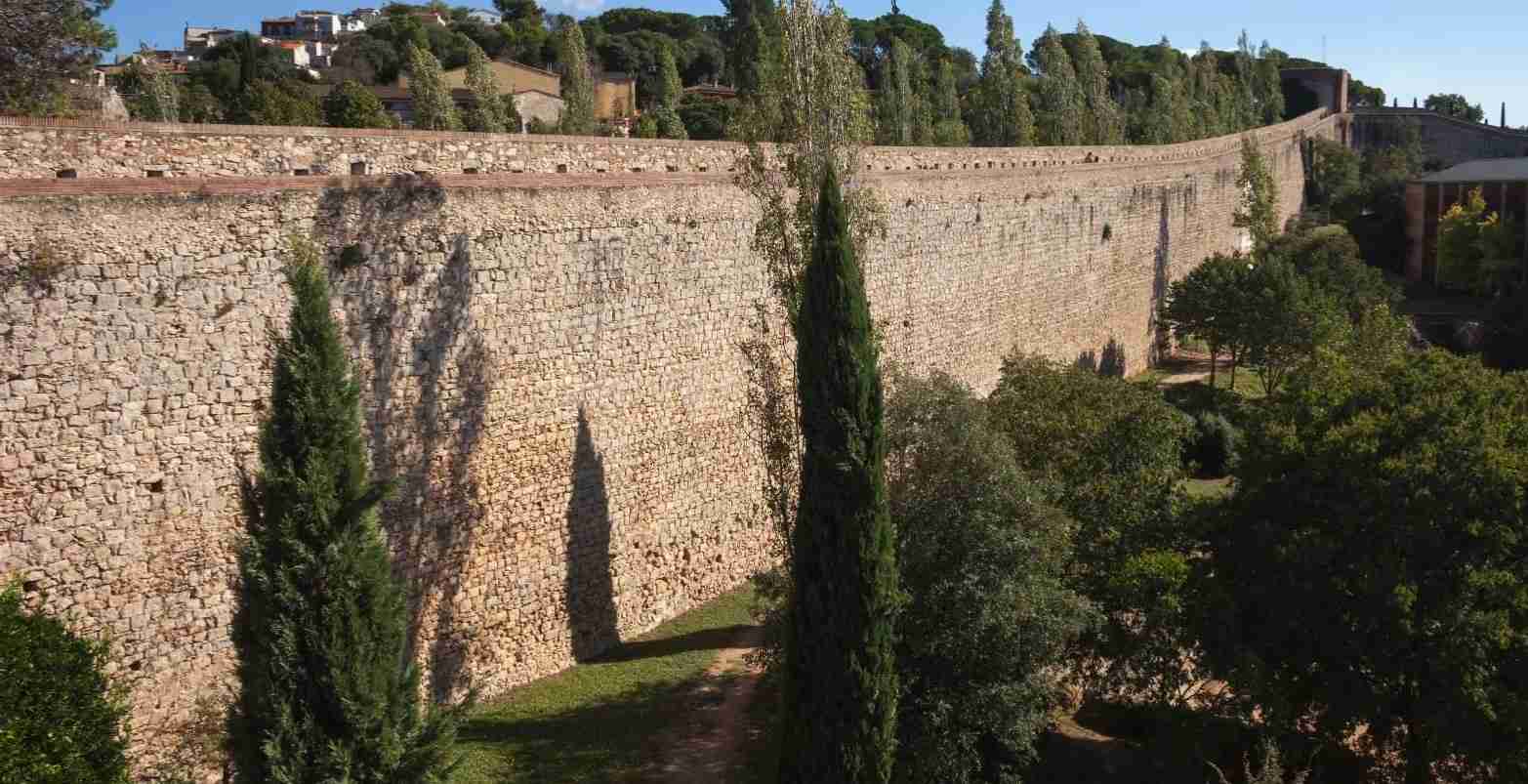
- Twenty centuries compressed into 2 km: The walls incorporate distinct construction phases from Roman, Carolingian, medieval, and early-modern periods, all readable in the stonework — irregular polygonal blocks for Rome, doubled-width courses for the Carolingian reform, square towers for the 14th-century expansion.
- The most extensive Carolingian fortification in Europe: The 9th- and 10th-century rebuilding transformed Girona into the principal Christian stronghold on the Frankish-Arab frontier, a status that determined the character of every stone laid thereafter.
- Torre Gironella — apex and archive: The ruined tower at the highest point of the wall complex sits on Roman and Iberian foundations, served as last refuge for Girona’s Jewish community during the 1391 pogrom, and provides the finest panoramic view in the city.
- The Força Vella — a city within the city: The Roman perimeter now encloses Girona Cathedral, the Jewish Quarter (El Call), and the Arab Baths, creating one of the densest concentrations of heritage in Catalonia within a single walkable enclosure.
- A monument to resistance: Girona’s walls withstood assaults in 793, major sieges in 1285, and three separate French sieges during the Peninsular War of 1808–1809, earning the city the epithet La Immortal — the Immortal City.
People Also Ask About the Girona Carolingian Wall
How long does it take to walk the full Girona city wall route?
A complete traverse of the Passeig de la Muralla, from the Jardins dels Alemanys near the cathedral to the Jardins de la Muralla at the southern end, takes between 45 minutes and 90 minutes depending on pace and the number of towers you choose to climb. The walkable section covers approximately 1 kilometre along the top of the restored ramparts; including the ground-level Passeig Arqueòlogic circuit and diversions into the Força Vella, the total itinerary described in this guide extends to about 3 kilometres. Allow a full half-day to do it justice, particularly if you intend to visit the Arab Baths, Torres Gironella, and the monastery of Sant Pere de Galligants along the way.
What distinguishes the Carolingian section from the Roman and medieval sections of the wall?
The Carolingian section — built during the 9th and 10th centuries when Girona sat on the border between the Frankish empire and Muslim-controlled territory — is recognisable by its doubled wall thickness and semicircular towers, a departure from the square Roman towers of the original Força Vella. Where Roman construction used irregular polygonal blocks of local nummulitic limestone, Carolingian builders reinforced the curtain walls from the inside, laying courses of sandstone and recycled Roman material to nearly double the original width. The medieval extension of the 14th century, built under King Peter IV of Aragon, reverted to square tower forms and a lower profile suited to artillery-era warfare. Standing at Torre Gironella and looking south, you can trace all three phases in a single sightline.
What can you see from the Girona wall walk?
From the wall walk’s highest points, near Torre Gironella and the Carolingian curtain, views extend across the tiled rooftops of the old town to the Gothic nave and Baroque façade of the cathedral, the bell tower of the Basilica of Sant Feliu, the green ribbon of the River Onyar, and on clear days the summits of the eastern Pyrenees. Looking down into the old town from the Carolingian sections, the labyrinthine street plan of the Jewish Quarter is visible as a dense mesh of medieval rooftops barely wider than the alleys beneath. From the lower wall sections near the Jardins de la Muralla, the modern city and the Devesa park spread out to the west. Each tower offers a slightly different sightline, making it worth climbing every accessible one rather than stopping at the first.
Is the Girona wall walk accessible for visitors with mobility limitations?
The wall walk is not wheelchair accessible. The route involves steep stone staircases at every entry and exit point, uneven cobbled surfaces along the walkway itself, and open steps inside the towers. Visitors with limited mobility can experience much of the historical context from street level along the Passeig Arqueòlogic — the ground-level path along the base of the northern wall between Portal de Sobreportes and the Jardins dels Alemanys — which is flat and accessible. The Arab Baths, the Jewish History Museum, and the Cathedral are all partially accessible for wheelchair users and provide complementary engagement with the same heritage.
Extended multi-day tours – 5+ days
Featured Girona Multi-Day Tour Packages
3 days
Girona 3-Day Discovery Tour
- ✓ Comprehensive Girona experience
- ✓ Expert local guides included
- ✓ All accommodation included
- ✓ Transportation provided
5 days
Girona 5-Day Highlights Experience
- ✓ Comprehensive Girona experience
- ✓ Expert local guides included
- ✓ All accommodation included
- ✓ Transportation provided
7 days
Girona 7-Day Cultural Journey
- ✓ Comprehensive Girona experience
- ✓ Expert local guides included
- ✓ All accommodation included
- ✓ Transportation provided
10 days
Girona 10-Day Complete Adventure
- ✓ Comprehensive Girona experience
- ✓ Expert local guides included
- ✓ All accommodation included
- ✓ Transportation provided
Multi-day tour packages powered by TourRadar. Prices and availability subject to change.
Introduction — Girona’s Living Fortress
Few cities in southern Europe remain as legible as Girona. Where other ancient settlements have been razed, rebuilt, and buried under modern accumulation until only a fragment survives, Girona has retained the physical fabric of its past in a configuration that still makes spatial sense. The walls that once defended the Roman colony of Gerunda still stand above the streets that were the Roman cardo and decumanus. The towers the Carolingian counts erected on Charlemagne’s southern border still command the high ground above the medieval Jewish Quarter. The bastions that defied three French siege trains in 1808 and 1809 still face the mountains from which those armies descended.
The reason Girona preserved its walls while so many other Catalan cities demolished theirs in the 19th century is partly geographical — the old town occupies a hilltop too steep for easy commercial expansion — and partly a product of the same stubborn civic pride that produced the city’s siege legend. Whatever the cause, the result is a monument of exceptional completeness. The walls were designated a cultural asset of national interest in 1967 and subsequently restored across multiple campaigns that stabilised the structure without sanitising its character. The towers retain their rough texture. The Arabic inscriptions carved into certain stones during the Moorish occupation are still legible. The holes punched into the upper courses by Napoleonic cannon remain unpatched in several places, a deliberate decision by the restorers to preserve the evidence of the city’s most famous ordeal.
The cultural itinerary described in this guide is not merely a walking route. It is an exercise in stratigraphic reading — the discipline of extracting history from the physical sequence of construction, repair, and adaptation that has accumulated on this hilltop over more than two thousand years. Every section of the wall records a different political reality: the Roman decision to anchor an empire’s communication network at this river crossing; the Carolingian understanding that this hilltop commanded the only viable land route between France and the Iberian south; the medieval counts’ knowledge that a city’s survival depended on the relationship between its walls and its water supply, its garrison and its community. To walk the Carolingian Wall of Girona is to walk through decisions made under extreme necessity, translated into stone.
From Roman Gerunda to Carolingian Frontier City — The Making of the Walls
Roman Origins — The First Enclosure
The Roman colony of Gerunda was established around 77 BC during the Sertorian Wars, when Pompey and his forces sought to control the Via Heraclea — the main road connecting Rome’s territories in Italy with its possessions in Hispania. The road, later renamed the Via Augusta, ran along the coast and through the river valleys of the northeast, and the hilltop above the confluence of the Onyar and Galligants rivers offered an ideal control point: defensible ground straddling the principal communications artery of the western empire.
The first walls enclosed a roughly triangular perimeter following the natural contours of the hill, with the high point — where Torre Gironella stands today — as the northeastern apex. The cardo maximus, the main north-south street of the Roman grid, ran from the northern gate (the Portal de Sobreportes) down to the southern gate, following the line of what is now the Carrer de la Força. The decumanus, the east-west axis, has not been securely identified, but the Roman grid can still be read in the street plan of the Força Vella quarter. Some archaeological findings suggest the Roman walls were constructed over even earlier Iberian settlement walls — the nummulitic limestone blocks of a pre-Roman fortification have been identified in the lowest courses in several places — though this remains a subject of scholarly discussion.
The Roman wall used irregular polygonal blocks of local stone, a technique known as opus poligonal, that is still visible in the most ancient surviving stretches near the Basilica of Sant Feliu. The most important concentration of Roman masonry survives on the southeastern slope of the hill, where the characteristic rounded fossils embedded in the nummulitic limestone — the same stone that gives Girona its distinctive grey-gold colour — betray the original Roman construction beneath later reinforcement. By the 3rd century AD, as barbarian pressure intensified, the towers flanking the northern gate were rebuilt in rectangular sandstone blocks and the curtain walls substantially thickened.
The Carolingian Transformation — Frontier Necessity and Imperial Ambition
The political geography of the early medieval period remade Girona twice within a single generation. The first transformation came with the Muslim conquest of the Iberian Peninsula. In 714, three years after the initial crossing of the Strait of Gibraltar, Moorish forces reached Gerunda and incorporated it into the expanding Umayyad territory that would become Al-Andalus. For seven decades the city sat within the Moorish sphere, its old Roman walls repurposed by new administrators, its population gradually adapting to the changed political reality.
The second transformation came in 785, when the citizens of Girona — their precise motivations uncertain, though the Frankish sources speak simply of “the men of Girona submitting to King Charles” — opened their gates to the forces of Charlemagne and joined what would become known as the Marca Hispanica, the Hispanic March. This southern borderland of the Carolingian empire was a military frontier zone rather than an integrated territory, designed to push the boundary of Christian control as far south as the Pyrenees and beyond. Girona, as the first significant city south of the mountain passes, became the linchpin of this defensive project.
The strategic importance of the city’s position — on the border between the Carolingian empire and the Emirate of Córdoba — generated the most intensive phase of wall construction the city had ever seen. Between roughly the 820s and the end of the 10th century, Carolingian engineers undertook the great reform of the fortifications that gives the walls their current designation. The changes were systematic: the existing Roman curtain walls were reinforced from the interior, effectively doubling their thickness; new semicircular towers were added at intervals along the northern and eastern faces, providing flanking coverage along the wall line; the perimeter of the northern sector was modified to incorporate additional high ground. The resulting circuit was more formidable than the Roman original in every measurable dimension.
The political figure most closely associated with this transformation is Guifré el Pilós — Wilfred the Hairy — the Count of Barcelona and Girona from approximately 878 until his death in 897. Wilfred was the first Carolingian count in the region to hold his position hereditarily, without requiring fresh confirmation from the Frankish crown, a shift that effectively marked the beginning of an autonomous Catalan political identity. His consolidation of the Girona fortifications was inseparable from his political project: a defensible capital for a territory that was beginning to understand itself as distinct from both the Frankish kingdom to the north and the Islamic south. The wall he rebuilt and extended is, in this sense, one of the earliest material expressions of what would eventually become Catalonia.
The military necessity behind the Carolingian reforms was demonstrated almost immediately. In 793, Moorish forces launched a major raid across the Pyrenean frontier, and Girona’s walls held. The assault of 827, part of the revolt of Aisso, tested the defences again, with similar results. Each siege validated the investment in the Carolingian reconstruction and reinforced the city’s identity as a stronghold. By the time the County of Girona was being absorbed into the expanding County of Barcelona in the late 10th century, the city’s reputation as an impregnable position was already centuries old.
Medieval Expansion and the Making of the Força Vella
By the 11th century, the population of Girona had grown well beyond the Roman perimeter. New communities had established themselves outside the original enclosure — the parishes of Sant Feliu, Sant Pere, and Santa Eulàlia all occupied ground outside the ancient walls — and the defensive logic of the Carolingian circuit required updating. The construction of the castles of Sobreportes and of the Vescomte (built to protect the two main entrances to the upper city) and the strengthening of the Torre Gironella complex at the northern apex of the wall represented the first significant medieval additions to the Carolingian fabric.
The great medieval expansion came in the 14th century, during the reign of King Peter IV of Aragon (Pere el Cerimoniós — Peter the Ceremonious), when rapid urban growth made a second concentric circuit of walls essential. The new outer enclosure, built largely between the 1360s and 1400s, enclosed the expanded urban area including the parishes and commercial districts that had grown up outside the Carolingian perimeter. It introduced a different architectural vocabulary — heavier square and round towers suited to the artillery age that was beginning to transform siege warfare — and left the older Carolingian circuit as the inner sanctum of what was now called the Força Vella: the old fortress.
The Força Vella designation captures a transformation in function as well as form. The ancient hilltop circuit, which had been the entire city for centuries, became a fortified enclosure within the city — a citadel-within-a-city containing the cathedral, the bishop’s palace, the Jewish quarter, and the administrative core. This dual layering, an inner Carolingian fortress nested within a medieval outer circuit, gives Girona’s heritage landscape its characteristic density.
Nineteenth-Century Attrition and Twentieth-Century Revival
The Napoleonic Wars inflicted damage on the walls that was never fully repaired by the Spanish state, and by the mid-19th century the expanding city was pressing against the medieval circuit in ways that led municipal authorities to demolish several sections to open new streets and commercial arteries. The loss was significant: the western and southern stretches of the medieval outer wall were largely dismantled, along with portions of the Carolingian circuit that were considered obstacles to urban growth. What remained was, by the late 19th century, a fragmented and largely forgotten infrastructure.
The turnaround came slowly. The 1967 designation as a national monument of cultural interest provided legal protection. Progressive restoration campaigns from the 1970s onwards stabilised the surviving fabric and opened the elevated walkway to the public. The opening of the Passeig de la Muralla as a public promenade, completed in the early 2000s, transformed the walls from an archaeological concern into a daily feature of Girona life. Today, the circuit is used as a park, a viewpoint, an educational resource, and one of the most popular free attractions in Catalonia — a remarkable reversal from the neglect of the previous century.
The Marca Hispanica — Why Girona’s Walls Were So Heavily Fortified
The designation of Girona as a key node in the Carolingian Marca Hispanica requires some context to appreciate fully, because the political geography of the 9th century bears almost no resemblance to the map that modern visitors bring with them. When Charlemagne’s advisers and generals looked south from the Pyrenees in the 780s, they saw not Spain but a fragmented, contested borderland where the boundaries between Christian and Muslim authority shifted with every season’s campaigning. Girona was not a provincial city absorbed into a stable empire; it was the first secure position the Franks had managed to establish south of the mountains, and its security was precarious from the first day.
The Emirate of Córdoba — the successor state to the Umayyad caliphate that had conquered Iberia in 711 — controlled everything south and west of Girona. Its military expeditions regularly crossed the Pyrenees or swept up the Mediterranean coast. The 793 assault on Girona and the broader raid that reached the Frankish heartland of Septimania in the same year illustrated the real meaning of frontier life. Holding Girona meant maintaining the walls in a state of permanent military preparedness, garrisoning them adequately, and ensuring that the population — who had, after all, lived under Moorish rule and might have their own views on which side of the frontier they preferred — remained loyal to the Carolingian administration.
The response to this challenge was architectural, political, and cultural simultaneously. Architecturally, the walls were rebuilt to a standard that represented the cutting edge of Carolingian military engineering: doubled thickness, semicircular towers with internal staircases, a continuous parapet walkway connecting the entire circuit. Politically, the city was made the seat of a county — a direct representative of royal authority — with the resources to maintain the garrison. Culturally, the Carolingian presence generated an overlay of Frankish naming conventions, religious foundations, and legendary associations that has never fully faded: the cathedral tower still carries the name Torre de Carlemany (Charlemagne’s Tower), even though it dates from the 11th century, centuries after the emperor’s death in 814.
The figure of Charlemagne loomed so large in the civic imagination of medieval Girona that from 1345 until at least 1484, the emperor was commemorated liturgically in the diocese as a local saint — a genuinely extraordinary honour for a Frankish king remembered primarily for the military action that incorporated the city into his frontier zone. The legends surrounding his role were embellished across generations until they bore little relationship to the documented historical record, but they served a real civic function: providing a foundation myth that anchored Girona’s Christian identity to the most prestigious name in the Carolingian world.
The longer-term consequence of the Marca Hispanica framework was the emergence of an autonomous Catalan identity that owed its character to the frontier condition. The counts of Barcelona and Girona governed territories that were too exposed and too valuable to be managed at a distance from Paris; necessity produced administrative independence, and administrative independence produced political self-consciousness. By the time the last nominal Carolingian ties were severed in the late 10th century, the counties of Catalonia had been governing themselves for generations. Girona’s walls were not merely a defensive installation: they were the material precondition for a political culture that is still distinct today.
The Itinerary — A Walk Through Carolingian and Medieval Girona
The itinerary described here begins at the Portal de Sobreportes — the north gate of the Roman city, now the most dramatic single threshold in the old town — and follows the wall circuit clockwise to Torre Gironella, then descends along the Carolingian walkway to the Jardins de la Muralla. Parallel ground-level sections along the Passeig Arqueòlogic and through the Jewish Quarter are integrated into the route, making this a complete circuit rather than a simple ramparts walk. Allow between two and three hours for the full itinerary.
Starting Point — Portal de Sobreportes and the Cathedral Precinct
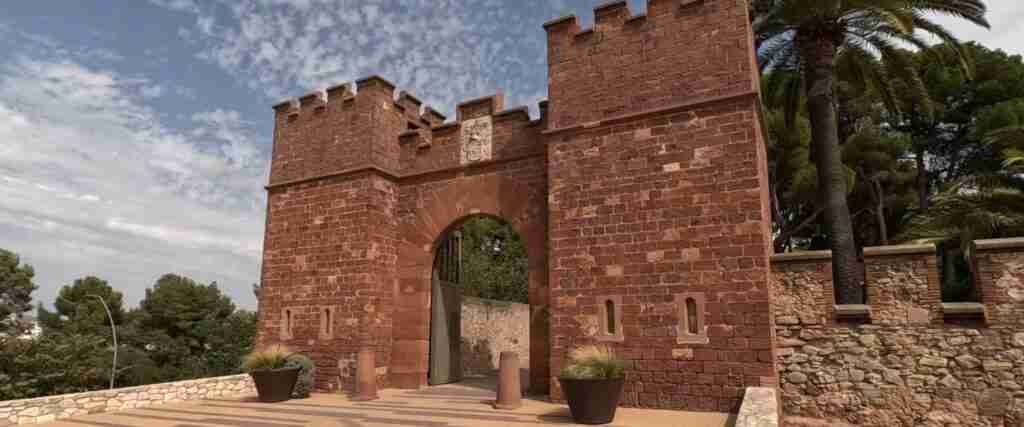
The Portal de Sobreportes is the north gate of the Roman city, and its two massive cylindrical flanking towers are among the most visually arresting elements of the entire fortification. The gate corresponds to the original Roman north entrance, founded in the 1st century BC and rebuilt with square towers in the 3rd century AD as the barbarian threat intensified. The current towers — circular, roughly 12 metres in diameter — are medieval replacements from the 11th century that were built using the structure and much of the stone of their Roman predecessors, a characteristic Girona practice of constructional continuity that makes precise dating so difficult in many parts of the circuit.
The gate is reached from the Plaça de la Catedral by descending the 90-step staircase of the cathedral — one of the most photographed approaches to any Gothic building in Catalonia — and passing beneath the arch. The archway is narrow and set at an angle to the approaching road, a deliberate defensive configuration designed to slow enemy momentum and prevent direct ram access to the gate. On either side of the passage, the cylindrical towers rise sheer from the street, their rounded profiles a notable contrast with the angular Baroque façade of the cathedral visible through the gate from the south.
From Portal de Sobreportes, turn left immediately through the gate and follow the line of the northern wall westward. This section of the Passeig Arqueòlogic — the Archaeological Walk, also known as the Queen Joan Walk (Passeig de la Reina Joana) — follows the outer base of the wall along a shaded path with the fortifications rising on the right. The first notable structure encountered is the Casal de les Serraïnes, a medieval building whose name — House of the Saracens, or Moorish women — reflects a popular legend connecting it to the period of Muslim occupation. Its arcaded façade is one of the more elegant architectural details along the ground-level route.
The Jardins dels Alemanys — Portal to the Elevated Walk
The Jardins dels Alemanys — the German Gardens — sit immediately behind the cathedral apse, in the angle between the northern wall and the eastern wall of the cathedral precinct. The name derives from a medieval tradition of German pilgrims who camped here en route to Santiago de Compostela, and the gardens retain a quality of enclosed contemplation that is entirely different from the exposed grandeur of the wall walk above. Large cypress trees shade the paths, and fragments of Roman masonry are visible in the lower courses of the surrounding walls.
The main access point to the elevated wall walk rises from the Jardins dels Alemanys via a flight of stone stairs. This is the starting point for the upward traverse that leads to Torre Gironella. The adjacent Jardins de la Francesa — the French Gardens — take their own name from a local legend: the tradition that a Frenchwoman who settled here during the Napoleonic occupation haunts the gardens, one of several ghost stories that the residents of the old town have attached to their ancient infrastructure over the centuries. The two gardens together form a green wedge between the cathedral precinct and the beginning of the Carolingian wall circuit, and they are worth spending time in before the more demanding sections of the route.
The Apex — Torre Gironella
Torre Gironella crowns the highest point of the entire wall circuit, a ruined bastion complex that represents over two thousand years of accumulated construction. The earliest evidence for a fortified structure on this spot suggests occupation from around 994 AD, though the foundations incorporate Roman masonry that may predate this by a millennium, and the possibility of even earlier Iberian construction beneath cannot be ruled out. What visitors encounter today is a partially stabilised ruin — walls standing to varying heights, some roofless chambers intact to their vaulting, open spaces where buildings have collapsed — that conveys the scale and complexity of the original fortification without the tidy restoration that has been applied to the walkway sections below.
The tower occupies the northeastern apex of the original Roman perimeter, the point where the north wall and east wall of the Força Vella meet at their highest elevation. From the summit of the ruined complex, the panorama covers the entire old town, the river valleys to the west and north, and on clear days the first ridges of the eastern Pyrenees. The view south along the Carolingian curtain wall — the most photographed perspective in the entire circuit — shows the walkway descending in a long curve through successive towers toward the lower ground of the medieval extension.
Torre Gironella carries a particular weight in Girona’s Jewish history. When the anti-Jewish pogroms of 1391 swept across the Iberian Peninsula, reaching Girona in a wave of violence that destroyed Jewish communities in dozens of cities, the Jews of Girona’s El Call took refuge in the tower complex. The choice was not accidental: Torre Gironella was the defensible apex of the city, garrisoned and walled on all sides, and the Jewish community evidently had a relationship with the fortification that made it accessible to them in extremis. The pogrom of 1391 killed or forcibly converted much of Girona’s Jewish population; those who took refuge in the tower survived the immediate violence, but the community never recovered its pre-1391 scale. The ruins of the tower today bear no plaque commemorating this episode, a characteristic Girona reticence about its own history that visitors occasionally remark upon.
The steps to the upper level of the Gironella complex are uneven and steeper than those elsewhere on the circuit. Appropriate footwear is important here. The interior of the ruined structure can be explored freely, and the spaces between surviving walls — some still with arched openings intact — have a quality of raw historical immersion that the more polished sections of the walkway below cannot match.
The Carolingian Curtain — Heart of the Wall Walk
Descending south from Torre Gironella, the route transitions onto the walkway section that gives the Passeig de la Muralla its popular designation as the Carolingian wall walk. Facing Torre Gironella and looking south, everything to the right belongs to the Carolingian reconstruction of the 9th and 10th centuries — the doubled-thickness curtain walls, the semicircular towers at intervals, the continuous parapet that allowed defenders to patrol the entire circuit under cover. Everything to the left belongs to the later medieval expansion, a lower and broader profile suited to a different era of warfare.
The Carolingian section is the most visually coherent stretch of the entire circuit. The masonry here is denser and more varied than in the restored sections below: courses of Roman spolia (recycled Roman stonework) alternate with Carolingian-period sandstone, with occasional medieval repair patches visible as slightly different coloured or textured insertions in the wall face. Walking it, you are walking on material that was laid by workers whose political master was the Count of Girona, whose strategic purpose was to maintain the boundary of Christian Europe against the Emirate of Córdoba, and whose immediate predecessors had done the same job for the builders of the Roman empire.
The towers along this section are worth entering individually. Each one provides a different angle on the old town below and the countryside to the east. The internal staircases — stone steps worn smooth by centuries of use — have a different character from the reconstructed stairs of the lower walk: narrower, steeper, with walls that close in on either side in a way that makes the defensive function viscerally comprehensible. An attacker who managed to force entry into one of these towers would find himself fighting upward in an enclosed spiral, with defenders above and the knowledge that he had left his own escape route far below.
The stretch from Torre Gironella to the point where the walk descends toward Sant Domènec takes about 20 minutes to cover at a steady pace, longer if you climb every tower and linger at each viewpoint. The entire section is above the roofline of the houses below, and the panoramic quality of the experience is consistent throughout. In the early morning, when the light falls at a low angle from the east, the texture of the Carolingian masonry is at its most readable — individual stone courses, repair patches, and the characteristic doubly-thick profile of the reinforced curtain wall all stand out with unusual clarity.
The Middle Tier — Sant Domènec, the University Belt, and the Torre del Telègraf
The central section of the wall circuit passes through a zone where the military and the academic have coexisted since the medieval period. The Convent of Sant Domènec — now the Faculty of Arts of the University of Girona — occupies the hillside immediately west of the wall at its mid-point, its Gothic cloister and church visible through gaps in the curtain wall from the walkway above. The convent was established in the 13th century as a Dominican foundation and became one of the principal ecclesiastical institutions of the city; its current function as a university faculty represents a kind of institutional continuity — the pursuit of formal knowledge in the same buildings across seven centuries.
The Torre del Telègraf — the Telegraph Tower — is one of the more historically layered towers along this section. Its name derives not from the Carolingian period but from the Napoleonic: a visual telegraph relay station was established here during the siege years of 1808–1809, connecting the city’s military command with observation posts on the surrounding hills. The tower itself is older, a standard component of the Carolingian curtain wall, but its 19th-century adaptation illustrates the way in which the ancient infrastructure was continuously pressed into service for contemporary military purposes across every era of the city’s history.
From a gateway beneath the Telegraph Tower, it is possible to descend from the wall walk into the Plaça de Sant Domènec, a small square with a café beneath plane tree shade that serves as a natural rest stop for anyone completing the full circuit. From here, the Torre Rufina is visible to the left — a substantial square tower that marks the junction between the Carolingian circuit and the later medieval extension. The Plaça is also the point from which many visitors choose to exit the wall walk and explore the Sant Domènec complex and the University area before re-ascending to complete the route.
The Descent — Torre Rufina, the Lower Sections, and the Medieval Perimeter
The lower sections of the wall walk, descending from the Sant Domènec area toward the Jardins de la Muralla at the southern end, incorporate the most extensive sections of the 14th-century medieval extension. These walls are visually different from the Carolingian curtain above: lower in profile, thicker at the base, and incorporating square towers rather than the semicircular forms of the Carolingian period. The change reflects both architectural fashion and military necessity — the growing importance of artillery in 14th-century siege warfare required walls that could better absorb horizontal impact and provide platforms for defending cannon.
Torre Rufina stands at one of the transition points between the Carolingian and medieval sections, its mass visible from several vantage points along the descent. The tower takes its name from a local family and has been associated with the Jewish community of the adjacent El Call quarter — the houses built up against its base were part of the dense urban fabric of medieval Girona in which the Jewish population lived and worked alongside the Christian majority. The tower represents one of the points at which the wall became not simply a military perimeter but an urban edge condition, a surface against which medieval Girona built itself.
The southern walk descends through a sequence of viewpoints offering perspectives over the new city and the Devesa park — the large 19th-century park along the River Ter that provides the green counterpoint to the stone density of the old town. The combination of medieval fortification and urban parkland in the same visual field gives this section of the walk a different character from the dramatic Carolingian heights above: more contemplative, less austere, with bench seating and the sound of the city audible below.
The Southern Gardens — Jardins de la Muralla and the Route’s End
The Jardins de la Muralla at the southern end of the wall walk mark the terminus of the elevated circuit. The gardens occupy a landscaped space created when several sections of the medieval outer wall were demolished in the 19th century, and their current form — terraced lawns, shaded seating, a guitarist or street musician on most afternoons — represents the 20th-century transformation of the defensive infrastructure into public green space. From here, the Plaça de Catalunya and the train station are a short walk, making this the natural exit point for visitors arriving from or returning to the lower city.
The Portal de Sant Cristòfol, named for a nearby 14th-century chapel that no longer stands in its original form, provides an alternative exit point slightly before the Jardins de la Muralla. The gate’s current form dates to an 18th-century restoration but occupies the location of a medieval gate that controlled access to the southeastern quadrant of the outer circuit. A descent through the Portal de Sant Cristòfol leads directly into the historic street network of the old town and provides an alternative continuation of the itinerary through the Jewish Quarter.
The Towers — Architectural Anatomy of a Defensive System
The towers of Girona’s walls are not merely decorative intervals in the curtain wall; they are the structural logic of the entire system. Without towers, a masonry wall is a passive obstacle that an attacker can approach from any direction with impunity. With towers projecting from the wall face, the defenders can deliver fire along the length of the curtain in both directions — “flanking fire” in military terminology — denying attackers the protection of the wall’s dead angle. The spacing, size, and design of the towers along Girona’s circuit reflects this logic across multiple construction periods, with each phase making different choices that respond to the military technology of its era.
The Roman towers of the Força Vella were primarily square or rectangular in plan, a form suited to the concentrated missile fire of ballista and catapult. The Carolingian towers introduced the semicircular projecting form that became the standard of early medieval military engineering: rounder shapes are structurally stronger against battering, more resistant to undermining, and provide better flanking angles for archers on the curved wall faces. The 14th-century towers of the outer medieval circuit returned to a hybrid form — square towers with rounded external faces — that accommodated both the old archery functions and the newer requirements of artillery placement on the tower roof platform.
The construction materials visible in the towers also carry chronological information. The oldest courses — Roman — use irregular polygonal blocks of local nummulitic limestone, with a characteristic bumpy texture caused by the small rounded fossils embedded in the stone (the same nummulites, ancient marine organisms, that give the stone its name). Carolingian courses mix recycled Roman stone with freshly quarried sandstone in a more regular course pattern. Medieval additions use smoother cutting and more uniform block sizes, reflecting improvements in stone-working tools and techniques.
The Torre Gironella complex at the apex of the circuit represents the most elaborate tower installation in the city, combining elements from all three major construction periods. Its current ruined state, while frustrating for visitors seeking clear interpretation, actually reveals the stratigraphic complexity better than any restoration could: the exposed cross-sections of the walls show layer upon layer of construction activity, with Roman foundations, Carolingian reinforcement, medieval additions, and Napoleonic-era patching all visible in a single slice through the fabric.
Along the Carolingian walkway section, the semicircular towers are the most consistently identifiable feature of the 9th- and 10th-century construction. They project from the outer face of the curtain wall at intervals of approximately 50 to 70 metres — a spacing calculated to ensure that the entire length of the curtain between any two towers falls within effective arrow range from both tower positions. Each tower has an internal staircase rising to a roof platform, and the roof platforms are connected to the wall walkway, allowing defenders to move continuously around the circuit without descending to ground level.
The Força Vella and the Jewish Quarter — A Community Within the Walls
The Força Vella — Old Fortress — is the name given to the area enclosed within the original Roman perimeter of Gerunda, now the innermost and highest part of Girona’s old town. Within this enclosure, on the narrow streets climbing toward the cathedral from the south, lies the El Call — the Jewish Quarter — one of the best-preserved medieval Jewish urban environments on the Iberian Peninsula and, by some assessments, in all of Europe.
The earliest documentary evidence for a Jewish presence in Girona dates from 888 AD, a preserved document mentioning 25 Jewish families. By the 12th century, a flourishing community of several hundred families had established itself primarily on the Carrer de la Força — the old Roman cardo maximus, appropriately the central spine of the Força Vella — and in the labyrinthine alleys running perpendicular to it. At its peak the community numbered some 800 residents, a substantial fraction of the city’s total population. The Jewish Quarter was an economic and intellectual centre of some distinction: among its residents was Rabbi Moshe ben Nahman (Nahmanides), born in Girona in 1194, one of the most important Jewish scholars, physicians, and philosophers of the medieval period, whose commentary on the Torah remains a standard reference in Jewish learning.
The walls that enclosed the Força Vella were not abstract heritage for the Jewish community: they were, at various moments, the primary guarantor of physical survival. The relationship between the wall and the community was most acutely demonstrated in 1391, when anti-Jewish violence swept across the Iberian Peninsula following decades of rising tension. When the pogroms reached Girona, the city’s Jewish residents fled to the Força Vella and ultimately to the Torre Gironella, the most defensible point in the entire circuit. The tower provided physical safety during the immediate violence, but the pogrom marked the beginning of the end of Jewish life in Girona. The community lost much of its population to forced conversion and violence; those who remained faced increasing restriction, taxation, and hostility. The final expulsion came in 1492, when the Catholic Monarchs Ferdinand and Isabella issued the Alhambra Decree, forcing all Jews in the Spanish kingdoms to convert or leave.
The physical legacy of the Jewish Quarter survives in exceptional condition. The Carrer de la Força, the Manuel Cúndaro, the Sant Llorenç — alleys barely wide enough for two people to pass — retain their medieval proportions and stone-paved surfaces. The buildings, many of them dating from the 12th to 15th centuries in their core fabric, present the characteristic blank lower-storey façades of medieval urban Jewish domestic architecture, designed to minimise vulnerability on the street level. The Museu d’Història dels Jueus, housed in the building associated with the synagogue of the medieval community at number 8 Carrer de la Força, provides comprehensive documentary and artefactual coverage of the community’s history, from its Carolingian-era origins to the expulsion.
Walking through El Call while simultaneously aware of the wall circuit above and around it — the Roman foundations of the Força Vella visible as massive stone courses at the base of certain buildings, the Torre Gironella presiding over the whole from its position at the northeastern apex — produces a sense of historical layering that is difficult to achieve by documentary means alone. The Jewish Quarter is not a museum installation: it is a living urban fabric in which the medieval pattern of streets and plots has survived because the hill it occupies is too steep and the buildings too robust for easy demolition and replacement. The walls that protected the community are the same walls that preserved its physical setting.
Beyond the Wall — Three Monuments in the Shadow of the Ramparts
The Banys Àrabs — Hybrid Heritage Along the Passeig Arqueòlogic
The Arab Baths — Banys Àrabs — are the most architecturally coherent heritage building along the ground-level Passeig Arqueòlogic route, and their position immediately inside the northern wall circuit makes them an essential complement to any wall itinerary. Built in the late 12th century, the baths represent a fascinating hybrid of building traditions: the spatial sequence of rooms — apodyterium (changing room), frigidarium (cold room), tepidarium (warm room), caldarium (hot room) — follows the Roman bath plan; the decorative vocabulary, particularly the lantern dome of the frigidarium resting on eight columns above an octagonal pool, draws on the architectural tradition of the Moorish baths that flourished in Al-Andalus; and the construction technique is the Catalan Romanesque masonry being developed simultaneously in the surrounding monasteries and churches.
The baths were built not by Moors — the Muslim presence in Girona had ended in 785, nearly four centuries before the baths’ construction — but by Christian craftsmen operating under the influence of a bathing culture that had been transmitted across the religious boundary. They are called “Arab” in the popular tradition because they exhibit the spatial and decorative characteristics of a bathing tradition more commonly associated with Islamic architecture, a naming convention that captures a genuine historical relationship between the Christian and Islamic cultures of medieval Iberia even as it misattributes the actual builders. The baths functioned as a public facility until the 17th century, were subsequently used as a convent annex, and opened to the public as a heritage site in the 20th century.
Sant Pere de Galligants — The Romanesque Cloister at the Wall’s Northern End
The monastery of Sant Pere de Galligants stands at the northern end of the wall circuit, where the Carolingian perimeter meets the banks of the Galligants river and the begin of the open country beyond the city. The 12th-century Romanesque church and cloister are among the finest examples of Catalan Romanesque architecture in the region — a style characterised by blind arcading on the exterior walls, carved capitals in the cloister combining figurative biblical narrative with elaborate vegetable and geometric ornament, and the restrained geometric clarity of the bell tower rising above the river.
The monastery is now the home of the Museu Arqueològic de Catalunya — Girona, the regional archaeological museum, making it simultaneously a remarkable piece of heritage architecture and one of the best places to engage with the pre-history and Roman history of the region. The Roman-period material in the museum’s collection includes inscriptions, structural elements, and small finds from the site of ancient Gerunda that provide essential context for the wall itinerary above. The museum’s display of Roman masonry techniques, for instance, makes the distinctions between polygonal opus poligonal and later construction phases much more legible when you subsequently walk the wall circuit.
The monastery’s position at the foot of the wall — tucked into the angle between the city’s northern defensive perimeter and the natural boundary of the Galligants valley — reflects the characteristic medieval urban pattern in which ecclesiastical foundations chose positions that were sheltered by but adjacent to the military infrastructure. The monks of Sant Pere de Galligants could see the wall circuit rising above them from their cloister and could reach the city’s main gates within minutes; they were participants in the civic life of the fortified city while maintaining the spatial and institutional separateness that monastic life required.
The Cathedral and the Torre de Carlemany
The Cathedral of Santa Maria de Girona is the dominant monument of the Força Vella and the building that defines the skyline seen from the wall walk. Construction began in the 11th century with the Romanesque apse and cloister — still partially intact on the north side of the cathedral — and continued across six centuries to produce the Gothic nave completed in the 15th century, a space of extraordinary spatial ambition: at 23 metres, it is the widest Gothic nave in existence, a calculation of structural daring that required four successive master builders to propose and eventually execute before the cathedral chapter agreed to proceed.
The Torre de Carlemany — Charlemagne’s Tower — is the Romanesque bell tower that rises from the north transept of the cathedral, and its name encapsulates the entire legend of Carolingian Girona. Built in the 11th century, centuries after the emperor’s death in 814, the tower was given Charlemagne’s name in recognition of the founding myth that attributed the city’s Christian identity to his conquest. It is a Romanesque tower in every architectural detail — five storeys of twin-arched windows rising from a square base — but its popular designation invokes the Carolingian memory that ran through Girona’s civic self-understanding from the 9th century to the present. Standing below the tower from the Plaça de la Catedral and looking up at the structure that gave the Carolingian emperor a permanent presence in the city’s skyline is one of the more charged moments in any itinerary of the walls.
The Cathedral Treasury Museum, accessible from within the cathedral, houses the Tapestry of Creation — a large 11th-century embroidered panel depicting the Days of Creation surrounded by allegorical figures of the months, seasons, and winds. It is one of the most important surviving pieces of Romanesque textile art anywhere in Europe and rewards careful examination in the museum’s controlled conditions before or after the exposure and exertion of the wall circuit outside.
A City That Never Yielded — Girona’s Record of Resistance
Girona’s position on the only viable land route between France and the rest of the Iberian Peninsula made it a military objective in almost every conflict that affected the region. The number of sieges the city has sustained exceeds that of almost any comparably sized European city: Carolingian-era assaults in 793 and 827; the French invasion in 1285 during the Aragonese Crusade; the siege of 1462 during the Catalan Civil War; conflicts during the Franco-Spanish War of the 17th century; further sieges in 1684, 1694, and the twin sieges of 1710–1713 during the War of the Spanish Succession. Each left its mark on the walls — in repairs, in modifications, in the introduction of new architectural elements suited to contemporary siege methods.
The Carolingian-era assaults of 793 and 827 were the first major tests of the rebuilt Frankish fortifications, and both were repelled. The 793 raid, the largest Moorish military operation against the Marca Hispanica up to that date, reached the walls of Girona but did not breach them, and the Moorish force withdrew having failed to take the city. The 827 assault, part of an internal revolt led by a figure known as Aisso who allied himself with the Emirate of Córdoba, similarly failed to take Girona. These early successes established the city’s reputation as a defensible position and validated the investment in the Carolingian reconstruction that had preceded them.
The defining episode in Girona’s siege history — the event that crystallised the city’s self-understanding as a place of exceptional resistance — came in 1809, during the third of three French sieges during the Peninsular War. The first two sieges, in June 1808 and June–August 1808, had been repulsed by a garrison of regular troops and city militia who were substantially outnumbered by the French forces. The third siege began on 6 May 1809, with a French army of 18,000 troops — later reinforced to 32,000 — deploying 40 artillery batteries around the city. The defence was led by General Mariano Álvarez de Castro, a career officer who had previously defended Barcelona’s Montjuïc castle and who brought to Girona’s defence both professional military competence and a strategic vision of what the siege meant in the broader context of the Peninsular War.
Over the next seven months, the French artillery fired an estimated 20,000 explosive shells and 60,000 cannonballs into the city. Álvarez had approximately 5,600 regular troops and militia at the start of the siege, supplemented by the voluntary service of the civilian population — including a remarkable company of women called the Company of Santa Bàrbara who maintained supply lines, cared for the wounded, and carried ammunition to the ramparts. In August, French forces captured Montjuïc castle, the principal hilltop fortification outside the city walls. Álvarez constructed barricades and trenches inside the city itself, converting every block into a secondary defensive position, and the fighting continued. The walls themselves, old and damaged as they were by centuries of repair and neglect, held.
Girona capitulated on 12 December 1809, after seven months, forced not by military defeat but by disease and famine that had reduced the garrison and population to a state of complete physical collapse. Álvarez himself, ill and incapacitated, had already handed command to a subordinate before the surrender. He died shortly after in French captivity, on 22 January 1810, before he could be repatriated. The battle had cost the French army an estimated 14,000 casualties — dead, wounded, or ill — against Spanish losses of approximately 9,000. A large French army had been kept immobilised before a single city for an entire campaigning season.
The Spanish Cortes, sitting in Cádiz as the wartime parliament of the resistance, awarded Girona the title La Immortal — the Immortal City — in recognition of the defence. The epithet has remained in use in the city ever since. The statue of the Defensors de Girona — the Defenders of Girona — erected subsequently in the old town, commemorates not just the garrison but the civilian population and the women of the Company of Santa Bàrbara who sustained the defence alongside the military. Walking the walls today, it is impossible to look at the surviving cannon damage in certain courses of stonework without thinking of what those walls were required to endure.
Practical Guide — Visiting the Wall
The Passeig de la Muralla is open year-round with no admission charge. Opening hours run from 8 AM to 9 PM between September and May, and from 8 AM to 11 PM between June and August. Multiple access points are distributed around the circuit, making it easy to join or leave the route at various stages. The principal access points are through the Jardins dels Alemanys (behind the cathedral, reached from Carrer dels Alemanys), from the Torre Gironella area, and from the Jardins de la Muralla at the southern end.
The direction of the walk matters for practical and experiential reasons. Beginning from the Jardins dels Alemanys end and ascending toward Torre Gironella involves a sustained uphill section through the Carolingian masonry — steep in places, with multiple staircases. Beginning from the Torre Gironella end, accessed from the Jardins dels Alemanys by climbing the access stairs first, allows the highest and most dramatic sections to be experienced early, with the balance of the route running downhill. Most visitors find the second approach more satisfying, though it is the more demanding opening. Beginning from the Jardins de la Muralla and ascending produces the gentlest gradient overall but reverses the historical sequence, taking visitors through the 14th-century medieval extension before the Carolingian circuit.
Appropriate footwear is not optional: the walkway surface is stone, the tower staircases are uneven, and some sections have no handrail. Comfortable walking shoes or light hiking footwear are the minimum requirement. In summer, sun protection and water are both necessary — the upper sections of the wall circuit have no shade and offer no water sources, and the walk is more demanding than its short length suggests, particularly in high temperatures. Morning visits before 10 AM and evening visits after 5 PM are substantially more comfortable in July and August and produce better photographic light on the masonry.
The complete itinerary described in this guide — including the ground-level Passeig Arqueòlogic, the elevated wall walk, the Torre Gironella ruin, diversions into the Jewish Quarter and the Banys Àrabs, and the visit to Sant Pere de Galligants — covers approximately 3 kilometres with perhaps 100 metres of cumulative ascent and descent. It is comfortably achievable in a morning or afternoon, and the proximity of cafés in the Plaça de Sant Domènec and throughout the old town provides natural rest points. The wall walk itself, without the complementary ground-level and interior sections, takes 45 to 90 minutes depending on pace.
Photography is permitted throughout, and the walls provide exceptional subjects at every time of day. The early morning golden light on the Carolingian masonry from the eastern face of the circuit is particularly valued by photographers; the view of the cathedral from the Carolingian walkway in evening light is among the most widely reproduced images of Girona. The ruined chambers of Torre Gironella, with their mix of light and shadow and the quality of raw exposed stonework, reward close attention that standard travel photography misses.
Guided tours of the walls are available through Girona Tour and the city’s official tourist office, with options ranging from historical wall walks to thematic tours covering the Napoleonic siege, the Jewish heritage, and the Game of Thrones filming locations. In 2015 and 2016, the streets and walls of Girona served as “Braavos” for the filming of the sixth season of Game of Thrones; the Carrer de la Força and the Arab Baths in particular appeared in key sequences, and a significant number of visitors now arrive with this association in mind. The heritage substance of the walls vastly exceeds any filmed legacy, but the popular interest generated by the television connection has introduced many visitors to the city who might not otherwise have come.
Frequently Asked Questions
What are the opening hours of the Girona wall walk?
The Passeig de la Muralla is open from 8 AM to 9 PM between September and May and from 8 AM to 11 PM between June and August. It is open every day of the year and is free to enter. Specific sections near Torre Gironella may occasionally be closed for maintenance; the city’s tourism office posts current information on closures. The ground-level Passeig Arqueòlogic is accessible at all times as a public pathway.
How many named towers does the Girona wall circuit include?
The surviving wall circuit includes several named towers distributed between the Força Vella (Carolingian circuit) and the medieval outer extension. Among the most significant are Torre Gironella at the northeastern apex, Torre Cornèlia and Torre Rufina along the Carolingian and transitional sections, and the Torre del Telègraf (Telegraph Tower) in the middle tier of the circuit. The Portal de Sobreportes, the north gate flanked by two large cylindrical towers, is technically a gate complex rather than a tower but is the most architecturally complete surviving gateway in the circuit. Not all towers are accessible to climb; those on the elevated walkway section from Torre Gironella southward are open during wall walk hours.
What is the Força Vella and how does it relate to the wall circuit?
The Força Vella — Old Fortress — is the area enclosed within the original Roman perimeter of Gerunda, now the highest and most historically dense part of Girona’s old town. It contains the cathedral, the bishop’s palace, the Jewish Quarter (El Call), and the Arab Baths, among other monuments. When the city expanded beyond the Roman perimeter in the medieval period and a new outer circuit of walls was constructed in the 14th century, the Força Vella became an inner fortress — a citadel-within-the-city — rather than the entire defensive perimeter. The dual-wall structure, with the Força Vella as the inner sanctum and the medieval extension as the outer circuit, is the basic spatial organisation that still defines Girona’s old town.
Can children manage the Girona wall walk?
Children aged 8 and over who are comfortable with stairs and heights manage the wall walk well; the route is engaging for young visitors who respond to the towers, the views, and the scale of the masonry. Children under 8 can be carried or supported on the steeper staircase sections but require close supervision throughout. Strollers and pushchairs cannot navigate the wall walk itself, though the ground-level Passeig Arqueòlogic is accessible with a stroller. The ruined sections around Torre Gironella require particular care with young children due to uneven surfaces and the absence of continuous handrails.
What is the historical significance of the 1391 events at Torre Gironella?
In 1391, anti-Jewish pogroms swept across the Iberian Peninsula, driven by a combination of economic resentment, religious incitement, and social tension. The violence reached Girona as part of this broader wave, destroying or forcibly converting Jewish communities in dozens of cities. The Jews of Girona’s El Call sought physical refuge in the Torre Gironella complex, the most defensible point in the city, and survived the immediate violence there. The episode represents one of the last moments of the medieval community’s integrity: the pogrom so dramatically reduced the community’s numbers and confidence that recovery was never complete. The final expulsion under the Alhambra Decree of 1492 ended a Jewish presence in Girona that had lasted at least six centuries.
Who was Wilfred the Hairy and what was his role in the wall’s history?
Guifré el Pilós — Wilfred the Hairy — was the Count of Barcelona and Girona from approximately 878 until his death in 897, and the first count to hold the position hereditarily without Frankish royal confirmation, a shift that is traditionally taken to mark the beginning of autonomous Catalan political identity. His consolidation of Girona as the frontier capital of the Carolingian southern march produced or accelerated much of the 9th-century rebuilding of the walls — the doubling of the curtain wall thickness, the addition of semicircular towers, the extension of the northern perimeter — that gives the fortification its current designation as the longest Carolingian wall in Europe. His political legacy, an independently minded territorial nobility governing the Catalan counties as a de facto autonomous unit, shaped the character of Catalan culture for centuries. The walls he rebuilt or extended are as much a monument to this political project as to its defensive function.
What is the best starting point for a first visit to the walls?
For a first visit, the Jardins dels Alemanys behind the cathedral provide the most logical and contextually rich starting point. From here, visitors can ascend directly to the wall walk and head toward Torre Gironella, experiencing the highest and most dramatic Carolingian section in the first portion of the walk rather than at the end. The descent from Torre Gironella along the curtain wall toward Sant Domènec and the Jardins de la Muralla then runs with the grain of the hillside rather than against it, making the second half of the circuit progressively easier. Visitors with limited time who can manage only a portion of the circuit should prioritise the Torre Gironella and the Carolingian section immediately below it — roughly 40 minutes of walking — as the most historically distinctive and visually rewarding stretch.
How is the Girona wall different from other famous European city walls?
The walls of Girona are distinguished from other celebrated European city wall circuits — Dubrovnik, York, Lucca — primarily by their chronological depth and the legibility of their construction history. Where many European city walls preserve a predominantly single-period character (Dubrovnik’s walls are largely medieval, York’s are substantially Roman with medieval overlay), Girona’s circuit incorporates at least four clearly distinguishable construction phases whose different masonry techniques, tower forms, and construction materials are readable even to a non-specialist visitor. The Carolingian phase, in particular, is without close parallel in Europe: no other surviving city wall circuit preserves such extensive evidence of 9th-century Frankish military engineering in a continuous walkable circuit. The combination of Roman foundation, Carolingian rebuild, medieval extension, and early-modern reinforcement in a compact 2-kilometre circuit accessible for free makes Girona’s walls an unparalleled resource for understanding the development of Western defensive architecture.
What nearby monuments should be combined with a wall itinerary?
The Arab Baths (Banys Àrabs) on Carrer de Ferran el Catòlic, immediately inside the northern wall circuit, combine seamlessly with the Passeig Arqueòlogic ground-level route and take approximately 30 minutes to visit. The monastery and museum of Sant Pere de Galligants at the northern end of the circuit provides excellent archaeological context and a fine Romanesque cloister. The Cathedral of Santa Maria and its Treasury Museum reward at least an hour’s exploration, including the Tapestry of Creation. The Museu d’Història dels Jueus at 8 Carrer de la Força provides the fullest documentary coverage of the Jewish community whose history is so interwoven with the wall’s own. The Basilica of Sant Feliu, at the foot of the cathedral steps on Pujada de Sant Feliu, contains eight 4th-century Roman sarcophagi among the most significant Early Christian funerary monuments in Catalonia.
How should visitors read the different periods of masonry during the walk?
The key distinguishing features are stone type, cutting technique, and course regularity. Roman masonry uses irregular polygonal blocks of local nummulitic limestone — a grey-gold stone with a bumpy texture from embedded fossil shells — laid without mortar in tightly fitted courses. Carolingian additions mix recycled Roman stone with freshly quarried sandstone (a yellower material), laid in more regular courses and recognisable by the doubled-thickness profile where the curtain wall was reinforced from the inner face. Medieval construction from the 14th century onwards used more uniformly cut stone and larger blocks, reflecting improvements in quarrying and dressing techniques. Where the Carolingian semicircular towers transition to medieval square towers — most visibly in the area around Torre Rufina — the architectural vocabulary changes abruptly enough to be perceptible without specialist training. The walls reward slow walking and close attention to the stonework rather than the broad visual sweep from the viewpoints, though that is rewarding too.