Statue of Liberty Art Collections Guide
The Statue of Liberty stands as one of the greatest sculptural achievements in art history, a work that successfully combines aesthetic beauty with functional engineering at unprecedented scale. Understanding Lady Liberty as artwork rather than merely monument reveals Frédéric Auguste Bartholdi’s artistic genius and the sophisticated creative decisions underlying every visible element. The statue represents the culmination of neoclassical sculptural traditions applied to colossal scale, requiring artistic solutions to problems no sculptor had previously faced.
Key Takeaways
- The statue itself represents Frédéric Auguste Bartholdi’s masterwork in neoclassical sculpture, combining artistic vision with unprecedented scale
- The museum inside the pedestal houses original artistic materials including Bartholdi’s study models, the original 1886 torch, and historical documents
- Bartholdi’s preliminary sketches and progressive models demonstrate sophisticated artistic development from concept to colossal execution
- The statue’s face shows classical idealization following Greco-Roman sculptural traditions, possibly influenced by Bartholdi’s mother Charlotte
- Artistic details including drapery folds, hand gestures, and facial expression were carefully designed for visibility from long distances
- The original torch gilded with gold leaf represents craftsmanship at the highest level of 19th-century metalworking artistry
Introduction: Monumental Sculpture as Art
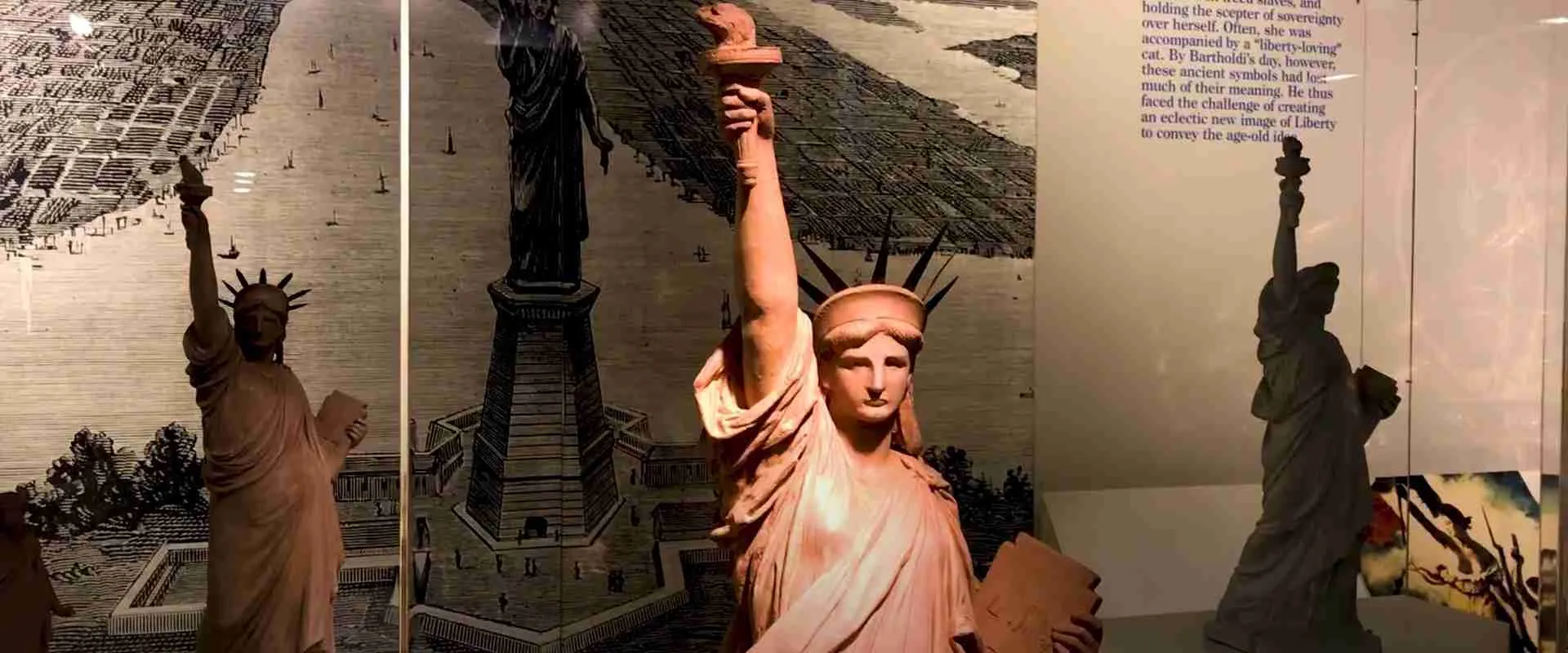
The museum collections associated with the Statue of Liberty preserve and display artistic materials that illuminate the creative process behind this icon. These collections include Bartholdi’s working models at various scales, preparatory sketches, the original torch with its artistic embellishments, historical photographs documenting construction, and artifacts revealing how artistic vision transformed into physical reality. Examining these materials provides insight into 19th-century artistic practice while demonstrating the intensive labor required to create monumental sculpture.
This guide explores the statue as artwork, analyzes the museum collections that preserve her artistic heritage, and examines how Bartholdi’s creative decisions shaped one of the world’s most recognizable images. Understanding the artistic dimensions of the Statue of Liberty enriches appreciation for this monument beyond its symbolic and historical significance, revealing the aesthetic achievement that makes the statue not just meaningful but beautiful.
People Also Ask About Statue of Liberty Art Collections
What artistic style is the Statue of Liberty?
The Statue of Liberty exemplifies neoclassical sculpture, an artistic style that draws inspiration from ancient Greek and Roman art. Bartholdi modeled Lady Liberty after classical representations of Libertas, the Roman goddess of freedom, incorporating traditional elements including contrapposto stance, idealized facial features, and flowing drapery styled after Roman garments. The neoclassical style emphasized clarity, order, restraint, and reference to classical antiquity, principles evident throughout the statue’s design. This artistic choice wasn’t merely aesthetic—neoclassicism carried political associations with republican government and Enlightenment values, making it philosophically appropriate for a monument celebrating liberty and democracy. The style also provided established visual vocabulary for creating dignified, timeless figures at monumental scale.
Where can you see Bartholdi’s original models of the Statue of Liberty?
Several of Bartholdi’s original models survive in various museums. The Statue of Liberty Museum inside the pedestal on Liberty Island displays some working models and provides the most accessible viewing location for visitors. The Musée des Arts et Métiers in Paris houses a significant model. The Museum of the City of New York possesses models and related materials. Additional models exist in private collections and other institutions. These models range from small clay sketches used for initial design exploration to larger plaster models at quarter-scale used for creating the full-size statue. Viewing these models reveals Bartholdi’s artistic process and shows how he refined the design through successive iterations, testing proportions and details before committing to final colossal scale.
What happened to the original Statue of Liberty torch?
The original 1886 torch was replaced during the 1980s restoration after damage from 1916 modifications made it irreparable. Engineers in 1916 had cut away sections of copper and installed glass panels attempting to improve illumination, creating structural weaknesses and allowing water infiltration that caused extensive corrosion. Rather than attempting restoration, conservators created an entirely new torch following Bartholdi’s original design more faithfully. The new torch was gilded with gold leaf using traditional techniques. The original torch, preserved as artifact, is now displayed prominently in the Statue of Liberty Museum inside the pedestal, allowing visitors to see this important artistic element up close. The original torch shows Bartholdi’s decorative metalwork and bears the patina and damage from over a century of exposure.
How did Bartholdi create the statue’s facial features?
Bartholdi developed the statue’s face through careful study of classical sculpture combined with possible influence from his mother Charlotte’s features, though this connection remains debated among scholars. He created progressive models, refining the facial features at each enlargement. The face follows classical ideals of beauty—serene expression, balanced proportions, idealized rather than individualized features. Bartholdi understood that facial details visible on small models might disappear at colossal scale, so he simplified and clarified features to ensure they would read from long distances. The face measures 17 feet 3 inches from chin to cranium, with eyes that are two-and-a-half feet wide. Every feature was scaled to remain recognizable and expressive when viewed from boats in the harbor hundreds of feet away. The result combines classical beauty with practical visibility requirements unique to monumental sculpture.
Extended multi-day tours – 5+ days
Featured New York Multi-Day Tour Packages

3 days
New York 3-Day Discovery Tour
- ✓ Comprehensive New York experience
- ✓ Expert local guides included
- ✓ All accommodation included
- ✓ Transportation provided

5 days
New York 5-Day Highlights Experience
- ✓ Comprehensive New York experience
- ✓ Expert local guides included
- ✓ All accommodation included
- ✓ Transportation provided

7 days
New York 7-Day Cultural Journey
- ✓ Comprehensive New York experience
- ✓ Expert local guides included
- ✓ All accommodation included
- ✓ Transportation provided

10 days
New York 10-Day Complete Adventure
- ✓ Comprehensive New York experience
- ✓ Expert local guides included
- ✓ All accommodation included
- ✓ Transportation provided
Multi-day tour packages powered by TourRadar. Prices and availability subject to change.
Bartholdi’s Artistic Vision and Creative Development
Frédéric Auguste Bartholdi brought extensive artistic training and experience to the Statue of Liberty project. Born in 1834 in Colmar, Alsace, Bartholdi studied painting and sculpture in Paris, developing skills in traditional academic techniques. His artistic education emphasized classical forms, careful observation of nature, and mastery of various scales from small models to public monuments. Before conceiving Liberty, Bartholdi had created numerous public sculptures in France, establishing reputation for monumental work. His earlier proposal for a colossal lighthouse at the Suez Canal in the form of an Egyptian peasant woman, though never realized, demonstrated his fascination with sculpture at enormous scale.
The artistic conception of the Statue of Liberty began with small clay sketches exploring possible forms. Bartholdi created numerous preliminary studies testing different poses, gestures, and compositions. These early sketches show experimentation—Liberty holding the torch in different positions, various arrangements of tablet and chains, different drapery treatments. Bartholdi worked through these possibilities at small scale where changes cost little, gradually refining his vision. These preliminary sketches, some of which survive in museum collections, reveal the artistic decision-making process underlying the final design. The sketches show that Bartholdi considered and rejected numerous alternatives before settling on the composition we know.
Once satisfied with the basic concept, Bartholdi created a detailed model approximately four feet tall that captured all major design elements. This model, carefully finished with precise details of facial features, drapery folds, and symbolic objects, served as the definitive artistic statement of intent. Bartholdi paid particular attention to the face at this stage, creating idealized features that would remain beautiful and dignified when enlarged. The drapery received careful attention—each fold designed to create strong shadows and clear lines visible from distance. The pose and gestures were finalized, establishing the contrapposto stance and the precise angle of the upraised arm. This model became the reference for all subsequent work.
Scaling from four feet to 151 feet required sophisticated technical and artistic procedures. Bartholdi employed a pointing system using plumb lines and mathematical calculations to transfer proportions accurately. He created intermediate models at progressively larger scales—approximately nine feet tall, then 36 feet tall—checking at each stage that the design maintained its power and clarity. This process wasn’t merely mechanical copying; Bartholdi made artistic adjustments at each scale. Features that worked at four feet sometimes required modification when enlarged—subtle changes in proportions, clarification of details, adjustments to ensure visibility. This iterative process demonstrates Bartholdi’s understanding that artistic success at monumental scale requires more than simple enlargement.
The full-scale plaster model constructed in Bartholdi’s Paris workshop represented the culmination of this artistic development. This enormous model, built in sections, provided templates for creating the copper skin. Creating this full-scale model required extraordinary precision and artistic judgment. Bartholdi supervised every stage, ensuring that his artistic vision survived the translation from small studies to colossal reality. The full-scale model allowed him to verify that facial features, drapery folds, and details would appear as intended. Seeing his creation at actual size for the first time must have been powerful experience, confirming or challenging his artistic choices. The successful creation of this model proved that his artistic vision could indeed be realized at unprecedented scale.
Sculptural Details and Artistic Techniques
The Statue of Liberty’s face demonstrates Bartholdi’s mastery of classical sculptural ideals adapted to colossal scale. The facial features follow Greco-Roman conventions of idealized beauty—serene expression, balanced proportions, regular features. The face shows no signs of stress, effort, or extreme emotion; instead, Lady Liberty maintains calm dignity appropriate to representing timeless ideals rather than momentary feelings. Some scholars suggest Bartholdi modeled the face partly on his mother Charlotte, though this remains debated. Whether or not this connection is accurate, the face definitely shows classical idealization rather than realistic portraiture. The features were designed for symbolic representation, not individual characterization.
Specific facial elements reveal careful artistic decisions. The eyes, measuring two-and-a-half feet wide, gaze slightly upward and outward, creating impression of looking toward the future with confidence. The line of sight was precisely calculated—Bartholdi wanted the statue to appear to look over arriving ships rather than down at them, suggesting welcoming guidance rather than judgment. The nose, measuring 4 feet 6 inches long, follows classical straight profile rather than more naturalistic curves. The mouth, 3 feet wide, maintains neutral expression suggesting neither smile nor frown—serene composure. These features combine to create face that appears both human and idealized, approachable yet dignified, specific yet universal.
The drapery demonstrates sophisticated understanding of how cloth behaves and how sculptors can represent fabric in solid materials. Bartholdi designed the flowing robes following Roman sculptural traditions, creating folds that serve multiple purposes. The vertical folds reinforce the statue’s monumentality and direct the eye upward. Diagonal folds across the torso create dynamic visual interest and suggest slight movement, preventing the figure from appearing static. Deep folds create strong shadows that enhance three-dimensional modeling visible from long distances. The drapery also conceals the structural elements underneath—Eiffel’s iron framework and connection points remain invisible beneath the artistic surface. This marriage of aesthetic beauty and practical concealment shows Bartholdi’s skill in solving artistic problems at monumental scale.
The hands received particular artistic attention as they carry symbolic objects and communicate gesture. The right hand holds the torch aloft in gesture of offering or presentation, the arm fully extended to maximum height. The hand measures 16 feet 5 inches long, with the index finger alone extending 8 feet. These proportions required careful calculation to avoid appearing distorted from viewing angles below. The left hand holds the tablet inscribed with the date of American independence. This hand grasps the tablet firmly but not tensely, suggesting secure possession rather than struggle. The arrangement of fingers, the angle of wrist, the relationship between hand and tablet—all these details received artistic consideration to create believable gesture at enormous scale.
The crown represents one of the statue’s most distinctive artistic elements. Seven spikes radiate from Liberty’s head, representing the seven continents and seven seas. These spikes measure approximately 9 feet long each, substantial enough to be visible from great distance yet proportionally appropriate to the head. The crown also features windows—25 in total, designed to represent gemstones. These windows serve practical purpose, providing light and viewing opportunities from inside the crown, while contributing aesthetically to the crown’s jewellike appearance. Bartholdi designed the crown to suggest both rays of sun and precious diadem, combining natural and artificial imagery to enhance the statue’s symbolic power. The crown’s form makes the statue instantly recognizable even in simplified representations.
Museum Collections on Liberty Island
The Statue of Liberty Museum, opened in 2019 inside the pedestal on Liberty Island, houses the most comprehensive collection of artifacts and artworks related to the monument. This modern museum facility provides climate-controlled environment for preserving materials while making them accessible to millions of annual visitors. The collections include working models, the original torch, historical photographs, construction documents, and multimedia presentations explaining the statue’s creation and evolution. The museum serves both preservation and educational functions, protecting artistic heritage while interpreting it for contemporary audiences.
The museum’s centerpiece is the original 1886 torch, displayed prominently in a gallery designed to showcase this important artifact. Visitors can view the torch up close, seeing details impossible to observe when it was mounted 305 feet above ground. The copper and glass construction shows Bartholdi’s original artistic vision before the 1916 modifications. The torch bears visible damage and patina from over a century of exposure, providing tangible connection to the statue’s history. The torch’s gilded flame sections, though weathered, still suggest the golden light Bartholdi intended. Interpretive materials explain the torch’s significance, its removal during the 1980s restoration, and the creation of the replacement torch. This display allows visitors to appreciate the torch as artwork rather than merely functional element.
Working models at various scales demonstrate Bartholdi’s artistic process. The museum displays plaster models showing progressive enlargement from initial concepts to full-size sections. These models reveal how Bartholdi refined details at each scale, making adjustments to ensure the design would succeed at colossal dimensions. Visitors can compare models at different scales, seeing how proportions change and details evolve. Some models show construction marks—measuring points, section divisions, and annotations indicating how they would be scaled up. These working traces provide insight into 19th-century sculptural practice and the labor-intensive process of creating monumental sculpture before modern technology.
Historical photographs documenting construction offer visual narrative of the statue’s creation. Images show the statue rising in Bartholdi’s Paris workshop, various sections during fabrication, the head displayed at exhibitions, the disassembled pieces being packed for shipment, and reassembly in New York. These photographs function as both historical documents and artworks in their own right, capturing a unique moment in artistic and engineering history. The photographs allow visitors to imagine the enormous undertaking of creating the statue, showing the scale of the project and the dedication of workers who made it possible. Contemporary audiences, accustomed to computer-aided design and modern construction equipment, often find these images revelatory, appreciating the achievement more fully when understanding the limited technology available in the 1880s.
Bartholdi’s sketches and drawings, some displayed in the museum or available in archival collections, show his artistic thinking. These preliminary studies range from rough compositional sketches to detailed drawings of specific elements. Some drawings show mechanical details indicating how artistic and engineering considerations intersected. Others focus purely on aesthetic questions—how drapery should fall, what expression the face should show, how various elements should relate compositionally. These drawings reveal Bartholdi as serious artist carefully considering every decision, not merely conceiving a basic idea and leaving details to assistants. The drawings demonstrate that artistic achievement at this level requires sustained attention to countless specific choices that collectively create successful whole.
The Original Torch: Artistic Masterpiece
The original 1886 torch represents extraordinary achievement in decorative metalwork and artistic design. Bartholdi conceived the torch as the statue’s crowning element, both literally and symbolically. The flame portion featured copper panels shaped to suggest flickering fire, with cutout sections designed to allow interior illumination to shine through. Around the flame, decorative metalwork created ornamental frame that would be visible from boats approaching the harbor. The torch was gilded—covered with thin layers of gold leaf that would catch sunlight during day and glow when internally illuminated at night. This combination of three-dimensional form, decorative detail, and gilding made the torch a significant artwork in its own right, not merely functional element.
The craftsmanship required to create the original torch involved multiple specialized skills. Coppersmiths shaped the flame sections using repoussé technique, hammering copper sheets over forms to create three-dimensional flame shapes. The metalwork required suggesting fire’s organic, flowing forms in rigid copper—a challenge requiring artistic sensitivity and technical skill. Decorative elements around the flame base were created through additional metalwork, possibly including cast elements. The entire assembly then received gilding, an ancient technique involving applying extremely thin sheets of gold to copper surface. This gilding served both aesthetic and practical purposes—creating the golden glow Bartholdi desired while protecting the copper underneath. The original torch demonstrated the highest levels of 19th-century metalworking artistry.
The 1916 modifications to the torch, undertaken with good intentions to improve illumination, unfortunately damaged this artistic masterpiece. Engineers cut away sections of the copper flame and installed glass panels, fundamentally altering Bartholdi’s design. These modifications weakened the structure and allowed water infiltration that caused corrosion. The changes also compromised the artistic integrity—the torch no longer looked as Bartholdi intended. By the 1980s, the torch had deteriorated so severely that restoration was impossible. The decision to create entirely new torch rather than attempting to restore the original was difficult but necessary. The original torch’s preservation as museum artifact at least ensures that visitors can see Bartholdi’s artistic vision, even if it can no longer function as part of the living monument.
The replacement torch created during the 1980s restoration represents contemporary craftspeople’s attempt to honor Bartholdi’s original artistic vision. Working from historical photographs, drawings, and the surviving original torch, artisans created a new copper torch following the original design more closely than the 1916 version. The new torch features flame sections shaped similarly to the original, with decorative elements matching Bartholdi’s intent. Crucially, the new torch received gold leaf gilding using traditional techniques, creating the golden glow that was always part of Bartholdi’s artistic conception. The replacement torch demonstrates respect for the original artistic vision while employing modern materials and techniques to ensure longevity. This careful restoration honors both artistic heritage and practical requirements of maintaining a functioning monument.
Viewing the original torch in the museum provides opportunities for artistic appreciation impossible when it was mounted at great height. Visitors can examine the copper work up close, seeing the marks of hammering and shaping. The decorative metalwork becomes visible in detail. The effects of weathering and patina create their own aesthetic interest—the torch shows its history through its surface. This intimate viewing experience allows appreciation of the craftsmanship and artistry that went into creating this element. Museum interpretation helps visitors understand what they’re seeing, explaining construction techniques, materials, and artistic decisions. The torch becomes not just historical artifact but artwork deserving appreciation for its beauty and craftsmanship.
Artistic Influences and Classical References
The Statue of Liberty draws from rich tradition of classical sculpture, particularly Roman representations of female personifications of virtues and concepts. Libertas, the Roman goddess of freedom, provided the primary iconographic model. Ancient Roman art frequently depicted Libertas wearing a pileus (liberty cap) and holding various attributes. Bartholdi adapted these classical references, replacing the liberty cap with a radiating crown and giving Liberty a torch and tablet instead of traditional Roman attributes. These modifications updated classical iconography for modern context while maintaining clear connection to ancient precedents. The reference to classical antiquity wasn’t merely aesthetic—it connected the statue philosophically to ancient republican values that both French and American revolutionaries claimed as inspiration.
The Colossus of Rhodes, one of the Seven Wonders of the Ancient World, directly inspired Bartholdi’s ambition to create a harbor monument of comparable significance. This ancient bronze statue of the sun god Helios stood over 100 feet tall at the entrance to Rhodes harbor until its destruction by earthquake around 226 BCE. Though no reliable images of the Colossus survive, its reputation as monumental harbor sculpture capturing classical achievement inspired Bartholdi to attempt a modern equivalent. The parallel between ancient Rhodes and modern New York Harbor, between ancient sun god and modern Liberty, would have been clear to educated 19th-century audiences. This reference to ancient wonder elevated the statue’s ambitions—Bartholdi wasn’t merely creating a monument but attempting to match the greatest achievements of ancient art.
Neoclassical sculpture traditions of the 18th and 19th centuries provided more immediate artistic context. Neoclassicism emphasized return to classical principles after the ornate excesses of Baroque and Rococo styles. Neoclassical sculptors studied ancient Greek and Roman works, seeking to recreate their dignity, simplicity, and idealization. Public monuments across Europe and America during this period adopted neoclassical style, making it the dominant aesthetic for civic sculpture. Bartholdi worked within this tradition, applying its principles to unprecedented scale. The statue’s neoclassicism connected her to broader artistic movement while distinguishing her through sheer size and engineering innovation.
French academic sculpture training shaped Bartholdi’s artistic approach. The French Academy emphasized careful study of classical art, mastery of human anatomy, and technical proficiency in various sculptural techniques. Academic training stressed importance of preliminary studies, progressive development through models, and attention to details of proportion and composition. Bartholdi’s systematic approach to creating the statue—from sketches through progressive models to full-scale execution—reflects this academic training. The careful attention to anatomical accuracy visible in the statue’s hands, face, and figure demonstrates academic emphasis on understanding human form. Even at colossal scale requiring simplification, the statue maintains anatomical correctness that reveals thorough academic training.
Contemporary public monuments influenced Bartholdi’s artistic thinking. Throughout the 19th century, European cities erected numerous public sculptures commemorating historical figures, celebrating virtues, or marking important events. Bartholdi was familiar with this tradition and contributed to it through various commissions. The Statue of Liberty represented evolution of public monument traditions—maintaining commemorative and symbolic functions while achieving scale that made it landmark visible throughout New York Harbor. This ambition to create not just sculpture but defining landmark of an entire city reflected 19th-century confidence in art’s power to shape urban identity and public consciousness. The statue’s success in achieving this goal influenced subsequent monument design worldwide.
Preservation and Conservation of Artistic Elements
Preserving the Statue of Liberty’s artistic integrity requires constant attention from conservators balancing respect for Bartholdi’s original design with practical requirements of maintaining a 135-year-old structure exposed to harsh maritime conditions. Conservation philosophy aims to preserve the statue as Bartholdi created it while accepting certain changes—particularly the green patina—as part of the monument’s evolved identity. This approach requires distinguishing between changes that represent natural aging versus damage requiring intervention, between modifications that enhance versus those that compromise artistic integrity.
The green patina covering the copper skin represents a significant conservation question. Should the statue be cleaned to restore the original copper color, or should the patina be preserved? Conservators concluded that the patina serves protective function, preventing further copper corrosion, and has become integral to the statue’s identity. Most people cannot imagine Lady Liberty any color but green. The decision to preserve the patina represents acceptance that monuments evolve over time and that some changes enhance rather than diminish artistic value. This philosophy respects both Bartholdi’s original creation and the statue’s historical development, acknowledging that the monument’s biography includes its weathering and evolution.
The 1980s restoration faced numerous artistic conservation challenges. Replacing the torch required creating new artwork that honored Bartholdi’s original design while using modern materials and techniques. The restoration team studied historical photographs, examined the surviving original torch, and consulted Bartholdi’s drawings to ensure the replacement matched original artistic intent. Similar careful research informed replacement of corroded framework elements and repairs to damaged copper sections. Throughout the restoration, conservators asked: What would Bartholdi have intended? How can we preserve his artistic vision while ensuring structural soundness? These questions guided decisions about what to preserve, what to restore, and what to replace.
Ongoing conservation work addresses continuous challenges of maintaining artistic elements. The copper skin requires periodic inspection and minor repairs where damage occurs. The crown’s windows need maintenance to prevent water infiltration. The drapery folds accumulate dirt and biological growth requiring careful cleaning that doesn’t damage the patina. Interior elements including the museum collections require climate control and preservation treatments. This constant maintenance ensures that artistic details remain visible and intact for future generations. Conservation work is never finished—it represents ongoing commitment to preserving artistic heritage against inevitable forces of time and nature.
Documentation forms crucial part of conservation practice. High-resolution photography and laser scanning create detailed records of the statue’s current condition, allowing conservators to track changes over time and detect developing problems before they become serious. These digital records also preserve information about artistic details for research and educational purposes. Documentation practices evolve with technology—modern techniques provide information impossible to obtain in earlier decades. This documentation serves both conservation planning and art historical research, ensuring that detailed knowledge of the statue’s artistic elements is preserved even as the monument itself continues aging and evolving.
Artistic Legacy and Influence on Subsequent Monumental Sculpture
The Statue of Liberty’s successful combination of artistic ambition and engineering innovation influenced subsequent monument design worldwide. The statue demonstrated that colossal sculpture could maintain artistic quality while solving unprecedented technical challenges. Later monument builders studied Bartholdi’s methods—the progressive modeling system, the separation of framework and skin, the flexible connection system—adapting these solutions to their own projects. The statue proved that monuments could achieve landmark scale while remaining beautiful and meaningful, inspiring ambitious projects that might otherwise have seemed impossible.
Art Deco monuments of the early 20th century, including Christ the Redeemer in Rio de Janeiro, show Liberty’s influence in their ambition, scale, and engineering approaches. Christ the Redeemer employs similar strategies—prominent harbor location, reinforced concrete framework, exterior surface of tiles rather than structural material—adapting Bartholdi’s innovations to different aesthetic goals. The confidence to attempt such projects derived partly from Liberty’s demonstration that colossal sculpture was achievable. The artistic success of these later monuments validates Bartholdi’s approach while showing how his methods could be adapted to varying artistic styles and cultural contexts.
Socialist Realism monuments erected in the Soviet Union and other communist countries during the mid-20th century represent different artistic ideology but similar technical challenges to those Bartholdi solved. Colossal figures like the Motherland Calls in Volgograd require solutions to wind loads, material selection, and structural support comparable to Liberty. Soviet engineers studied the statue’s structural system while creating socialist monuments that rejected neoclassical aesthetic in favor of heroic realism. This demonstrates how engineering solutions can be separated from aesthetic choices—the technical innovations making Liberty possible proved valuable regardless of artistic style or political ideology.
Contemporary colossal sculptures including the Statue of Unity in India show continued relevance of principles Bartholdi established. Modern monuments employ advanced materials and computer-aided design unavailable in the 19th century, but face fundamentally similar challenges: creating recognizable human figures at enormous scale that will withstand weather and time while remaining aesthetically successful. Monument builders still reference the Statue of Liberty when planning new projects, studying how Bartholdi balanced artistic vision with practical requirements. Liberty’s continuing influence demonstrates that solving artistic problems at monumental scale established principles that remain relevant despite technological advances.
The statue’s artistic influence extends beyond monumental sculpture to influence popular iconography, graphic design, and visual culture more broadly. The statue’s instantly recognizable silhouette—crowned figure holding torch aloft—has become one of the most reproduced images in history. This iconographic success results from Bartholdi’s artistic decisions about proportions, gesture, and distinctive elements like the crown. The statue’s power as image derives from its artistic strength—a less carefully designed monument would not have achieved such complete visual penetration. This demonstrates that artistic quality in public monuments serves practical purposes beyond beauty, creating images that can communicate effectively across cultures and contexts.
Frequently Asked Questions About Statue of Liberty Art Collections
What artistic techniques did Bartholdi use to create the statue?
Bartholdi employed progressive modeling, creating increasingly large versions of his design to ensure proper proportions at each scale. He started with clay sketches, then created detailed four-foot plaster model, followed by intermediate models at nine feet and 36 feet, finally producing full-scale plaster sections. He used a pointing system with plumb lines and measurements to transfer proportions accurately during enlargement. The copper skin was shaped using repoussé technique, where craftspeople hammered copper sheets over wooden forms. These traditional sculptural methods, scaled to unprecedented size, required development of specialized tools and techniques. The systematic approach demonstrated Bartholdi’s mastery of academic sculptural training applied to unique challenge of colossal monument creation.
Where is the Statue of Liberty museum located?
The Statue of Liberty Museum is located inside the pedestal on Liberty Island, accessible to all visitors who take the ferry to the island. The museum opened in 2019 and houses the original 1886 torch, working models, historical photographs, and exhibits explaining the statue’s creation and significance. Visitors can explore the museum without climbing to the crown or upper pedestal levels, making the collections accessible to everyone. The museum provides climate-controlled environment protecting artifacts while displaying them effectively. Interactive exhibits and multimedia presentations supplement the physical collections, offering comprehensive introduction to the statue’s artistic and historical importance. The museum has become essential component of the Liberty Island visitor experience.
Can you see Bartholdi’s face in the statue?
The statue’s face represents idealized classical beauty rather than realistic portrait of any individual. Some scholars have suggested that Bartholdi may have been influenced by his mother Charlotte’s features, though this remains debated and unproven. The face follows Greco-Roman sculptural conventions emphasizing balanced proportions, serene expression, and idealized rather than individualized characteristics. Bartholdi designed the features for symbolic representation of Liberty rather than personal portraiture. The face was carefully scaled to remain expressive and visible from great distances—features that worked at small model size required adjustment when enlarged to ensure they would read correctly when viewed from boats in the harbor. The result combines classical beauty with practical requirements unique to monumental sculpture.
What materials are displayed in the museum collections?
The Statue of Liberty Museum collections include the original 1886 torch with its copper and glass construction, plaster working models at various scales showing Bartholdi’s progressive design development, historical photographs documenting construction in France and America, sketches and drawings revealing Bartholdi’s artistic process, artifacts from the construction including tools and copper samples, documents related to fundraising and dedication ceremonies, and multimedia presentations explaining engineering and construction. The collections preserve both artistic and historical materials, offering comprehensive view of how the monument was conceived, created, and evolved. The museum displays represent selection from larger archival collections, with additional materials available to researchers. The collections serve both preservation and educational functions, protecting artistic heritage while making it accessible.
How did the 1916 torch modifications affect the statue’s artistic integrity?
The 1916 modifications severely compromised the torch’s artistic integrity by cutting away sections of Bartholdi’s original copper flame and installing glass panels. These changes, intended to improve illumination, fundamentally altered Bartholdi’s design and created structural weaknesses. The modifications allowed water infiltration causing extensive corrosion. The torch no longer appeared as Bartholdi intended—the flame’s shape was distorted and the overall design compromised. By the 1980s restoration, the torch had deteriorated beyond repair. The restoration team decided to create entirely new torch following Bartholdi’s original design more faithfully, preserving the damaged 1916 torch as historical artifact. This decision honored Bartholdi’s artistic vision while acknowledging that the modifications had become part of the statue’s history. The preserved original torch now allows visitors to see both Bartholdi’s craftsmanship and the effects of well-intentioned but ultimately damaging modifications.
What classical sculptures influenced Bartholdi’s design?
Bartholdi drew inspiration from ancient Roman representations of Libertas, the goddess of freedom, adopting her iconography while adapting it to modern context. The Colossus of Rhodes, one of the Seven Wonders of the Ancient World, inspired his ambition to create monumental harbor sculpture. Classical Greek and Roman statuary provided models for idealized human figures, contrapposto stance, and flowing drapery. Neoclassical sculptures from the 18th and 19th centuries offered more immediate precedents for public monuments celebrating virtues and ideals. Bartholdi’s academic training emphasized study of classical art, making these influences natural. He adapted classical traditions rather than merely copying them, creating monument that referenced ancient precedents while remaining distinctly modern in scale, engineering, and specific symbolic content. The classical influences connect the statue to long artistic traditions while the unprecedented scale and innovative engineering make it groundbreaking.
How is the statue’s artistic heritage preserved for future generations?
Preservation of the statue’s artistic heritage involves ongoing conservation of the monument itself and careful stewardship of related collections and archives. The National Park Service maintains comprehensive conservation program including regular inspections, cleaning, and repairs to protect the copper skin and structural elements. The museum collections are housed in climate-controlled facilities with professional conservation standards. Digital documentation including high-resolution photography and laser scanning creates detailed records of the statue’s condition and artistic details. Educational programs interpret the statue’s artistic significance for contemporary audiences. Research and scholarship continue examining Bartholdi’s methods and the statue’s artistic importance. International cooperation with French institutions preserves materials and knowledge in both countries. These multifaceted preservation efforts ensure that the statue’s artistic heritage—both the monument itself and related collections—will remain accessible and meaningful for future generations.
What role did Gustave Eiffel play in the statue’s artistic design?
Gustave Eiffel designed the internal iron framework but did not contribute to the statue’s external artistic appearance, which remained entirely Bartholdi’s creation. Eiffel’s role was purely structural engineering—creating the framework that would support Bartholdi’s artistic vision. However, Eiffel’s engineering solutions enabled the artistic achievement by making the statue physically possible. The flexible connection system allowing the copper skin to move independently from the framework meant Bartholdi could shape the exterior purely for aesthetic effect without structural compromises. This collaboration between artist and engineer proved ideal—each brought specialized expertise while respecting the other’s domain. Bartholdi determined what the statue would look like, Eiffel determined how to make it stand. This division of responsibilities allowed both artistic and engineering excellence, demonstrating that great monuments require both aesthetic vision and technical mastery.
Are there other Bartholdi sculptures visitors can see?
Frédéric Auguste Bartholdi created numerous other sculptures throughout his career, many visible in France. The Lion of Belfort, a monumental sculpture in Bartholdi’s hometown of Belfort, represents one of his major works. The Fontaine Bartholdi in Lyon features elaborate allegorical figures. Various monuments and sculptures in French cities demonstrate his range and skill. Small-scale bronzes and models of Bartholdi’s works appear in museums worldwide. The Musée Bartholdi in Colmar, France, housed in his birthplace, displays extensive collections of his works, models, and personal effects. Viewing these other sculptures provides context for understanding Bartholdi’s artistic development and demonstrates that the Statue of Liberty, while his most famous work, represents culmination of entire artistic career rather than isolated achievement. His other works show consistent themes including interest in monumental scale, classical influences, and symbolic representation.
How do art conservators maintain the statue’s artistic details?
Art conservators employ various techniques to maintain the statue’s artistic elements while respecting both original design and evolved character. Regular inspections identify areas requiring attention before minor problems become major damage. Gentle cleaning removes accumulations that might obscure details without harming the protective patina. Damaged copper sections receive repairs using traditional coppersmithing techniques matched to original work. The gold-leafed torch requires periodic re-gilding to maintain its intended appearance. Interior elements including stairs and platforms receive maintenance ensuring visitor safety without compromising historical character. Conservation treatments balance preservation of original materials with necessary interventions. Detailed documentation records all conservation work, creating archive of treatments and decisions. Conservators consult historical materials including Bartholdi’s models and drawings to ensure their work honors original artistic intent. This careful, research-based approach ensures that conservation enhances rather than compromises the statue’s artistic integrity.