
Beyond the Romantic Palaces: Sintra Hinterland Off-the-Beaten-Track Itinerary 2026
Sintra’s Romanticist palaces rank among Portugal’s most visited monuments, and by mid-morning on any summer weekend, Pena Palace operates under timed-entry slots while queues at Quinta da Regaleira stretch past the gate. Yet within the same UNESCO-designated cultural landscape lies a radically quieter Sintra: a Franciscan monastery embedded in cork trees, a cloud-forest garden in a Moorish palace, and a wine village where pre-phylloxera vines still grow in Atlantic sand. This 2026 planning guide maps a two-day circuit through that other Sintra — its logistics, access constraints, verified costs, and weather contingencies.
Key Takeaways
- The hinterland circuit covers two full days: Day One visits Monserrate Palace (€12/adult) and Capuchos Convent (€11/adult) — sites that routinely see a fraction of the footfall of Pena Palace; Day Two follows the Colares coast road through Colares wine village, Azenhas do Mar, and Cabo da Roca.
- Private cars are banned from the Pena Palace and Moorish Castle approach roads, but the hinterland sites — Monserrate and Capuchos — remain reachable by private vehicle, giving self-drivers a logistics advantage unavailable at the main palaces.
- Budget travelers spend €85–€120 per person daily (two sharing a budget guesthouse); mid-range visitors spend €150–€230 daily; the complete two-day circuit costs €170–€240 (budget) or €300–€460 (mid-range) per person.
- Bus 435 (Scotturb) reaches Monserrate from Sintra station every 20 minutes from 9:30am; Capuchos Convent requires a taxi (€17–€21 one way) or private vehicle — no tourist bus terminates at the convent entrance in 2026.
- Monserrate Palace roof restoration with scaffolding continues until Q1 2027; the interior and gardens remain fully open, but exterior photography of the facade will be affected.
- The Sintra hills’ microclimate generates regular morning fog; this often enhances the atmosphere at Capuchos and Monserrate — save the exposed coastal circuit (Azenhas do Mar, Cabo da Roca) for Day Two when clearing is more predictable.
People Also Ask About Sintra Hinterland 2026
How do you avoid the crowds at Sintra’s main palaces in 2026?
The most effective strategy in 2026 is to skip the main palaces entirely on your first day and target Monserrate Palace and Capuchos Convent instead. Both are managed by Parques de Sintra under the same admission standards as Pena Palace, but attract a fraction of the visitor traffic. Monserrate Palace is a five-minute drive or a 20-minute Bus 435 ride west of Sintra center; Capuchos Convent is a further 4.5km into the forest. On peak-season weekends when Pena Palace fills its timed slots days in advance, both hinterland sites commonly have near-empty ticket offices at 9:00am. Travelers who do want the main palaces should book timed-entry slots online at bilheteira.parquesdesintra.pt at least several days ahead and arrive at opening time to beat the coach groups.
Can you drive to Monserrate Palace and Capuchos Convent in 2026?
Yes — and this is the key logistics advantage of the hinterland circuit. Private vehicles, including rental cars, cannot access the roads to Pena Palace or the Moorish Castle; police checkpoints enforce this restriction actively. The hinterland sites work differently: Monserrate Palace sits on the EN375 road connecting Sintra center to Colares, and is accessible by private car with limited on-site parking. Capuchos Convent is reached via the EN247-3 after passing the Cabo da Roca road junction — a narrow, winding approach of approximately 16km from Sintra center. A small parking area serves the convent entrance. Self-drivers should arrive early at Capuchos: the car park is small and fills by late morning on peak-season days. Factor in the road’s winding character when estimating journey time; allow 30–35 minutes from Sintra center.
What does the two-day Sintra hinterland circuit cost in 2026?
The two-day circuit runs €170–€240 per person for budget travelers (two sharing a guesthouse at €65–€90/room), €300–€460 for mid-range visitors (hotel at €120–€180/room), and €510–€840 for those staying in higher-end accommodation and hiring a car. Day One admissions — Monserrate Palace (€12) and Capuchos Convent (€11) — total €23 per person. Day Two admissions — Cabo da Roca Lighthouse essential entry (€5) plus optional Colares wine tasting (€5–€8) — run €10–€13 per person. The 24-hour Scotturb bus pass (€13.50) covers Buses 435 and 403 for car-free travelers. These figures are current 2025 rates from the official Parques de Sintra pricing page; check parquesdesintra.pt before visiting as prices are subject to update.
What is the best way to reach Capuchos Convent without a car in 2026?
The most practical car-free option in 2026 is a taxi from Sintra center: approximately 17 minutes, €17–€21 one way (check current meter rates on the day). Split between two travelers this becomes €8.50–€10.50 per person each way. Uber and Bolt operate in Sintra and may meet or undercut taxi prices depending on surge demand. Bus access is possible via Carris Metropolitana routes (note: the former Scotturb 440 and 441 no longer operate; check the Carris Metropolitana app for current departures from Portela de Sintra station), but the journey involves connections and is slower than a taxi for a day circuit that also includes Monserrate. Viator-listed guided tours that include Capuchos are a fourth option: licensed operators access roads and parking areas that rental cars cannot, providing an all-in logistics solution with no navigation required.
Extended multi-day tours – 5+ days
Featured Lisbon Multi-Day Tour Packages

3 days
Lisbon 3-Day Discovery Tour
- ✓ Comprehensive Lisbon experience
- ✓ Expert local guides included
- ✓ All accommodation included
- ✓ Transportation provided
5 days
Lisbon 5-Day Highlights Experience
- ✓ Comprehensive Lisbon experience
- ✓ Expert local guides included
- ✓ All accommodation included
- ✓ Transportation provided
7 days
Lisbon 7-Day Cultural Journey
- ✓ Comprehensive Lisbon experience
- ✓ Expert local guides included
- ✓ All accommodation included
- ✓ Transportation provided

10 days
Lisbon 10-Day Complete Adventure
- ✓ Comprehensive Lisbon experience
- ✓ Expert local guides included
- ✓ All accommodation included
- ✓ Transportation provided
Multi-day tour packages powered by TourRadar. Prices and availability subject to change.
Why the Sintra Hinterland Offers Something Different in 2026
The Sintra UNESCO World Heritage Site encompasses far more than the Romanticist palaces that fill travel photography and tour-group itineraries. The designation, inscribed in 1995, covers the entire cultural landscape of the Sintra hills — a territory of approximately 9,000 hectares that includes monasteries predating the palaces, garden estates of unusual botanical richness, a geologically distinctive hill range that creates its own weather, and a coast that runs from pine-forested cliffs to the westernmost lighthouse on the European mainland.
What the hinterland offers in 2026 that the main visitor circuit does not is space and silence. This is not a small thing. Capuchos Convent, one of the most intensely atmospheric religious sites in Portugal, is visited by a small number of people at any given time even in high summer. The contrast with Pena Palace — where crowd-management systems channel visitors through timed access gates — is total. Monserrate Palace, while not obscure, operates at a pace of visitor flow that still allows extended contemplation of its extraordinary gardens and the chance to photograph the building’s intricate Moorish-Hindu facade without camera intrusion from other visitors.
The hinterland circuit also offers a more complete picture of the Sintra landscape. The main palace route is essentially a vertical one: up the hill by bus to the main monuments, back down to the station. The hinterland and coastal circuit is horizontal: it moves west through the forest, drops to the wine-producing plain around Colares, and meets the Atlantic at three distinct sites — a cliffside village, a sandy beach served by a century-old tram, and the continental headland at Cabo da Roca. These are connected not just by road but by ecology: the moist, forested interior of the Sintra hills transitions to the Atlantic coastal scrub through a sequence of landscapes that are part of what makes the Sintra-Cascais Natural Park worth the UNESCO designation in the first place.
For travelers who have already visited Pena Palace and Quinta da Regaleira, the hinterland offers a second Sintra visit that feels entirely different. For first-time visitors willing to reorganize their priorities, it offers a Sintra that resembles the one that drew writers, eccentrics, and landscape designers here beginning in the 18th century — before the coach parties arrived.
The 2026 context matters in two specific ways. First, private vehicle restrictions around the main palaces have been actively enforced since 2023 and remain in place — but Monserrate and Capuchos are outside the restricted zone, making the hinterland circuit comparatively simple for self-drivers. Second, Monserrate Palace is undergoing roof restoration with scaffolding until Q1 2027, which affects exterior photography but not the visit experience itself. Both of these conditions are worked into the logistics framework below.
Designing a Crowd-Free 2-Day Monastic & Coastal Circuit
The circuit divides naturally into two complementary days. Day One stays inland and vertical, ascending from Sintra center into the Sintra hills for Monserrate Palace and then deeper into the forest for Capuchos Convent. Day Two moves horizontal and westward: down from the hills to Colares village, along the coastal plateau to the cliffside village of Azenhas do Mar and the beach at Maçãs Beach (Praia das Maçãs), and out to Cabo da Roca at the Atlantic edge. The two days can be done in either order, but the forest-first, coast-second sequence is recommended because the hills’ morning fog often clears by mid-afternoon, while the coastal viewpoints benefit from afternoon light. Reversing the order means risking the forest walk in full midday heat while the coast sits under morning grey.
Both days are logistically independent of the main palace circuit. You will not need timed-entry reservations. You will not be competing for bus space with the tour-group coaches that dominate the 434 circuit. The principal logistics questions for this hinterland circuit are vehicular access, the Capuchos transport gap, and how to connect the coastal sites efficiently — all addressed in the section below.
Parking, Shuttle Feasibility, and Off-Grid Trail Navigation in 2026
Parking at Monserrate Palace: Monserrate Palace sits on the EN375 road approximately 3.5km west of Sintra center. The site has a small car park at the entrance gates. In peak summer season (July–August), this fills quickly; arriving by 9:15am — roughly at the park’s 9:00am opening — typically secures a space. If the Monserrate car park is full, limited roadside parking exists on the EN375 itself, but the road is narrow and verges are used informally; be aware of safety and do not block access gates. There is no staffed overflow facility. If arriving by Bus 435, the stop is close to the palace entrance; the 24-hour Scotturb pass (€13.50) covers the return journey as well as the Bus 403 used on Day Two.
Parking at Capuchos Convent: A small parking area is available at the convent entrance off the EN247-3. Access is via a junction just after the Cabo da Roca road turnoff — Parques de Sintra’s official directions specify: after passing the road to Cabo da Roca, turn right at Pé da Serra onto the EN247-3 toward Capuchos. The approach road is narrow and lined with stone walls; passing places are limited. Peak-season arrivals should aim for before 10:30am to find space reliably. The GPS coordinates for the convent entrance are approximately 38°46’58″N, 9°26’09″W (verify on current navigation apps before departure, as remote coordinates can shift between map versions).
Shuttle feasibility for Capuchos: There is no tourist shuttle serving the convent directly in 2026. Bus 435 (Scotturb) operates a circuit from Sintra station to Monserrate, Quinta da Regaleira, and Seteais Palace — its westernmost stop is on the Estrada dos Capuchos road rather than at the convent itself. Walking the final distance from that stop is possible but involves an uphill stretch and is not practical as part of a timed day circuit. The practical car-free options remain: taxi from Sintra center (€17–€21, 17 min), Uber/Bolt, or a Viator-listed guided tour that includes transportation.
Off-grid trail navigation in the Sintra hills: The Sintra-Cascais Natural Park maintains a network of marked hiking trails, including the PR8 circular route — approximately 15km — which connects the coastal zone through pine forest and into the Colares wine demarcated zone. Within the forest around Capuchos and Monserrate, signposted trail sections link the two sites and extend into the upper ridge of the Sintra hills. These trails provide an alternative or supplement to the road-based circuit: it is, for example, possible to park at Monserrate and follow marked forest paths toward the Capuchos area, though trail conditions after rain can be slippery and some sections are steep. For trail navigation, download the official map from the Sintra-Cascais Natural Park (icnf.pt) or use the AllTrails app, which covers the main marked routes with user-updated condition notes. Phone signal is unreliable in the forested interior — download offline maps before departure.
Microbus and licensed tour vehicle access: Licensed tour operators registered with the municipality are authorized to enter areas restricted to rental cars and can drop passengers at or near Capuchos and at other points on the hinterland circuit. Viator-listed tours of the Sintra hinterland typically use minibuses or small licensed vans and include all transport within the cost. For groups of four or more, a private Viator-booked tour often comes out cost-competitive with independent taxis once all the inter-site journeys are aggregated — and eliminates all parking stress. This is particularly relevant for the day-one forest circuit, where the Capuchos transport gap is the principal logistical complication for car-free travelers.
Day One Sequence: Monserrate Palace to Capuchos Convent
Recommended start time: 9:00–9:15am. Arrive at Monserrate Palace at opening; the gardens are at their most atmospheric before 11:00am when tour groups begin arriving. Allow 90 minutes to two hours for the palace and gardens. Transfer to Capuchos Convent by car (15 minutes via the Cabo da Roca road junction) or taxi — the taxi option works well as a one-way journey, hiring at Monserrate’s exit and booking a return for the afternoon. At Capuchos, allow 60–90 minutes; the site is compact but detailed and rewards slow looking. Return to Sintra for lunch — the historic center has several pastelaria and tasca options near the national palace. An afternoon option is the Chalet of the Countess of Edla inside Pena Park: entry is included in the Pena Park ticket (€12 for park only) and the site is less visited than the palace itself. This optional third element can round out Day One without replicating the Pena Palace queue experience.
Day Two Sequence: Colares, Azenhas do Mar, Maçãs Beach, and Cabo da Roca
Recommended start time: 10:00–10:30am. The coastal circuit benefits from slightly later starts: the historic tram departs Sintra at 10:20am (check schedule before the visit, as seasonal and service variations apply), a convenient anchor for car-free travelers. By car, the route from Sintra to Colares via the EN375 takes approximately 10 minutes; Colares to Azenhas do Mar adds another 8 minutes on the coastal road. The sequence Colares → Azenhas do Mar → Maçãs Beach → Cabo da Roca works well westward; alternatively, starting at Cabo da Roca and reversing the route means finishing at Maçãs Beach for an afternoon swim, which many travelers find appealing in warmer months. Bus 403 (Scotturb) covers the Sintra–Cabo da Roca leg for car-free travelers and takes approximately 40 minutes; from Cabo da Roca, connecting buses or a taxi cover the coastal village loop. The Carris Metropolitana 1248 bus from Portela de Sintra station reaches Azenhas do Mar in approximately 28–31 minutes, running every 30 minutes.
Understanding Sintra Hinterland Access Restrictions in 2026
Access regulation in Sintra has tightened incrementally since 2023 and remains in force as of 2026. Understanding precisely which restrictions apply to which areas is critical for planning the hinterland circuit accurately.
Areas where private vehicles are restricted: The road to Pena Palace and the Moorish Castle is closed to private vehicles, including rental cars. Only licensed tour operators, local residents, service vehicles, and emergency vehicles are authorized. Police checkpoints are maintained and divert unauthorized vehicles before they reach the monuments. The historic center of Sintra (Sintra-Vila) also restricts private vehicle circulation to residents; the use of peripheral car parks and public transport into the center is strongly recommended by the municipality and Parques de Sintra. There are only a handful of on-street spaces in the center, and these fill early.
Areas where private vehicles can travel (the hinterland advantage): Monserrate Palace is on the EN375, an open road accessible to all vehicles. Capuchos Convent is reached via the EN247-3, also open to private vehicles. The Cabo da Roca area is accessible by car from both the Sintra and Cascais directions. Colares village, Azenhas do Mar, and Maçãs Beach are all accessible by road with local parking at each point. In practical terms, the entire hinterland circuit of this article can be driven without encountering any of the restrictions that affect the main palace circuit. Self-drivers should note this distinction explicitly in their planning: the restriction that makes Pena Palace frustrating for rental-car visitors is simply not a factor on the hinterland route.
Car parks available for non-restricted areas: The main peripheral car parks for Sintra center are at Portela de Sintra station (approximately 150 spaces, very low daily rate, with bus transfers to the historic center) and on the outskirts of the town. For Monserrate and Capuchos, parking is at the respective sites. For Colares, free roadside and village-center parking is available. Azenhas do Mar has a small free car park at the cliff viewpoint, which fills on summer weekend afternoons. Maçãs Beach has a larger car park above the beach.
Natural Park temporary restrictions: The Sintra-Cascais Natural Park is a protected landscape, and temporary access restrictions can be imposed by authorities in cases of fire risk, flooding, or other adverse conditions. These are rare but possible — especially in summer. Check the Natural Park’s status (icnf.pt) and local news before the visit during July and August when fire-risk restrictions are most likely to be active. Tour operators are often faster than individual travelers at receiving restriction updates, which is another reason guided transport has a practical advantage in high-risk fire seasons.
Parking meter and payment in Sintra: On-street metered parking in Sintra uses coin-operated meters or mobile payment via local apps. On-street time limits apply and should be observed — wardens are active around the historic center. For the hinterland sites, there are no meters at the site car parks, but spaces are limited and informal.
Day One in 2026: Monserrate Palace, Capuchos Convent, and the Forest Interior
Day One occupies the forest interior of the Sintra hills, moving progressively deeper into the landscape as the morning develops. The two principal sites — Monserrate Palace and Capuchos Convent — are both open from 9:00am, both charge standard Parques de Sintra admission, and both are included in the annual Parques de Sintra Friend’s Card if purchasing a pass for multiple visits. Between the two sites lies a stretch of cork oak, eucalyptus, and Atlantic laurisilva forest where the Sintra hills’ characteristic cloud-catching humidity is most palpable.
Monserrate Palace and Park in 2026: Architecture, Garden, and the Restoration Notice
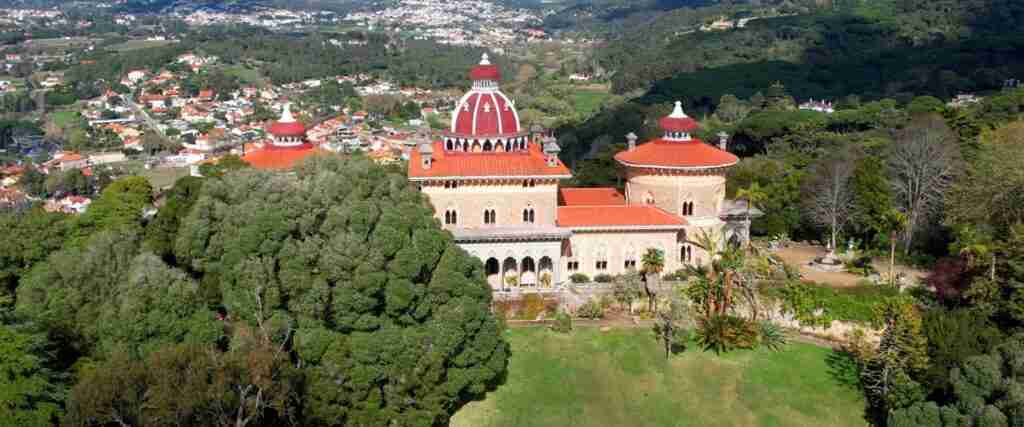
Monserrate Palace is the most architecturally inventive building in Sintra, and arguably in Portugal — a claim that sounds excessive until you stand in front of it. The current building was commissioned in the 1850s by Francis Cook, later created the 1st Baronet Cook, on a site with a much older history. The estate is traditionally associated with the English novelist and collector William Beckford, who is documented as having stayed in the Sintra area in the late 18th century and is credited in local historical accounts with laying out an early version of the gardens. The palace that exists today is a 19th-century creation in a style that blends Romanticist, Moorish, and Indic architectural vocabulary — arched loggias, a central dome, and exterior stonework that combines Portuguese limestone with patterns drawn from Mughal and Moorish sources. It is unusual, accomplished, and almost always half-empty.
What to expect from the 2026 visit: Roof restoration works involving scaffolding and temporary covering are underway at Monserrate Palace until Q1 2027, as confirmed by Parques de Sintra’s official notices. This affects exterior photographs of the facade. The palace interior is accessible through separate ticketing and is not affected by the scaffolding; the gardens, which extend across the hillside in a sequence of botanical zones, are fully open. For most visitors, the garden experience is the centrepiece of the Monserrate visit: it is large, diverse, and holds an exceptional collection of tree ferns, tropical specimens, and the so-called Mexico Garden, New World Garden, and Japanese Garden zones, laid out across different microclimates of the hillside. The restoration work, while an inconvenience for photographers, does not diminish the garden circuit.
Logistics: Tickets cost €12 per adult (current rate from parquesdesintra.pt; youths 6–17 and seniors 65+ pay €10; children under 6 free). The ticket office closes from 12pm to 1pm daily — automatic ticket vending machines are available during this window. Online pre-purchase is available and bypasses any queue at the ticket office, which is advisable in July and August. Last admission to the park is 6:00pm; last admission to the palace is 5:00pm or 5:30pm (verify on the official site before visiting). Arriving at opening — 9:00am for the park, 9:30am for the palace — ensures the best conditions: lower visitor numbers, cooler temperatures, and the garden mist that characterizes Monserrate mornings in all seasons.
What the gardens offer: Allow a minimum of 90 minutes for the gardens; two hours is better if you are interested in the botanical collection. The upper garden terraces offer elevated views across the forested hillside toward the hills. The palace itself, accessible via the park ticket, holds a sequence of ornate reception rooms with Moorish plasterwork and tiled floors that show the same fusion of influences as the exterior. The café and ticket shop near the entrance are open during standard hours.
Capuchos Convent in 2026: Sintra’s Most Intimate Monument
Capuchos Convent is the most affecting monument in Sintra, and one of the most affecting in Portugal. Founded in 1560 — its founding is traditionally associated with D. João de Castro, Portuguese Viceroy of India, and his family — the convent was built not to demonstrate wealth or power but to vanish into the forest. That is still the experience today: you arrive at a car park in the trees, follow a path through cork oaks, and find what appears to be a collection of boulders until you realize the boulders are the convent. The chapels, dormitories, and cells slip between moss-covered rocks. The corridors squeeze through cracks in the stone. Every surface inside that might have offered comfort is lined with cork — the doors, the benches, the low ceilings, the cell walls. The Franciscan (Capuchin) community that occupied the convent until the dissolution of religious orders in Portugal in 1834 called this arrangement poverty. Anyone who walks through it today calls it remarkable.
The official name is Convento da Santa Cruz da Serra de Sintra — the Convent of the Holy Cross of the Sintra Hills — though it is universally known in both Portuguese and English as Capuchos Convent (or Convent of the Capuchos). Parques de Sintra uses the English name “Convent of the Capuchos” on all official English-language materials.
What to expect from the 2026 visit: Capuchos is genuinely unlike any other heritage site on the Sintra circuit. There are no queues, no crowd-management systems, no timed entry slots. On a summer morning, you may have entire sections of the convent to yourself. The site is compact — a full circuit of all open areas takes 45–75 minutes — but the complexity and atmospheric density of the architecture reward slow exploration. The Cork Cell, the Chapel of the Passion of Christ, the Cave of Friar Honório, and the Bell Courtyard are the principal points of interest; each is small, so moving through them carefully rather than briskly is the appropriate pace. An audio guide in English and Portuguese is included with some ticket options (check at booking).
Logistics: Tickets cost €11 per adult (youths 6–17 and seniors 65+ pay €9; family ticket 2 adults + 2 youths €29). The convent opens at 9:00am; last admission is 5:00pm and the site closes at 5:30pm. The ticket office does not have a lunchtime closure slot listed but capacity is limited — advance purchase at bilheteira.parquesdesintra.pt is available and provides security for peak-season visits. The site is accessed via a short footpath from the car park; the path is unpaved and can be slippery after rain. Sturdy footwear is appropriate.
The forest trails around Capuchos: A network of marked paths begins at the Capuchos car park and extends into the surrounding forest toward the ridge of the Sintra hills. These trails are part of the Sintra-Cascais Natural Park trail system and connect to marked routes in the wider area. The terrain is forested, humid, and quieter than any other section of the Sintra landscape. If time allows after the convent visit, a 30-minute walk on the lower forest path offers the kind of landscape experience — mossy stone, filtered light, complete quiet — that the tourist circuit at the main palaces cannot provide. Check current trail conditions at the Parques de Sintra information point or via the AllTrails app before extending the walk, particularly after periods of rain.
Optional Extension: The Chalet of the Countess of Edla in 2026
If Day One finishes before late afternoon, the Chalet of the Countess of Edla provides a third site without requiring a separate ticket — entry is included in the Park of Pena ticket (€12/adult for park-only entry). The chalet is inside Pena Park but is a separate building from Pena Palace itself: a Swiss chalet-style residence built for the Countess of Edla in the 1860s, with decorative cork-bark interiors that echo the Capuchos convent visited earlier in the day. The entrance gate closes from 12pm to 2pm daily; the chalet itself is accessible until 5:30pm (palace) and the park is open until 7pm. Combining this with the morning forest circuit creates a Day One that covers three distinct sites — a Romanticist palace garden, a Franciscan monastery, and an intimate royal retreat — all within the quieter half of the Sintra monument family. Note: Pena Palace itself is accessed separately on the same park ticket, but involves the main palace queuing system and is explicitly outside the scope of this hinterland itinerary.
Day Two in 2026: Colares Wine Village, Azenhas do Mar, and Cabo da Roca
Day Two leaves the hills and moves west toward the Atlantic. The Sintra hills drop steeply to a coastal plateau of considerable agricultural character: market gardens, small holdings, and vine plots occupy the flat land between the foot of the hills and the coastal cliffs. Colares village is the pivot point — a genuine working village rather than a tourist staging post, with a specific and unusual wine identity that earns a stop in itself. From Colares the road continues to the coast at Azenhas do Mar and Maçãs Beach, and from there southwest to the headland at Cabo da Roca. The day can be done by car in a relaxed half-day if the sites are visited efficiently, or stretched to a full day by including lunch on the cliffs, a walk along the coastal path, and an evening departure from Cabo da Roca.
Colares in 2026: Where the Vine Survived the Great Plague
Colares has an exceptional claim in European wine history. When the phylloxera aphid devastated European vineyards from the 1870s onward, destroying virtually every ungrafted vine on the continent, the sandy coastal soils around Colares proved resistant to the pest: phylloxera cannot burrow through sand to reach vine roots in the same way it does in clay and silt soils. The result was that the Ramisco grape variety — a red variety grown on extremely low, bush-trained vines in the dune sands — survived ungrafted in Colares while the rest of Portugal replanted on American rootstock. The Colares demarcated wine region is among the oldest in Portugal and produces wines of unusual character: highly tannic when young, Ramisco wines from the dune plots age in ways that reflect both the soil and the Atlantic proximity.
The Colares Regional Wine Cellar, founded in 1931, is the institutional center of this wine culture and currently brings together the majority of the region’s producers. The cellar offers guided visits with wine tasting with advance booking; visit is not available on a walk-in basis in peak season. Contact the cellar directly via the Visit Sintra portal (visitsintra.travel) to arrange. Even without a tasting, Colares village itself is worth 30–45 minutes: the village square, the stone church, and the small cafés give a picture of the agricultural community that surrounds the vineyards. The village is on the historic tram route (the Sintra Tram stops in Colares en route between Sintra and Maçãs Beach), making it accessible to car-free travelers on the day-two circuit without requiring a separate detour.
Azenhas do Mar and Maçãs Beach in 2026
Azenhas do Mar — whose name translates as “Watermills of the Sea,” a reference to a once-active stream that powered mills on its way to the Atlantic — is the most visually striking village on the Sintra coast. White houses cascade down the cliff face to the shoreline in a way that is simultaneously dramatic and domestic; the village has been attracting artists and visitors since the mid-20th century when Lisbon families built summer homes here alongside the original fishing-community housing. The architecture, which combines traditional vernacular structures with more formal summer-house design, creates a layered visual effect that makes the village particularly interesting to explore on foot. A natural ocean pool cut into the rock at the base of the cliff is one of the village’s distinctive features.
Getting there: by car from Sintra, the drive to Azenhas do Mar takes approximately 15–20 minutes via Colares. By public transport, Carris Metropolitana Line 1248 departs from Portela de Sintra station (norte entrance, stop P5) approximately every 30 minutes and reaches the main coastal stops — Avenida Luís Augusto Colares and Largo Padre António — in approximately 28–31 minutes. Download the Carris Metropolitana app for real-time departures; rural bus stops involve waiting, and knowing the next departure prevents unnecessary delays. Note that old travel guides still reference Scotturb buses 440 and 441 to Azenhas do Mar; these routes no longer operate. Use Carris Metropolitana 1248 as the current correct service.
Maçãs Beach (Praia das Maçãs) is 2km south of Azenhas do Mar and is the terminus of the historic Sintra Tram (Eléctrico de Sintra) — a ride from Sintra’s tram stop (Vila Alda, near the MU.SA Museum of Modern Art) that takes 40–45 minutes through the Colares wine area to arrive just above the beach. The 1930s-era Brill tram cars run a limited number of departures daily (three on weekdays: 10:20am, 2pm, 4pm from Sintra; six on summer weekends: 10:20am, 12:10pm, 2pm, 3pm, 4pm, 5pm from Sintra — verify the current schedule at the tram stop or the official Eléctrico de Sintra information point before relying on it, as seasonal variations apply). Single tickets cost €5 for adults and €2.50 for seniors and youths 6–18; children under 6 travel free. The tram carries up to approximately 45 passengers and becomes very popular in summer — arrive at the departure stop early. The tram is itself a historical experience — one of the few remaining tourist tramlines in Portugal operating with early-20th-century vehicles — and the 40-minute ride through the vine country is as much part of the day as the destination.
Between Azenhas do Mar and Maçãs Beach, a 20–25 minute coastal walk along the clifftops connects the two points and offers the best views of the cliff architecture at Azenhas do Mar from outside the village. The path is informal but well-used; sturdy footwear is appropriate as the surface includes compacted earth and some rocky sections.
Cabo da Roca in 2026: The Edge of the Continent
Cabo da Roca is the westernmost point of mainland Europe — the headland where the Serra de Sintra meets the Atlantic at 140 metres of cliff. The experience is elemental: the scale of the ocean from this position, with nothing between you and North America, is unambiguous. The site has been managed by Parques de Sintra since the organization took over the interpretation center and lighthouse, and a formal admission system now applies. The Cabo da Roca Lighthouse (the Parques de Sintra site) charges €5 for an essential visit (adults; youths and seniors also €5) or €10 for a panoramic visit that includes the lighthouse tower access. The courtyard and interpretation center open at 9:30am and close at 5:30pm. The headland itself — the cliffs, the wind, the view — is free to approach from the surrounding road and path.
Getting there: Bus 403 (Scotturb) connects Sintra station directly to Cabo da Roca in approximately 40 minutes, running between the two points on a service that also continues to Cascais — a useful option if returning to Lisbon via Cascais and the Cascais Line train rather than retracing back through Sintra. The 24-hour Scotturb pass (€13.50) covers Bus 403. By car from Sintra, the drive is approximately 30–35 minutes via the coastal road.
The Cabo da Roca experience is weather-dependent in a way that differs from the forest sites. The headland is exposed and windy in all seasons; in summer, it is one of the more reliably clear points on the Sintra coast, but Atlantic fronts can obscure the horizon rapidly. The contrast with the sheltered Capuchos and Monserrate gardens — visited the previous day under the cloud-forest canopy — makes the Cabo da Roca experience particularly vivid: the Sintra landscape reveals its full geographical range in the two-day circuit from deep forest to open ocean.
Budget, Costs, and Admissions for the Sintra Hinterland 2026
Admission Costs in 2026
All prices below are current 2025 rates from Parques de Sintra’s official pricing page (parquesdesintra.pt); they represent the most accurate available figures for 2026 planning, but Parques de Sintra reviews pricing periodically. Check the official site before visiting and note that online pre-purchase is available for all sites.
- Monserrate Palace and Park: adults €12, youths 6–17 and seniors 65+ €10, family (2 adults + 2 youths) €33. Park open 9:00am–7:00pm (last admission 6:00pm); palace 9:30am–6:00pm (last admission 5:00–5:30pm). Ticket office closed 12pm–1pm; automatic vending machines available.
- Capuchos Convent: adults €11, youths and seniors €9, family €29. Open 9:00am–5:30pm; last admission 5:00pm.
- Chalet of the Countess of Edla (optional Day One extension): included in Pena Park ticket (park-only entry €12/adult). Entrance gate closed 12pm–2pm; access via other Pena Park entrances during this window.
- Cabo da Roca Lighthouse: essential visit €5/adult (all ages); panoramic visit €10/adult, €5 youth/senior. Open 9:30am–5:30pm.
- Colares Regional Wine Cellar visits and tasting: advance booking required; pricing varies by tour format — contact directly via visitsintra.travel.
- Azenhas do Mar village: free entry. Ocean pool: free access to the area (check for any seasonal admission if applicable on day of visit).
- Maçãs Beach: free.
- Cabo da Roca headland (outside the lighthouse site): free to visit.
Day One admissions total: Monserrate Palace €12 + Capuchos Convent €11 = €23 per person.
Day Two admissions total: Cabo da Roca Lighthouse (essential) €5 + Colares wine tasting (optional) €5–€8 = €10–€13 per person.
Two-day admissions combined: €33–€36 per person.
Three Budget Tiers for the 2-Day Circuit in 2026
All costs below are per person, per day, assuming two people sharing accommodation. Hotel room costs are halved before being included in per-person totals.
Budget travelers (two sharing a guesthouse or hostel, €65–€90/room): hotel per person €32–€45, meals €29–€44 (pastelaria breakfast, tasca lunch, simple dinner), transport €8–€12 (bus passes and shared taxi to Capuchos), admissions €14–€20. Total: approximately €85–€120 per person daily. For the full two-day circuit: €170–€240 per person.
Mid-range travelers (two sharing a mid-range hotel, €120–€180/room): hotel per person €60–€90, meals €55–€85 (café breakfast, good restaurant lunch, sit-down dinner), transport €15–€30 (bus passes plus Uber shares), admissions €18–€25. Total: approximately €150–€230 per person daily. For the full two-day circuit: €300–€460 per person.
Upper-range travelers (two sharing a boutique or 4-star hotel, €200–€350/room): hotel per person €100–€175, meals €110–€165 (hotel breakfast, restaurant lunch, fine dinner), transport €25–€50 (hire car or private driver contribution), admissions €20–€30. Total: approximately €255–€420 per person daily. For the full two-day circuit: €510–€840 per person.
The Car vs. Public Transport Cost Comparison in 2026
The hire-car option costs €35–€65 per day for a small car, split between two people: €17.50–€32.50 per person per day, plus approximately €15 in fuel for the two-day circuit (split to €7.50 per person). The total hire-car addition per person over two days comes to approximately €42–€75 — not much more than two taxi journeys to Capuchos and back. The practical advantage of a hire car over the taxi-and-bus combination for this circuit is significant: Capuchos is reached without pre-booking a taxi, Monserrate and Colares are driven between without transfer waits, and the coastal circuit (Colares → Azenhas do Mar → Maçãs Beach → Cabo da Roca) flows as a continuous loop rather than a series of bus connections.
The public-transport-only approach is entirely viable for Day Two (Scotturb Bus 403 to Cabo da Roca; Carris Metropolitana 1248 to Azenhas do Mar; tram to Maçãs Beach). Day One is the challenge: Bus 435 handles the Monserrate leg efficiently, but Capuchos requires a taxi or shared ride. Budget travelers who plan to use public transport throughout should factor in two one-way taxis to Capuchos (approximately €17–€21 per taxi, split between two travelers = €8.50–€10.50 per person each way) and build the taxi into the budget accordingly.
Getting to Sintra and Around the Hinterland in 2026
Train from Lisbon to Sintra in 2026
The CP (Comboios de Portugal) Sintra Line connects Lisbon Rossio station to Sintra station in approximately 40 minutes, with departures roughly every 10–20 minutes throughout the day. The single fare from Lisbon is approximately €2.25–€2.50 (check the current rate at cp.pt before traveling, as CP periodically revises urban line fares). Trains run from early morning to late evening, making early 9:00am arrivals at Sintra easily achievable with a 7:30–8:15am departure from Rossio. The Sintra Line also serves Portela de Sintra station, one stop before Sintra, which is the departure point for Carris Metropolitana buses to the coastal villages.
CP offers a combined Train and Bus ticket (Train&Bus) that is valid for one day on the Sintra Line and on Scotturb routes 434 and 435. This provides a convenient integrated option for travelers using the tourist bus circuit. For the hinterland circuit, which also uses Bus 403 to Cabo da Roca, the 24-hour Scotturb pass (€13.50, bought from the driver or at the bus station) covers all Scotturb routes and may be more economical for a full two-day transit circuit. Check scotturb.pt for current fare structures before purchasing, as pass options and pricing have evolved with Sintra’s public transport reorganization.
The Scotturb Bus Network and the 24-Hour Pass in 2026
The Scotturb tourist bus network in Sintra comprises two primary circuits and several supporting routes relevant to this itinerary.
Bus 435 (Villa Express 4 Palácios): Departs from Sintra station (alongside Bus 434), operates a circuit of approximately 13km covering Quinta da Regaleira, Seteais Palace, and Monserrate Palace, then returns to Sintra. Departures approximately every 20 minutes from 9:30am; summer service runs to 7:50pm, off-season to 6:10pm. The circuit ticket costs approximately €5.50; the 24-hour pass covers unlimited trips on this route. This is the primary bus for reaching Monserrate Palace without a car. Bus 435 also passes the Estrada dos Capuchos, which is the road (though not the entrance) to Capuchos Convent — the stop is not at the convent itself.
Bus 403 (Sintra–Cascais via Cabo da Roca): Connects Sintra station to Cabo da Roca (approximately 40 minutes) and continues to Cascais. The route passes through Colares and provides a practical option for the Day Two coastal circuit without a car. Departures are approximately once per hour from Sintra, covering regular hours through the day — check the current scotturb.pt timetable before visiting, as exact departure times have adjusted with network changes. Covered by the 24-hour Scotturb pass.
Carris Metropolitana 1248: This is the correct current bus for Azenhas do Mar from Portela de Sintra station. Departs approximately every 30 minutes; journey approximately 28–31 minutes. Note: older guides reference Scotturb 440 and 441 for Azenhas do Mar — those routes no longer operate. Use the Carris Metropolitana app for current departures and real-time tracking.
The 24-hour Scotturb pass costs €13.50 and covers routes 403, 434, and 435. For travelers doing both days of the hinterland circuit by bus (with taxis to Capuchos), two 24-hour passes come to €27 per person — considerably less than a hire car per-person share of €42–€75 for the two-day circuit, though the Carris Metropolitana Line 1248 fare for Azenhas do Mar (approximately €2–€3 per journey) is not covered by the Scotturb pass and is purchased separately. The decision between bus-plus-taxi and hire car depends primarily on whether Capuchos is on the itinerary: bus-only works well for Monserrate and the coastal circuit, but Capuchos adds either a taxi cost (€17–€21 per trip) or a pre-arranged tour to the calculation.
Hiring a Car for the Sintra Hinterland in 2026
Hiring a car makes the most sense for the hinterland circuit if: the group includes three or more people (taxi costs per-person become competitive with hire car only at smaller group sizes); Capuchos Convent is a priority and the independence of arriving and departing at will matters; or the coastal circuit Day Two will be extended beyond the bus-served stops.
Car rental options in Sintra include major international agencies at Lisbon Humberto Delgado Airport (where most road-trip visitors collect vehicles) or at locations in the Sintra–Algueirão area. Picking up a vehicle in Sintra town center is simpler than navigating the vehicle into the restricted historic center. Small cars (category A/B) for two days cost approximately €70–€130 plus fuel — split between two travelers, approximately €42–€75 per person for the two-day circuit. Road tolls are minimal on the routes covered by this itinerary.
Self-drivers should note the following road characteristics: the EN375 to Monserrate is well-maintained and straightforward. The EN247-3 to Capuchos is narrow in sections with stone walls on both sides — meeting an oncoming vehicle requires one car to reverse to a passing place. Take this road slowly and avoid it during the late-morning peak when day visitors are arriving. The coastal roads from Colares to Azenhas do Mar and Maçãs Beach are straightforward by Portuguese rural road standards. The Cabo da Roca approach has no unusual hazards but can be busy with tourist coaches in high summer.
Weather, Cloud-Forest Fog, and Contingency Planning in 2026
The Sintra hills have a microclimate substantially different from Lisbon, Cascais, and the surrounding coastal plain. The hills intercept moisture from Atlantic airstreams and generate their own cloud cover, resulting in notably higher rainfall and humidity than the surrounding areas. This is the same ecological condition that produces the extraordinary range of plant species in the Monserrate gardens and the moss-covered atmosphere of Capuchos — the cloud-forest quality of the Sintra landscape is a direct product of its weather, not merely its elevation.
When Fog Helps, When It Hinders
At Capuchos Convent and in the Monserrate gardens, morning fog and cloud cover are atmospheric rather than obstructive. The filtered light through forest canopy, the mist on the moss-covered convent walls, and the obscured views of the wider landscape all heighten the sense of immersion in the site. Many visitors consider the misty forest walk from the car park to the convent entrance to be among the most memorable parts of the visit. Photography of the architecture benefits from overcast diffuse light, which reduces harsh shadows in the carved stonework at Monserrate. For the forest interior, cloud cover is a positive condition.
For the coastal circuit — Azenhas do Mar, Maçãs Beach, and Cabo da Roca — the situation is different. The viewpoints at Azenhas do Mar lose their principal appeal in heavy fog; the ocean pool and cliff walk are fine in cloud, but the panoramic views across the Atlantic that make the site distinctive require at least partial clearing. Cabo da Roca under thick fog is wind and grey cliff with no ocean visible — still geographically significant, but the experiential reward is reduced. The recommended approach for planning the two-day sequence is therefore: Day One in the forest regardless of morning cloud (which often burns off or thins by afternoon), Day Two on the coast when the forecast suggests afternoon clearing. The Portuguese national meteorological authority, IPMA (ipma.pt), provides reliable short-range forecasts for the Sintra and Lisbon coast area.
Wet-Weather Fallback Plan for 2026
The Sintra hills receive measurably more rainfall than the surrounding area, and autumn and winter visits should include genuine wet-weather planning. Rain does not close Capuchos or Monserrate, and both sites have some covered or sheltered areas — the convent’s interior corridors are fully sheltered, as is the Monserrate palace interior. The forest trails, however, become slippery after rain; Capuchos’ path from the car park is manageable with appropriate footwear but is not suitable for sandals or light shoes in wet conditions. Rain gear and waterproof walking shoes are standard kit for the hinterland circuit in any month outside June to August, and are advisable even in summer.
For the coastal circuit in rain or storm conditions, the cliffs at Azenhas do Mar and Cabo da Roca can be exposed to strong Atlantic wind and spray. The Cabo da Roca headland is physically safe to visit but uncomfortable and often spectacular in stormy conditions. Azenhas do Mar’s viewpoints are best avoided in very strong wind, particularly the clifftop path to the ocean pool. Maçãs Beach has limited covered facilities.
A rain-day alternative for the coastal portion is to redirect to the indoor collections at Sintra: the MU.SA Museum of Modern Art near the tram departure point, or the private interior of the National Palace of Sintra in the historic center (tickets €13/adult for the essential visit). These indoor options are also valid fallbacks if Monserrate’s garden circuit feels truncated by poor conditions.
For genuine high-fire-risk summer days, the Natural Park issues access restrictions that can close trails and, in extreme cases, road access to Capuchos and other forest sites. These are rare but do occur in July and August during dry periods with high wind. Check IPMA for fire-risk alerts and monitor local news if visiting in a dry, windy period. Tour operators typically receive restriction notices directly and adjust itineraries accordingly — another practical advantage of the guided-tour option.
Where to Stay for the Sintra Hinterland Itinerary 2026
Staying in Sintra Town: The Best Base for an Early Start
Staying in Sintra town overnight gives the clearest logistical advantage for this circuit: both Monserrate Palace (9:00am opening) and Capuchos Convent (9:00am opening) are best approached at or near opening time, and arriving from Lisbon by train does not allow this without an impractically early departure. Overnight guests can walk to the Bus 435 stop from most central accommodations and board the first 9:30am departure to reach Monserrate close to the palace’s 9:30am interior opening.
Budget options in Sintra town and the Portela de Sintra area start at approximately €65–€90 per room per night for guesthouses and boutique hostels with private rooms. Mid-range hotels — of which there are several in and around the historic center and along the station road — run approximately €120–€180 per room per night in peak season. Upper-range options include historic properties such as the Valverde Sintra Palácio de Seteais, a palace-hotel on the Bus 435 route itself, in the €200–€350+ range per room. Booking well in advance for July and August is essential; Sintra accommodation fills early in peak season, particularly on weekends.
Staying on the western side of Sintra — in the Colares village area or in properties near Monserrate — shortens the Day One commute but reduces access to the train station for Day Two’s transit options. For self-drivers, this trade-off is positive; for car-free travelers, central Sintra or the Portela area is the better base.
Staying in Lisbon and Day-Tripping in 2026
Day-tripping from Lisbon to do both days of this circuit consecutively is possible but involves a 40-minute train journey each way. The practical constraint is the early-morning access strategy: the 9:00–9:30am arrival window at Monserrate or Capuchos requires departing Lisbon Rossio station no later than 8:15–8:30am, which is manageable but requires early rising. For the coastal Day Two, a slightly later start is acceptable, and the day-trip logistics are less time-pressured.
Lisbon’s accommodation market is broader and often more competitive in price at the mid-range and upper levels than Sintra’s. Staying in Lisbon and using the Sintra train for both days reduces the logistical complexity of managing two different Sintra departure points. The trade-off is the missed experience of early-morning Sintra before the day-trip coaches arrive — the approximately 30–60 minutes between the site’s opening and the arrival of the first coach parties is the quietest and most atmospheric window of the day, and it is easier to capture this staying overnight in Sintra.
Money-Saving Strategies for the 2026 Sintra Hinterland Circuit
Book admissions online in advance. Parques de Sintra’s online ticketing at bilheteira.parquesdesintra.pt allows pre-purchase with a mandatory date reservation that can be rescheduled for up to one year. This avoids any queue at the ticket office and provides entry security on peak-season days when popular monuments can reach capacity. The admission prices are the same online and in person.
Use the 24-hour Scotturb pass for car-free Day One and Day Two. At €13.50, the 24-hour pass covers Bus 435 to Monserrate and Bus 403 to Cabo da Roca, effectively handling all bus transit for a full day on either the hinterland or the coastal circuit. Two passes for two consecutive days cost €27. Compare this against the cost of individual tickets before purchasing; if the transit plan only uses two segments per day, individual tickets may be comparable in price. Check the current fare structure at scotturb.pt.
Visit Capuchos Convent as the last stop on Day One, not the first. If using a taxi to reach Capuchos from Monserrate, departing from Monserrate’s exit rather than Sintra center reduces the taxi distance slightly. More importantly, finishing at Capuchos means the return taxi journey is from a fixed known location, making it easier to pre-book for a specific pickup time. The entry timing is less critical at Capuchos (visitor numbers are low throughout the day) compared to Monserrate, where early arrival matters more.
Take the Sintra Tram for Day Two, not Uber. At €5 per adult, the historic tram to Maçãs Beach is the same cost as a short Uber ride but provides a 40-minute scenic journey through Colares and the vine country that is itself part of the Day Two experience. The limited schedule is the constraint — book or plan around the available departures rather than treating the tram as a flexible on-demand service. Missing the last departure and taking a taxi is the fallback, so note the return departure times from Maçãs Beach.
Eat at the pastelaria and tasca level, not at tourist restaurant prices. Sintra’s historic center has several cafés and pastry shops where a breakfast of pastel de nata (custard tart) and coffee costs €2–€4 per person. Lunch at a simple tasca or a small restaurante de bairro runs €12–€18 per person for a full meal with a glass of wine. The Colares area and coastal villages generally have lower restaurant prices than the historic center of Sintra. The single most significant daily saving for budget travelers is choosing lunch and dinner venues slightly outside the main tourist grid.
Combine the Chalet of the Countess of Edla with a Pena Park visit rather than buying a separate ticket. The chalet is included in the Pena Park ticket (€12 for park only). If visiting only the park — without queuing for the palace itself — the €12 ticket covers two sites: the park landscape and the chalet. This is a reasonable Day One supplement for travelers who want a third site without the Pena Palace queue.
Use Carris Metropolitana for Azenhas do Mar rather than taxis. At approximately €2–€3 per journey on Carris Metropolitana 1248, the bus is considerably cheaper than a taxi or Uber (€10–€15 per trip) for the Azenhas do Mar leg. The 30-minute frequency and 28–31 minute journey make it practical for Day Two. The Carris Metropolitana app provides real-time departure data; check before walking to the stop.
Visit in the shoulder season. May, June, and September offer Sintra weather nearly as reliable as July and August, with considerably lower accommodation prices (mid-range hotels may drop to €90–€130/room), shorter or absent queues at all sites, and more availability at Colares wine cellar visits. October has the best chance of cloud-forest atmospheric conditions at Capuchos and the highest likelihood of the Sintra hills’ characteristic mist. Winter visits are possible but require checking the tram schedule (very limited in November–February) and accepting that some café and restaurant options in the coastal villages may be closed or on reduced hours.
Frequently Asked Questions
Is Monserrate Palace worth visiting in 2026 despite the roof restoration works?
Yes — the restoration affects the palace exterior, where scaffolding and a temporary covering are in place on the roofs until Q1 2027 as confirmed by Parques de Sintra. The palace interior, including its ornate Moorish-style reception rooms, is accessible through the standard ticket and is not affected by the work. The gardens — the principal reason most visitors come to Monserrate — are fully open and unaffected. For garden and interior experience, 2026 is as valid a time to visit as any. For exterior architectural photography of the full facade, wait until the restoration is complete. The admission price (€12/adult) remains unchanged during the restoration period.
How early should you arrive at Capuchos Convent in 2026 to avoid other visitors?
Capuchos Convent is significantly less visited than the main Sintra palaces at any hour, but the quietest window is from opening time (9:00am) to approximately 11:00am. During this period, visitor numbers are typically very low and the site can feel nearly private. By midday, guided tour groups on the broader Sintra hinterland circuit begin arriving. If arriving by taxi from Sintra center, a 9:00am taxi departure reaches the convent approximately at opening time. Self-drivers who arrive at Monserrate at 9:00am and allow 90 minutes for the gardens can be at Capuchos by 10:30–11:00am, still in the quiet morning window.
What buses serve the Sintra hinterland in 2026?
Bus 435 (Scotturb) is the primary bus for Monserrate Palace, departing Sintra station every 20 minutes from 9:30am and stopping near the palace entrance. Bus 403 (Scotturb) runs Sintra to Cabo da Roca (approximately 40 minutes) and continues to Cascais, covering the Day Two coastal circuit. Carris Metropolitana Line 1248 connects Portela de Sintra station to Azenhas do Mar approximately every 30 minutes (28–31 minute journey). Note: Scotturb routes 440 and 441 that appear in older guides no longer operate — use Carris Metropolitana 1248 for Azenhas do Mar. The 24-hour Scotturb pass (€13.50) covers routes 403, 434, and 435. Use the Carris Metropolitana app for Line 1248 real-time departures.
Should you hire a car for the Sintra hinterland itinerary in 2026?
A hire car significantly simplifies Day One: it removes the Capuchos taxi dependency, allows flexible timing between Monserrate and Capuchos, and opens the smaller forest roads between the sites. For Day Two (coastal circuit), bus connections are practical enough that a hire car is optional rather than essential. The hire-car cost over two days runs approximately €70–€130 for a small car; split between two people and including fuel, the per-person cost is approximately €42–€75 for the full circuit. The critical difference versus the main palace circuit is that hire cars CAN access Monserrate and Capuchos — unlike the restricted Pena Palace and Moorish Castle roads — making self-driving genuinely practical for this specific itinerary.
What is the Colares wine region and how do you visit it in 2026?
Colares is one of Portugal’s oldest wine demarcations, located on the coastal plain between the Sintra hills and the Atlantic. When phylloxera devastated European vineyards from the 1870s onward, the Colares vines survived because the Ramisco grape is grown in sandy coastal soils where the aphid cannot reach the roots. The result is one of the rare regions in Europe still producing wine from ungrafted vines. The Colares Regional Wine Cellar, founded in 1931, offers guided tours and tastings with advance booking through the Visit Sintra portal (visitsintra.travel); walk-in visits are not reliably available in peak season. Colares village is accessible by the historic Sintra Tram en route to Maçãs Beach, making a brief stop straightforward for car-free travelers on Day Two.
How does fog and weather affect the Sintra hinterland experience in 2026?
The Sintra hills generate their own microclimate — noticeably more humid, cloudier, and wetter than Lisbon and the surrounding coast. For the forest sites (Monserrate and Capuchos), morning cloud and fog enhance the atmosphere considerably and should not deter visitors; many consider misty mornings at Capuchos the best version of the visit. For the coastal circuit (Azenhas do Mar, Cabo da Roca), cloud reduces the primary value of the viewpoints over the Atlantic. The recommended sequence — forest on Day One, coast on Day Two — gives the cloud-forest the early morning it suits and gives the coastal circuit the afternoon clearing that commonly follows morning cloud. Check IPMA (ipma.pt) for short-range forecasts specific to the Sintra coast before each day.
Can you combine the Sintra hinterland circuit with the main palaces in 2026?
Combining everything in two days is logistically difficult if the main palaces are included. Pena Palace requires timed-entry pre-booking and dominates at least half a day; Quinta da Regaleira adds another two to three hours. Adding Monserrate, Capuchos, and the coastal circuit to these leaves insufficient time for each. The more practical approach is to treat the hinterland circuit as a dedicated two-day program and consider the main palaces as a separate visit, either on an additional day or a future trip. For travelers with only one day available, a common compromise is Monserrate Palace in the morning (less visited than Pena, no timed entry needed) combined with Quinta da Regaleira in the afternoon, which pairs two architecturally exceptional sites while staying within a single day’s budget of energy and time.
What is the best time of year to do the Sintra hinterland itinerary in 2026?
May, June, and September are the optimal months: stable weather, reliable afternoon sunshine, lower accommodation prices than July–August, and manageable visitor numbers at all hinterland sites. October offers the best atmospheric cloud-forest conditions at Capuchos and Monserrate, with the added bonus of autumn colour in the hillside vegetation. July and August are viable but require earlier-morning starts to avoid heat in the forest and peak accommodation prices. Winter visits (November–February) are possible: the sites are open (with reduced hours at some), visitor numbers are minimal, and the Sintra landscape is at its most botanically lush. The constraint is the Sintra Tram, which runs a very limited winter schedule — check before planning the coastal circuit around it in the off-season.
Where should you stay to best explore the Sintra hinterland in 2026?
Staying in Sintra town or the Portela de Sintra area provides the best base: early access to the 9:30am Bus 435 departure, walking distance to the historic center for meals, and proximity to Portela de Sintra station for Carris Metropolitana buses to the coast. Mid-range hotels near the train station run approximately €120–€180/room/night in peak season; budget guesthouses in the area run €65–€90/room. Travelers with hire cars can also consider properties in Colares village or the EN375 road near Monserrate, which puts Day One sites within a five-minute drive. Staying in Lisbon is practical for day-trips but requires a 40-minute train journey each way and makes the early-morning access window — the quietest and most atmospheric hour at both Capuchos and Monserrate — harder to capture.
How do licensed tour operators provide logistics advantages in 2026?
Licensed tour operators registered with the Sintra municipality are authorized to access road areas and parking zones closed to rental cars, including some restricted roads in the Sintra hills. For the hinterland circuit, this distinction matters primarily at Capuchos Convent, where car-free travelers otherwise depend on taxis or shared rides. A Viator-listed hinterland tour (multiple operators offer half-day and full-day circuits covering Monserrate and Capuchos) bundles transport, sometimes the Colares coastal connection, and occasionally a wine tasting into a single pre-arranged price. Group tour prices vary by operator and group size; for solo travelers or pairs, a licensed minibus tour often costs €30–€70 per person for the half-day circuit, which compares favorably with the taxi + bus + waiting-time combination for independent car-free travelers. Check Viator listings specifically for “Sintra hinterland,” “Sintra hidden gems,” or “Sintra Capuchos tour” for current operator options and prices before visiting.