
Siena Free Things to Do 2026: Complete Guide to Budget Experiences
Siena’s medieval splendor offers exceptional experiences without requiring entrance fees, from its UNESCO-listed historic center to magnificent churches housing Renaissance masterpieces. This comprehensive guide reveals how to explore this Tuscan jewel’s greatest attractions, witness the legendary Palio horse race, and discover hidden corners—all while spending nothing on admission tickets in 2026.
Key Takeaways: Experiencing Siena Free in 2026
- Siena’s historic center is a completely free UNESCO World Heritage Site offering Gothic architecture, medieval streets, and the iconic shell-shaped Piazza del Campo
- The Basilica di San Domenico provides free daily entry to view Saint Catherine’s relics and Renaissance frescoes by Sodoma, open 7:30 AM to 6:30 PM throughout 2026
- Witnessing the Palio di Siena horse race from the center of Piazza del Campo costs nothing if you arrive early and secure standing space on July 2 and August 16, 2026
- Fortezza Medicea operates as a free public park offering panoramic Tuscan views, shaded gardens, and children’s play areas throughout 2026
- Self-guided exploration of Siena’s 17 contrade neighborhoods reveals authentic local culture through colorful street flags, fountains, and community museums with occasional free access
- Free public fountains including the historic Fontebranda provide complimentary water refills, saving money while exploring Siena’s hilly terrain in 2026
People Also Ask About Siena Free Experiences 2026
What are the completely free major attractions in Siena in 2026?
Piazza del Campo, Siena’s magnificent shell-shaped central square, remains completely free and accessible 24 hours daily in 2026. The Basilica di San Domenico offers free entry to its Gothic interior housing Saint Catherine’s preserved head and frescoes by Renaissance master Sodoma, with daily visiting hours from 7:30 AM to 6:30 PM. Fortezza Medicea functions as a free public park providing panoramic views across the Tuscan countryside and Siena’s skyline. The entire UNESCO-listed historic center costs nothing to explore on foot, including medieval streets, neighborhood fountains, and architectural exteriors of churches and palaces.
Can you watch the Palio di Siena for free in 2026?
Yes, watching the Palio di Siena from the center of Piazza del Campo costs nothing in 2026, scheduled for July 2 and August 16. Free standing-room access requires arriving several hours before the race begins, typically by early afternoon, to secure a good viewing position within the square’s sloped center. The paid grandstand seating surrounding the piazza costs hundreds of euros, but the traditional free viewing experience from the campo’s center offers an authentic atmosphere with thousands of Sienese locals. The preliminary historical parade featuring all 17 contrade in medieval costumes begins approximately two hours before the 90-second race.
Are Siena’s churches free to enter in 2026?
The Basilica di San Domenico provides completely free daily entry throughout 2026 with no admission charge, donation requirement, or restricted visiting hours beyond the standard 7:30 AM to 6:30 PM schedule. The famous Siena Cathedral (Duomo) requires paid tickets starting at €8 for basic entry in 2026, though you can admire its spectacular black-and-white striped Gothic exterior and detailed facade sculptures for free from Piazza del Duomo. Several smaller parish churches throughout Siena’s historic center offer free access during non-Mass hours, though operating schedules vary and should be verified locally. Attending Mass services at any church remains free, though visitor entry to naves and chapels may be restricted during services.
What free viewpoints offer the best panoramas of Siena in 2026?
Fortezza Medicea provides the most accessible free panoramic viewpoint in 2026, offering 360-degree views across Siena’s terracotta rooftops and surrounding Tuscan hills without requiring climbing stairs or paying admission. The exterior plaza of Basilica di San Domenico delivers sweeping free views toward the Duomo and central historic district from its elevated hilltop position. Walking the perimeter of Siena’s medieval city walls reveals multiple free vantage points at different elevations, particularly effective during golden hour for photography. The area surrounding Fontebranda fountain in the northwest historic center offers a free elevated perspective toward the city’s architectural core without crowds.
Extended multi-day tours – 5+ days
Featured Siena Multi-Day Tour Packages

3 days
Siena 3-Day Discovery Tour
- ✓ Comprehensive Siena experience
- ✓ Expert local guides included
- ✓ All accommodation included
- ✓ Transportation provided
5 days
Siena 5-Day Highlights Experience
- ✓ Comprehensive Siena experience
- ✓ Expert local guides included
- ✓ All accommodation included
- ✓ Transportation provided

7 days
Siena 7-Day Cultural Journey
- ✓ Comprehensive Siena experience
- ✓ Expert local guides included
- ✓ All accommodation included
- ✓ Transportation provided
10 days
Siena 10-Day Complete Adventure
- ✓ Comprehensive Siena experience
- ✓ Expert local guides included
- ✓ All accommodation included
- ✓ Transportation provided
Multi-day tour packages powered by TourRadar. Prices and availability subject to change.
Introduction: Discovering Siena’s Free Treasures in 2026
Siena stands as one of Italy’s most remarkably preserved medieval cities, its entire historic center designated a UNESCO World Heritage Site since 1995 for its outstanding Gothic architecture and urban planning achievements. While many visitors allocate significant budgets for cathedral tickets, museum passes, and guided tours, Siena reveals its most authentic character through completely free experiences that require only time, comfortable walking shoes, and curiosity. The city’s 53,000 residents maintain living traditions within neighborhoods called contrade, each displaying distinctive colors and emblems throughout streets accessible without charge. Understanding which experiences cost nothing allows travelers in 2026 to immerse themselves in Siena’s cultural heartbeat while preserving budgets for dining, wine tasting, and optional paid attractions.
The distinction between free and paid experiences in Siena often surprises first-time visitors. The Basilica di San Domenico, housing some of Renaissance Italy’s most venerated religious relics and artistic masterpieces, charges no admission fee whatsoever and welcomes contemplative exploration throughout daylight hours. Meanwhile, the nearby Duomo complex, while architecturally stunning, requires tickets starting at €8 that escalate to €18 or more for comprehensive access. This guide prioritizes genuinely free experiences—no suggested donations, no timed entry windows, no advance reservations—while acknowledging that Siena’s greatest treasures often combine both categories. The Palio horse race exemplifies this perfectly: witnessing the event from the campo center costs nothing but demands physical stamina and early arrival, while grandstand seating commands premium prices.
Siena’s compact historic center measures roughly 1.5 kilometers across, making it entirely walkable within a day while remaining dense with cultural landmarks, hidden courtyards, and neighborhood identity markers. The city occupies three hilltops converging at Piazza del Campo, creating dramatic elevation changes that reward explorers with unexpected panoramas around virtually every corner. Free access to this topography means travelers can ascend from the Fontebranda fountain district through winding medieval lanes to the Fortezza Medicea park without purchasing a single ticket. The physical layout naturally guides visitors through contrade territories marked by street-mounted flags, ceramic plaques identifying neighborhood boundaries, and public fountains featuring each district’s symbolic animal. This organic wayfinding system transforms aimless wandering into cultural education at no cost.
Planning free experiences in Siena for 2026 requires understanding the city’s seasonal rhythms and crowd patterns. July and August bring intense summer heat alongside the two annual Palio races, creating peak visitor numbers but also maximum cultural energy within the contrade. Spring months of April through June and autumn’s September through October offer mild weather for extensive walking while maintaining access to all year-round free attractions. Winter’s November through March period sees fewer tourists and occasionally shortened hours at some churches, though the Basilica di San Domenico and Fortezza Medicea maintain consistent schedules. The Duomo’s famous marble floor becomes visible during specific 2026 periods from June 27 to July 31 and August 18 to October 15, though viewing the floor requires paid entry while the exterior remains perpetually free to photograph.
Piazza del Campo: Siena’s Free Heart 2026
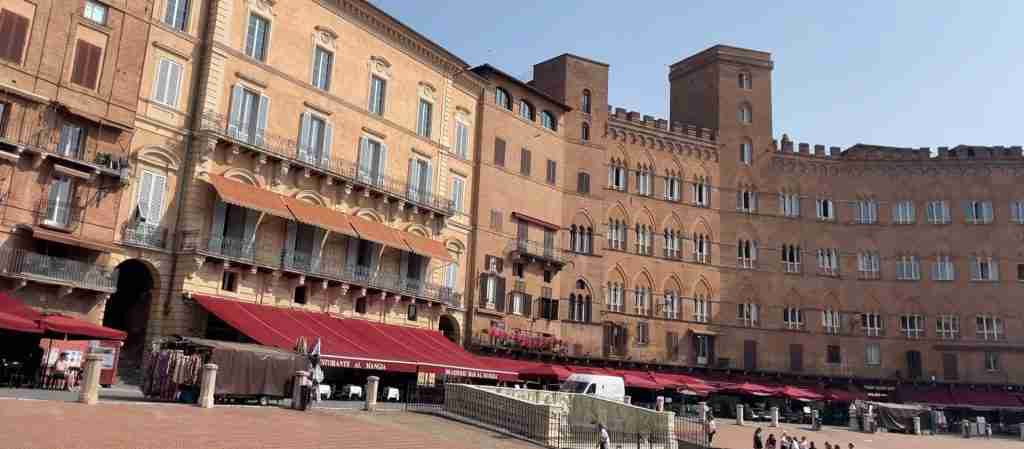
Piazza del Campo ranks among Europe’s greatest medieval public spaces and costs absolutely nothing to access, experience, or photograph throughout 2026. This shell-shaped square slopes downward toward Palazzo Pubblico and the Torre del Mangia tower, creating a natural amphitheater where Sienese residents have gathered for eight centuries. The distinctive herringbone brick paving divides the campo into nine sections representing Siena’s medieval Government of Nine that ruled the city-state during its 13th and 14th-century golden age. Sitting directly on the sloped pavement is not merely permitted but traditionally encouraged—locals and visitors spread across the bricks during sunny afternoons, creating an open-air social gathering space unlike any other Italian piazza.
The architectural ensemble surrounding Piazza del Campo tells Siena’s complete civic history through building facades visible without entering a single paid museum. Palazzo Pubblico’s fortress-like Gothic exterior features the distinctive Sienese combination of brick and travertine stone, its lower level punctuated by graceful triple-arched windows. The 102-meter Torre del Mangia bell tower soars from the palazzo’s left corner, though climbing the 400 steps requires a ticket while photographing from below costs nothing. The Fonte Gaia fountain occupies the campo’s upper curve, displaying marble replica panels of Jacopo della Quercia’s original 15th-century sculptures that depict biblical scenes and allegorical virtues. The originals reside in the Santa Maria della Scala museum requiring admission, but the detailed craftsmanship of the 19th-century replicas provides free artistic appreciation.
Observing daily life in Piazza del Campo throughout different times reveals Siena’s authentic rhythms beyond tourist activities in 2026. Early morning between 7:00 AM and 9:00 AM finds the campo nearly empty, offering unobstructed photography of the space’s geometric perfection with golden sunrise light illuminating the Palazzo Pubblico’s facade. Midday brings local workers enjoying lunch breaks on the bricks alongside tourists, creating a democratic mixing of residents and visitors that defines Siena’s accessible character. Late afternoon from 5:00 PM until sunset attracts the largest crowds, particularly on weekends when Italian families promenade through the historic center. Evening hours after 9:00 PM transform the illuminated campo into a romantic setting, with couples and small groups scattered across the space beneath spotlit palazzo walls.
The campo serves multiple practical functions beyond architectural appreciation, all accessible without charge in 2026. Public restrooms occupy the building at Via di Città entrance, though these require a small fee of approximately €1—the only cost associated with campo use. Several cafes and restaurants ring the upper perimeter offering outdoor seating, though sitting on the pavement itself costs nothing and provides equivalent people-watching opportunities. The campo hosts various free events throughout the year including occasional concerts, civic ceremonies, and market setups, with the 2026 calendar typically published through Siena’s tourism office. The twice-annual Palio transforms the entire space into a racetrack on July 2 and August 16, creating the year’s most significant free spectacle for those willing to stand in the center for hours.
Connecting from Piazza del Campo to Siena’s other free attractions requires no navigation technology—the city’s medieval street network naturally channels pedestrians toward major landmarks. Via di Città climbs upward from the campo’s northeast corner toward the Duomo district, passing contrade fountains and medieval tower houses. The southwest exit near Palazzo Pubblico leads down toward San Domenico basilica through the Fontebranda neighborhood. Exploring these radiating streets costs nothing and reveals Siena’s layered character more authentically than any guided tour, with each contrada displaying its own identity through building decorations, street names referencing neighborhood history, and residents greeting each other in dialect.
Basilica di San Domenico: Free Renaissance Masterpieces 2026
The Basilica di San Domenico (also called Basilica Cateriniana) offers completely free entry to one of Siena’s most artistically significant churches, open daily from 7:30 AM to 6:30 PM throughout 2026 with no admission charge, donation requirement, or timed tickets. This imposing Gothic brick structure dominates its hilltop position northwest of Piazza del Campo, its fortress-like exterior concealing ethereal Renaissance frescoes and the venerated relics of Saint Catherine of Siena, Italy’s patron saint. The complete absence of entry fees distinguishes San Domenico from Siena’s paid cathedral complex while arguably providing equal artistic and spiritual value for contemplative visitors.
Saint Catherine’s Chapel (Cappella di Santa Caterina) constitutes the basilica’s primary artistic treasure, positioned along the right nave and accessible immediately upon entering through the left-side main entrance in 2026. Renaissance master Giovanni Antonio Bazzi, called Il Sodoma, painted two magnificent frescoes depicting the saint’s mystical experiences: The Ecstasy of Saint Catherine shows the moment she received Christ’s stigmata, while The Fainting of Saint Catherine illustrates her mystical death experience. The chapel’s marble altar houses Catherine’s preserved head within a gilded reliquary, brought from Rome in 1383 and miraculously surviving a 1531 fire that destroyed portions of the basilica. Her mummified thumb resides in a separate reliquary, both relics visible for free contemplation throughout visiting hours without queuing or time restrictions.
Andrea Vanni’s 14th-century fresco of Saint Catherine represents the only authenticated portrait painted during the saint’s lifetime, positioned in the Chapel of the Vaults near the basilica entrance. This historically significant artwork shows Catherine wearing the black and white habit of Dominican tertiaries, her expression captured by an artist who knew her personally as a spiritual disciple. The fresco’s placement allows free viewing without entering deeper sections of the church, making it accessible even during brief visits. Interpreting the artwork’s context enhances appreciation: Vanni painted this shortly after Catherine’s death in 1380, working from direct memory rather than idealized hagiographic tradition.
The basilica’s vast nave extends 77 meters in length with Egyptian cross floor plan, its brick walls rising to 27-meter height beneath timber-beamed ceilings that demonstrate Cistercian Gothic austerity. Large cross vaults soar above the nave, creating an acoustically resonant space that enhances the contemplative atmosphere. The left transept houses Guido da Siena’s Maestà, a 13th-century altarpiece considered foundational to Sienese painting’s development toward greater naturalism. Francesco di Giorgio Martini’s Adoration of the Child occupies another chapel, displaying the Sienese Renaissance combination of Gothic delicacy and humanist observation. Benvenuto di Giovanni, Matteo di Giovanni, and other local masters contributed altarpieces throughout the side chapels, all visible for free during the basilica’s generous opening hours.
Practical visiting strategies maximize the free San Domenico experience in 2026. Arriving before 9:00 AM on weekdays finds the basilica nearly empty, allowing unobstructed viewing of all artworks and quiet contemplation in Saint Catherine’s Chapel without tourist groups. The church maintains cooler temperatures than outdoor Siena even during summer months, making it an ideal midday refuge during July and August heat while providing artistic enrichment. Photography without flash is permitted for personal use, enabling documentation of the frescoes and architectural details. Mass services occur weekdays at 9:30 AM in the Chapel of Our Lady of the Vow, with additional services at 8:00 AM, 11:00 AM, 12:15 PM, and 6:00 PM (6:30 PM in summer) on Sundays and holidays—attending Mass is free though visitor exploration may be restricted during services.
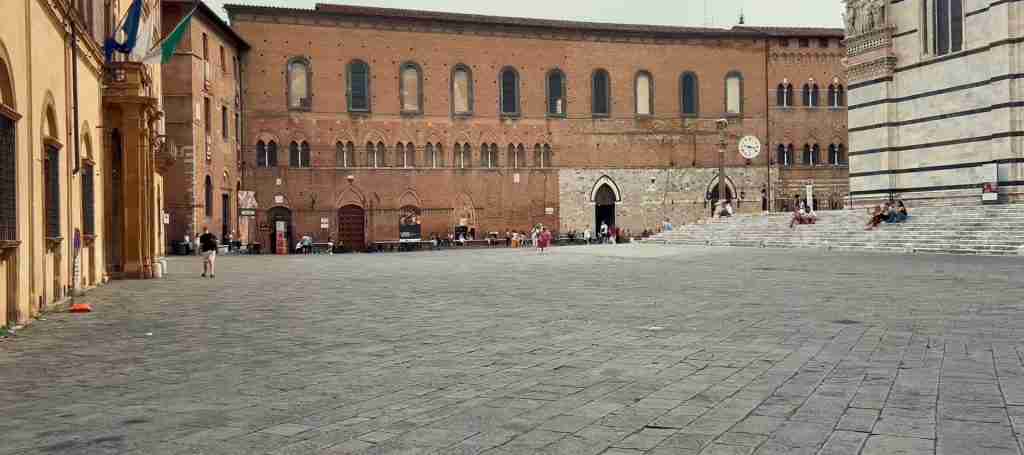
The exterior plaza surrounding San Domenico provides one of Siena’s finest free panoramic viewpoints, particularly toward the Duomo’s distinctive black-and-white campanile rising across the valley. This elevated perspective shows the historic center’s three-hill topography clearly, with Palazzo Pubblico’s Torre del Mangia visible in the middle distance. The plaza’s open space and benches invite resting after climbing from the campo, with several neighborhood cafes nearby for refreshments (these obviously cost money, though sitting on the plaza benches costs nothing). The red brick fortress-like basilica exterior deserves architectural appreciation beyond the interior artworks—its reduced-height 14th-century campanile shows modifications after an 1798 earthquake, while the Chapel of the Vaults’ exterior structure explains why the main entrance occupies the left side rather than the traditional facade position.
Free Churches and Religious Sites in Siena 2026
Beyond San Domenico, several smaller churches throughout Siena’s historic center offer free entry during non-service hours in 2026, though verifying current access policies locally is advisable as schedules may vary. These sacred spaces provide additional opportunities to experience Sienese Gothic and Renaissance art without admission charges while escaping tourist crowds that concentrate in paid museums. Each church maintains its own character and neighborhood identity, reflecting the contrada system’s influence on Siena’s parish structure.
The Church of San Francesco occupies a prominent position near Piazza San Francesco in the southeastern historic district, its large Gothic structure built between 1326 and 1475. While the interior has been modified considerably from its original medieval appearance, the church preserves important 14th-century frescoes and typically allows free access during daylight hours. The adjacent cloister occasionally hosts free temporary exhibitions, particularly during Siena’s cultural events calendar. The church’s elevated position provides views toward the Duomo and surrounding neighborhoods from the exterior plaza.
Various contrade museums attached to neighborhood churches sometimes offer free entry days or windows, particularly during the weeks preceding each year’s July and August Palio races when contrade pride intensifies. The Museo della Tartuca (Tortoise contrada) provides occasional free access to visitors interested in understanding how these neighborhood allegiances shape Sienese identity. The Museo dell’Aquila (Eagle contrada) similarly opens periodically without charge. Schedules for these community-run spaces remain fluid, but asking locally or checking contrada websites before visiting may reveal free opportunities. These small museums display historical costumes, Palio victory banners, and neighborhood archives that illuminate Siena’s unique social structure.
Attending Mass services at any Siena church remains universally free in 2026, though this obviously differs from tourist visiting. The Duomo celebrates weekday Mass at 9:30 AM in the Chapel of Our Lady of the Vow, with Sunday and holiday services at 8:00 AM, 11:00 AM, 12:15 PM, and 6:00 PM (6:30 PM summer), providing opportunities to experience the cathedral’s interior architecture and organ music without purchasing the standard €8+ tickets. San Domenico maintains its own Mass schedule as detailed in the previous section. Respectful attire with covered shoulders and knees applies universally when attending services or visiting churches as sacred spaces rather than museums.
Exploring the UNESCO Historic Center Free in 2026
Siena’s entire historic center carries UNESCO World Heritage designation since 1995, recognizing its extraordinary preservation of medieval urban planning and Gothic architecture—and walking these streets costs absolutely nothing in 2026. The protected zone encompasses the three historic hills (Terzi) of Città, San Martino, and Camollia, each subdivided into contrade whose territories are marked by street flags, ceramic plaques, and public fountains. Self-guided exploration reveals layers of history visible in building facades, street patterns following ancient Roman foundations, and architectural details that reward attentive observation.
Via di Città forms the historic center’s primary commercial street, climbing from Piazza del Campo northeast toward the Duomo through a succession of medieval palaces and modern shops occupying ground floors. The street’s name changes to Via Banchi di Sopra and Via Banchi di Sotto as it curves around the campo, creating a continuous pedestrian circuit through Siena’s commercial heart. Window shopping costs nothing and provides insight into contemporary Sienese life beyond tourism—local boutiques, pasticcerie displaying traditional sweets like ricciarelli and panforte, wine shops offering free browsing of Chianti Classico labels. The street’s medieval tower houses rise above retail spaces, many families having occupied upper floors for generations.
Loggia della Mercanzia marks the intersection where Via di Città meets Banchi di Sopra, its 15th-century Gothic arches creating an open-air commercial tribunal space. The free-to-view structure features stone benches, vaulted ceilings, and sculptures representing Justice and classical virtues—merchants once resolved trade disputes here under these allegorical gazes. The loggia provides architectural context for understanding Siena’s medieval commercial power, when the city’s banks rivaled Florence’s financial houses. Photographing the space from multiple angles reveals changing light patterns throughout the day, particularly effective during late afternoon when western sun illuminates the carved details.
Each contrada maintains its own public fountain serving both practical and symbolic functions, all accessible for free viewing and photography in 2026. The Fontebranda fountain in the northwest district ranks as Siena’s oldest and most historically significant water source, its Gothic brick facade dating to 1246. Three large arched openings once allowed residents to collect water, laundry washing, and animal watering in separated sections, demonstrating medieval urban planning sophistication. The fountain operates continuously, providing free drinking water for refilling bottles—a practical money-saving function during summer exploration. Other notable contrada fountains include the Chiocciola (snail) fountain decorated with the neighborhood’s spiral emblem and the Onda (wave) fountain showing its aquatic symbol.
Street-level architectural details throughout the historic center reveal Siena’s building culture without requiring museum access. Stone family crests mark palazzo entrances, identifying noble lineages that dominated neighborhoods for centuries. Iron torch holders and rings for tethering horses survive on many building facades. Medieval “buchette del vino” (wine windows) appear at ground level—small doors through which wine was sold directly from palace cellars to avoid guild taxes. Ceramic street signs identify each contrada territory with the neighborhood’s color scheme and symbolic animal. These free-to-observe elements accumulate into comprehensive understanding of how medieval Siena functioned as a living city rather than a preserved monument.
Fortezza Medicea: Free Park and Panoramic Views 2026
Fortezza Medicea operates as a free public park throughout 2026, offering panoramic Tuscan views, shaded walking paths, and open green spaces without admission charges, restricted hours, or advance booking requirements. This 16th-century fortress occupies the northwestern edge of Siena’s historic center, its massive brick walls and bastions built by Medici overlords to demonstrate Florentine control after Siena’s 1555 conquest ended the republic’s independence. The fortress’s transformation into peaceful public gardens represents post-unification Italy’s policy of converting military structures to civic amenities.
The ramparts provide 360-degree panoramic views across Siena’s terracotta rooftops, the Duomo’s striped campanile, and surrounding Tuscan countryside extending toward distant hills. Walking the perimeter circuit takes approximately 20 minutes at leisurely pace, with multiple vantage points offering photographic compositions combining urban architecture and rural landscape. The fortress elevation exceeds the Duomo and campo levels, creating the highest publicly accessible viewpoint within Siena’s immediate historic center. Sunset viewing attracts local couples and photographers during summer months, though the free access means no reservation competition exists as with paid tower climbs.
Within the fortress walls, extensive lawn areas and tree-lined paths create a green oasis contrasting with the historic center’s dense stonework. Families use the space for picnics and children’s play, particularly on weekend afternoons when Sienese residents promenade through the park. Several benches positioned in shaded locations invite resting during midday heat, making the fortress an effective free refuge during summer afternoon temperatures. The grass allows sitting or lying directly, though picnic activities should respect the public park setting. No food vendors operate within the fortress, meaning any refreshments require bringing supplies or purchasing from nearby shops before entering.
The Enoteca Italiana occupies permanent exhibition space within the fortress’s Medici-era vaults, showcasing Italian wines through a government-sponsored collection representing every region. While wine tasting requires payment, browsing the enoteca’s physical space and informational displays costs nothing and provides wine education through label design, regional classifications, and denomination systems. The temperature-controlled vaults maintain optimal wine storage conditions year-round, creating pleasantly cool environments during summer visits. Temporary exhibitions occasionally occupy additional fortress spaces, with some requiring tickets while others remain free—checking locally or through Siena’s tourism office reveals current programming.
Accessing Fortezza Medicea requires a 10-15 minute walk uphill from Piazza del Campo through the northwestern historic district, passing through the Onda and Chiocciola contrade. The Fontebranda fountain marks the approximate halfway point, where Via Vallerozzi begins the final ascent toward the fortress entrance. The walk itself costs nothing and reveals neighborhood character distinct from the touristy campo surroundings, with local bars and small shops serving resident populations. Multiple access points penetrate the fortress walls, though the main entrance at Piazza Caduti nelle Foibe provides the most obvious gateway. The park maintains no official closing time but naturally empties after sunset when illumination becomes limited.
Palio di Siena: Free Viewing Experience 2026
Witnessing the Palio di Siena horse race from Piazza del Campo’s center costs absolutely nothing in 2026, scheduled for July 2 (Palio di Provenzano) and August 16 (Palio dell’Assunta), though the completely free experience demands significant physical stamina, early arrival, and tolerance for dense crowds. This twice-annual spectacle represents Siena’s most important cultural event, when ten of the city’s seventeen contrade compete in a 90-second bareback horse race around the campo’s brick perimeter. The free standing-room tradition dates to the Palio’s medieval origins, maintaining democratic access while paid grandstand seating surrounds the square for those unwilling to stand for hours.
Securing good viewing position in the campo center for free requires arriving between 2:00 PM and 3:00 PM on race day, though the most strategic spectators claim spaces by noon or earlier for the 7:00 PM summer races. The campo’s sloped surface means the lower center provides optimal sightlines toward the finish line near Palazzo Pubblico, while the upper perimeter against the barriers offers slightly less crowded conditions with restricted views. Once positioned, leaving forfeits your space—no bathroom breaks, no food runs, no escape until after the race concludes. Temperatures regularly exceed 35°C (95°F) during July and August races, with limited shade coverage and no seating infrastructure within the free zone.
The race itself lasts barely 90 seconds, three laps around the campo’s makeshift dirt track requiring approximately 30 seconds per circuit. The free experience encompasses far more than this brief athletic event—the historical parade (Corteo Storico) begins around 5:00 PM, featuring all seventeen contrade in medieval costumes, drummers, and flag throwers performing synchronized flag displays. This two-hour procession showcases Siena’s neighborhood identities and medieval pageantry traditions, providing substantial entertainment before the race. The blessing of horse and jockey in each competing contrada’s neighborhood church, occurring approximately two hours before parade commencement, is also free to observe for those willing to navigate between contrade territories.
The post-race celebration in the winning contrada’s neighborhood transforms entire streets into free victory parties lasting until dawn. The winning neighborhood receives the Palio banner (a hand-painted silk standard) during an ecstatic celebration in the campo immediately after the race, but the authentic festivities move to the contrada’s home territory within minutes. Visitors can join these street parties without invitation or payment—tables appear along neighborhood streets, wine flows freely (truly free, passed to anyone present), and the winning horse is paraded through the district receiving veneration as the neighborhood’s hero. This spontaneous celebration provides deeper cultural immersion than the race itself, revealing how profoundly contrada identity shapes Sienese life.
Race day realities for free viewing require serious preparation in 2026. Bring water bottles (at least 2 liters per person), sunscreen, hats, and any medications needed during a 5+ hour period without facilities. Wear comfortable shoes for standing on uneven bricks. Eat a substantial meal before claiming your position. Accept that leaving forfeits your viewing spot permanently. Bathroom facilities within the campo are non-existent—the nearest accessible restrooms require exiting the square entirely. Heat exhaustion affects dozens of spectators annually, requiring medical extraction through dense crowds. The experience is memorable but physically demanding, particularly for children, elderly visitors, or anyone with mobility limitations.
Non-race Palio experiences offer free cultural engagement throughout the year in 2026. The contrade museums (detailed earlier) intensify their displays during weeks preceding each race, sometimes offering extended free hours. Trial races (prove) occur on June 29-30 and July 1 for the July Palio, and August 13-14-15 for the August race—these practice runs around the campo are completely free to watch and attract far smaller crowds while demonstrating the actual racing mechanics. The contrada dinner (cena della prova generale) on the night before each race fills neighborhood streets with communal tables, though these are technically private contrada events rather than public spectacles. Observing from nearby without intruding on neighborhood gatherings costs nothing and provides anthropological insight into contemporary tribal loyalty systems.
Free Markets and Local Life in Siena 2026
Siena’s weekly outdoor market operates every Wednesday morning from approximately 8:00 AM to 1:00 PM around Fortezza Medicea and nearby streets, offering free browsing opportunities among vendors selling clothing, household goods, local produce, and regional food products. This authentic local market serves Sienese residents’ practical shopping needs rather than tourist souvenir hunting, creating genuine cultural observation opportunities while exploring vendor offerings costs nothing. The market atmosphere reveals contemporary Tuscan daily life beyond the historic center’s museum-like preservation, with vendors calling out prices in dialect and local shoppers examining seasonal produce.
The food vendors concentrate near La Lizza area adjacent to the fortress, displaying Tuscan agricultural abundance through seasonal fruits, vegetables, cheeses, cured meats, and regional specialties. While purchasing requires payment obviously, examining the products and observing shopping interactions provides free education in Italian food culture. Vendors typically tolerate photography of their displays if approached respectfully, enabling documentation of Tuscan produce varieties and traditional preparation methods indicated through signage. The cheese vendors particularly showcase regional production from Pecorino Toscano to aged Parmigiano-Reggiano, with the visual displays alone teaching cheese classification systems.
Non-food vendors offer clothing, leather goods, housewares, and general merchandise at prices significantly below tourist-oriented shops in the historic center. Browsing these stalls costs nothing and provides comparative shopping intelligence for travelers considering purchases. The leather goods vendors display bags, belts, and wallets representing various quality levels from Chinese imports to genuine Tuscan artisan production—learning to distinguish these through examination rather than purchase saves money on eventual acquisitions. Haggling remains limited compared to southern Italian markets, but polite negotiation on clothing and accessories sometimes yields modest discounts.
The market’s location near Fortezza Medicea enables combining free experiences efficiently in 2026. Arriving at the market around 9:00 AM allows two hours of browsing before vendor activity declines around 11:00 AM, followed by ascending into the fortress park for midday views and rest. The Wednesday market timing also means contrade neighborhoods and major attractions experience lower tourist concentrations than weekend periods, creating better free exploration conditions throughout the historic center. The market disappears completely by 2:00 PM, with street cleaning restoring normal traffic patterns shortly thereafter.
Permanent food shops throughout Siena’s historic center allow free window shopping and occasional product sampling in 2026, particularly at specialty stores hoping to attract tourist purchases. Pasticcerie display traditional Sienese sweets including panforte (dense fruitcake), ricciarelli (almond cookies), and cavallucci (anise-spiced cookies) in elaborate presentations. Wine shops offer free browsing of Tuscan labels, with knowledgeable staff sometimes providing brief educational descriptions when not busy with paying customers. Salumerie (delicatessens) showcase regional cured meats and cheeses through window displays that function as edible still life compositions. These permanent retailers maintain higher prices than the Wednesday market but provide concentrated expertise in Sienese food traditions.
Self-Guided Walking Routes Through Contrade 2026
Creating self-guided walking routes through Siena’s seventeen contrade costs nothing and reveals the neighborhood identity system that defines Sienese social structure in 2026. Each contrada maintains its own colors, symbolic animal, territory boundaries, and fierce loyalty system that has survived since medieval times. Walking deliberately through multiple contrade territories while observing identity markers provides deeper cultural understanding than visiting isolated monuments, transforming aimless wandering into structured anthropological exploration.
A comprehensive contrade walking route beginning at Piazza del Campo and covering the historic center’s major districts takes approximately 3-4 hours at moderate pace with stops for observation and photography. Exit the campo via Via di Città northward into Aquila (Eagle) territory, marked by yellow and blue striped flags and eagle emblems on ceramic plaques. The Aquila fountain stands at Via della Sapienza, displaying the neighborhood’s heraldic eagle. Continue toward the Duomo district, crossing into Civetta (Owl) territory identified by red and black colors. The Civetta museum occasionally offers free entry days—asking locally may reveal opportunities. Descend Via del Capitano into Onda (Wave) contrada, recognizable through blue and white dolphin imagery. The Onda fountain occupies Via di Fontebranda near the historic Fontebranda fountain.
Northwest districts include Chiocciola (Snail) territory surrounding the fortress area, displaying yellow and red snail emblems, and Lupa (She-Wolf) contrada adjacent to San Domenico basilica, marked by orange and white colors with the Roman she-wolf symbol. Each contrada boundary typically features ceramic plaques identifying the crossing point, though unmarked transitions also occur where neighborhoods blend along shared streets. Observing these territorial markers costs nothing but requires attentiveness—locals navigate contrada geography unconsciously, while visitors must consciously note flags, fountain symbols, and street plaques to track neighborhood changes.
Southern and eastern districts accessible through free walking include Nicchio (Seashell), Torre (Tower), Valdimontone (Ram), Leocorno (Unicorn), and Selva (Forest) contrade. Each maintains distinctive character through architecture, street atmosphere, and residential demographics. The Nicchio and Torre contrade near Porta Romana show less tourist concentration than central districts, revealing authentic neighborhood life through local bars, small groceries, and residents conducting daily activities. The Selva contrada occupies the northeastern sector toward Porta Pispini, its forest symbol appearing in green and orange street decorations. Walking these less-visited territories costs nothing and provides escape from campo crowds while demonstrating how 53,000 Sienese residents maintain seventeenth-century allegiances in contemporary life.
Each contrada’s church serves as its spiritual and organizational center, with the neighborhood society (società) maintaining headquarters in adjacent buildings. While the museums require varying admission policies, observing the churches’ exteriors and noting each contrada’s patron saint provides free cultural education. The baptismal font in each church includes the contrada’s symbolic animal, emphasizing how neighborhood identity supersedes even religious affiliation in Sienese priorities. Photographing these details costs nothing and creates visual documentation of an urban organizational system unparalleled elsewhere in Italy.
The best seasons for contrada walking in 2026 vary by objective. June and early July before the first Palio see neighborhoods decorating streets with flags and preparing for competition, creating maximum visual identity display. The days immediately following each Palio race show winning contrada celebrations continuing through street decorations and victory symbols. Spring (April-May) and autumn (September-October) offer comfortable walking temperatures without Palio-related crowds, ideal for contemplative neighborhood observation. Winter months see reduced street decorations but reveal authentic daily life without tourist influence.
Free Panoramic Viewpoints Across Siena 2026
Beyond Fortezza Medicea’s ramparts (detailed earlier), multiple free elevated viewpoints throughout Siena and its immediate surroundings provide panoramic perspectives across the medieval cityscape and Tuscan countryside in 2026. These vantage points require no admission fees, timed reservations, or special access permissions—only willingness to walk uphill and occasional tolerance for unmanicured viewing conditions. Strategic viewpoint selection based on time of day, photographic objectives, and physical stamina maximizes the free panoramic experience.
The Basilica di San Domenico’s exterior plaza (mentioned in the church section) delivers sweeping views eastward toward the Duomo’s distinctive black-and-white striped campanile rising above intervening buildings. This elevated position shows Siena’s three-hill topography clearly, with the campo district occupying the central depression between San Domenico’s hill and the Duomo’s prominence. Morning light illuminates the cathedral optimally from this western viewpoint, creating ideal conditions for photography between 8:00 AM and 10:00 AM. The plaza’s benches enable extended contemplation without time pressure, while the nearby neighborhood cafes (requiring payment) provide optional refreshment facilities.
Walking Siena’s medieval perimeter walls reveals multiple elevated perspectives at different cardinal directions, all accessible without fees in 2026. The wall circuit near Porta Camollia in the northern historic sector provides views across the Chianti hills extending toward Florence, particularly effective during late afternoon when western sun illuminates the rolling landscape. The southwestern walls near Porta Romana offer southward vistas toward the Crete Senesi clay hills, their distinctive grey-white geology creating moonscape-like formations visible from Siena’s elevated position. Walking the complete perimeter circuit takes approximately 90 minutes, though accessing individual viewpoint sections requires only 15-20 minute detours from central routes.
The area surrounding Via del Poggio ai Meli northeast of the Duomo complex provides a less-known free viewpoint toward Siena’s southern districts and distant Monte Amiata volcano (visible on clear days). This residential neighborhood sees minimal tourist traffic, creating an authentic local atmosphere while delivering expansive panoramas from public streets. The viewpoint requires a 15-minute uphill walk from the Duomo area but rewards effort with uncrowded conditions ideal for contemplative viewing. No infrastructure exists beyond basic street amenities, meaning no vendors, facilities, or formal observation decks—just public roadway offering southwest perspectives across the Tuscan landscape.
Several contrada fountains occupy elevated positions providing limited but atmospheric viewpoints integrated with neighborhood architecture. The Onda fountain area near Fontebranda combines the historic water source with views toward San Domenico basilica across the intervening valley. The Chiocciola fountain district northwest of the campo offers glimpses toward the fortress and surrounding hills through breaks in the medieval building fabric. These neighborhood viewpoints provide context for understanding Siena’s topographic relationship to its water sources—the city’s hilltop position required elaborate fountain systems to supply residents, with each contrada maintaining territorial control over its water access points.
Optimal timing for panoramic viewing varies by season and desired atmospheric conditions in 2026. Sunrise viewing (approximately 6:00 AM summer, 7:30 AM winter) finds most viewpoints completely empty with golden light illuminating eastern-facing facades and countryside. Midday provides maximum visibility distance on clear days but harsh overhead light that flattens architectural details. Late afternoon between 5:00 PM and 7:00 PM delivers warm side lighting that enhances building textures and creates depth through shadow modeling. Sunset viewing attracts local photographers to popular viewpoints like Fortezza Medicea, though lesser-known perimeter wall positions maintain solitude even during golden hour. Night viewing shows illuminated monuments against darkened countryside, though most viewpoints lack dedicated lighting infrastructure requiring careful navigation.
Free Festivals and Cultural Events Siena 2026
Beyond the Palio races, Siena hosts various free cultural events, religious observances, and civic celebrations throughout 2026 that welcome public participation without admission charges. The specific dates and programming for many events are typically confirmed only months in advance, requiring checking with Siena’s tourism office, the Visit Siena website, or local event calendars closer to travel dates. Major festivals with historical continuity occur annually on fixed dates, while contemporary cultural programming follows more flexible scheduling.
The Feast of Saint Catherine (Festa di Santa Caterina) on April 29 commemorates Siena’s patron saint with religious processions, special Masses, and civic ceremonies accessible to all visitors in 2026. The central Mass at the Duomo welcomes public attendance without charge, though seating fills early requiring arrival well before the scheduled start time. Processions through the historic center following religious observances allow free viewing from any public space along the route. Neighborhood celebrations in the contrade associated with Catherine (particularly Oca and Lupa where she lived and died) sometimes include street gatherings and traditional food offerings shared with the community.
The Feast of the Assumption (August 15) holds particular significance as the titular feast of Siena’s Duomo (Cathedral of Santa Maria Assunta) and one of Italy’s most important national holidays. Religious ceremonies at the cathedral and San Domenico basilica remain free to attend, while the evening often includes free outdoor concerts or cultural programming in Piazza del Campo. The proximity to the August 16 Palio creates a multi-day celebration atmosphere throughout the city, with contrade preparing for competition while religious observances honor the cathedral’s dedication.
Christmas season brings special cultural programming from late November through early January, much of it free to experience in 2026. Nativity scenes (presepi) appear in numerous churches throughout the historic center, with the Duomo, San Domenico, and smaller parish churches creating elaborate displays accessible during normal visiting hours. The city decorates Via di Città and Piazza del Campo with lights and seasonal displays, transforming the medieval center into an atmospheric winter setting. Occasional free concerts in historic churches utilize the acoustically resonant spaces for choral performances or early music ensembles, though specific programming requires consulting December event calendars.
The city’s university population creates informal cultural energy throughout the academic year (October through June), with student-oriented events occasionally open to public participation. The University of Siena ranks among Italy’s oldest institutions, its student presence energizing neighborhoods around the historic center beyond typical tourism patterns. Free lectures, exhibitions, and performances sometimes welcome general audiences, though advance research through university cultural calendars helps identify accessible programming. The university libraries, while primarily serving enrolled students, sometimes host free exhibitions in public areas.
Practical Money-Saving Strategies for Free Siena 2026
Maximizing free experiences in Siena requires strategic planning around practical necessities that can rapidly drain budgets if approached reactively in 2026. Water, food, transportation, and timing decisions separate travelers spending €50 daily from those spending €150 while accessing identical free cultural attractions. The following strategies complement the free experiences detailed earlier by minimizing unavoidable costs.
Carry a reusable water bottle and refill at Siena’s numerous free public fountains throughout the historic center. Fontebranda fountain, contrade neighborhood fountains, and small fountains along Via di Città provide potable water continuously at no cost, eliminating the need to purchase bottled water at €1.50-2.50 from shops and cafes. A single person consuming two liters daily saves €6-10 across a three-day Siena visit simply by using free fountains. Verify fountain water is marked “potabile” (drinkable) rather than “non potabile” before consuming, though most historic fountains serve drinking-quality water.
Pack picnic supplies purchased from supermarkets rather than eating all meals in restaurants, consuming these in free public spaces like Fortezza Medicea park or on benches throughout the historic center. A Coop supermarket operates near the train station area with another location north of the walls at Via dei Gazzani. Prices run 50-70% below tourist-oriented shops in the campo district. A picnic lunch featuring bread, cheese, salumi, and fruit costs €5-8 per person versus €15-25 for restaurant pranzo. Eating breakfast at your accommodation and packing lunch enables allocating restaurant budget toward a single quality dinner showcasing Tuscan cuisine.
Walking from Siena’s main train station to the historic center saves the €1.50 urban bus ticket by traversing the escalators through the shopping center and ascending Via Tozzi/Via del Porrione. The 25-30 minute walk provides first orientation to Siena’s topography while costing nothing. The initial escalator section (inside Siena FS shopping center) minimizes the elevation gain from train station to city center, making the walk manageable even with luggage. Returning to the station reverses this route downhill, an easy 20-minute descent saving another bus fare.
Schedule museum and paid attraction visits strategically around free experiences to prevent cultural overload and expenditure concentration. Visiting the free Basilica di San Domenico provides substantial artistic satisfaction before deciding whether to purchase the Duomo complex ticket. Exploring contrade neighborhoods and Piazza del Campo for a full day establishes whether Siena’s atmosphere justifies extending the stay versus moving to other Tuscan destinations. Spreading paid experiences across multiple days rather than concentrating them prevents both budget strain and cultural exhaustion—seeing two major paid attractions plus multiple free sites daily maintains sustainable pacing.
Visit during shoulder seasons (April-May, September-October) rather than peak summer for more affordable accommodation while retaining full access to free attractions in 2026. July-August hotel rates often run 40-60% higher than April or October prices for identical rooms, while free experiences like Basilica di San Domenico, Fortezza Medicea, and historic center walking remain completely unaffected by season. The Palio races occur only in July and August, but the free trial races (prove) during the preceding days provide nearly equivalent cultural exposure without accommodation premium surcharges.
Combining Free Siena with Budget Day Trips 2026
Siena’s central Tuscan location enables combining free urban experiences with budget-conscious countryside exploration in 2026, though acknowledging that most day trips incur transportation costs even when destinations offer free attractions. Public bus networks connect Siena to surrounding hill towns and agricultural valleys, with fares substantially lower than organized tours or rental cars. Strategic day trip selection balances transportation investment against worthwhile free experiences at destinations.
San Gimignano’s medieval tower skyline attracts day-trippers from Siena via Tiemme public buses (route 130), with the journey requiring approximately 60-70 minutes and costing roughly €6-8 roundtrip in 2026. Walking San Gimignano’s historic center costs nothing, as does viewing the tower exteriors that define the town’s UNESCO-listed skyline. The Rocca fortress at the highest point provides free access to its perimeter walls offering Tuscan countryside panoramas. Climbing individual towers requires tickets (€5-9), but appreciating the overall medieval urban composition remains free through street-level exploration and fortress viewpoint access.
Monteriggioni’s perfectly preserved circular medieval walls lie 15 kilometers north of Siena, accessible via Tiemme buses toward Florence with service approximately hourly. The roundtrip fare costs roughly €4-6 in 2026, while Monteriggioni’s exterior walls and the view from its parking area remain free to photograph and admire. The interior village is tiny (population 100) but free to walk, with the walk around the external wall circuit providing the primary visual experience. The wall walk itself requires a modest ticket, though the ground-level perimeter walk and external views cost nothing. Combining Monteriggioni with morning free experiences in Siena creates an efficient full-day program—explore Siena’s free attractions until midday, then bus to Monteriggioni for afternoon countryside atmosphere.
The Chianti wine region surrounding Siena offers free landscape appreciation, though accessing specific vineyards and wineries without personal transportation proves challenging via public bus networks. Cyclists can rent bicycles in Siena for approximately €15-25 daily, then pedal through Chianti hills stopping at viewpoints and small villages entirely for free. The physical effort substitutes for transportation costs while providing intimate landscape engagement impossible from buses or cars. Packing picnic supplies from Siena supermarkets enables countryside consumption at scenic rest stops without restaurant expenses. This option suits physically fit travelers comfortable cycling 30-50 kilometers daily on hilly terrain.
Returning to Siena each evening rather than booking multiple hotel bases saves money while the free attractions detailed throughout this guide provide evening entertainment after day trips. Piazza del Campo at sunset, Fortezza Medicea for post-dinner strolls, and wandering illuminated contrade neighborhoods cost nothing while offering atmospheric experiences distinct from daytime tourism. The campo’s evening scene particularly rewards those staying in Siena—watching locals gather, musicians occasionally performing informally, and the palazzo facades illuminated against darkening sky creates memorable experiences without expenditure.
Frequently Asked Questions: Free Siena Experiences 2026
Do you need to pay to enter Piazza del Campo in Siena?
No, Piazza del Campo remains completely free and open 24 hours daily throughout 2026. No admission charge, reservation, or restricted access applies to this central public square. You can sit directly on the sloped brick pavement, photograph the architectural ensemble, and spend unlimited time in the space without payment. The only costs associated with the campo involve optional purchases from surrounding cafes, restaurants, and shops, or the approximately €1 public restroom fee. Palazzo Pubblico and Torre del Mangia require tickets for interior access, but viewing these structures from the campo costs nothing.
Is the Siena Cathedral free to visit?
No, entering the Siena Cathedral interior requires purchasing tickets starting at €8 for basic access to the cathedral and Piccolomini Library in 2026. The comprehensive OPA Si Pass granting entry to the cathedral, baptistery, crypt, museum, and Facciatone viewpoint costs approximately €18+ depending on season. However, you can admire the cathedral’s spectacular Gothic facade, black-and-white marble exterior, and architectural details from Piazza del Duomo entirely for free. Attending Mass services provides free access to the cathedral nave during worship times, typically 9:30 AM weekdays and multiple services on Sundays and holidays, though visitor exploration may be restricted during services.
Can you watch the Palio di Siena for free?
Yes, watching the Palio di Siena from the center of Piazza del Campo costs absolutely nothing on the race dates of July 2 and August 16 in 2026. Securing free viewing position requires arriving several hours before the race, typically between 2:00 PM and 3:00 PM for the 7:00 PM summer races, and standing in dense crowds for the duration. Once positioned, you cannot leave without forfeiting your space. Bring water, sun protection, and expect no facilities during a 5+ hour wait period. The paid grandstand seating surrounding the square costs hundreds of euros but provides seating, shade, and amenities. The free experience is authentic and traditional but physically demanding.
Are there any free museums in Siena?
Siena’s major museums including the Civic Museum, Cathedral Museum, and Santa Maria della Scala hospital complex all require paid admission in 2026. However, the Basilica di San Domenico functions essentially as a free museum, housing Renaissance masterpieces by Sodoma and other Sienese artists, Saint Catherine’s relics, and significant Gothic architecture without admission charges. Several contrade museums occasionally offer free entry days during Palio preparation periods, though schedules vary and should be verified locally. The Enoteca Italiana in Fortezza Medicea allows free browsing of Italian wine displays, though tasting requires payment.
What is the best free thing to do in Siena?
Walking the entire UNESCO-listed historic center while observing contrade identity markers, medieval architecture, and neighborhood fountains provides the most comprehensive free Siena experience in 2026. This self-guided exploration requires no admission fees, combines multiple cultural elements (Gothic buildings, neighborhood allegiances, urban planning history), and takes 3-4 hours at moderate pace. The route from Piazza del Campo through various contrade to San Domenico basilica, then up to Fortezza Medicea for panoramic views, encompasses Siena’s essential character while costing nothing. This walking experience surpasses any single monument visit for understanding how medieval Siena functioned as an integrated urban system.
How long should you spend at the free Basilica di San Domenico?
Allow 45-60 minutes for thorough exploration of the Basilica di San Domenico in 2026, including contemplative time in Saint Catherine’s Chapel viewing Sodoma’s frescoes and the saint’s relics. Brief visits of 20-30 minutes permit seeing the major artworks and architectural nave, suitable for travelers on tight schedules. Art history enthusiasts may spend 90+ minutes examining the various chapel altarpieces, understanding the building’s Gothic Cistercian design, and appreciating the acoustic properties. The exterior plaza viewpoint toward the Duomo adds another 10-15 minutes to the total visit. Unlike ticketed museums with timed-entry pressure, the free admission allows returning multiple times during a Siena stay without additional cost.
Is Fortezza Medicea really free, or are there hidden costs?
Fortezza Medicea operates as a genuine free public park throughout 2026 with zero admission charges, reservation requirements, or hidden fees for accessing the fortress walls, rampart walkways, lawn areas, or panoramic viewpoints. The Enoteca Italiana wine showroom inside the fortress is free to browse, though wine tastings require payment. No vendors, facilities, or services within the fortress demand payment beyond optional purchases at the enoteca. Reaching the fortress requires walking uphill from the historic center, which obviously costs nothing. The complete fortress experience including rampart circuit and park rest time involves no expenditure whatsoever.
Can you get free water in Siena?
Yes, numerous free public fountains throughout Siena’s historic center provide potable drinking water continuously in 2026. Fontebranda fountain serves as the most historic source, while each contrada maintains neighborhood fountains offering free water refills. Small fountains along Via di Città and throughout the centro storico are marked “potabile” indicating drinkable water. Carrying a reusable bottle and refilling at these free sources eliminates the need to purchase bottled water at shops and cafes. The tap water in Siena meets all European quality standards, making fountain water completely safe for consumption.
Are there free guided tours in Siena?
Some walking tour companies operate “free” tours based on tip-only models in Siena, where no upfront fee is charged but guides expect tips of €10-15 per person at the conclusion. These differ from genuinely free experiences but provide historical context and orientation at lower cost than standard paid tours. Student volunteers or cultural associations occasionally offer free interpretive walks during special events or festivals, though schedules remain irregular. Self-guided exploration using downloadable contrade maps and this guide’s information provides completely free orientation to Siena’s major districts and cultural systems. The tourism office occasionally distributes free printed walking route maps covering the historic center and major landmarks.
What free things can you do in Siena at night?
Evening strolls through the illuminated historic center cost nothing and reveal Siena’s medieval character under dramatically different lighting conditions in 2026. Piazza del Campo at night features palazzo facade illumination creating golden stone reflections, with locals and visitors gathering on the sloped pavement without time restrictions or fees. The Duomo exterior gains dramatic presence under spotlighting visible for free from Piazza del Duomo. Walking through contrade neighborhoods observes residential evening activities—locals dining at outdoor tables, small bars serving neighborhood regulars, and the more intimate street life distinct from daytime tourist flows. Fortezza Medicea technically remains accessible after dark though limited lighting makes evening visits less practical than daylight exploration.