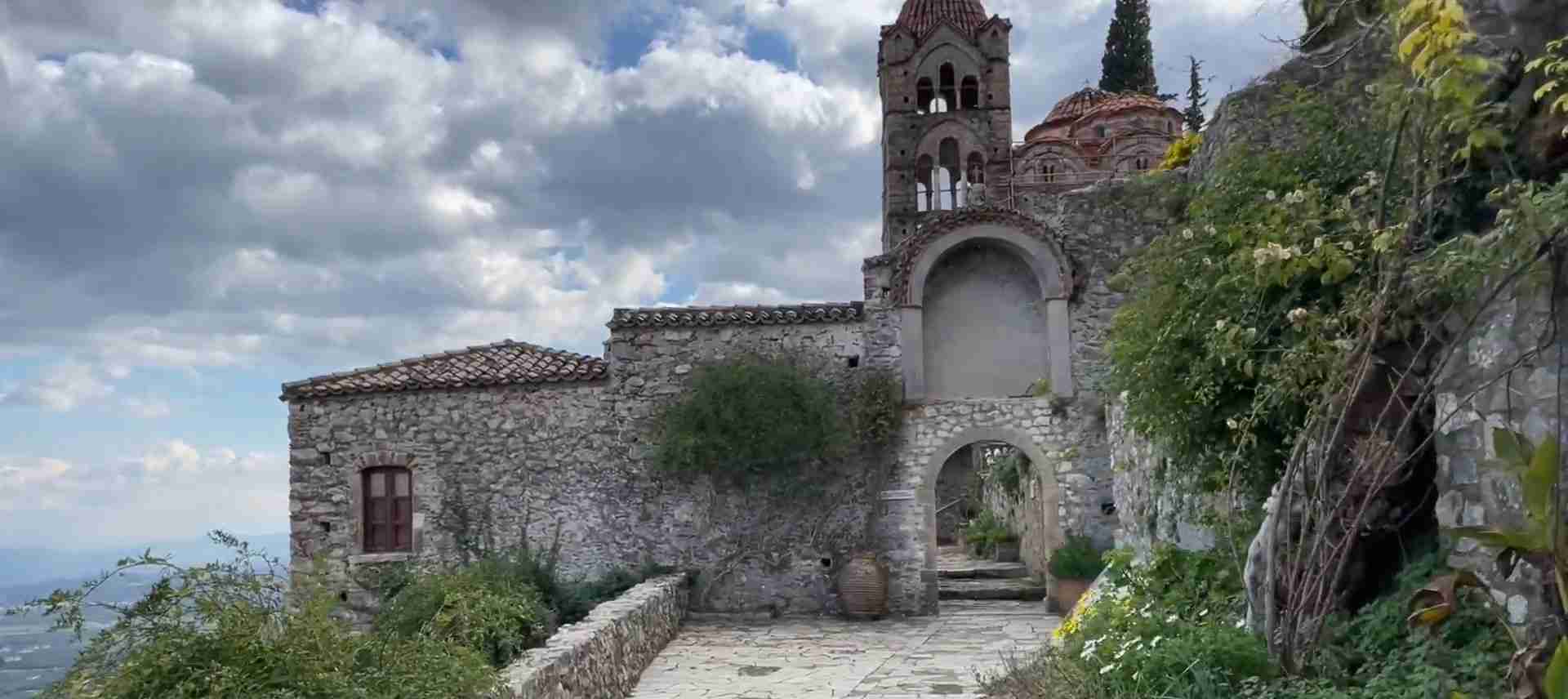
Mystras UNESCO Guide: Peloponnese Byzantine Ghost City
Mystras stands as the Mediterranean’s most intact Byzantine ghost city, where medieval churches, palaces, and cobblestone streets cascade down the slopes of Mount Taygetos in the Peloponnese. Abandoned in 1832 yet miraculously preserved, this fortified hillside settlement witnessed the final flowering of Byzantine civilization before the empire’s fall, serving as the intellectual and artistic capital of the Despotate of Morea during the Palaeologan Renaissance.
Key Takeaways
- UNESCO Recognition: Inscribed in 1989 as an exceptionally well-preserved example of a late Byzantine fortified city, recognized for its testimony to Byzantine and Post-Byzantine artistic development during the Palaeologan Renaissance
- Historical Evolution: Founded in 1249 as a Frankish fortress, transformed into the Byzantine Despotate capital in 1348, and abandoned in 1832 when modern Sparta was rebuilt, leaving perfectly preserved medieval ruins
- Architectural Significance: Features the complete urban fabric of a Byzantine city including defensive castle, palace complex, fourteen churches with extraordinary frescoes, monasteries, and residential quarters arranged on steep hillside terraces
- Cultural Legacy: Served as the intellectual center where philosopher Georgios Gemistos Plethon taught Neoplatonic philosophy, influencing the Italian Renaissance and shaping Byzantine culture’s final artistic flowering
- Present Status: Remains a living archaeological site with the Pantanassa Monastery still inhabited by Orthodox nuns, offering visitors the rare experience of exploring an entire Byzantine city frozen in time
- Distinctive Character: Called the “wonder of the Morea,” Mystras represents the only Byzantine city where you can walk complete medieval streets, enter frescoed churches, and experience the spatial organization of late Byzantine urban planning
People Also Ask About Mystras Byzantine Ghost City
Why is Mystras Called a Ghost City?
Mystras earned the designation “ghost city” because its entire population abandoned the settlement in 1832 when King Otto of Greece decided to rebuild ancient Sparta 8 kilometers to the east. The abandonment was complete and deliberate—families relocated en masse to the new town of Sparti, leaving behind their homes, churches, and palaces virtually intact. Unlike most abandoned cities that deteriorate gradually, Mystras was consciously preserved as a medieval relic, creating the haunting spectacle of a complete Byzantine city standing empty on the mountainside. Today only the nuns of Pantanassa Monastery inhabit this once-thriving capital, maintaining the single active religious presence among the silent ruins of churches, palaces, and houses that once sheltered thousands.
What Makes Mystras Architecturally Significant Among Byzantine Sites?
Mystras represents the only surviving example of a complete late Byzantine urban center where architectural evolution, spatial planning, and decorative programs remain intact and readable as a unified system. The site preserves the full hierarchy of Byzantine civic architecture—from the defensive kastro at the summit through the Palace of the Despots and metropolitan cathedral to residential quarters—arranged according to the steeply sloping topography that made wheeled vehicles impossible and created a pedestrian city of stepped streets and terraced buildings. The architectural significance extends to the churches, which demonstrate the distinctive “Mystras type” combining Latin Crusader and Byzantine forms: basilica ground floors supporting domed cross-in-square upper levels with elaborate exterior brickwork decoration. The frescoes within these churches, executed by the finest Byzantine artists of the 14th and 15th centuries, represent the culmination of Byzantine painting traditions.
How Did Mystras Influence the Italian Renaissance?
Mystras served as the critical transmission point for Byzantine scholarship and Neoplatonic philosophy to Renaissance Italy through the teachings and travels of intellectuals who gathered at the Despotate capital during the 15th century. Georgios Gemistos Plethon, who taught in Mystras from approximately 1410 to 1452, championed Platonic thought and emphasized the Hellenic foundations of Byzantine culture, directly inspiring Cosimo de’ Medici to establish the Platonic Academy in Florence after meeting Plethon during the Council of Florence. Plethon’s student Bessarion, who became Cardinal Bessarion after converting to Catholicism, brought hundreds of Greek manuscripts to Italy and actively promoted classical learning among Italian humanists. These Mystras-trained scholars carried not only texts but the living tradition of Byzantine philosophical method, manuscript illumination techniques, and theological debate that had flourished in this final Byzantine cultural center.
What Happened to Mystras After the Byzantine Empire Fell?
After surrendering to Ottoman forces in 1460, Mystras continued as a significant provincial town under Turkish rule, maintaining its Christian population and churches while serving as an administrative center for the region. The Venetians captured the city in 1687 during the Morean War and held it until 1715, when it returned to Ottoman control. Mystras suffered devastating damage during the Greek War of Independence when Egyptian forces under Ibrahim Pasha massacred the population and burned the city in 1825. The catastrophic destruction convinced Greek King Otto that rebuilding Mystras was impractical, leading to his decision in 1832 to refound ancient Sparta nearby and relocate Mystras’s surviving population. The process of abandonment completed in 1953 when remaining properties were confiscated, transforming Mystras from living city to archaeological monument.
Extended multi-day tours – 5+ days
Featured Peloponnese Islands Multi-Day Tour Packages
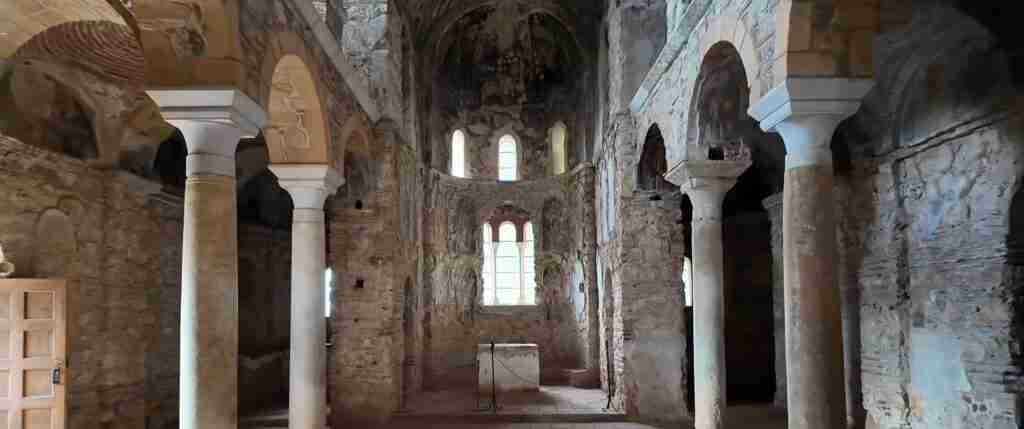
3 days
Peloponnese Islands 3-Day Discovery Tour
- ✓ Comprehensive Peloponnese Islands experience
- ✓ Expert local guides included
- ✓ All accommodation included
- ✓ Transportation provided
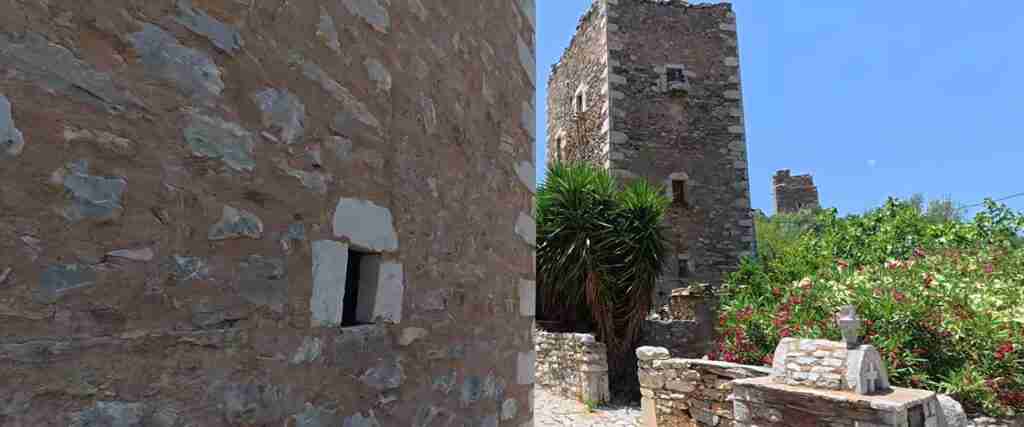
5 days
Peloponnese Islands 5-Day Highlights Experience
- ✓ Comprehensive Peloponnese Islands experience
- ✓ Expert local guides included
- ✓ All accommodation included
- ✓ Transportation provided
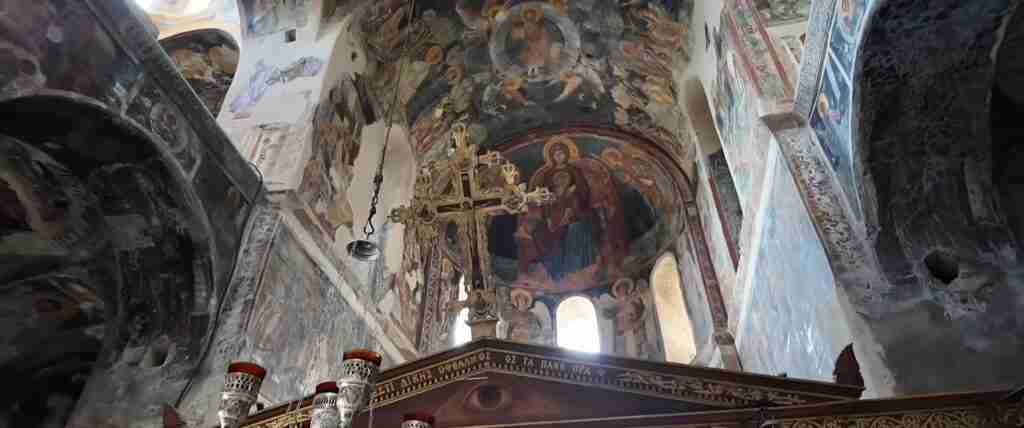
7 days
Peloponnese Islands 7-Day Cultural Journey
- ✓ Comprehensive Peloponnese Islands experience
- ✓ Expert local guides included
- ✓ All accommodation included
- ✓ Transportation provided
10 days
Peloponnese Islands 10-Day Complete Adventure
- ✓ Comprehensive Peloponnese Islands experience
- ✓ Expert local guides included
- ✓ All accommodation included
- ✓ Transportation provided
Multi-day tour packages powered by TourRadar. Prices and availability subject to change.
Introduction: Understanding Mystras Byzantine Heritage
The fortified Byzantine city of Mystras occupies an entire hillside of Mount Taygetos in the southern Peloponnese, rising from the valley floor at 250 meters elevation to the Frankish castle at 620 meters on a conical peak commanding views across the Laconian plain to modern Sparta. This extraordinary archaeological site preserves not fragments or isolated monuments but the complete urban fabric of a late Byzantine capital—defensive walls enclosing upper and lower towns connected by cobblestone paths, fourteen churches with vivid frescoes, palace complexes, monasteries, aristocratic mansions, and the modest houses of merchants and artisans arranged on terraces carved into the steep mountainside. The physical preservation is matched by historical significance: Mystras served as the capital of the Byzantine Despotate of Morea from 1348 to 1460, functioning as the empire’s western stronghold and cultural center during the final centuries before Constantinople’s fall.
The city’s foundation in 1249 by Frankish prince William II of Villehardouin represented the Crusader states’ attempt to control the restive Laconian plain and its Slavic populations. When William surrendered Mystras to Byzantine Emperor Michael VIII Palaiologos in 1262 as ransom after his capture at the Battle of Pelagonia, the fortress became the nucleus for Byzantine reconquest of the Peloponnese. Greek populations from Frankish-controlled Lacedaemonia (ancient Sparta) migrated to Mystras where they lived as equals rather than subjects, rapidly transforming the military outpost into a thriving Byzantine city. By the early 14th century, Mystras had eclipsed Monemvasia as the provincial capital, and in 1348 Emperor John VI Kantakouzenos established the Despotate of Morea with Mystras as its seat, installing his son Manuel as the first Despot with lifetime tenure.
The Despotate period from 1348 to 1460 marked Mystras’s golden age, coinciding with and contributing to the Palaeologan Renaissance—the final flowering of Byzantine art, literature, and philosophy before the empire’s extinction. The Despots, drawn from the Palaiologos imperial family, governed the Peloponnese as semi-autonomous rulers while maintaining allegiance to Constantinople. They attracted scholars, philosophers, artists, and architects to their capital, creating an intellectual environment that rivaled the imperial city itself. Georgios Gemistos Plethon established his philosophical school in Mystras, teaching Neoplatonism and championing the revival of ancient Greek thought. The construction of magnificent churches—the Metropolis (1264), Peribleptos (mid-14th century), Pantanassa (1428)—covered with elaborate frescoes by master painters demonstrated Byzantine artistic vitality even as the empire contracted territorally and economically.
The abandonment of Mystras in 1832, traumatic for its inhabitants but fortuitous for archaeology and architectural history, preserved a medieval Byzantine city in a state of completeness unmatched anywhere in the former Byzantine world. Constantinople’s Byzantine monuments survive as isolated structures within a modern metropolis, while most provincial Byzantine cities either evolved into modern towns (Thessaloniki, Ioannina) or deteriorated into archaeological rubble (Mistra’s fate had it not been abandoned). Mystras stands frozen at the moment of its 19th-century depopulation, offering visitors the extraordinary experience of walking Byzantine streets, entering aristocratic mansions with their vaulted cisterns and timber-framed upper stories, ascending to the Palace of the Despots where emperors governed, and standing within churches whose frescoed walls still convey the theological sophistication and artistic brilliance of late Byzantine culture.
Mystras UNESCO World Heritage Status and Recognition
The United Nations Educational, Scientific and Cultural Organization inscribed the Archaeological Site of Mystras on the World Heritage List in 1989, recognizing its outstanding universal value under criteria (ii), (iii), and (iv). Criterion (ii) acknowledges Mystras as a site exhibiting important interchange of human values, specifically its role in the development and transmission of Late Byzantine and Post-Byzantine art that influenced the Mediterranean world and beyond. The designation under criterion (iii) recognizes Mystras as bearing unique testimony to the Byzantine cultural tradition, particularly the Palaeologan Renaissance of the 14th and 15th centuries. Criterion (iv) establishes Mystras as an outstanding example of an architectural type and landscape illustrating a significant stage in human history—the late Byzantine fortified city.
The UNESCO evaluation emphasized several factors justifying Mystras’s inscription. First, the site constitutes an exceptionally well-preserved example of a Byzantine city whose architectural and urban fabric remains intact and readable, allowing scholars and visitors to understand Byzantine urban planning, defensive architecture, ecclesiastical building, and domestic construction as an integrated system. Second, the artistic heritage of Mystras—particularly the church frescoes executed during the Palaeologan period—represents the culmination of Byzantine painting traditions and demonstrates the continuing vitality and innovation of Byzantine art even as the empire faced political and military decline. Third, the intellectual legacy of Mystras, embodied in the teachings of Plethon and the scholarship of figures like Bessarion, played a crucial role in transmitting Greek learning to Renaissance Italy.
The authenticity of Mystras as a World Heritage property derives from its complete abandonment in the 19th century, which preserved the medieval urban character without subsequent development or modern interventions that might compromise historical integrity. The site’s layout, street network, defensive walls, and building foundations remain exactly as they existed when the city was inhabited. Restoration work on selected monuments—particularly major churches and the Palace of the Despots—has followed rigorous archaeological and architectural standards, using traditional techniques and materials to stabilize structures while preserving original fabric wherever possible. The Hellenic Ministry of Culture, through the 5th Ephorate of Byzantine Antiquities in Sparta, manages the site according to Archaeological Law 3028/2002 which provides comprehensive protection for antiquities and cultural heritage.
The Outstanding Universal Value statement approved by the World Heritage Committee emphasizes that Mystras constitutes a monumental late-Byzantine complex with distinct and well-preserved elements including urban planning, street network, secular and ecclesiastical architecture, and artistic production. The site’s significance extends beyond its physical remains to its historical role as a center where Byzantine culture achieved its final Renaissance, influencing artistic and intellectual developments across the Mediterranean. The churches of Mystras, covered with magnificent frescoes during the Palaeologan period, represent a truly outstanding example of late Byzantine culture. This cultural florescence, occurring even as the Byzantine Empire contracted toward its final extinction in 1453, demonstrates the resilience and continuing creativity of Byzantine civilization.
Historical Evolution of Mystras From Frankish Fortress to Byzantine Capital
The history of Mystras begins in late 1248 when William II of Villehardouin, ruler of the Frankish Principality of Achaea, completed his conquest of Byzantine territories in the Peloponnese by capturing Monemvasia, the last Byzantine stronghold. William spent the winter of 1248-1249 touring his newly acquired Laconian territories, selecting sites for new fortifications to control the region. Near his residence of Lacedaemonia (the settlement built on ancient Sparta’s ruins), he identified a conical spur of Mount Taygetos rising 620 meters above the plain as the ideal location for a fortress. Construction began in 1249, creating a powerful castle to monitor the restive Slavic Melingoi tribes inhabiting the Taygetos mountains and to anchor Frankish control of southern Laconia.
William’s enjoyment of his new fortress proved brief. In September 1259, he led his army north to aid the Latin Empire against the Empire of Nicaea, the Byzantine successor state. At the Battle of Pelagonia in northern Greece, Nicaean forces under Emperor Michael VIII Palaiologos crushed the allied Frankish-Latin army, capturing William and many of his nobles. William remained imprisoned for two years while Michael negotiated the terms of his release. In 1261, Michael’s forces recaptured Constantinople, ending the Latin Empire and restoring the Byzantine Empire. Michael, now firmly established on the imperial throne, demanded a steep price for William’s freedom: an oath of fealty, a substantial ransom, and the cession of three strategically crucial fortresses in the southeastern Peloponnese—Monemvasia, Grand Magne, and Mystras. In 1262, Byzantine forces took possession of Mystras.
The Byzantine acquisition of Mystras created an isolated outpost deep in Frankish-controlled territory. The Principality of Achaea still held the surrounding Laconian plain including Lacedaemonia, placing Mystras in a precarious position. However, the Greek population of Lacedaemonia, who had lived as second-class subjects under Frankish rule, saw opportunity in the Byzantine presence. Families began migrating from Frankish-controlled Lacedaemonia to Byzantine Mystras where they enjoyed equal civic rights and Orthodox religious freedom. A settlement grew rapidly around the fortress as refugees, merchants, and artisans established homes on the terraced hillside. The rebellious Melingoi of the mountains also reached accommodation with Byzantine authorities, recognizing imperial sovereignty in exchange for autonomy. When Frankish forces attempted to recapture Mystras in 1263, they found it strengthened and defended by an enlarged population determined to remain under Byzantine rule.
Over the following decades, Byzantine military campaigns gradually extended control from Mystras across the Laconian plain and into neighboring regions. Lacedaemonia’s population continued migrating to Mystras, and by the late 13th century, the Frankish settlement was abandoned—its inhabitants, defensive purpose, and economic functions all transferred to the Byzantine hilltop city. Mystras supplanted Monemvasia as the provincial capital, and in 1289 the Byzantine military governor relocated his administration from Monemvasia to Mystras, recognizing the city’s superior strategic position and growing economic importance. The bishopric transferred from Sparta to Mystras, establishing the Metropolis (Cathedral of Saint Demetrios) as the ecclesiastical center for the region.
The establishment of the Despotate of Morea in 1348 transformed Mystras from provincial capital to seat of an autonomous Byzantine principality. Emperor John VI Kantakouzenos, who had abdicated and retired to Mystras, installed his son Manuel as the first Despot (lord) of Morea with lifetime tenure, creating a semi-independent state that governed most of the Peloponnese while maintaining allegiance to Constantinople. The Palaiologos imperial family assumed control of the Despotate in 1383 when Theodore I Palaiologos became Despot, establishing a dynastic tradition whereby younger sons or brothers of the emperor ruled Morea. The Despots maintained their own court, diplomatic relations, military forces, and economic policies, functioning as autonomous rulers who nevertheless recognized Constantinople’s ultimate authority.
The Despotate period from 1348 to 1460 witnessed Mystras’s transformation into one of the Byzantine world’s most important cultural centers. The Palaiologos Despots attracted scholars, theologians, philosophers, artists, and architects to their capital, creating an intellectual environment that rivaled and sometimes surpassed Constantinople itself. Massive construction projects expanded the Palace of the Despots into a complex of throne rooms, reception halls, residential quarters, and administrative offices. New churches and monasteries rose across the hillside—Peribleptos, Pantanassa, the Hodegetria—each decorated with frescoes by the finest Byzantine painters. Wealthy aristocrats built substantial mansions with vaulted lower stories for cisterns and stables supporting timber-framed upper residences featuring large reception rooms, balconies, and elaborate fireplaces.
The intellectual flowering of Mystras reached its peak during the early 15th century under Despot Theodore II Palaiologos, who invited Georgios Gemistos Plethon to establish a philosophical school in the city around 1410. Plethon taught Neoplatonic philosophy, championed the study of ancient Greek texts, and emphasized the Hellenic foundations of Byzantine civilization, attracting students from across the Byzantine world and even from Italy. His teachings influenced not only Byzantine intellectual life but also, through his attendance at the Council of Florence in 1438-1439, inspired Italian humanists including Cosimo de’ Medici to establish the Platonic Academy in Florence. Other scholars associated with Mystras included Bessarion, who became a cardinal and major figure in transmitting Greek learning to Renaissance Italy, and numerous theologians who participated in debates over church union and Byzantine theological traditions.
The final decades of Mystras under Byzantine rule witnessed both cultural brilliance and political decline. The last Byzantine emperor, Constantine XI Palaiologos, served as Despot of Morea from 1428 to 1448 before ascending to the imperial throne in Constantinople. The Despotate maintained relative prosperity even as Constantinople faced increasing Ottoman pressure, but after Constantinople’s fall in 1453, Mystras’s position became untenable. In 1460, Despot Demetrios Palaiologos surrendered Mystras to Ottoman Sultan Mehmed II, ending Byzantine rule. The city that had served as the empire’s western cultural center for over a century now entered three and a half centuries of Ottoman and briefly Venetian control.
Byzantine Architecture and Churches of Mystras
The architectural ensemble of Mystras demonstrates the complete range of late Byzantine building types arranged according to both defensive requirements and the steep hillside topography that defined urban organization. The city divided into three distinct zones: the Kastro (fortress) crowning the 620-meter summit; the Upper Town descending from the fortress gate to approximately 400 meters elevation; and the Lower Town extending from 400 meters down to the defensive walls at 250 meters. This vertical organization created a hierarchical settlement pattern with the fortress and Palace of the Despots occupying the most defensible positions, major churches and monasteries distributed across both upper and lower zones, and residential quarters filling terraced lots on the hillside slopes.
The defensive architecture of Mystras combines Frankish military engineering from the original 1249 construction with Byzantine expansions and modifications made during the 13th through 15th centuries. The Kastro at the summit preserves substantial portions of William of Villehardouin’s original fortress including massive curtain walls, a multi-story keep, cisterns, and the main gate accessed by a steep approach path. Byzantine modifications strengthened vulnerable sections, added towers for enfilading fire along the walls, and incorporated the fortress into an expanded defensive circuit that eventually enclosed both upper and lower towns. The main entrance to the fortified city, located in the Lower Town, features a vaulted gateway with defensive machicolations and a complex approach designed to expose attackers to flanking fire from towers.
The Palace of the Despots constitutes the most significant secular building complex in Mystras and one of the finest examples of late Byzantine palatial architecture surviving anywhere in the former empire. The palace developed over nearly two centuries as successive Despots added wings and modified earlier structures, creating an L-shaped complex arranged around courtyards on a terrace in the Upper Town near the fortress. The earliest section, the northwest wing, dates to the late 13th or early 14th century and features massive stone construction with barrel-vaulted ground-floor chambers. The northeast wing, added in the mid-14th century, rises to full three-story height and includes the magnificent throne room on the upper level—a vast hall with eight Gothic windows providing panoramic views across the Laconian plain toward Sparta and the distant Parnon mountains.
The churches of Mystras represent the pinnacle of late Byzantine ecclesiastical architecture and fresco painting. The city preserves fourteen churches ranging from the Metropolis (Cathedral of Saint Demetrios), the largest and earliest major church begun shortly after 1264, to the elegant Pantanassa monastery church completed in 1428, one of the last major Byzantine churches built before Constantinople’s fall. These churches demonstrate the architectural type known as the “Mystras style”—a distinctive hybrid combining elements from both Latin and Byzantine traditions. The typical Mystras church features a three-aisled basilica ground floor supporting an upper level organized as a domed cross-in-square plan, creating a two-story church that accommodates large congregations while maintaining the theological symbolism of Byzantine dome-and-cross architecture.
The Metropolis (Cathedral of Saint Demetrios) dominates the Lower Town, built on a broad terrace near the main entrance to the fortified city. Constructed beginning shortly after 1264 when the bishopric transferred from Sparta to Mystras, the Metropolis demonstrates the early Byzantine architectural approach before the distinctive Mystras two-story type fully developed. The church presents as a three-aisled basilica with narthex and side chapels, originally covered by a timber roof that was later replaced with vaulting and a dome. The interior preserves extensive fresco cycles dating from the late 13th through early 15th centuries, including a magnificent Last Judgment scene covering the west wall and detailed narrative cycles depicting the life of Christ and major saints. The episcopal complex surrounding the Metropolis includes residential buildings, a library, workshops, and courtyards, creating a complete administrative center for the bishopric.
The Monastery of Peribleptos, perched on a cliff edge in the Lower Town with dizzying views across the valley, preserves perhaps the finest fresco ensemble in Mystras. Built in the mid-14th century, the church follows the two-story Mystras type with exceptional refinement in both architecture and decoration. The ground-floor basilica features elegant proportions and carefully articulated spaces, while the upper chapel achieves ethereal lightness through tall windows and the dome’s graceful pendentives. The frescoes, executed by master painters circa 1360-1370, cover every surface with scenes from the life of Christ, the Virgin Mary, and saints, rendered with the sophisticated technique and theological depth characteristic of Palaeologan Renaissance painting. The Nativity, Transfiguration, and Resurrection scenes rank among Byzantine art’s finest achievements.
The Church of Hagia Sophia, located in the Upper Town near the Palace of the Despots, functioned as the palace church and demonstrates direct architectural connections to Constantinople. Built circa 1350-1365, possibly on the orders of the first Despot Manuel Kantakouzenos, the church presents a pure domed cross-in-square plan without the basilica ground floor typical of most Mystras churches. This plan, standard in Constantinople but rare in provincial Byzantine cities, emphasizes Hagia Sophia’s role as a court church associated with the Despotate’s ruler. The church originally connected to the palace complex through galleries, allowing the Despot and his court to attend services without entering public spaces. The interior preserves remarkable frescoes including an extraordinary Christ Pantocrator in the dome and vivid narrative scenes in the side chapels.
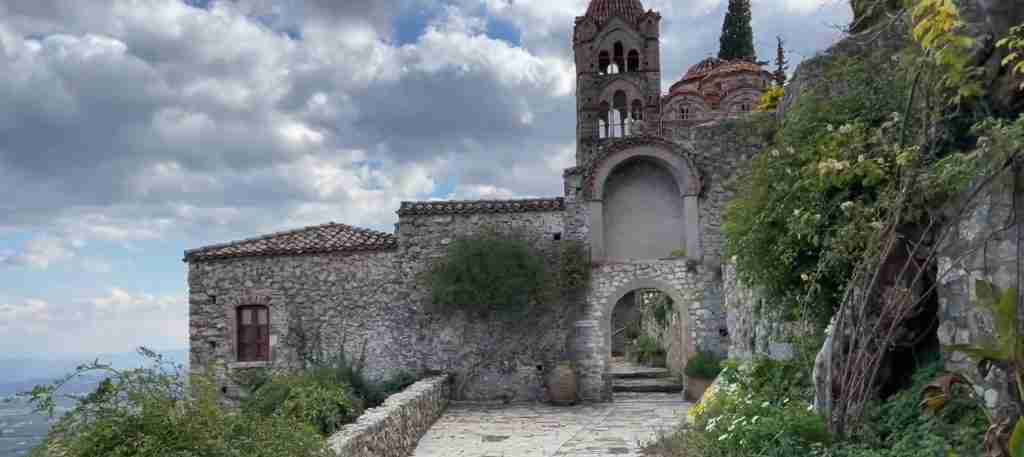
The Monastery of Pantanassa, built in 1428, represents the final flowering of Byzantine architecture before Constantinople’s fall and remains the only church in Mystras still functioning as an active monastery, inhabited by Orthodox nuns who maintain the liturgical traditions. The church demonstrates the fully developed Mystras architectural type with a three-aisled basilica ground floor, cross-in-square upper chapel, and a distinctive belltower that rises above the narthex. The exterior displays elaborate stone and brick decoration including blind arcades, ceramic insets, and intricate brickwork patterns that create a richly textured surface. The interior frescoes, painted shortly after construction, show both traditional Byzantine iconography and emerging stylistic innovations that anticipate post-Byzantine developments.
Residential architecture in Mystras demonstrates the full social hierarchy of late Byzantine urban society. The Laskaris House and Frangopoulos House, both dating to the early 15th century, exemplify aristocratic mansion design with their characteristic three-story structure: vaulted ground floors housing cisterns and stables, intermediate storage levels, and timber-framed upper stories containing large reception rooms (the oikos) opening onto balconies with commanding views. These mansions employed sophisticated construction techniques including ashlar masonry for lower stories, timber framing with brick infill for upper levels, and elaborate fireplaces with carved stone mantels. Smaller houses throughout the city show variations on this model adapted to different economic levels, from substantial merchant residences to modest artisan dwellings, all arranged on narrow terraced lots following the contours of the hillside.
Palaeologan Renaissance and Mystras Intellectual Legacy
Mystras achieved its greatest historical significance as the intellectual and cultural center of the Palaeologan Renaissance, the final flowering of Byzantine civilization during the 14th and 15th centuries when art, literature, philosophy, and scholarship flourished even as the empire contracted territorially and faced existential threats from Ottoman expansion. The Despotate of Morea, governed from Mystras, became a haven for intellectuals fleeing the political turbulence of Constantinople and a laboratory for philosophical and theological innovations that would influence both late Byzantine culture and the Italian Renaissance. The concentration of scholars, philosophers, theologians, artists, and manuscript illuminators in this provincial capital created an intellectual environment rivaling Constantinople itself.
The arrival of Georgios Gemistos Plethon in Mystras around 1410 marked the beginning of the city’s golden age as a philosophical center. Plethon, born circa 1355-1360 in Constantinople, had studied philosophy, astronomy, and mathematics, developing a profound commitment to Neoplatonic philosophy and ancient Greek learning. Invited by Despot Theodore II Palaiologos to establish a school in Mystras, Plethon taught there for over forty years until his death in 1452. His philosophical system combined Platonic metaphysics with elements from Stoicism, Zoroastrianism, and ancient Greek religion, creating a syncretic philosophy that emphasized the Hellenic foundations of Byzantine culture and challenged the dominance of Aristotelian thought in Byzantine intellectual life.
Plethon’s teachings at Mystras attracted students from across the Byzantine world and even from Italy, creating a philosophical circle that debated fundamental questions about the relationship between ancient Greek philosophy and Christian theology, the nature of political organization, and the possibility of Byzantine cultural renewal. His most controversial work, the “Laws” (Nomoi), proposed a complete reorganization of Byzantine society along Platonic lines with a philosopher-king ruling according to ancient Greek principles. While this radical proposal found limited support in conservative Byzantine circles, Plethon’s emphasis on Greek cultural heritage and philosophical rationalism profoundly influenced Byzantine intellectuals who recognized that their civilization faced potential extinction.
The Council of Florence in 1438-1439, convened to discuss potential union between the Orthodox and Catholic churches, provided the occasion for Plethon to transmit Byzantine philosophical learning directly to Italian humanists. Plethon, then in his eighties, accompanied Emperor John VIII Palaiologos to Florence as part of the Byzantine delegation. During the council proceedings, Plethon lectured on Platonic philosophy to audiences of Italian scholars and clerics who were astonished by his profound knowledge of ancient texts and philosophical sophistication. Cosimo de’ Medici attended Plethon’s lectures and, inspired by the Byzantine philosopher’s teachings, later founded the Platonic Academy in Florence. This direct transmission from Mystras to Florence represents one of the crucial moments in the cultural exchange between Byzantine East and Renaissance Italy.
Bessarion of Nicaea, Plethon’s most distinguished student, embodied the intellectual bridge between Mystras and Renaissance Italy. Born in Trebizond circa 1403, Bessarion studied in Constantinople before joining Plethon’s circle in Mystras, where he absorbed Neoplatonic philosophy while maintaining Orthodox theological commitments. Appointed metropolitan of Nicaea in 1437, Bessarion accompanied the Byzantine delegation to the Council of Florence where he became a leading advocate for church union between Orthodoxy and Catholicism. After the council, Bessarion converted to Catholicism and was created a cardinal, establishing himself in Rome where he assembled one of the Renaissance’s finest libraries of Greek manuscripts. His role in transmitting Greek learning to Italy, promoting scholarly exchange between East and West, and supporting refugee Byzantine scholars after Constantinople’s fall made him the crucial figure connecting the intellectual world of Mystras to Renaissance humanism.
The scholarly production of Mystras extended beyond philosophy to theology, historiography, and manuscript illumination. The scriptorium associated with the Pantanassa monastery produced illuminated manuscripts that rank among late Byzantine art’s finest achievements, combining traditional iconographic programs with innovative artistic techniques. Theologians associated with Mystras participated actively in the debates over church union, producing treatises defending Orthodox positions or advocating accommodation with Rome. The library resources available in Mystras attracted scholars researching ancient texts, patristic theology, and classical literature, creating a research center that preserved and transmitted Greek learning during a period when Constantinople faced increasing political instability.
The philosophical debates centered in Mystras during the 15th century extended beyond Plethon’s Neoplatonism to include vigorous arguments over the relative merits of Platonic versus Aristotelian philosophy. Gennadios Scholarios, a conservative theologian who later became the first Orthodox Patriarch under Ottoman rule after Constantinople’s fall, attacked Plethon’s philosophical syncretism and defended Aristotelian thought as more compatible with Orthodox theology. These debates, conducted through written treatises circulated among Byzantine intellectuals, addressed fundamental questions about the relationship between reason and revelation, the nature of philosophical truth, and the compatibility of ancient Greek thought with Christian doctrine. The intellectual sophistication of these discussions demonstrates the continuing vitality of Byzantine philosophical culture even as the empire approached extinction.
The artistic legacy of Mystras, particularly in fresco painting and architectural decoration, represents the visual dimension of the Palaeologan Renaissance. The churches of Mystras employed the finest Byzantine painters of the 14th and 15th centuries, artists who developed sophisticated techniques for representing three-dimensional space, modeling figures with light and shadow, and conveying complex theological concepts through visual narrative. The frescoes in Peribleptos, Pantanassa, and other Mystras churches demonstrate the Late Byzantine style at its height, combining traditional iconography with naturalistic observation, emotional expressiveness, and sophisticated compositional strategies. This artistic achievement influenced painting throughout the Orthodox world, from the Balkans to Russia, and contributed to the development of post-Byzantine painting traditions including the Cretan School.
The intellectual and cultural legacy of Mystras extended well beyond the city’s political extinction in 1460. Byzantine scholars who had trained in Mystras or absorbed its intellectual traditions carried Greek learning to Renaissance Italy, contributing to the humanist movement’s rediscovery of classical antiquity. The manuscripts copied in Mystras scriptoria preserved ancient texts that might otherwise have been lost. The philosophical debates initiated by Plethon influenced European thought about Platonism, political philosophy, and the relationship between ancient and Christian cultures. The artistic innovations developed in Mystras churches shaped Orthodox iconographic traditions for centuries. The city that served as Byzantine civilization’s final cultural capital thus ensured that Byzantine intellectual and artistic achievements survived the empire’s political destruction.
Mystras Urban Planning and Physical Layout
The physical organization of Mystras reflects both the imperatives of medieval defensive architecture and the constraints imposed by the steep hillside topography that made the site defensible but challenged conventional urban planning. The city developed over two centuries from William of Villehardouin’s 1249 fortress to the fully elaborated late Byzantine capital that existed when Ottoman forces captured the city in 1460, creating a unique urban form adapted to terrain that rises 370 vertical meters from the Lower Town walls to the fortress summit. This vertical development, with upper and lower towns separated by approximately 200 meters of elevation change, produced a distinctive spatial organization unlike the typical Byzantine city built on relatively flat terrain.
The fortress (Kastro) occupying the 620-meter summit functioned as the ultimate defensive refuge and military command center. The castle walls enclosed a roughly triangular area of approximately 6,000 square meters containing the multi-story keep, barracks, cisterns for water storage, magazines for weapons and supplies, and a small chapel. The main gate, protected by a gatehouse with murder holes for dropping projectiles on attackers, accessed a steep approach path that zigzagged up the final 220 meters from the Upper Town gate. This approach, deliberately designed to exhaust attackers and expose them to defensive fire from walls and towers, made the fortress virtually impregnable to medieval siege tactics. The fortress served not only defensive purposes but symbolic ones, visibly asserting Byzantine authority over the Laconian plain visible for dozens of kilometers in all directions.
The Upper Town descended from the fortress gate to the approximate midpoint of the fortified hillside, occupying the zone from roughly 620 meters to 400 meters elevation. This zone contained the Palace of the Despots positioned on a large terrace near the fortress, aristocratic mansions arranged on stepped lots, churches including Hagia Sophia (the palace church) and the Monastery of the Hodegetria, and residential quarters for court officials and wealthy merchants. The palace terrace provided a relatively level building platform of approximately 3,000 square meters where the multi-wing palace complex could develop without the severe terracing required elsewhere in the city. Streets in the Upper Town consisted primarily of stepped footpaths following the steepest grade contours, with occasional switchbacks to manage particularly severe slopes. The impracticality of wheeled vehicles on such terrain meant that all goods moved by human or animal porterage.
The Lower Town extended from approximately 400 meters elevation down to the defensive walls at 250 meters, encompassing the largest area and densest population concentration. This zone contained the Metropolis (cathedral) with its extensive episcopal complex, major monasteries including Peribleptos and Pantanassa, substantial residential quarters arranged on terraced lots, commercial areas near the main gate, workshops for artisans and craftsmen, and the primary entrance to the fortified city. The gentler slopes in portions of the Lower Town allowed for more conventional street patterns including some relatively level paths suitable for pack animals, though steep stepped streets remained the dominant circulation pattern. The defensive walls enclosing the Lower Town extended for approximately 2.5 kilometers, punctuated by towers and gates that controlled access to the city.
The street network of Mystras demonstrates Byzantine urban planning adapted to extreme topography, creating a hierarchical system of primary circulation routes connecting major zones with secondary and tertiary paths serving individual neighborhoods and building lots. The main route from the Lower Town entrance to the fortress followed a switchback pattern ascending the hillside, with major churches and the palace positioned along or near this primary path. Secondary streets branched from the main route to serve residential districts, typically following contour lines to minimize grade changes before turning uphill with steep steps to reach higher elevations. The narrowest paths, sometimes reduced to 1-2 meters width, provided access to individual houses and small churches positioned on remote sections of the hillside.
Water supply and management represented critical infrastructure challenges in a hillside city where springs and cisterns had to serve populations living across 370 meters of elevation. The city relied on multiple water sources including springs on Mount Taygetos channeled through ceramic pipes to cisterns, rainwater collected from roofs and directed to underground storage chambers, and wells dug into permeable rock layers. The Palace of the Despots included substantial cisterns beneath the courtyard to ensure water availability during sieges. Churches and monasteries maintained their own cisterns, while residential buildings incorporated vaulted ground-floor chambers that served dual purposes as stables and water storage. The steep terrain provided natural drainage for sewage and stormwater, though the concentration of population created sanitation challenges in densely built neighborhoods.
The defensive system protecting Mystras evolved over two centuries as the city expanded and Byzantine military architecture developed. The original Frankish castle at the summit provided the initial defensive core, but as settlement grew on the hillside below, successive building campaigns extended walls to enclose both upper and lower towns. The final defensive circuit, completed during the 15th century, created a double-walled system with outer walls extending along the hillside base and inner walls protecting the approaches to the fortress. Towers positioned at strategic intervals provided enfilading fire along vulnerable wall sections, while gates featured sophisticated defensive architecture including barbicans, murder holes, and narrow passages forcing attackers into constricted killing zones. The steep terrain enhanced defensive effectiveness, making assault extremely difficult even if attackers breached the outer walls.
Building lots in Mystras adapted to the hillside topography through sophisticated terracing techniques that created level platforms for construction while minimizing earthwork and retaining wall requirements. Typical residential lots measured 10-20 meters wide by 15-30 meters deep, oriented with their long axis perpendicular to slope contours to maximize usable space. Buildings occupied the upper portion of terraced lots, with lower areas serving as courtyards, gardens, or access paths. Retaining walls constructed from local limestone supported terrace platforms, with heights ranging from 2-3 meters for modest houses to 6-8 meters for major structures like churches and palaces. This terracing created the distinctive stepped appearance characteristic of Mystras, with buildings rising in tiers up the hillside like the seats of an ancient amphitheater.
Conservation Status and Site Management at Mystras
The Archaeological Site of Mystras operates under the management of the Hellenic Ministry of Culture through the 5th Ephorate of Byzantine Antiquities based in Sparta, which holds responsibility for conservation, restoration, archaeological research, visitor management, and protection of the property’s outstanding universal value. The site enjoys comprehensive legal protection under Archaeological Law 3028/2002 “On the Protection of Antiquities and Cultural Heritage in General,” which establishes strict controls on any activities that might affect archaeological sites, monuments, or their surrounding environment. Additional protection derives from ministerial decrees published in the Official Government Gazette that specifically designate Mystras and establish buffer zones, construction restrictions, and land-use regulations.
The authenticity of Mystras as a World Heritage property benefits from the complete abandonment of the medieval city in the 19th century, which preserved the urban fabric without modern development that might compromise historical integrity. When the population relocated to modern Sparta beginning in 1832, they left buildings, streets, defensive walls, and public spaces virtually intact, creating an archaeological site of unusual completeness where the spatial organization and architectural character of a late Byzantine city remains readable. The process of abandonment occurred gradually over a century—the bulk of population departed in the 1830s-1840s, but some families remained until the 1953 expropriation when the Greek state confiscated remaining properties to complete the transformation from living settlement to protected archaeological monument.
Conservation and restoration work at Mystras follows rigorous standards established by international charters including the Venice Charter and ICOMOS principles for archaeological sites. Interventions aim to stabilize structures, prevent further deterioration, and make monuments safe for visitors while preserving maximum original fabric and avoiding reconstruction that might compromise authenticity. Restoration projects employ traditional construction techniques and materials matching those used in original construction—local limestone masonry, Byzantine brick bonding patterns, lime mortars, timber framing, and ceramic roof tiles produced according to historical specifications. The approach emphasizes minimal intervention, distinguishing new work from original through subtle differences in detailing or materials while maintaining visual harmony.
Major restoration projects completed since UNESCO inscription include stabilization of the Palace of the Despots, where structural problems threatened collapse of portions of the complex. Engineers installed discrete steel reinforcement to secure walls and vaults while preserving the palace’s architectural character and original masonry. The throne room, which had suffered significant damage from earthquakes and weathering, underwent comprehensive restoration including repair of the Gothic windows, consolidation of wall surfaces, and reconstruction of missing sections of the upper story using archaeological evidence and historical documentation. The result allows visitors to understand the palace’s original scale and magnificence while clearly distinguishing restored sections from authentic medieval fabric.
Church conservation focuses on protecting the irreplaceable fresco cycles that constitute Mystras’s most significant artistic heritage. The Hellenic Ministry of Culture employs specialized conservators trained in Byzantine fresco preservation techniques to stabilize deteriorating wall paintings, remove harmful salts from plaster surfaces, clean paintings obscured by candle smoke and atmospheric pollution, and protect frescoes from environmental damage. The Peribleptos monastery church underwent extensive fresco conservation that revealed brilliant colors and fine details previously hidden beneath centuries of grime. Conservation work proceeds methodically, treating small sections at a time using techniques that preserve original pigments and plaster while ensuring long-term stability. Climate monitoring systems installed in major churches track humidity, temperature, and light levels to identify conditions that might accelerate deterioration.
Archaeological research continues to expand knowledge of Mystras’s history, architecture, and daily life through excavations in undeveloped areas of the site, architectural surveys of monuments, and analysis of artifacts recovered from earlier excavations. Ongoing work includes excavation of residential quarters in the Lower Town, revealing houses, workshops, and commercial structures that illuminate the economic and social organization of the Byzantine city. Architectural historians continue studying the construction techniques, design evolution, and decorative programs of Mystras churches, contributing to broader understanding of late Byzantine architecture. Ceramic analysis, numismatic studies, and examination of other artifacts provide evidence for trade connections, craft production, and material culture during the Despotate period.
Visitor management at Mystras balances public access with conservation requirements, allowing approximately 120,000 annual visitors to experience the site while protecting vulnerable monuments and archaeological remains. The site offers two entrance gates—the main entrance in the Lower Town and an upper entrance near the fortress—allowing visitors to plan circuits according to interests and physical capabilities. Marked paths guide visitors through the site while directing foot traffic away from fragile areas. Major churches remain open for viewing with protective barriers preventing visitors from touching frescoes, while some monuments close periodically for conservation work or when structural concerns require temporary restrictions. Interpretive signage in Greek and English provides historical context and architectural information at major monuments.
The ongoing challenge for site management involves preventing deterioration caused by natural processes—earthquakes, weathering, vegetation growth—while accommodating visitor access and maintaining the site’s appearance as an abandoned medieval city rather than an overly restored archaeological park. Vegetation management represents a particular challenge, as the pine trees and cypresses covering the hillside create the romantic atmosphere that enhances visitor experience but also damage structures through root systems and increase fire risk. Selective vegetation removal protects monuments while maintaining the landscape character that contributes to Mystras’s outstanding universal value. Earthquake preparedness requires continuous monitoring of structural conditions and implementation of discrete seismic retrofitting where necessary to prevent collapse during seismic events common in the Peloponnese.
Experiencing Mystras as a Visitor
Visiting Mystras offers the rare opportunity to explore an entire Byzantine city where medieval streets, palaces, churches, and houses remain preserved in their original spatial relationships, creating an immersive experience of late Byzantine urban life impossible to achieve at sites where modern development has obscured or destroyed the historical urban fabric. The archaeological site covers approximately 4.5 square kilometers of steep hillside terrain requiring 3-6 hours to explore depending on visitor interests, physical condition, and whether you visit all monuments or focus on major highlights. The vertical topography means visitors climb approximately 370 meters elevation from the Lower Town entrance to the fortress summit, equivalent to ascending an 80-story building via steep paths and stone staircases.
Most visitors enter through the main entrance in the Lower Town, which provides access to the Metropolis cathedral complex, major monasteries including Peribleptos and Pantanassa, and residential quarters before ascending to the Upper Town containing the Palace of the Despots and Hagia Sophia church. This routing follows the historical pattern of approaching Mystras from the plain, passing through the defensive gate into the lower city before climbing toward the fortress. An alternative entrance in the Upper Town near the palace allows visitors with limited mobility to access the upper monuments and fortress without climbing from the lower levels, though this approach sacrifices the experience of ascending through the complete urban hierarchy from lower town through upper town to castle summit.
The Metropolis (Cathedral of Saint Demetrios) provides an ideal introduction to Mystras architecture and fresco painting. The large three-aisled basilica with its elaborate fresco cycles covering walls and vaults demonstrates the scale and artistic ambition of late Byzantine ecclesiastical architecture. Visitors can study the magnificent Last Judgment scene dominating the west wall, narrative cycles depicting Christ’s life and miracles, portraits of saints and church fathers, and the double-headed eagle symbol of the Palaiologos imperial dynasty. The courtyard surrounding the Metropolis preserves foundations of episcopal buildings, creating a complete monastery complex that illustrates the integration of religious, administrative, and residential functions in Byzantine ecclesiastical institutions.
The Monastery of Peribleptos, reached via a steep path from the Lower Town, offers the finest fresco viewing experience at Mystras. The church occupies a dramatic cliffside location with views across the Evrotas valley, and the interior preserves an exceptionally complete and well-preserved fresco program covering every surface with religious imagery. The Nativity, Transfiguration, and Resurrection scenes demonstrate Byzantine painting at its artistic peak, with sophisticated compositions, refined technique, subtle color harmonies, and theological depth. Visitors should allow sufficient time to study the frescoes carefully, as the richness of detail and iconographic complexity rewards extended viewing. The monastery continues operating with a small community of nuns who maintain the church and grounds according to Orthodox monastic traditions.
The Pantanassa monastery church, the last major church built in Mystras before the Byzantine Empire’s fall, combines architectural elegance with the distinction of being the only church still functioning for regular worship. Orthodox nuns inhabit the monastery, maintaining the liturgical services and monastic routines that have continued at this location for nearly six centuries. Visitors can enter the church and view the frescoes, but should respect the active religious function by maintaining appropriate decorum—modest dress, quiet behavior, and refraining from photography during services. The exterior of Pantanassa displays particularly elaborate stone and brick decoration with blind arcades, ceramic insets, and geometric patterns creating a richly textured facade.
The ascent to the Upper Town and Palace of the Despots requires climbing steep stepped paths that switchback up the hillside, but the effort rewards visitors with both architectural magnificence and spectacular views. The palace complex demonstrates Byzantine secular architecture at its most developed, with the massive throne room preserving eight tall Gothic windows that flood the interior with light and frame views across the Laconian plain. Visitors can explore multiple wings of the palace, each representing different construction phases and functional purposes—ceremonial halls, residential quarters, administrative offices, storage areas. The terrace in front of the palace provides panoramic views encompassing the ruined city descending the hillside below, modern Sparta on the plain, and the Parnon mountains forming the eastern horizon.
The Church of Hagia Sophia, positioned near the palace in the Upper Town, functioned as the court church for the Despots and demonstrates architectural sophistication matching its elevated status. The pure cross-in-square plan without basilica lower level reflects direct influence from Constantinopolitan architectural models, emphasizing Hagia Sophia’s role as an elite institution. The church originally connected to the palace through galleries allowing the Despot to attend services without using public streets. The interior frescoes include a powerful Christ Pantocrator in the dome and vivid narrative scenes, while the exterior preserves elaborate brickwork decoration characteristic of late Byzantine church architecture.
The climb to the fortress summit represents the final and most strenuous portion of a complete Mystras visit, ascending approximately 220 vertical meters from the Upper Town entrance via a steep rocky path. The fortress preserves substantial portions of the original 1249 Frankish construction including curtain walls, the multi-story keep, and cisterns. From the castle walls, visitors gain comprehensive views of the entire archaeological site spread across the hillside below, understanding how the defensive system integrated the fortress, upper town, and lower town into a unified fortified complex. The views extend beyond Mystras itself to encompass the Laconian plain, modern Sparta, and the surrounding mountains, illustrating the strategic considerations that led William of Villehardouin to select this location for his fortress.
Walking the streets and paths of Mystras between major monuments allows visitors to experience the Byzantine urban environment—narrow stepped streets barely wide enough for pack animals, houses built on narrow terraced lots with vaulted cisterns beneath residential quarters, defensive walls punctuated by towers and gates, small churches serving neighborhood congregations. The residential architecture, particularly aristocratic mansions like the Laskaris House and Frangopoulos House, demonstrates sophisticated construction techniques and spatial organization adapted to steep hillside terrain. The complete abandonment of the city means visitors can explore this urban fabric without modern intrusions, creating an unusually authentic experience of a medieval Byzantine city.
Mystras Relationship to Ancient Sparta and the Laconian Plain
The relationship between Mystras and ancient Sparta, separated by only 8 kilometers and 2,400 years of history, creates one of the most compelling juxtapositions in Greek archaeology—the ruins of classical civilization’s most militaristic society overlooked by the medieval Byzantine city that rose to prominence precisely because ancient Sparta had declined into insignificance. When William of Villehardouin selected the site for his 1249 fortress, ancient Sparta existed only as scattered ruins and a small settlement called Lacedaemonia inhabited by Greek farmers living among the remnants of the classical city. The Frankish prince needed a defensible position to control the Laconian plain and chose the conical spur of Mount Taygetos, creating a fortified hill town that would eventually absorb Lacedaemonia’s population and eclipse ancient Sparta’s memory for six centuries.
Ancient Sparta reached its zenith during the classical and Hellenistic periods (8th through 2nd centuries BCE) as the dominant military power in the Peloponnese and one of the Greek world’s most distinctive societies, known for its unique social system, warrior culture, austere lifestyle, and military prowess demonstrated at battles including Thermopylae, Plataea, and Leuctra. However, unlike Athens or Corinth, Sparta never developed monumental architecture or urban infrastructure comparable to other major Greek cities. The Spartans deliberately avoided building defensive walls (trusting their army for protection) and constructed few public buildings, creating a dispersed settlement of villages rather than a concentrated urban center. This architectural modesty meant that when Sparta declined following defeats by Thebes and later Roman conquest, the physical city left minimal archaeological remains.
By the medieval period, ancient Sparta had deteriorated to the point that travelers and geographers struggled to locate its exact site. The Byzantine settlement of Lacedaemonia occupied a portion of the ancient city’s territory but remained a minor provincial town with no special significance until the 13th century. When Byzantine forces captured Mystras fortress in 1262, Lacedaemonia’s Greek population recognized opportunity—they could relocate to Byzantine-controlled Mystras where they enjoyed equal civic rights and Orthodox religious freedom, escaping second-class status under Frankish rule. The migration from Lacedaemonia to Mystras accelerated through the late 13th century, and by 1300, Lacedaemonia stood virtually abandoned while Mystras thrived as a growing Byzantine city.
This population transfer from plain to hillside reversed the typical pattern of ancient versus medieval settlement. Usually, medieval cities developed on the sites of ancient predecessors, either occupying the same location (Athens, Thessaloniki) or establishing new centers adjacent to ancient ruins (Byzantine Corinth near ancient Corinth). Mystras represents the unusual case of a medieval city developing on virgin terrain while the ancient city site stood empty, creating a geographical separation between classical and Byzantine urban centers. The relationship demonstrates how defensive requirements in the medieval period—the need for naturally defensible positions and fortified hilltop locations—could override the economic and communication advantages that had led ancient cities to occupy easily accessible positions on plains or coasts.
Western travelers visiting the Peloponnese during the Ottoman period often confused Mystras with ancient Sparta, assuming that the impressive hillside city they encountered must be the legendary ancient power they had read about in classical texts. This confusion persisted into the early 19th century when philhellenes and classical scholars arrived expecting to find Sparta’s ruins and instead encountered a thriving Ottoman-era town at Mystras with its Byzantine churches and medieval architecture. The realization that Mystras was not ancient Sparta but rather a medieval successor contributed to the decision to refound Sparta on the ancient site after Greek independence, spatially separating the classical and Byzantine legacies that had become conflated in the modern town.
The decision by King Otto of Greece in 1832 to rebuild modern Sparta (Sparti) on the ancient site 8 kilometers from Mystras rather than continue occupying the medieval city represented both practical considerations and ideological commitments. Practically, Mystras had suffered severe damage during the Greek War of Independence and occupied difficult hillside terrain unsuited to modern urban development with wheeled vehicles and industrial infrastructure. Ideologically, Greek nation-builders in the 1830s prioritized classical heritage over Byzantine traditions, seeking to establish continuity with ancient Greek civilization rather than the medieval Byzantine Empire that many Europeans viewed as culturally inferior and politically oppressive. Refounding Sparta on the ancient site symbolically reconnected modern Greece to its classical heritage while relegating the Byzantine past to the status of archaeological curiosity.
Modern Sparta developed as a planned 19th-century city with a grid street pattern, neoclassical public buildings, and modern amenities, creating a stark contrast with medieval Mystras visible on the hillside to the west. The modern city functions as the administrative capital of Laconia prefecture and a commercial center for the agricultural Eurotas valley, while Mystras operates exclusively as an archaeological site and tourist destination. The two cities maintain complementary rather than competitive relationships—Sparta provides hotels, restaurants, transportation connections, and urban services for visitors exploring the archaeological sites of the region, while Mystras offers the historical and architectural attractions that draw tourists to Laconia. The Museum of the Olive and Greek Olive Oil in Sparta and the archaeological museum complement Mystras’s in-situ monuments by displaying artifacts and providing contextual information about ancient and Byzantine Laconian civilization.
The view from Mystras across the Laconian plain to modern Sparta and the Parnon mountains beyond creates one of the most historically layered landscapes in Greece. Visitors standing on the Palace of the Despots terrace or the fortress walls can trace three distinct historical geographies: the ruins of ancient Sparta scattered across the plain below (mostly invisible without archaeological knowledge), the gridded streets of modern Sparta established in 1834, and the Byzantine hillside city of Mystras itself. This palimpsest landscape illustrates how successive civilizations selected different locations within the same region according to varying strategic, economic, and cultural priorities—ancient Sparta choosing the plain for agricultural access and military maneuvering, Byzantine Mystras occupying a defensible hilltop during an era of constant warfare, and modern Sparta returning to the plain when defensive considerations became less critical than transportation connections and economic development.
Frequently Asked Questions About Mystras Byzantine Ghost City
How long does it take to visit Mystras completely?
A thorough visit to the entire Archaeological Site of Mystras requires 4-6 hours depending on your pace, interest in Byzantine architecture, and physical fitness for climbing the steep hillside paths. Visitors who want to see all major monuments—the Metropolis, Peribleptos monastery, Pantanassa monastery, Palace of the Despots, Hagia Sophia church, and the fortress—while also exploring residential quarters and walking the medieval streets should allocate a full day. Those with limited time can visit the most important monuments (Metropolis, Peribleptos, Palace) in 2-3 hours, though this abbreviated visit necessarily omits many significant sites. The vertical topography means substantial climbing—approximately 370 meters elevation gain from the Lower Town entrance to the fortress summit—which requires reasonable physical condition and appropriate footwear for steep stone staircases and uneven paths.
Can you stay overnight in Mystras or must you base in Sparta?
Mystras itself offers no accommodation options as the medieval city is entirely abandoned and operates solely as an archaeological site with no hotels, guesthouses, or residential facilities. The small modern village of Mystras located at the base of the archaeological site contains a few small hotels and tavernas, providing the closest accommodation to the monuments. However, most visitors base themselves in modern Sparta (Sparti) 8 kilometers to the east, which offers a full range of hotels from budget to upscale, numerous restaurants serving traditional Greek and regional Laconian cuisine, shops, banks, and all urban amenities. Sparta’s larger accommodation inventory and restaurant scene make it the practical choice for overnight stays, with the short 15-minute drive or bus ride to Mystras allowing early morning or late afternoon visits when lighting conditions enhance photography and crowds thin.
What is the best time of day to visit Mystras for photography?
The ideal photography times at Mystras are early morning (8:00-10:00 AM when the site opens) and late afternoon (4:00-6:00 PM in summer, 3:00-5:00 PM in winter) when angled sunlight creates dramatic shadows on the Byzantine architecture, enhances the texture of stone and brick facades, and illuminates church interiors through windows. Morning light approaches from the east, beautifully lighting the Palace of the Despots and churches in the Upper Town while casting the fortress into relief against the sky. Afternoon light from the west creates golden tones on the entire hillside and produces spectacular views across the Laconian plain toward the Parnon mountains. Midday light (11:00 AM-3:00 PM), particularly in summer, creates harsh shadows and washed-out colors that flatten architectural details. Early morning visits offer the additional advantage of cooler temperatures in summer, fewer crowds, and the atmospheric quality of exploring a ghost city in relative solitude before tour groups arrive.
Are the church frescoes at Mystras well-preserved and visible?
The Byzantine frescoes in Mystras churches rank among the finest and best-preserved examples of late Byzantine painting surviving anywhere, with several churches maintaining fresco cycles of exceptional quality, vivid colors, and iconographic completeness. The Peribleptos monastery church preserves perhaps the most magnificent ensemble with scenes from Christ’s life and major feast days rendered in sophisticated compositions with remarkable preservation of original pigments. The Metropolis cathedral contains extensive frescoes from multiple periods (late 13th through early 15th centuries) including the spectacular Last Judgment covering the west wall. The Pantanassa monastery displays well-preserved frescoes from the early 15th century showing the latest developments in Byzantine painting before Constantinople’s fall. Conservation work completed by the Hellenic Ministry of Culture has cleaned many frescoes, removing centuries of candle smoke and grime to reveal brilliant blues, reds, golds, and flesh tones. Visitors should bring binoculars to study upper-level frescoes in church domes and vaults where details can be difficult to see from ground level.
Is Mystras accessible for visitors with limited mobility?
Mystras presents significant accessibility challenges for visitors with mobility limitations due to the steep hillside terrain, stone staircases, uneven paths, and 370-meter elevation change from Lower Town to fortress summit. The site offers no wheelchair-accessible routes, and many monuments require climbing steps to enter. However, visitors with limited mobility can still experience important aspects of Mystras by using the upper entrance near the Palace of the Despots, which provides vehicle access to the upper site area and allows visiting the palace, Hagia Sophia church, and enjoying views across the archaeological site without climbing from the lower levels. This approach requires driving to the upper entrance (or arranging a taxi) and limits the visit to upper monuments, but permits experiencing Byzantine palatial architecture and panoramic views. The Metropolis in the Lower Town can be reached with minimal climbing from the main entrance, offering another option for those who cannot manage the full hillside ascent. Visitors should realistically assess their physical capabilities before visiting, as the terrain genuinely challenges even moderately fit individuals.
What should visitors wear and bring when visiting Mystras?
Visitors to Mystras should wear sturdy walking shoes with good ankle support and traction for navigating steep stone staircases, uneven cobblestone paths, and occasionally loose rocks—athletic shoes, hiking boots, or walking shoes work well, while sandals, dress shoes, or high heels prove inadequate and potentially dangerous. Modest clothing respecting the religious nature of churches is required: shoulders covered, no shorts above the knee, no sleeveless tops—lightweight long pants or below-knee skirts and shirts with sleeves appropriate for both cultural respect and sun protection. Bring a hat, sunglasses, and high-SPF sunscreen as the hillside offers limited shade and summer sun proves intense. Carry at least 1-2 liters of water per person as the climbing generates substantial perspiration and the site provides no water fountains or refreshment facilities. A small daypack allows carrying water, camera equipment, guidebook, and purchased items while keeping hands free for climbing. Binoculars enhance viewing of upper-level frescoes and architectural details. The site offers minimal shade, so sun protection is essential year-round.
How does Mystras compare to other Byzantine sites in Greece?
Mystras stands unique among Byzantine archaeological sites in Greece and throughout the former Byzantine Empire for preserving a complete medieval city—urban street network, defensive architecture, ecclesiastical buildings, palatial complex, and residential quarters—in its original spatial relationships and geographical setting. While other important Byzantine sites like Meteora, Mount Athos, or Thessaloniki preserve magnificent individual monuments or monastery complexes, none offers the complete urban experience possible at Mystras where visitors walk Byzantine streets, understand defensive systems, see the spatial hierarchy from fortress to palace to cathedral, and experience how aristocrats, clergy, and common citizens lived in proximity within a fortified hillside city. The closest comparisons might be Monemvasia, another Byzantine fortress town in the Peloponnese, or certain Italian sites like Matera, but Mystras surpasses these in the completeness of preservation and the sophistication of the monuments. The concentration of high-quality fresco painting in multiple churches makes Mystras the premier site for understanding late Byzantine artistic achievement.
What happened to the Byzantine artifacts and treasures from Mystras?
The Byzantine artifacts, manuscripts, icons, and portable treasures from Mystras dispersed through various historical processes including Ottoman conquest, systematic looting, Western collecting, and museum transfers. When Mystras surrendered to Ottoman forces in 1460, Sultan Mehmed II confiscated significant treasures and religious objects, either keeping them for imperial collections or distributing them as gifts to loyalists. During subsequent centuries of Ottoman and Venetian rule, icons, manuscripts, and precious metal objects gradually left the city through sale, theft, or transfer to other religious institutions. The catastrophic burning of Mystras in 1825 during the Greek War of Independence destroyed or damaged many remaining artifacts. After the population relocated to Sparta in the 1830s, remaining portable objects were transferred to the new town’s churches. Today, artifacts excavated from Mystras reside primarily in the site museum located within the archaeological area, which displays Byzantine ceramics, coins, architectural fragments, and smaller finds. Significant manuscripts and icons from Mystras churches are now held in Greek national museums, monasteries including Mount Athos, and international collections that acquired Byzantine materials during the 19th and 20th centuries.
Can visitors attend religious services at Pantanassa monastery?
The Pantanassa monastery maintains an active Orthodox monastic community of nuns who conduct regular religious services according to the Byzantine liturgical calendar, and visitors are generally welcome to attend these services respectfully. The nuns celebrate Divine Liturgy on Sundays and major feast days, typically beginning around 7:00-8:00 AM and lasting approximately 90 minutes. Visitors attending services should observe proper Orthodox church etiquette: arrive before the service begins, dress modestly with covered shoulders and knees, women should cover their heads with a scarf, remain standing throughout the service (Orthodox churches traditionally do not use pews), avoid photography during worship, maintain silence, and follow the congregation’s lead regarding crossing oneself and venerating icons. The liturgy is conducted entirely in Greek using Byzantine chant traditions, creating an authentic experience of Orthodox monasticism as practiced for centuries. Those interested in attending should inquire at the monastery entrance about service times, which may vary seasonally or for special feast days.
What role does Mystras play in modern Greek cultural identity?
Mystras occupies a significant but complex position in modern Greek cultural consciousness, representing both the final flowering of Byzantine Hellenic civilization and the difficult medieval heritage that 19th-century Greek nation-builders initially sought to downplay in favor of classical antiquity. The site embodies the Palaeologan Renaissance—a period when Byzantine intellectuals like Georgios Gemistos Plethon explicitly emphasized the Hellenic foundations of Byzantine culture and championed the study of ancient Greek philosophy and literature. This Hellenic emphasis within late Byzantine culture makes Mystras more palatable to modern Greek nationalism than other Byzantine sites that stress Orthodox theological traditions or the Roman imperial legacy. The city’s role as the Byzantine Despotate capital during the empire’s final century, maintaining Greek language, Orthodox faith, and intellectual traditions while Constantinople faced increasing Ottoman pressure, creates a narrative of cultural persistence appealing to modern Greek identity. Mystras appears in Greek school curricula as a symbol of Byzantine cultural achievement, features prominently in tourism promotion emphasizing Greece’s medieval heritage alongside classical antiquity, and serves as a pilgrimage site for Orthodox Christians connecting with Byzantine spiritual traditions.