Historic Centre of Salzburg UNESCO Guide: Baroque Masterpiece of the Alps
Key Takeaways
- Historic Centre of Salzburg earned UNESCO World Heritage designation in 1996 for its exceptional baroque urban architecture and outstanding universal value as a cultural landscape
- The city preserves one of Europe’s best-preserved baroque town centers, featuring masterworks by Italian and Austrian architects from the 17th and 18th centuries
- Salzburg’s unique position as a prince-archbishopric for over 1,100 years created an extraordinary fusion of ecclesiastical and secular architectural traditions
- The historic center encompasses 236 hectares including the medieval Altstadt (Old Town), Neustadt (New Town), and strategic hilltop fortifications
- UNESCO recognition protects architectural ensembles representing the artistic genius of the baroque period and the city’s role as a major European cultural center
- Conservation efforts maintain authentic baroque streetscapes while integrating modern urban life, setting international standards for heritage preservation
Understanding Salzburg’s UNESCO World Heritage Significance
The Historic Centre of Salzburg stands as one of the most compelling examples of a European baroque city north of the Alps, earning its place on the UNESCO World Heritage List through a remarkable convergence of architectural excellence, cultural significance, and historical continuity. The city’s inscription in 1996 recognized not merely individual monuments but an entire urban landscape that embodies the aesthetic ideals and political power structures of the baroque period.
Salzburg’s UNESCO designation rests on three fundamental criteria that demonstrate its outstanding universal value. First, the historic center represents a masterpiece of human creative genius through its exceptional baroque architecture and urban planning. The city’s architects—primarily Italian masters working for powerful prince-archbishops—created an integrated architectural vision that transformed medieval Salzburg into a baroque showpiece. Second, the urban ensemble exhibits an important interchange of human values spanning centuries, as architectural styles from Romanesque through late baroque evolved in continuous dialogue. Third, Salzburg offers exceptional testimony to the cultural tradition of a prince-archbishopric, a unique political entity that wielded both spiritual and temporal authority.
The protected UNESCO zone encompasses the entire historic core on both banks of the Salzach River. On the left bank, the Altstadt preserves its medieval street pattern overlaid with baroque facades, ecclesiastical complexes, and aristocratic residences. The right bank Neustadt developed during baroque expansion, featuring geometric planning principles and monumental religious architecture. Above both districts, the Hohensalzburg Fortress crowns the Festungsberg, providing strategic protection and symbolic dominance over the urban landscape below.
What distinguishes Salzburg from other baroque cities is the remarkable completeness and authenticity of its historic fabric. While many European cities suffered wartime destruction or unsympathetic modernization, Salzburg preserved its baroque character through a combination of fortunate circumstances and deliberate conservation policies. The city escaped major damage during World War II, leaving architectural ensembles intact. Subsequent urban planning prioritized heritage preservation over radical development, establishing protection mechanisms that predated UNESCO designation.
The cultural landscape of Salzburg extends beyond built heritage to encompass the natural setting that frames and enhances the architectural ensemble. The surrounding mountains create a dramatic backdrop for baroque spires and domes, while the Salzach River provides the organizing spine for urban development. This integration of natural and cultural elements creates what UNESCO describes as a “harmonious whole” where architecture and landscape achieve perfect balance.
People Also Ask About Historic Centre of Salzburg UNESCO Heritage
Why is Salzburg’s Historic Centre a UNESCO World Heritage Site?
Salzburg’s Historic Centre earned UNESCO World Heritage status in 1996 due to its outstanding universal value as one of Europe’s finest baroque urban ensembles. The designation recognizes three specific achievements: the city represents a masterpiece of baroque architecture and urban planning created by Italian and Austrian masters; it demonstrates exceptional interchange of cultural values through continuous architectural evolution from medieval to late baroque periods; and it provides unique testimony to the prince-archbishopric tradition that shaped Central European culture for over a millennium. The UNESCO committee particularly noted the exceptional preservation of baroque streetscapes, the integration of ecclesiastical and secular architecture, and the harmonious relationship between built heritage and natural landscape setting.
What makes Salzburg’s baroque architecture internationally significant?
Salzburg’s baroque architecture achieves international significance through the exceptional quality of individual monuments and the comprehensive urban vision that unified them into a coherent whole. Italian architects including Vincenzo Scamozzi, Santino Solari, and Giovanni Antonio Daria brought innovative design principles from Rome and northern Italy, adapting them to the Alpine context and local building traditions. The result was a distinctly Salzburg baroque style characterized by elegant proportions, sophisticated spatial sequences, and masterful integration with topography. Major architectural ensembles—the cathedral complex, university buildings, and aristocratic palaces—demonstrate technical virtuosity in vault construction, facade articulation, and interior decoration. This concentration of high-quality baroque architecture within a compact urban area creates an architectural density matched by few other European cities.
How does UNESCO protect Salzburg’s historic heritage?
UNESCO World Heritage designation provides Salzburg with international recognition and establishes conservation obligations under the World Heritage Convention. Austria’s federal monument protection laws and Salzburg’s municipal building codes implement these obligations through comprehensive regulatory frameworks. Any construction, renovation, or alteration within the protected zone requires approval from heritage authorities who evaluate projects against strict authenticity and compatibility criteria. Conservation principles prioritize maintaining historic building substance, preserving traditional crafts and materials, and ensuring new interventions respect the baroque ensemble’s character. UNESCO monitors the site through periodic reporting mechanisms and reactive monitoring when threats emerge. The World Heritage status also attracts international expertise for conservation projects and promotes best practices in heritage management that benefit preservation efforts worldwide.
What role did the prince-archbishops play in creating baroque Salzburg?
The prince-archbishops of Salzburg served as the primary patrons and creative visionaries behind the city’s baroque transformation. These ecclesiastical rulers wielded both spiritual authority as archbishops and secular power as princes of the Holy Roman Empire, commanding resources and political influence that enabled ambitious building programs. Wolf Dietrich von Raitenau initiated baroque urbanism in the late 16th century, demolishing medieval structures to create monumental squares and commissioning Italian architects to design churches and palaces. His successors Marcus Sitticus and Paris Lodron continued this architectural agenda, building the cathedral, expanding university facilities, and constructing defensive works. Later prince-archbishops commissioned baroque masterpieces including the Kollegienkirche and pilgrimage churches. This continuous patronage over two centuries created architectural unity and exceptional quality that defines Salzburg’s character.
Extended multi-day tours – 5+ days
Featured Salzburg Multi-Day Tour Packages
7 days
7 Days by Train in Munich & Zurich: Alpine Dreams & Bavarian Charms
- ✓ Comprehensive Salzburg tour
- ✓ Expert local guides included
- ✓ All accommodation arranged
- ✓ Transportation provided
5 days
5 Days in Salzburg: History, Mountains, and City Highlights
- ✓ Comprehensive Salzburg tour
- ✓ Expert local guides included
- ✓ All accommodation arranged
- ✓ Transportation provided
7 days
Christmas in Central Europe, Vienna to Berlin
- ✓ Comprehensive Salzburg tour
- ✓ Expert local guides included
- ✓ All accommodation arranged
- ✓ Transportation provided
7 days
Christmas in Central Europe, Berlin to Vienna
- ✓ Comprehensive Salzburg tour
- ✓ Expert local guides included
- ✓ All accommodation arranged
- ✓ Transportation provided
Multi-day tour packages powered by TourRadar. Prices and availability subject to change.
Historical Evolution of Salzburg’s Urban Landscape
Salzburg’s urban history begins with Roman settlement at the strategic junction where the Salzach River emerges from Alpine valleys into the Bavarian plain. The Roman municipium Iuvavum occupied the Nonnberg area, establishing patterns of settlement that influenced medieval development. Following Roman withdrawal, the site’s strategic and economic importance attracted Bavarian settlers who recognized the value of salt deposits that gave the city its name—Salzburg meaning “Salt Fortress.”
The transformation from regional settlement to European cultural center began in 696 when Saint Rupert founded a monastery and established Salzburg as a Christian missionary base. Pope Gregory II elevated Salzburg to archbishopric status in 798, granting Archbishop Arno jurisdiction over Bavaria and adjacent territories. This ecclesiastical authority combined with territorial acquisitions to create the prince-archbishopric, a unique political entity that endured until secularization in 1803.
Medieval Salzburg developed on the left bank of the Salzach in the shadow of the Hohensalzburg Fortress. Archbishop Gebhard began fortress construction in 1077 during the Investiture Controversy, establishing military dominance over the valley. Successive archbishops expanded the fortress into the largest fully preserved castle complex in Central Europe. The medieval town below grew organically along curving streets connecting marketplace, cathedral, and monastery. Romanesque architecture dominated, including St. Peter’s Abbey Church and the early cathedral.
The baroque transformation commenced under Prince-Archbishop Wolf Dietrich von Raitenau (1587-1612), who envisioned Salzburg as an Alpine Rome. A devastating fire in 1598 destroyed much of the medieval cathedral quarter, providing opportunity for comprehensive urban renewal. Wolf Dietrich commissioned Italian architect Vincenzo Scamozzi to design a new cathedral and created the spacious Residenzplatz by demolishing 55 burgher houses. He laid out geometric garden complexes and initiated palace construction that established the architectural ambitions that would define baroque Salzburg.
Prince-Archbishop Marcus Sitticus von Hohenems (1612-1619) continued the Italian architectural program, commissioning Santino Solari to complete the cathedral and building suburban pleasure palaces including Hellbrunn. His successor Paris Lodron (1619-1653) established the Benediktineruniversität, strengthened fortifications during the Thirty Years’ War, and expanded the right-bank Neustadt according to baroque planning principles. The Neustadt development created wide, straight streets in deliberate contrast to the organic medieval Altstadt, demonstrating baroque ideals of geometric order and monumental perspective.
The 18th century brought the mature baroque phase under prince-archbishops including Johann Ernst von Thun and Franz Anton von Harrach. Fischer von Erlach designed the Kollegienkirche and Dreifaltigkeitskirche, introducing sophisticated spatial concepts and dynamic facade compositions. The university expanded with new buildings, aristocratic families constructed urban palaces, and public squares received monumental fountains. This building campaign created the integrated architectural ensemble that defines Salzburg’s UNESCO-protected historic center.
The prince-archbishopric’s dissolution in 1803 ended Salzburg’s political independence but preserved its architectural heritage. The city passed to Bavaria, then Austria, avoiding the radical urban renewal that transformed many European cities during industrialization. Salzburg’s economic stagnation in the 19th century paradoxically protected historic fabric from demolition, while recognition of architectural value inspired early conservation efforts. The 20th century brought systematic heritage protection and World Heritage designation, ensuring the baroque ensemble’s preservation for future generations.
Baroque Architectural Masterpieces and Urban Spaces
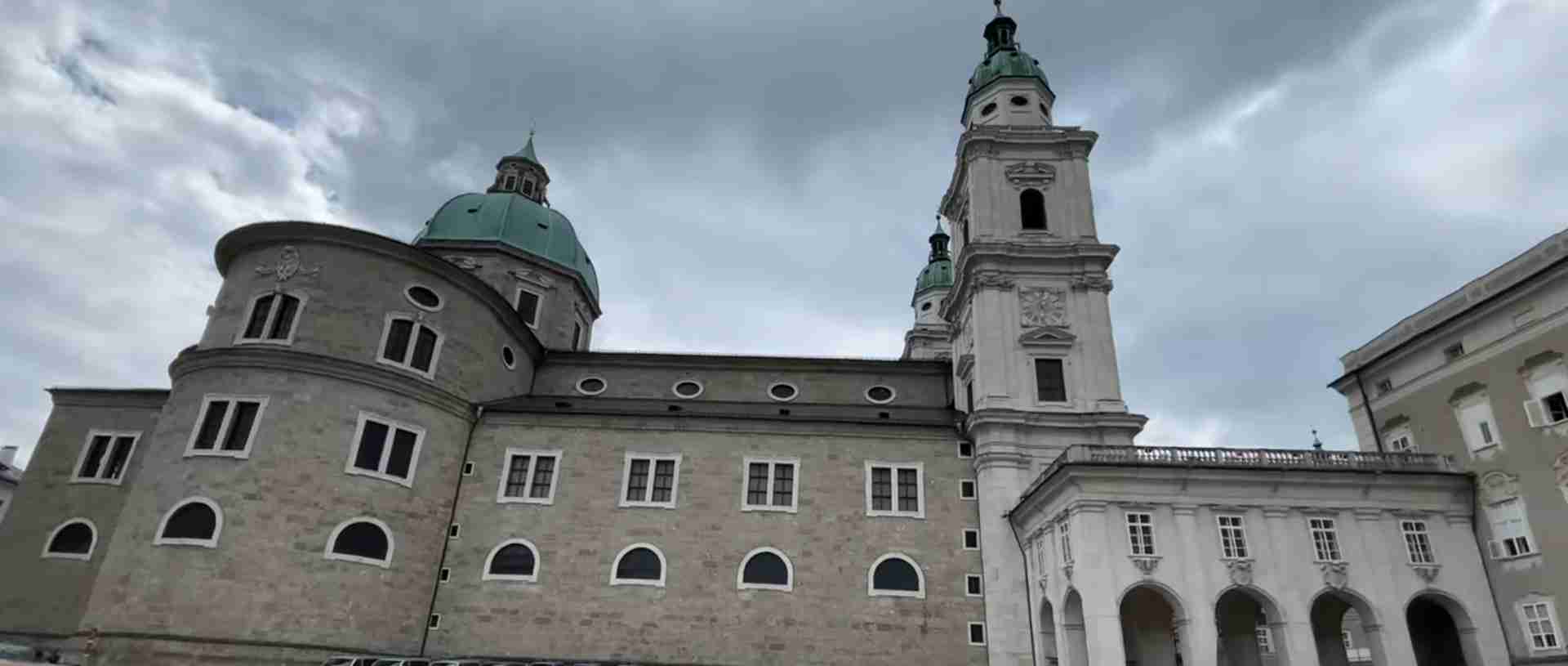
Salzburg Cathedral stands as the architectural and spiritual centerpiece of the historic center, embodying the prince-archbishops’ ambitions and establishing design principles that influenced subsequent baroque development. Santino Solari designed the cathedral for Prince-Archbishop Marcus Sitticus, constructing the massive structure between 1614 and 1628. The cathedral’s Italian early baroque style, featuring a monumental facade with twin towers and central dome, introduced architectural vocabulary that became Salzburg’s signature. The facade employs three distinct levels with engaged columns, statues in niches, and a central pediment topped by statues of Saint Rupert and Saint Virgilius. The towers rise 79 meters, creating landmarks visible throughout the city and establishing vertical dominance over the urban skyline.
The cathedral’s interior demonstrates baroque spatial grandeur through proportions that balance length, width, and height into harmonious relationships. The central nave extends 101 meters with a width of 45 meters, creating vast volumes illuminated through high clerestory windows and the dome’s oculus. White stucco work contrasts with gray marble to articulate architectural elements, while side chapels contain baroque altarpieces and sculpture. The main dome, reconstructed after World War II damage, rises above the crossing with frescoes depicting scenes from the life of Saint Rupert. Bronze baptismal font from 1321 connects baroque splendor to medieval heritage, while the crypt beneath preserves remains of the earlier Romanesque cathedral.
The Residenz complex opposite the cathedral demonstrates secular baroque architecture adapted to the prince-archbishops’ dual role as spiritual and temporal rulers. Construction began under Wolf Dietrich and continued through the 17th century, creating an extensive palace surrounding three courtyards. The state rooms showcase baroque interior decoration at its finest, with ceiling frescoes by Johann Michael Rottmayr and Martino Altomonte, elaborate stucco work, and period furnishings. The Carabinieri Hall features monumental frescoes glorifying Prince-Archbishop Johann Ernst von Thun’s virtues, while the Conference Room displays Chinese porcelain collections and silk wall coverings. The palace’s scale and decoration rival Vienna’s imperial residences, asserting the prince-archbishops’ status as sovereign princes of the Holy Roman Empire.
Fischer von Erlach’s Kollegienkirche (1696-1707) represents mature baroque architecture at its most sophisticated. Commissioned by Prince-Archbishop Johann Ernst von Thun for the Benedictine University, the church introduces dynamic spatial concepts and innovative facade composition. The facade employs concave and convex surfaces to create movement, while towers flanking the central section establish vertical emphasis. The interior’s oval central space connects to side chapels through sophisticated spatial transitions, demonstrating Fischer von Erlach’s mastery of baroque geometry. Natural light floods the white interior through windows positioned to create dramatic illumination effects. The church’s positioning closes the Universitätsplatz perspective, creating an architectural climax to the urban space and demonstrating baroque principles of perspective composition.
The Dreifaltigkeitskirche (Church of the Holy Trinity, 1694-1702) showcases Fischer von Erlach’s ability to create monumental architecture on constrained urban sites. Built for the archiepiscopal court, the church features an oval central plan with facade directly addressing the street. The facade’s convex central section projects toward viewers, creating sculptural three-dimensionality enhanced by engaged columns and dramatic pediment. Inside, the oval space rises to a frescoed dome supported on massive piers, with side niches containing baroque altars. The church demonstrates how baroque architects manipulated geometry and perspective to create imposing presence within tight urban contexts.
Mirabell Palace and Gardens represent baroque secular architecture and landscape design. Archbishop Wolf Dietrich built the original palace (then called Altenau) for his mistress Salome Alt, demonstrating the wealth and power available to Salzburg’s rulers. Fire destroyed the original in 1818; reconstruction preserved the baroque Marble Hall, one of the world’s finest rococo ceremonial spaces. Georg Raphael Donner’s baroque staircase survives, featuring sculptural putti balustrades and elaborate decorative programs. The geometric gardens, redesigned by Fischer von Erlach, demonstrate baroque landscape principles with parterres, fountains, and sculptural programs creating an outdoor extension of palace architecture. The gardens’ axis aligns with Hohensalzburg Fortress, integrating natural topography into formal landscape composition.
The Getreidegasse represents baroque urban streetscape preserved to exceptional degree. This medieval commercial street received baroque overlay when burgher houses gained new facades, courtyards, and wrought-iron shop signs. The narrow street creates canyon-like spatial character, with four and five-story buildings establishing continuous facade planes. Projecting bay windows, decorative portals, and elaborate signs create rich architectural texture. Inner courtyards accessed through passages (Durchhäuser) preserve medieval spatial organization while incorporating baroque architectural details. Mozart’s birthplace at Getreidegasse 9 exemplifies the prosperous burgher houses that defined Salzburg’s commercial architecture.
Monumental urban squares demonstrate baroque urban design principles through geometric planning, perspective compositions, and integration of architecture, sculpture, and landscape. Residenzplatz, created by Wolf Dietrich’s demolitions, functions as the ceremonial heart of baroque Salzburg. The 1658 Residenzbrunnen by Tommaso di Garona dominates the square with Triton figures supporting a basin crowned by muscular male figures. Domplatz (Cathedral Square) creates an enclosed forecourt for the cathedral, with the facade as theatrical backdrop for religious processions and ceremonies. Kapitelplatz features the baroque Kapitelschwemme fountain and modern sculpture, demonstrating how the historic ensemble accommodates contemporary art.
Cultural Significance and Artistic Heritage
Salzburg’s cultural significance extends far beyond architectural heritage to encompass music, education, religion, and the arts. The city’s identity as a cultural capital derives from the prince-archbishops’ patronage, which established institutions and traditions that continue to define Salzburg’s character. This cultural legacy earned UNESCO recognition as integral to the site’s outstanding universal value.
The musical tradition begins with the establishment of the court Hofkapelle, which employed distinguished composers and maintained high musical standards. Heinrich Ignaz Franz Biber served as Kapellmeister in the 17th century, composing virtuosic violin works and elaborate church music. Georg Muffat brought French and Italian musical influences to Salzburg, enriching the musical vocabulary available to court composers. This sophisticated musical culture created the environment into which Wolfgang Amadeus Mozart was born in 1756. Mozart’s compositions for Salzburg’s court and churches, including masses, symphonies, and serenades, established the city’s association with musical genius that endures today.
The Salzburg Festival, founded in 1920, transformed the baroque city into a premier venue for performing arts. Max Reinhardt’s vision of utilizing historic spaces as theatrical settings capitalized on the architectural heritage’s dramatic potential. The Felsenreitschule (rock riding school) carved into the Mönchsberg became a unique performance venue, while the cathedral and residence provided settings for concerts and theatrical productions. The festival established Salzburg as an international cultural destination, attracting artists and audiences who experience baroque architecture as living cultural space rather than museum exhibits.
Educational institutions founded by the prince-archbishops continue to contribute to Salzburg’s cultural vitality. The Benediktineruniversität, established by Paris Lodron in 1622, provided theological and philosophical education until secularization. The modern Paris Lodron University Salzburg maintains this educational tradition, with faculties housed partly in baroque buildings. St. Peter’s Abbey maintains a continuous monastic presence since 696, preserving religious and cultural traditions across thirteen centuries. The abbey’s library contains medieval manuscripts and early printed books, while the church hosts concerts and religious ceremonies in spaces unchanged since the baroque period.
Artistic heritage encompasses painting, sculpture, and decorative arts created for Salzburg’s churches and palaces. Johann Michael Rottmayr and Martino Altomonte painted ceiling frescoes that represent Austrian baroque painting at its finest. Rottmayr’s monumental compositions in the Residenz demonstrate mastery of illusionistic perspective and allegorical programs glorifying princely patrons. Georg Raphael Donner’s sculptural works, including the Mirabell staircase putti and fountain sculptures, exemplify baroque sculpture’s dynamic energy and technical virtuosity. Decorative arts including wrought ironwork, stucco decoration, and liturgical objects demonstrate craftsmen’s skill in creating integrated artistic ensembles.
Religious traditions maintain cultural continuity with the prince-archbishopric era. The cathedral hosts major liturgical celebrations including the consecration of bishops, maintaining ceremonies developed over centuries. Corpus Christi processions through baroque streets recreate traditional religious pageantry, while Christmas and Easter celebrations utilize the architectural settings for which they were designed. Pilgrimage churches on the city’s periphery, including Maria Plain, continue to attract devotees seeking spiritual connection in baroque sacred spaces.
UNESCO Conservation and Preservation Efforts
Salzburg’s conservation efforts establish international standards for preserving baroque urban heritage while accommodating modern urban life. The city’s approach balances strict protection of historic fabric with necessary adaptations, demonstrating that heritage sites can remain vital living cities rather than museum pieces. This conservation philosophy aligns with UNESCO’s emphasis on maintaining authenticity while ensuring continued use and relevance.
Legal protection frameworks provide the foundation for heritage conservation. Austria’s Federal Monuments Office (Bundesdenkmalamt) designates and protects individual monuments under national heritage law, while Salzburg’s historic center receives additional protection as an ensemble. The city’s building code establishes specific regulations for the protected zone, requiring heritage impact assessments for any construction or alteration. These regulations address facade modifications, roof alterations, window replacements, and new construction, ensuring interventions respect the baroque ensemble’s character and scale.
Restoration projects demonstrate sophisticated approaches to preserving historic building substance while ensuring structural stability and modern functionality. The cathedral’s restoration following World War II bomb damage established principles for authentic reconstruction using original materials and techniques. Damaged baroque frescoes receive conservation treatment by specialist restorers trained in traditional methods. Stone facades undergo careful cleaning to remove pollution deposits without damaging historic surfaces. Roof structures receive renewal using traditional materials including copper and ceramic tiles, maintaining the colorful roofscape that characterizes Salzburg’s skyline.
Traditional craft preservation ensures skills necessary for authentic conservation remain available. Stucco workers maintain techniques for creating baroque decorative elements, while stone masons preserve traditional carving and finishing methods. Fresco restorers train in historic painting techniques, understanding pigments and binding media used in original works. This craftwork knowledge transfer occurs through apprenticeship programs and specialized training institutions, ensuring future generations possess skills for heritage conservation.
Urban planning integrates heritage protection with contemporary development needs. Salzburg restricts building heights in the protected zone to preserve baroque skyline profiles and view corridors. New construction requires careful design to respect historic scale, proportions, and materials while allowing contemporary architectural expression. Infrastructure improvements including utilities and transportation minimize visual impact, placing cables underground and designing street furniture to complement historic contexts. Pedestrianization of the Altstadt enhances the historic quarter’s character while reducing vehicle traffic’s damaging effects.
Tourism management addresses challenges arising from Salzburg’s popularity as a destination. The city attracts over 7 million annual visitors, creating pressure on historic fabric and urban infrastructure. Management strategies include visitor flow analysis, capacity limits in sensitive locations, and promotion of alternative routes to distribute tourist traffic. Interpretation programs provide context for architectural heritage, helping visitors appreciate cultural significance beyond superficial tourism. This balanced approach maintains the site’s accessibility while protecting the qualities that justify UNESCO designation.
Community engagement ensures local residents support conservation efforts and participate in heritage stewardship. Public consultation processes involve residents in planning decisions affecting the historic center. Educational programs in schools teach local history and architectural heritage, fostering appreciation among younger generations. Residents living in historic buildings receive advice on sensitive renovations and maintenance, recognizing their role as custodians of heritage properties. This community involvement creates shared responsibility for preserving Salzburg’s UNESCO heritage.
The Baroque Ensemble Within Natural Landscape
Salzburg’s outstanding universal value derives partly from the exceptional integration of baroque architecture with dramatic Alpine landscape. The prince-archbishops and their architects deliberately composed architectural ensembles to harmonize with natural topography, creating what UNESCO describes as a unified cultural landscape. This relationship between built and natural heritage distinguishes Salzburg from other baroque cities and contributes significantly to its aesthetic impact.
The Salzach River functions as the organizing spine for urban development, dividing the historic center into distinct left-bank and right-bank quarters while providing scenic waterway that enhances architectural views. Baroque architects exploited the river’s linear geometry, creating building frontages designed as continuous facades addressing the water. The Makartplatz and Rudolfskai embankments showcase this planning principle, with palace facades creating an urban wall defining the river’s edge. Bridges crossing the Salzach provide viewpoints for experiencing baroque architecture against mountain backdrops, particularly the Staatsbrücke’s panorama encompassing cathedral, fortress, and Gaisberg peak.
The Hohensalzburg Fortress crowning the Festungsberg demonstrates integration of military architecture with topography. The fortress exploits the mountain’s strategic advantages while creating a dramatic silhouette visible throughout the Salzburg basin. The fortress functions as architectural pivot between city and mountains, mediating between horizontal urban fabric and vertical Alpine peaks. Its white walls and red roofs contrast with forest-covered slopes, creating a visual landmark that identifies Salzburg from distant viewpoints and establishes the city’s distinctive profile.
The Mönchsberg and Kapuzinerberg mountains frame the historic center, providing natural boundaries while offering elevated viewpoints for experiencing the urban ensemble. Baroque architects conceived specific buildings as terminating vistas from mountain paths, creating architectural-landscape dialogues across vertical dimensions. The Mönchsberg’s sheer cliff faces rising directly from the Altstadt create dramatic spatial compression, with narrow streets canyon-like at the mountain’s base before opening to expansive squares. Modern walkways along the Mönchsberg preserve historic viewing positions, allowing visitors to experience compositions intended by baroque planners.
Gardens and parks demonstrate baroque landscape design principles adapted to Alpine topography. Mirabell Gardens utilize geometric planning on relatively flat terrain, creating parterres aligned with fortress viewpoints and mountain peaks. Hellbrunn, located in suburban landscape, integrates palace architecture with water features powered by Alpine springs. The gardens’ waterworks including fountains, grottoes, and hydraulic automata demonstrate baroque fascination with controlling nature through technology while celebrating water’s aesthetic and recreational possibilities. These landscape designs extend architectural principles into nature, creating seamless transitions between built and natural heritage.
View corridors protect visual relationships between architectural monuments and landscape features. Planning regulations preserve sight lines from key locations, preventing new construction from blocking views of fortress, cathedral, or mountain peaks. These protected perspectives maintain the baroque ensemble’s legibility, allowing observers to grasp spatial relationships intended by original designers. The cathedral dome visible above rooflines from multiple viewpoints, the fortress appearing at street terminations, and mountain peaks framing urban spaces all result from conscious preservation of baroque visual strategies.
Seasonal transformations enhance the cultural landscape’s aesthetic qualities, creating temporal variety within the permanent architectural framework. Winter snow covers mountain peaks while leaving baroque facades visible, creating color contrasts between white summits and pastel buildings. Spring brings flowering trees in gardens and along riverbanks, softening architectural geometries with organic forms. Summer’s long daylight illuminates baroque facades from multiple angles, revealing architectural details through changing light. Autumn foliage on the Kapuzinerberg and Mönchsberg provides colorful backdrop for stone architecture. These seasonal variations demonstrate the living quality of Salzburg’s cultural landscape, remaining dynamic rather than static.
Photography and Artistic Representation
Photographing Salzburg’s baroque heritage requires understanding architectural principles, spatial relationships, and lighting conditions that reveal the ensemble’s qualities. The city’s compact scale and topographic variety provide exceptional photographic opportunities, from intimate streetscapes to expansive panoramas integrating architecture and landscape. Successful photography captures not merely individual monuments but the spatial and visual relationships that create Salzburg’s character as a UNESCO World Heritage site.
Cathedral photography benefits from multiple vantage points revealing different architectural aspects. The facade shot from Residenzplatz emphasizes monumentality and baroque composition, best photographed mid-morning when sunlight illuminates the facade while shadows articulate architectural relief. Wide-angle lenses capture the complete facade within the square’s spatial frame, while telephoto compression from across Residenzplatz isolates facade details and statuary. Interior photography requires high ISO settings and wide apertures to handle low light, with shots from the main entrance emphasizing spatial depth through nave perspective converging toward the high altar. Dome photography from below captures fresco details, while elevated positions in the organ loft provide comprehensive views of the interior space.
Fortress photography from multiple angles demonstrates the structure’s domination of the urban landscape. Classic fortress shots from the Altstadt use buildings in the foreground to establish scale relationships, showing the fortress rising above the baroque city. The view from Mönchsberg across the valley captures the fortress against mountain backdrops, revealing its strategic position. Sunset photography from the fortress ramparts looking toward the cathedral creates silhouette compositions with dramatic sky colors. Night photography transforms the illuminated fortress into a glowing landmark suspended above the city, requiring long exposures to balance fortress floodlighting with ambient city lights.
Street photography in the Getreidegasse and surrounding lanes captures baroque urban character through architectural details and spatial qualities. Early morning shooting provides empty streets and soft light ideal for architectural documentation. Detail shots of wrought-iron signs, doorways, and window compositions reveal craftwork quality. Vertical compositions emphasizing the street’s narrow proportions and vertical facade development create dramatic spatial compression. Including pedestrians provides scale references while capturing the quarter’s continued vitality as living urban space rather than museum district.
Garden photography at Mirabell demonstrates formal landscape design through geometric compositions and perspective alignments. Shooting along the central axis toward the fortress creates baroque spatial composition with palace architecture, garden parterres, and mountain fortress aligned. Fountain photography benefits from backlighting that transforms water into luminous sculptural elements. Seasonal photography captures floral displays changing garden color palettes while maintaining geometric structure. Wide shots establish complete garden layouts, while detail photography focuses on sculptural elements, plantings, and architectural features.
Panoramic photography from elevated viewpoints synthesizes architecture and landscape into comprehensive compositions revealing Salzburg’s cultural landscape. The Hohensalzburg fortress ramparts provide 360-degree perspectives encompassing the complete historic center, river valley, and surrounding mountains. The Mönchsberg walkway offers panoramas across the Altstadt toward the Neustadt and beyond. These elevated positions require understanding perspective compression through telephoto lenses and managing exposure across bright sky and shadowed valley areas. Stitched panoramas from multiple exposures create ultra-wide compositions capturing the complete baroque ensemble within its landscape setting.
Lighting conditions vary dramatically with seasons and weather, requiring adaptive photographic strategies. Summer’s high-angle sun creates harsh shadows but illuminates north-facing facades beautifully. Winter’s low sun angle provides warm light throughout the day ideal for facade photography. Overcast conditions eliminate harsh shadows while reducing contrast, suitable for capturing architectural detail without extreme brightness ranges. Blue hour twilight following sunset creates atmospheric images with illuminated buildings glowing against blue sky, requiring tripod stability for long exposures balancing artificial and natural light.
Salzburg’s Influence on European Baroque Urbanism
Salzburg’s baroque transformation influenced architectural and urban planning developments throughout Central Europe, establishing models for ecclesiastical capitals and demonstrating how comprehensive urban redesign could assert political power and cultural sophistication. The city’s UNESCO designation recognizes this broader significance beyond local heritage value, acknowledging Salzburg’s role in disseminating baroque urbanism across European territories.
The prince-archbishops’ patronage model inspired other ecclesiastical rulers throughout the Holy Roman Empire to undertake similar architectural programs. The bishops of Würzburg, Bamberg, and Passau commissioned baroque urban projects emulating Salzburg’s transformation from medieval town to baroque showpiece. These rulers recognized that architectural splendor demonstrated power, wealth, and cultural refinement while providing appropriate settings for religious ceremony and aristocratic court life. Salzburg established the template: comprehensive urban planning, engagement of leading architects, integration of ecclesiastical and secular buildings, and creation of monumental public spaces.
Italian architects working in Salzburg transmitted design innovations northward from Rome and northern Italy, adapting Mediterranean baroque to Alpine contexts. Santino Solari’s cathedral design introduced Italian early baroque vocabulary including monumental facades, dome construction, and integrated sculptural programs. Fischer von Erlach synthesized Italian spatial concepts with French planning principles and Austrian decorative traditions, creating a distinctive Austrian baroque that influenced architecture throughout the Habsburg territories. These architectural exchanges positioned Salzburg as a cultural intermediary translating Italian innovations for German-speaking lands.
Urban planning principles developed in Salzburg influenced later baroque city planning across Europe. The creation of geometric squares through building demolition and comprehensive facade redesign demonstrated how medieval urban fabric could be transformed without complete reconstruction. The integration of architecture, landscape, and topography provided models for creating unified cultural landscapes. Perspective planning that aligned streets with distant monuments or landscape features established baroque spatial principles subsequently employed in palace gardens and capital city planning throughout Europe.
The Benedictine University’s architectural program influenced university planning in other cities, demonstrating how educational institutions could employ baroque architecture to assert intellectual authority and cultural sophistication. The integration of church, teaching buildings, and student residences around geometric courtyards created functional models for Catholic educational institutions throughout Counter-Reformation territories. Salzburg established that universities were not merely utilitarian facilities but architectural ensembles embodying educational ideals through built form.
Conservation practices developed for Salzburg’s baroque heritage influenced international approaches to protecting historic urban ensembles. The city’s integration of heritage protection with continued urban vitality demonstrated that comprehensive protection could accommodate modern life. Conservation techniques for baroque facades, interiors, and decorative arts established standards subsequently applied to baroque heritage elsewhere. Salzburg’s UNESCO designation strengthened arguments for protecting baroque urban ensembles throughout Europe, providing a benchmark for evaluating outstanding universal value in similar contexts.
Living Heritage and Contemporary Cultural Life
Salzburg’s UNESCO heritage remains a living cultural landscape rather than a preserved museum, with baroque architecture providing settings for contemporary cultural life, religious practice, educational activities, and daily urban functions. This vitality demonstrates successful heritage management that maintains authenticity while ensuring continued relevance and use, fulfilling UNESCO’s emphasis on heritage as resource for sustainable development.
The cathedral functions as the archdiocese’s spiritual center, hosting daily masses, major liturgical celebrations, and religious ceremonies that maintain traditions established during the prince-archbishopric era. The archbishop’s liturgical ceremonies employ baroque rituals and vestments, while church music maintains the polyphonic traditions for which Salzburg became famous. The building’s continued use for its original purpose preserves authentic relationships between architecture and function, ensuring the space retains spiritual meaning beyond aesthetic or historical significance.
The Salzburg Festival transforms the historic center into a performance venue each summer, utilizing baroque architecture as theatrical setting. The Felsenreitschule carved into the Mönchsberg hosts opera productions that exploit the unique architecture’s acoustical and spatial qualities. Cathedral concerts place audiences in baroque sacred space for musical performances, creating experiences unavailable in modern concert halls. The Residenz state rooms host chamber music recitals, allowing intimate encounters with baroque architecture and music. These festival activities animate historic spaces, demonstrating their capacity to serve contemporary cultural needs while preserving architectural heritage.
Educational institutions utilize baroque buildings for teaching and research, maintaining the intellectual traditions the prince-archbishops established. The university occupies buildings originally constructed for educational purposes, preserving functional continuity while accommodating modern pedagogical requirements. Libraries housed in baroque structures provide atmospheric settings for scholarship while preserving architectural integrity. This continued educational use demonstrates adaptive reuse that respects heritage while serving contemporary needs.
Residential and commercial uses maintain the historic center’s vitality as a living neighborhood rather than tourist district. Families occupy apartments in baroque burgher houses, continuing residential traditions spanning centuries. Shops operate from ground-floor spaces designed for commerce, with wrought-iron signs identifying businesses as in baroque times. Restaurants and cafes utilize baroque courtyards and halls, providing gathering spaces that serve social functions similar to their historical uses. This functional diversity ensures the historic center remains economically viable and socially integrated rather than gentrified or touristified into monoculture.
Contemporary art interventions demonstrate how the baroque ensemble can accommodate new creative expressions. Stephan Balkenhol’s sculpture in Kapitelplatz introduces modern art into baroque context, creating dialogue between contemporary and historic aesthetics. Gallery spaces in baroque buildings exhibit contemporary art, utilizing historic architecture as backdrop and counterpoint to new work. These artistic interventions respect heritage while demonstrating continued creative vitality, avoiding the historic center becoming frozen in past aesthetics.
Community events utilize public spaces for gatherings that maintain social traditions within baroque urban framework. Christmas markets fill Residenzplatz and Domplatz with seasonal celebrations, utilizing these spaces for community gathering as originally intended. Open-air concerts and performances activate squares during summer, demonstrating the spaces’ flexibility for multiple uses. Religious processions move through baroque streets during major feast days, maintaining ceremonial uses of urban space that informed original architectural design. These community activities ensure the UNESCO heritage remains socially meaningful to residents rather than existing solely for tourist consumption.
Frequently Asked Questions About Salzburg UNESCO Heritage
What specific criteria qualified Salzburg for UNESCO World Heritage status?
Salzburg met three of UNESCO’s ten criteria for outstanding universal value. Criterion (ii) recognizes the city as an exceptional example of interchange of human values, demonstrated through architectural evolution from Romanesque through late baroque periods. Criterion (iv) identifies Salzburg as an outstanding example of a type of building or architectural ensemble illustrating significant stages in human history—specifically, the baroque transformation of a medieval city. Criterion (vi) acknowledges direct association with events, living traditions, and artistic works of outstanding universal significance, including Mozart’s birthplace and the development of baroque architecture and music. These criteria collectively establish Salzburg’s importance to world cultural heritage beyond national or regional significance.
How large is Salzburg’s UNESCO protected area?
The UNESCO World Heritage property encompasses 236 hectares of the historic center including both Altstadt and Neustadt districts. The protected zone extends from the Hohensalzburg Fortress across both banks of the Salzach River, incorporating all major baroque architectural ensembles, medieval street patterns, and significant monuments. The buffer zone adds an additional 467 hectares surrounding the core area, protecting views and visual relationships between the historic center and landscape features. This comprehensive protection ensures the entire baroque urban ensemble receives safeguarding rather than merely isolated monuments.
Who were the most important architects who designed baroque Salzburg?
Several distinguished architects created Salzburg’s baroque character. Vincenzo Scamozzi, the Italian master who completed Palladio’s work in Vicenza, provided early design advice for Wolf Dietrich’s cathedral and urban planning projects. Santino Solari designed and constructed the cathedral between 1614 and 1628, establishing the architectural vocabulary that defined Salzburg baroque. Johann Bernhard Fischer von Erlach, the most celebrated Austrian baroque architect, designed the Kollegienkirche, Dreifaltigkeitskirche, and other masterpieces that represent mature baroque at its finest. Johann Lukas von Hildebrandt, Fischer von Erlach’s rival, contributed designs for palace interiors and garden architecture. These architects, working primarily for prince-archbishops, created the integrated architectural vision that earned UNESCO recognition.
What conservation challenges does Salzburg face?
Salzburg confronts typical challenges facing popular heritage destinations: balancing tourism management with heritage protection, maintaining historic building fabric while meeting modern building codes, and preserving authentic character amid economic pressures for development. Specific issues include air pollution damaging stone facades, traffic vibrations affecting structural stability, and climate change impacts including increased rainfall causing water infiltration. Tourism brings over 7 million annual visitors, creating crowding in narrow medieval streets and wear on historic surfaces. Managing these challenges requires coordinated efforts among heritage authorities, urban planners, building owners, and tourism officials to ensure conservation priorities remain paramount while maintaining the city’s economic vitality and accessibility.
Can buildings in the UNESCO zone be modified or renovated?
Modifications and renovations within the UNESCO protected zone require approval from heritage authorities who evaluate proposals against strict criteria for compatibility, authenticity, and impact on the baroque ensemble’s character. Building owners can undertake necessary maintenance, structural repairs, and interior adaptations following conservation principles. Facade alterations, window replacements, roof modifications, and additions require careful design ensuring new elements respect historic scale, proportions, materials, and architectural language. New construction is permitted only if designed to integrate sensitively with existing fabric, typically requiring contemporary design that acknowledges historic context without mimicking historic styles. This regulatory framework balances property rights with collective responsibility for preserving World Heritage values for future generations.
How does Salzburg’s baroque character differ from other European baroque cities?
Salzburg’s baroque character derives from the unique political status and patronage patterns of the prince-archbishopric, creating distinctive characteristics compared to other baroque cities. Unlike Vienna’s imperial baroque or Munich’s ducal baroque, Salzburg developed as an ecclesiastical capital where church and state authority combined in single rulers who commissioned both sacred and secular architecture. The city’s compact scale and Alpine setting created intimate urban spaces rather than expansive palace complexes, while dramatic topography allowed integration of architecture and landscape uncommon in flat-terrain cities. The exceptional preservation of baroque fabric without wartime destruction or extensive modernization distinguishes Salzburg from cities that lost architectural integrity. These factors combine to create a baroque urban ensemble with specific qualities justifying UNESCO’s recognition as outstanding universal value.
What role does Mozart’s legacy play in UNESCO designation?
Mozart’s association with Salzburg contributed to the city’s UNESCO designation under criterion (vi), which recognizes sites with direct associations to events or living traditions of outstanding universal significance. While the architectural ensemble earned designation primarily through criteria (ii) and (iv) addressing urban and architectural values, Mozart’s birthplace and early compositional work in Salzburg add cultural significance beyond built heritage. The city’s role in nurturing Mozart’s genius and the musical traditions that supported his development demonstrate the prince-archbishopric’s cultural sophistication and patronage quality. This association enhances Salzburg’s significance as a cultural center where architecture, music, and artistic life achieved exceptional integration, creating a complete cultural landscape rather than merely architectural monuments.
How does UNESCO monitor Salzburg’s heritage protection?
UNESCO employs periodic reporting mechanisms requiring Austria to submit comprehensive reports every six years on Salzburg’s conservation status, management effectiveness, and any threats to outstanding universal value. These reports address conservation activities, tourism impacts, urban development pressures, and management plan implementation. UNESCO’s World Heritage Centre and advisory bodies ICOMOS and ICCROM review these reports, providing recommendations and identifying areas requiring attention. If significant threats emerge—such as inappropriate development or inadequate conservation—UNESCO conducts reactive monitoring missions to assess situations firsthand. Salzburg’s proactive conservation approach and effective management systems maintain the site in good condition, avoiding the threatened status applied to heritage sites facing serious risks. This monitoring ensures international accountability for heritage protection while providing technical advice and support when needed.
What makes the relationship between Salzburg’s architecture and natural landscape significant?
The integration of baroque architecture with Alpine landscape creates a cultural landscape where natural and human-made elements achieve harmonious balance, contributing to Salzburg’s outstanding universal value. Baroque architects deliberately composed buildings to engage with topography, creating dramatic spatial sequences exploiting natural features. The Salzach River provides scenic foreground for architectural ensembles, mountains create backdrops enhancing monuments’ visual impact, and elevated positions including the Hohensalzburg Fortress exploit natural defensibility while creating architectural landmarks. This conscious integration distinguishes Salzburg from cities where architecture and landscape exist independently. The cultural landscape concept recognizes that human activity shaped the natural environment while natural features influenced architectural decisions, creating inseparable relationships between natural and cultural heritage that collectively justify UNESCO protection.
How does modern urban life coexist with baroque heritage in Salzburg?
Salzburg successfully integrates modern urban functions within the baroque ensemble through careful planning, sympathetic interventions, and regulations balancing preservation with adaptation. The historic center accommodates residential, commercial, educational, and cultural uses while maintaining architectural integrity. Modern building services including heating, electricity, and telecommunications integrate unobtrusively, with cables underground and mechanical equipment hidden within building volumes. Pedestrianization improves environmental quality and visitor experience while reducing vehicle impacts. Contemporary retail, restaurants, and services operate from ground-floor spaces, providing economic vitality without compromising facades or interiors. Cultural institutions including museums and performance venues adapt baroque buildings to modern uses through reversible interventions respecting historic fabric. This successful coexistence demonstrates that heritage protection enhances rather than inhibits urban vitality, creating distinctive places people value for living, working, and visiting.