
Famagusta Best Tours & Walking Routes 2026: Secret Spots & Lesser-Known Treasures
Famagusta’s walled medieval city, haunting ghost town, and ancient ruins create one of Cyprus’s most compelling historical destinations, offering walking routes through Gothic architecture, Byzantine churches, and abandoned 1970s resort streets frozen in time. The combination of organized tours revealing hidden narratives and self-guided routes through secret corners makes exploring this fortified port city both accessible and endlessly rewarding for visitors seeking authentic cultural immersion beyond typical tourist circuits.
Key Takeaways: Essential Famagusta Tour & Walking Information 2026
- Tour Value 2026: Comprehensive guided tours range €30-80 ($32-85) for full-day experiences including Varosha Ghost Town, medieval Famagusta, and Salamis ruins, with acclaimed local guides offering deeply personal historical perspectives unavailable through generic operators.
- Walking Route Access: Famagusta’s compact walled center measures approximately 1.5 kilometers across, making all major monuments accessible within 20-30 minute walks, while the Venetian walls circuit provides a complete 3-kilometer perimeter route with bastion viewpoints overlooking the harbor and ghost town.
- Varosha Ghost Town 2026: The partially reopened abandoned resort operates daily from 8 AM to 8 PM in summer, requiring no entrance fee for walking the designated streets, though photography restrictions apply near military installations and access remains limited to specific corridors within the larger sealed zone.
- Secret Spot Concentrations: Lesser-known treasures cluster in three areas: the southeastern walls near Namık Kemal Dungeon, the northern neighborhoods beyond Lala Mustafa Pasha Mosque where local life continues away from tour groups, and the coastal paths between Palm Beach and ancient Salamis revealing hidden coves and archaeological fragments.
- Best Tour Selection 2026: Mr. John Tours and The Original Red Bus dominate reviews for Varosha experiences with personal narratives from those who lived through the 1974 events, while private operators through ToursByLocals and local guides offer customizable routes combining history, hidden churches, and coastal nature trails.
- Self-Guided Advantages: Independent walkers gain flexibility to discover artisan workshops in Famagusta Castle Arcade, climb empty bastions at dawn for photography, explore St. George of the Greeks Church ruins without time pressure, and follow unmarked paths to coastal caves and abandoned neoclassical buildings beyond tour itineraries.
People Also Ask About Famagusta Tours & Walking Routes 2026
What Are the Best Guided Tours in Famagusta for 2026?
The best guided tours in Famagusta for 2026 include Mr. John’s Famagusta Ghost Town Tour at €30 ($32) for 6-7 hours offering personal narratives from someone who grew up in Varosha before 1974, The Original Red Bus Varosha Experience featuring extended time inside the ghost town with mobile app augmented reality showing historic photos, and ToursByLocals private cultural tours at $330-630 allowing customization of medieval sites, Salamis ruins, Karpaz Peninsula nature spots, and hidden monastery visits. Group tours from Ayia Napa and Protaras through major operators cost €57-71 ($60-75) and combine Famagusta’s walled city with Salamis archaeological site and Varosha perimeter viewing, though these provide less time at each location and follow rigid schedules limiting spontaneous discovery of secret corners.
Can You Walk Around Famagusta’s Old Town Independently in 2026?
Yes, Famagusta’s walled old town is completely accessible for independent walking in 2026, with the entire historic center measuring roughly 1.5 kilometers in diameter and all major monuments within 15-30 minute walks of each other. The Venetian walls create natural boundaries making navigation straightforward, and the flat terrain suits all fitness levels for self-guided exploration. Varosha Ghost Town requires walking through a designated checkpoint from the old city walls but charges no entrance fee and allows independent visitors from 8 AM to 8 PM daily during summer months. Independent walkers should carry passports or EU ID cards for potential security checks, respect photography restrictions near military zones, and note that Othello Castle and Lala Mustafa Pasha Mosque charge small admission fees for interior access.
What Hidden Spots Should I Include in My Famagusta Walking Route for 2026?
Hidden spots for your 2026 Famagusta walking route include the Namık Kemal Dungeon museum honoring the imprisoned 19th-century writer, St. George of the Greeks Church ruins with surviving Byzantine frescoes and Gothic arches overtaken by vegetation, Famagusta Castle Arcade featuring local artisan shops and occasional open-air markets away from tourist flows, and the southeastern bastion corners offering solitary harbor viewpoints. Beyond the walled city, follow coastal paths north from Palm Beach to discover unnamed coves between Salamis archaeological site, explore the Ayioi Anargyri Chapel perched on cliffs above turquoise waters, and walk unmarked trails through Cape Greco National Park leading to sea caves and the natural Kamara tou Koraka bridge viewpoint accessible only on foot.
How Much Do Famagusta Walking Tours Cost in 2026?
Famagusta walking tours cost €30-80 ($32-85) for full-day guided experiences in 2026 depending on operator and inclusions. Budget-conscious travelers favor Mr. John Tours at €30 per person for comprehensive 6-7 hour itineraries covering the Green Line dividing Cyprus, Varosha Ghost Town with interior access, and medieval Famagusta with personal historical narratives. Mid-range group tours through major operators like TUI and EMAN Travel cost €57-71 ($60-75) including transportation from coastal resorts but offering less personalization. Premium private tours through ToursByLocals range $330-630 for up to four people with customizable itineraries, dedicated local guides, and flexibility to explore hidden neighborhoods, lesser-known churches, and coastal nature routes beyond standard circuits.
Extended multi-day tours – 5+ days
Featured Cyprus Multi-Day Tour Packages
3 days
Cyprus 3-Day Discovery Tour
- ✓ Comprehensive Cyprus experience
- ✓ Expert local guides included
- ✓ All accommodation included
- ✓ Transportation provided

5 days
Cyprus 5-Day Highlights Experience
- ✓ Comprehensive Cyprus experience
- ✓ Expert local guides included
- ✓ All accommodation included
- ✓ Transportation provided

7 days
Cyprus 7-Day Cultural Journey
- ✓ Comprehensive Cyprus experience
- ✓ Expert local guides included
- ✓ All accommodation included
- ✓ Transportation provided
10 days
Cyprus 10-Day Complete Adventure
- ✓ Comprehensive Cyprus experience
- ✓ Expert local guides included
- ✓ All accommodation included
- ✓ Transportation provided
Multi-day tour packages powered by TourRadar. Prices and availability subject to change.
Introduction: Exploring Famagusta’s Hidden Layers Through Tours & Walking Routes 2026
Famagusta stands apart from Cyprus’s resort destinations through its stratified history visible in every street corner where Venetian fortifications meet Ottoman conversions of Gothic cathedrals, Crusader architecture merges with Turkish Cypriot neighborhoods, and the frozen-in-time Varosha ghost town creates one of the Mediterranean’s most haunting urban landscapes. The walled medieval city remains remarkably compact, with the entire historic center walkable in under an hour yet requiring days to properly absorb the layered narratives embedded in crumbling facades, hidden courtyards, and unmarked alleyways where local life continues far from tourist attention. Understanding Famagusta demands moving beyond surface-level monument visits to engage with both guided tours offering historical context from those who lived through the 1974 division and independent walking routes revealing secret corners, lesser-known churches, and coastal paths connecting ancient Salamis to contemporary Turkish Cypriot culture.
The destination’s unique political situation as part of Northern Cyprus controlled by Turkey since 1974 creates both challenges and opportunities for exploration. Visitors crossing from the internationally recognized Republic of Cyprus in the south encounter a different currency (Turkish Lira alongside accepted euros), distinct cultural atmosphere blending Turkish and Cypriot traditions, and access to the partially reopened Varosha ghost town where nature reclaims modernist hotels and apartment blocks abandoned for nearly five decades. This complex reality makes choosing appropriate tours and walking routes crucial, as generic day-trippers miss the nuanced stories told by local guides with personal connections to the city’s turbulent past, while independent walkers without proper orientation overlook hidden gems tucked into northeastern bastions, southeastern wall sections, and northern neighborhoods beyond the main monument cluster.
For 2026, Famagusta’s tour landscape offers exceptional diversity ranging from €30 budget tours with acclaimed personal narratives to premium private experiences exploring Karpaz Peninsula wilderness, monastery-hopping along coastal routes, and food-focused walks through Turkish Cypriot neighborhoods where traditional meze culture thrives. The walking infrastructure balances accessibility—flat terrain throughout the walled city, clear wall-circuit paths, designated routes through Varosha—with adventure opportunities including unmarked trails to sea caves, coastal scrambles between ancient ruins, and exploration of crumbling Gothic churches slowly surrendering to vegetation. Whether joining group tours for structured historical education or crafting self-guided routes combining secret bastions, hidden beaches, and local artisan workshops, visitors discover that Famagusta rewards those willing to venture beyond Othello Castle and Lala Mustafa Pasha Mosque into the quieter corners where authentic urban archaeology unfolds.
This guide details the best organized tours operating in 2026, maps comprehensive walking routes for independent exploration, identifies lesser-known treasures consistently overlooked by standard itineraries, and provides practical strategies for combining guided experiences with self-directed discovery. Understanding which tours offer genuine historical depth versus superficial monument visits, knowing how to navigate Varosha’s restrictions and access points, recognizing the hidden architectural gems scattered through residential neighborhoods, and planning walking routes that balance major sites with secret spots transforms a typical Famagusta visit into immersive cultural engagement with one of the Mediterranean’s most historically complex and visually striking destinations.
Best Guided Tours in Famagusta 2026: Comparing Operators & Experiences
Selecting appropriate guided tours in Famagusta requires understanding the fundamental split between personal-narrative tours led by locals with direct historical connections and conventional sightseeing operations following standard circuits. Mr. John Tours has emerged as the gold standard for Varosha experiences, with Mr. John himself having grown up in the ghost town before the 1974 Turkish intervention forced his family’s evacuation. His tours cost €30 ($32) per person for comprehensive 6-7 hour experiences including pickup from Ayia Napa and Protaras hotels, passage through the Green Line checkpoint, guided walking through reopened Varosha streets where he points out his family home and childhood school, exploration of medieval Famagusta’s monuments, and return transportation. The emotional authenticity comes from Mr. John being joined by Mr. Ahmed, a Turkish Cypriot guide who also lived through the events, creating rare two-sided historical perspective impossible to replicate through generic tour companies.
The Original Red Bus competes with similarly personal approaches, offering the Varosha Experience tour with maximum time inside the ghost town, upstairs seating guarantees on double-decker buses providing elevated views along the sealed perimeter, and an innovative mobile app overlaying historic photographs onto current scenes through augmented reality technology. Their pricing aligns with Mr. John’s budget-friendly range while adding technological enhancement appealing to younger travelers wanting both emotional narrative and digital context. Both operators receive consistent praise across review platforms for small-group atmospheres, generous time allocations allowing unhurried exploration rather than rushed monument check-offs, and guides who answer questions with genuine knowledge rather than rehearsed scripts. These budget-tier tours achieve remarkable value by focusing on quality guiding over luxury amenities, operating comfortable coaches rather than premium vehicles, and keeping group sizes moderate without venturing into impersonal mass tourism.
Mid-range group tours through major operators like TUI, EMAN Travel, and resort-based excursion desks cost €57-71 ($60-75) per person and package Famagusta with Salamis archaeological site visits, St. Barnabas Monastery stops, and sometimes lunch inclusions. These suit travelers prioritizing convenience and comprehensive itineraries covering multiple locations in single days, though they sacrifice the personal storytelling distinguishing Mr. John and Red Bus experiences. The larger group sizes—often 40-50 passengers—reduce individual interaction with guides, and tight schedules allocate only 1.5-2 hours for Famagusta exploration including lunch, insufficient time to properly absorb the walled city’s architectural diversity or discover hidden corners beyond the main monument axis. Review feedback consistently notes that while these tours efficiently show major highlights, they feel rushed and miss the emotional depth available through smaller, story-focused operators.
Premium private tours through ToursByLocals range $330-630 for groups up to four people, with pricing reflecting dedicated guides, customizable itineraries, and luxury transportation. These excel for travelers wanting specialized interests addressed—Byzantine church architecture, Ottoman historical perspectives, nature photography along Karpaz Peninsula, food-focused walking tours through Turkish Cypriot neighborhoods—that standard group tours ignore. Local guides like Sirin, Marina, and Cemaliye maintain excellent ratings by tailoring routes to client interests rather than following rigid circuits, allocating time based on what genuinely engages each group rather than maximizing monument count, and accessing lesser-known locations including rural monasteries, hidden coves for swimming breaks, and local restaurants serving authentic Cypriot cuisine rather than tourist-targeted establishments. The per-person cost becomes reasonable when split among three or four travelers, particularly for those seeking photography opportunities requiring time and positioning impossible in larger groups.
Specialized walking tours operate less formally through local contacts rather than major booking platforms. Guides offering neighborhood-focused routes through Turkish Cypriot residential areas north of the mosque, artisan workshop visits in Famagusta Castle Arcade, and combined walking-cycling routes to coastal areas typically charge €40-60 ($43-64) per person for half-day experiences or accept negotiated rates for small groups. These grassroots tours access perspectives entirely absent from conventional operators—conversations with local business owners about adapting to Northern Cyprus’s economic isolation, visits to family-run bakeries producing traditional pastries, exploration of Ottoman-era hamams still functioning as community gathering spaces—that reveal Famagusta’s living cultural continuity beyond its frozen-in-time ghost town reputation. Finding these operators requires local inquiry rather than online booking, with hotel concierges in Northern Cyprus and Turkish Cypriot tourism offices providing connections to guides specializing in cultural immersion over monument recitation.
Multi-day tour packages incorporating Famagusta as one component of broader Northern Cyprus exploration cost $600-1200 per person for 3-7 day itineraries through operators like Bookmundi and specialized Cyprus adventure companies. These combine Famagusta with Kyrenia’s harbor and castle, Bellapais Abbey in mountain settings, Karpaz Peninsula wild donkey encounters, and Nicosia’s divided capital experience. The extended format allows proper time allocation—full days in each location rather than rushed half-day stops—and builds comprehensive understanding of Northern Cyprus’s distinct character beyond just architectural sightseeing. However, solo travelers and couples face significant premiums due to single-occupancy supplements, making these better suited for small groups able to share costs or travelers with generous budgets prioritizing comprehensive cultural education over budget efficiency.
Self-Guided Walking Routes 2026: Complete Circuits Through Famagusta’s Monuments
The Classic Walls Circuit provides the foundational self-guided walking route, circumnavigating Famagusta’s complete Venetian fortification system across approximately 3 kilometers of mostly accessible pathways with periodic bastion ascents offering elevated viewpoints. Begin at Othello Castle near the harbor, where the €3 admission (check official site for current 2026 rates as pricing may vary) provides access to the iconic tower Shakespeare referenced in his tragedy, courtyard displays about Venetian military architecture, and rampart walks overlooking the small fishing harbor still functioning today. From the castle, walk southwest along Istiklal Caddesi following the inner wall line to Martinengo Bastion, the massive angular projection designed by Renaissance military engineers to withstand Ottoman artillery. Climb the earthwork slopes—steep but short—to reach the bastion summit where 360-degree views encompass the ghost town to the south, mountains to the north, and the complete medieval city layout.
Continue south from Martinengo to the Ravelin Bastion and Diocare Bastion sequence, where fewer visitors venture and vegetation increasingly overtakes the stonework creating atmospheric ruin photography opportunities. These southeastern sections reveal how nature reclaims military infrastructure, with fig trees growing from wall crevices and wildflowers colonizing the earthen slopes each spring. The path becomes less defined here, requiring attention to footing on uneven stones and occasional scrambles over collapsed masonry, but the isolation rewards explorers with solitary monument experiences impossible at heavily trafficked Othello Castle. Descend from the walls near the southern Ravelin and walk through residential neighborhoods where Turkish Cypriot families live in converted Venetian structures, Ottoman additions grafted onto Gothic foundations, and modernist 1960s apartments inserted into the historic fabric.
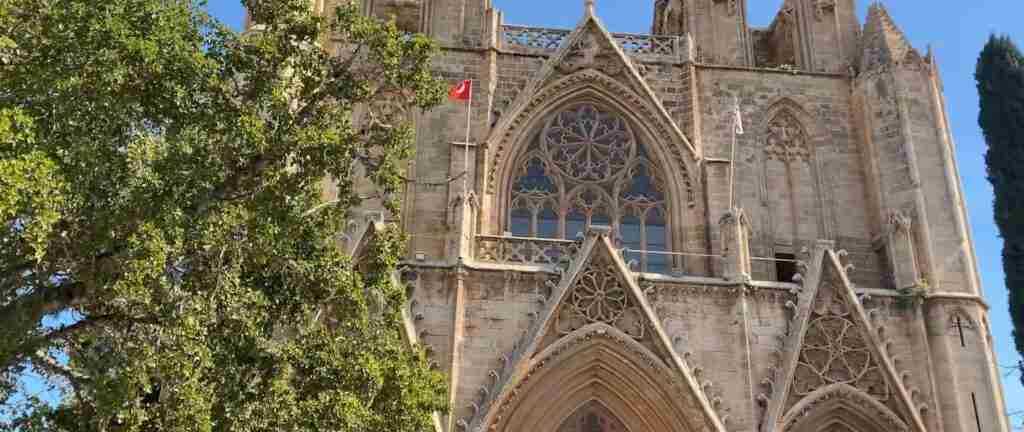
The Ecclesiastical Heritage Route focuses on Famagusta’s extraordinary concentration of medieval churches representing Gothic, Byzantine, and mixed architectural traditions within the compact walled area. Start at Lala Mustafa Pasha Mosque, the converted Cathedral of St. Nicholas featuring soaring Gothic arches, elaborate stone tracery, and the striking juxtaposition of Islamic minaret against French Gothic facade. The mosque welcomes visitors outside prayer times with modest dress requirements, and stepping inside reveals how Ottoman builders adapted rather than demolished Crusader architecture, adding prayer niches and removing Christian iconography while preserving the fundamental spatial grandeur. From the mosque, walk northeast to St. George of the Greeks Church, perhaps Famagusta’s most atmospheric ruin where Byzantine frescoes survive on interior walls despite exposed conditions, Gothic additions show cultural synthesis between Latin and Orthodox communities, and unchecked vegetation creates hauntingly beautiful decay impossible in actively maintained monuments.
Continue east to the twin churches of Saints Peter and Paul, another converted mosque retaining Gothic architectural elements, before seeking out lesser-known ecclesiastical ruins scattered through northeastern neighborhoods. The Church of St. Anne survives as fragmentary walls overtaken by residential construction, while the Church of Santa Maria ruins hide in a courtyard accessible only through a narrow passage between Ottoman-era houses. These hidden churches require local direction or determined map-following, as they lack signage and tourism infrastructure, but discovering them rewards persistence with authentic urban archaeology experiences and photography opportunities free from crowds. The route concludes at the Nestorian Church ruins near the eastern walls, where unique Syrian Christian architectural elements distinguish the structure from Catholic and Orthodox counterparts.
The Literary & Cultural Route traces locations connected to Famagusta’s artistic and intellectual history beyond conventional military-political narratives. Begin at the Namık Kemal Dungeon near the Land Gate, where the 19th-century Ottoman playwright and patriot was imprisoned for his reformist political writings. The small museum occupies his actual cell, displaying manuscripts, personal effects, and explanatory panels about his literary contributions and the Ottoman government’s fear of intellectuals challenging autocratic rule. From the dungeon, walk to Othello Castle, engaging with Shakespeare’s use of Cyprus as Othello’s setting and the centuries of romantic mythology surrounding Christoforo Moro, the Venetian governor possibly inspiring the character.
Continue to Famagusta Castle Arcade, a contemporary arts space within converted Venetian structures hosting rotating exhibitions by Turkish Cypriot artists, occasional live music on weekend evenings, and craft shops selling locally made ceramics, textiles, and jewelry. This living cultural venue demonstrates how historic fabric supports ongoing creative production rather than existing solely as museum space. The arcade’s small-scale intimacy and integration into neighborhood life create authentic interaction with local cultural producers impossible at major monuments. Conclude at St. George of the Latins Church, another Gothic ruin associated with Crusader literary culture and the transmission of chivalric romance traditions from Europe to Cyprus’s multicultural society.
Varosha Ghost Town Walking Access 2026: Routes, Restrictions & Photography
Accessing Varosha Ghost Town in 2026 requires understanding the specific entry procedures, designated walking routes, and photography restrictions governing this partially reopened abandoned resort district. The official entrance checkpoint sits along the Famagusta city walls on the southern perimeter, accessible by walking from the medieval center in approximately 15 minutes or taking local minibuses for minimal fares. Visitors must carry valid passports or EU national ID cards, as security personnel conduct checks before allowing entry, and the area operates under Turkish military oversight despite recent partial civilian openings. Operating hours run 8 AM to 8 PM during summer months and 8 AM to 5 PM in winter, with last entry permitted one hour before closing. Entrance is free for pedestrians, though bicycle and e-scooter rentals available inside the zone cost approximately 150 Turkish Lira ($5) for several-hour periods.
The designated walking route follows approximately 2 kilometers of reopened streets forming a rough loop through the ghost town’s central corridor. Security fencing and military presence clearly delineate accessible zones from the larger sealed area remaining off-limits, and attempting to enter restricted sections risks detention and equipment confiscation. The permitted route encompasses several major streets where 1970s hotels, apartment blocks, shops, and cinemas stand in various states of decay, with nature aggressively reclaiming structures through trees growing inside buildings, vines covering facades, and vegetation breaking through asphalt. The eerie atmosphere derives from buildings appearing as though residents left suddenly—rusted shutters hanging askew, faded shop signs still readable, balconies collapsed into themselves—creating powerful visual testimony to the 1974 conflict’s human displacement.
Photography faces significant restrictions that independent visitors must understand to avoid confrontation with security forces. Photographing military installations, personnel, vehicles, or restricted areas is strictly forbidden and may result in immediate camera/phone confiscation. Signs mark prohibited photography zones, and security officers actively monitor visitors for compliance. Within permitted areas, photography of buildings, streets, and general ghost town atmosphere is allowed, though some officers inconsistently interpret rules leading to occasional conflicts with photographers. The safest approach photographs only designated streets while avoiding any military presence in frames, keeps cameras lowered when passing checkpoints, and asks permission before photographing if uncertain about specific locations.
The physical walking experience through Varosha demands appropriate footwear and sun protection, as limited shade exists along exposed streets and deteriorating infrastructure creates uneven surfaces with trip hazards. Palm Beach at the southern end of the accessible route provides swimming opportunities in remarkably clear waters alongside the haunting backdrop of abandoned beachfront hotels, and small cafes near the beach offer refreshments and toilet facilities. The beach section demonstrates the surreal juxtaposition of leisure activities against ruins, with sunbathers and swimmers using the same sand where 1970s resort guests once lounged before the sudden evacuation. Walking the complete designated route requires 45-90 minutes depending on photography stops and pace, with most visitors spending 1.5-2 hours total including beach time.
Independent visitors benefit from pre-visit research about Varosha’s history to properly contextualize the visual experience. Understanding that this was Cyprus’s premier tourist destination in the early 1970s, hosting celebrities like Elizabeth Taylor and Brigitte Bardot at luxury hotels now crumbling, adds emotional weight to walking past specific structures. Knowing that Greek Cypriot residents who fled in 1974 still advocate for return rights nearly five decades later transforms the ghost town from curiosity into ongoing humanitarian issue. Recognizing that Turkish Cypriot authorities partially reopened the area in 2020 after decades of complete sealing places the current access within political negotiation contexts. This historical grounding elevates the walking experience from urban exploration novelty to engagement with complex displacement legacies that continue shaping Cyprus’s divided present.
Hidden Bastions & Secret Viewpoints 2026: Lesser-Known Wall Sections
The northeastern bastion sequence between Arsenal Gate and Canbulat Gate contains Famagusta’s least-visited fortification sections, where solitary exploration becomes possible even during peak tourist seasons. The Arsenal Bastion features well-preserved Venetian stonework with intact gun emplacements facing the direction of historical Ottoman siege lines, and climbing to the platform summit provides unobstructed views toward Salamis archaeological site and the Karpaz Peninsula’s distant hills. The isolation here stems from position away from main monument clusters and lack of signage directing tourists to these sections, creating opportunities for contemplative engagement with military architecture without crowds diluting the atmosphere. Early morning visits capture ideal photography lighting as the sun rises over the Mediterranean, illuminating the honey-colored limestone walls and casting long shadows across the defensive angles.
The Diamante Bastion at the northwestern corner represents the fortress system’s most geometrically sophisticated element, with Renaissance engineering principles visible in the precisely calculated angles designed to eliminate defensive blind spots. A narrow path ascends the earthwork glacis to the platform level, where the 360-degree perspective encompasses both the walled city’s interior layout and the surrounding landscape toward Kyrenia mountains. Few visitors discover this bastion due to its position at the opposite end from Othello Castle and major tourist flows, yet it provides superior photographic compositions combining architectural detail with landscape context. The platform’s spaciousness allows spreading out for extended stays, picnicking if desired, and watching sunset color changes across the fortification’s stone textures.
The Ravelin Bastion on the southern wall near Varosha offers the most dramatic views of the ghost town’s skyline, with unobstructed sightlines toward the abandoned hotels rising above vegetation. This position served strategic importance during Venetian control for observing approaching threats from the sea, and today it provides the most comprehensive visual understanding of Varosha’s scale and the contrast between the living walled city and frozen resort district. The bastion’s height elevates viewers above intervening vegetation and fencing, creating photography opportunities impossible from ground-level perspectives. Visiting at golden hour produces especially powerful images as the setting sun backlights the ghost town’s silhouettes against the Mediterranean horizon.
Lesser-known gates punctuating the wall circuit provide secret access points and historical interest beyond the heavily trafficked Land Gate. The Limassol Gate on the southern wall retains original drawbridge mechanisms visible in the stonework above the passage, and the gate’s thickness demonstrates the multiple defensive layers Renaissance engineers incorporated against artillery attack. Walking through the gate tunnel from exterior to interior reveals how defenders created kill zones where attackers faced crossfire from multiple angles. The gate surroundings retain Ottoman-era buildings grafted directly onto Venetian structures, showing architectural continuity across conquering cultures.
The Sea Gate at the harbor represents Famagusta’s most photographed fortification element after Othello Castle, yet early morning visits before tour groups arrive provide solitary appreciation of how the gate controlled maritime trade entering Cyprus’s deepest natural harbor. The adjacent small fishing harbor continues active use, with colorful boats moored beneath walls that once witnessed Venetian merchant vessels, Ottoman siege fleets, and British colonial shipping. The working harbor atmosphere distinguishes this location from purely archaeological monument experiences, demonstrating how historic infrastructure still serves functional purposes within contemporary Turkish Cypriot life.
Secret Churches & Religious Heritage Routes 2026: Beyond Lala Mustafa Pasha Mosque
St. George of the Greeks Church stands as Famagusta’s most emotionally powerful ecclesiastical ruin, combining architectural grandeur with atmospheric decay that few monuments equal. The church occupies an inconspicuous location in residential neighborhoods east of Lala Mustafa Pasha Mosque, requiring directional attention to locate despite its substantial size. The Gothic structure with Byzantine decorative elements reflects the cultural synthesis between Latin Crusader and Greek Orthodox communities sharing medieval Cyprus, with pointed arches rising to considerable height while interior frescoes follow Orthodox iconographic traditions. What makes the site extraordinary is the complete absence of restoration or tourist infrastructure, allowing natural processes to slowly reclaim the space through vegetation, weathering, and structural deterioration that many visitors find more moving than pristine monuments.
Interior frescoes survive in fragmentary condition on upper wall sections and choir areas, depicting saints and biblical scenes in the characteristic Byzantine style with large eyes, formal poses, and gold-leaf backgrounds now faded to brown tones. The exposed condition accelerates deterioration, yet this vulnerability creates urgency in the viewing experience—recognizing that each year brings further loss to these centuries-old artworks increases appreciation for what remains. Photography inside requires careful light management as no artificial illumination exists, but the natural light streaming through empty window openings creates dramatic contrast between illuminated frescoes and shadowed architectural details. The site receives perhaps 20-30 visitors daily compared to hundreds at the mosque, creating contemplative atmosphere and the frequent possibility of completely private viewing.
The Nestorian Church ruins near the eastern walls represent one of Cyprus’s few surviving Assyrian Christian monuments, with architectural elements distinguishing it from both Latin Catholic and Greek Orthodox traditions. The church served the Nestorian community that migrated to Cyprus during medieval periods, maintaining theological positions condemned by mainstream Christianity but creating unique cultural expressions. The ruins consist primarily of foundation walls and lower courses, requiring imagination to reconstruct the original structure, yet the historical significance of documenting Nestorian presence on Cyprus makes the site valuable for those interested in Christian denominational diversity beyond the dominant Catholic-Orthodox binary. The location’s obscurity means zero tourism infrastructure and potential difficulty locating the exact site without precise directions, yet determined explorers value discovering monuments that guidebooks rarely mention.
The twin churches of Saints Peter and Paul demonstrate Ottoman adaptive reuse of Crusader architecture, with the larger structure converted to a mosque while retaining Gothic arches, buttresses, and the overall spatial configuration. The conversion process added mihrab prayer niches aligned toward Mecca, removed Christian imagery, and inserted minaret structures, yet the fundamental Gothic character remains immediately evident. Comparing this church-turned-mosque with nearby unconverted ruins illustrates the different fates befalling Famagusta’s ecclesiastical heritage depending on Ottoman decisions about which structures to preserve through functional adaptation versus allowing abandonment. The smaller Peter church stands roofless with vegetation colonizing the nave, while the Paul church functions actively as a neighborhood mosque demonstrating cultural continuity despite religious transformation.
Hidden chapel ruins scattered through residential neighborhoods require local knowledge or determined exploration to discover, as they survive as fragmentary walls integrated into later construction or isolated in courtyards accessed through narrow passages between buildings. The Church of St. Anne’s remains consist of a single Gothic arch rising between Ottoman-era houses, visible only from specific angles as surrounding construction obscures most perspectives. The Church of Santa Maria survives as foundation walls in a private courtyard, technically inaccessible to tourists yet sometimes viewable if residents grant permission. These fragmentary ruins demonstrate the scale of medieval Famagusta’s ecclesiastical wealth—historical records document over 300 churches within the walled city during the Lusignan period—while showing how most have vanished into the urban fabric through incorporation, destruction, or complete disappearance.
Salamis Archaeological Site Walking Routes 2026: Ancient Ruins & Coastal Trails
Salamis archaeological site sits approximately 10 kilometers north of Famagusta’s walled city, accessible via local minibuses for minimal fares or by rental car/taxi for greater scheduling flexibility. The site charges €5 entrance (check official sources for current 2026 pricing as rates may adjust), and the expansive ruins require 2-3 hours to properly explore the major areas including the gymnasium complex, amphitheater, Byzantine basilica, and scattered residential quarters. The site’s scale surprises first-time visitors accustomed to compact archaeological areas, as Salamis encompasses dozens of hectares with monuments separated by substantial distances requiring walking between areas. Comfortable footwear becomes essential given the uneven ancient paving, sandy areas between structures, and exposure to sun across the largely shade-free landscape.
The gymnasium-bath complex represents Salamis’s most visually impressive area, with partially restored colonnades creating dramatic frames for photography and marble sculptures positioned around the palaestra courtyard. The latrine section demonstrates Roman engineering through its sophisticated plumbing system, and explanatory panels detail how the complex functioned as social center beyond just athletic training facilities. Walking through the various rooms reveals the scale of civic investment in public amenities during the city’s prosperity under Roman rule, when Salamis served as Cyprus’s capital before earthquakes triggered decline and eventual abandonment. The complex’s preservation state allows understanding architectural relationships between components—how bathers moved from exercise areas to hot rooms to cold plunges—in ways that more ruined sites cannot communicate.
The Roman amphitheater occupies a prominent position with views toward the coast, and though partially reconstructed for stability, it maintains atmospheric qualities evoking the structure’s entertainment functions. The seating capacity suggests a substantial urban population, and the orchestra floor’s dimensions accommodate imagining gladiatorial contests and dramatic performances that once occupied this space. Climbing to the upper seating tiers provides elevated perspectives over the entire archaeological zone and the surrounding landscape toward the modern coastline. The amphitheater occasionally hosts contemporary cultural events during summer months, creating interesting temporal layers where ancient performance space continues serving similar functions two millennia later.
The coastal walking route from Salamis heads north along the beach toward Glapsides Beach and the ancient harbor remains, following approximately 3 kilometers of sandy shoreline with periodic archaeological fragments emerging from the dunes. This route receives minimal traffic compared to the main site monuments, creating opportunities for beachcombing, swimming breaks in clear waters, and discovering pottery sherds, mosaic fragments, and architectural elements scattered along the foreshore. The ancient harbor’s location remains debated among archaeologists, but visible stone foundations emerging from the waterline at Salamis’s northern edge likely represent quay structures or warehouse foundations from the city’s maritime commercial period. The beach walking provides welcome contrast to the architectural intensity of the main ruins, and the combination of cultural and natural elements appeals to those seeking varied experiences beyond pure monument viewing.
Hidden trails beyond the main archaeological circuit lead to lesser-documented areas including scattered tombs, residential foundation walls, and the Royal Necropolis located several kilometers from the central site. The Royal Necropolis requires separate planning as it sits disconnected from the main archaeological zone, but its tombs demonstrate elite burial practices during Salamis’s city-kingdom period before Roman conquest. The tombs feature stone chambers, dromos entrance passages, and periodic surviving decorative elements. Access challenges including unmarked roads and lack of public transportation mean most visitors skip this component, yet those with rental vehicles and archaeological interests find the detour worthwhile for understanding Salamis’s complete historical span beyond the Roman-Byzantine periods emphasized in the main site.
Cape Greco & Karpaz Peninsula Walking Routes 2026: Coastal Nature Trails
Cape Greco National Forest Park provides Famagusta District’s premier coastal walking experiences, with marked trails traversing dramatic sea cliffs, leading to sea cave formations, and offering Mediterranean viewpoints that rank among Cyprus’s most photographed landscapes. The Aphrodite Trail stretches 2 kilometers along the northeastern coastline, following relatively flat terrain suitable for all fitness levels while providing continuous sea views and access to multiple cave entrances accessible during calm conditions. The trail name references mythology associating this coastline with Aphrodite’s birth from sea foam, and signage along the route explains geological formations, endemic plant species, and seabird nesting areas that make Cape Greco a protected Natura 2000 site.
The Sea Caves Trail descends from the cliff-top path to shoreline level, requiring careful footing on steep sections with loose stone and occasional scrambling over limestone outcrops. The caves themselves penetrate deep into the cliff face, with some extending 70-80 meters into the rock and creating cathedral-like spaces where water enters during rough seas. Visiting during calm summer conditions allows swimming into cave entrances and snorkeling in the remarkably clear waters revealing rocky bottom topography and occasional fish schools. The water temperature stays comfortable May through October, and the isolation compared to sandy beaches means minimal crowds even during peak tourist seasons. Cliff diving from designated jump points attracts adventurous visitors, though significant hazards including submerged rocks and variable water depths require extreme caution.
The Kamara tou Koraka natural rock arch provides Cape Greco’s signature photo opportunity, with the limestone bridge spanning a gap in the coastal cliffs and framing the Mediterranean horizon beyond. The viewpoint sits approximately 200 meters from the main trail via a marked spur path, and reaching the optimal photographic position requires descending rough terrain to the cliff edge where the arch appears in profile. The arch itself is not walkable due to instability and protected status, but the viewpoint provides clear perspective on how centuries of wave action carved through the softer limestone layers while leaving harder stone intact. Sunset visits produce especially dramatic lighting as the sun descends toward the horizon visible through the arch opening.
The European Long Distance Trail E4 passes through Cape Greco as part of its route from Cyprus to Gibraltar, and the marked sections provide well-maintained paths with interpretive signage about geological and biological features. The E4 connection allows ambitious walkers to follow the trail northward beyond Cape Greco toward Protaras and Ayia Napa or southward toward less-developed coastal areas with minimal construction. The trail infrastructure includes periodic benches positioned at viewpoint locations, distance markers helping with navigation, and occasional shade structures providing sun protection. The complete E4 section through the park covers approximately 8 kilometers, requiring 3-4 hours at moderate pace with photo stops and rest breaks.
The Karpaz Peninsula represents Cyprus’s wildest landscape, with the narrow finger of land extending northeast from Famagusta toward Syria creating 80 kilometers of largely undeveloped coastline, mountain backdrop, and traditional village life continuing with minimal tourism influence. Walking routes here lack the formal infrastructure of Cape Greco, instead following unmarked coastal paths, rural roads connecting villages, and trails to isolated beaches accessible only on foot. The wild donkey population roaming freely across the peninsula creates unexpected wildlife encounters, and Golden Beach at the peninsula’s northeastern tip provides pristine sand stretching several kilometers with loggerhead sea turtle nesting sites protected by conservation programs. Reaching Karpaz requires rental car as public transportation is minimal, and accommodations concentrate in a few small villages, making this territory for adventurous independent travelers rather than conventional tour participants.
Turkish Cypriot Neighborhood Routes 2026: Living Culture Beyond Monuments
The northern neighborhoods beyond Lala Mustafa Pasha Mosque contain residential areas where Turkish Cypriot daily life continues largely disconnected from the tourist flows concentrated around major monuments. Walking these streets reveals local bakeries producing traditional simits and pogacas, coffeehouses where men gather for afternoon backgammon games, and small shops selling household goods rather than souvenirs. The social atmosphere differs markedly from the walled city’s southern and eastern sections dominated by heritage tourism, with children playing in narrow streets, women shopping at vegetable markets, and the rhythms of ordinary urban life rather than monument visiting. These neighborhoods demonstrate that Famagusta functions as a living city for Turkish Cypriot residents rather than existing solely as an archaeological attraction for foreign visitors.
The covered market complex near the northern walls operates mornings Monday through Saturday, with vendors selling fresh produce, fish, olives, cheeses, and prepared foods reflecting both Turkish culinary traditions and Cyprus’s unique regional variations. Walking through the market provides authentic cultural immersion unavailable at monument sites, with vendors calling out prices in Turkish, shoppers negotiating for better rates, and the sensory experience of food smells, crowded aisles, and the social interactions that mark traditional marketplace culture. Photography here requires sensitivity and ideally permission from vendors, as many prefer not appearing in tourist photos while conducting ordinary business. The market also offers practical benefits for self-catering travelers seeking ingredients for picnic lunches or fresh fruit for walking routes.
The artisan workshops clustered in Famagusta Castle Arcade and surrounding streets continue traditional crafts including ceramics production, textile weaving, and metalwork using techniques passed through generations. These workshops function primarily for local markets rather than tourist sales, though visitors can observe craftspeople working and sometimes purchase items directly. The arcade spaces themselves occupy converted Venetian structures, creating atmospheric settings where contemporary creative production unfolds within historic architectural fabric. The arcade also hosts occasional open-air markets on weekends, with local artists, food vendors, and musicians creating vibrant community gathering spaces that demonstrate how the walled city’s social life extends beyond heritage tourism.
The Ottoman-era hamam near the Land Gate continues operating as a functioning bathhouse serving local residents, though tourist access varies depending on scheduling and management policies. When accessible, the hamam provides rare opportunity to experience traditional Turkish bath culture in its authentic context rather than tourist-adapted spa settings, with separate hours for men and women, traditional marble massage platforms, and the social dimension of bathhouse culture as community gathering space. The building’s architectural interest includes domed ceiling with star-pattern skylights, marble surfaces developed over centuries of use, and the heating system’s engineering visible in basement sections.
Walking routes through residential neighborhoods require cultural sensitivity and respect for private spaces, as wandering down streets primarily for photography purposes can feel intrusive to residents going about daily activities. The approach should emphasize observation and appreciation rather than aggressive photography, seeking permission before photographing people directly, and supporting local businesses through purchases at bakeries, cafes, and shops rather than treating neighborhoods as open-air museums. Learning basic Turkish greetings and phrases facilitates positive interactions, and many residents, particularly older generations, appreciate visitors showing interest in contemporary Turkish Cypriot life beyond just historical monuments.
Photography Walking Routes 2026: Best Light & Hidden Composition Spots
The golden hour photography route begins at the western bastions one hour before sunset, following the walls southward to capture the limestone fortifications illuminated by warm directional light that emphasizes texture and creates long dramatic shadows across the defensive angles. The Martinengo Bastion provides elevated vantage points for wide-angle compositions incorporating the ghost town, mountains, and Mediterranean in single frames, while the wall-top paths allow tracking the changing light quality as the sun descends toward the horizon. The optimal route concludes at the southern Ravelin Bastion where the ghost town’s silhouetted skyline appears against the sunset colors, creating dramatic backlit compositions impossible to achieve at other times. This timing requires planning as the bastion descent and walk back to the walled city occurs as twilight fades, necessitating headlamps or phone lights for safe navigation.
The dawn architecture route targets the eastern walls and gates where early morning sunlight illuminates stone facades while leaving the western sides in shadow, creating high-contrast conditions emphasizing architectural relief details that midday light flattens. Starting at Othello Castle when the site opens allows photographing the iconic tower before tour groups arrive, and the morning light angle produces particularly effective images of the Venetian lion relief above the main gate. Continuing to the Land Gate captures the drawbridge mechanisms and gate tunnel with dramatic directional lighting, while St. George of the Greeks Church benefits from morning sun penetrating the roofless interior and illuminating surviving frescoes that afternoon backlighting obscures. This route’s primary advantage beyond lighting quality is the solitude of early arrival before crowds dilute photographic opportunities and preclude carefully composed shots.
The atmospheric decay route focuses on lesser-visited ruins where vegetation overtakes architecture and natural deterioration creates visually powerful compositions impossible at actively maintained monuments. St. George of the Greeks Church anchors this route, with fig trees growing from walls, wildflowers colonizing the nave floor, and light filtering through empty Gothic windows creating ethereal qualities. Secondary locations include the Church of St. Anne’s single standing arch framed by Ottoman houses, the northwestern bastions where nature aggressively reclaims earthwork glacis, and Varosha’s accessible streets where trees grow through building roofs and balconies collapse into facades. This photography style emphasizes Cyprus’s layered historical abandonment cycles, where structures built by one culture fall into ruin before partial adoption or complete neglect by successive populations.
The details and textures route zooms into architectural elements often overlooked in wide landscape compositions, documenting stone carving details, decorative capitals, medieval graffiti carved into walls, and weathering patterns that reveal construction techniques and material properties. Lala Mustafa Pasha Mosque’s Gothic facade provides rich detail opportunities in the tracery patterns, door surrounds, and capital variations, while Othello Castle’s Lion of St. Mark relief demonstrates Renaissance sculptural skill. The Venetian walls offer macro photography subjects in the various stone types quarried for construction, mortar technologies changing across repair campaigns, and tool marks left by medieval masons visible in dressed stone surfaces. This approach requires macro or telephoto lenses for isolated detail capture, and the resulting images create abstract compositions that document craft traditions independent of conventional architectural photography.
The human element route integrates people into heritage compositions, photographing how contemporary Turkish Cypriot life unfolds within and around historic structures. The northern neighborhood streets provide opportunities for candid documentation of daily activities—children playing beneath Venetian arches, shop owners beneath Ottoman facades, worshippers entering and exiting the mosque—that situate heritage within living contexts rather than presenting monuments as isolated from human presence. This approach requires particular sensitivity regarding permissions and cultural respect, as photographing people without consent feels invasive and reduces subjects to exotic elements rather than individuals with agency. The ideal methodology involves conversation, building rapport, and requesting permission explicitly, which often leads to posed portraits that lack spontaneity but respect subject dignity.
Cycling Routes Combining Famagusta, Salamis & Coastal Trails 2026
Bicycle rental in Famagusta operates through several shops near the walled city charging approximately €15-20 ($16-21) daily for standard touring bikes with minimal gears suitable for the region’s flat terrain. The most popular cycling route follows the coastal road from Famagusta north to Salamis archaeological site, covering approximately 10 kilometers of paved road with dedicated bike lanes for significant sections and light traffic volumes allowing comfortable cycling even for less experienced riders. The route passes through scattered development and agricultural land before reaching Salamis, where secure bike parking exists near the site entrance. The relatively flat terrain makes this accessible for all fitness levels, though the summer heat argues for early morning or late afternoon cycling when temperatures moderate and the low-angle sunlight provides better landscape illumination.
The extended coastal route continues north from Salamis toward Glapsides Beach and Boğaz fishing village, adding another 8-10 kilometers of primarily coastal views with occasional detours inland past agricultural fields and traditional stone houses. Boğaz provides lunch stops at fish restaurants serving fresh catches in simple preparations emphasizing quality ingredients over elaborate presentation, and the working harbor atmosphere offers authentic glimpses of small-scale fishing operations continuing traditional livelihoods. The return route follows the same coastal road, making this approximately 40 kilometers round trip from Famagusta manageable as a half-day excursion including swimming, site visits, and meal breaks.
The Karpaz Peninsula cycling route represents a multi-day commitment requiring panniers for camping gear or accommodation bookings in the sparse villages offering lodging. The route follows the main peninsula road eastward from Famagusta approximately 80 kilometers to the peninsula’s tip at Golden Beach, passing through Dipkarpaz village, visiting rural monasteries including the important Apostolos Andreas pilgrimage site, and encountering the famous wild donkey population freely roaming across the landscape. The route’s challenges include limited water sources between villages, minimal food options requiring carrying supplies, and summer heat that makes cycling primarily viable during cooler months. However, the rewards include dramatic coastal and mountain scenery, complete escape from mass tourism, and immersion in rural Turkish Cypriot life continuing traditional agriculture and fishing with minimal modern intrusion.
The Cape Greco circuit combines paved coastal roads with unpaved trails through the national park, requiring mountain bikes or hybrid touring bikes with wider tires capable of handling rough surfaces. The route totals approximately 25 kilometers incorporating the Aphrodite Trail, various sea cave access points, and the cliff-top viewpoints toward the natural rock arch. The terrain includes moderate hills requiring low gears, though nothing approaching mountain cycling difficulty, and the combination of road sections, trails, and viewpoint stops creates varied experiences maintaining interest throughout. Rental shops in nearby Ayia Napa and Protaras offer mountain bikes suitable for this route, and bringing swimwear allows cooling breaks in the sea caves and coves accessible from the coastal paths.
Multi-Day Walking & Touring Itineraries 2026: Comprehensive Routes
A three-day comprehensive Famagusta itinerary balances organized tours with independent walking routes, allowing both guided historical context and self-directed exploration of hidden corners. Day one joins Mr. John Tours’ Varosha and walled city experience, absorbing the personal narratives and historical overview that inform subsequent independent discovery. The guided format ensures understanding the Green Line’s political context, Varosha’s tragic history, and the major monuments’ architectural significance while benefiting from the insider perspectives only locals who lived through the 1974 events can provide. The tour concludes mid-afternoon, allowing evening independent walking along the northern walls to lesser-visited bastions and through Turkish Cypriot residential neighborhoods for dinner at local restaurants.
Day two focuses on ecclesiastical heritage and hidden architectural gems through self-guided walking following the routes detailed earlier. Begin with dawn photography at St. George of the Greeks Church while morning light illuminates the interior frescoes, continue to the Namık Kemal Dungeon when it opens, explore the northeastern bastions reaching the Diamante corner, and spend afternoon hours discovering the scattered church ruins and Famagusta Castle Arcade artisan workshops. This day requires significant walking totaling 8-10 kilometers, though the flat terrain and periodic shade in covered passages make this manageable with appropriate rest breaks. Evening concludes with sunset from the southern bastions overlooking Varosha and dinner in the old town’s restaurant cluster near the mosque.
Day three expands beyond Famagusta’s walls to Salamis archaeological site and coastal areas. Morning rental car or taxi to Salamis allows 2-3 hours exploring the gymnasium complex, amphitheater, and coastal remains before driving north to Boğaz for fresh fish lunch at harbor restaurants. The afternoon continues to Cape Greco National Park for walking the Aphrodite Trail, visiting sea caves, and photographing the natural rock arch before returning to Famagusta through Protaras and Ayia Napa resort areas, experiencing the contrast between Northern Cyprus’s relative underdevelopment and the southern coast’s mass tourism infrastructure. This itinerary provides comprehensive Famagusta-area coverage while maintaining reasonable daily activity levels avoiding the exhaustion that overly ambitious plans create.
A week-long Northern Cyprus itinerary incorporates Famagusta within broader exploration of the region’s diverse attractions. Days one and two follow the comprehensive Famagusta pattern detailed above, establishing historical foundation and exploring the walled city thoroughly. Day three drives to Kyrenia, exploring the harbor castle, Bellapais Abbey in mountain settings, and St. Hilarion Castle on dramatic cliff-top positions. Days four and five venture into the Karpaz Peninsula, visiting rural monasteries, encountering wild donkeys at Golden Beach, and experiencing village life in traditional settlements largely untouched by tourism. Day six explores divided Nicosia, crossing between northern and southern sectors to understand the capital city’s unique partition. Day seven returns to Famagusta for final explorations of areas missed earlier or revisiting favorites before departure.
Family-Friendly Walking Routes & Tour Options 2026
Family walking routes in Famagusta require careful planning to balance historical interest with children’s attention spans and energy levels, focusing on visually dramatic sites over abstract architectural appreciation. The walls circuit abbreviated version follows just the western and southern sections from Othello Castle to Martinengo Bastion and the Ravelin viewpoint overlooking Varosha, covering approximately 1.5 kilometers with clear ghost town views and castle exploration appealing to children’s imagination. Othello Castle’s compact size prevents the overwhelm larger archaeological sites create, and climbing the ramparts provides active engagement beyond passive monument viewing. The ghost town perspective from the bastions offers concrete visual drama that children grasp immediately, particularly when parents provide age-appropriate context about the abandoned buildings and why people left suddenly.
Varosha walking proves surprisingly family-appropriate despite the melancholic subject matter, as children respond to the concrete observable decay—trees growing through roofs, balconies collapsing, rusted cars visible in parking areas—rather than abstract historical trauma. The flat walking, clear boundaries preventing wandering into restricted zones, and the Palm Beach swimming conclusion create positive family experience structure. Parents should prepare age-appropriate historical explanations emphasizing the hopeful narrative that the partial reopening represents progress toward eventual reconciliation rather than focusing exclusively on conflict and displacement that might disturb younger children.
Salamis archaeological site appeals to children through its scale and recognizable structures like the amphitheater and the mosaic fragments scattered across the site. The beach immediately adjacent to the ruins allows combining cultural education with swimming and play, and the relatively open site layout prevents the claustrophobic feeling some children experience in enclosed museum spaces. The gymnasium’s latrine section particularly fascinates children when presented as ancient bathroom technology, making cultural heritage tangible through relatable human functions. The site requires 1.5-2 hours to tour the highlights without rushing or exhausting young visitors, and bringing snacks and water becomes essential as on-site facilities are minimal.
Tour selection for families prioritizes operators allowing flexible timing rather than rigid schedules, with private tours through ToursByLocals better accommodating children’s unpredictable needs for bathroom breaks, snack stops, and energy fluctuations than large group tours maintaining tight timetables. The price premium for private tours becomes worthwhile when traveling with young children, as the ability to adjust itineraries on-the-fly—cutting short a site if children lose interest, extending time at places they particularly enjoy—prevents the stress of keeping children compliant with inflexible group schedules. Some private guides specifically mention family-friendly approaches in their profiles, indicating experience adapting historical narratives for younger audiences and incorporating activity elements beyond pure monument viewing.
Seasonal Considerations for Famagusta Walking Routes 2026
Spring walking in Famagusta from March through May offers optimal conditions combining comfortable temperatures, wildflower blooms transforming the walls and ruins with color, and moderate tourist crowds allowing peaceful exploration of major sites. Temperatures range 18-28°C (64-82°F) with minimal rainfall, creating ideal outdoor activity weather without the summer heat that makes midday walking uncomfortable. The wildflower season peaks in April when poppies, chamomile, and various endemic species colonize the wall earthworks, ruined church interiors, and Varosha’s abandoned streets, creating exceptional photography opportunities as nature reclaims historic structures. Early morning and late afternoon temperatures feel particularly pleasant for extended walking, and the longer daylight hours compared to winter allow completing comprehensive routes without rushed final sections in fading light.
Summer walking from June through August requires significant heat management strategies, with daytime temperatures frequently exceeding 35°C (95°F) and exposed stone surfaces radiating absorbed heat making the experience physically taxing for unaccustomed visitors. The optimal summer approach shifts major walking to early morning hours before 10 AM and evening periods after 5 PM when the worst heat subsides, while midday hours focus on indoor attractions like Othello Castle’s shaded courtyard or museum spaces with climate control. Carrying substantial water becomes mandatory rather than optional, with dehydration risks genuine during extended summer walking without adequate fluid intake. The summer season’s advantage lies in extended operating hours at sites like Varosha remaining open until 8 PM, allowing evening exploration when temperatures moderate and dramatic sunset lighting enhances photography.
Autumn walking from September through November revives ideal conditions as temperatures decline from summer peaks while remaining comfortably warm, with September often considered the optimal single month balancing pleasant weather, reduced crowds as European school holidays conclude, and summer’s infrastructure still fully operational. October brings occasional rainfall returning green vegetation to the landscape after summer’s browning, though rain rarely creates persistent disruption to outdoor plans. The autumn light quality appeals particularly to photographers, with lower sun angles creating more directional illumination enhancing architectural texture and the Mediterranean’s blue intensity seeming to deepen as summer haze clears. Tour availability remains high through October before some operators reduce schedules in November’s shoulder period.
Winter walking from December through February faces minimal weather obstacles in Cyprus’s mild Mediterranean climate, though increased rainfall and cooler temperatures require appropriate clothing and planning. Daytime highs typically reach 15-20°C (59-68°F), comfortable for walking with light jackets, while occasional storms bring genuine rain requiring waterproof gear. The winter advantage lies in exceptional solitude at monuments receiving perhaps 10-20% of summer visitor numbers, allowing completely private experiences at major sites that feel crowded during peak seasons. Varosha’s reduced hours closing at 5 PM rather than 8 PM limit evening access, and some tour operators reduce frequency or cease winter operations entirely. However, the dramatically reduced hotel rates and flight costs during winter’s low season make this appealing for budget-conscious travelers willing to accept occasional weather uncertainty.
Border Crossing Procedures & Documentation Requirements 2026
Crossing from the Republic of Cyprus in the south to Northern Cyprus requires understanding the specific checkpoints, documentation requirements, and practical procedures governing movement between the two territories. The primary checkpoints from southern coastal areas toward Famagusta include the Deryneia crossing near Ayia Napa and the Akyar/Beyarmudu crossing further west, both operating daily with extended hours accommodating day-trip visitors. All travelers must present valid passports or EU national identity cards at both the Republic of Cyprus exit checkpoint and the Northern Cyprus entry checkpoint located short distances apart. Photocopies or digital images are not accepted—only original documents with sufficient validity remaining satisfy border control requirements.
The crossing procedure involves stopping at the southern checkpoint where Republic of Cyprus immigration officers check documents and occasionally ask about visit purposes, followed by continuing approximately 100-300 meters to the northern checkpoint where Turkish Cypriot authorities repeat the documentation check and may ask similar questions. The entire process typically requires 5-15 minutes during normal traffic periods, though weekend peak hours can extend waits to 20-30 minutes as queues develop. The checkpoints operate in both directions allowing same-day return, and there are no fees or charges for pedestrian crossings, making day trips from southern Cyprus resorts financially accessible.
Vehicle crossings involve additional insurance requirements, as standard car rental agreements from Republic of Cyprus typically prohibit taking vehicles into Northern Cyprus. Travelers who wish to drive across must verify their rental contract specifically allows northern crossings and purchase third-party insurance at the checkpoint, sold immediately before crossing for approximately €15-25 ($16-27) covering short-term periods. Some rental companies explicitly forbid northern crossings in their contracts, making violation grounds for insurance voidance and potential significant liability if accidents occur. The safest approach verifies crossing permission during the rental booking process, with some companies catering specifically to cross-border travel while others maintain strict southern-only policies.
Currency exchange becomes relevant as Northern Cyprus uses the Turkish Lira alongside widespread euro acceptance, while the Republic of Cyprus uses euros exclusively. ATMs in Northern Cyprus dispense Turkish Lira, and exchange offices near border crossings convert euros to lira at competitive rates. However, most tourist-oriented businesses in Famagusta including restaurants, tours, and attractions accept euros directly, often providing change in euros rather than lira. Credit cards work widely though small businesses and market vendors prefer cash, making carrying some currency advisable regardless of card availability. The dual-currency situation creates occasional confusion with prices listed in both currencies, requiring attention to which price actually applies to avoid overpaying through currency confusion.
Practical Information: Logistics, Safety & Local Customs 2026
Accommodation in Famagusta concentrates in several areas with distinct characters and price points. The old town itself offers limited lodging options primarily consisting of small guesthouses and converted historic buildings operating as boutique hotels, providing authentic atmospheric stays within walking distance of all major monuments. These typically charge €50-80 ($54-86) per night for double rooms with basic amenities, trading luxury facilities for location and character. The modern city area north and west of the walls provides mid-range hotels and apartment rentals at €60-100 ($64-108) nightly, offering greater space and contemporary amenities while requiring 10-15 minute walks or short taxi rides to reach the walled city. The Palm Beach area near Varosha appeals to beach-focused visitors with resort-style hotels at €80-150 ($86-161) nightly combining coastal access with relative proximity to historical sites.
Transportation within Famagusta operates primarily through walking for the walled city and immediate surroundings, with the compact scale making cars unnecessary and often counterproductive given limited parking and narrow streets unsuitable for vehicles. Local minibuses run routes connecting the old town to outlying areas including Salamis and coastal districts, charging minimal fares around €1-2 ($1-2) per trip with schedules posted at major stops. Taxis provide on-demand transport for reaching Salamis, Boğaz, or return trips from distant walking destinations, with fares typically negotiated before departure rather than metered, ranging €15-30 ($16-32) for most in-district trips. Rental cars become valuable for Karpaz Peninsula exploration or combining Famagusta with other Northern Cyprus destinations, available from €30-50 ($32-54) daily depending on vehicle type and rental duration.
Safety in Famagusta poses minimal concerns for typical tourist activities, with violent crime against visitors exceptionally rare and petty theft uncommon compared to major European tourism destinations. The Turkish Cypriot community maintains social cohesion and visitor hospitality traditions making aggressive harassment or scams essentially absent from the tourist experience. Standard urban precautions apply—securing valuables in accommodations rather than leaving in plain sight in vehicles, maintaining awareness in crowded market areas where pickpockets theoretically operate though rarely, and avoiding completely isolated areas after dark though Famagusta’s walled city maintains active evening street life making this concern minimal. The political situation between north and south Cyprus creates no direct safety implications for tourists, who move freely between territories without encountering hostility or restrictions beyond the border formalities.
Local customs emphasize hospitality and respect for religious sites, with visitors expected to dress modestly when entering the mosque covering shoulders and knees at minimum, with women often provided headscarves at the entrance if needed. Photography inside the mosque is generally permitted outside prayer times, though asking permission demonstrates respect and occasionally photography restrictions apply during specific religious observations. The call to prayer sounds five times daily from minarets across the old town, and while this represents atmospheric cultural immersion for many visitors, those sensitive to early morning noise should consider accommodation placement relative to minarets. Tipping practices follow moderate European norms with 10% customary at restaurants for good service, though not mandatory, and small tips appreciated by guides, taxi drivers, and other service providers without the aggressive expectation sometimes encountered in heavily touristed destinations.
Food & Restaurant Recommendations Along Walking Routes 2026
Traditional Turkish Cypriot cuisine combines Anatolian Turkish influences with Cypriot Greek elements and Mediterranean ingredients, creating distinctive dishes unavailable in mainland Turkey or southern Cyprus. The meze tradition dominates dining culture, with restaurants serving sequential small plates rather than single large courses, encouraging communal eating and extended meal times. Aspava Restaurant & Bar near the harbor has earned local reputation for authentic meze service despite lacking printed menus or posted prices, instead bringing continuous waves of hot and cold dishes followed by grilled meat platters in quantities ensuring guests leave fully satisfied. The format requires trusting the restaurant’s fair pricing and accepting the surprise element, though reviews consistently describe reasonable bills given the food quantity and quality provided.
Petek Pastanesi near the mosque specializes in traditional Cypriot sweets and pastries, serving exceptional baklava varieties, kadayif with various fillings, and local specialties like hellimli börek featuring halloumi cheese in flaky pastry layers. The bakery operates from early morning serving breakfast items including simits, pogacas, and various filled breads alongside strong Turkish coffee, making this ideal for quick morning fuel before walking routes or afternoon breaks between monument visits. The prices remain remarkably affordable with substantial pastries costing €1-3 ($1-3), and outdoor seating provides views toward the mosque’s Gothic facade while consuming the sweets.
Bedis Beach Restaurant north toward Salamis offers the combination of quality seafood, beachfront setting, and reasonable pricing that coastal restaurants often fail to achieve simultaneously. The menu emphasizes simply prepared fresh fish grilled or baked with minimal elaboration allowing ingredient quality to dominate, alongside Cyprus-style mezze including local cheeses, vegetables, and dips. The location provides swimming access adjacent to the restaurant, allowing meal breaks during beach days or combining Salamis site visits with lunch overlooking the Mediterranean. Reservations help during summer peak periods though walk-in space usually exists during shoulder seasons and off-peak hours.
The covered market’s prepared food stalls provide authentic local lunch experiences at minimal cost, with vendors selling stuffed vegetables, grilled meats, pides (Turkish-style flatbreads with various toppings), and other traditional items consumed standing at counters or perched on stools. This represents genuine local food culture rather than tourist-adapted dining, with prices around €3-6 ($3-6) for substantial meals and the social atmosphere of market shopping and eating integrated into single experiences. The market operates mornings only, making this breakfast or early lunch territory rather than evening dining, and the complete absence of English menus or explanations requires pointing at desired items or asking for recommendations from vendors who generally offer samples to help decision-making.
Coffee culture thrives in Famagusta’s traditional coffeehouses where Turkish coffee served in small cups alongside water represents social ritual rather than mere caffeine consumption. Coffeehouses cluster near the mosque and along major streets, with primarily male clientele during daytime hours gathering for coffee, conversation, and endless backgammon games. Some establishments welcome tourists including women, while others maintain traditional male-only atmospheres that foreign visitors should respect by patronizing the more inclusive alternatives. The coffee itself arrives very strong and sweet unless specifically requested otherwise, with grounds settling to the cup bottom requiring careful sipping to avoid consuming the sediment.
Combining Famagusta with Broader Northern Cyprus Itineraries 2026
Kyrenia integration creates natural Famagusta combination itineraries, with the two destinations representing Northern Cyprus’s primary tourist draws located approximately 70 kilometers apart requiring 1.5 hours driving time. Kyrenia’s harbor setting, mountain backdrop, and preserved Venetian castle contrast with Famagusta’s fortified medieval character and ghost town atmosphere, providing complementary rather than redundant experiences. A typical combination allocates 2-3 days in each location with a day trip option to Bellapais Abbey and St. Hilarion Castle in the Kyrenia mountains, creating comprehensive Northern Cyprus coverage within week-long timeframes.
Nicosia’s divided capital status makes day trips from Famagusta valuable for understanding Cyprus’s partition through the only divided capital city globally. The drive requires approximately 45 minutes, and spending a day crossing between northern and southern sectors via the Ledra Street checkpoint provides perspective on how the same city functions under two completely different administrations separated by the UN-patrolled buffer zone. The northern Nicosia walking route includes the Büyük Han caravanserai converted to artisan shops and cafes, Selimiye Mosque (another Gothic cathedral conversion), and the Venetian walls encircling the old city. Crossing south allows comparison with the Greek Cypriot perspective, modern commercial districts, and the Cyprus Museum’s exceptional archaeological collections.
The Karpaz Peninsula extension requires dedicated time and transportation, as the 160-kilometer round trip from Famagusta to Golden Beach at the peninsula tip demands full-day minimum and preferably overnight accommodation in villages like Dipkarpaz. The route passes through increasingly rural landscapes, visits the important Apostolos Andreas Monastery pilgrimage site, provides opportunities for wild donkey encounters along roadside areas, and reaches Golden Beach where loggerhead sea turtles nest during summer months. The peninsula’s undeveloped character represents Northern Cyprus’s most pristine coastal and rural environments, though the sparse infrastructure means travelers must prepare for basic accommodation, limited dining options, and long distances between services.
Multi-week itineraries combine Northern Cyprus with southern destinations including Paphos, Limassol, and the Troodos Mountains, creating comprehensive island coverage experiencing both territories’ distinct characters. This requires mental and logistical adjustment to the different currencies, languages, political perspectives, and tourism infrastructures operating in north versus south, but provides complete understanding of Cyprus’s complex identity impossible when visiting just one territory. The practical logistics involve either renting separate vehicles in each territory or utilizing the fewer rental companies explicitly allowing cross-border driving, and planning accommodation sequences that minimize unnecessary backtracking across the Green Line.
Photography Equipment & Technical Recommendations 2026
Lens selection for Famagusta photography should emphasize wide-angle capabilities for architectural interiors and fortification perspectives, with a 16-35mm full-frame equivalent covering most situations from Lala Mustafa Pasha Mosque’s vaulted interior to the bastion viewpoints encompassing ghost town and harbor. A standard zoom like 24-70mm provides versatility for architectural details, street photography in Turkish Cypriot neighborhoods, and general monument documentation without requiring lens changes. Photographers prioritizing atmospheric ruin photography benefit from fast prime lenses around 35mm or 50mm with wide apertures enabling low-light work inside St. George of the Greeks Church and creating shallow depth-of-field isolating architectural details against blurred backgrounds.
The harsh Mediterranean sunlight creates high-contrast conditions challenging proper exposure, particularly during summer midday hours when shadows turn nearly black while highlights blow out in direct sun. Circular polarizing filters reduce sky brightness, increase Mediterranean blue saturation, and minimize reflections from marble and limestone surfaces, becoming near-essential accessories for outdoor architectural photography. HDR bracketing techniques combining multiple exposures capture the complete dynamic range when single exposures cannot hold both shadow detail and highlight information, particularly useful inside structures where bright doorways or windows appear alongside dark vaulted interiors.
Tripods provide stability for low-light interior photography and enable long-exposure techniques showing Varosha with motion-blurred vegetation suggesting wind movement against static architectural decay. However, the compact tripods restrictions inside some monuments and the annoyance of carrying full-size tripods during extended walking routes argue for stabilization alternatives including monopods for lighter-weight support or relying on high-ISO performance from modern cameras producing clean images at ISO 3200-6400. The lightweight approach proves more practical for full-day walking routes where tripod weight and bulk discourage bringing the equipment despite theoretical image quality advantages.
Drone photography faces strict restrictions in Northern Cyprus including complete prohibition near military installations and controlled zones, making Varosha and most border areas off-limits for aerial imaging. The old town contains numerous military-sensitive areas where even ground-level photography faces restrictions, making drone flight extremely risky legally regardless of photographic appeal. Photographers determined to capture aerial perspectives should verify current regulations with Turkish Cypriot authorities before traveling, as enforcement varies and confiscation of equipment represents genuine risk. The combination of legal restrictions and practical concerns about drawing security attention makes drones poor choices for Famagusta despite the compelling aerial compositions the ghost town and fortifications could provide.
Accessibility Considerations for Limited Mobility Visitors 2026
Famagusta’s medieval infrastructure presents significant accessibility challenges for wheelchair users and those with limited mobility, as the historic fabric prioritizes preservation over modern accessibility standards. The Venetian walls circuit includes steep bastion ascents, uneven stone surfaces, and stairs without ramps or elevators, making much of the fortification system inaccessible to wheelchairs. However, the walled city’s flat internal streets allow wheelchair navigation between major monuments even if accessing wall-top paths proves impossible. The main monuments including Lala Mustafa Pasha Mosque feature ground-level accessibility with minimal steps at entrances, though interior thresholds and uneven floors create navigation challenges requiring assistance.
Othello Castle’s courtyard level remains accessible with assistance over the entrance threshold, though the rampart walks require climbing stairs eliminating wheelchair access to upper levels. The castle’s compact size means the courtyard visit provides reasonable monument experience without seeing every section. St. George of the Greeks Church’s ruined state creates severe accessibility barriers with collapsed flooring, vegetation obstructing paths, and complete absence of constructed access routes, making this unsuitable for wheelchair visitors. The more maintained monuments like the mosque provide better accessibility prospects than atmospheric ruins where structural deterioration creates hazardous conditions regardless of mobility level.
Varosha Ghost Town’s flat paved streets theoretically allow wheelchair access, though the deteriorating pavement surfaces with cracks, potholes, and vegetation growth create rough conditions challenging for manual wheelchair users and uncomfortable even in assisted wheelchairs. The designated walking route’s approximately 2-kilometer distance may exceed comfortable range for some limited-mobility visitors, though the ability to turn back at any point allows adjusting the route to individual capacity. Palm Beach at the route’s conclusion lacks beach wheelchair infrastructure, though the cafe facilities provide accessible dining and rest areas.
Organized tours generally accommodate limited mobility visitors with advance notice allowing operators to modify itineraries, though the physical access limitations to many sites mean modified experiences focus on what’s accessible rather than attempting full standard routes. Private tours offer greater flexibility than group tours for accommodating mobility needs, allowing time adjustments, vehicle-based viewing when walking proves impossible, and elimination of components requiring physical access impossible for particular disabilities. Communication about specific needs during booking ensures operators prepare appropriately rather than discovering accessibility requirements upon arrival when modification options become limited.
Frequently Asked Questions About Famagusta Tours & Walking Routes 2026
Are Famagusta Tours Safe in 2026?
Yes, Famagusta tours operate safely in 2026 with minimal crime, stable political conditions in Northern Cyprus, and well-established tourism infrastructure supporting visitor activities. The Turkish Cypriot community maintains strong hospitality traditions making aggressive harassment or scams essentially absent, and violent crime against tourists is exceptionally rare. The political situation between Northern and Southern Cyprus creates no direct safety implications for visitors, who move freely between territories through established checkpoints without encountering hostility. Standard urban precautions apply regarding securing valuables and maintaining awareness in crowded areas, but Famagusta represents one of the Mediterranean’s safest destinations for independent walking and organized tour participation.
How Much Walking Is Required on Famagusta Tours in 2026?
Typical full-day Famagusta tours involve 3-5 kilometers of walking across flat terrain with periodic rest stops, manageable for most fitness levels though potentially challenging for those with significant mobility limitations. The compact walled city’s 1.5-kilometer diameter means monuments cluster closely, but comprehensive tours including Varosha Ghost Town, wall sections, and multiple churches accumulate moderate distances. Self-guided walking routes range 2-8 kilometers depending on ambitions, with the complete walls circuit totaling approximately 3 kilometers and ecclesiastical heritage routes covering 4-6 kilometers across the medieval center. The flat terrain throughout makes distance more relevant than elevation, and the Mediterranean climate requires heat management during summer months regardless of distance covered.
Can You Visit Varosha Independently Without a Tour in 2026?
Yes, Varosha Ghost Town welcomes independent visitors in 2026 without requiring tour participation, with free entrance for pedestrians walking the designated routes from 8 AM to 8 PM during summer months. The access checkpoint sits along the southern walls accessible by walking from Famagusta’s walled center in approximately 15 minutes, and visitors simply present passports or EU ID cards to security personnel before entering the permitted zone. The designated walking route covers approximately 2 kilometers with clear signage and fencing marking accessible areas versus restricted sections. Independent access allows unlimited time within operating hours compared to tours’ structured schedules, though visitors miss the historical narratives and personal stories that guided tours provide through operators like Mr. John who grew up in Varosha before 1974.
What Is the Best Time of Day to Walk Famagusta’s Walls in 2026?
Early morning from 7-9 AM and late afternoon from 5-7 PM provide optimal wall-walking conditions in 2026, avoiding midday heat that makes exposed stone surfaces uncomfortable during summer months while capturing superior photography lighting as low sun angles emphasize architectural texture. Dawn arrivals before tourist flows begin allow completely solitary experiences at major viewpoints and bastions that feel crowded during midday peak hours, while sunset timing produces dramatic golden-hour illumination across the ghost town and Mediterranean horizon. Winter walking remains comfortable throughout the day given moderate temperatures, though early morning and late afternoon still provide better lighting quality for photography regardless of season.
Are Famagusta Walking Routes Suitable for Children in 2026?
Yes, selected Famagusta walking routes suit families with children in 2026, particularly the abbreviated walls circuit combining Othello Castle with Martinengo Bastion viewpoints covering approximately 1.5 kilometers, and the Varosha Ghost Town route offering concrete visual drama children grasp immediately. Salamis archaeological site appeals through recognizable structures like the amphitheater and beach access allowing cultural education combined with swimming. Routes requiring extensive walking exceeding 3-4 kilometers or focusing heavily on abstract architectural appreciation may exceed young children’s interest levels, arguing for strategic selection emphasizing visually dramatic sites over comprehensive coverage. Family-appropriate tours exist through private operators allowing schedule flexibility accommodating children’s unpredictable needs for breaks, snacks, and energy management impossible on rigid group tour timetables.
How Do Famagusta Tour Prices Compare to Other Cyprus Destinations in 2026?
Famagusta tour prices range €30-80 ($32-85) for full-day experiences in 2026, representing exceptional value compared to southern Cyprus destinations like Paphos and Limassol where equivalent tours typically charge €60-100 ($64-108) through major operators. The budget tours led by acclaimed local guides like Mr. John at €30 per person provide quality and personal narrative depth rivaling premium southern Cyprus experiences costing triple the price. Private tours through platforms like ToursByLocals cost $330-630 for groups up to four people, aligning with but not significantly exceeding southern Cyprus private tour pricing. The overall value proposition favors Northern Cyprus including Famagusta due to lower tourism development saturation, fewer mass-market operations, and operators competing more on quality than premium pricing strategies.
Can You Cross from Southern Cyprus to Famagusta for a Day Trip in 2026?
Yes, day trips from southern Cyprus resorts including Ayia Napa, Protaras, Larnaca, and Limassol to Famagusta operate easily in 2026 using the Deryneia or Akyar/Beyarmudu checkpoints requiring 5-15 minutes crossing time with valid passports or EU national IDs. Organized tours from southern resorts handle border formalities and transportation for €57-71 ($60-75) per person, while independent travelers cross via rental car (verifying contract allows northern entry) or hire taxis for the border-to-Famagusta leg after walking across as pedestrians. The day-trip format allows experiencing Famagusta’s walled city, Varosha Ghost Town, and Salamis ruins within 6-8 hours total including border crossings, though overnight stays enable more relaxed exploration without time pressure from return crossing requirements.
What Are the Must-See Hidden Spots in Famagusta That Tours Often Miss in 2026?
Must-see hidden spots consistently overlooked by standard tours include St. George of the Greeks Church ruins featuring surviving Byzantine frescoes and atmospheric Gothic decay without crowds, Namık Kemal Dungeon museum honoring the imprisoned 19th-century writer with minimal visitor traffic, Famagusta Castle Arcade artisan community operating craft workshops and occasional markets away from main monument flows, and the northeastern bastion corners offering solitary harbor viewpoints impossible at heavily photographed Othello Castle. Beyond the walled city, coastal paths between Palm Beach and Salamis reveal unnamed coves and archaeological fragments, while the Ayioi Anargyri Chapel perched on cliffs above Cape Greco provides dramatic seascapes accessible only via walking trails. These locations require independent discovery or private tour arrangements rather than appearing on group tour itineraries prioritizing major monuments over hidden gems.
Do Famagusta Tours Operate Year-Round in 2026?
Most major Famagusta tour operators including Mr. John Tours and The Original Red Bus operate year-round in 2026 with daily departures during peak summer months and reduced frequency during winter shoulder seasons November through February. Spring and autumn maintain near-daily schedules meeting demand from visitors timing trips for optimal weather without summer peak crowds. Some specialized operators and private guides reduce winter availability or require advance booking to justify operating during low-demand periods, while the most established tours maintain consistent scheduling regardless of season. Independent travelers visiting during winter shoulder periods should verify specific operator schedules in advance rather than assuming summer-level availability, though sufficient options exist year-round preventing complete inability to access organized tour experiences.
Can You Walk Famagusta’s Entire Venetian Walls Circuit in 2026?
Yes, the complete Venetian walls circuit remains walkable in 2026 totaling approximately 3 kilometers around the walled city’s perimeter, though some sections feature rough surfaces, vegetation obstruction, and steeper bastion ascents requiring moderate fitness levels and appropriate footwear. The circuit includes accessible paved sections near major gates and bastions alongside portions where nature increasingly reclaims pathways creating uneven conditions. The southeastern wall sections receive minimal maintenance compared to heavily trafficked western areas near Othello Castle, resulting in more adventurous exploration character requiring attention to footing. Most visitors walk selected wall sections rather than attempting complete circuits, with the western and southern segments from Othello Castle to the Ravelin Bastion providing the most rewarding viewpoints and best-maintained access while covering approximately half the total perimeter.