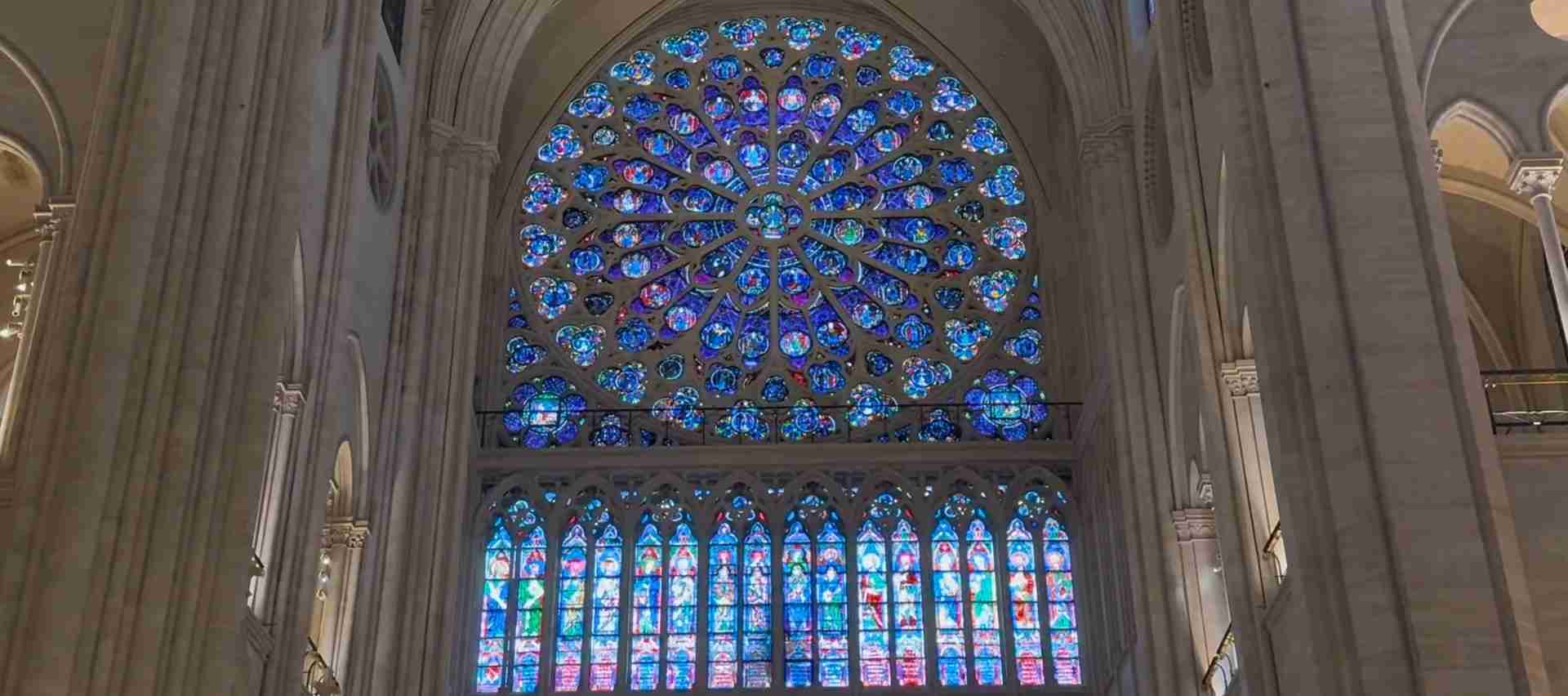
Claire Tabouret’s Revolutionary Stained Glass: Notre-Dame’s 2026 Artistic Renaissance
Notre-Dame Cathedral’s 2026 artistic transformation centers on six monumental stained glass windows by French artist Claire Tabouret, scheduled for installation by year’s end following one of the most controversial art commissions in French cultural history. These contemporary windows will replace 19th-century designs that survived the 2019 fire intact, marking the first major artistic intervention in the UNESCO World Heritage cathedral in over 150 years.
Key Takeaways
- Claire Tabouret’s six contemporary stained glass windows depicting Pentecost will be installed in Notre-Dame’s south aisle chapels by late 2026, completing the cathedral’s post-fire restoration
- Full-scale maquettes are displayed at Paris’s Grand Palais through March 15, 2026, offering the only public preview before installation
- The commission sparked intense controversy with 323,000+ petition signatures opposing the replacement of undamaged Viollet-le-Duc windows from 1844
- Notre-Dame reopened December 8, 2024, with free admission and an optional reservation system managing 12 million expected annual visitors in 2026
- The windows are being fabricated at Atelier Simon-Marq in Reims, the same workshop that created Marc Chagall’s stained glass for Reims Cathedral
- This project represents one of contemporary art’s most scrutinized interventions into a historic monument, compared to earlier controversies surrounding Pei’s Louvre Pyramid and Buren’s Palais Royal columns
People Also Ask About Claire Tabouret’s Notre-Dame Windows 2026
When will Claire Tabouret’s stained glass windows be installed in Notre-Dame in 2026?
Claire Tabouret’s six stained glass windows are scheduled for installation in late 2026, completing by the end of the year. The windows are currently being fabricated at Atelier Simon-Marq workshop in Reims, France, translating Tabouret’s full-scale paper designs into glass and lead using traditional techniques. Once installed, the windows will occupy six bays along Notre-Dame’s south aisle chapels, permanently replacing the 19th-century windows designed by Eugène Viollet-le-Duc and Jean-Baptiste Lassus. The installation timeline depends on completion of the meticulous fabrication process, which involves master glassmakers translating Tabouret’s designs into approximately 50 individual glass sections per window. Visitors hoping to see the installed windows should plan Notre-Dame visits for December 2026 or later, as earlier 2026 visits will show the original windows still in place.
Can I see Claire Tabouret’s Notre-Dame window designs before they’re installed in 2026?
Full-scale maquettes of all six Tabouret windows are displayed at Paris’s Grand Palais in the exhibition “In a Single Breath” running through March 15, 2026. These monumental works, standing approximately 23 feet tall, present Tabouret’s designs as ink-on-paper maquettes composed of around 50 pieces per window corresponding to the actual glass sections. The exhibition, located at 3 Avenue du Général Eisenhower in Paris’s 8th arrondissement, represents the only opportunity to view the complete designs before installation. The Grand Palais presentation includes preparatory sketches and documentation of Tabouret’s working process, offering insight into how contemporary artists approach historic commissions. After March 15, 2026, the maquettes will be removed and the designs will only be visible once the actual stained glass windows are installed in Notre-Dame by late 2026.
Why is there controversy about replacing Notre-Dame’s stained glass in 2026?
The controversy centers on President Emmanuel Macron’s 2023 decision to commission contemporary windows to replace 19th-century stained glass by Viollet-le-Duc that survived the 2019 fire undamaged. Over 323,000 people signed petitions opposing the replacement, arguing it violates the 1964 Venice Charter principles of historic preservation that call for maintaining original elements when they remain intact. Heritage organizations, including the National Heritage and Architecture Commission and Sites and Monuments, formally objected that replacing functioning historic windows contradicts established conservation ethics. Critics argue Macron used the post-fire restoration as pretext for an unnecessary contemporary intervention, politicizing Notre-Dame’s sacred and historic character. Supporters counter that Notre-Dame has always evolved artistically across centuries and that Tabouret’s windows honor tradition while bringing fresh spiritual vitality. The debate reflects broader tensions between preservation orthodoxy and living artistic engagement with historic monuments.
How much did Claire Tabouret’s Notre-Dame windows cost in 2026?
The stained glass commission forms part of Notre-Dame’s €846 million ($865 million) total restoration budget, with sources citing approximately €4 million specifically for the window project including design, fabrication, and installation. This expenditure covers Tabouret’s artistic fees, the extensive work by Atelier Simon-Marq master glassmakers translating designs into actual stained glass, materials including glass and lead, and the complex installation process requiring specialized expertise. The cost proved contentious among critics who questioned spending millions on contemporary art to replace undamaged historic windows when other restoration priorities remained. Supporters argue the investment represents a tiny fraction of the total budget and will create permanent artistic legacy comparable to historic commissions that enriched the cathedral over centuries. The windows join other contemporary additions to the restored cathedral including new liturgical furniture, reliquary designs, and updated audiovisual systems.
Extended multi-day tours – 5+ days
Featured Paris Multi-Day Tour Packages
3 days
Paris 3-Day Discovery Tour
- ✓ Comprehensive Paris experience
- ✓ Expert local guides included
- ✓ All accommodation included
- ✓ Transportation provided
5 days
Paris 5-Day Highlights Experience
- ✓ Comprehensive Paris experience
- ✓ Expert local guides included
- ✓ All accommodation included
- ✓ Transportation provided
7 days
Paris 7-Day Cultural Journey
- ✓ Comprehensive Paris experience
- ✓ Expert local guides included
- ✓ All accommodation included
- ✓ Transportation provided
10 days
Paris 10-Day Complete Adventure
- ✓ Comprehensive Paris experience
- ✓ Expert local guides included
- ✓ All accommodation included
- ✓ Transportation provided
Multi-day tour packages powered by TourRadar. Prices and availability subject to change.
Introduction
Notre-Dame Cathedral’s 2026 transformation culminates five years of unprecedented restoration following the devastating April 15, 2019 fire that destroyed the spire and roof while sparing the historic structure and most artistic treasures. The cathedral reopened December 8, 2024, to international celebration, but the artistic chapter concludes only when Claire Tabouret’s six contemporary stained glass windows are installed in late 2026. This commission represents contemporary art’s most scrutinized intervention into a UNESCO World Heritage monument, generating fierce debate about the balance between preservation and living artistic tradition.
The 44-year-old French painter, based in Los Angeles, won a December 2024 competition organized by the French Ministry of Culture after more than 100 artists submitted proposals. President Emmanuel Macron and Paris Archbishop Laurent Ulrich jointly selected Tabouret’s design depicting Pentecost, the moment when the Holy Spirit descended upon Christ’s disciples, marking Christianity’s birth. The biblical narrative offers powerful themes of unity, communication across differences, and divine inspiration that resonated with decision-makers seeking to reinforce Notre-Dame’s spiritual mission while acknowledging contemporary artistic vitality.
The windows will replace six bays of 19th-century stained glass designed by architects Eugène Viollet-le-Duc and Jean-Baptiste Lassus during their 1844 restoration of Notre-Dame. Those geometric windows, featuring minimal color palettes and simple patterns, survived the 2019 fire completely intact. The decision to replace undamaged historic elements sparked immediate controversy, with heritage organizations arguing the move violates fundamental conservation principles. Over 323,000 people signed petitions opposing the replacement, making this among France’s most contentious cultural decisions in recent decades.
Yet Tabouret’s defenders invoke historical precedent. The artist herself references iconic Parisian controversies including I.M. Pei’s Louvre Pyramid and Daniel Buren’s black-and-white columns at Palais Royal, both initially condemned but now beloved landmarks. Notre-Dame itself evolved continuously across eight centuries through successive artistic interventions. The cathedral’s current form reflects medieval origins, 19th-century restoration, and now 21st-century reconstruction, each era leaving its artistic mark. Supporters argue that living cathedrals must engage contemporary artists just as medieval patrons commissioned the greatest talents of their age.
The exhibition “In a Single Breath” at Paris’s Grand Palais presents full-scale maquettes of all six windows through March 15, 2026, allowing public engagement before installation. Meanwhile, master glassmakers at Atelier Simon-Marq in Reims translate Tabouret’s designs into actual stained glass using centuries-old techniques. This same workshop created Marc Chagall’s windows for Reims Cathedral and collaborated with Joan Miró, establishing expertise in translating contemporary artistic visions into traditional glass mediums. The windows’ late 2026 installation will mark Notre-Dame’s complete artistic renewal, fulfilling Macron’s promise to restore the cathedral “even more beautiful than before.”
The Artist Behind the Commission: Claire Tabouret
Claire Tabouret emerged as one of France’s most acclaimed contemporary painters following her 1981 birth in Pertuis and art education culminating at École Nationale Supérieure des Beaux-Arts in Paris. After a decade establishing her career in Los Angeles, she maintains studios in both California and France, creating large-scale figurative paintings characterized by rich colors, expressive brushwork, and themes exploring identity, movement, and collective human experience. Her work appears in major collections worldwide and commands significant market attention, with paintings regularly selling for six figures at international auctions.
Tabouret’s artistic practice centers on capturing fleeting moments and elusive aspects of human presence. She cites Claude Monet’s water lilies as foundational inspiration, particularly their representation of movement and transience. Her figurative canvases feature faces and bodies rendered with deliberate ambiguity, suggesting psychological complexity and the impossibility of fully grasping individual identity. This thematic preoccupation with what cannot be completely captured or frozen aligns conceptually with stained glass’s interaction with changing light throughout the day, creating dynamic visual experiences rather than static images.
Before winning the Notre-Dame commission, Tabouret explored stained glass through her “Altar” series created with husband Nathan Thelen. These works transferred watercolor paintings onto glass panels mounted in mahogany stands, creating intimate devotional objects that sold successfully at art fairs. The series demonstrated Tabouret’s understanding of how light transforms painted imagery when viewed through glass, preparing her technically and conceptually for the cathedral commission’s challenges. The Notre-Dame project represents a dramatic scale shift from these experimental works to monumental architectural interventions.
In December 2024, French authorities announced Tabouret’s selection from among 83 applications submitted by over 100 internationally recognized artists. The competition brief required designs for six windows along Notre-Dame’s south aisle depicting Pentecost, the moment when God sent the Holy Spirit to the Apostles following Christ’s ascension. Tabouret approached this narrative as a story about community, celebration, and unity across differences, themes she found deeply meaningful despite her self-described non-religious perspective. Her vision balanced respect for the biblical narrative’s accessibility with artistic ambition to create spiritually resonant contemporary art.
Tabouret’s recent career includes prominent exhibitions reinforcing her credentials for such an important commission. She participated in the 2024 Venice Biennale’s Vatican Pavilion, demonstrating comfort engaging religious themes and contexts. Her solo show “Forces Vives” at Palais Idéal du Facteur Cheval in Hauterives, France, explored architecture’s relationship to artistic vision. A retrospective “Weaving Waters, Weaving Gestures” at Museum Voorlinden in Wassenaar, Netherlands, coincided with the Grand Palais window maquettes exhibition, establishing 2025-2026 as the defining period of her international recognition.
The artist acknowledges the audacity required to intervene in “a beloved and historic building” while expressing trust in contemporary artists’ capacity to contribute meaningfully to living monuments. She describes the commission as an opportunity to serve “something bigger than me” after years focused on personal artistic development. Tabouret frames her windows as promoting unity during times of war, division, and tension, using the Pentecost theme’s message of communication across language barriers as metaphor for contemporary social healing. This idealistic vision positions the windows as not merely aesthetic interventions but spiritual statements addressing current human needs.
The Windows: Design and Execution 2026
Claire Tabouret’s six stained glass windows stand approximately 23 feet tall, designed to fill the south aisle chapels’ Gothic arched openings that define Notre-Dame’s nave rhythm. Each window divides into roughly 50 individual sections corresponding to lead channels and structural divisions, creating complex compositions that balance large figural elements with intricate geometric patterns. The designs depict Pentecost’s narrative progression, showing the Holy Spirit’s descent upon the Apostles through vivid imagery combining densely grouped figures with expansive landscape elements.
Tabouret created the designs using monotype technique, a printmaking process she has practiced extensively throughout her career. This method involves painting with ink on transparent plexiglass surfaces, working the image in reverse while alternating free brushwork with stenciled patterns for decorative borders and serial motifs. The painted plexiglass is then pressed onto very thick paper using a studio press, transferring the image while creating characteristic monotype textures and tonal variations. This approach proved ideal for stained glass translation because it naturally creates distinct sections and emphasizes light transmission effects similar to glass’s translucent qualities.
The color palette balances vivid blues, greens, and ember reds with consideration for Notre-Dame’s interior luminosity requirements. Tabouret specifically designed the windows to avoid compromising the cathedral’s famous white, neutral light that illuminates the restored stonework’s ivory tones. This technical constraint required careful chromatic choices ensuring the new windows provide visual interest and spiritual resonance without overpowering the architectural context. The artist studied how Viollet-le-Duc’s existing windows manage light and sought continuity with their approach while introducing contemporary color intensity.
Geometric patterns and decorative rosettes reference the 19th-century windows being replaced, creating visual dialogue between contemporary intervention and existing artistic heritage. Tabouret liberally deploys Viollet-le-Duc’s geometric motifs in backgrounds, ensuring the new windows don’t completely abandon predecessor designs but rather build upon and transform them. This strategy addresses preservation concerns by maintaining formal connections to the removed windows while introducing figurative complexity absent from the geometric originals. The decorative elements created through stencils harmonize with the free-painted figural sections, balancing control and spontaneity.
Tabouret acknowledges influences from modernist masters who worked in stained glass, particularly Marc Chagall’s “lightness” and Henri Matisse’s bold color relationships. These 20th-century precedents demonstrated how contemporary artists could successfully create windows for historic religious buildings by respecting architectural context while asserting personal artistic vision. Matisse’s Chapelle du Rosaire in Vence and Chagall’s extensive cathedral commissions proved that traditional stained glass techniques accommodate modern aesthetics when artists understand the medium’s unique demands. Tabouret studied these examples closely while developing her Notre-Dame approach.
The biblical narrative unfolds across the six windows with careful attention to storytelling clarity. Tabouret emphasized making the Pentecost story “understood by as many people as possible,” avoiding obscure iconography or artistic abstractions that might confuse viewers unfamiliar with the biblical account. Figures depicting the Apostles appear in various poses showing their reception of the Holy Spirit, surrounded by symbolic elements including flames representing divine presence and imagery suggesting universal communication. The compositions balance narrative legibility with artistic sophistication, serving both devotional and aesthetic functions.
Each window required approximately 50 individual pieces painted and assembled to create the full-scale maquettes displayed at Grand Palais. These paper maquettes serve as detailed guides for the master glassmakers at Atelier Simon-Marq who translate Tabouret’s designs into actual stained glass. The fabrication process involves selecting appropriate glass types and colors, cutting pieces to precise shapes, applying paint or stain for details, firing the glass to permanent hardness, and assembling sections with lead channels (cames) that create the windows’ characteristic black linear networks. This traditional process requires months of specialized labor for each window.
Viewing the Maquettes: Grand Palais Exhibition 2026
The exhibition “In a Single Breath” (D’un seul souffle) at Paris’s Grand Palais presents Claire Tabouret’s full-scale window maquettes in a specially designed installation evoking the Atelier Simon-Marq workshop’s atmosphere. Running from December 10, 2025, through March 15, 2026, this exhibition represents the only opportunity for public viewing before the actual windows are installed in Notre-Dame. The Grand Palais location at 3 Avenue du Général Eisenhower in Paris’s 8th arrondissement places the display in one of the city’s most prestigious exhibition venues.
The six towering arched forms rise in sequence under the Grand Palais’s signature gridded glass ceiling, creating a processional rhythm calibrated to Notre-Dame’s proportions. Mounted within pale wooden armatures echoing Gothic fenestration, the maquettes establish spatial relationships that preview how the finished windows will appear in the cathedral’s architectural context. The installation design by Jean-Paul Camargo transports visitors into the creative process, presenting working documents rather than polished final artworks. This approach emphasizes the ongoing nature of the commission, with the maquettes serving as intermediate steps toward the realized stained glass.
Each 23-foot-tall maquette comprises approximately 50 individual paper pieces corresponding to the glass sections that will form the actual windows. These pieces display Tabouret’s monotype technique in full detail, showing the characteristic textures and tonal variations created by pressing ink-painted plexiglass onto thick paper. Viewers can examine brushwork quality, observe how stenciled decorative elements integrate with free-painted figures, and understand the technical complexity required to translate painting into glass. The proximity allowed by the exhibition format provides insights impossible once the windows occupy their cathedral positions high above viewers’ heads.
The exhibition includes preparatory sketches and additional working materials documenting Tabouret’s design evolution. These supplementary displays reveal how the artist developed compositions through multiple iterations, testing different approaches to figure placement, color relationships, and narrative clarity. The process documentation helps viewers appreciate the care invested in creating windows that will permanently alter a UNESCO World Heritage monument. Exhibition labels explain technical aspects of monotype printing and stained glass fabrication, educating visitors about the specialized craftsmanship involved in both Tabouret’s designs and their translation into glass.
Visitor responses at the Grand Palais have proved generally positive despite the broader controversy surrounding the commission. Many who oppose replacing the historic windows acknowledge Tabouret’s artistic quality and the designs’ spiritual resonance when experiencing them directly. The exhibition format allows nuanced engagement beyond polarized debate, letting viewers form personal responses to the work’s aesthetic and devotional merits. This public preview serves important democratic functions, providing transparency about a commission that will permanently transform France’s most symbolically important building.
The Grand Palais exhibition coincides with Tabouret’s retrospective at Museum Voorlinden, creating a major dual presentation establishing her artistic significance. The simultaneous exhibitions position the Notre-Dame commission within her broader practice, showing how the windows connect to her ongoing themes exploring movement, identity, and collective experience. Visitors to both exhibitions can understand how Tabouret’s figurative painting vocabulary translates into architectural contexts and how her artistic concerns engage monumental public commissions versus gallery-scale works.
After March 15, 2026, the maquettes will be removed from public display as the actual stained glass fabrication nears completion. This creates urgency for visitors hoping to see Tabouret’s designs before installation. The exhibition catalog published by the Grand Palais provides permanent documentation of the designs and creative process, though printed reproductions cannot convey the maquettes’ monumental scale and material presence. For those unable to visit Paris before mid-March 2026, the catalog offers the best alternative documentation until the finished windows are installed in Notre-Dame later in the year.
The Controversy: Heritage vs. Contemporary Art 2026
The decision to replace Notre-Dame’s undamaged 19th-century stained glass ignited one of France’s most contentious cultural debates in decades, crystallizing fundamental tensions between historic preservation orthodoxy and living artistic engagement with monuments. President Emmanuel Macron’s 2023 announcement of the contemporary window commission immediately drew opposition from heritage organizations, architectural historians, and concerned citizens who argue the intervention violates established conservation principles. Over 323,000 people signed petitions demanding the Viollet-le-Duc windows remain in place, making this France’s largest heritage controversy since I.M. Pei’s Louvre Pyramid sparked similar protests in the 1980s.
Critics ground their opposition in the 1964 Venice Charter, international heritage conservation’s foundational document establishing restoration ethics. The Charter’s Article 11 states: “The valid contributions of all periods to the building of a monument must be respected, since unity of style is not the aim of a restoration.” Opponents argue that Viollet-le-Duc’s 1844 windows constitute valid historic contributions deserving preservation, especially since they survived the 2019 fire undamaged. Removing functioning historic elements to install contemporary substitutes contradicts the Charter’s directive to maintain authentic fabric across all periods of a monument’s evolution.
The National Heritage and Architecture Commission, reporting to France’s Ministry of Culture, formally objected to the replacement decision despite supporting Tabouret’s artistic quality. Commission members acknowledged the proposed windows’ merit while questioning the necessity of removing historic elements that contribute to Notre-Dame’s 19th-century restoration layer. Their position reflects professional consensus that preservation best practices favor minimal intervention and retention of existing fabric unless structural or functional necessity demands replacement. The Commission’s opposition proves particularly significant as it represents expert heritage professionals rather than merely public sentiment.
Sites and Monuments, another major heritage organization, announced intentions to appeal the replacement decision through legal channels. While time constraints make successful intervention unlikely given fabrication timelines, the organization’s stance demonstrates professional conservators’ unity against what they characterize as politically motivated cultural vandalism. These formal objections distinguish the Notre-Dame controversy from typical public resistance to contemporary art, as leading preservation authorities join popular opposition in questioning the intervention’s ethical foundation.
French Catholics expressed divided responses, with some welcoming fresh artistic engagement with Notre-Dame’s living spiritual mission while others viewed the commission as secular political interference in sacred space. Art historian Pierre Téqui, writing in Catholic publications, acknowledged Tabouret as “definitely a great artist” while questioning whether artistic quality justifies replacing historic elements. Some faithful objected specifically to President Macron’s involvement as head of state who owns the cathedral, viewing his decision to commission contemporary art as inappropriate assertion of political authority over religious patrimony and spiritual space.
Supporters counter these arguments by emphasizing Notre-Dame’s continuous artistic evolution across eight centuries. The cathedral’s current form results from successive interventions including 13th-century additions, 17th-century modifications, and Viollet-le-Duc’s extensive 19th-century restoration that itself replaced medieval elements. Medieval patrons commissioned the greatest artists of their age; contemporary engagement with living artists continues this tradition rather than breaking with it. Archbishop Laurent Ulrich’s support for the commission reflects theological understanding that living faith requires contemporary artistic expression, not fossilized preservation of historic forms.
Tabouret herself invokes precedent of controversial Parisian interventions that became beloved landmarks. Daniel Buren’s black-and-white columns installed at Palais Royal in 1985 sparked fierce opposition but now rank among Paris’s most photographed contemporary artworks. I.M. Pei’s glass pyramid at the Louvre generated protests claiming it would destroy the museum’s classical character, yet visitors now consider it an essential architectural icon. The Eiffel Tower, criticized as visual pollution when erected for the 1889 World’s Fair, became Paris’s defining symbol. These examples suggest that initial resistance to contemporary interventions often gives way to acceptance and eventual appreciation.
The debate reflects broader cultural tensions between France’s self-image as guardian of historic patrimony versus its role fostering living artistic culture. Critics accuse Macron of exploiting the post-fire restoration as pretext for unnecessary modernization, politicizing Notre-Dame’s reconstruction to assert presidential cultural legacy. Supporters argue that refusing contemporary artistic contributions condemns monuments to museum status, denying them the living engagement that created their artistic richness across centuries. These philosophical differences prove difficult to reconcile, as both positions claim to defend Notre-Dame’s authentic character while defining authenticity differently.
The controversy’s intensity reflects Notre-Dame’s unique symbolic importance as France’s spiritual, cultural, and national icon. Decisions affecting lesser-known monuments rarely generate such passionate responses, but Notre-Dame occupies sacred status transcending ordinary heritage concerns. The cathedral survived the Revolution, witnessed Napoleon’s coronation, inspired Victor Hugo’s literature, and symbolized French civilization through centuries of political transformation. Any intervention carries weight beyond aesthetic or architectural merits, becoming statement about French identity, cultural values, and relationship between past and present.
The Fabrication Process at Atelier Simon-Marq
Atelier Simon-Marq in Reims, France, translates Claire Tabouret’s full-scale maquettes into actual stained glass windows using traditional techniques perfected across nearly 400 years of continuous operation. This workshop represents one of Europe’s most prestigious stained glass manufacturers, having created windows for major cathedrals and collaborated with 20th-century masters including Marc Chagall and Joan Miró. The Simon-Marq family’s expertise spans generations, maintaining craft knowledge and technical skills essential for executing complex artistic commissions in the demanding medium of architectural glass.
The fabrication process begins with Tabouret’s paper maquettes serving as detailed guides for color selection, cutting patterns, and compositional assembly. Master glassmakers analyze each design to determine appropriate glass types, considering factors including transparency, texture, color intensity, and how different glasses interact with natural and artificial light. Stained glass encompasses diverse material varieties from antique hand-blown sheets to modern machine-made products, each offering distinct optical and aesthetic qualities. Selecting glasses that realize Tabouret’s artistic vision while meeting Notre-Dame’s architectural requirements demands deep material knowledge and visual judgment.
Craftsmen create full-scale working drawings (cartoons) from the maquettes, mapping precise cutting patterns for each individual glass piece. These cartoons account for lead channel (came) widths that will separate glass sections, ensuring proper fit when pieces are assembled. The drawings mark where paint or stain will be applied to create details including faces, drapery folds, and decorative elements that cannot be achieved through glass color alone. This preparatory stage requires meticulous accuracy, as errors in measurement or pattern design become permanent flaws once glass is cut and assembled.
Glass cutting follows the cartoon patterns using traditional tools including diamond-tipped cutters and breaking pliers. Each piece must be cut to exact shapes allowing tight fit within lead channels while accommodating the material’s physical properties. Curved cuts and intricate shapes demand particular skill, as glass breaks unpredictably if not scored and snapped with proper technique. Master glassmakers develop tactile understanding of how different glass types respond to cutting pressure, adjusting technique based on material thickness, texture, and internal stress patterns. This craft knowledge cannot be fully codified in instructions but must be learned through apprenticeship and practice.
Painting glass details requires specialized techniques distinct from painting on canvas or paper. Glass paint (vitreous enamel) consists of ground glass powder mixed with metallic oxides for color, suspended in temporary binding medium. Artists apply this paint to glass surfaces using brushes, creating details ranging from fine lines to broad tonal washes. Multiple paint layers can build complex effects, though each layer requires separate firing. The painting style must account for how light transmission affects visibility, as opaque paint appears as dark silhouette when backlit. Tabouret’s designs require careful translation of her monotype brushwork into glass painting techniques achieving similar expressive qualities.
Firing painted glass pieces in kilns transforms temporary paint into permanent fusion with the glass surface. Temperatures reaching 1200-1400 degrees Fahrenheit melt the vitreous enamel, bonding it permanently to the base glass. The firing process demands precise temperature control and timing, as insufficient heat leaves paint vulnerable to flaking while excessive heat can deform glass or alter intended colors. Different paint colors fire at different temperatures, sometimes requiring multiple firings for complex pieces. Master glassmakers monitor kiln temperatures and adjust firing schedules based on experience with specific materials and desired effects.
Assembly involves fitting individual glass pieces into H-shaped lead channels (cames) that create the windows’ structural framework and characteristic black linear networks. The lead’s soft, malleable nature allows it to be shaped around glass pieces’ edges, creating weatherproof seals while accommodating slight dimensional variations. Craftsmen solder joints where lead channels intersect, creating rigid panel units. Cement is then forced under the lead flanges to secure glass pieces firmly and create weatherproof seals. This traditional assembly method has changed little since medieval times, as lead’s unique properties make it ideal for creating flexible yet strong stained glass structures.
Each completed panel undergoes cleaning to remove assembly residues and polishing to achieve final optical clarity. Panels are then tested vertically to ensure structural integrity and examine how light transmission creates intended visual effects. This stage often reveals issues invisible during assembly, requiring adjustments or repairs before installation. The panels must withstand their own weight when vertical, resist wind loads, accommodate thermal expansion and contraction, and maintain weatherproof seals for decades of exposure. Meeting these practical requirements while realizing artistic vision represents stained glass craft’s fundamental challenge.
When the Windows Will Be Installed in 2026
The actual installation of Claire Tabouret’s stained glass windows is scheduled for late 2026, completing Notre-Dame’s post-fire restoration and fulfilling President Macron’s promise to restore the cathedral “even more beautiful than before.” The precise installation timeline depends on Atelier Simon-Marq’s fabrication progress and coordination with Notre-Dame’s ongoing construction schedules. Current planning targets autumn or early winter 2026 for removing the existing Viollet-le-Duc windows and mounting Tabouret’s contemporary replacements, though exact dates remain subject to technical requirements and potential delays.
Installation requires specialized expertise in architectural stained glass mounting, as the windows must be secured safely within Notre-Dame’s 13th-century Gothic stonework. The south aisle chapel openings feature complex tracery patterns and structural elements that determine how window panels can be fitted and supported. Installation teams must remove existing windows carefully to preserve them for future museum display, as commitment was made that the Viollet-le-Duc windows would not be destroyed but rather relocated to institutional collections where they can continue serving educational and historical purposes.
The window openings will likely require structural assessment and potential repairs before new windows can be mounted. Eight centuries of settling plus the 2019 fire’s effects may have created minor deformations or damage requiring correction. Stone surfaces where windows seat must be cleaned, repaired if necessary, and prepared to receive new installations. This preparatory work proceeds concurrent with final window fabrication, ensuring opening readiness when panels arrive from Atelier Simon-Marq. Cathedral authorities prioritize installation quality over speed, accepting delays if needed to ensure long-term stability and weather resistance.
Weather conditions significantly affect installation scheduling, as exposed window openings during panel mounting create vulnerability to rain and wind. Installation typically occurs during dry periods with stable weather forecasts, potentially limiting work to specific seasonal windows. The complexity of safely maneuvering large, fragile glass panels into elevated Gothic openings requires calm conditions and adequate daylight. Installation teams may need several weeks to complete all six windows, working methodically to ensure each panel is properly secured before proceeding to the next.
Once installed, the windows will require period of observation to monitor performance and identify any issues requiring adjustment. Initial installation may reveal unexpected light effects, structural concerns, or aesthetic relationships with surrounding architecture that differ from design anticipations. Minor modifications might be necessary during this settling period, addressing problems before they become serious. Cathedral authorities committed to ongoing maintenance ensuring the windows’ long-term preservation, as stained glass requires periodic inspection and conservation to prevent deterioration.
Visitors to Notre-Dame during installation period will likely encounter restricted access to affected south aisle chapels and possible scaffolding or protective barriers obscuring views. Cathedral management will balance installation requirements against visitor experience, attempting to minimize disruption while ensuring work proceeds safely and efficiently. Those specifically interested in viewing the installation process may find limited observation opportunities, though safety and conservation concerns typically prevent close public access during delicate technical operations.
Following installation, the windows will become permanent fixtures experiencing Notre-Dame’s full range of lighting conditions across days and seasons. Tabouret designed the windows anticipating how morning, midday, and afternoon sun angles will activate different colors and compositional elements. Seasonal variations in light quality and intensity will create changing visual experiences throughout the year. This dynamic relationship between glass, light, and architectural context represents stained glass’s essential character, transforming static designs into living artworks that evolve continuously through natural illumination cycles.
Completion of the window installation marks Notre-Dame’s full artistic renewal following the 2019 fire. While structural restoration finished with the December 2024 reopening, the Tabouret windows represent the final major artistic intervention, bringing 21st-century creative vision into dialogue with eight centuries of accumulated patrimony. This moment parallels historic completions like Viollet-le-Duc’s 19th-century restoration or the medieval cathedral’s original consecration, marking transitions between eras while establishing new baselines for future generations’ relationship with the monument.
Visiting Notre-Dame in 2026: Practical Planning
Notre-Dame Cathedral maintains completely free admission in 2026, continuing France’s policy of universal access to national religious monuments. The cathedral expects approximately 12 million annual visitors following its December 8, 2024, reopening, creating crowd management challenges that the reservation system addresses. Visitors can explore Notre-Dame either spontaneously by joining the entrance line or by booking free timed-entry slots through the official website (notredamedeparis.fr) or the “Compagnon de Visite” mobile app available for iOS and Android devices.
Operating hours run Monday through Friday from 7:50 AM to 7:00 PM, with extended Thursday hours until 10:00 PM. Weekend hours operate Saturday and Sunday from 8:15 AM to 7:30 PM. Last entry occurs 30 minutes before closing times. These schedules may vary during special events, holidays, or liturgical celebrations, so visitors should verify current hours on the official website before planning visits. The cathedral closes completely on certain major holidays including January 1, May 1, and December 25.
The optional reservation system releases timed-entry slots between 24 and 72 hours in advance, though exact release times vary and new slots appear regularly throughout each day. Securing reservations requires persistence, as high demand often fills available slots quickly. Visitors should attempt booking just after midnight Paris time or check frequently for newly released capacity. However, reservations remain optional, and visitors without advance bookings can join the spontaneous entry line accepting potentially longer wait times, especially during peak tourist seasons and weekend days.
Security screening applies to all visitors regardless of reservation status. Airport-style scanning checks bags and personal items before cathedral entry, creating initial queuing even for those with reserved time slots. Visitors should arrive at least 15-30 minutes before reserved entry times to allow for security processing. Large bags, oversized luggage, and prohibited items cannot enter, though small tourist bags meeting 30x30x15 cm maximum dimensions are permitted. No luggage storage exists onsite, requiring visitors to plan accordingly.
Optimal visiting times for avoiding crowds include weekday mornings between 7:50 AM opening and 11:00 AM, late afternoons from 5:00 PM to closing, and off-season months outside the April-August peak tourist period. Thursday evenings until 10:00 PM offer extended access with typically lighter crowds than daytime hours. Weekends attract both tourists and local worshippers, particularly Sunday when mass services may limit sightseeing access to certain areas. Early morning visits provide best natural light for photography and quieter, more contemplative atmosphere.
The cathedral’s redesigned visitor route proceeds clockwise from the central portal, establishing a “biblical, educational, and symbolic path” toward light and life. Information desks near the entrance provide brochures and orientation assistance. The Compagnon de Visite app serves dual purpose as reservation tool and guided tour platform, offering detailed information about chapels, artworks, and architectural elements in multiple languages including English, French, German, and Spanish. Visitors bringing earbuds can listen to audio guides through the app rather than reading text descriptions.
Mass services occur regularly throughout the week, with Sunday masses drawing significant attendance. Visitors attending services bypass reservation requirements, using dedicated queues established 20 minutes before each service begins. Sunday organ recitals at 4:00 PM provide free musical performances in authentic liturgical contexts. The cathedral’s enhanced audiovisual systems installed during restoration create improved acoustic experiences for both religious services and cultural programming including the 2025-2026 Sacred Music Season offering 50 Tuesday evening concerts at 8:30 PM.
The Treasury, located in a separate room accessible from the main cathedral, displays precious liturgical objects, sacred vessels, ornaments, and historical artifacts including the Crown of Thorns relic. Treasury admission costs €12 paid directly at the entrance, representing the only fee within Notre-Dame. The Crown of Thorns is venerated every first Friday of the month from 3:00-5:00 PM and every Friday from 3:00-6:30 PM, displayed in its new monumental reliquary designed by Sylvain Dubuisson occupying the axial chapel at the cathedral’s eastern end.
Photography is permitted throughout the cathedral for personal, non-commercial purposes without flash. Visitors should photograph respectfully, avoiding disruption of worship or blocking circulation in narrow aisle sections. The restored cathedral’s remarkable cleanliness and bright stonework create excellent photography conditions, though achieving good images of stained glass requires understanding light conditions and exposure settings. The Tabouret windows, once installed in late 2026, will offer dramatic new photography subjects, particularly when backlit by natural light creating the full color intensity and visual effects.
Combining Notre-Dame with Other Paris Cultural Experiences 2026
Notre-Dame’s central Île de la Cité location positions it within walking distance of Paris’s densest concentration of major cultural attractions, allowing visitors to create comprehensive half-day or full-day itineraries combining the cathedral with complementary experiences. The island itself preserves medieval Paris character despite modern development, offering atmospheric streetscapes, historic buildings, and Seine riverside perspectives that contextualize Notre-Dame within its urban setting. Strategic planning maximizes limited Paris time while managing the fatigue associated with intensive sightseeing.
Sainte-Chapelle stands just 400 meters from Notre-Dame, housing the world’s finest collection of 13th-century stained glass windows covering 6,500 square feet across 15 monumental panels and the spectacular rose window. Built by King Louis IX to house Christ’s Crown of Thorns and other passion relics, the chapel demonstrates Gothic architecture’s logical conclusion in creating structures that are essentially glass walls held by minimal stone frameworks. The intense blue tones and biblical narrative sequences provide perfect complement to viewing Tabouret’s contemporary windows at Notre-Dame, illustrating both medieval mastery and modern interpretation of the stained glass medium. Advance ticket reservations prove essential, as the chapel limits capacity and entrance lines can exceed one hour during peak seasons.
The Conciergerie, also on Île de la Cité, preserves significant portions of the medieval royal palace including the spectacular Gothic Hall of the Men-at-Arms. The building’s later history as Revolutionary prison where Marie-Antoinette awaited execution adds historical layers complementing architectural interest. Combined tickets for Sainte-Chapelle and Conciergerie offer cost savings for visitors planning to see both monuments. The three Île de la Cité major sites (Notre-Dame, Sainte-Chapelle, Conciergerie) can be experienced in a single morning or afternoon for visitors maintaining efficient pacing.
The Archaeological Crypt beneath Notre-Dame’s forecourt displays Roman, medieval, and early modern Paris layers revealed through excavations. Underground galleries present foundation remains, street traces, and architectural fragments documenting the island’s 2,000-year urban evolution. The crypt provides historical context for understanding Notre-Dame’s relationship to earlier settlements occupying this strategic Seine location. Separate admission tickets are required, and the crypt maintains different hours than the cathedral, closing Mondays and certain holidays.
The Latin Quarter across the Seine’s left bank offers medieval streets, bookshops, cafes, and the Panthéon monument housing tombs of France’s greatest citizens. The Sorbonne University district preserves intellectual quarter character dating to the Middle Ages when scholars and students congregated in this area. Walking tours connecting Notre-Dame to Latin Quarter highlights create half-day cultural itineraries balancing monuments, neighborhoods, and atmospheric experiences. The Pont Saint-Michel provides direct pedestrian connection from Île de la Cité to the Latin Quarter’s network of historic streets.
The Musée de Cluny (National Museum of the Middle Ages) displays Europe’s finest medieval art collection including the celebrated Lady and the Unicorn tapestries, Gothic sculptures, illuminated manuscripts, and decorative arts spanning the 5th through 15th centuries. The museum occupies both Roman thermal bath ruins and the 15th-century Hôtel de Cluny, creating architectural interest beyond the collections. Visitors interested in medieval context for Notre-Dame’s artistic heritage find this museum essential, as it illuminates the cultural world that created Gothic cathedrals and their artistic programs. The museum sits approximately 700 meters from Notre-Dame, reachable by pleasant walk through the Latin Quarter.
River cruises departing near Notre-Dame provide Seine perspectives showing the cathedral’s dramatic riverside elevation and flying buttresses. Various operators offer one-hour circuits passing major monuments including the Eiffel Tower, Louvre, and Musée d’Orsay while providing multilingual commentary. Evening cruises with illumination create romantic experiences, though daytime cruises allow better architectural observation and photography. The Bateaux-Mouches and Vedettes du Pont Neuf companies operate frequent departures from quays near the cathedral.
The Claire Tabouret exhibition at Grand Palais adds contemporary art dimension to Notre-Dame visits through March 15, 2026. The Grand Palais sits approximately 2.5 kilometers from Notre-Dame, requiring metro travel or extended walks. Visitors can combine morning cathedral visits with afternoon Grand Palais exhibition experiences, creating dialogue between the architectural context and the artistic designs. This pairing proves particularly valuable for understanding how Tabouret’s maquettes will function once installed as actual stained glass, as the exhibition presents designs in controlled gallery lighting while Notre-Dame reveals the dynamic light conditions they’re designed to engage.
The Louvre Museum’s medieval and Renaissance collections provide broader artistic context for understanding Notre-Dame’s cultural significance. The museum’s Northern European painting galleries include devotional works contemporary with the cathedral’s construction and later periods. Sculpture courts display Gothic architectural fragments and religious statuary similar to Notre-Dame’s portal programs. French decorative arts collections show evolution of liturgical objects and precious metalwork. Comprehensive Louvre visits require multiple hours or days, but targeted medieval galleries can be experienced in 90-120 minutes when combined with Notre-Dame as part of medieval Paris themed itineraries.
The Broader Context: Contemporary Art in Historic Religious Spaces
Claire Tabouret’s Notre-Dame commission joins a distinguished tradition of contemporary artists creating works for historic churches and cathedrals, demonstrating that living religious communities engage modern artistic vision rather than treating sacred spaces as frozen museums. This practice finds particularly strong expression in France and Germany, where Catholic and Protestant authorities have commissioned major 20th and 21st-century artists to create windows, sculptures, and architectural interventions that dialogue with medieval and baroque inheritances. The results prove that contemporary art can enhance rather than compromise historic religious architecture when thoughtfully executed.
Marc Chagall stands as the exemplary 20th-century master of contemporary stained glass for historic churches. His windows for Reims Cathedral (1974), Metz Cathedral (1958-1968), and numerous other French churches demonstrated how modernist color sensibility and personal iconography could serve Christian liturgical contexts while respecting architectural frameworks. Chagall’s fluid compositions, vivid blues, and dreamlike biblical imagery created distinctively modern expressions of traditional religious themes. His success validated the principle that contemporary artists need not imitate medieval precedents but can bring authentic personal vision to sacred commissions.
Henri Matisse’s Chapelle du Rosaire in Vence (1947-1951) represents the summit of modern religious art, as the aging artist designed the entire chapel including architecture, stained glass windows, ceramics, furnishings, and liturgical vestments as unified Gesamtkunstwerk. The chapel’s white walls, simple window patterns in yellow, green, and blue, and black line drawings demonstrate how radical simplification can create spiritual atmosphere more effectively than elaborate decoration. Matisse proved that contemporary aesthetic principles including abstraction and minimalism serve contemplative religious purposes, influencing all subsequent thinking about modern art in sacred contexts.
Gerhard Richter’s monumental abstract window for Cologne Cathedral (2007) sparked controversy similar to the Tabouret commission when he installed 11,500 hand-blown glass squares in 72 colors creating pixelated effect rather than traditional figuration. Critics argued that abstract patterns lacked appropriate religious content for a cathedral context, while supporters praised the window’s meditative quality and how shifting daylight creates ever-changing color relationships. The Richter window now ranks among Cologne Cathedral’s most celebrated features, validating adventurous contemporary interventions when executed with artistic integrity and material quality.
Anselm Kiefer created windows for Strasbourg Cathedral (2010) using photographs of tree branches printed onto glass, departing from traditional stained glass techniques while engaging themes of growth, reaching toward heaven, and natural creation reflecting divine order. Kiefer’s approach demonstrated that contemporary artists need not restrict themselves to historical methods but can employ photography, unconventional materials, and conceptual strategies when creating liturgical art. The windows connect to both Christian symbolism and Kiefer’s broader artistic concerns about German history, memory, and redemption.
David Hockney designed a window for Westminster Abbey (2018) depicting the Creation using iPad drawings translated into stained glass, bringing digital age artistic tools into 13th-century Gothic architecture. The vivid colors, simplified forms, and deliberately joyful aesthetic created accessible, welcoming religious art contrasting with traditional solemnity. Hockney’s window proves that populist contemporary approaches can succeed in elevated ecclesiastical contexts when they genuinely communicate spiritual content rather than merely asserting artistic novelty.
These precedents establish that successful contemporary religious art requires several conditions: authentic spiritual engagement rather than cynical commercial exploitation, respect for architectural context while asserting contemporary vision, technical mastery of chosen medium ensuring work quality matches historic surroundings, and willingness to address religious themes meaningfully rather than treating them as mere decoration. Artists meeting these standards contribute to living tradition rather than undermining it. Tabouret’s windows face judgment according to these criteria, as future generations determine whether her work enriches Notre-Dame or represents regrettable departure from conservation wisdom.
The international pattern demonstrates that controversy typically accompanies initial commissions, followed by gradual acceptance as works prove their spiritual and aesthetic merits through long-term exposure. Immediate responses reflect cultural anxiety about change more than objective assessment of artistic quality. The Tabouret windows will require years or decades before fair evaluation becomes possible, as initial positions soften and new generations encounter the works without preconceptions shaped by installation controversies. History suggests that well-executed contemporary interventions eventually integrate into monuments’ accepted character, becoming valued parts of accumulated artistic layers.
Notre-Dame’s Eight Centuries of Artistic Evolution
Notre-Dame’s current appearance represents continuous artistic evolution across eight centuries rather than pristine medieval preservation, undermining arguments that contemporary interventions violate historic character. Construction began in 1163 under Bishop Maurice de Sully, continuing through the 13th century as successive campaigns added western façade towers, transept extensions, and chapels ringing the nave and choir. Each generation of patrons and architects contributed artistic visions reflecting contemporary tastes, theological emphases, and technical capabilities, creating accumulated architectural palimpsest rather than unified design from single era.
The medieval cathedral featured extensive polychrome decoration that modern visitors associate with Italian churches rather than French Gothic. Original paint schemes covered sculpture, architectural elements, and interior surfaces in vivid reds, blues, golds, and greens creating dramatically different visual character than current stone and glass aesthetic. Medieval parishioners experienced riotously colored environment rather than austere gray stone, challenging assumptions about Gothic authenticity. Centuries of grime and deliberate removals erased these finishes, creating modern appearance that reflects 19th and 20th-century preference for exposed stone rather than medieval reality.
The 17th century brought major alterations reflecting Baroque aesthetic and Counter-Reformation theology. Louis XIII and Louis XIV sponsored renovations including choir screen removal, side chapel modifications, and installation of new sculptures and paintings by leading contemporary artists. These interventions destroyed medieval elements in service of then-current artistic values, establishing precedent for each era reshaping the cathedral according to contemporary priorities. Revolutionary period saw further destruction including façade sculpture removal and repurposing the building for secular functions, severing continuity with medieval sacred use.
Eugène Viollet-le-Duc’s 1844-1864 restoration represented 19th-century vision of Gothic architecture based on rationalist interpretation of medieval principles. Viollet-le-Duc reconstructed the spire (destroyed in 18th century) according to his theories about what medieval builders would have designed if unconstrained by construction limitations. He replaced deteriorated sculpture with new versions reflecting academic medievalism rather than authentic Gothic expressionism. His stained glass windows for side chapels employed geometric patterns and grisaille (gray) tones based on Cistercian aesthetic rather than the richly colored figural programs typical of 13th-century Parisian churches.
The Viollet-le-Duc restoration itself sparked contemporary controversy, with critics accusing him of imposing personal artistic theories onto medieval monument and destroying authentic medieval fabric. Yet his work now counts as historic layer deserving preservation, illustrating how each generation’s interventions eventually achieve heritage status. The spire destroyed in 2019’s fire was Viollet-le-Duc’s 19th-century design, not medieval original, yet its loss was mourned as authentic Notre-Dame element. This demonstrates how temporal distance transforms controversial additions into accepted tradition.
Early 20th-century efforts cleaned stonework, repaired sculpture, and addressed structural issues resulting from Revolutionary damage and 19th-century restoration impacts. Mid-century liturgical reforms following Vatican II altered altar arrangements and congregational space organization, adapting medieval architecture to contemporary Catholic worship practices. Each intervention reflected theological and aesthetic values of its period, continuing the pattern of successive generations reshaping Notre-Dame according to current needs and understandings.
The 2019 fire and subsequent restoration represent this evolution’s latest chapter, combining strict historical reconstruction (the oak roof and spire rebuilt exactly as Viollet-le-Duc designed) with contemporary additions (Tabouret’s windows, new liturgical furniture, updated audiovisual systems). This mixed approach acknowledges that living monuments require both respect for accumulated heritage and openness to contemporary needs. The five-year restoration employed 1,200 artisans using traditional medieval techniques for structural work while incorporating modern safety systems, accessibility improvements, and artistic commissions. This balances preservation and innovation, maintaining the pattern established across eight centuries.
Understanding Notre-Dame’s continuous evolution contextualizes the Tabouret window controversy, revealing that arguments for frozen preservation contradict the monument’s actual history. Every generation modified the cathedral, sometimes destroying earlier work, always asserting contemporary artistic and theological values. The question becomes not whether contemporary interventions are appropriate but whether specific interventions demonstrate artistic quality and spiritual integrity worthy of joining accumulated artistic layers. Future generations will judge whether Tabouret’s windows enriched Notre-Dame’s evolution or represented unfortunate departure from wise stewardship.
Frequently Asked Questions About Tabouret’s Notre-Dame Windows 2026
Where will Claire Tabouret’s stained glass windows be located in Notre-Dame?
The six windows occupy chapels along Notre-Dame’s south aisle nave, the side of the cathedral facing the Seine River. These chapels line the main nave between the western entrance and the transept crossing, positioned approximately 20-30 feet above floor level in the clerestory zone. Each window fills a Gothic arched opening approximately 23 feet tall, creating monumental visual presence visible from throughout the nave. The south aisle location receives strong natural light during morning and midday hours as sun travels from east to south, creating optimal illumination conditions for experiencing stained glass’s full chromatic effects. Visitors viewing the windows from the nave floor will look upward and southward, seeing the designs backlit by natural daylight filtering through the colored glass.
Can I visit Notre-Dame specifically to see the Tabouret windows being installed in 2026?
Installation is scheduled for late 2026, though exact dates remain subject to fabrication progress and construction scheduling. Cathedral access during installation will likely be maintained for general visitors, but the specific south aisle chapels receiving new windows may be closed or obscured by scaffolding and protective barriers. Cathedral authorities prioritize visitor safety and conservation requirements over installation viewing opportunities, typically restricting close access during delicate technical operations. Visitors hoping to observe installation should monitor Notre-Dame’s official website for announcements about timing and any special viewing opportunities. However, most installation work occurs at heights and in conditions preventing safe or meaningful public observation. The best approach involves visiting after installation completion when windows can be experienced in their intended architectural context with proper lighting and viewing distances.
What happens to Viollet-le-Duc’s original windows being replaced?
The removed 19th-century windows will be preserved in museum collections rather than destroyed, as French authorities committed to maintaining these historic elements for public viewing and scholarly study. Several Paris museums including the Musée de Cluny and Cité de l’Architecture et du Patrimoine have expressed interest in displaying the windows as examples of Viollet-le-Duc’s restoration philosophy and 19th-century stained glass technique. The windows’ museum presentation will provide educational context about Notre-Dame’s artistic evolution, Viollet-le-Duc’s controversial restoration approaches, and the decision-making around contemporary replacements. This preservation strategy addresses heritage concerns by ensuring the replaced windows remain accessible to public and scholars rather than being discarded or entering private collections. The museum installations may include interpretive materials explaining why the windows were replaced and documenting the controversy surrounding that decision.
How does Claire Tabouret’s work compare to medieval stained glass?
Tabouret’s windows employ traditional stained glass fabrication techniques including hand-cut glass pieces, painted details, and lead assembly methods essentially unchanged since medieval periods, but her artistic vision reflects contemporary sensibilities rather than attempting medieval imitation. Medieval stained glass featured elaborate iconographic programs depicting biblical narratives, saints’ lives, and doctrinal concepts through standardized visual languages developed over centuries. Tabouret’s Pentecost narrative follows this thematic tradition but renders figures and compositions in her personal painterly style characterized by expressive brushwork, psychological ambiguity, and modern color relationships. Medieval windows typically filled entire architectural openings with dense figuration and minimal negative space, while Tabouret balances densely grouped figures with expansive landscape elements. Her color palette draws from contemporary art influences including Chagall and Matisse rather than medieval precedents, creating vivid chromatic effects that reference modernist stained glass traditions. The fundamental difference lies in artistic intention: medieval windows communicated established religious narratives through collective visual languages, while Tabouret brings individual contemporary artist’s vision to biblical subject matter.
Will the new windows affect Notre-Dame’s interior lighting?
Tabouret designed the windows specifically to maintain Notre-Dame’s characteristic white, neutral interior light rather than overwhelming the space with intense color. The restored cathedral features dramatically cleaned stonework appearing nearly ivory rather than the dark gray familiar to pre-fire visitors, creating brighter interior that authorities wish to preserve. Tabouret’s color choices balance vivid hues that activate visually when backlit against restraint ensuring the windows don’t dominate the architectural experience. The south aisle location means the windows primarily affect light in their immediate vicinity rather than throughout the nave, as main illumination comes from clerestory windows above and the famous rose windows at each end. Cathedral authorities reviewed Tabouret’s designs specifically for lighting impacts, requiring adjustments to ensure compatibility with the restored interior’s overall luminous character. Visitors will notice colored light patterns on nearby stone surfaces when sun shines directly through the windows, but the nave’s general brightness should remain similar to current conditions.
How can I learn more about the artistic process behind the windows?
The Grand Palais exhibition “In a Single Breath” running through March 15, 2026, provides the most comprehensive documentation of Tabouret’s creative process including full-scale maquettes, preparatory sketches, and materials explaining monotype technique and stained glass translation. The exhibition catalog published by Grand Palais offers permanent documentation with essays, photographs, and technical descriptions available for purchase. Notre-Dame’s official website and mobile app will likely include interpretive content about the windows following installation, explaining the commission’s history, artistic approach, and biblical narrative. Atelier Simon-Marq occasionally offers workshop tours or presentations about their stained glass fabrication processes, though these require advance arrangement and may have language or accessibility limitations. French cultural media including France Culture radio and Arte television have produced documentaries about the commission that may be accessible online with subtitles. Academic publications in art history and conservation journals will analyze the windows’ artistic merits and conservation implications as scholarly discourse develops around the project.
Is there controversy about replacing windows that survived the fire?
Intense controversy surrounds the decision, with over 323,000 petition signatures opposing the replacement of Viollet-le-Duc’s undamaged 19th-century windows. Critics argue that replacing functioning historic elements violates the 1964 Venice Charter’s preservation principles and represents unnecessary intervention when the original windows survived the 2019 fire intact. Heritage organizations including the National Heritage and Architecture Commission formally objected despite acknowledging Tabouret’s artistic quality, questioning why historic fabric should be removed rather than preserved. Opponents characterize the commission as politically motivated cultural vandalism exploiting post-fire reconstruction to assert contemporary artistic legacy. Supporters counter that Notre-Dame evolved continuously across eight centuries through successive artistic interventions and that living cathedrals require contemporary artistic engagement rather than frozen preservation. The debate reflects fundamental disagreements about whether monuments should prioritize conservation orthodoxy or living artistic traditions, with both positions claiming to defend Notre-Dame’s authentic character while defining authenticity differently.
Can I attend the Grand Palais exhibition to see the window designs?
The exhibition “In a Single Breath” remains open through March 15, 2026, at Grand Palais located at 3 Avenue du Général Eisenhower in Paris’s 8th arrondissement. Standard Grand Palais admission tickets provide access to the Tabouret exhibition along with other current displays. Advance ticket reservations through the Grand Palais website ensure entry without queuing, particularly during weekends and popular visiting periods. The exhibition allows close examination of full-scale maquettes impossible once the actual windows are installed high in Notre-Dame’s walls, making this the optimal opportunity for detailed viewing. Photography is typically permitted in Grand Palais exhibitions for personal purposes without flash, allowing visitors to document the designs. The museum offers standard accessibility accommodations including wheelchair access, though the monumental maquettes’ scale and installation height may present viewing challenges for some visitors. After March 15, 2026, the maquettes will be removed and the exhibition catalog will provide the only permanent visual documentation until the finished windows are installed in Notre-Dame.
Who selected Claire Tabouret for the Notre-Dame commission?
President Emmanuel Macron and Paris Archbishop Laurent Ulrich jointly selected Tabouret following a competition organized by the French Ministry of Culture in 2024. Over 100 internationally recognized artists participated, submitting 83 applications proposing contemporary window designs for the six south aisle chapels. The selection committee evaluated proposals based on artistic quality, technical feasibility, appropriateness for Notre-Dame’s architectural and spiritual context, and ability to address the required Pentecost theme. Macron’s direct involvement as head of state who owns Notre-Dame and Ulrich’s participation as cathedral administrator representing Catholic Church authority demonstrate the commission’s political and religious significance. The joint decision-making reflects French law governing Notre-Dame ownership by the state while respecting Catholic Church’s role in determining liturgical and spiritual appropriateness. Critics viewed Macron’s involvement as inappropriate political interference in cultural and religious patrimony, while supporters argued presidential engagement demonstrates proper state stewardship of nationally significant monuments.
Will there be any events or celebrations when the windows are installed in late 2026?
Cathedral authorities have not announced specific installation ceremonies, though the completion of Notre-Dame’s post-fire restoration will likely involve commemorative events acknowledging the windows as the final major artistic intervention. Potential celebrations might include dedication liturgies blessing the new windows, public presentations explaining Tabouret’s artistic vision and the fabrication process, and media coverage documenting the installation’s historical significance. The December 8, 2024, cathedral reopening established precedent for major ceremonial events marking restoration milestones, suggesting window installation may receive similar treatment. Visitors hoping to attend installation-related events should monitor Notre-Dame’s official website and French cultural media for announcements as late 2026 approaches. The windows’ controversial status makes ceremonies politically sensitive, as large public events might provide platforms for continued opposition protests. Cathedral leadership must balance desire to celebrate artistic achievement against awareness that installation remains contentious among significant portions of French public and heritage community.