Click on the thumbnail to
enlarge map
Lake Titicaca is the world’s highest navigable lake and the center of a region where thousands of subsistence farmers eke out a living fishing in its icy waters, growing potatoes in the rocky land at its edge or herding llama and alpaca at altitudes that leave Europeans and North Americans gasping for air. It is also where traces of the rich Indian past still stubbornly cling, resisting in past centuries the Spanish conquistadors’ aggressive campaign to erase Inca and preInca cultures and, in recent times, the lure of modernization.
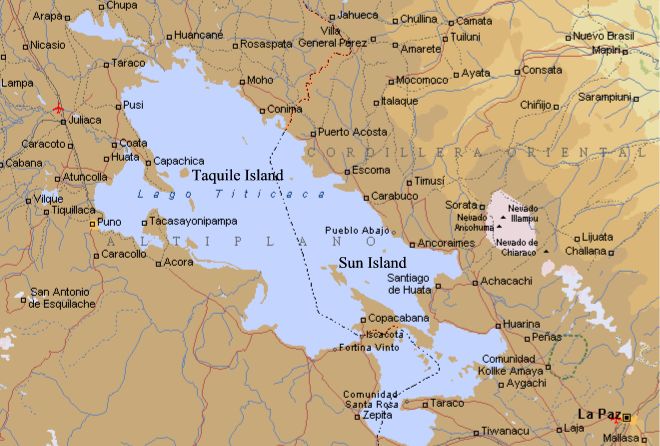
When Peruvians talk of turquoise blue Titacaca, they proudly note that it is so large it has waves. This, the most sacred body of water in the Inca empire and now the natural separation between Peru and Bolivia, has a surface area exceeding 8,000 square kilometers (3,100 square miles), not counting its more than 30 islands.
The most famous islands are:
Uros, located in the Bay of Puno
Taquile, located 35 kilometers from the City of Puno
Amantani, it is 38 kilometers from the city of Puno
Suasi which is located 70 kilometers from the city of Puno.
The climate in the surrounding areas of the lake is not extremely cold as one would expect about 3800 meters. The area surrounding the lake is the most important geo-economic region south Peruvian Andes, only in this area are the 49% alpaca, 32% of sheep, 29% of flames and 10% of all cattle Peru.
The population has also grown greatly in this area, only in the Peruvian living around the lake more than a million people. Due to the climate and agriculture subsisting by the moderate climate that produces the Lake Titicaca. If the Lake Titicaca not exists, this area had been a frozen wasteland without inhabitants.
| Services | Duration |
 SILLUSTANI CHULLPAS HALF DAY TOUR SILLUSTANI CHULLPAS HALF DAY TOUR |
Half day |
| CHUCUITO JULY AND POMATA HALF DAY TOUR |
Half day |
| QUECHUA ROUTE FULL DAY TOUR |
Full day |
| THE AYMARA ROUTE FULL DAY |
Full day |
| UROS AND TAQUILE ISLAND FULL DAY EXCURSION | Full day |
| UROS AND AMANTANY ISLANDS FULL DAY TOUR | Full day |
| UROS ISLAND AND LLACHON PENINSULA FULL DAY TOUR | Full day |
| UROS LLACHON PENINSULA OVERNIGHT AND TAQUILE ISLAND 2 DAYS | 2 days and 1 night |
| UROS AMANTANI OVERNIGHT AND TAQUILE ISLAND 2 DAYS |
2 days and 1 night |
| SUN ISLAND FULL DAY EXCURSION | Full day |
| SUN ISLAND OVERNIGHT EXCURSION | 2 days and 1 night |
| PUNO – LA PAZ FULL DAY CRUISE | Full day cruise |
| PUNO LA PAZ OVERNIGHT | 2 days and 1 night |
| PUNO – COPACABANA SUN ISLAND 2 DAYS TOUR | 2 days and 1 night |
| SACRED LAKE OF THE INCAS TOUR- 4 DAYS AND 3 NIGHTS | 4 days and 3 night |
| MILLENARIAN PUNO TOUR – 4 DAYS AND 3 NIGHTS | 4 days and 3 night |
| LIVING IN TITICACA TOUR- 4 DAYS AND 3 NIGHTS | 4 days and 3 night |
Below our selection of package tours, please make a choice
INCLUDES: Catamaran accommodations based on double occupancy ( only for 2 days and 1 night packages ). All scheduled land and lake transportation. All transfers. All scheduled excursions with English-speaking guide services. All entrance fees. Meals as specified in the itinerary.
NOT INCLUDED IN THE FEE
International or domestic airfares, airport departure taxes or visa fees, excess baggage charges, additional nights during the trip due to flight cancellations, alcoholic beverages or bottled water, snacks, insurance of any kind, laundry, phone calls, radio calls or messages, reconfirmation of flights and items of personal nature.